Arms control, the new arms race, and some reasons for optimism

|
“The end of arms control as we know it”
The last agreement limiting America’s and Russia’s nuclear arsenals is months away from expiring. Vox, By Alex Ward@AlexWardVoxalex.ward@vox.com Aug 3, 2020, In December 2019, a secretive group of elite Americans and Russians gathered around a large square table. It was chilly outside, as Dayton, Ohio, can get in the winter, but the mood inside was just as frosty.
The 147th meeting of the Dartmouth Conference, a biannual gathering of citizens from both nations to improve ties between Washington and Moscow, had convened. Former ambassadors and military generals, journalists, business leaders, and other experts came together to discuss the core challenges to the two countries’ delicate relationship, as members had since 1960. In recent years, that has included everything from election interference to the war in Ukraine. But now the prospect of an old danger worried them most, just as it had the group’s quiet supporters President Dwight Eisenhower and Soviet Chairman Nikita Khrushchev decades before: nuclear catastrophe. Proceedings typically start with a lengthy summary of the relationship, touching on security, medical, societal, political, and religious issues up for discussion. This time, the synopsis was unnervingly short. “We went right into the nuclear issue,” said a conference member, speaking on condition of anonymity because they were not authorized to speak openly about the event. “There was a belief we were in serious danger because it’s the end of arms control as we know it.” “It was dramatic and sobering,” the member added. The US and Russia were then barely over a year away from losing the last major arms control agreement between them: New START, short for the Strategic Arms Reduction Treaty. That agreement limits the size of the two countries’ nuclear arsenals, which together account for 93 percent of all nuclear warheads on earth. The deal expires on February 5, 2021, and those sitting around the table feared its demise. The trepidation inspired the group’s four co-chairs to do something the Dartmouth Conference hadn’t done in its 60-year existence: release a statement. “Given the deep concerns we share about the security of our peoples, for the first time in our history we are compelled by the urgency of the situation to issue this public appeal to our governments,” they wrote, calling for the US and Russia to invoke the treaty’s five-year extension. Today, roughly half a year before New START stops, the group’s members continue to stress the consequences. “We’re at a decisive point,” said retired US Army Brig. Gen. Peter Zwack, who was at the December meetings. “The entire arms control regime of the past 50 years is about to pass.” Seventy-five years ago this week, the US dropped atomic bombs on Hiroshima and Nagasaki in Japan, unleashing a weapon of mass destruction on the world. Decades of painstaking diplomacy between the world’s two greatest nuclear powers, the US and Russia, helped keep both nations from unleashing that destructive power on each other ever since. But now the US and Russia are mere months from throwing it all away. New START may soon join other defunct arms control agreements, including one prohibiting ground-based intermediate-range missiles scrapped in 2019 and another allowing overflights of nuclear facilities likely to end this year. One reason for all of this: President Donald Trump wants to put his own stamp on arms control history, one way or another…….. “The president has directed us to think more broadly than the current arms control construct and pursue an agreement that reflects current geopolitical dynamics and includes both Russia and China,” a senior administration official told me on the condition of anonymity. “We’re continuing to evaluate whether New START can be used to achieve that objective.” That evaluation has turned into a delicate process with Russia, with high-level and working-level meetings taking place in Vienna to see if New START can be salvaged. Officials from both countries met again at the end of July in Austria’s capital, while China — which the US wants involved to discuss limiting its nuclear and missile capabilities, even though it isn’t a party to New START — didn’t show up……… If New START ends, then, the general animosity between the US and Russia could lead to a nuclear arms race and prompt China to keep building up its forces — a situation unlike anything we’ve seen since the Cold War. “We’re creating the greater threat of a conflict that could literally destroy each country and perhaps even our planet,” Leon Panetta, the former CIA director and defense secretary, told me. The following account of the looming death of US-Russia arms control is based on conversations with over 20 current and former US officials, lawmakers, and experts on three continents. It traces the story of arms control from its origins to its possible end in the coming years, and what that end could mean for all of us. The long and dangerous road to arms control……………..Trump takes control, and trashes arms controlNuclear war is a threat Donald Trump has often talked about over the years, and he has sometimes seemed genuinely concerned about it…….. When Trump took office on January 20, 2017, three major arms control-related agreements were in force: the INF Treaty, a confidence-building measure known as Open Skies, and New START, the agreement Obama had negotiated just a few years earlier. Yet, rather than continue the progress his predecessors made toward making the world safer from the threat of nuclear war, Trump decided to tear it all down, while pursuing an exit from the Iran nuclear deal and ineffective nuclear diplomacy with North Korea. Of those three US-Russia agreements, one is gone, another is almost gone, and the last, it seems, is on the way out. That’s not all bad, some experts say, as Russia did cheat on some of the agreements and the US showed those actions would have consequences. But most experts I spoke to are concerned that Trump is tearing down an artifice with no new blueprints to make it better, or even rebuild what exists. “The whole arms control regime is under considerable stress,” former Energy Secretary Ernest Moniz, who now leads the Nuclear Threat Initiative, told me. “It’s badly frayed.” Let’s take each deal in turn. The INF Treaty The Intermediate-Range Nuclear Forces (INF) Treaty was signed by President Ronald Reagan and Soviet leader Mikhail Gorbachev in December 1987. It prohibited Washington and Moscow from fielding ground-launched cruise missiles that could fly between 310 and 3,400 miles.Both countries signed the deal as a way to improve relations toward the end of the Cold War. However, the two nations still could — and since have — built up cruise missiles that can be fired from the air or sea……… Ultimately….. “the president made the decision to leave” the deal. That officially happened in August 2019. Open SkiesOriginally an idea by Eisenhower and made a reality in 2002, the Open Skies Treaty allows nations to conduct unarmed flights over another country’s military installations and other areas of concern. Entering into effect 10 years later, it has since helped the 34 North American and European signatories, including the US and Russia, gain confidence that others weren’t developing advanced weapons in secret or planning big attacks…….. In May 2020, Trump decided America would withdraw from the Open Skies Treaty, kicking off a six-month clock before the US could officially leave the deal. …………. New STARTAs a reminder, the New START arms control deal became effective in 2011 during the Obama administration. The treaty’s goal, essentially, is to limit the size of the American and Russian nuclear arsenals, the two largest in the world. To ensure those limits are met and kept, the treaty also allows Washington and Moscow to keep tabs on the other’s nuclear programs through stringent inspections and data sharing, thereby curbing mistrust about each other’s nuclear and military plans. At the time, it was heralded as a major achievement and is still considered such by top lawmakers………… As of mid-July 2020, the two nations had exchanged more than 20,400 total notifications about the state of their arsenals. Rose Gottemoeller, who led the New START negotiations for the US at the State Department, told me all that goes away if Trump decides not to stay in the agreement. “The Russians won’t allow for verifications and inspections without a legal basis,” she said. And without the ability to get deep insight into Russia’s nuclear forces, trust would surely erode. “The exact thing which gives us an excellent understanding of Russian strategic forces is all going to break down,” said Gottemoeller, who in 2019 stepped down as NATO’s deputy secretary. “Unless you have access to verify what’s going on with the warheads on missiles or submarines, you don’t really understand what’s going on.” Putin, Russia’s president, says he sees value in the deal. “Russia is not interested in starting an arms race and deploying missiles where they are not present now,” he told Russian officials in December. “Russia is ready to immediately, as soon as possible, by the end of this year, without any preconditions, extend the START Treaty so that there would be no further double or triple interpretation of our position.” Trump hasn’t taken up Putin on his offer yet, even though those two could extend the agreement for up to five years without anyone else’s input………….. So why get out of a deal that almost everyone says is vital to keeping US-Russia relations stable? The answer is China…….. In July, top US arms control negotiator Marshall Billingslea extended an “open invitation” to Chinese officials to join the US and Russia in Austria for New START talks, even though Beijing has long said it won’t sign on to New START since its arsenal is so much smaller than Washington’s and Moscow’s. …………… The new arms race“Arms control creates an additional layer of insurance between states not getting along well and a possible hot war,” Samuel Charap, who served as a senior adviser to Gottemoeller after New START entered into force, told me. “If you remove the failsafe, you create more risk.” Without the longstanding architecture in place, Washington and Moscow would enter a dangerous arms control hiatus and could see already poor relations spiral out of control. The US and Russia have many nuclear-tipped missiles already pointed at each other, but it would be even worse if both sides try to one-up their adversary by creating more deadly and usable weapons. That, unfortunately, is exactly what’s happening. Welcome to the new arms race. ……………….. A review conference for the treaty was supposed to take place in April but was postponed due to the coronavirus. Whenever it meets, the lack of US-Russia arms control commitment could make it the testiest gathering in decades. Some may seriously push for the NPT to be dissolved. And if that’s the case, what’s to stop nations like Iran, Saudi Arabia, or others from sprinting toward the bomb? Second, the end of an important era in global security fades away with nothing to replace or build on it. “The good old days when arms control was going hand-in-hand with a cooperative security relationship — which basically ties my security to your security — those days are gone, and I don’t see them coming back,” said the University of Hamburg’s Kühn. The only chance of a return to that time, he added, would likely be after Trump, Putin, and Chinese President Xi Jinping leave their offices………………. There are reasons for optimism. Washington and Moscow are having conversations now, including a working-level meeting in July in Vienna. Even though the administration is skeptical of arms control, and Billingslea is not a fan of the concept, Trump’s team at least hasn’t outright rejected negotiations. However unlikely now, the two powers could come to an agreement before New START’s expiration on February 5. If they don’t, a newly elected Joe Biden could quickly reach a deal with Putin before the deadline, though he’d have limited time since his term would start in late January. “The election in November will be a major inflection point for New START specifically,” Moniz, the former energy secretary who helped strike the Iran nuclear deal, told me. “If Biden wins, I can’t imagine that he wouldn’t extend New START.”……… https://www.vox.com/world/21131449/trump-putin-nuclear-usa-russia-arms-control-new-start |
|
Portuguese party PAN lodges complaint to U.N. about Spain’s ageing Almarez nuclear power station
The risks associated with Almaraz have been making headlines for years (click here).
So has the perceived ‘inertia’ of the Portuguese government in tackling them (click here).
As PAN’s leading MP André Silva stresses, what’s crucial at this point is a ‘transfrontier evaluation of the environmental impact” of the decision to prolong the life of the 41-year-old power station running two very old fashioned reactors beyond the 2023/ 2o24 limit previously established.
The latest approval by Spain extends the reactors’ lives to 2027 and 2028 respectively.
Says Silva: ‘We have on the one hand’ Spain that is violating two conventions, and on the other a Portuguese government and a Portuguese environment minister that does nothing about it.
Spain’s unilateral decision to further extend the lifespan of a plant that sits so close to Portuguese territory – not to mention on the banks of the river Tejo – is “an affront to Portuguese people” who, according to a study conducted by the Portuguese army, would be severely impacted in the event of any kind of serious incident (click here).
The two conventions André Silva refers to are the Espoo Convention, which requires environmental impacts in situations like these, and the Arhus Convention, which obliges Madrid to ‘inform and consult’ Portuguese counterparts before making any decisions.
Says Silva, “it is fundamental that the international community is alerted to this problem, which is not simply environmental but social and political as well”.
‘Ideally’ Almaraz should have been mothballed 10 years ago “but Spanish authorities have successively renewed its continuation”, despite the increasing risks of a nuclear accident, which as Silva stresses, would have a “disastrous impact” on Portugal.
This is in fact the second time a formal complaint has been lodged against Spain over activity at Almaraz. A bid to stop a warehouse for nuclear waste being constructed in 2017 resulted in the creation of a commission, but this has never presented any ‘material’ / findings or reports to speak of.
United Arab Emirates new nuclear power risks further destabilising the Gulf region
destabilizing the volatile Gulf region, damaging the environment and
raising the possibility of nuclear proliferation,” Paul Dorfman, a
researcher at University College London’s Energy Institute, wrote in an
op-ed in March. Noting that the U.A.E. had other energy options, including
“some of the best solar energy resources in the world,” he added that
“the nature of Emirate interest in nuclear may lie hidden in plain sight
— nuclear weapon proliferation.”
https://www.nytimes.com/2020/08/01/world/middleeast/uae-nuclear-Barakah.html
Donald Trump on nuclear proliferation and global heating – he’s incompetent about both
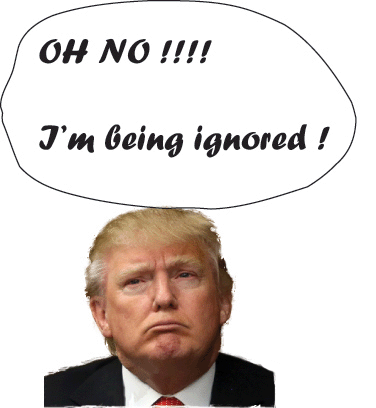 Trump Says Nuclear Proliferation Is Scarier Than Climate Change. He’s Failing at Both. Mother Jones
“Enlightened leadership would be treating both as emergencies.”
WILL PEISCHEL 31 Jul 20, On Tuesday morning, President Donald Trump set off a furor when he told Axios reporter Jonathan Swan that during a recent call with Vladimir Putin, he hadn’t bothered to mention US intelligence suggesting that Russia had offered bounties to Taliban fighters for killing American service members. Trump said that instead, the two leaders had discussed nuclear nonproliferation efforts—and then he inexplicably pivoted to downplaying the threat of climate change.
“If we can do something with Russia in terms of nuclear proliferation, which is a very big problem, bigger problem than global warming, a much bigger problem than global warming in terms of the real world, that would be a great thing,” he said told Swan.
Bringing up global climate change—which already affects the lives of millions—was apparently an arbitrary tangent to the conversation. Even if it wasn’t, experts say attempting to rank the two existential threats against each other isn’t exactly a useful way to gauge either of them. …….
New START, a weapons treaty between Russia and the United States to limit nuclear stockpiles, is slated to expire in early 2021. The treaty contains a provision allowing it to be extended for five years, activated by signatures from both presidents. “If there was seriousness to his remarks, he could do that with the stroke of a pen,” Pomper says. Pomper also criticized Trump for abandoning the Iran nuclear deal and for his failed efforts to scale back North Korea’s weapons programs. On top of that, the Under Secretary of State for Arms Control and International Security Affairs is serving only in an acting role. “Basically, it’s hard to find a situation in the nonproliferation arms control world where it’s gotten better after this administration,” Pomper says. “I’m kind of at a loss for words.”
Efforts to confront global climate change—the smaller problem, according to Trump—are in a similar state. That’s perhaps less surprising, given Trump’s long record of dismissing global warming as a Chinese hoax. We’re already dealing with the consequences. “We’re seeing droughts and wildfires,” says Astrid Caldas, a senior climate scientist with Union of Concerned Scientists. “Here we are with the ninth tropical storm this year, about to be named, if it happens. This usually doesn’t happen until September.” And though climate change was a known existential threat long before Trump entered the picture, Caldas says the administration’s stewardship has done additional damage. “The denial of climate change and calling it a hoax, the whole administration rolling back of environmental regulations and the pulling out of the Paris Agreement,” she says, “all of these things signal that there is not a concern about people’s well being.” https://www.motherjones.com/environment/2020/07/trump-says-nuclear-proliferation-is-scarier-than-climate-change-hes-failing-at-both/
Iran’s Khamenei refuses talks with U.S., says Trump wants them only for election propaganda
Iran’s Khamenei Rejects Talks With U.S. Over Missile, Nuclear Programs, RFERL, 30 Jul 20
| Iran’s Supreme Leader Ayatollah Ali Khamenei has ruled out negotiations with Washington over Tehran’s ballistic missile and nuclear programs, calling the United States “Iran’s main enemy.”
“America’s brutal sanctions on Iran are aimed at collapsing our economy…..Their aim is to limit our influence in the region and to halt our missile and nuclear capabilities,” Khamenei said on July 31 in a live speech on state television…….. Khamenei said he would not agree to negtiations with the United State that were aimed only at boosting Trump’s reelection hopes. “This old man in charge, he apparently made some propaganda use out of his negotiations with North Korea. Now he wants to use (talks with Iran) for the (November 3 U.S. presidential) election,” he said. …… https://www.rferl.org/a/iran-s-khamenei-rejects-talks-with-u-s-over-missile-nuclear-programs/30758648.html |
Plan for nuclear-weapon free zone is unlikely to impress Israel
Eliminating Israel’s bomb with a nuclear-weapon-free zone? https://www.aspistrategist.org.au/eliminating-israels-bomb-with-a-nuclear-weapon-free-zone/, 29 Jul 2020 Ramesh Thakur Nuclear-weapon-free zones (NWFZs) deepen and extend the scope of the Nuclear Non-proliferation Treaty and embed the non-nuclear-weapon status of NPT states parties in additional treaty-based arrangements. This is why several NPT review conferences have repeatedly affirmed support for existing NWFZs and encouraged the development of additional zones.
There are currently five zones: in Latin America, the South Pacific, Southeast Asia, Africa and Central Asia. At a minimum, all NWFZs prohibit the acquisition, testing, stationing and use of nuclear weapons within the designated territory of the zone. They also include protocols for pledges by nuclear powers not to use or threaten to use nuclear weapons against members of the zone.
Israel has seemed more interested in implementing a military solution to its security challenges, including the threat of a preventive strike on Iran, than in exploring diplomatic options. But it’s simply not credible that Israel can keep its unacknowledged nuclear arsenal indefinitely, while every other regional state can be stopped from getting the bomb in perpetuity. The alternatives for Israeli security planners are regional denuclearisation or proliferation. The latter would entail the further risks of heightened tension and increased instability. Moreover, a nuclear-weapon capability is of no use to Israel in deterring or managing the threat of terrorism.
Because ‘the logic of using force to secure a nuclear monopoly flies in the face of international norms’, Israel could consider trading its nuclear weapons for a stop to Iran’s development of a nuclear-weapon capability by agreeing to an NWFZ. Conversely, the confidence built among states through an NWFZ process can spill over into other areas of regional interactions. The experience of working together in negotiating a zonal arrangement, and then working together once the zone is operational, generates habits of cooperation and sustains mutual confidence, both of which are necessary conditions for resolving other regional security issues.
Can an NWFZ be used for nuclear disarmament of a non-NPT state?
When the NPT was extended indefinitely in 1995, the package deal included a resolution on the creation of a Middle East zone free of weapons of mass destruction. The resolution required all regional states (including those outside the NPT) to sign, and International Atomic Energy Agency safeguards to be applied to all nuclear facilities in the region. The 2010 NPT review conference—the last one that had an agreed final document—reiterated the importance of the 1995 resolution and requested the UN secretary-general and Russia, the UK and the US—co-sponsors of the 1995 resolution—to convene a conference in 2012 to that end.
Finnish diplomat Jaakko Laajava was appointed as the facilitator and Helsinki was named as the venue for the conference scheduled to begin on 17 December 2012. However, on 23 November Victoria Nuland of the US State Department said there would be no conference ‘because of present conditions in the Middle East and the fact that states in the region have not reached agreement on acceptable conditions for a conference’. The failure contributed to the collapse of the 2015 review conference.
Like the Red Queen in Through the looking-glass, the UN has to run very fast just to stay where it is. The adoption of the Treaty on the Prohibition of Nuclear Weapons might be thought to have made another NWFZ redundant. Yet, by an 88 to 4 vote (75 abstentions), UN General Assembly decision 73/546 of 22 December 2018 called on the secretary-general to convene a conference at UN headquarters in 2019 to elaborate a legally binding treaty for establishing a WMD-free zone in the Middle East. Importantly, however, in paragraph a(iii), the document stipulated that all decisions of the conference ‘shall be taken by consensus by the States of the region’. The conference was held on 18–22 November 2019. Its political declaration affirmed ‘the intent and solemn commitment’ to pursue a treaty-based commitment, just like in 1995.
Not surprisingly, Israel is wary of the proposal’s origins in a document to which it did not subscribe, adopted by a conference to review and extend a treaty that it has not signed, whose core prohibition it has ignored. In a formal letter to the secretary-general (document A/72/340 (Part 1), 16 August 2017), Israel emphasised ‘the need for a direct and sustained dialogue between all regional States to address the broad range of security threats and challenges’. It’s difficult to see how negotiations can begin until all states explicitly accept the existence of Israel. No NWFZ has previously been established among states that refuse to recognise one another and do not engage in diplomatic relations and whose number includes some that are formally at war.
The bleak security and political environment in the conflict-riven Middle East is particularly inauspicious for the creation of an NWFZ. There is no regional organisation to initiate and guide negotiations, nor is there a regional dialogue process that can form the backdrop to negotiations. An NWFZ in regions of high conflict intensity may have to follow rather than cause the end of conflicts. Syria is convulsed in a civil war. Egypt has yet to sign the IAEA Additional Protocol and the Chemical Weapons Convention, or ratify the Comprehensive Nuclear-Test-Ban Treaty, the Biological Weapons Convention and the African NWFZ. But it does strongly support a WMD-free zone in the Middle East.
Turkey is a NATO member. The possession and deployment of nuclear weapons are integral to NATO doctrine and command structure and US tactical nuclear weapons are based in Turkey. How can this be reconciled with Turkey’s membership of an NWFZ? Alternatively, how meaningful would a Middle Eastern NWFZ be without Turkey?
Most crucially, Israel is already a nuclear-armed state. This immediately raises an obvious but critical question. Is the expectation that Israel will sign a protocol as a nuclear-armed state, or that it must sign the treaty after first eliminating its nuclear weapons? The latter would be without precedent and transform the Middle East NWFZ treaty from a normal non-proliferation treaty into a unique disarmament treaty. An NWFZ is traditionally established as a confidence-building measure among states that have already forsworn the nuclear option. It is unlikely to be established as a disarmament measure, or even to constrain the future potential of states like Iran that retain the nuclear option in their national security calculus.
Ramesh Thakur, a former UN assistant secretary-general, is emeritus professor at the Australian National University and director of its Centre for Nuclear Non-Proliferation and Disarmament.
US-Russia launch talks in Vienna on nuclear arms control
The talks come less than a year before the expiration of New START, the last remaining nuclear arms control deal. The United States and Russia have entered a new phase of talks on nuclear arms control in Vienna, with working groups comprising government experts from both sides starting to meet for the first time.Over the course of three days, starting Tuesday, the groups of experts will deal with military doctrines and potentials, transparency and verification, as well as with security in space, according to the Russian foreign ministry.
The new format was set up in June in negotiations between US arms-control envoy Marshall Billingslea and Russia Deputy Foreign Minister Sergei Ryabkov in the Austrian capital.
The talks are taking place less than a year before the expiration of the New START agreement, the last remaining nuclear arms-control deal between the countries, which together possess about 90 percent of the world’s nuclear weapons.
The US-Russia Intermediate-Range Nuclear Forces (INF) treaty, which had banned nuclear-capable, land-launched missiles with a range between 500km (310 miles) and 5,500km (3,417 miles), ended last year, after the US initiated a pull-out, accusing Moscow of cheating.
Washington also wants China to take part in the arms control negotiations, but Beijing has made it clear that it is not interested.
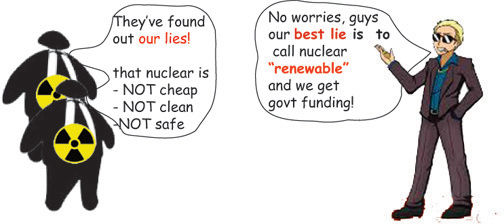
U.S. International Development Finance Corporation now calling nuclear projects “renewable”
|
DCF Opens Door to Fund Nuclear Power Projects Abroad, JDSupra, Sachin Desai, Amy Roma
On July 23, 2020, the U.S. International Development Finance Corporation (DCF) announced its intention to open the door to funding opportunities for nuclear projects abroad. In a summary of its decision following a voluntary 30-day comment period, DCF announced that it has enabled “its full suite of finance products to support all civil nuclear projects that meet the United States’ highest safety security, and nonproliferation standards and laws.” In doing so, it modified the definition of “renewable energy” in its Environmental and Social Policy and Procedures (ESPP) to allow for consideration of nuclear projects. The former ESPP specifically excluded nuclear power from the definition of renewable energy. Removing this prohibition aligns the definition with the United States Energy Information Administration’s definition, as discussed in our previous blog, “US Government Proposes to Lift Ban on Financing Nuclear Energy Projects Overseas.” DCF CEO Adam Boehler boasted that this decision will “accelerate growth in developing economies with limited energy resources,” after the proposal received over 800 comments with overwhelming support and bi-partisan participation. ……… Some comments did pose concerns that nuclear energy would not help those communities that lacked access to energy and argued the benefits of renewables over nuclear energy. However, DCF responded that it will continue to prioritize developing countries, pursuant to the BUILD Act. Advancing U.S. Foreign Policy: Commenters largely viewed the proposed change as a way to increase U.S. competitiveness in the nuclear industry. … Additionally, comments discussed that DCF funding will carry great weight not only as a monetary mechanism, but also as a demonstration of government support. Generating Returns for American Taxpayers: Comments that fell into this category were also largely supportive and posited that the proposed changes would lead to an increase in jobs as well as a return on investment to fund future nuclear research and development. While a few comments demonstrated concern that DCF might fund “unproven technologies”… https://www.jdsupra.com/legalnews/dcf-opens-door-to-fund-nuclear-power-61753/ |
|
Kim Jong Un says that North Korea’s nuclear weapons guarantee its freedom from attack, and war
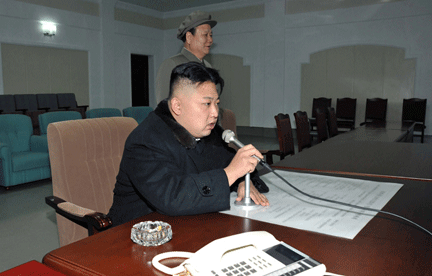 North Korea’s Kim Says No More War Thanks to Nuclear Weapons, VOA, By Reuters July 27, 2020 SEOUL, SOUTH KOREA – North Korean leader Kim Jong Un has said there will be no more war as the country’s nuclear weapons guarantee its safety and future despite unabated outside pressure and military threats, state media said Tuesday.
Kim made the remarks as he celebrated the 67th anniversary of the end of the 1950-53 Korean War, which fell on July 27, with a reception for veterans, the official KCNA news agency said.
The country developed nuclear weapons to win “absolute strength” to stave off another armed conflict, Kim said in a speech carried by KCNA, emphasizing the defensive nature of the programs. ………
The speech came amid stalled talks aimed at dismantling Pyongyang’s nuclear and missile programs in exchange for sanctions relief from Washington. ……https://www.voanews.com/east-asia-pacific/north-koreas-kim-says-no-more-war-thanks-nuclear-weapon
Lithuania urges EU to convince Belarus not to hurry with nuclear power plant start
EDF denies that China has increasingly big role in UK’s Hinkley Point nuclear project
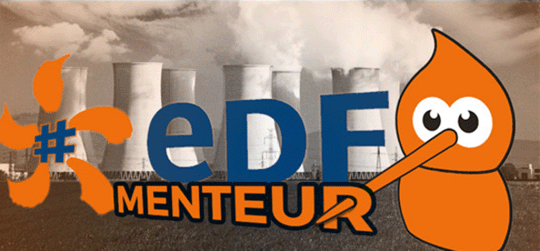 EDF Denies Rising Chinese Influence at U.K. Nuclear Site, Bloomberg, By Corinne Gretler, July 26, 2020,
- Chinese partner’s role bigger than disclosed, Telegraph said
- EDF said allegations are ‘untrue,’ CGN’s role not increasing
Electricite de France SA denied a media report that China General Nuclear Power Corp.’s role at a U.K. nuclear site is increasing, underlining the growing tensions about China’s involvement in critical infrastructure.
The company understated the number of Chinese personnel on site and leaned heavily on CGN’s expertise in planning and construction, the Sunday Telegraph reported, citing company documents and unidentified sources. The newspaper also said Chinese engineers proposed a way to lift a concrete dome onto the reactor at Hinkley Point C that would’ve involved dangling the heavy structure above workers, before it was deemed too dangerous…………
EDF owns about two-thirds of the Hinkley Point program while CGN holds the rest. The project was approved in 2016. The Tories have demanded a review of the plant, the Telegraph said, citing former Conservative leader Sir Iain Duncan Smith saying ministers were misled when they approved China’s role as just a financial partner in the project. https://www.bloomberg.com/news/articles/2020-07-26/dalio-warns-of-u-s-china-capital-war-that-would-hit-dollar
North Korea continues policy -no denuclearization talks until the US withdraws its “hostile policy.
This nuanced treatment of nuclear weapons in CMC meeting coverage is consistent with recent statements by North Korean officials, which indicated denuclearization is off the table for now and North Korea will proceed with its weapons development to cope with US “long-term threats.”…….
While Kim Yo Jong’s July 10 press statement seemed more conciliatory in tone than the previous Foreign Ministry statements, the bottom line was consistent with North Korea’s position since the Stockholm talks in October 2019: there will be no denuclearization talks until the US withdraws its “hostile policy.”[9] Kim added that North Korea must plan for “long-term threats” from the US and “strengthen and steadily increase our practical capabilities,” which implied going ahead with North Korea’s weapons development and production plan. https://www.38north.org/2020/07/cmc072020/
Britain’s Conservatives anxious to review UK’s nuclear build co-operation with China
Tory hawks press button on nuclear power battle with China, After Huawei, energy sector looks set to be next flashpoint in Sino-British relations, Ft.com, Jim Pickard, Daniel Thomas and Nathalie Thomas-20 July 20
CGN, which has already invested £3.8bn in the UK nuclear sector, is a junior funding partner for the new Hinkley Point power station in Somerset being built by France’s EDF, and is also involved with the French company’s other proposed plant at Sizewell in Suffolk.
Purpose of US International Development Finance Corporation perverted in the interests of the nuclear industry
|
Trump’s new foreign investment agency: Itching to build on nuclear quicksand. Bulletin of the Atomic Scientists, By Victor Gilinsky, Henry Sokolski, July 17, 2020 In 2018 a Republican Congress, with strong Democratic support, created the US International Development Finance Corporation to “provide the developing world with financially sound alternatives to unsustainable and irresponsible state-directed initiatives.” That’s government-speak for competing with China’s Belt and Road initiative. It didn’t take very long, however, for the new agency to fall in line with an irresponsible state-directed initiative of its own—the Trump administration’s all-out effort to encourage nuclear exports.
In June, the agency, whose own rules prohibit financing nuclear exports, proposed to fling the doors open to such financing, without limiting its scope to the agency’s mission to help the economies of the lower income countries with modest, environmentally sensible projects. There is no hint on what sorts of conditions would apply on funding nuclear reactors. Would the country have to have a system of safety regulation? Would it have to meet security requirements? Would it have to allow international inspections? It isn’t even clear whether the agency’s support would be limited to US reactor exports, and therefore subject to the requirements of the Atomic Energy Act’s Section 123 or whether they could also cover equipment purchases from other suppliers. Such details determine whether a federal bureaucracy is constrained to act responsibly, or whether it is free to cater to the latest whims of the White House. To justify its proposed action, the agency relies on the administration’s ritual talking points—that nuclear exports will “offer an alternative to the financing of authoritarian regimes while advancing US nonproliferation safeguards and supporting US nuclear competitiveness.” These pearls are straight out of the administration’s April 2020 interagency report “Restoring America’s Competitive Nuclear Energy Advantage.” So are the agency’s assurances that advanced “small modular reactors” and “microreactors” will have significantly lower costs than existing nuclear power plants and “could help deliver a zero-emission, reliable, and secure power source to developing countries, promoting economic growth and affordable energy access in underserved communities.” This is all pie in the sky: None of these plants have been built, and their characteristics and economics are speculative. But if the proposed change is restricted to small reactors or microreactors, the nuclear industry’s influential registered lobby, the Nuclear Energy Institute, hasn’t heard about it. The Institute’s president crowed her unqualified approval: “The US International Development Finance Corporation’s proposed policy change to lift its legacy prohibition on nuclear energy projects supports the development of clean, reliable energy worldwide, helps countries reach their energy development goals, buttresses US national security, and can help level the playing field for US firms.” Nor does her response suggest any awareness that the agency’s financing of nuclear projects will be limited to countries in the lower portion of the economic scale……, This whole affair is the latest expression of the administration’s organizing principle for nuclear energy policy—finding ways to loosen rules and to create subsidies to propel nuclear exports. This is supposed to energize the much-diminished domestic nuclear manufacturing sector. Since the whole policy doesn’t make any economic sense, the ultimate argument is based on the dogma: Come what may, we have to head off sales by our adversaries China and Russia……. The agency does have on its books good environmental, social, and economic criteria for evaluating projects. But will they be applied as intended?,………..https://thebulletin.org/2020/07/trumps-new-foreign-investment-agency-itching-to-build-on-nuclear-quicksand/# |
|
A USA resumption of nuclear testing ? -a green light for all other nations to start their own testing
if the U.S. were to resume nuclear testing, it would be a green light for all other nations to start their own testing.
 A restart of nuclear testing offers little scientific value to the US and would benefit other countries The Conversation, Ferenc Dalnoki-Veress, Scientist-in-Residence and Adjunct Professor, Middlebury, Miles A. Pomper, Senior Fellow, James Martin Center for Nonproliferation Studies, Middlebury 14 July 20,
“…….The U.S. tested nuclear bombs for decades. But at the end of the Cold War in 1992, the U.S. government imposed a moratorium on U.S. testing. This was strengthened by the Clinton administration’s decision to sign the Comprehensive Nuclear Test Ban Treaty. Although the Senate never ratified the treaty and it never entered into force, all 184 countries that signed the test ban, including the U.S., have followed its rules.
But in recent weeks, the Trump administration and Congress have begun debating whether to restart active testing of nuclear weapons on U.S. soil…….
We are two nuclear weapons researchers – a physicist and an arms control expert – and we believe that there is no value, from either the scientific nor diplomatic perspective, to be gained from resuming testing. In fact, all the evidence suggests that such a move would threaten U.S. national security. Continue reading
1 This Month
26 September – International Day for the Total Elimination of Nuclear Weapons





PLEASE OPPOSE HR 8255 AND S.3639 – bills would accelerate satellite deployment, with no environmental review or safeguards – https://ncstd5li.quorum.us/campaign/169331/
To see nuclear-related stories in greater depth and intensity – go to https://nuclearinformation.wordpress.com
-
Archives
- September 2026 (281)
- August 2026 (330)
- July 2026 (355)
- June 2026 (287)
- May 2026 (306)
- April 2026 (356)
- March 2026 (251)
- February 2026 (267)
- January 2026 (308)
- December 2025 (358)
- November 2025 (359)
- October 2025 (375)
-
Categories
- 1
- 1 NUCLEAR ISSUES
- business and costs
- climate change
- culture and arts
- ENERGY
- environment
- health
- history
- indigenous issues
- Legal
- marketing of nuclear
- media
- opposition to nuclear
- PERSONAL STORIES
- politics
- politics international
- Religion and ethics
- safety
- secrets,lies and civil liberties
- spinbuster
- technology
- Uranium
- wastes
- weapons and war
- Women
- 2 WORLD
- ACTION
- AFRICA
- Atrocities
- AUSTRALIA
- Christina's notes
- Christina's themes
- culture and arts
- Events
- Fuk 2022
- Fuk 2023
- Fukushima 2017
- Fukushima 2018
- fukushima 2019
- Fukushima 2020
- Fukushima 2021
- general
- global warming
- Humour (God we need it)
- Nuclear
- RARE EARTHS
- Reference
- resources – print
- Resources -audiovicual
- Weekly Newsletter
- World
- World Nuclear
- YouTube
-
RSS
Entries RSS
Comments RSS

