Now, in the times of the UN Nuclear Ban Treaty, nuclear deterrence continues, but becomes increasingly discredited
Nuclear deterrence is an idea that became a potentially lethal ideology, one that remains influential despite having been increasingly discredited…………….
Spectres Of Nuclear ‘MAD’ness: Between Deterrence And Survival – Eurasia Review August 8, 2021K.M. Seethi With the Treaty on the Prohibition of Nuclear Weapons (TPNW) in place, is there an optimistic scenario of a nuclear-weapon free world? This might certainly be a difficult but persistently challenging question the world has been grappling with ever since the cities of Hiroshima and Nagasaki were devastated by atomic bombs, way back in 1945.
Spectres of nuclear holocaust have been haunting political communities across the world even after the end of Cold War. While the world’s most powerful nuclear-weapon states (NWS) have been locked in a military logjam—often characterised as ‘Mutually Assured Destruction’ (MAD)—a few states in Asia (including threshold states like Iran) still get absorbed in the logic of ‘limited nuclear deterrence.’………………
Nukes Accumulation
Paradoxical it may seem, the Asian continent has again become a hotbed of global nuclear threats with several nuclear-weapon states now spanning fault lines running through East Asia, in the Korean Peninsula, China’s eastern and southern coastline and across the Himalayas in South Asia and West Asia–and all of them presently recalibrating their nuclear profiles. And the share of Asia in the ‘horizontal proliferation’ is quite significant. As per the data brought out by the Stockholm International Peace Research Institute (SIPRI), the NWS—the United States, Russia, the United Kingdom, France, China, India, Pakistan, Israel and North Kore—together have in their arsenal an estimated 13,080 nuclear weapons at the beginning of 2021. While Russia (6255) and the U.S. (5550) possess more than 90 per cent of the world’s nuclear weapons, China has 350 weapons in its inventory, followed by France (290), UK (225), Pakistan (165), India (156), Israel (90), and North.
Nuclear Ban Regime
The efforts seeking a legally mandatory instrument to ban nuclear weapons have long been underway. However, they have found a new relevance in the past decade with the increasing awareness about the humanitarian and environmental costs of use of nuclear arms. ……………… culminated in the passing of a resolution (71/258) by the UN General Assembly in 2017 to negotiate a legally binding instrument to ban nuclear weapons, leading towards their total elimination. And the Conference was held from 27 to 31 March and from 15 June to 7 July in New York which led to the TPNW. (Treaty for the Prohibition of Nuclear Weapons)
The Treaty envisages a broad set of regulations for prohibition on partaking in any nuclear weapon programmes and activities. These regulatory clauses stipulate that the signatories shall “not develop, test, produce, acquire, possess, stockpile, use or threaten to use nuclear weapons.” It also forbids “the deployment of nuclear weapons on national territory and the provision of assistance to any State in the conduct of prohibited activities.” The Treaty also makes it mandatory for the signatories “to provide adequate assistance to individuals affected by the use or testing of nuclear weapons, as well as to take necessary and appropriate measure of environmental remediation in areas under its jurisdiction or control contaminated as a result of activities related to the testing or use of nuclear weapons.”
TPNW was adopted (by a vote of 122 States in favour, with one vote against and one abstention) at the United Nations on 7 July 2017, and opened for signature by the Secretary-General on 20 September 2017. Following the deposit with the Secretary-General of the 50th instrument of ratification or accession of the Treaty on 24 October 2020, it entered into force on 22 January 2021 in accordance with its Article 15 (1).
‘Consensus’ For Opposition!
TPNW, which currently has 86 signatory states, has been totally ignored by the NWS and NATO member states. ‘Consensus’ among the NWS in regard to their opposition to the Treaty could also be a grim reminder. For example, in a joint statement made at the First Committee of the 73rd session of the UN General Assembly in October 2018, Russia, China, UK, U.S. and France had informed that they would not sign the TPNW. The statement says: “We will not support, sign or ratify this Treaty. The TPNW will not be binding on our countries, and we do not accept any claim that it contributes to the development of customary international law; nor does it set any new standards or norms. We call on all countries that are considering supporting the TPNW to reflect seriously on its implications for international peace and security.” ………………………..
Between Deterrence and Survival
In his The Evolution of Nuclear Strategy (1989), Lawrence Freedman says, “The Emperor Deterrence may have no clothes, but he is still Emperor.” David Barash adds: “Despite his nakedness, this emperor continues to strut about, receiving deference he doesn’t deserve, while endangering the entire world. Nuclear deterrence is an idea that became a potentially lethal ideology, one that remains influential despite having been increasingly discredited…………….
Way back in 1955, the well-known Russell-Einstein Manifesto had warned of the perils of nuclear weapons. This declaration put across what Bertrand Russell and Albert Einstein called “the stark and dreadful and inescapable” problem of the nuclear age: “Shall we put an end to the human race; or shall mankind renounce war?” Given the continuing proliferation tempo, both vertically and horizontally, peace loving people across the world can never abandon the dream of achieving the elimination of nuclear weapons from the face of the earth. The risk of catastrophic misuse of nuclear weapons, deliberately or―more likely―by accident or miscalculation, is as grave and immediate as it has ever been. And the existential threat nuclear weapons pose to life on this planet is as significant as those of climate change and global pandemic, and in many ways more immediate.
*The author is Director, Inter University Centre for Social Science Research and Extension (IUCSSRE), Mahatma Gandhi University, Kerala who also served as Dean and Professor of International Relations, MGU. He can be contacted at kmseethimgu@gmail.com https://www.eurasiareview.com/08082021-spectres-of-nuclear-madness-between-deterrence-and-survival-oped/
EU optimistic on nuclear deal despite Iran leadership change
EU optimistic on nuclear deal despite Iran leadership change
Agreement is “most likely scenario” says senior official Politico BY JACOPO BARIGAZZI, August 7, 2021 European Union negotiators are optimistic on the chances of reviving the nuclear deal with Iran, despite the election of hardliner Ebrahim Raisi as the country’s new president, a senior EU official said Saturday.
“We still think that the most likely scenario is an agreement. What I cannot tell you is when and [under] what conditions” said the senior official.
International negotiators have held six rounds of talks in Vienna to restore full compliance with the 2015 nuclear deal which has been on life support since the Trump administration’s decision to pull out in 2018. The deal curbed Tehran’s nuclear ambitions in exchange for sanctions relief.
Negotiations were paused following the election of Raisi in June. He was sworn in this week to replace the more moderate Hassan Rouhani.
Contacts this week with Iranian officials on the sidelines of Raisi’s inauguration have not clarified when talks on the nuclear deal will resume or who will be in Tehran’s negotiating team, said the EU official, who spoke on condition of anonymity due to the sensitivity of the talks……………….. https://www.politico.eu/article/eu-iran-nuclear-deal-leadership-vienna/
Problems continue for Iran nuclear talks as new Iran President takes office
Hopes of revived Iran nuclear talks dim amid delays as new hardline president takes office, By Natasha Bertrand and Nicole Gaouette, CNN, August 6, 2021 Washington (CNN)Biden administration officials are becoming increasingly pessimistic about reviving the Iran nuclear deal as the country’s new hardline president takes office and its nuclear program continues to accelerate, national security and intelligence officials familiar with the negotiations told CNN.
The deal’s original signatories known as the P5+1 — the US, UK, France, China, Russia and Germany — had hoped to begin their seventh round of negotiations by now. Some officials have expressed disappointment that the talks have been so delayed since the last round ended on June 20, especially as Iran’s nuclear advances risk making the current deal irrelevant.Now that President Ebrahim Raisi is officially in power after his inauguration Thursday, officials are hoping meetings will begin again in the next few weeks, but it’s still not clear if and when that will happen.
While Raisi is considered a hardliner, he has said that in principle he does not oppose the nuclear deal, known as the Joint Comprehensive Plan of Action or JCPOA, and American officials have said they don’t expect him to walk away from the talks………
Failure to return to the deal would be a blow to President Joe Biden’s foreign policy agenda.His officials, meanwhile, have fumed privately that they inherited major roadblocks to re-entering the deal from the previous administration and are now thinking through contingency plans.After President Donald Trump pulled out of the deal in 2018 and imposed a maximum pressure campaign on Iran with stiff new sanctions, Iran began developing and testing centrifuges that have shortened the time it would take to produce enough material for a bomb……..There is speculation among the P5 + 1 partners that the delay could be a tactical move by Iran. Increasingly, however, they also believe there is a real debate going on within the Iranian system on how to proceed with negotiations. https://edition.cnn.com/2021/08/06/politics/iran-nuclear-talks-pessimism-delay-raisi/index.html
Israel Says Iran Should ‘Never Become a Nuclear Power.’ But What if It Already Is One?
Analysis | Israel Says Iran Should ‘Never Become a Nuclear Power.’ But What if It Already Is One? When politicians talk of a ‘nuclear Iran,’ what exactly do they mean? It is important to understand the terminology, and also for Israel to be on the same page as the Americans before nuclear talks resume The epicenter of the core of Israeli policy on Iran’s nuclear ambitions and program can be reduced to one sentence: “Israel will never allow Iran to become a nuclear power.” A sentence that says it all despite the inherent vagueness, and accurately reflects Israeli interests and its mode of thought….. https://www.haaretz.com/israel-news/.premium.HIGHLIGHT-iran-is-already-a-nuclear-threshold-state-can-israel-live-with-it-1.10072666
International Symposium for Peace 2021: The Road to Nuclear Weapons Abolition- online international conference – held from Hiroshima
The Treaty on the Prohibition of Nuclear Weapons (TPNW) that took effect in January was the central theme of an international conference held online from Hiroshima on July 31. Issues discussed included how the treaty would contribute toward nuclear disarmament as well as the role Japan should play within the pact that it has not yet ratified.
The International Symposium for Peace 2021: The Road to Nuclear Weapons Abolition was sponsored by the
Hiroshima city government, the Hiroshima Peace Culture Foundation and The Asahi Shimbun. The theme for this year’s event was “A new world illuminated by ‘treaty of hope.’”
Asahi Shimbun 31st July 2021
https://www.asahi.com/ajw/articles/14408019
Algeria: deep resentment of French colonialism and the effects of nuclear bombing -still very real today.

In Algeria, France’s 1960s nuclear tests still taint ties, https://www.france24.com/en/africa/20210729-in-algeria-france-s-1960s-nuclear-tests-still-taint-ties More than 60 years since France started its nuclear tests in Algeria, their legacy continues to poison relations between the North African nation and its former colonial ruler.The issue has come to the fore again after President Emmanuel Macron said in French Polynesia on Tuesday that Paris owed “a debt” to the South Pacific territory over atomic tests there between 1966 and 1996.
The damage the mega-blasts did to people and nature in the former colonies remains a source of deep resentment, seen as proof of discriminatory colonial attitudes and disregard for local lives.
Diseases related to radioactivity are passed on as an inheritance, generation after generation,” said Abderahmane Toumi, head of the Algerian victims’ support group El Gheith El Kadem.
“As long as the region is polluted, the danger will persist,” he said, citing severe health impacts from birth defects and cancers to miscarriages and sterility.
France carried out its first successful atomic bomb test deep in the Algerian Sahara in 1960, making it the world’s fourth nuclear power after the United States, the Soviet Union and Britain.
Today, as Algeria and France struggle to deal with their painful shared history, the identification and decontamination of radioactive sites remains one of the main disputes.
In his landmark report on French colonial rule and the 1954-62 Algerian War, historian Benjamin Stora recommended continued joint work that looks into “the locations of nuclear tests in Algeria and their consequences”.
France in the 1960s had a policy of burying all radioactive waste from the Algerian bomb tests in the desert sands, and for decades declined to reveal their locations.
‘Radioactive fallout’
Algeria’s former veterans affairs minister Tayeb Zitouni recently accused France of refusing to release topographical maps that would identify “burial sites of polluting, radioactive or chemical waste not discovered to date”.”The French side has not technically conducted any initiative to clean up the sites, and France has not undertaken any humanitarian act to compensate the victims,” said Zitouni. According to the Ministry of the Armed Forces in Paris, Algeria and France now “deal with the whole subject at the highest level of state”.
“France has provided the Algerian authorities with the maps it has,” said the ministry.
Between 1960 and 1966, France conducted 17 atmospheric or underground nuclear tests near the town of Reggane, 1,200 kilometres (750 miles) from the capital Algiers, and in mountain tunnels at a site then called In Ekker.
Eleven of them were conducted after the 1962 Evian Accords, which granted Algeria independence but included an article allowing France to use the sites until 1967.
A radioactive cloud from a 1962 test sickened at least 30,000 Algerians, the country’s official APS news agency estimated in 2012.
French documents declassified in 2013 revealed significant radioactive fallout from West Africa to southern Europe. Algeria last month set up a national agency for the rehabilitation of former French nuclear test sites.
In April, Algeria’s army chief of staff, General Said Chengriha, asked his then French counterpart, General Francois Lecointre, for his support, including access to all the maps.
We respect our dead’Receiving the maps is “a right that the Algerian state strongly demands, without forgetting the question of compensation for the Algerian victims of the tests,” stressed a senior army officer, General Bouzid Boufrioua, writing in the defence ministry magazine El Djeich.”France must assume its historical responsibilities,” he argued.President Abdelmadjid Tebboune, however, ruled out any demands for compensation, telling Le Point weekly that “we respect our dead so much that financial compensation would be a belittlement. We are not a begging people.”France passed a law in 2010 which provided for a compensation procedure for “people suffering from illnesses resulting from exposure to radiation from nuclear tests carried out in the Algerian Sahara and in Polynesia between 1960 and 1998”.
But out of 50 Algerians who have since launched claims, only one, a soldier from Algiers who was stationed at one of the sites, “has been able to obtain compensation”, says the International Campaign to Abolish Nuclear Weapons (ICAN).
No resident of the remote desert region has been compensated, it said.
In a study released a year ago, “Radioactivity Under the Sand”, ICAN France urged Paris to hand Algeria a complete list of the burial sites and to facilitate their clean-up.
The 2017 Treaty on the Prohibition of Nuclear Weapons obliges states to provide adequate assistance to individuals affected by the use or testing of nuclear weapons.
It was signed by 122 UN member states, but by none of the nuclear powers. France argued the treaty was”incompatible with a realistic and progressive approach to nuclear disarmament”.
ICAN France in its study argued that “people have been waiting for more than 50 years. There is a need to go faster.
“We are still facing an important health and environmental problem that must be addressed as soon as possible.”
U.S. Weighing New Sanctions on Iran as Nuclear Deal Hangs in Balance
U.S. Weighing New Sanctions on Iran as Nuclear Deal Hangs in Balance https://www.democracynow.org/2021/7/30/headlines/us_weighing_new_sanctions_on_iran_as_nuclear_deal_hangs_in_balance HEADLINEJUL 30, 2021 The U.S. is reportedly planning to impose sanctions on Iran’s drone and guided missile programs. This comes following reports the Biden administration is weighing tightening oil sanctions on Iran if talks to relaunch the nuclear deal — which the U.S. unilaterally withdrew from — fail. Iran has repeatedly said it will not recommit to the agreement until the U.S. lifts its devastating sanctions.
UK government headed for huge costs, and a major row with China over Hinkley C nuclear power station.
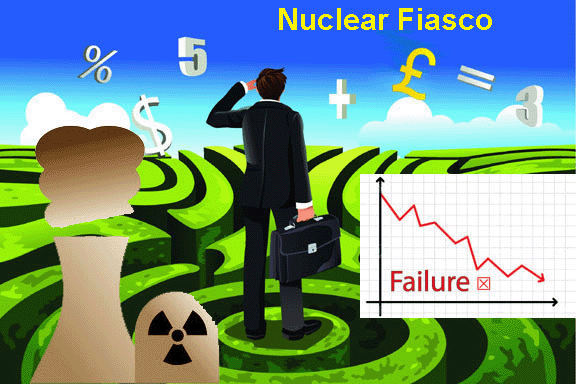
The Government is likely to become responsible for a huge bill for building Hinkley C power station. This is despite an insistence by the UK Government since they signed a deal with EDF to build Hinkley C in 2012
that electricity consumers will not have to pay for cost overruns for the project.
Yet it is now looking increasingly likely that this will end up being the case. When the deal was signed in 2012 the Government agreed to pay a much higher than expected £92.50 per MWh (in 2012 prices), this
price to be paid by consumers in their electricity bills (over twice the price given to recent offshore wind projects).
The Government claimed that there would be no bail-out if the project experienced large cost overruns
since the risk was borne by the holders of the share capital, EDF and also the Chinese state nuclear company, CGN. CGN holds around one third of the equity in Hinkley C.
But now there are mounting pressures on the Government to ensure that, for political and security reasons, China (through CGN) is not allowed to build its own nuclear design at Bradwell in Essex. Yet CNG only agreed to finance Hinkley C (and also in a similar fashion the planned Sizewell C project in Sufflok) on the basis that it was going to get the chance to showcase its own ‘Hualong’ nuclear plant at Bradwell.
If China’s Bradwell ambitions are thwarted then they will certainly pull out of the Sizewell C project and also do as much as is legally possible to forshorten their risks and responsibilities at Hinkley C. The Government is likely to have to take on big liabilities in the case of Hinkley C – that is against a long succession of pronouncements by Government ministers over the past nine years. Some are even urging the Government to take over all of CGN’s shareholdings in Hinkley C.
But even if the Chinese company cannot reclaim the money it will have spent on the project so far, if CGN is denied the opportunity to build at Bradwell they are very likely to refuse to pay for any cost overruns at Hinkley C (as well as pull out of Sizewell C). This means that the UK Government will have to take on the liability of future cost overruns, and maybe end up in a major row with China about financial compensation.
100% Renewables 28thy July 2021
French President acknowledges France’s debt to Polynesia, but no apology.
French President Emmanuel Macron said Tuesday that Paris owed “a debt” to
French Polynesia over nuclear tests conducted in the South Pacific
territory between 1966 and 1996, but stopped short of apologising.
Daily Mail 28th July 2021
Blackwater Against New Nuclear Group (BANNG) welcomes news that Chinese company may pull out of Bradwell project
The Blackwater Against New Nuclear Group (BANNG) has welcomed the news of the possible withdrawal of the Chinese project to build a gigantic nuclear power station at Bradwell but has struck a note of caution. ‘BANNG has campaigned against a new nuclear power station at Bradwell for the past 13 years’, said Andy Blowers, Chair of BANNG.
The news that the Chinese company developing the site may be under pressure to withdraw comes as
little surprise and has looked on the cards for some while especially since CGN, the majority shareholder, announced a pause in the development in February.
We believe the Bradwell site is unsuitable, unsustainable and unacceptable – whoever proposes to develop it. We must remain vigilant and continue to oppose any further nuclear development at this site’. Quite aside from the Government’s concerns, BANNG has long argued that the project is doomed for other reasons, not the least of which has been the overwhelmingly hostile reaction of the communities led by BANNG around
the Blackwater.
Plans for Bradwell B were launched just as the Covid-19 pandemic broke and shocked the public by the sheer scale of the project and its devastating impact on environment, communities and wellbeing. The
development encountered strong local political opposition with Maldon District Council, which had for many years supported it, declaring its opposition and Colchester Borough Council Councillors unanimously declaring theirs. West Mersea Town Council is also opposed and others have consistently voiced concerns.
BANNG 26th July 2021
Hinkley Point C and Sizewell nuclear power projects could unravel, leaving France’s nuclear company EDF with huge debt.
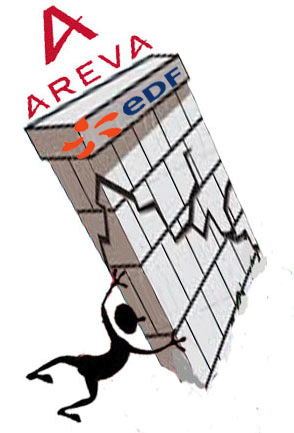
| It was never very likely that the government would allow a Chinese state-owned company to build a nuclear power station in Britain. So news that it is now looking for ways to remove China General Nuclear Power Group (CGN) from future nuclear projects hardly comes as a surprise. Under the terms of a deal struck in 2015 CGN was to take minority stakes in two French-led new nuclear power stations, Hinkley Point C and Sizewell C, while taking a majority stake in a third, Bradwell in Essex, which would use CGN’s own technology. This deal, first agreed by the coalition government, was approved with only minor alterations by Theresa May after a review concluded that Britain’s robust regulatory and technological safeguards were sufficient to protect against any threats to national security. Whether or not that assessment was right, the political context has since changed. The mood in parliament, particularly among Conservative MPs, has turned decisively against China, making it inconceivable that any government could allow China to build such sensitive national infrastructure. CGN was blacklisted from US government contracts in 2019 after being accused by the Trump administration of technology theft. That has made it harder for France’s EDF to attract the infrastructure investors that it needs to make Sizewell C financially viable. The risk is that China does not take its rejection well and the entire three-part deal unravels, with CGN withdrawing from Hinkley Point C in protest. That could leave EDF with a further shortfall of up to £4 billion. Times 26th July 2021 https://www.thetimes.co.uk/article/the-times-view-on-chinas-role-in-nuclear-plants-power-play-v70d2r76k |
Egypt postpones nuclear power plant amid tensions with Russia.
Egypt postpones nuclear power plant amid tensions with Russia over Nile dam,
Egypt pauses El-Dabaa nuclear power plant project for two years amid tensions hanging over the relationship with Russia due to its recent position on the Grand Ethiopian Renaissance Dam crisis and its rapprochement with Ethiopia. George Mikhailuly 28, 2021
Egypt announced the postponement of the completion of the El-Dabaa nuclear plant project to 2030 instead of 2028. Egyptian Nuclear and Radiological Regulatory Authority spokesman Karim al-Adham confirmed in statements to the Egyptian economic newspaper Enterprise July 14 that El-Dabaa nuclear plant will not be completed before 2030 due to the disruption caused by the coronavirus pandemic…………. https://www.al-monitor.com/originals/2021/07/egypt-postpones-nuclear-power-plant-amid-tensions-russia-over-nile-dam
The nuclear industry determined to influence climate talks before COP26

Nuclear industry under fire for trying to influence climate talks ahead of COP26. The National By Rob Edwards 25 July 21, HE nuclear industry has come under fire for trying to influence international talks in the run-up to the COP26 climate summit in Glasgow in November.
Six people from the European Nuclear Society registered to attend UN negotiations in May and June. Two were from the UK Government’s Magnox Ltd, which is decommissioning nuclear plants, and one was from the US nuclear firm, Westinghouse.
There were also 12 representatives from the International Atomic Energy Agency, the UN body charged with both promoting and regulating nuclear power, plus one from the Canadian Nuclear Association.
The nuclear industry was accused by environmentalists of “jumping on the bandwagon” of climate change. “The latest wheeze is to tell us that nuclear is the answer,” said Dr Richard Dixon, director of Friends of the Earth Scotland.
“With renewables and energy efficiency cheaper, quicker and safer than nuclear, they have already lost this argument and should have no place at COP26. The nuclear industry’s disastrous history of cost and time over-runs show very clearly that what they offer would be too little, too expensive and far too late.”
Pete Roche, policy adviser to the Scottish Nuclear Free Local Authorities, said: “When you look at nuclear power you find it is hopelessly expensive, far too slow to be of any use and hugely problematic – producing dangerous waste and with a potential risk of a serious accident.”……….. https://www.thenational.scot/news/19466992.nuclear-industry-fire-trying-influence-climate-talks-ahead-cop26/
Emmanuel Macron in French Polynesia – not likely to satisfy campaigners resentful of France’s nuclear tests legacy
In French Polynesia, Macron tackles nuclear test legacy, China dominance, President Emmanuel Macron is visiting French Polynesia to showcase France’s commitment to the region amid concerns about the impact of climate change on the Pacific island territory, the legacy of French nuclear testing on its atolls — and most of all, growing Chinese dominance in the region……Residents in the sprawling archipelago of more than 100 islands located midway between Mexico and Australia are hoping Macron confirms compensation for radiation victims following decades of nuclear testing as France pursued atomic weapons.
The tests remain a source of deep resentment, seen as evidence of racist colonial attitudes that disregarded the lives of islanders.
Analysis: France’s efforts to redress effects of nuclear testing unlikely to satisfy campaigners
French officials denied any cover-up of radiation exposure at a meeting earlier this month with delegates from the semi-autonomous territory led by President Édouard Fritch.
The meeting came after the investigative website Disclose reported in March that the impact from the fallout was far more extensive than authorities had acknowledged, citing declassified French military documents on the nearly 200 tests.
Only 63 Polynesian civilians have been compensated for radiation exposure since the tests ended in 1996, Disclose said……….
Climate change, pandemic also on the cards
Macron also plans to address risks for the islands from rising sea levels as well as cyclones that some scientists warn could become more dangerous due to climate change………. https://www.france24.com/en/france/20210725-in-french-polynesia-macron-tackles-nuclear-test-legacy-china
China threatens Japan with nuclear war over intervention in Taiwan
China threatens Japan with nuclear war over intervention in Taiwan, Business Standard, 23 July 21,
Deputy PM Aso urged dialogue to resolve any issue The Chinese Communist Party aired a video in which it warned Japan of a nuclear response and “full-scale war” if the island nation interferes in China’s handling of Taiwan, Fox News reported.
The video, which appeared on a channel approved by the CCP, singles out Japan as the one exception to China’s policy to not use nuclear weapons against non-nuclear powers.
“We will use nuclear bombs first,” the video said. “We will use nuclear bombs continuously. We will do this until Japan declares unconditional surrender for the second time.” The video was deleted from Chinese platform Xigua after gaining 2 million views, but copies were uploaded to YouTube and Twitter, Taiwan News reported. Accoding to Fox News,the threats follow comments made two weeks ago by Japanese officials about Taiwan’s sovereignty, with Deputy Prime Minister Taro Aso saying that Japan must “defend Taiwan,” The Japan Times reported……. https://www.business-standard.com/article/international/china-threatens-japan-with-nuclear-war-over-intervention-in-taiwan-121072300030_1.html
1 This Month



26 September – International Day for the Total Elimination of Nuclear Weapons


PLEASE OPPOSE HR 8255 AND S.3639 – bills would accelerate satellite deployment, with no environmental review or safeguards – https://ncstd5li.quorum.us/campaign/169331/
To see nuclear-related stories in greater depth and intensity – go to https://nuclearinformation.wordpress.com
-
Archives
- September 2026 (269)
- August 2026 (330)
- July 2026 (355)
- June 2026 (287)
- May 2026 (306)
- April 2026 (356)
- March 2026 (251)
- February 2026 (267)
- January 2026 (308)
- December 2025 (358)
- November 2025 (359)
- October 2025 (375)
-
Categories
- 1
- 1 NUCLEAR ISSUES
- business and costs
- climate change
- culture and arts
- ENERGY
- environment
- health
- history
- indigenous issues
- Legal
- marketing of nuclear
- media
- opposition to nuclear
- PERSONAL STORIES
- politics
- politics international
- Religion and ethics
- safety
- secrets,lies and civil liberties
- spinbuster
- technology
- Uranium
- wastes
- weapons and war
- Women
- 2 WORLD
- ACTION
- AFRICA
- Atrocities
- AUSTRALIA
- Christina's notes
- Christina's themes
- culture and arts
- Events
- Fuk 2022
- Fuk 2023
- Fukushima 2017
- Fukushima 2018
- fukushima 2019
- Fukushima 2020
- Fukushima 2021
- general
- global warming
- Humour (God we need it)
- Nuclear
- RARE EARTHS
- Reference
- resources – print
- Resources -audiovicual
- Weekly Newsletter
- World
- World Nuclear
- YouTube
-
RSS
Entries RSS
Comments RSS

