Europe to pay half for raising Russia’s dangerous sunken submarines, – while Russia builds new ones!

“The sunken submarines K-27 and K-159 are the potential source of contamination of the Arctic, the riskiest ones,”
As Moscow this spring took the Chair of the Arctic Council, the need to lift dangerous nuclear materials from the seabed was highlighted as a priority.
No other places in the world’s oceans have more radioactive and nuclear waste than the Kara Sea.
Europe to pay half … it is a dilemma that international partners are providing financial support to lift old Cold War submarines from the ocean, while Russia gives priority to building new nuclear-powered submarines threatening the security landscape in northern Europe.
EU willing to co-fund lifting of sunken nuclear subs from Arctic seabed https://thebarentsobserver.com/en/nuclear-safety/2021/11/europe-offers-pay-russia-raise-sunken-nuclear-subs The Northern Dimension Environmental Partnership (NDEP) has decided to start a technical review aimed to find a safe way to lift two Cold War submarines from the Barents- and Kara Seas. By Thomas Nilsen
“We are proceeding now,” says a smiling Jari Vilén, Finland’s Ambassador for Barents and Northern Dimension.
Projects aimed to improve nuclear safety are some of the few successful arenas for cooperation still going strong between the European Union and Russia.
“In roughly two years time we will have the understanding on what and how it can be done, what kind of technology has to be used,” Vilén elaborates with reference to the two old Soviet submarines K-159 and K-27, both rusting on the Arctic seabed with highly radioactive spent nuclear fuel elements in their reactors.
Continue readingThe US Faces Pressure To Do More To Address Its Nuclear Legacy In The Marshall Islands.

The US Faces Pressure To Do More To Address Its Nuclear Legacy In The Marshall Islands, Civil Beat By Anita Hofschneider 22 Nov 21, Marshallese are concerned about continued health effects from Cold War-era nuclear testing as well as a concrete dome in which the atomic waste was stored.
Two Congress members are asking the U.S. Department of Energy to provide more information about the effects of U.S. nuclear waste in the Marshall Islands.
The U.S. conducted 67 nuclear weapons tests in the Marshall Islands from 1946 to 1958, exposing Marshallese people to radiation that continues to have health and environmental implications. The U.S. then stored the atomic waste at Runit Dome, a concrete dome on Enewetak Atoll.
Rep. Katie Porter represents Orange County, California, and is chair of the Subcommittee on Oversight and Investigations in the House Committee on Natural Resources.
She has been seeking more details about the effects of nuclear testing in the Marshall Islands in the wake of a Los Angeles Times investigation that found the U.S. stored nuclear waste from Nevada in Runit Dome without informing the Pacific nation.
In a letter Friday, Porter and Rep. Raul Grijalva of Arizona asked for documents and correspondence among Department of Energy officials related to a letter that officials sent to the Marshall Islands about the state of nuclear waste in May.
The Department of Energy didn’t respond to a request for comment.
In October, Porter led a congressional hearing regarding concerns about Runit Dome, which is leaking radioactive waste. The Energy Department said in a report last year that the leaking is not significant.
“The U.S. has both a moral and national security imperative to address our nuclear legacy in the Marshall Islands,” Porter said at the hearing, adding that addressing the issue would be in line with the Biden administration’s commitment to racial justice and national security issues in the Pacific………
In their letter, Porter and Grijalva criticized the agency’s lack of response to repeated document requests, raised concerns about conflicting Energy Department testimony and the timing of the department’s May letter.
The U.S. is in the midst of renegotiating a treaty with the Marshall Islands that in part gives the U.S. military strategic denial rights over the country’s surrounding air and waters.
The Congress members described how the U.S. failed to evacuate Marshallese people quickly enough to protect them from the fallout during the 1946-1958 testing, and cited descriptions of how mothers later gave birth to babies with translucent skin and no bones.
A 2014 study analyzed how the radiation exposure in the Marshall Islands increased the risk of certain cancers, especially thyroid cancer.
Broader Concerns
Franscine Anmontha, communication director of the Marshall Islands National Nuclear Commission, said Saturday that the community is concerned about the ongoing health effects of radiation on people not only on the atolls enrolled in the U.S. medical program but on surrounding atolls.
“If you were to ask a group of young Marshallese people if they knew someone with cancer almost 90% of them would raise their hands,” she said. She said the commission wants to bring scientists to the Marshall Islands to analyze the dome so that they don’t have to rely solely on U.S. data……….
Friday’s letter is the second letter this month pressing the Biden administration for more information about the nuclear testing.
Several Congress members — including Hawaii Reps. Ed Case and Kai Kahele — wrote to the White House on Nov. 5 pushing for the appointment of a lead negotiator for treaty discussions who would have the ability to address concerns about nuclear waste.
The lead negotiator “should have the mandate to see that legacy issues related to U.S. nuclear testing in the region are appropriately resolved, including proper environmental protections, clean up, health benefits, and monetary compensation for victims and their descendants,” the lawmakers wrote…………. https://www.civilbeat.org/2021/11/the-us-faces-pressure-to-do-more-to-address-its-nuclear-legacy-in-the-marshall-islands/
The U.S. Is Bracing for Blows With Israel as Iran Nuclear Talks Near
The U.S. Is Bracing for Blows With Israel as Iran Nuclear Talks Near, U.S. officials say it’s already much more difficult to carry out a cyberattack to set back Iran’s nuclear program as Iran improves air defenses and places nuclear facilities underground. Amos Harel, Haaretz, 22 Nov 21,
The closer we get to the scheduled renewal Monday in Vienna of the talks to restore Iran’s nuclear agreement with world powers, the more the psychological warfare between the sides escalated. Oddly, perhaps, very few of these skirmishes are between Tehran and its negotiating partners. Most of them are between two countries that won’t have a foot in the door at the talks. The first is the United States, whose representatives will be in Vienna but won’t be participating in the direct talks on account of Iranian opposition. The other is Israel.
……………………. President Joe Biden’s hope that in his first year in office he could return to the agreement and afterward focus on a “longer, stronger” deal, has been dashed, in light of Iran’s intentional delaying policy. The regime in Tehran delayed talks during the period of the presidential elections in Iran, and waited a few more months after the hawkish President Ebrahim Raisi, entered office.
This is the current U.S. position, but the conclusion that goes along with it is interesting. According to the administration, not only has the policy of maximum pressure led by former president Donald Trump collapsed. Israel’s sabotage campaign against Iran’s nuclear program has also failed. Moreover, paradoxically, it seems that these actions have only served to move the Iranians closer to their goal…….. over the past 20 months Israel assassinated the head of the Iranian nuclear project, Mohsen Fakhrizadeh and caused significant explosions in four nuclear and missile facilities in Iran, in the hopes of delaying the ability of Iran to build a bomb. But the result, according to U.S. intelligence officials and the international inspectors, was the opposite of what was intended. The Iranians quickly restored operations at the sites and installed new centrifuges that can enrich uranium more rapidly.
……………. the sources in the U.S. administration believe that Iran wants to reach the status of a nuclear threshold state, which will leave it a very short distance from manufacturing a bomb if it wants to. This gloomy conclusion underscores the most recent report of the Institute for Science and International Security. In the report, published Sunday, the chief researcher of the prestigious U.S. think tank, David Albright, writes that Iran has enough uranium enriched to near-20 and 60 percent to produce sufficient weapon-grade uranium for a single nuclear weapon in as little as three weeks. Albright adds that some of the major advances are due to the installation of advanced centrifuges.
If Iran wants to manufacture a nuclear weapon, it still needs to execute the military part of its program – installing the bomb as a nuclear warhead on a ballistic missile, a process that according to various experts could take another one to two years. And yet, Albright’s conclusion shows how much the Iranians have advanced while the administrations in Washington – first Trump’s and now Biden’s – persuaded themselves that they were dealing well with the problem. https://www.haaretz.com/israel-news/.premium-the-u-s-is-bracing-for-blows-with-israel-as-iran-nuclear-talks-near-1.10407853
Will Germany’s Next Government Ditch U.S. Nuclear Bombs?
Explainer: Will Germany’s Next Government Ditch U.S. Nuclear Bombs? U.S. News, By Reuters|Reporting by Sabine Siebold, Editing by William Maclean, Nov. 22, 2021, BERLIN (Reuters) – NATO allies will be scouring the policies of Germany’s next federal government for one crucial detail: Will Berlin remain part of NATO’s nuclear sharing agreement?
Or will it drop out and ask the United States to remove its nuclear bombs from German soil?
While such a move might be popular among some Germans, it would reveal a rift within NATO at a time when the alliance’s relations with Russia are at their lowest since the end of the Cold War.
WHAT IS NATO’S NUCLEAR SHARING?
As part of NATO’s deterrence, the United States has deployed nuclear weapons in Belgium, Germany, Italy, the Netherlands and Turkey – all NATO allies that do not have their own nuclear weapons. In the case of a conflict, the air forces of these countries are meant to carry the American nuclear bombs.
WHAT EXACTLY IS GERMANY’S ROLE?
Around 20 U.S. nuclear bombs are estimated to be stored at the German air base of Buechel, in a remote area of the state of Rhineland-Palatinate. The base is also home to a squadron of Tornado fighter jets belonging to the German air force, the only German jets fitted to carry the nuclear bombs.
WHAT IS THE PROBLEM WITH THE TORNADO FIGHTER JETS?
The German air force has been flying the Tornado jets since the 1980s, and it has become increasingly expensive to maintain them and difficult to find spare parts to keep the plane in the air. The German defence ministry plans to phase out the jet between 2025 and 2030. Should Berlin not purchase new jets fitted for the task of carrying U.S. nuclear weapons, Germany would simply drop out of nuclear sharing when the last Tornado retires around 2030.
WHAT CHANGES MAY THE NEW GERMAN GOVERNMENT BRING?
In spring 2020, Defence Minister Annegret Kramp-Karrenbauer, a member of Chancellor Angela Merkel’s conservatives, proposed replacing the Tornado jets in Buechel with F-18s made by Boeing, but the decision was later pushed into 2022.
Now, the likely new German government will be led by the Social Democrats, a party that has some lawmakers who would like to get rid of U.S. nuclear weapons on German soil. The Greens, who are expected to be part of the coalition, also have some lawmakers who take that view………https://www.usnews.com/news/world/articles/2021-11-22/explainer-will-germanys-next-government-ditch-u-s-nuclear-bombs
China calls on the Association of Southeast Asian Nations (ASEAN) to make Southeast Asia a nuclear-weapons-free zone
China pushes for nuclear-weapon-free Southeast Asia, KhmerTimes, Aandolu Agency ISTANBUL 22 Nov 1 – China on Monday said it is ready to work with the members of the Association of Southeast Asian Nations (ASEAN) towards a nuclear-weapon-free region besides ensuring stability in the disputed South China Sea.
“China supports ASEAN’s efforts to build a nuclear-weapon-free zone, and is prepared to sign the Protocol to the Treaty on the Southeast Asia Nuclear-Weapon-Free Zone as early as possible,” President Xi Jinping told the China-Asia summit marking 30 years of the relations between two sides.
Beijing’s demand for a nuclear-free Southeast Asia comes as the US and UK empower their ally Australia with nuclear-armed submarines under a deal called AUKUS signed in September………..
The bilateral trade between China and ASEAN has skyrocketed by 85 times to $684.6 billion in 2020 from less than $8 billion in 1991, making the two sides each other’s largest trading partners. https://www.khmertimeskh.com/50975461/china-pushes-for-nuclear-weapon-free-southeast-asia/
The global nuclear weapons race is back on: New Zealand needs to continue its stance for disarmament.

Nuclear weapons back ‘in’ as countries up stakes in complex global tussle, Stuff, Lucy Craymer, Nov 22 2021 China is believed to be building missile silos and accelerating its nuclear programme; the UK has increased the cap on its overall nuclear weapon stockpile; and the US is undertaking a multibillion-dollar nuclear modernisation programme. Are we seeing a new weapons race, and what is nuclear-free New Zealand doing to cool the situation? National Correspondent Lucy Craymer reports.
A worrying global trend is emerging that indicates disarmament is stalling and in some cases countries are now accumulating more weapons. In 2020, despite an overall decline in the number of nuclear warheads, more have been deployed with operational forces, according to the Stockholm International Peace Research Institute (SIPRI) year book.
Furthermore, earlier this month a US Pentagon report found China was accelerating its nuclear armament programme and is on track to have 1000 warheads by 2030. This follows the release of satellite imagery of north-central China that shows, according to analysts, the appearance of at least three vast missile silo fields under construction. China has not confirmed the facilities or increases in arsenal.
The build-up is against a backdrop of geopolitical competition. Rivalry between the US and China continues to simmer; tensions between China and India are getting worse, with skirmishes reported at their border; and the relationship between India and Pakistan remains volatile.
“The risk of nuclear warfare is as bad – if not worse – now than at any time since the Cuban Missile crisis,” says Phil Twyford, Minister for Disarmament and Arms Control.
Renewed interest in nuclear weapons heralds a shift away from a period little more than a decade ago when US President Barack Obama spoke publicly about his deep interest in reducing nuclear arms, and broadly there was an appetite for disarmament.
Maria Rost Rublee, associate professor in international relations at Monash University says in the past decade geopolitics have shifted. Now, the likes of Russia are relying more heavily on their nuclear stockpiles for military security.
“What’s different today [from during the Cold War] is that we don’t just have two countries facing off, we have a lot more countries with nuclear weapons, including countries that might be more willing to use them,” Rublee says.
Earlier this month, the Pentagon estimated China will have up to 700 deliverable nuclear warheads by 2027. It currently has around 350, according to the Pentagon estimates.
However, Russia and the US continue to own over 90 per cent of the world’s nuclear weapons.
The US and Russia had more warheads in operation in January 2021 than a year earlier, even though they had reduced the overall number of weapons they had, according to SIPRI, an independent institute that does research in disarmament.
This year, the UK reversed a policy of reducing the country’s nuclear arsenal and increased the planned cap on nuclear warheads; and there are reports that India, Pakistan and North Korea are expanding their capabilities……………..
Tanya Ogilvie-White, senior research adviser at the Asia-Pacific Leadership Network, says China’s decision to expand its nuclear arsenal is a worrying development. But, she says, it’s partly a response to the nuclear modernisation going on in the likes of the US and Russia. Beijing has refrained from fielding some of the riskiest nuclear weapons, such as nuclear-capable cruise missiles, even though it has the capability to do so.
Ogilvie-White adds there has been a shift recently in the thinking of some decision makers globally, who now think actually firing a small nuclear weapon could de-escalate a situation as it would show a willingness to use such weapons.
“It’s deeply troubling,” says Ogilvie-White, who studies nuclear deterrence. “You don’t need many nuclear weapons to cause total havoc and kill millions of people. The idea that you could use them to win wars is a dangerous fallacy.”…….
How does Aukus fit within this?
Australia, the US and the UK have announced a new strategic partnership. As part of the agreement, Australia will get the technology required to build nuclear-powered submarines.
These are not nuclear weapons. However, it does raise concerns. Accidents happen. An increase in nuclear-propelled submarines boosts the risk that something could go wrong. It also raises questions about whether other countries could reach agreements for similar types of hardware.
It’s not all bad news
In January, a United Nations treaty banning nuclear weapons came into force. The treaty has been ratified by more than 55 countries – none of the nuclear powers have signed it.
Angela Woodward, who is deputy executive director of non-profit Verification Research, Training and Information Centre (Vertic), says while the treaty applies only to those who sign it, it makes nuclear weapons less acceptable and will hopefully create pressure in the same way treaty bans on chemical weapons and cluster munitions did.
According to an ICAN report, 127 financial institutions stopped investing in nuclear weapons this year, many due to the pressure that came about as a result of the treaty.
“The power of this treaty is only just starting to be realised,” says Woodward, who specialises in arms control and disarmament………………..
But is there more New Zealand can do?
New Zealand remains globally respected on nuclear issues due to its strong, and long-standing, stance against such weapons. Analysts say that New Zealand needs to continue to add its voice to concerns about non-proliferation and to speak out against activities by all nuclear-powered countries.
Twyford says he also believes New Zealand needs to continue to call out the nuclear weapon states for what they’re doing and not allow the diplomatic niceties or friendships and alliances to mute our voice. We do this, he says, in both multinational and bilateral forums.
“We are trying to build a renewed commitment to disarm. We’ve got to get out of this downward spiral.” https://www.stuff.co.nz/national/explained/127039453/nuclear-weapons-back-in-as-countries-up-stakes-in-complex-global-tu
New files expose Australian govt’s betrayal of Julian Assange and detail his prison torment
The documents obtained by Tranter and provided to The Grayzone provide an unobstructed view of the Australian junior ally’s betrayal of one of its citizens to the imperial power that has hunted him for years. As Julian Assange’s rights were violated at every turn, Canberra appears to have been complicit.
New files expose Australian govt’s betrayal of Julian Assange and detail his prison torment https://thegrayzone.com/2021/11/17/files-australian-julian-assange-prison/ KIT KLARENBERG· NOVEMBER 17, 2021
Documents provided exclusively to The Grayzone detail Canberra’s abandonment of Julian Assange, an Australian citizen, and provide shocking details of his prison suffering
Was the government of Australia aware of the US Central Intelligence Agency plot to assassinate Julian Assange, an Australian citizen and journalist arrested and now imprisoned under unrelentingly bleak, harsh conditions in the UK?
Why have the country’s elected leaders refused to publicly advocate for one of its citizens, who has been held on dubious charges and subjected to torture by a foreign power, according to UN Special Rapporteur on Torture Nils Melzer? What does Canberra know about Julian’s fate and when did it know it?
The Grayzone has obtained documents revealing that the Australian government has since day one been well-aware of Julian’s cruel treatment inside London’s maximum security Belmarsh Prison, and has done little to nothing about it. It has, in fact, turned a cold shoulder to the jailed journalist despite hearing his testimony of conditions “so bad that his mind was shutting down.”
Not only has Canberra failed to effectively challenge the US and UK governments overseeing Assange’s imprisonment and prosecution; as these documents expose in stark detail, it appears to have colluded with them in the flagrant violation of an Australian citizen’s human rights, while doing its best to obscure the reality of his situation from the public.
Continue readingRussian diplomat calls for coordinated global efforts to enact Nuclear-Test-Ban Treaty
Russian diplomat calls for coordinated global efforts to enact Nuclear-Test-Ban Treaty
According to Maria Zakharova, the Preparatory Commission has been taking effective steps to create conditions and infrastructure facilities necessary for the treaty’s effective operation
MOSCOW, November 19. /TASS/. The international community needs to coordinate its steps to make sure that the Comprehensive Nuclear-Test-Ban Treaty becomes an effective legal tool, Russian Foreign Ministry Spokeswoman Maria Zakharova said in a statement on Friday.
“Unfortunately, despite some undeniable achievements, the Comprehensive Nuclear-Test-Ban Treaty has not yet become an effective international legal tool. Well-coordinated steps by the international community are crucial for achieving this goal. Another eight nations from the so-called list of 44 need to ratify the treaty for it to come into force,” she pointed out. “We expect that the Preparatory Commission for the Comprehensive Nuclear-Test-Ban Treaty Organization will continue large-scale activities aimed at facilitating the early achievement of this goal based on a mandate enshrined in a resolution on the commission’s establishment and the treaty itself,” she added…………….
The United Nations General Assembly adopted the Comprehensive Nuclear-Test-Ban Treaty on September 10, 1996. On September 24, 1996, the document was opened for signing, but it still hasn’t taken effect as it needs to be ratified by the 44 countries listed in the treaty’s annex. The United States, China, Egypt, Israel and Iran have signed the treaty but haven’t ratified it yet, while three new nuclear powers – India, North Korea and Pakistan – have not signed the document. https://tass.com/politics/1363719
Australian Parliament should urgently review the potentially dangerous AUKUS deal
 | |||

Australian Federal Parliament Should Urgently Review the Potentially Dangerous AUKUS Deal https://worldbeyondwar.org/australian-federal-parliament-should-urgently-review-the-potentially-dangerous-aukus-deal/
By Australians for War Powers Reform, November 17, 2021
On September 15 2021, with no public consultation, Australia entered into a trilateral security arrangement with Britain and the United States, known as the AUKUS Partnership. This is expected to become a Treaty in 2022.
At short notice, Australia cancelled its contract with France to purchase and build 12 submarines on 16 September 2021 and replaced it with an arrangement to buy eight nuclear submarines from either Britain or the United States or both. The first of these submarines is unlikely to be available until 2040 at the earliest, with major uncertainties in relation to cost, delivery schedule and the ability of Australia to support such a capability.
Australians for War Powers Reform sees the public announcement of AUKUS as a smokescreen for other undertakings between Australia and the United States, the details of which are vague but which have major implications for Australia’s security and Independence.
Australia said the United States had requested increased use of Australian defence facilities. The US would like to base more bomber and escort aircraft in the north of Australia, presumably at Tindale. The US wants to increase the number of marines deployed in Darwin, which would see numbers rise to around 6,000. The US wants greater home porting of its vessels in Darwin and Fremantle, including nuclear-powered and armed submarines.
Pine Gap is in the process of significantly expanding its listening and war directing capabilities.
Acquiescing to these requests or demands considerably undermines Australian sovereignty.
The US is likely to want oversight, amounting to control, of northern air space and shipping lanes.
If the US deploys Cold War tactics against China, for that is what this military build-up is all about, it is likely to conduct aggressive flight missions up to the edge of Chinese air space with nuclear armed bombers, just as it did against the USSR. The US will patrol shipping lanes with greater frequency and intensity, knowing it has secure home bases only a short distance away, protected by surface-to-surface and surface-to-air missiles which are soon to be installed.
Any one of these flights or naval patrols could trigger a warlike response directed against Australian and US defence facilities and other assets of strategic value, such as oil, fresh water and infrastructure, or a cyber-attack on Australian communications and infrastructure.
Australia could be at war before most Australian politicians are aware of what is happening. In such an event, Parliament will have no say on going to war nor on the conduct of hostilities. Australia will be on a war footing as soon as these arrangements are in place.
AUKUS will be detrimental to national security. The ADF will lose its capacity to act independently.
Australians for War Power Reform believes these arrangements should not come into force, and that AUKUS should not become a Treaty.
We deplore the lack of consultation with neighbours, friends and allies, particularly relating to the storage and home porting of nuclear weapons and other US arms, ammunition and materiel.
We deplore the hostile profile adopted against our recent friend and major trading partner China.
We deplore the activities of the Australian Strategic Policy Institute (ASPI), funded by foreign arms manufacturers and the US State Department, in blind-siding the Australian people with its advocacy for such a deleterious outcome.
No North Korea nuclear, ICBM tests for the time being
Unification minister predicts no North Korea nuclear, ICBM test ‘for time being’South Korea’s Lee In-young also frames end-of-war declaration as starting point for denuclearization, NK news Jeongmin Kim November 17, 2021 North Korea is unlikely to test any nuclear weapons or long-range missiles in the immediate future, South Korea’s Minister of Unification Lee In-young said on Wednesday, as the country’s March 2022 presidential election fast approaches.
Speaking at an international symposium in Busan, South Korea’s second-largest city, Lee also once again pitched the idea of formally ending the Korean War, an initiative that the Moon Jae-in administration continues to push in its last months in office.
“North Korea is testing short-range missiles [these days] but it appears that there is a high possibility that it won’t test nuclear weapons or long-range missiles — as known as ‘strategic provocation’ — for the time being,” Lee said, without providing further explanation.
North Korea last tested an intercontinental ballistic missile (ICBM) in Nov. 2017, and its sixth and last nuclear test was in September that year. Leader Kim Jong Un announced a self-imposed moratorium on weapons of mass destruction (WMD) tests the following year, but he has made ambiguous remarks about whether to continue the test ban over the past two years.
Lee on Wednesday remained hopeful that inter-Korean relations will improve, alluding to “possibilities of step-by-step, simultaneous corresponding measures” by Washington should North Korea make progress in denuclearization steps……..
“Denuclearization and the completion of a peace regime [on the Korean Peninsula] will need a lot of time … but the end-of-war declaration could become a formal starting point for such a process,” he said. https://www.nknews.org/2021/11/unification-minister-predicts-no-north-korea-nuclear-icbm-test-for-time-being/
Australian-UK-US nuclear submarine deal makes the connection clear between civilian and military nuclear activities.

In failing fully to investigate this link between military nuclear and civil energy policy, the UK media have also missed more intimate connections. The senior Energy Ministry figure who negotiated the extraordinarily costly electricity contracts with France from the sole UK nuclear power plant currently under development went on to become the leading official in the Defence Ministry.
This same individual confirmed under questioning by Parliament that the nuclear submarine program is connected to civil nuclear policy. And it is this same person who is reported to have played a lead role in brokering the AUKUS deal.
In the United Kingdom, France, the United States, and Australia, policies in non-military, non-nuclear areas are often shaped by military nuclear interests. The AUKUS alliance is driven, in part, by a longstanding crisis in the nuclear submarine industry’s efforts to realize economies of scale.
In these countries, energy policy is steered towards risky, costly, delay-prone nuclear options rather than alternatives. In the process, policymakers impede progress on vital climate targets. Throughout, the public remains unaware. So, the gravest damage inflicted by hidden nuclear military interests is not their warping effects on non-military policy but on the health of democracy.
Australian-UK-US nuclear submarine deal exposes civilian-military links, https://thebulletin.org/2021/11/australian-uk-us-nuclear-submarine-deal-exposes-civilian-military-links/ Bulletin, By, Phil Johnstone | November 9, 2021 Andy Stirling Andy Stirling is Professor of Science and Technology Policy in the Science Policy Research Unit at Sussex University where he co-directs the ESRC. Phil Johnstone is a Senior Research Fellow at the Science Policy Research Unit at Sussex University. Phil has researched and published widely .
Under the AUKUS agreement, the United States and the United Kingdom plan to transfer nuclear submarine technologies to Australia. One international security scholar characterized the deal as “a terrible decision for the nonproliferation regime,” noting grave concerns for peace and security worldwide. Others have expressed concerns about “loopholes” surrounding nuclear submarine fissile materials, increased nuclear risks in the Pacific, and a potential acceleration of an arms race in the region. Still others doubt the purported efficacy of nuclear-propelled submarine designs.
Within national borders, nuclear activities often depend on expensive access to specific skills, supply chains, regulatory and design capabilities, educational and research institutions, and waste management and security infrastructures. These dependencies are especially strong in national struggles to build, maintain, and operate nuclear-propelled submarines. The AUKUS announcement overturned normally sacrosanct nuclear secrecy on these matters. It also raised bigger questions about energy policy, climate strategies, and democracy itself.
In democratic nuclear weapons states such as the United States, the United Kingdom, and France, shared civil-military nuclear industrial bases are largely—albeit indirectly—funded by electricity consumers. Colossal investments in new nuclear power are underwritten by anticipated revenues from future electricity sales. These investments flow through nuclear construction supply chains and outward to support military nuclear activities. In this way, crucial support is given to military infrastructures, outside of defense budgets and off the public books. But as civil nuclear power declines, this massive hidden funding flow may diminish, which presents problems for nuclear submarines whose costs are not only often prohibitive but escalating.
The AUKUS deal makes more sense when viewed in light of this crisis in the US, UK, and French national nuclear submarine industries. Spiralling civil nuclear construction delays, technological failures, bankruptcies, and fraud exercise little effect on government commitments to civil nuclear power, given pressure to underpin military capability. This is why these governments are failing to recognize the radical technology and market changes that render baseload power, according to industry, “outdated.” This is why policymakers so often neglect renewables and storage options that are outcompeting nuclear power. This is why some argue that nuclear power must persist as a “necessary part of the mix” in nuclear weapons states, despite diverse alternatives offering sufficient volumes of zero carbon power more quickly and cheaply than can nuclear.
Although well documented in the defense policy documents of existing and aspiring nuclear weapons states, these military drivers have been seriously neglected in discussions of energy and climate strategies. Recently however, some countries have begun to acknowledge the strong connections between civil and military nuclear capabilities.
In the United States, for instance, a report led by former energy secretary Ernest Moniz said in 2017 that “a strong domestic supply chain is needed to provide for nuclear Navy requirements. This supply chain has an inherent and very strong overlap with … commercial nuclear energy.” Since then, multiple high level reports have acknowledged that US military nuclear programs depend on a vibrant civil nuclear sector. “The connectivity of the civilian and military nuclear value chain—including shared equipment, services, and human capital—has created a mutually reinforcing feedback loop, wherein a robust civilian nuclear industry supports the nuclear elements of the national security establishment,” according to one study. Civil nuclear activities transfer an effective value of $26.1 billion dollars to the US military nuclear enterprise, according to this study.
In recent years, French press reports have hinted that dwindling civil nuclear power threatens national military nuclear capabilities. President Macron confirmed this when he said that “without civil nuclear power, there can be no military nuclear power.” Military drivers of civil nuclear activities are also acknowledged in more authoritarian nuclear states like Russia and China.
Australia possesses some of the most abundant and competitive renewable energy resources in the world. Yet the Australian nuclear lobby argues that acquiring military nuclear technology will benefit the claimed imperative to establish a civil nuclear industry. Prime Minister Scott Morrison asserted that he is not pushing for a civil nuclear power program, but other prominent voices disagree. Referring to submarine-derived small modular reactors, Australian politician and UK trade advisor Tony Abbott said that “if nuclear power is ok at sea, pretty soon it will be ok on land, too.” The Minerals Council for Australia claims that acquiring military nuclear technology is an “incredible opportunity” because it “connect[s] [Australia]… to the growing global nuclear power industry and its supply chains.”
Australian civil nuclear proponents welcome the aspirations of military nuclear proponents—and the reverse is also true. Australia’s military is concerned that a lack of a civil nuclear industry may pose difficulties for sustaining nuclear submarine competencies. Australian Navy Admiral Chris Barry pointed out that the absence of a civil nuclear industry left a “big gap” in the country’s ability to manage nuclear submarines. Some argue that a civil nuclear sector in Australia could provide the skills and expertise to enable military nuclear capability. Others are concerned that Australia will be the only country with nuclear submarines but no civilian nuclear industry. Military nuclear ambitions drive otherwise-inexplicable civil nuclear attachments.
In the United Kingdom, some worry about a post-imperial loss of a coveted “seat at the top table” of world affairs. Here again, nuclear submarine capabilities take center stage. Former prime minister Tony Blair worried that relinquishing nuclear capabilities would be “too big a downgrading of our status as a nation.” Meanwhile, detailed official energy policy analyses urged the government to set nuclear plans aside, given trends in renewables and related options. But shortly after a Defence Ministry report on submarine capabilities, Tony Blair swapped the open energy policy consultation for a quicker, covert process, after which the government proclaimed a “nuclear renaissance.”
The Royal Courts of Justice found reasoning for this policy insufficient, but Blair doubled down. “Nuclear power is back with a vengeance,” he said, invoking the name of the recently launched ballistic missile submarine, HMS Vengeance. He did not mention the military rationale. Since then, UK government white papers have failed to justify the country’s civil nuclear commitments—for instance by comparing nuclear costs with those of renewable alternatives. The commitment is taken for granted.
In the United Kingdom, the submarine industry’s openness about military pressures for civil nuclear power contrasts with energy policymakers’ silence. Now-declassified defense reports express grave worries that faltering civil nuclear programs undermine provision for essential military skills. Submarine-builder BAE Systems admits that funding for civil programs “masks” military costs. Naval reactor manufacturer Rolls Royce states that their expensive, government-funded efforts on ostensibly civilian small modular reactors can “relieve the burden” on Defence Ministry efforts to retain skills and capabilities for military programs. Numerous other government documents highlight synergies between civil and military nuclear skills. Yet when challenged, the UK Government denies that civil nuclear commitments influence military activities.
Boris Johnson emphasized that the AUKUS deal offers the United Kingdom “a new opportunity to strengthen Britain’s position as a science and technology superpower, and … could reduce the cost of the next generation of nuclear submarines for the Royal Navy.” Indeed, as discussed in this publication, the deal is “…likely to have particular significance for the UK’s nuclear program” because “the UK is struggling through a number of issues related to the revamping of its nuclear enterprise.” Despite government denials, Johnson’s statement confirms that the AUKUS deal is influenced by the same cost pressures and economies of scale associated with dogged maintenance of a shared civil-military industrial base.
In failing fully to investigate this link between military nuclear and civil energy policy, the UK media have also missed more intimate connections. The senior Energy Ministry figure who negotiated the extraordinarily costly electricity contracts with France from the sole UK nuclear power plant currently under development went on to become the leading official in the Defence Ministry. This same individual confirmed under questioning by Parliament that the nuclear submarine program is connected to civil nuclear policy. And it is this same person who is reported to have played a lead role in brokering the AUKUS deal.
In the United Kingdom, France, the United States, and Australia, policies in non-military, non-nuclear areas are often shaped by military nuclear interests. The AUKUS alliance is driven, in part, by a longstanding crisis in the nuclear submarine industry’s efforts to realize economies of scale. In these countries, energy policy is steered towards risky, costly, delay-prone nuclear options rather than alternatives. In the process, policymakers impede progress on vital climate targets. Throughout, the public remains unaware. So, the gravest damage inflicted by hidden nuclear military interests is not their warping effects on non-military policy but on the health of democracy.
Former Prime Minister Paul Keating scathing about Australia’s planned nuclear submarine deal

Mr Keating accused Mr Morrison of ‘wantonly leading Australia into a strategic dead end by its needless provocations against China’.
Australia’s eight nuclear subs by 2040 will be like ‘throwing toothpicks at a mountain’ when facing China, ex-PM declares in scathing pro-Beijing speech slamming Scott Morrison’s Covid origins probe. Daily Mail UK
- Australia cancelled a $90billion submarine contract with France in September
- Instead Scott Morrison has partnered with US and UK to obtain nuclear boats
- Former Prime Minister Paul Keating said they will be ‘very old’ when ready
- He also blasted Mr Morrison for offending China with call for Covid inquiry
By CHARLIE MOORE, POLITICAL REPORTER FOR DAILY MAIL AUSTRALIA 10 November 2021 In September, Mr Morrison cancelled a contract with France for 12 conventional submarines in favour of a new partnership with the US and UK known as AUKUS which will give Australia the technology to build nuclear boats for the first time.
But Mr Keating said they will take too long to arrive and pale in comparison to China’s navy which already has six nuclear-powered subs and more than 50 diesel-powered subs.
Mr Keating, who led Australia as a Labor Prime Minister between 1991 and 1996, said the eight US-style nuclear submarines would have no impact militarily.
‘These Virginia-class submarines were designed in the 1990s – by the time we have half a dozen of them it’ll be 2045 or 2050 – they’ll be 50 or 60 years old.
‘In other words, our new submarines will be old tech – it’ll be like buying an old 747.
‘And here we are, we’re going to wait 20 odd years to get the first one and 35 to 40 years to get the lot. For what will be then very old boats.’
Mr Keating said Australia was falling in line with the US strategy to use nuclear ‘hunter killer’ submarines to contain China.
‘The whole point of these hunter killer submarines is to round up the Chinese nuclear submarines and keep them in the shallow waters of the Chinese continental shelf before they get to the Mariana Trench and become invisible,’ he said.
‘To stop them having nuclear capability towards the United States.’
The 77-year-old insisted that China has no desire to expand its territory in the east and said Australia should be focussing on its own defence with conventional subs.
[Former Deputy Prime Minister] Kim Beazley and I built the Collins [class submarines]. I built the Anzac frigates, they were built for the defence of Australia. Their range was to stop any incoming vessels, military vessels against us,’ he said. ……….
Mr Keating accused Mr Morrison of ‘wantonly leading Australia into a strategic dead end by its needless provocations against China’.
Instead, he said Australia should show China respect for the way it has brought millions of people out of poverty with rapid economic growth over the past few decades.
‘I think what the Chinese want is the acknowledgement of validity of what they have done and what they have created,’ he said.
Mr Keating, who has frequently defended the Chinese Government, said Beijing does not represent a threat to Australia despite its military build up in the south and east china seas and its sweeping territorial claims in the region.
China does not represent a contiguous threat to Australia,’ he said, insisting it is not like the Soviet Union which wanted communism to spread across the world after the Second World War.
‘China is not about turning over the existing world order. It only wants to reform it, and it wants to reform it because of its only scale,’ he said.
‘It signed up to the World Trade Organisation, it signed up to the International Monetary Fund, it signed up to the World Bank, it signed up to the World Health Organisation.’……………… https://www.dailymail.co.uk/news/article-10184775/Paul-Keating-blasts-Australias-nuclear-submarines-pro-China-speech.html
Escalation of nuclear tensions between USA and China as a result of the AUKUS deal
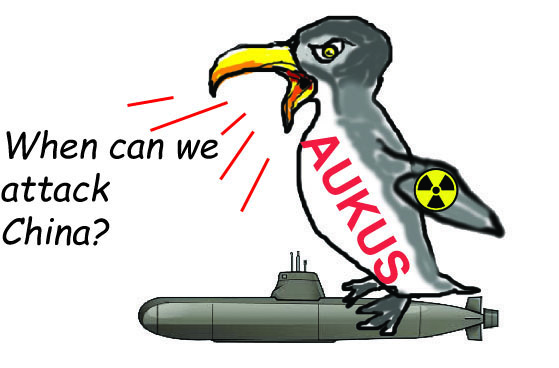
AUKUS, WEAPON PLANS SIGNAL NUCLEAR ESCALATION IN US-CHINA TENSIONS https://ctnewsjunkie.com/2021/11/10/op-ed-aukus/
by Jamil RaglandNovember 10, 2021, What do Groton, Connecticut, and Adelaide, Australia, have in common? Soon, both will be home to one of the United States’ most guarded secrets: nuclear submarine technology.
In mid-September, the United States, United Kingdom, and Australia announced the AUKUS trilateral security partnership (the acronym AUKUS is the combination of the abbreviation for each nation). The key feature of this new security partnership is that the United States will share its knowledge and capabilities in building nuclear-powered submarines with the Australian government. This is a major move, as the US has only shared this technology with Great Britain, the other member of AUKUS.
Australian Prime Minister Scott Morrison stressed that these would only be nuclear-powered submarines, not nuclear armed. Yet as the leaders of the AUKUS nations described their intent to “preserve security and stability in the Indo-Pacific,” all eyes turned to China, the nation which went unmentioned in the remarks, yet who was clearly the focus of the new partnership.
Chinese Foreign Ministry Spokesman Zhao Lijian responded by saying that the security partnership was “extremely irresponsible.” He went on to say that the nuclear submarine cooperation among AUKUS “has seriously undermined regional peace and stability, intensified the arms race, and undermined international non-proliferation efforts.”
Yet China itself tested a new kind of missile in August which ups the ante in terms of weaponry. Known as a hypersonic missile, this weapon is designed to evade US missile defense systems that were built to shoot down old-style ballistic missiles that follow a predictable trajectory after launch. The new Chinese missile enters the atmosphere from a lower point and is maneuverable, which makes intercepting them much more difficult. And the missile is capable of carrying a nuclear payload.
It seems that 50 years of living with “mutually assured destruction” as an actual policy during the US-Soviet Cold War has taught the leaders of the largest nations in the world nothing about the dangers of nuclear posturing. After near accidents and close calls such as the Cuban Missile Crisis, which brought both nations to the brink of war, it appeared that maybe a lesson had been learned. Real progress was made between the Soviet Union (now Russia) and the United States in reducing nuclear stockpiles. At the global peak, there were more than 70,000 nuclear weapons around the world; that number is now down to about 13,000.
But this progress is threatened by the foolhardy arms race the Chinese Foreign Ministry spokesperson warned about, even as his nation was participating in it. We now have US military personnel bragging about the “exquisite timing” with which they can now detonate nuclear weapons to maximize their horrifying destructive capabilities. This is almost certainly a response to China’s new hypersonic missile. And up the ladder of escalation we go.
I’m too young to have experienced bomb drills during the height of the Cold War, but I had teachers who did. My eighth-grade history teacher was obsessed with impressing upon us the power of nuclear weapons; he described in detail the blast radius of a 50-megaton thermonuclear bomb. He showed us the movie The Day After, which showed the after-effects of a nuclear war between the United States and Russia.
He told us that even though we didn’t live near the nuclear silos like the families in the movies, we still weren’t safe. Pratt & Whitney in East Hartford, and of course the naval base at Groton, would put Connecticut on the front lines of a nuclear conflict. I had nightmares for weeks about my impending vaporization.
But ultimately, I realized I was worried about nothing. The Soviet Union had collapsed, and Russia and the United States, while not exactly friends, weren’t exactly enemies either. We were living in what policymakers and writers called the “unipolar moment,” where the United States stood unchallenged in the world. The potential for nuclear war was confined to the movies, no matter how real they seemed.
Now though, what seemed like fantasy is creeping back into the realm of the possible. New weapons, partnerships, and acronyms can’t mask the feeling of historical déjà vu that we’re experiencing now. We even have an island nation to serve as a potential flashpoint for Armageddon – Taiwan in this case, not Cuba. Unless our leaders head off potential conflict and find a peaceful way to coexist, we may have to live with a day after that none of us want.
Jamil Ragland writes and lives in East Hartford. You can read more of his writing at www.nutmeggerdaily.com.
UK government considers withdrawing from EU science and research programmes
| The government is considering withdrawing from EU science and research programmes worth £77 billion because of deteriorating relations with Brussels. Ministers are working on alternatives to Horizon Europe, the EU’s research funding scheme, Copernicus, its satellite system, and Euratom, its atomic energy treaty. Withdrawing would pull up to £15 billion in funding from Brussels and deny British researchers the opportunity to participate in its programmes. A government paper circulated to a Brexit cabinet sub-committee last week and leaked to The Sunday Telegraph suggests that the government is considering pulling out of the schemes if relations with Brussels deteriorate further. The UK is to pay £2.1 billion annually to the Horizon programme to maintain access for British scientists and researchers to pan-European projects and funding. It has also secured access to the Copernicus Earth observation programme, important to the UK space sector, and has also agreed to continue its involvement in the Euratom nuclear research programme. Times 8th Nov 2021 https://www.thetimes.co.uk/article/row-with-european-union-puts-77bn-science-and-research-schemes-at-risk-33n82pv9z |
Nuclear power, fossil fuel companies represented at COP26 climate talks

Revealed: 1,000 fossil fuel and big business reps at COP26, The Ferret, Rob Edwards November 6, 2021,

As many as 141 people registered for COP26 from the nuclear power industry across the globe, including the UK’s Nuclear Industry Association and the World Nuclear Association.
More than 20 were part of the Young Generation Network of nuclear professionals.
Nearly 1,000 representatives from the fossil fuel industry, big business and nuclear power companies have registered to attend the COP26 climate summit in Glasgow, according to an analysis by The Ferret.
They include executives from Shell, BP, Equinor, Chevron, Total, Gazprom and other major oil and gas companies, as well as multinational corporations such as McDonald’s, Bayer, Walmart, HSBC, PepsiCo, Nestlé and Microsoft.
There are also delegations from the coal industry, tobacco companies and pesticide manufacturers. Eleven people from two climate sceptic think-tanks have registered for the summit.
Campaigners are outraged that the oil and nuclear industries were being allowed to influence COP26, and called for polluters to be kept away from the summit. They warned of the “corporate capture of climate policies”….. They include executives from Shell, BP, Equinor, Chevron, Total, Gazprom and other major
oil and gas companies, as well as multinational corporations such as McDonald’s, Bayer, Walmart, HSBC, PepsiCo, Nestlé and Microsoft. There are also delegations from the coal industry, tobacco companies and pesticide manufacturers. Eleven people from two climate sceptic think-tanks have registered for the summit. [details of these participants is given]…………………..
As many as 141 people registered for COP26 from the nuclear power industry across the globe, including the UK’s Nuclear Industry Association and the World Nuclear Association. More than 20 were part of the Young Generation Network of nuclear professionals.
The nuclear industry promotes itself as a low-carbon solution to the climate crisis. But some environmentalists argue that it’s too expensive, unreliable and dangerous, compared to renewable energy……..
This list is described as “provisional”, with a final version due to be issued after COP26 has closed. It does not include so-called “overflow” delegates which under UN rules can been added by countries without their names appearing on the official list of participants.
Friends of the Earth Scotland called for polluters to be kept out of COP26. “Many different groups in society need to talk and work together to tackle the climate crisis,” said the environmental group’s director, Dr Richard Dixon.
“But the last people you want at the COP are the big oil firms who continue to profit from fuelling climate change and the nuclear, carbon capture and carbon market enthusiasts who are peddling solutions that are no solution at all.”
The campaign group, Glasgow Calls Out Polluters, decried “political failure” at COP26. “These big polluters’ climate plans are a death sentence for many, but they are nevertheless appeased by the authorities at the COP,” said the group’s Scott Tully from Glasgow.
“The presence and access of these big polluters is in stark contrast with the exclusion of civil society, which draws into disrepute the legitimacy of these talks.”
The anti-poverty charity, Oxfam Scotland, said it was “worrying” that those who have fuelled the climate crisis were given so much access. “Civil society groups, in particular from poorer countries in the south, have found it so hard to attend or even to observe the talks,” said the group’s head, Jamie Livingstone.
“Unless COP26 prioritises the voices of those facing the consequences of climate inaction, it will be impossible for the talks to deliver climate justice.”
Dr Will Dinan, an expert on lobbying from the University of Stirling, accused fossil fuel companies of lobbying to delay action to cut climate pollution. “Climate campaigners have long been concerned about corporate influence on UN environmental decision-making in general, and the corporate capture of climate policies in particular,” he said………….. https://theferret.scot/1000-fossil-fuel-big-business-cop26/
1 This Month

of the week – THE ONENESS of HUMANITY
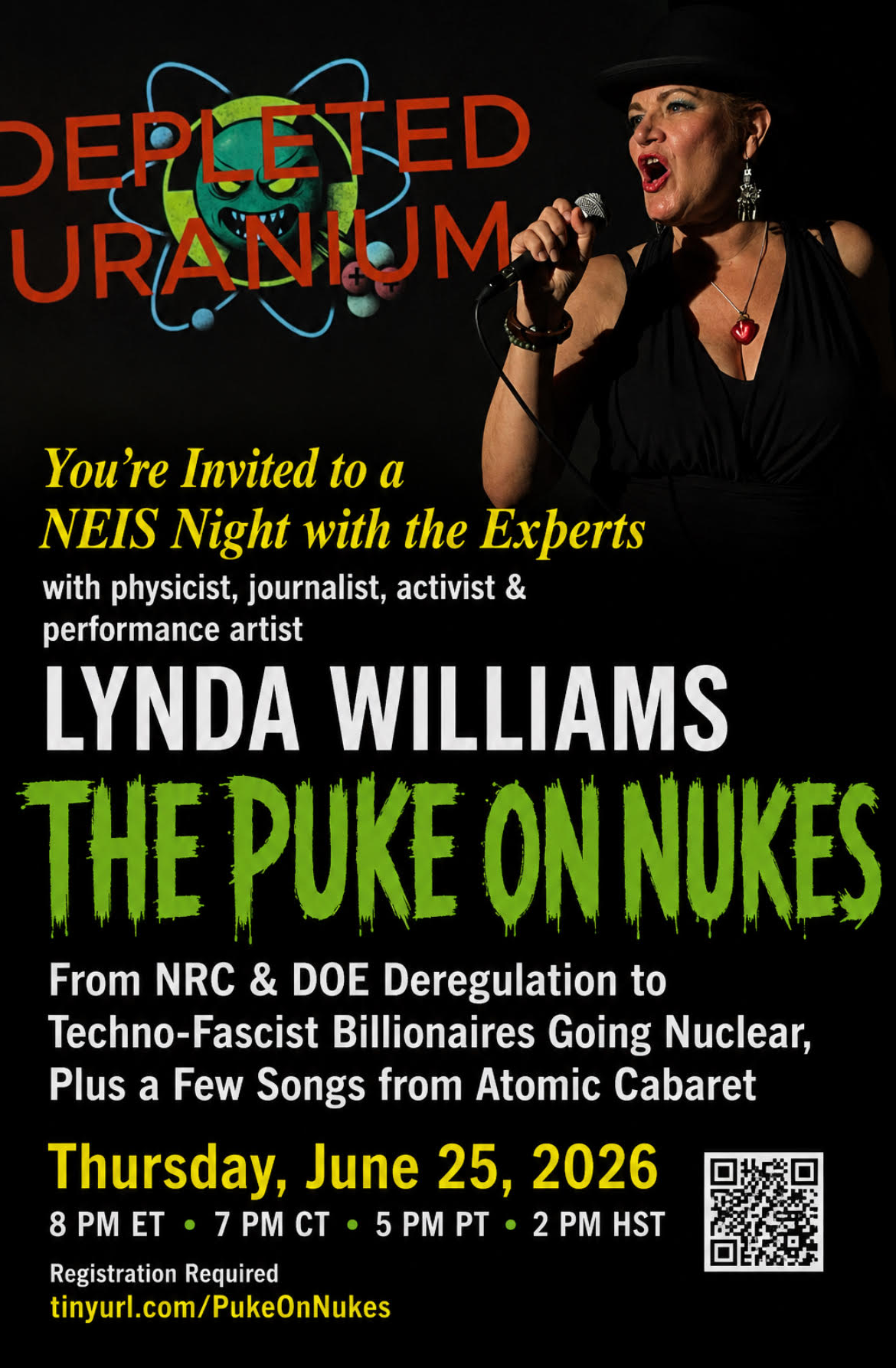
25 June- THE PUKE ON NUKES
Thursday, June 25, 2026
7pm Central Time (8pm ET, 6pm MT, 5pm PT) UTC – 5
From NRC & DOE Deregulation to Techno-Fascist Billionaires Going Nuclear, Plus a Few Songs from Atomic Cabaret REGISTER
26 June – Radiation Trainwreck at the NRC / Join the Protect Better Campaign – https://us02web.zoom.us/meeting/register/4ZlZ5_qLSHGiLSCg8FF6Bg#/registration

1st July – Webinar Waste of Space: The Environmental Harm of Military and Civil Space Activity st July, 7 pm

Report Launch Online: We are seeing an increasing exploitation of space for military and commercial purposes. This must change.

Protect Sazan Island from the Trump family! https://secure.avaaz.org/campaign/en/protect_sazan_island_from_the_trump_family_loc/?bqFCVab&v=174511&cl=22707147157&_checksum=5e9dde668860e8231c33699735e16a1fbf22ab2cb01da50c999fe8732b9775ef&utm_source=email&utm_medium=blast_email&utm_campaign=174511


Cuba Is Not a Failed State – It Is a Besieged State
PETITION: “Global Appeal to Endorse Palestinian Right of Return of Refugees”
To see nuclear-related stories in greater depth and intensity – go to https://nuclearinformation.wordpress.com
-
Archives
- June 2026 (241)
- May 2026 (306)
- April 2026 (356)
- March 2026 (251)
- February 2026 (268)
- January 2026 (308)
- December 2025 (358)
- November 2025 (359)
- October 2025 (376)
- September 2025 (257)
- August 2025 (319)
- July 2025 (230)
-
Categories
- 1
- 1 NUCLEAR ISSUES
- business and costs
- climate change
- culture and arts
- ENERGY
- environment
- health
- history
- indigenous issues
- Legal
- marketing of nuclear
- media
- opposition to nuclear
- PERSONAL STORIES
- politics
- politics international
- Religion and ethics
- safety
- secrets,lies and civil liberties
- spinbuster
- technology
- Uranium
- wastes
- weapons and war
- Women
- 2 WORLD
- ACTION
- AFRICA
- Atrocities
- AUSTRALIA
- Christina's notes
- Christina's themes
- culture and arts
- Events
- Fuk 2022
- Fuk 2023
- Fukushima 2017
- Fukushima 2018
- fukushima 2019
- Fukushima 2020
- Fukushima 2021
- general
- global warming
- Humour (God we need it)
- Nuclear
- RARE EARTHS
- Reference
- resources – print
- Resources -audiovicual
- Weekly Newsletter
- World
- World Nuclear
- YouTube
-
RSS
Entries RSS
Comments RSS
 nuclear-news