Rosatom, Russia’s nuclear corporation, exports nuclear fuel to Finland and others – has not been sanctioned by USA and Europe
Rosatom, which is the world’s biggest exporter of nuclear reactors and maintains a near-monopoly over the fuel they use to generate electricity, hasn’t been sanctioned by the U.S. and Europe.
it’ll be “three to four years” before Russian fuel currently being used in Finland needs to be swapped out in full for new assemblies.
Europe’s other energy problem: relying on Russian nuclear fuel https://www.mining.com/web/europes-other-energy-problem-relying-on-russian-nuclear-fuel/ Bloomberg News | April 7, 2022 A day before Russia invaded Ukraine, it sent four highly-trained armed guards across the border on a special mission to deliver fuel to an aging nuclear power facility.

Reactors based on Soviet designs generate power across the former Cold War bloc, accounting for more than half of all electricity in Ukraine and around two-fifths in a swath of territory arching from Finland to Bulgaria. So the fuel shipment was routine enough — until President Vladimir Putin ordered his army to war.
Russia and Ukraine agree the small security detachment arrived by train on Feb. 23 and was present as technicians unloaded a new batch of fuel rods at the Rivne Nuclear Power Plant 340 kilometers (210 miles) west of Kyiv. They differ wildly over what happened to the so-called Atomspetstrans guards as fighting began.
Ukraine told the International Atomic Energy Agency last week that they were disarmed and subsequently refused to return home. The Kremlin accused Kyiv of taking the four employees of state-owned Rosatom hostage. The IAEA is assessing the situation as it prepares to return monitors to Ukraine.
The incident was just one nuclear flashpoint of a war that’s being fought amid a fleet of operating reactors as well as the entombed site of the world’s worst atomic accident at Chernobyl.
But it also highlights another looming energy challenge for leaders on Moscow’s European periphery even as the continent moves to bar more Russian fossil fuels: how to cut their reliance on nuclear trade with a heavily-sanctioned Russia that many in the region want to further isolate.
“Countries are taking it a lot more seriously because of the situation,” top U.S. nuclear official Bonnie Jenkins said in an interview last month. “They are aware of their dependence.”
Rosatom, which is the world’s biggest exporter of nuclear reactors and maintains a near-monopoly over the fuel they use to generate electricity, hasn’t been sanctioned by the U.S. and Europe.
Non-proliferation experts have warned that doing so could boomerang back by coaxing more countries to enter fuel markets. U.S. officials said last month sanctions would have to be carefully calibrated to avoid damaging allied economies, as well as other U.S. diplomatic efforts, like the nuclear negotiations with Iran. Those talks foresee continued supply of fuel to the Persian Gulf country’s Russia-built reactor.
For Moscow, atomic exports remain a key geopolitical lever, and it’s using state financing to expand Rosatom’s reach with new units in China, India, Iran and Turkey, none of which have enforced war-penalties so far imposed on Russia.
Nuclear fuel differs from commodities like gas or coal because it requires precision-engineered assemblies that conform to licensing requirements set by safety regulators. Trying to cut ties prematurely with Russia could imperil electricity supplies for almost 100 million Europeans in countries that rely on nuclear plants as their biggest source of clean energy.
Jenkins, 61, the U.S. State Department’s under-secretary for arms control and international security, cautioned the switch could take years.
Still, said Liisa Heikinheimo, deputy director general for energy at Finland’s Economy Ministry, “it’s a fact that an alternative supplier is needed. It’s about to be a problem that’s soon reality.”
Finland, where Fortum Oyj operates two Soviet-built VVER reactors 90 kilometers east of Helsinki, has tried to find alternatives to Russia. It contracted British Nuclear Fuel Ltd., now owned by Westinghouse Electric Co., in the 1990s but ultimately stuck with Rosatom’s competitive prices.
More recently, the U.S. Department of Energy and Ukraine worked with Westinghouse to dislodge Rosatom fuel from 15 operating reactors, which still supply more than half the country’s electricity after six weeks of war wrought billions of dollars in damages to infrastructure.
Fuel made by Westinghouse, owned by private-equity investors at Brookfield Business Partners LP, now generates power at six Ukrainian units, with engineers needing until mid-decade to supply the rest.
“Westinghouse started in Ukraine because of the government-to-government agreement with the U.S.,” said Jose Emeterio Gutierrez, the Spanish nuclear engineer who formerly led the company’s decade-long effort to compete with Rosatom. But nuclear-fuel market peculiarities, along with a Soviet technological legacy, makes diversification difficult, he said.
Few nations possess the vast infrastructure needed to convert and enrich uranium ore into metal, which then has to be engineered into ceramic pellets and inserted into zirconium fuel rods with a safety tolerance measured in millimeters. A catalog of international regulations ensures that material isn’t diverted for weapons.
Rising demand for stable energy supplies, along with the European Union’s green label on nuclear power, could help to speed up the process.
Slovakia, with four Russian-built units, pitched a fuel consortium last month to share costs. The U.S. is also involved, pledging last week to help the Czech Republic diversify fuel for its six Russian-designed reactors.
But moving away from Rosatom will require time, said Heikinheimo, who figures it’ll be “three to four years” before Russian fuel currently being used in Finland needs to be swapped out in full for new assemblies.
(By Jonathan Tirone, Kati Pohjanpalo and Jesper Starn, with assistance from Thomas Hall)
AUKUS hypersonic announcement will ‘escalate global tensions’, warns CND

”………………… In a joint statement on Wednesday, the trio announced that they would now “commence new trilateral cooperation on hypersonics and counter-hypersonics, and electronic warfare capabilities. ”
Growing proliferation
Australia is already co-operating with Washington on hypersonic weapon development as part of the Southern Cross Integrated Flight Research Experiment (SCIFiRE). UK officials said they will not be formally joining SCIFiRE. They will instead co-operate in research and development in the area so they can expand their options.
Hypersonic missiles travel at five times the speed of sound and can be armed with either conventional or nuclear warheads. Faster than cruise missiles, they can in theory evade existing air defence systems. The US, Russia, and China have all undertaken testing of the weapon.
CND General Secretary Kate Hudson said: “The latest expansion of the AUKUS military pact will further escalate global tensions, at a time when the threat of nuclear war is at its highest in decades. The announcement that a programme initially centred on providing a non-nuclear state with nuclear-powered submarines – in itself risking wider nuclear proliferation – will now include hypersonic missiles, is of great concern. This AUKUS expansion will accelerate arms racing in the Asia-Pacific region, leading to increased militarisation, and potentially helping provoke conflict over Taiwan. Not to mention the fact that military budgets are already escalating – what will the opportunity cost be for embarking on a whole new class of weaponry be?” https://cnduk.org/aukus-hypersonic-announcement-will-escalate-global-tensions-warns-cnd/
The European Commission Platform on Sustainable Finance concludes that nuclear and gas power are not green
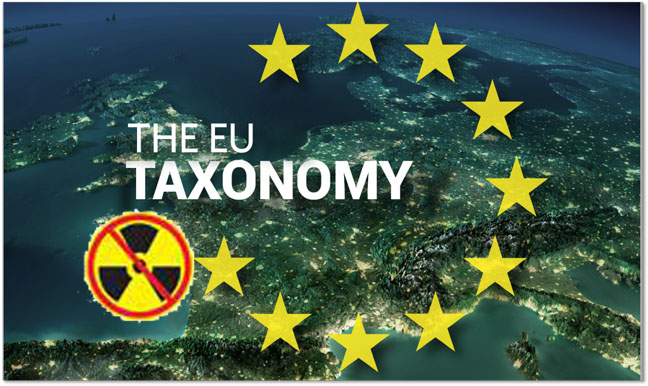
Nuclear and gas power ‘not green’, say EC experts https://environment-analyst.com/global/107948/nuclear-and-gas-power-not-green-say-ec-experts
EC Platform on Sustainable Finance delivers final report on extending sustainable finance rules across the whole EU economy, and includes a bombshell.
A European Commission (EC) expert group has made wide-ranging recommendations on extending the scope of the EU Taxonomy – the classification system that defines environmentally sustainable economic activities – across the European economy.
The EC Platform on Sustainable Finance’s final report will inform important new EU legislation, due in the autumn, which will in turn guide future policy and investment decisions.
The report concludes that gas and nuclear power cannot be described as ‘green’ under the taxonomy’s ‘do no significant harm’ (DNSH) rules – although leaves the final decision to the European Commission.
The expert panel’s final report considers 12 sectors, including manufacturing, transport, agriculture, fishing, building and disaster risk management. It is still finalising criteria for forestry and agriculture.
The report proposes a ‘traffic light’ system, listing red activities requiring urgent transition to avoid significant harm, amber activities that could more easily qualify for taxonomy-recognised investment, and green, low environmental impact (LEnvI) activities.
Welcoming the report, Sebastien Godinot, senior economist at WWF European policy office, commented: “The platform’s recommendations are a crucial step towards the much-needed ‘biodiversity taxonomy’, aimed at driving billions into nature-friendly activities.”
He added: “However, WWF is concerned that some criteria for critical sectors like forestry and agriculture are not [yet] included. The platform must publish recommendations for them no later than May.”
The EU Taxonomy, which came into force earlier this year, provides the technical underpinning for a number of interlinked EU regulations on sustainable finance products, disclosures and reporting. The taxonomy’s purpose is to increase financial flows towards green activities and to reduce green-washing by setting science-based criteria for performance. It is hoped that the taxonomy will become a global ‘gold standard’ for green finance.
The taxonomy is governed by the Taxonomy Regulation, which came into force on 12 July 2020 and identifies activities that improve or diminish six objectives (climate change mitigation, climate change adaptation, sustainable water resources, transitioning to a circular economy, pollution prevention and control and protecting biodiversity and ecosystems). Article 26.2(a) of this regulation requires the commission to report on applying its rules across the wider economy and to define sectors that have no environmental impact or are outside its scope.
At the same time as the taxonomy came into effect, the EC presented the Taxonomy Climate Delegated Act (TCDA). In response to restrictions to Europe’s natural gas supplies at the beginning of the year, the legislation was controversially complemented by a second Delegated Act, which defined nuclear and natural gas powered energy as ‘green’. This caused widespread objections from environmental and climate change groups.
The TCDA is being scrutinised by the European Parliament and the Council, before going back to the EC. The EC is expected to draft a new Delegated Act, building on the platform’s latest recommendations, in the autumn. This should resolve whether nuclear and gas-powered energy will count as sustainable for policy and investment purposes in the EU.
While asserting that nuclear and gas power are not green, the platform’s report gives the commission ‘wiggle room’ by suggesting a “systems-wide approach to the low-carbon transition”.
It says: “The extended Taxonomy framework would acknowledge the reasons why these activities are not green, explaining why, in some cases, [they] may be significantly harmful, but also showing that there is potential for valid and urgent transitions away from significantly harmful performance.”
Uzbekistan: Nuclear deal with Russia still on the table despite sanctions
Uzbekistan: Nuclear deal with Russia still on the table despite sanctions, eurasianet, Even if Rosatom is not targeted by sanctions, its future projects could still be affected. Apr 6, 2022 When Uzbekistan fired the starting pistol four years ago on plans to go nuclear as a way to address the chronic energy shortages that plague it every winter, the world was a different place.
Russian President Vladimir Putin was not an international pariah. And Shavkat Mirziyoyev, his Uzbek counterpart, was courting him as a guest of honor in Tashkent.
The high point of Putin’s visit was when he and Mirziyoyev symbolically inaugurated the start to a project to build an $11 billion nuclear power plant in an area just east of Bukhara. The work was to be done by Russia’s state-owned Rosatom, a commanding presence in the global nuclear power industry, and to be funded with loans from Moscow………
When Uzbekistan fired the starting pistol four years ago on plans to go nuclear as a way to address the chronic energy shortages that plague it every winter, the world was a different place.
Russian President Vladimir Putin was not an international pariah. And Shavkat Mirziyoyev, his Uzbek counterpart, was courting him as a guest of honor in Tashkent.
The high point of Putin’s visit was when he and Mirziyoyev symbolically inaugurated the start to a project to build an $11 billion nuclear power plant in an area just east of Bukhara. The work was to be done by Russia’s state-owned Rosatom, a commanding presence in the global nuclear power industry, and to be funded with loans from Moscow.
…………………… “It is absolutely the case that projects that have not yet been completed or that still are in the design stages are extremely vulnerable to sanctions difficulties and interference, even if Rosatom is not itself presently subject to such sanctions,” Richard Nephew, the director of the International Security Initiative at Columbia University’s Center on Global Energy Policy, told Eurasianet by email. “Sanctions targeting financial transactions, technology transfers and the like will all undermine efforts to engage in and complete such projects.”
While there are clear risks to proceeding with the project, there are risks to scrapping it, too.
Aside from the certainty that cancellation would antagonize a belligerent Russia, finding a new partner to build a plant that Mirziyoyev said in 2018 would be completed within a decade would take time.
So is building the Russo-Uzbek nuclear power station still viable?
“Possibly, though given the long lead times required to develop and implement nuclear reactor projects, by the time such a project were to begin, it could be covered by sanctions,” said Nephew. “In general, it would not be advisable to start development of such projects now, given this risk.” https://eurasianet.org/uzbekistan-nuclear-deal-with-russia-still-on-the-table-despite-sanctions
Argentina wants China to fully fund $8.3 bln nuclear plant
Argentina wants China to fully fund $8.3 bln nuclear plant amid cash shortfall. By Eliana Raszewski, 6 Apr 22, LIMA, Argentina, (Reuters) – Argentina is pushing China to fully finance a new $8.3 billion nuclear power plant in the country, as the government grapples with high debt levels and looks to bring down its fiscal deficit as part of a recent deal with the International Monetary Fund.
The South American nation signed an agreement with the China National Nuclear Corporation (CNNC) for construction of a nuclear power plant in February. CNNC at the time said it would finance 85% of the cost, with Argentina shouldering the rest.
The country, however, now faces a tighter fiscal outlook. It needs to hit a fiscal balance by 2025 from a 3% deficit last year under terms of a recent $44 billion IMF program, including cutting billions of dollars in energy subsidies.
“We’re aiming for 100% in terms of financing from China to guarantee no delays given the problems we have with funding,” said Jorge Sidelnik, executive director of Argentina’s state operator Nucleoelectrica Argentina, the local partner……………………. https://www.reuters.com/business/energy/argentina-wants-china-fully-fund-83-bln-nuclear-plant-amid-cash-shortfall-2022-04-05/
Ukraine is ground zero for the expansion of the U.S.-Russia proxy war, (and the war industry is jubilant)

This six-week war surely has left the war industry jubilant. In Washington, Biden recently proposed what would be the largest U.S. “defense” budget in history, more than $813 billion.
The U.S. Has Its Own Agenda Against Russia Ukraine is ground zero for the expansion of the U.S.-Russia proxy war. The Intercept, Jeremy Scahill, April 2 2022 Ever since Vladimir Putin launched his invasion of Ukraine, there has been an unprecedented cohesion of messaging emanating from the U.S. government, its NATO and other European allies, and large segments of the Western media establishment. As massive quantities of weapons pour into Ukraine, there has been consistent media and political agitation for President Joe Biden and other Western leaders to “do more” or answer for why they are not further escalating the situation, including through the imposition of a no-fly zone.
The White House smells Putin’s blood in the waters of his disastrous invasion. The flow of weapons, the sweeping sanctions, and other acts of economic warfare are ultimately aimed not just at defending Ukraine and making the regime pay for the invasion in the immediate present, but also setting in motion its downfall. “For god’s sake, this man cannot remain in power,” Biden said during his recent visit to Poland. The White House sought to walk back the line and clarify that it did not constitute a change in policy but was merely an expression of the president’s righteous anger. The kerfuffle over what Biden really meant is less important than the very public actions of the U.S. and its allies.
It should not be assumed that the strategies and actions being employed by Washington and its allies in their proxy war against Moscow will always be in the best interest of Ukraine or its people. Likewise, Ukraine’s calls for military support and action from the West — however justifiable and sincere they are — may not be in the best interest of the rest of the world, particularly if they increase the likelihood of nuclear war or World War III. The desire to avoid this scenario by advocating for a negotiated solution to the war that addresses Russia’s stated concerns or its rationale for the invasion is not a capitulation to Putin and it is not appeasement. It is common sense.
While the fate of Ukraine and the lives of its civilian population are evoked in calls for more escalatory action from the West, it is these very people who will suffer and die in large numbers every day the war drags on. Western media coverage is often crafted to portray only one outcome as acceptable: a decisive Ukrainian victory, in which the government of Volodymyr Zelenskyy emerges from the horrors of the Russian invasion in complete control of all of its territory, including Crimea and the Donbas region. Ukraine, as a free and independent state, should be free to join NATO, and Russia has no legitimacy in questioning the implications of such a move. Advocacy for accepting anything short of this outcome is a victory for Russia and therefore traitorous to even consider………………
The routine belligerence exhibited by countless politicians, pundits, and media figures about taking the fight to Putin in Ukraine is largely chickenhawkery. …………
when you listen to the fine details of Ukraine’s own negotiators and leaders, it’s clear that they understand that the war does not end with the swift annihilation of Putin, the downfall of Russia, or with a clean and complete Ukrainian retention of its territorial sovereignty. That’s why Zelenskyy’s government has acknowledged that the issue of NATO membership, a formalized neutrality status, and an internationally brokered process on the status of Crimea will all be on the table.
There has been much noise about Russia’s recent indications that it was drawing down its military actions in parts of Ukraine, particularly around the capital Kyiv. The U.S. and NATO have acknowledged a partial drawdown but asserted that Russian forces appear to be repositioning, likely for use in the east. Russia has also said as much itself. Moscow’s position is that “the main goals of the first stage of the operation have generally been accomplished.”
There is a peculiar dynamic surrounding the analysis of Putin’s comments on his intentions for Ukraine. He is accused of lying when his remarks undermine the U.S. narrative, but we are told to believe he is absolutely telling the truth when his pugnacious threats bolster the U.S. position.
Whether or not Putin intended to seize all of Ukraine and become an imperial occupier, he did seem to believe his invasion could cause the Ukrainian government to collapse and its leaders to flee in fear. That did not happen. Instead, U.S. and NATO-armed Ukrainian forces outside Kyiv have fought the Russian troops ferociously and inflicted significant losses against them on the battlefield. At the same time, by opening multiple fronts, Moscow forced Ukraine to defend vital territory, including its capital. This strategy exacted a tremendous human toll on the Russian military, but it did take some heat off Russian forces in the Donbas territories in the east, which Putin has cited as his territorial priority in the operation.
But the question of Putin’s original intent — to take Kyiv or to use that threat as a strategy to spread Ukraine’s defenses thin — is now largely irrelevant except in the rhetorical battlespace focused on Russian weakness, incompetence, or failure.
The most contentious issue in the negotiations to end the war will likely have little to do with NATO membership. Zelenskyy has already conceded that to end the war Ukraine will have to drop that ambition and adopt a neutral and nonaligned status, though he does want to continue the pursuit of joining the European Union. Russia will certainly oppose any attempts for Kyiv to win a backdoor “Article 5” status that could trigger defense of Ukraine by Western powers in cases of future military actions by Moscow. Ukraine has suggested that it would also want China and Turkey to be a part of such a guarantee, not just adversaries of Russia. There are indications that the U.S. doesn’t think the proposal is viable, and Britain’s deputy prime minister bluntly stated, “Ukraine is not a NATO member,” adding, “We’re not going to engage Russia in direct military confrontation.”
Based on the reports out of the recent negotiations in Turkey, it seems that the most incendiary questions will revolve around the breakaway republics in the Donbas region. Ukraine has effectively said it wants a return to the pre-invasion status quo, which would mean erasing the Putin-recognized declarations of independence from Donetsk and Luhansk. Russia, which is currently expanding its control over the Donbas and seizing more territory, is unlikely to agree. This dynamic more than any other could delay or block any meaningful resolution and would be a central focus in a potential summit between Zelenskyy and Putin.
Once there is a brokered agreement, the flow of Western weapons into Ukraine and Russian military support for the separatists will result in a constant state of war footing for many years to come. A cloud portending more fighting and bloodshed will remain hovering over eastern Ukraine. If U.S. and other NATO troops resume their training exercises in Ukraine, as Biden has indicated they should, this means that there will always be a risk of incidents that could quickly escalate.
This six-week war surely has left the war industry jubilant. In Washington, Biden recently proposed what would be the largest U.S. “defense” budget in history, more than $813 billion. Germany and other European countries are publicly committing to buying and selling more weapons and spending more on defense. NATO is raising the prospect of expanding its permanent military presence in Europe and Washington is reasserting its political dominance over Europe on security matters.
But despite the image of global unity of cause being promoted by the U.S. and its NATO allies, several large and powerful nations, including China, India, Indonesia, and NATO member Turkey, are not marching to Washington’s drumbeat — not in the proxy-war business and not in the policy of sanctioning and vilifying Russia.
The overt war in Ukraine will have to end at the negotiating table. But the proxy war is escalating and will have consequences that extend far beyond the current battlefield. https://theintercept.com/2022/04/01/russia-ukraine-proxy-war-washington-diplomacy/
Ending Ukraine’s suffering. The decision to negotiate this is up to Ukraine, not USA
 |
Putin, The Nuclear Threat, And Ending The War: To Squeeze Or Not To Squeeze? Michael Krepon, Forbes, 4 Apr 22,
To squeeze or not to squeeze. That is the question that tries analytically minded souls…………..
………..The majority view among the punditocracy counsels a negotiated settlement. One concern is that if Putin feels cornered, he could do something everyone will regret — like using a nuclear detonation in war. Even if he doesn’t, the longer this war lasts, the more Ukrainian city blocks will be reduced to rubble.
………….most analysts argue that we ought to give Putin a face-saving exit, which means conceding Ukrainian territory to Russia. How much territory to concede would be a hard issue in any negotiated settlement.
………. the deciding vote on the question of to squeeze or not to squeeze belongs to the government and people of Ukraine. It’s their land, their casualty counts, and their cities. NATO is obliged to take its cues from Volodymyr Zelensky. https://www.forbes.com/sites/michaelkrepon/2022/04/04/putin-the-nuclear-threat-and-ending-the-war-to-squeeze-or-not-to-squeeze/?sh=51ec25776109
Nuclear Free Local Authorities back international challenge to UK nuclear weapons policies in UN Human Rights Council
Nuclear Free Local Authorities have this week backed a challenge to the British Government’s nuclear weapons policies in the UN Human Rights Council.
The NFLA has joined with international partners in charging that the UK Government’s policy of retaining, and reserving the right to use, a nuclear weapons arsenal is in violation of the Right to Life, a right enshrined in Article 6 of the International Covenant on Civil and Political Rights (ICCPR), to which the UK is a signatory. The NFLA is a partner member of ICAN, the International Campaign to Abolish Nuclear Weapons.
“The destructive power of these weapons is truly frightening, and their primary targets are cities and their civilian populations,” said Councillor David Blackburn, Chair of the NFLA Steering Committee. “Any nation contemplating their use must realise that their victims would be millions of innocent men, women and children peacefully going about their daily lives. In no way can the possession or threat of use by any state be compatible with that state’s obligations under international law to maintain the right to life. The UK is such a nuclear weapon armed state and that is why the NFLA is backing this challenge.”
The report has been submitted to the Human Rights Council by the Basel Peace Office, in cooperation with other civil society organisations, as part of the UN periodic review of the obligations of the United Kingdom under international human rights law, including the ICCPR.
Russia has recently made nuclear threats to the USA and NATO if they intervene in the invasion of Ukraine, whilst in the past a British defence secretary threatened a pre-emptive strike on Russia. Such threats highlight the importance of addressing the risks associated with nuclear deterrence policies. Nine states continue to possess nuclear weapons and maintain the option of initiating nuclear war.
“In times of high tensions involving nuclear-armed and/or allied states, plans and preparations for the use of nuclear weapons elevate the risk of nuclear war which would be a humanitarian catastrophe, severely impacting rights of current and future generations,” says Alyn Ware, Director of the Basel Peace Office. “Compliance with the Right to Life with respect to nuclear weapons is therefore an urgent matter, impacting not the rights of all humanity and of future generations.”
The UK deploys about 160 nuclear warheads (40 on each of their 4 strategic nuclear submarines) which are ready to be fired at any time, including, according to a revised government policy, in response to threats from chemical and biological capabilities or emerging technologies that could have a comparable impact.
In 2018 the UN Human Rights Committee affirmed that the threat or use of nuclear weapons is incompatible with the Right to Life, and that signatories to the ICCPR have obligations to refrain from developing, acquiring, stockpiling and using them, and also have obligations to destroy existing stockpiles and pursue negotiations in good faith to achieve global nuclear disarmament.
he submission makes several recommendations to enable the UK Government to comply with its obligation to maintain the Right to Life. These include adopting no-first-use policies, cancelling plans to renew nuclear weapons systems, taking measures to phase out the role of nuclear weapons in their security doctrines and advancing at the 2022 Non-Proliferation Treaty Review Conference a goal for the global elimination of nuclear weapons by 2045, the 75th anniversary of the NPT.
The submission also highlights the connection between nuclear weapons and climate change, with a recommendation to the UK Government to re-allocate nuclear weapons budgets to renewable energy development and climate action financing.
If the UN Human Rights Council decides to pick up on the challenges and recommendations in the submission and direct these to the UK Government, they are required to respond.
To see the submission to the Human Rights Council please go to this link:
http://baselpeaceoffice.org/sites/default/files/imce/HumanRights/submission_to_the_human_rights_council_regarding_uk_nuclear_weapons_policies_and_practices_final_version_with_annex.pdf
Iran blames US for halt to nuclear talks
Iran blames US for halt to nuclear talks, The United States is responsible for the pause in talks between Tehran and world powers in Vienna aimed at reviving their 2015 nuclear deal, an Iranian foreign ministry spokesperson says.
“America is responsible for the halt of these talks … a deal is very much within reach,” Saeed Khatibzadeh told a weekly news conference on Monday…………..https://www.canberratimes.com.au/story/7686412/iran-blames-us-for-halt-to-nuclear-talks/
Macron rubbing hands with glee as UK energy crisis means EDF poised for ‘£30bn payday’

Macron rubbing hands with glee as UK energy crisis means EDF poised ‘£30bn payday’. EMMANUEL MACRON could win big from the UK energy crisis, with EDF being tipped to secure contracts worth nearly £30 billion.
Dr Paul Dorfman, an associate fellow at the University of Sussex said: “The UK has a very strong relationship with EDF, they own and run the substance of UK reactors and are helping to build Hinckley point and the rest of it.
“However, EDF are in debt. Moodys, the financial organisation has recently downgraded EDF’s credit rating. A quarter of all of France’s reactors are currently offline due to safety and security problems, that’s
largely because they have an ageing nuclear fleet, like us.
“In order to kind of try to prolong their lifespan, the French government has big upgrade of their nuclear. “The cost estimates are around £70-80 billion just to upgrade, just to keep them tottering on.”
EDF is currently constructing the Hinckley Point C nuclear power station and is also adding new reactors to Sizewell C in Suffolk and Bradwell B in Essex. Dr Dorfman has warned that these new reactors constructed by EDF are the same type of EPR reactors that were built in France, which the French court of Auditors estimated cost an extra €19billion (almost £16 billion). He continued: “EDF is clear about the need for Government investment in order to proceed with Sizewell C.”
Express 1st April 2022
Ukraine: Transfer of Power Balance from West to East
Ukraine: Transfer of Power Balance from West to East, Consortium News, March 31, 2022
Own goal: Cameron Leckie says the Western response to Russia’s invasion of Ukraine is rapidly accelerating what had been a more drawn-out process. By Cameron Leckie By Cameron Leckie
Pearls and Irritations Most of the debate and coverage of the ongoing Russo-Ukrainian war in Australia and the Western world is decidedly banal. It is characterized by the simplification of an extremely complex situation to generate a narrative that can be summarized as Putin and Russia are evil and Ukraine is good.
This gross simplification is not helpful in either understanding the causes of the war, the nature of the war, its broader implications and most importantly of all, how it can be ended with the least number of additional deaths and injuries and damage to Ukraine’s infrastructure
The preponderance of human-interest reporting of the conflict in lieu of coverage of the war itself is illustrative. The heartbreaking examples of families torn asunder along with the brave exploits of Ukrainian soldiers or allegations of war crimes by Russia, whilst important, tends to trigger an emotional response rather than provide an accurate depiction of the course of events.
Partly this is because very few mainstream Western reporters, if any, appear to be located where the bulk of the fighting is, namely in the Donbass and around Mariupol. The resulting vacuum is filled by claims, many unverified and unverifiable, from the Ukrainian side, the aforementioned human-interest stories or the impact of missile strikes in and around the major cities. Truth has long been described as the first casualty of war. It would be unwise to think that this conflict is an exception. We should thus take a healthy dose of skepticism about the media reporting and analysis of the war — from all sides.
A narrative that seems to be gaining traction is that the Russian forces have culminated and Ukraine may actually be winning. This narrative could well be wishful thinking, influenced by the desire for Russia to lose, the overwhelming pro-Ukrainian bias of reporting and analysis and a misunderstanding of Russia’s aims and strategy…………………
Approximately 60,000 of Ukraine’s best trained and equipped troops are located in the Donbass. It would appear unlikely that this force is capable of anything other than localized tactical level manoeuvre at this point due to a combination of ever dwindling supplies of ammunition, fuel and rations, Russia’s dominance in the air and ground based combat power, and the effects of combat to date.
A narrative that seems to be gaining traction is that the Russian forces have culminated and Ukraine may actually be winning. This narrative could well be wishful thinking, influenced by the desire for Russia to lose, the overwhelming pro-Ukrainian bias of reporting and analysis and a misunderstanding of Russia’s aims and strategy…………………
Approximately 60,000 of Ukraine’s best trained and equipped troops are located in the Donbass. It would appear unlikely that this force is capable of anything other than localized tactical level manoeuvre at this point due to a combination of ever dwindling supplies of ammunition, fuel and rations, Russia’s dominance in the air and ground based combat power, and the effects of combat to date.
The direct Russo-Ukraine conflict is however just one level of this conflict. Ukraine is actually an unfortunate pawn in the much bigger conflict. As long time Russia analyst Gilbert Doctorow notes this is a
“full-blown proxy war between the United States of America and the Russian Federation, and it is about ending or perpetuating American global hegemony.”
Whilst the war in Ukraine will end sooner or later, the implications at a global scale of this proxy war will be of much greater consequence for a much greater period of time.
The Western response to Russia’s invasion has been to substantially increase its military aid to Ukraine (which is unlikely to change the outcome of the war) and implement economic (and cultural) sanctions of an unprecedented scale and nature on Russia.
This approach is unlikely to work for multiple reasons, the primary one being as I stated in my last article that there “are no sanctions that the U.S. or Europe can implement that will not have a greater impact upon those countries than on Russia or create further divisions among the Western powers.”
Whilst the sanctions will have a disruptive and negative effect on the Russian economy, they will not be devastating for the simple fact that Russia is too important to the global economy. The initial shock of the sanctions did not cause a collapse of the Russian financial system, nor did it result in a bank run. The ruble has already regained some of its value versus the U.S. dollar and Russia has (for now) made bond repayments.
Russia is far from being isolated. Whilst a majority of countries voted against Russia at the United Nations General Assembly, of more importance is the countries that are not sanctioning Russia. Outside of the West virtually no country is sanctioning Russia, including the world’s two most populous, China and India with the world’s second and sixth largest economies.
Russia has many willing buyers for its energy, mineral and agricultural produce. Countries not on Russia’s “unfriendly country list” will receive preferential deals for exports as already evidenced by the rupee-ruble oil mechanism with India and a natural gas and grain deal with Pakistan.
The impact of Western businesses withdrawing from Russia, whilst causing short-to-medium term disruptions, will in the longer term be managed through an expansion of Russia’s import-substitution policies and sourcing goods from other countries.
There are already reports that the sale of Chinese mobile phones in Russia have more than doubled whilst the Chinese financial company UnionPay is replacing VISA and Mastercard. The effect of the sanctions policy may very well be the permanent gifting of a market of 140 million people to Chinese and Indian businesses……………………
De-dollarization
The sanctions, including the unprecedented freezing of a central banks assets, are also undermining trust in the Western financial system. The trend towards de-dollarization will rapidly accelerate from here on as countries seek to minimize the risk of trading with the U.S. dollar…………..
It seems clear that the Western powers have overestimated the impact that the sanctions would have on Russia, had not fully thought through the implications, were unprepared for the consequences and have no feasible way of reversing their actions. Meanwhile the majority of the world’s countries will continue to trade and maintain their relationship with Russia for the simple reason that it is in their interests to do so…………..
There is a good chance that 2022 will in hindsight be viewed as the decisive tipping point. Unfortunately, the penny has not yet dropped with Western governments and their compliant media of what their actions have triggered. Enlightened self-interest suggests that a major change in direction is required in the West, Australia included, to make the best of a bad situation. https://consortiumnews.com/2022/03/31/ukraine-transfer-of-power-balance-from-west-to-east/
The Red Scare, Viewpoint by Alice Slater
The writer serves on the Boards of World Beyond War, the Global Network Against Weapons and Nuclear Power in Space. She is also the UN NGO representative for the Nuclear Age Peace Foundation.
NEW YORK (IDN) 4 Apr 22, ”……………………………………………………………….– [in 1989] The painful, searing vision of the cemetery of mass, unmarked graves in Leningrad haunts me still. Hitler’s siege of Leningrad resulted in nearly one million Russian deaths. On every street corner it seemed, memorial statutes paid tribute to some part of the 27 million Russian who died in the Nazi onslaught. So many men over sixty. who I passed in the streets of Moscow and Leningrad, had their chests bedecked with military medals from what Russians called the Great War. What a beating they took from the Nazis—and how prominent a part it still plays in their culture today as the tragic Ukrainian chaos unfolds.
At one point, my guide asked, “Why don’t you Americans trust us?” “Why don’t we trust you?” I exclaimed, “What about Hungary? What about Czechoslovakia?” He looked at me with a pained expression, “But we had to protect our borders from Germany!” I looked into his watery blue eyes and heard the fervent sincerity in his voice. At that moment, I felt betrayed by my government and the years of constant fearmongering about the communist threat. The Russians were in a defensive posture as they built their military might. They used Eastern Europe as a buffer against any repetition of the ravages of war they had experienced at the hands of Germany. Even Napoleon had invaded straight through to Moscow in the previous century!
It’s clear that we’re creating bad will and hatred again with the unseemly expansion of NATO, despite Regan’s promises to Gorbachev that it wouldn’t expand “one inch to the east” of Germany, while keeping nuclear weapons in five NATO countries, placing missiles in Romania and Poland, and playing war games, including nuclear war games, on Russia’s borders. Small wonder that our refusal to deny NATO membership to Ukraine has been met by the current awful violent onslaught and invasion by Russia.
It is never mentioned in the unrelenting media assault on Putin and Russia that at one point, Putin, despairing of ever being able to halt the eastward expansion of NATO, asked Clinton if Russia could join NATO. But he was rejected as were other Russian proposals to the US to negotiate for the elimination of nuclear weapons in return for giving up missile emplacements in Romania, to return to the ABM Treaty and the INF Treaty, to ban cyberwar, and to negotiate a treaty to ban weapons in space.
In a Matt Wuerker cartoon Uncle Sam is on a psychiatrist’s couch fearfully clutching a missile saying, “I don’t understand—I have 1800 nuclear missiles, 283 battleships, 940 planes. I spend more on my military than the next 12 nations combined. Why do I feel so insecure!” The psychiatrist answers: “It’s simple. You have a military-industrial complex!”
What’s the solution? The world should issue a call for sanity!!
Call for a Global Peace Moratoriun
CALL FOR A GLOBAL CEASEFIRE AND A MORATORIUM on any new weapons production—not one more bullet– including and especially nuclear weapons, let them rust in peace! …………. https://www.indepthnews.net/index.php/opinion/5193-the-red-scare
North Korea says Seoul ‘crazy’ to talk of preemptive strike on ‘nuclear power’
Kim Yo Jong and military official warn tensions could ignite into war and that Pyongyang rethinking inter-Korean affairs, NK News, Jeongmin Kim, April 3, 2022 A North Korean military official has slammed South Korea’s defense minister as “crazy” for mentioning “preemptive strike” capabilities, warning that the DPRK is a “nuclear power” and can “destroy” any major targets in Seoul if needed.
………………..Pak’s criticism comes two days after Suh Wook reportedly said the South Korean military is equipped with “capabilities and posture to conduct a precision strike against the launch point” when there are clear signs of a missile launch, in a speech at a ceremony to revamp Seoul’s missile commands on Friday. His remarks were in line with president-elect Yoon Suk-yeol’s support for a preemptive strike to stop a North Korean attack.
……… EXPERT ASSESSMENTS
Experts on Sunday raised concerns about the increased risk of military conflict on the Korean Peninsula, criticizing Seoul for contributing to raising tensions.
“North Korea is unfortunately correct that a non-nuclear state is out of its mind to actively threaten a nuclear state,” said Van Jackson, professor of international relations at Victoria University of Wellington and a former Pentagon official.
“If you have intelligence that there’s a high likelihood North Korea will launch some kind of attack, then by all means make deterrent threats. But North Korea isn’t on the verge of attacking the South, and brandishing threats of preemption — or massive retaliation — under status quo normalcy is literally goading a nuclear-armed adversary to be more adversarial,” Jackson said, asserting that “there’s no need to show and tell” capabilities that are already known.
Toby Dalton, a senior fellow and co-director of the Nuclear Policy Program at the Carnegie Endowment for International Peace, agreed.
“Deterring North Korea’s nuclear coercive threats is best done quietly and with confidence,” he said. “Chest-thumping rhetoric about preemptive strikes is not helpful.”
Ankit Panda, a senior fellow in the Nuclear Policy Program at the Carnegie Endowment for International Peace, noted the increased likelihood of conflict due to either side misjudging the other’s intentions.
“South Korea has strong incentives to limit damage to its territory — including by taking out North Korean nuclear-capable launchers — and North Korea has strong incentives to slow and degrade what it may perceive to be an invasion of its territory,” he said. “Both Koreas think they’ll get to shoot first in a war. That’s inherently destabilizing and dangerous.”
But for North Korea to escalate beyond just words, it will need a more “compelling domestic or strategic rationale,” he added.
Edited by Bryan Betts https://www.nknews.org/2022/04/north-korea-says-seoul-crazy-to-talk-of-preemptive-strike-on-nuclear-power/
China call USA the ”Leading Instigator” of the Russia/Ukraine conflict.
| |||
China Calls U.S. ‘Leading Instigator’ of Russia, Ukraine Conflict, Newsweek BY MATTHEW IMPELLI 4/1/22 China called the U.S. the “leading instigator” of the ongoing conflict between Russia and Ukraine on Friday.
During a daily press conference, Chinese Foreign Ministry spokesperson Zhao Lijian said, “As the culprit and the leading instigator of the Ukraine crisis, the US has led NATO in pursuing five rounds of eastward expansions in the next two decades or so since 1999.”
“NATO’s membership has increased from 16 to 30 countries and the organization moved over 1000 kilometers eastward to somewhere near Russia’s borders, pushing the latter to the wall,” Zhao added…………
While the U.S. and NATO members have condemned Russia and President Vladimir Putin, China has yet to take a concrete side on the issues, calling for peace between the two nations. https://www.newsweek.com/china-calls-us-leading-instigator-russia-ukraine-conflict-1694354
Caitlin Johnstone: The Target is China

One thing that does seem clear is that the only way the empire has any chance of stopping the rise of China is by maneuvers that will be both highly disruptive and existentially dangerous for the entire world. If you think things are crazy now, just you wait until the imperial crosshairs move to Beijing.
On the empire’s grand chessboard, Russia is the queen piece, but China is the king
https://consortiumnews.com/2022/04/01/caitlin-johnstone-the-target-is-china/ April 1, 2022 The Pentagon’s current strategy document clearly identifies Enemy No. 1. And it’s not Russia. By Caitlin Johnstone, CaitlinJohnstone.com
The Pentagon has produced its latest National Defense Strategy (NDS), a report made every four years to provide the public and the government with a broad overview of the U.S. war machine’s planning, posturing, developments and areas of focus.
You might assume with all the aggressive brinkmanship between Moscow and the U.S. power alliance this year that Russia would feature as Enemy No. 1 in the 2022 NDS, but you would be assuming incorrectly. The U.S. “Defense” Department reserves that slot for the same nation that’s occupied it for many years now: China.
Antiwar’s Dave DeCamp writes the following:
“The full NDS is still classified, but the Pentagon released a fact sheet on the document that says it “will act urgently to sustain and strengthen deterrence, with the People’s Republic of China (PRC) as our most consequential strategic competitor and the pacing challenge for the Department.”
The fact sheet outlines four priorities for the Pentagon:
-Defending the homeland, paced to the growing multi-domain threat posed by the PRC
-Deterring strategic attacks against the United States, Allies, and partners
-Deterring aggression, while being prepared to prevail in conflict when necessary, prioritizing the PRC challenge in the Indo-Pacific, then the Russia challenge in Europe
-Building a resilient Joint Force and defense ecosystem”
“The Pentagon says that while China is the focus, Russia poses ‘acute threats’ because of its invasion of Ukraine,” DeCamp writes, showing the empire’s view of Moscow as a second-tier enemy.
Ahead of a meeting with China’s Foreign Minister Wang Yi, Russian Foreign Minister Sergei Lavrov has made some comments which clearly illustrate the U.S.-centralized empire’s actual problem with Moscow.
“We, together with you, and with our sympathisers will move towards a multipolar, just, democratic world order,” Lavrov said to the Chinese government on Wednesday.
And that right there, ladies and gentlemen, is the real reason we’ve been hearing so much hysterical shrieking about Russia these last five or six years. It’s never been about Russian hackers. Nor about a Kremlin pee tape. Nor about Trump Tower. Nor about GRU bounties in Afghanistan. Nor about Manafort, Flynn, Bannon, Papadopoulos or any other Russiagate Surname of the Week. It’s not even actually about Ukraine. Those have all been narrative-shaping constructs manipulated by the U.S. intelligence cartel to manufacture support for a final showdown against Russia and China to prevent the emergence of a multipolar world.
The U.S. government has had a policy in place since the fall of the Soviet Union to prevent the rise of any powers which could challenge its imperial agendas for the world. During the (first) Cold War the strategy promoted by empire managers like Henry Kissinger was to court China out of necessity to pull it away from the U.S.S.R., which was when we saw business ties between China and the U.S. lead to immense profits for certain individuals in both nations and the influx of wealth which now has China on track to surpass the U.S. as an economic superpower.
Once the U.S.S.R. ended, so too did the need to remain on friendly terms with China, and subsequent decades saw a sharp pivot into a much more adversarial relationship with Beijing.
In what history may one day view as the U.S. empire’s greatest strategic blunder, empire managers forecasted the acquisition of post-soviet Russia as an imperial lackey state which could be weaponized against the new Enemy No. 1 in China. Instead, the exact opposite happened.
Former Secretary of State Hillary Clinton told the Bloomberg New Economy Forum last year that she’d “heard for years that Russia would become more willing to move toward the west, more willing to engage in a positive way with Europe, the U.K., the U.S., because of problems on its border, because of the rise of China.” But that’s not what occurred.
“We haven’t seen that,” Clinton said. “Instead what we’ve seen is a concerted effort by Putin maybe to hug China more.”
The empire’s expectation that Moscow would come groveling to the imperial throne on its own meant that no real effort was expended trying to establish goodwill and win over its friendship. NATO just kept on expanding and the empire got increasingly aggressive and belligerent in its games of global conquest.
This error has led to the strategist’s ultimate nightmare of having to fight for global domination against two separate powers at once. Because empire architects incorrectly predicted that Moscow would end up fearing Beijing more than it fears Washington, the tandem between China’s economic power and Russia’s military power that experts have been pointing to for years has only gotten more and more intimate.
And now here we are with Russian and Chinese officials openly discussing their plans to create a multipolar world while Chinese pundits crack jokes about the U.S. empire’s transparent ploys to turn Beijing against Moscow over the Ukraine invasion:
On the empire’s grand chessboard, Russia is the queen piece, but China is the king. Just as with chess it helps to take out your opponent’s strongest piece to more easily pursue checkmate, the U.S. empire would be well advised to try and topple China’s nuclear superpower friend and, as Consortium News Editor-in-Chief Joe Lauria recently put it, “ultimately restore a Yeltsin-like puppet to Moscow.”
Basically, all we’re looking at in the major international news stories of our time is the rise of a multipolar world crashing headlong into an empire which has espoused the belief that unipolar domination must be retained at all cost, even if it means flirting with the possibility of a very fast and radioactive third world war.
This is the Hail Mary pass of the U.S. hegemon; its last-ditch effort to secure control before forever losing any chance at it. Many anti-imperialist pundits I read regularly seem quite confident that this effort will fail, while I personally think those forecasts may be a bit premature. The way the chess pieces are moving it definitely does look like there’s a plan in place, and I don’t think they’d be orchestrating that plan if they didn’t believe it had a chance to succeed.
One thing that does seem clear is that the only way the empire has any chance of stopping the rise of China is by maneuvers that will be both highly disruptive and existentially dangerous for the entire world. If you think things are crazy now, just you wait until the imperial crosshairs move to Beijing.
1 This Month



26 September – International Day for the Total Elimination of Nuclear Weapons


PLEASE OPPOSE HR 8255 AND S.3639 – bills would accelerate satellite deployment, with no environmental review or safeguards – https://ncstd5li.quorum.us/campaign/169331/
To see nuclear-related stories in greater depth and intensity – go to https://nuclearinformation.wordpress.com
-
Archives
- September 2026 (257)
- August 2026 (330)
- July 2026 (355)
- June 2026 (287)
- May 2026 (306)
- April 2026 (356)
- March 2026 (251)
- February 2026 (267)
- January 2026 (308)
- December 2025 (358)
- November 2025 (359)
- October 2025 (375)
-
Categories
- 1
- 1 NUCLEAR ISSUES
- business and costs
- climate change
- culture and arts
- ENERGY
- environment
- health
- history
- indigenous issues
- Legal
- marketing of nuclear
- media
- opposition to nuclear
- PERSONAL STORIES
- politics
- politics international
- Religion and ethics
- safety
- secrets,lies and civil liberties
- spinbuster
- technology
- Uranium
- wastes
- weapons and war
- Women
- 2 WORLD
- ACTION
- AFRICA
- Atrocities
- AUSTRALIA
- Christina's notes
- Christina's themes
- culture and arts
- Events
- Fuk 2022
- Fuk 2023
- Fukushima 2017
- Fukushima 2018
- fukushima 2019
- Fukushima 2020
- Fukushima 2021
- general
- global warming
- Humour (God we need it)
- Nuclear
- RARE EARTHS
- Reference
- resources – print
- Resources -audiovicual
- Weekly Newsletter
- World
- World Nuclear
- YouTube
-
RSS
Entries RSS
Comments RSS

