2016 GOP presidential field is a hotbed of science denial
Watch 2 GOP Presidential Candidates Call Out Their Party for Denying Science http://www.motherjones.com/environment/2015/10/graham-pataki-climate-change-cnbc-debate Real talk on  climate change and vaccines. —By Jeremy Schulman | Wed Oct. 28, 2015 The
 —especially when it comes to the most high-profile candidates. Jeb Bush once called himself a global warming “skeptic.” According to one prominent climate scientist, Texas Sen. Ted Cruz’s declaration that the planet has stopped warming is “a load of claptrap…absolute bunk.” And then there’s Donald Trump, who has called climate change a “hoax” and also used last month’s GOP debate to falsely suggest that vaccines cause autism.
Still, Graham took a thinly veiled shot at President Barack Obama’s climate policies. “I just want a solution that would be good for the economy, that doesn’t destroy it,” he said. (Watch his statements above.)
Republican politicians trying to remove Wisconsin’s ban on new nuclear power stations
Lawmakers introduce bills to lift state’s nuke ban LaCrosse Tribune 9 Oct 15 By Chris Hubbuch Republican lawmakers have introduced legislation that would end Wisconsin’s 32-year-old effective ban on the construction of new nuclear plants.
Companion bills sponsored by Sen. Frank Lasee of De Pere and Rep. Kevin Petersen of Waupaca would eliminate a 1983 requirement that the Public Service Commission not approve construction of a new nuclear plant unless there is a facility with sufficient capacity to receive the spent fuel from all nuclear plants in the state.
The bills also would change the state’s energy priority policy, requiring regulators to consider atomic energy options before nonrenewable combustible resources.
Neither lawmaker responded to requests for comment Thursday……..
With the 2013 closure of the Kewaunee power station, Wisconsin has only one operational nuclear plant, the Point Beach generating station in Two Rivers.
The La Crosse Boiling Water Reactor in Genoa — the state’s first nuclear plant — was shut down in 1987 and is in the midst of a decommissioning process expected to take at least another five years.
In 2012, Dairyland Power Cooperative transferred the spent fuel rods into dry casks in the culmination of a $40 million, five-year project. Dairyland spends about $2 million a year to store the nearly 120,000 pounds of nuclear waste until the federal government makes good on a contract to transfer it to a permanent storage site.
With a capacity of just 50 megawatts, LACBWR was less than a tenth the size of Wisconsin’s other nuclear plants and was considered too small to be cost-effective.
Dairyland spokeswoman Deb Mirasola said regardless of any changes to state law, the company has no plans for a new nuclear generator.
Bernie Sanders and Hillary Clinton must face to USA’s dangerous nuclear industry
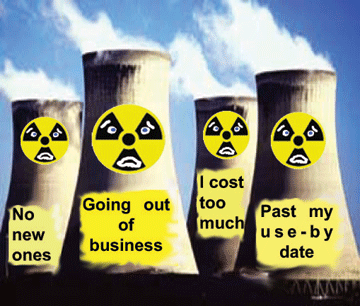 Why Bernie and Hillary Must Address America’s Dying Nuke Reactors http://ecowatch.com/2015/10/03/sanders-clinton-nuclear-power/ Harvey Wasserman | October 3, 2015 As the first Democrat presidential debate finally approaches (on Oct. 13), America’s nuke power industry is in accelerated collapse.
The few remaining construction projects in the U.S. and Europe are engineering and economic disasters.
Presidential candidates Hillary Clinton and Bernie Sanders may address this in broad terms. But as a nation we must now focus on the 99 dying U.S. reactors that threaten us all every day. In terms of our national survival, this is what Sanders and Clinton really must discuss.
In the biggest picture, Fukushima and Germany‘s transition to renewables have escalated the energy debate to a whole new level.
Fukushima still dumps huge quantities of radioactive water into the Pacific every day. The site is out of control. The myth that U.S.-made reactors can’t explode has been buried forever. Three melted cores are still missing. Especially among young children, health impacts in the region are devastating. Two dozen General Electric clones of Fukushima Unit 1 now operate in the U.S. They all need to shut.
Meanwhile the extreme success of Germany’s Solartopian Energiewende makes it clear the world can indeed run entirely on renewables. The central electric grid is no longer sustainable. All German nukes will be done by 2022. Germany’s great green community-based assault on King CONG (coal, oil, nukes and gas) is ahead of schedule and under budget. Clean energy prices are plummeting along with climate impacts.
Worldwide reactor construction has sunk into economic chaos. Russia, China, India and several smaller countries are still talking about building new reactors. This is an issue of grave concern for all of us.
But the radioactive road signs bode badly for them all.
France’s Areva, once the industry flagship, is in shambles. Reactor projects in Finland and at Flamanville, France, are billions over budget and years behind schedule. So are the two each in South Carolina and Georgia, where the local economies stand to be devastated by gargantuan cost overruns. Detroit Edison wants to stick the people of Michigan with the enormous up-front costs of a proposed new construction fiasco at Fermi 3, which could bankrupt an already shaky state economy.
It will take years more of dedicated activism to make sure the lessons of these failed projects are understood everywhere.
But in the meantime, above all, we fear the 99 U.S. reactors that crumble as we speak:
1. The infamously lax Nuclear Regulatory Commission (NRC) warns that Pilgrim, south of Boston, can’t meet even the NRC’s absurdly loose safety standards. Entergy may shut it down rather than pay to fix it up. The two candidates should demand they do it now.
2. Indian Point Unit 2, near New York City, has been operating without a license. The Unit 3 permit expires in December. Both must shut immediately.
3. The shield building at Ohio’s Davis-Besse is literally crumbling. FirstEnergy wants Ohio’s Public Utilities Commission to hand it a $3 billion bailout. This may be the world’s most decrepit nuke. It should have shut a very long time ago.
4. Exelon is begging the Illinois legislature for massive bailouts at five money-losing, increasingly dangerous reactors. That should be denied.
5. Entergy’s FitzPatrick in New York is losing millions, as is nearby Ginna. Both must go.
6. California’s Diablo Canyon reactors sit atop an interconnected web of 12 known fault-lines. They are 45 miles from the San Andreas, less than half the distance of Fukushima from the seismic trench that destroyed it. They are in violation of state and federal water quality laws. They’re being propped up by a corrupt Public Utilities Commission. They need to close.
… and that’s just for starters.
Through the rest of this presidential campaign, we can expect the Democrats to broadly endorse a green-powered future, and question the sanity of nuke power.
Thanks to decades of hard campaigning by the global grassroots No Nukes movement, that’s no longer hard to do. Even Donald Trump has made rumblings about shutting Indian Point. Even Ohio’s Gov. John Kasich is posturing as a friend of renewables, an industry he’s done his best to decimate.
What we really need now are focused, persistent campaigns to bring these rogue nukes down before they blow up. Every one of them has the power to kill millions, irradiate entire sections of the globe and bankrupt us all.
In the big picture, Clinton and Sanders could start with a demand to remove the federal insurance that protects these radioactive relics from liability when the inevitable melt-downs arrive.
But they can help us most by addressing these dying nukes by name, and by joining us in court and on the barricades to get them buried before they kill again.
1 This Month


31st January – Challenging the War Machine – a DECLASSIFIED UK SUMMIT


Website of the Week
Now until to February 10, 2026 Radioactive waste storage in France: the debate is finally open! How to participate?
-
Archives
- January 2026 (227)
- December 2025 (358)
- November 2025 (359)
- October 2025 (377)
- September 2025 (258)
- August 2025 (319)
- July 2025 (230)
- June 2025 (348)
- May 2025 (261)
- April 2025 (305)
- March 2025 (319)
- February 2025 (234)
-
Categories
- 1
- 1 NUCLEAR ISSUES
- business and costs
- climate change
- culture and arts
- ENERGY
- environment
- health
- history
- indigenous issues
- Legal
- marketing of nuclear
- media
- opposition to nuclear
- PERSONAL STORIES
- politics
- politics international
- Religion and ethics
- safety
- secrets,lies and civil liberties
- spinbuster
- technology
- Uranium
- wastes
- weapons and war
- Women
- 2 WORLD
- ACTION
- AFRICA
- Atrocities
- AUSTRALIA
- Christina's notes
- Christina's themes
- culture and arts
- Events
- Fuk 2022
- Fuk 2023
- Fukushima 2017
- Fukushima 2018
- fukushima 2019
- Fukushima 2020
- Fukushima 2021
- general
- global warming
- Humour (God we need it)
- Nuclear
- RARE EARTHS
- Reference
- resources – print
- Resources -audiovicual
- Weekly Newsletter
- World
- World Nuclear
- YouTube
-
RSS
Entries RSS
Comments RSS
 nuclear-news