Greenland refuses to allow exploitation for uranium
Energy Transition Minerals, formerly Greenland Minerals A/S, has been
informed by Naalakkersuisut that their application for an exploitation
permit in Kuannersuisut has been refused. The ministry announced this in a
short press release on Friday afternoon. Energy Transition Minerals has
applied for permission for exploitation at Kuannersuit in Narsaq,
targeting, among other things, rare earths, zinc and uranium.
Sermitsiaq 2nd June 2023
EDITORIAL: Government turns a blind eye to lessons from nuclear disaster

https://www.asahi.com/ajw/articles/14923055 June 2, 2023
It appears that the lessons learned from the 2011 Fukushima nuclear disaster have been taken so lightly.
The government and a majority of the Diet are heavily responsible for pushing through a reversal of the nation’s nuclear policies without careful deliberation, shifting from a “reduction of dependence” on nuclear power and heading to its “maximum utilization.”
We must keep asking ourselves whether we can solve the many difficult problems plaguing nuclear power plants and whether they could end up haunting future generations.
This week, a bill related to promoting nuclear plants was passed by the Diet.
The government’s responsibilities and measures aimed at the active utilization are stipulated in the Atomic Energy Basic Law.
The new law also relaxed restrictions on nuclear reactors’ operational periods introduced after the catastrophic disaster at the Fukushima No. 1 nuclear power plant, opening a path to allowing reactors to operate beyond 60 years if certain conditions are met.
The Asahi Shimbun in its editorials has opposed the bill and called for its reconsideration.
That is because nuclear plants are plagued with a mountain of issues such as the ever-growing nuclear waste and Japan’s nuclear fuel cycle that has reached an impasse, not to mention safety and economic concerns.
And it is unacceptable for the government to reverse its stance to restarting nuclear plants without showing a path to solving the problems.
Now is the time to speed up reforms to make renewable energy a primary power source from the standpoint of the overall energy policy.
Returning to dependence on nuclear plants could lead to going down the wrong path.
The bill was also rushed along as the government adopted the new policy last year after only several months of debate.
The Diet was supposed to do everything in its power to scrutinize the bill from multiple perspectives, but no deep discussions ensued.
We can’t help but be disappointed.
Reasons cited for the about-face were the need for a stable supply of energy and the decarbonization of energy sources.
But how much of a role do nuclear plants actually play in these goals? And why is it necessary to treat them differently?
The government shied away from answering these questions head-on and repeatedly said it was important to pursue all possible options, including nuclear energy.
With several bills covering a variety of issues bundled into the legislation, discussions on concrete measures also wandered off-track.
It had been explained that the limit on the reactors’ operational periods was originally intended to reduce safety risks.
But the government claimed that it decided from the standpoint of the nation’s energy strategy, instead of safety regulations.
Although it was a major shift, the government failed to provide convincing explanations.
After all, numerous questions, including fundamental problems, were left unanswered.
If this stance continues, it will be inevitable for the government to single-mindedly devote itself to the promotion of its new polices on nuclear plants.
The latest policy shift was led by the economy ministry, seriously undermining the principle of separation between “promotion and regulation,” which is the heart of the nuclear policy introduced in light of the Fukushima disaster.
The government seems set to support the restart of nuclear plants and construction of new ones.
However, at the very least, safety procedures and economic benefits of nuclear plants must be thoroughly considered.
And, no matter how many efforts are made, inconvenient realities about nuclear plants won’t disappear.
The government and party members who voted for the bill must keep firmly in mind that they will have to face these realities sooner or later.
Unlimited money to Ukraine is now allowed, through USA’s “Debt Sealing” arrangement.

Debt Ceiling Deal Puts No Limits on Ukraine Aid https://scheerpost.com/2023/06/02/debt-ceiling-deal-puts-no-limits-on-ukraine-aid/
Emergency spending that has been used to arm Ukraine is exempt and it could also be used to arm Taiwan
June 2, 2023, By Dave DeCamp / Antiwar.com
The debt ceiling agreement reached between the White House and House Republicans places no constraints on spending on the war in Ukraine, a White House official told Bloomberg.
The $113 billion that has been authorized to spend on the war in Ukraine so far was passed as supplemental emergency funds, which is exempt from the spending caps that are part of the debt ceiling deal.
According to the Congressional Budget Office, funding “designated as an emergency requirement or for overseas contingency operations would not be constrained, and certain other funding would not be subject to the caps.” The deal suspends the nation’s debt limit through January 1, 2025.
Hawks in Congress are looking to use emergency spending to increase the $886 billion military budget that was agreed to as part of the deal. The emergency funds could go beyond Ukraine and might be used to send weapons to Taiwan or for other spending that hawks favor as part of their strategy against China.
“We are almost certainly going to need a supplemental for Ukraine, which is, in my view, one of the most pressing defense challenges we have right now,” said Sen. Richard Blumenthal (D-CT), according to Roll Call. “And the other obligations flow from China and Taiwan on one hand and Russia and Ukraine on the other.”
Other senators said they favor using the emergency funding to raise military spending altogether. The $886 billion budget is what President Biden asked for 2024, but Republican hawks have blasted the request as “inadequate.”
“Clearly our support for Ukraine will be outside the budget, as it has been in the past, but I’d like to see additional support for our own military in emergency supplementals as well,” said Sen. Mitt Romney (R-UT).
The Senate passed the agreement, known as the Fiscal Responsibility Act of 2023, on Thursday night in a vote of 63-36, sending the bill to President Biden’s desk. The legislation was passed through the House on Wednesday in a vote of 314-117.
France, Germany Dispute Over Nuclear Energy Leaves EU Deadlocked on Renewables

- Paris wants to win greater role for nuclear in energy revamp
- Disputed law on clean energy is key element of EU Green Deal
Bloomberg ,By Ewa Krukowska, Ania Nussbaum and, Petra Sorge, 3 June 2023
France is seeking to reopen negotiations over a key Green Deal law in an effort to ensure a greater role for nuclear in Europe’s energy transition, a move fiercely opposed by Germany, leaving the talks in deadlock.
The government in Paris has informed Sweden, which holds the EU’s rotating presidency, that it’s seeking changes to an agreement already brokered with other EU entities, according to officials with knowledge of the matter. Such a step would require revisiting talks with the bloc’s parliament and the European Commission ………………………….. (Subscribers only) https://www.bloomberg.com/news/articles/2023-06-02/eu-in-deadlock-over-renewables-as-france-and-germany-lock-horns#xj4y7vzkg
Bill to extend operating period of nuclear plants passes Japan’s Upper House
BY GABRIELE NINIVAGGI, Japan Times, May 31, 2023
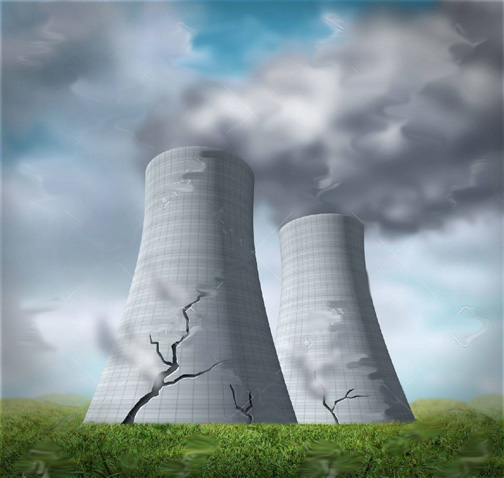
A bill to extend the operating period of nuclear power plants to over 60 years — providing safety conditions are met — passed the Upper House on Wednesday, paving the way for a comprehensive overhaul of Japan’s nuclear policy.
The ruling coalition led by the Liberal Democratic Party, with the external support of two opposition parties — the Democratic Party for the People and Nippon Ishin no Kai — voted in favor of the bill, while other opposition forces on the left and center-left vocally opposed the legislation, saying that proposals to guarantee the safety of nuclear power plants were insufficient………..(Subscribers only) https://www.japantimes.co.jp/news/2023/05/31/national/nuclear-plant-operating-period-bill-pass/
1
Government’s nuclear-free policy remains unchanged: Cabinet
05/29/2023, Focus Taiwan, By Chen Chun-hua, Kuo Chien-shen, Wang Yang-yu, Wang Cheng-chung, Liu Chien-ling and Evelyn Kao
Taipei, May 29 (CNA) The government’s policy of creating a “nuclear-free homeland” has not changed, and there is no consideration of extending the service of Taiwan’s nuclear power plants, Cabinet spokesman Lin Tze-luen (林子倫) said Monday.
Lin was responding to comments by Vice President and Democratic Progressive Party (DPP) presidential candidate Lai Ching-te (賴清德) that Taiwan’s nuclear reactors might be reactivated in an emergency situation, seemingly contradicting the DPP’s policy.
Lin said in a post to reporters that the Ministry of Economic Affairs and Taiwan Power Co. (Taipower) are carrying out the phasing out of Taiwan’s nuclear plants in line with the original plans and are not considering extending their lifespan……
Taiwan currently has only one nuclear power plant still producing power, the third nuclear power plant near the southern tip of the island. It is scheduled to be shut down by 2025 and be decommissioned.
The first and second nuclear plants along Taiwan’s northern coast have started their decommissioning processes. The fourth nuclear plant in Gongliao in northeastern Taiwan was nearly completed but never operated, and the DPP government shipped away its unused fuel rods……………………………………….more https://focustaiwan.tw/politics/202305290012
Israel’s New Minister for Nuclear Absurdity
Yossi Melman, HAARETZ, 28 May 23
Shortly after the cabinet approves David Amsalem’s appointment as minister in charge of the Israel Atomic Energy Commission, which will happen soon, he’ll head south to visit the Shimon Peres Negev Nuclear Research Center in Dimona.
Amsalem will be accompanied by Dr. Gil Dagan, the research center’s director, and Moshe Edri, the IAEC’s director general. They will go down a few floors, to an underground level, and arrive at the “Golda Balcony.”
Based on what nuclear whistleblower Mordechai Vanunu told the Sunday Times in 1986, this balcony is located two floors below ground level, in the research center’s Building 2. From it, senior Israeli officials can observe the center’s production facilities, which are commonly known as the Dimona nuclear reactor. Ever since Prime Minister Golda Meir visited the reactor roughly half a century ago, reactor workers have called this observation platform the Golda Balcony.
Last week, Prime Minister Benjamin Netanyahu decided to appease and flatter Amsalem, who is constantly angry and bitter, by appointing him as minister in charge of the Holy of Holies of Israeli security.
………………………………….. It’s impossible to understand Netanyahu’s decision to appoint one of his most loquacious, loudmouthed and irritable ministers to Israel’s most sensitive position, thereby making him privy to the country’s most classified secrets. Dealing with Israel’s nuclear program requires someone with very fine tuning, who walks on tiptoe and scrupulously maintains maximum secrecy. All these are traits seemingly far beyond Amsalem’s ability. He acts like a bull in a china shop.
………………..Way back in 1952, Ben-Gurion set up the IAEC and put chemistry professor Ernst David Bergmann in charge of it. Bergmann is considered the father of Israel’s nuclear program, which, according to foreign reports, is primarily a military nuclear program.
………………..According to foreign reports, in 1966, Israel became the sixth country in the world to acquire nuclear weapons, following the five big powers. It did so thanks to France, which provided it with a nuclear reactor, the equipment needed to run it and the uranium needed to fuel it between 1958 and 1962.
According to those reports, Israel has at least several dozen nuclear bombs based on both uranium and plutonium, as well as planes, missiles and submarines capable of launching them. Israel, which initially agreed to sign the Nuclear Non-Proliferation Treaty but later backtracked on this promise, also refuses to allow international supervision of the Dimona reactor.
………………… Other agencies include the air force, whose planes, according to foreign reports, are supposed to carry the bombs, and the navy, whose submarines can also be armed with missiles carrying nuclear warheads.
Foreign reports about Israel’s nuclear program also describe a facility called Kanaf 2, located west of Beit Shemesh, where Jericho surface-to-surface missiles armed with nuclear warheads are stored deep underground.
Amsalem, in his usual offensive language, called demonstrators against the government’s planned legal overhaul “anarchists.” These “anarchists” include reservist pilots and submariners, reservists from the air force’s special operations unit, and scientists from Rafael and the Dimona reactor who are responsible for Israel’s nuclear program. Now, when there’s no limit to absurdity, at least the official kind, he will be the minister in charge of them.
Clearly, ultimate responsibility was and remains in Netanyahu’s hands, and the powers he has granted his irascible minister are limited. Netanyahu, Defense Minister Yoav Gallant, Israel Defense Forces Chief of Staff Herzl Halevi and everyone else privy to the secrets of Israel’s nuclear program will continue running it in practice.
Nevertheless, Amsalem’s addition to the elite circle of people in the know sends a symbolic message:…………………. https://www.haaretz.com/opinion/2023-05-28/ty-article-opinion/.premium/this-is-israels-new-minister-for-atomic-absurdity/00000188-638e-dde3-abf9-fb8fa1570000
Australian Prime Minister Albanese refuses to meet with Assange’s wife
Oscar Grenfell@Oscar_Grenfell, 22 May 2023, WSWS,
Asked by independent MP Andrew Wilkie why he would not meet with Mrs Assange, Albanese brushed aside the question, declaring: “Who I meet with is determined by the priorities that my office has.”
Over the past month, Albanese has met with a multitude of business tycoons. He attended the wedding of right-wing radio shock jock Kyle Sandilands, alongside a convicted drug dealer and reputed crime boss. Most recently, Albanese fawned over US President Joe Biden in Tokyo on the weekend. Biden is overseeing the attempt to extradite Assange from Britain, and imprison him for 175 years for exposing American war crimes.
Albanese proclaimed in parliament, he was not interested in meeting Assange’s wife, which he said would be akin to a “demonstration” and “grandstanding.” Albanese sought to dress up the refusal by reiterating vague comments that “enough is enough” in relation to the Assange case, and he cannot see that anything is served by the WikiLeaks founder’s continued incarceration.
While Albanese claims he has made this position clear to the US administration, there is no evidence of that, including in extensive correspondence obtained under freedom of information requests between various American and Australian government bodies. Labor continues to give carte blanche to the very administration seeking Assange’s destruction.
The obvious question is: if Albanese won’t even meet with Assange’s wife, a basic act of respect and courtesy that he has extended to thousands of others over the course of his year in office, why would anyone think the prime minister is waging a fight for the imprisoned Australian journalist’s freedom behind closed doors?
As part of her visit to Australia, Stella Assange yesterday addressed the National Press Club in Canberra.
The speech was a powerful plea for Assange’s freedom, an exposure of the draconian conditions under which he is detained in Britain’s maximum-security Belmarsh Prison and a clear outline of the fundamental issues of democratic rights at stake in the attempted prosecution of her husband.
Stella noted a groundswell of support for Assange. She stated: “I would like to thank the overwhelming dedication of the Australian people, who have brought about a sea change in awareness and solidarity for Julian’s plight. This unity in support for my husband is a source of enormous encouragement for our family. It nurtures Julian’s ability to continue on.”
She added: “The reality is that to regain his freedom, Julian needs the support of his home country. This is a political case, and it needs a political solution.”
In discussing her presence in Australia, and also what she speaks about with her husband, Stella stressed Assange’s connection to Australia. He had been raised in the country, and had shared his extensive memories, from surfing in Byron Bay, to beekeeping in Melbourne’s Dandenong Ranges and riding a horse in the New South Wales Northern Rivers.
“That’s how I imagine Julian when he is free,” she said………………………..
Stella outlined the draconian security procedures required for her and her two children to visit their father. They had to pass innumerable checkpoints, searches and scans for their visits. The children had only ever seen their father in the inhospitable prison visiting room. For the elder of the two, now six years old, “Prisons feature in his dreams and his nightmares.”
Turning to the case, Stella stated: “A 175 year sentence is a living death sentence. A prospect so desperate that the English court found that it would drive him to take his own life, rather than live forever in hell. We must do everything we can to ensure that Julian never, ever, sets foot in a US prison. Extradition in this case is a matter of life and death.”
She explained: “For most people, Julian is a symbol. A symbol of staggering injustice, because he is in prison on trumped up charges for exposing the crimes of others. A symbol because he faces a bewildering 175 year sentence for publishing the truth. A symbol of a sophisticated form of state violence dressed up in complexity and indirection that not even Franz Kafka could have imagined.
“For the press and the public, Julian’s case is the most brutal attack on press freedom that the Western world has seen in the last 70 years. A foreign government is using the political offences in its statute books to indict a foreign national abroad, because of what he or she published in a different country.
“Accurate, damning publications exposing their war crimes. If sovereignty is to mean anything, if jurisdiction is a proper legal and political reality, the case against Julian cannot be understood as anything other than an absurdity.”
Despite the dire threat to press freedom, the address was largely subjected to a media boycott. Only a handful of nationally-recognised journalists attended. Several prominent publications sent junior staff, fresh out of university, armed only with arrogance and obnoxious questions based on the slanders that have been used to attack Assange.
The shameful display underscored the fact that broad sections of the official media function as nothing more than state propagandists. While they are cheering on each new step in Australia’s integration into the US preparations for war with China, this corrupted layer is hostile to a genuine journalist who exposed war crimes………………………………………. https://www.wsws.org/en/articles/2023/05/23/gavm-m23.html?fbclid=IwAR180uIICBGtiZ8Fb3gyk6bwi2YScNh7OxnAQDK0979TWB0XNzNFuUBpSso
New Zealand won’t give up its nuclear-free stance, says Prime Minister Chris Hipkins
Mark Quinlivan, 23 May 23, https://www.newshub.co.nz/home/politics/2023/05/new-zealand-won-t-give-up-its-nuclear-free-stance-says-prime-minister-chris-hipkins.html
“New Zealand’s nuclear-free position is long-standing and it’s not going to change.”
Chris Hipkins is refusing to budge on New Zealand’s nuclear-free status and says there are still no plans for Aotearoa to join a non-nuclear arm of a US-led defence alliance.
The Prime Minister appeared on AM on Tuesday, having just returned from a trip to Papua New Guinea to meet with US Secretary of State Antony Blinken and Pacific leaders.
“I was pretty clear [with Blinken]; New Zealand’s nuclear-free position is long-standing and it’s not going to change,” he told host Ryan Bridge.
Hipkins noted that position would prevent New Zealand from “ever” being directly involved in a defence alliance between Australia, the UK and the US – known as AUKUS.
“The US is still committed to a security relationship with New Zealand regardless of our nuclear-free status – I think that’s a good thing.”
Hipkins would not be drawn on even considering the possibility of allowing US nuclear submarines into New Zealand waters.
“We don’t allow those in New Zealand waters and that’s not going to change,” he said. “Many other Pacific nations have similar concerns.”
Bridge asked Hipkins what New Zealand’s specific concerns were.
The Prime Minister said New Zealand was “concerned about nuclear energy… because of the environmental impact of it, and the potential for environmental disaster”.
As for New Zealand joining a second, nuclear-free tier of AUKUS, Hipkins reiterated it remained unclear how that would work.
It comes after Defence Minister Andrew Little earlier this year confirmed Washington had raised the possibility of New Zealand becoming a non-nuclear partner of the alliance.
Rishi Sunak ‘turns his back’ on UK’s nuclear test veterans a year after pledging support
The Prime Minister has refused to look at their evidence of a criminal cover-up within the Ministry of Defence, less than a year after pledging his support for a police investigation
By Susie Boniface, 22 May 2023 https://www.mirror.co.uk/news/politics/rishi-sunak-turns-back-veterans-30046288
It comes after the G7 summit in Japan when the PM visited a memorial honouring the 200,000 who died at Hiroshima and Nagasaki in 1945, the event that triggered Britain’s own atomic experiments.
Campaigner Alan Owen, whose father died after witnessing 24 nuclear bombs in just 78 days, said: “He was happy to take the headlines for getting us a medal, but now he’s turned his back on 22,000 men who suffered and died for the nuclear deterrent that he’s relying on to keep us safe from Vladimir Putin.”
Nuke veterans have waited 70 years for official recognition, and since the weapons trials have suffered a legacy of cancers, miscarriages, and birth defects in their children.
Sunak delivered them a medal just a month after taking office.
During the Tory leadership campaign last summer, a spokesman for Sunak told the Mirror: “Rishi supports the campaign for nuclear veterans to be recognised for their service.
“We are incredibly grateful for our nuclear veterans’ sacrifice which kept Britain safe during the Cold War… He would also back an investigation into whether the tests represented a criminal offence towards these veterans.”
After making the medal announcement at the National Memorial Arboretum last November, he briefly met Laura Morris, of Salford, whose grandfather John witnessed several H-bombs in 1958, later lost his son Steven to cot death, and developed pernicious anaemia before being refused a war pension.
He had multiple blood tests during the trials, but the results are not in his medical file.
Parliament has been told all such records are at the Atomic Weapons Establishment in “scientific data”, but veterans, widows, and next-of-kin have been refused access. Withholding or falsifying medical records is a crime. Laura asked the PM to meet and discuss it, and he told her he would.
Her MP, Labour’s Rebecca Long-Bailey, said: “It’s frankly soul-destroying that the PM made a promise in person to my constituent but now fails to keep his word. It has taken six months to decide that he just can’t find the time.”
“In the Tory leadership contest he promised he’d support a criminal investigation, and now he won’t meet us so we can show him the evidence,” she said.
“It’s appalling that after what these veterans have suffered, and I truly hope he changes his mind, and meets them as promised.”
In a letter to Laura, Sunak said the “extraordinary sacrifice” of veterans had been overlooked “for too long” and he had been “delighted” to announce the medal.
He added: “The significance and poignancy of the announcement was not lost on me.
“I was greatly moved to meet and speak with the veterans during the event, including your grandfather… I want to thank him, not only for his years of service and campaigning, but also for bravely sharing his experiences with others.
“Unfortunately due to diary pressures, I am currently unable to meet you.
Robert F Kennedy’s Peace Platform – BRING IT HOME
In the long term, a nation’s strength does not come from its armies. America spends as much on weaponry as the next nine nations combined, yet the country has grown weaker, not stronger, over the last 30 years. Even as its military technology has reigned supreme, America has been hollowing out from the inside. We cannot be a strong or secure nation when our infrastructure, industry, society, and economy are infirm.
A high priority of a Kennedy administration will be to make America strong again. When a body is sick, it withdraws its energy from the extremities in order to nourish the vital organs. It is time to end the imperial project and attend to all that has been neglected: the crumbling cities, the antiquated railways, the failing water systems, the decaying infrastructure, the ailing economy. Annual defense-related spending is close to one trillion dollars. We maintain 800 military bases around the world. The peace dividend that was supposed to come after the Berlin Wall fell was never redeemed. Now we have another chance.
As President, Robert F. Kennedy, Jr. will start the process of unwinding empire. We will bring the troops home. We will stop racking up unpayable debt to fight one war after another. The military will return to its proper role of defending our country. We will end the proxy wars, bombing campaigns, covert operations, coups, paramilitaries, and everything else that has become so normal most people don’t know it’s happening. But it is happening, a constant drain on our strength. It’s time to come home and restore this country.
In Ukraine, the most important priority is to end the suffering of the Ukrainian people, victims of a brutal Russian invasion, and also victims of American geopolitical machinations going back at least to 2014. We must first get clear: Is our mission to help the brave Ukrainians defend their sovereignty? Or is it to use Ukraine as a pawn to weaken Russia? Robert F. Kennedy will choose the first. He will find a diplomatic solution that brings peace to Ukraine and brings our resources back where they belong. We will offer to withdraw our troops and nuclear-capable missiles from Russia’s borders. Russia will withdraw its troops from Ukraine and guarantee its freedom and independence. UN peacekeepers will guarantee peace to the Russian-speaking eastern regions. We will put an end to this war. We will put an end to the suffering of the Ukranian people. That will be the start of a broader program of demilitarization of all countries.
We have to stop seeing the world in terms of enemies and adversaries. As John Quincy Adams wrote, “Americans go not abroad in search of monsters to destroy.” Robert F. Kennedy will revive a lost thread of American foreign policy thinking, the one championed by his uncle, John F. Kennedy who, over his 1000 days in office, had become a firm anti-imperialist. He wanted to exit Vietnam. He defied the Joint Chiefs of Staff and refused to bomb Cuba, thus saving us from nuclear Armageddon. He wanted to reverse the imperialistic policies of Truman and Eisenhower, rein in the CIA, and support freedom movements around the world. He wanted to revive Roosevelt’s impulse to dissolve the British empire rather than take it over.
John F. Kennedy’s vision was tragically cut short by an assassin’s bullet. But now we have another chance. The country is ailing, yes, but underneath there is vitality still. America is a land rich in resources, creativity, and intelligence. We just need to get serious about healing our society, to become strong again from the inside.
America was once an inspiration to the world, a beacon of freedom and democracy. Our priority will be nothing less than to restore our moral leadership. We will lead by example. When a warlike imperial nation disarms of its own accord, it sets a template for peace everywhere. It is not too late for us to voluntarily let go of empire and serve peace instead, as a strong and healthy nation.
Energy minister Andrew Bowie in visit to Suffolk projects
Energy Minister Andrew Bowie is on a fact-finding visit to Suffolk where
he found out about the job prospects at Sizewell C – but also heard the
concerns of those opposed to the project. Mr Bowie is minister of state at
the new Department for Energy and Net Zero – responsible for maintaining
the nation’s power and moving to a greener economy.
He started his visit at
Suffolk New College in Ipswich where he visited its Net Zero Skills Centre.
He and local MP Tom Hunt met with students and got to meet with some of the
people participating in their apprenticeship program. The Net Zero Skills
Centre aims to equip and train students with knowledge and experience of
sustainable technologies.
Mr Bowie later headed up the coast where he met
groups and businesses concerned about the impact of Sizewell C on the area.
Alison Downes of Stop Sizewell C said: “We welcomed Mr Bowie to Theberton
& Eastbridge Village Hall this afternoon. “We reiterated our continued
opposition to Sizewell C and our view that the East Suffolk Council
election results amount to a rejection of his Government’s energy
policies.” The meeting included Harry Young, Chair of the Suffolk Coast
Destination Management Organisation and Nick Burfield, former Policy
Director of Suffolk Chamber of Commerce. Adam Rowlands, Suffolk Area
Manager of the RSPB, was also able to join the meeting at Stop Sizewell
C’s invitation.
East Anglian Daily Times 18th May 2023
https://www.eadt.co.uk/news/23529555.energy-minister-andrew-bowie-visit-suffolk-projects/
France to speed up nuclear power deployment
By Davide Basso | EURACTIV.fr 17 May 23
A bill to speed up the construction of new nuclear reactors was approved by the French parliament on Tuesday (16 May), with the government hailing it as an environmental step forward.
Lawmakers on Tuesday validated the bill to accelerate the construction of new nuclear reactors. The compromise text struck between the National Assembly and the Senate was voted by 339 votes to 399.
MPs from the majority (Renaissance, Horizons, Modem), the independents (LIOT), the right (Les Républicains) and the extreme right (Rassemblement national) voted in favour of the text, in addition to a dozen communist MPs.
Among the opponents, the Greens, the radical left (La France insoumise) and a handful of Communists voted “against” while the Socialists abstained.
Once it comes into force, the new law will speed up the construction of new nuclear reactors by simplifying the required administrative procedures and planning documents. The Energy Transition Ministry expects future construction times to be reduced by at least two years.
In addition, a 50% cap on nuclear power’s share of France’s electricity mix was removed. The text also provides for tightening the penalties for those who illegally enter a nuclear power plant, now set at a maximum of two years imprisonment.
….. Environmental NGOs denounced “a law that is disconnected from ecological and climatic imperatives”. Greenpeace, in particular, questioned “the slowness of the construction of nuclear reactors”, as well as “the safety” and “the conflicts of water use” that are to be expected………………. https://www.euractiv.com/section/politics/news/france-to-speed-up-nuclear-power-deployment/
Poland’s Greens oppose construction of small nuclear reactor in Kraków
MAY 17, 2023 https://notesfrompoland.com/2023/05/17/polands-greens-opposes-construction-of-small-nuclear-reactor-in-krakow/
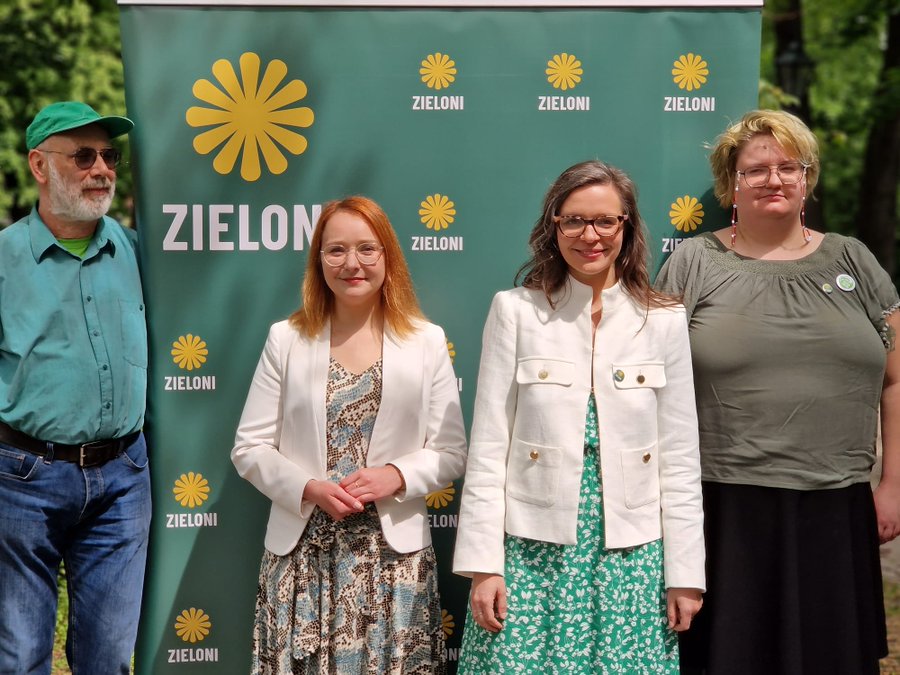
The Greens (Zieloni), who are part of Poland’s largest opposition grouping, have raised concern over the proposed construction of a nuclear small modular reactor (SMR) in Kraków.
They argue that the technology, which is still in development, is not sufficiently tested and produces large amounts of nuclear waste. They have called for investment in renewables instead.
Last month, state energy firm Orlen announced that it would by the end of this year announce 20 potential locations for the SMRs that it is developing in partnership with a group of American and Canadian corporations and with financing from US government agencies.
Of the seven potential sites unveiled already, one is in the Nowa Huta district of Kraków. Yesterday, two Green MPs, Małgorzata Tracz and Klaudia Jachira, organised a protest against those plans, saying that “no one has asked residents of Kraków for their opinion”.
Jachira noted that SMRs are still an experimental technology and “there is no evidence whether they work and what the risks are”, reports Gazeta Krakowska. Tracz cited research from Stanford University indicating that SMRs produce up to nine times more radioactive waste per unit of energy than large reactors.
The pair called for Orlen to provide more information on the costs and benefits of SMRs, to explain how waste will be managed, and to hold consultations with residents.
In response, Orlen Synthos Green Energy, which is responsible for developing the SMRs, noted that. while Nowa Huta is among the preferred locations. no final decision has been made.
“Following studies and consultations with local authorities, [we] will spend two years studying in detail the possibility of building a small nuclear unit in Nowa Huta,” said the firm. “Once the potential is confirmed, priority will be given to inviting local communities to dialogue. Only on this basis will decisions be taken.”
No more Hibakusha: Nuclear Free Local Authorities urge PM to make peace pledge at Hiroshima Summit

On the eve of a summit of G7 world leaders being hosted in Hiroshima by Prime Minister Kishida of Japan, the Chair of the UK/Ireland Nuclear Free Local Authorities has written to Rishi Sunak to urge the Prime Minister to use this unique opportunity to pledge the UK Government to work for a nuclear-weapon free world.
The Japanese port city of Hiroshima was utterly devastated by the explosion of an atomic bomb equivalent in force to 15,000 tons of the conventional high explosive TNT in the morning of the 6 August 1945. Most buildings were totally destroyed by the blast and a fireball consumed the city centre. 70,000 inhabitants died on that day, many of them high-school students, and a further 70,000 by the end of that year, being the victims of blast, heat and radiation. Prime Minister Kishida is a son of that city and a second-generation Hibakusha, A-bomb survivor, having many relatives who died as a result of the explosion; consequently he is totally opposed to nuclear weapons.
The Federation of Scientists have estimated there are approximately 12,500 nuclear weapons possessed at this time by nine states in the world(1). They are many more times powerful that the bomb which destroyed Hiroshima. An all-out nuclear war could extinguish all life on Earth.
Rishi Sunak will be the first British Prime Minister to attend a summit in that city which will be held on the weekend of 19 to 21 May. The NFLAs, being conscious that the summit is being held in the world’s first A-bombed city and at a time when the world is again faced with the possibility of the use of nuclear weapons as a consequence of the ongoing conflict in Ukraine, wrote to the Prime Minister asking him to visit the Peace Memorial Museum and the Peace Park, and to meet with the Hibakusha, the Japanese A-bomb survivors, who, despite their advanced age, continue to speak out against nuclear weapons.
In 1968, the United Kingdom was one of first signatories to the UN Nuclear Non-Proliferation Treaty (the NPT). As a nuclear weapon state, the UK pledged under Article VI to ‘pursue negotiations in good faith on effective measures relating to cessation of the nuclear arms race at an early date and to nuclear disarmament, and on a treaty on general and complete disarmament.’
Mindful of the fact that 55 years on, the UK has yet to honour these obligations as a nuclear nation, NFLA Chair, Councillor Lawrence O’Neill, also requested Prime Minister Sunak ‘use this Summit to publicly recommit this nation to these pledges and then return home to earnestly begin work to achieve them’.
The NFLAs’ sister organisation, Mayors for Peace, is based in the city after being established by Hiroshima Mayor Araki at the United Nations in 1982. Over 8,200 mayors from across the world now represent an international coalition opposed to nuclear weapons, including 101 in the UK and the Republic of Ireland. Some of these UK/Ireland members are also Nuclear Free Local Authorities. Hiroshima Mayor Matsui currently serves as President of Mayors for Peace and the Secretariat has recently issued an Open Letter to world leaders. For information, this is also reproduced below. [on original]
1 This Month
23-25 October – on Zoom – World BEYOND War’s annual global conferenc


Shut down the radiation-damaged Heysham nuclear reactors now
To see nuclear-related stories in greater depth and intensity – go to https://nuclearinformation.wordpress.com

Say No to NASA’s Reckless Nuclear Reactor on the Moon
Say No to NASA’s Reckless Nuclear Reactor on the Moon
-
Archives
- October 2026 (190)
- September 2026 (339)
- August 2026 (330)
- July 2026 (355)
- June 2026 (287)
- May 2026 (306)
- April 2026 (356)
- March 2026 (251)
- February 2026 (267)
- January 2026 (308)
- December 2025 (358)
- November 2025 (359)
-
Categories
- 1
- 1 NUCLEAR ISSUES
- business and costs
- climate change
- culture and arts
- ENERGY
- environment
- health
- history
- indigenous issues
- Legal
- marketing of nuclear
- media
- opposition to nuclear
- PERSONAL STORIES
- politics
- politics international
- Religion and ethics
- safety
- secrets,lies and civil liberties
- spinbuster
- technology
- Uranium
- wastes
- weapons and war
- Women
- 2 WORLD
- ACTION
- AFRICA
- Atrocities
- AUSTRALIA
- Christina's notes
- Christina's themes
- culture and arts
- Events
- Fuk 2022
- Fuk 2023
- Fukushima 2017
- Fukushima 2018
- fukushima 2019
- Fukushima 2020
- Fukushima 2021
- general
- global warming
- Humour (God we need it)
- Nuclear
- RARE EARTHS
- Reference
- resources – print
- Resources -audiovicual
- Weekly Newsletter
- World
- World Nuclear
- YouTube
-
RSS
Entries RSS
Comments RSS

