Cumbria set for more nuclear reactors as questions are raised over why land isn’t being used for renewable energy
Cumberland Council are set to discuss small modular reactors and nuclear
power in Cumbria. Councillor Jill Parry for Bothel and Wharrels, Green
Party will ask her question to leader of Cumberland Council Councillor Mark
Fryer, who represents St Johns and Great Clifton, Labour.
“Can the leader please ask the Solway Community Power Company for more detail of the
proposal, including an outline what investigations, surveys and other
preparatory work are needed at this very early stage, and share the
response with council? “
“Would it not be more appropriate for the council
to push that the land is used for renewable energy technologies, such as
solar, in the meantime, which could generate real-time useable electricity
for residents now and could stay in place if SMRs don’t happen?”
Lancashire Live 24th July 2023
https://www.lancs.live/news/cumbria-news/cumbria-set-more-nuclear-reactors-27375167
Iran says ready to settle remaining dispute with IAEA over nuclear program
IXinhua https://www.chinadaily.com.cn/a/202307/27/WS64c15113a31035260b818ab4.html 2023-07-27
TEHRAN – Iran’s nuclear chief said on Wednesday the country is determined to close a remaining case of outstanding differences with the International Atomic Energy Agency (IAEA) regarding its nuclear program, according to the Iranian Students’ News Agency.
Speaking to reporters on the sidelines of a cabinet meeting in the Iranian capital Tehran on Wednesday, President of the Atomic Energy Organization of Iran (AEOI) Mohammad Eslami said the country has sent a “comprehensive and written” response to the IAEA regarding the two remaining “undeclared sites,” in which the agency claims to have found “traces of uranium.”
If the agency does not accept the response and has any uncertainty or doubt regarding the issue, Iran will provide further explanation and review the documents, he added.
The AEOI chief said his organization is enriching uranium according to the level stipulated in a 2020 law passed by the Iranian parliament to counter the U.S. sanctions.
He added Iran’s “relations with the agency are based on the agreement reached with IAEA Director General Rafael Grossi during his visit to Tehran in March as well as the safeguards agreements and the Non-Proliferation Treaty and we are implementing what we have agreed to do.”
He noted that Iran and the IAEA are in “constant and sustainable” interactions with each other.
Faced with international sanctions, the country signed a nuclear deal, formally known as the Joint Comprehensive Plan of Action (JCPOA), with world powers in July 2015, agreeing to put some curbs on its nuclear program in return for the removal of the sanctions on the country. The United States, however, pulled out of the deal in May 2018 and reimposed its unilateral sanctions on Iran, prompting the latter to drop some of its nuclear commitments according to the law passed by its parliament in December 2020.
The Iranian parliament’s law mandated the government to restrict inspections of Iran’s nuclear facilities by the IAEA and accelerate the development of the country’s nuclear program beyond the limits set under the JCPOA.
The talks on the JCPOA’s revival began in April 2021 in Vienna. No breakthrough has been achieved after the latest round of talks in August 2022.
UK govt to pour another £170million of taxpayers’ cash into planned Sizewell C nuclear plant: is it value for money?
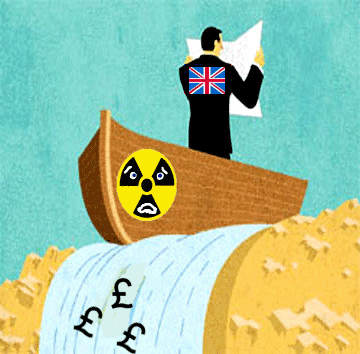
The government is to plough another £170million of taxpayers’ cash into the
proposed Sizewell C nuclear plant. The Department for Energy Security and
Net Zero said the cash was in addition to the £679 million the government
invested in the Suffolk power station late last year, when it took joint
control of the project with EDF, of France.
Last year’s investment included about £100 million to buy China General Nuclear out of its 20 per cent stake. EDF said: “This is another big endorsement and will put us in an
even stronger position to begin full construction.” The government said
the money would be used “to prepare the Sizewell C site for future
construction, procure key components from the project’s supply chain and
expand its workforce”. It said it was “previously allocated funding for
development work”.
The government pledged in the budget in 2021 to
provide up to £1.7 billion “to enable a final investment decision in a
large-scale nuclear project this parliament”.
Stop Sizewell C, a campaign group, said: “It sticks in the throat to see ministers splashing more taxpayers’ cash months before a final investment decision, while maintaining total secrecy about whether Sizewell C can achieve value for money.”
Times 25th July 2023
https://www.thetimes.co.uk/article/cash-boost-for-construction-of-sizewell-c-nuclear-plant-rg6rr5slv
Ontario opts for high-risk nuclear over low-risk energy sources
Rather than increasing energy efficiency and productivity and reducing the need for new energy resources, the province has chosen nuclear expansion.
The Star, By Mark Winfield , Friday, July 21, 2023
The consequences of these decisions for Ontario electricity ratepayers and taxpayers are likely to stretch far into the future. No cost estimates are available for the proposed nuclear projects. The bids submitted as part of the province’s last attempt at a new-build nuclear project would optimistically suggest costs in the range of $50 billion for the Bruce project alone. The costs of the four smaller reactors proposed for Darlington remain unknown, given that none of the proposed type of reactor have ever been built or operated before anywhere in the world.
………………………………………. private capital has been hesitant to engage with nuclear projects, and progress on a much-touted nuclear “renaissance” in Europe and North America has been slow. This has been despite aggressive efforts by governments to guarantee returns on investment and assume ultimate liability for waste management, decommissioning costs and accidents. It is no surprise that the only significant investor in the first of the proposed new “small” reactors at Darlington was the federal government’s own Infrastructure Bank.
A rational planning process around electricity and decarbonization would have prioritized the options with the lowest economic, environmental, technological and safety risks first. Higher risk options, like new nuclear, should only be considered where it can be demonstrated that the lower-risk options have been fully optimized and developed in the planning process.
…………………………….. The good news is that the province’s announcements remain at a preliminary stage — key technical approvals for new build reactor projects will still be needed and their economics remain very open questions. There may still be time for Ontario to move toward a more rational, open, and evidence-based approach to energy planning and decarbonization. But nuclear proponents will be doing everything they can to lock in the government’s choices as quickly as possible. https://www.thestar.com/opinion/contributors/ontario-opts-for-high-risk-nuclear-over-low-risk-energy-sources/article_49afb2a3-7cca-5dee-bc2b-5d57eef76a75.html
Tory nuclear expansion programme

Renew Extra Weekly, 22 July 23
“…..a bit delayed, the secretary of state for energy security and net zero, Grant Shapps, has officially launched Great British Nuclear (GBN), the new ‘arm’s-length’ government agency that is meant drive the delivery of new nuclear energy projects- especially small modular reactors (SMRs). The press release was very up tempo…………………………………………
………talk of a ‘massive revival’ of UK nuclear may be a bit premature. In all about £233m has been allocated to new SMR work so far, plus £700m for the big Sizewell C., and it’s far from clear whether either of these options, big or small, will get the go ahead. Funding Sizewell C will not be easy, according to a review in Nuclear Engineering International, with few investors coming forward, and a review of SMR options concluded that ‘none of the tested concepts is able to compete economically with existing renewable technologies’.
Nevertheless, a tender for procurement contracts for SMRs has been launched which states that between one and four awards could be made for grant funding, and, ultimately, up to £20bn spent on developing designs and funding construction. However, that’s all a bit speculative. ……………………………the £20bn will mostly presumably involve GBN seeking partnerships with private sector companies and private finance. Shapps stressed that this was ‘not a spending commitment’ by government.
……… It will in any case take a while for GBN to get fully established, at present it hardly exists, and even longer for SMRs to exist- the Guardian noted that, in relation to the SMR competition, ‘a final decision on each project will not occur before 2029’.
……..the Rolls Royce isalso not exactly a small reactor. At 470MW, it is actually larger than unit 1 at Fukushima and most of the old UK Magnox reactors.
…………………………..chided by Labour, with Shadow energy minister Alan Whitehead saying ‘it’s shambolic that after 13 years of Tory government, not one of the 10 nuclear sites approved by the last Labour government have been built,’ the UK does now have an ambitious nuclear programme, at least on paper, with a commitment to build a massive 24GW of nuclear capacity, the equivalent of a quarter of total generating capacity, by 2050. But, as I have indicated, it is far from clear if it can be achieved, especially given the low cost of renewables.
……………………….Leaving aside the cost issue and the still unresolved issue of long term radioactive waste disposal, nuclear enthusiasts do sometimes claim that we will need nuclear to back up variable renewables. However, there are cheaper ways to do that, including advanced batteries,………………………….
Given options like these, the whole idea of needing ‘baseload plants’ has become redundant. Certainly building new large inflexible nuclear plants for backup would be very expensive and inefficient, and we have no idea if SMRs would be any better. ………………………………………………….. more https://renewextraweekly.blogspot.com/2023/07/tory-nuclear-expansion-programme.html
Is the UK Government unable to fund its promised nuclear renaissance?
- “Great British Nuclear has no legal basis – the Energy Bill has been delayed till the autumn, so it can’t do anything legally.
- “Great British Nuclear has no budget, so it can’t buy anything or commission anything.
- “Great British Nuclear has no premises.
- “Great British Nuclear has no paid staff.”
Great British Nuclear officially launched, sparks funding doubts.
Electrical Review 18th July 2023
“………………… So we’ve heard that Great British Nuclear has high hopes to kickstart a renaissance period for nuclear power in the UK, but how does it plan on achieving that? Well, thanks to the official launch, we now have more concrete information as to what the body plans to do.
The UK Government has officially launched Great British Nuclear, a new Government agency that is designed to support the growth of nuclear energy in the UK.
The official launch of Great British Nuclear was initially tipped for July 13, although the launch was pushed back due to “unforeseen circumstances.” Despite the delayed start, the Government has high hopes for the new department, with it hoping to create a renaissance for nuclear energy in the UK.
One of Great British Nuclear’s first acts will be to kickstart a competition for small modular reactor (SMR) technology, which it believes could help boost energy security, create cheaper power, and grow the economy through well-paid jobs.
Many in the industry have been calling for the UK Government to do more to encourage the construction of more nuclear power, including SMRs, as the UK transitions towards cleaner power generation. The UK Government has even gone so far as to claim that nuclear will be essential to our net zero future, noting that it will provide a ‘baseload’ to cover more intermittent renewable energy generation – something that our Gossage Gossip columnist recently described as a ‘load of cobblers’.
How will Great British Nuclear Help?
So we’ve heard that Great British Nuclear has high hopes to kickstart a renaissance period for nuclear power in the UK, but how does it plan on achieving that? Well, thanks to the official launch, we now have more concrete information as to what the body plans to do.
From today, companies can register their interest with Great British Nuclear to participate in a competition to secure funding support to develop their SMRs. Additionally, the Government body is eager to explore future sites for new large gigawatt-scale nuclear power plants, such as those at Hinkley Point C and Sizewell C.
That’s about as much as we know about Great British Nuclear’s initial plans – although the UK Government is throwing its weight behind the nuclear industry with a brand-new funding package totalling up to £157 million.
This includes:
Up to £77.1 million of funding for companies to accelerate advanced nuclear business development in the UK and support advanced nuclear designs to enter UK regulation, maximising the chance of small and advanced modular reactors being built during the next ParliamentUp to £58 million funding for the further development and design of a type of advanced modular reactor (AMR) and next generation fuel. AMRs operate at a higher temperature than SMRs and as a result they could provide high temperature heat for hydrogen and other industrial uses alongside nuclear power. This includes:
- Up to £22.5 million to Ultra Safe Nuclear Corporation UK in Warrington to further develop the design of a high temperature micro modular reactor, a type of AMR suited to UK industrial demands including hydrogen and sustainable aviation fuel production.
- Up to £15 million to the National Nuclear laboratory in Warrington to accelerate the design of a high temperature reactor, following its success in Japan.
- Up to £16 million to National Nuclear Laboratory in Preston to continue to develop sovereign coated particle fuel capability, a type of robust advanced fuel which is suitable for high temperature reactors.
A further £22.3 million from the Nuclear Fuel Fund will enable eight projects to develop new fuel production and manufacturing capabilities in the UK, driving up energy security and supporting the global move away from Russian fuel. This will include:
- Over £10.5 million to Westinghouse Springfields nuclear fuel plant in Preston to manufacture more innovative types of nuclear fuel for customers both in the UK and overseas, boosting jobs and skills in the North West.
- Over £9.5 million to Urenco UK in Capenhurst Chester, an international supplier of nuclear materials, to enrich uranium to higher levels, including LEU+ and high assay low enriched uranium (HALEU). LEU+ will allow for current reactors and SMRs to run for longer between refuelling outages, improving reactor efficiency and economics both in the UK and abroad. HALEU development will ensure that the UK remains at the forefront of fuel development for future advanced reactors.
- Over £1 million has also been awarded to Nuclear Transport Solutions, a subsidiary of the Nuclear Decommissioning Authority, to develop transport solutions to facilitate a supply chain for highly enriched uranium in the UK and internationally.
- Over £1.2 million to support MoltexFLEX, a UK molten salt reactor developer based in the North West, to build and operate rigs for the development of molten salt fuel. Molten Salt Reactors (MSRs) are an AMR type that use a molten salt as a coolant and fuel, leading to intrinsic safety compared with conventional fuels.
Is the UK Government unable to fund its promised nuclear renaissance?
Despite announcing £157 million in investment for the nuclear industry in the UK, many experts will argue that the UK Government’s funding plans are woefully inadequate to meaningfully move the needle.
Recent nuclear projects within the UK have been unable to get off the ground without significant Government intervention, including Hinkley Point C, which the Government has committed at least £679 million towards, despite the new reactor facing constant delays – with its opening date now set for September 2028.
Rolls-Royce, which is currently undergoing regulatory testing on its small modular reactor technology, has suggested that SMRs will be cheaper – although the company still believes each SMR will carry a price tag of at least £1.8 billion when they start rolling out of factories in 2030. That is expected to get you around 440 MW of generation – which for the same price, you could purchase 782 Enercon E82 onshore wind turbines, netting you up to 2346 MW of generation.
One industry insider suggested that the UK Government’s woeful funding figures was “the best example I have ever seen of what a Government on its last legs sounds like when it has nothing to say and no money to spend.” Adding that, “All this amount will buy you, literally, is a very large pile of paper and possibly a few more headlines.”
Given the Conservative Party’s performance in recent polls, it’s likely the UK Government is unwilling to commit large amounts to Great British Nuclear when it’s unlikely to be in Government for much longer. Unfortunately, large infrastructure projects of this nature require huge investment across multiple parliamentary terms – and the short-sighted nature of the country’s leaders got us into this situation in the first place. In fact, by the time Hinkley Point C comes online, it will be 20 years since the Government of the day supported a new reactor.
Will the launch of Great British Nuclear move the needle?
The UK Government is hopeful that Great British Nuclear will move the needle in the development of nuclear power technology in the UK. While it may not have the budget to invest in new nuclear reactors itself – it could potentially foster an environment that is ultimately friendly to nuclear power.
Unfortunately, as our industry insider notes:
- “Great British Nuclear has no legal basis – the Energy Bill has been delayed till the autumn, so it can’t do anything legally.
- “Great British Nuclear has no budget, so it can’t buy anything or commission anything.
- “Great British Nuclear has no premises.
- “Great British Nuclear has no paid staff.”
So, the chance of meaningfully moving the needle is essentially nil. But at least the current Government can capture headlines and act like it’s trying to help. https://electricalreview.co.uk/2023/07/18/great-british-nuclear-officially-launched-sparks-funding-doubts/
UK government launches”Great British Nuclear” with big bribes, and big promises, for the “small nuclear reactor” industry

Shapps announces £157m in grants at launch of new UK nuclear body
Guardian, Joe Middleton, Tue 18 Jul 2023
The UK government is to offer grants of £157m as part of its launch of a new body to support the nuclear power industry.
Great British Nuclear (GBN) will be tasked with helping deliver the government’s commitment to provide a quarter of the UK’s electricity from nuclear energy by 2050.
The new body will help drive rapid expansion of nuclear power plants in the UK, boost energy security and reduce dependence on fossil fuel imports, said the energy security secretary, Grant Shapps.
It is hoped that a competition to develop small modular reactors (SMRs) will drive billions of pounds of investment into the technology, which the government hopes will be cheaper and quicker to build than traditional large nuclear power plants.
However, environmental campaigners and academics have argued that SMRs have no track record and that time and resources would be better spent on renewables such as more offshore wind.
The launch at the Science Museum in London on Tuesday was delayed from last week after it clashed with the government’s public sector pay deal announcement.
The government’s previous attempts to attract funding for conventional large reactors have so far only yielded the much delayed and over-budget Hinkley Point C nuclear plant in Somerset.
Shapps is expected to announce the winners of the competition in the autumn, with a number of manufacturing firms such as Rolls-Royce and Hitachi interested in developing SMRs.
The government said it was still committed to Hinkley Point C and also Sizewell C, a nuclear power plant in Suffolk that was announced last year and has been backed with £700m of public funds.
In addition to the competition launch, Shapps announced that up to £157m of grant funding would be available. There will be up to £77m to accelerate the development of a nuclear business in the UK and support new designs, and a further £58m for the development and design of a new advanced modular reactor that operates at higher temperatures……………………………………….
Dr Doug Parr, the chief scientist for Greenpeace UK, accused the government of “obsessing” over nuclear power and decried SMRs.skip past newsletter promotion.
“As the government tries to whip up investment for the latest generation of reactors, it is striking how many of the nuclear industry’s speculative claims are being repeated by ministers as fact,” he said. “The hype seems to have been enough to convince our government that nuclear’s last gasp is in fact a new dawn, but at their radioactive cores SMRs remain the same bad bet.
“SMRs have no track record, but initial indications are that the familiar problems of cost overruns and delays will be repeated, and the accumulation of unmanageable waste will continue.”
Parr added: “By continually obsessing about nuclear, the government is taking its eye off the net zero ball, which will have to be delivered through a predominantly renewable, modern electricity grid. No number of SMRs will fix the government’s lacklustre effort to address issues of delayed connections, smart local grids and home efficiency.”
Steve Thomas, an emeritus professor of energy policy at the University of Greenwich, said: “Yet again, the British government has proved credulous to the claims of the nuclear industry that a new generation of technology will solve all the problems of its predecessors.
“SMRs are a long way from being commercially ready and at best will be as uneconomic as existing technology and at worst won’t even be technically feasible. The answers to reaching net zero with electricity are already available – energy efficiency and renewables. This announcement will only divert time and resources from these.” https://www.theguardian.com/business/2023/jul/18/grants-of-157m-offered-in-support-of-uks-nuclear-power-industry
Nuked blood: PM Rishi Sunak is urged to uncover the truth on veterans’ missing health records

The PM has been told to fix his “broken promises” as MPs urge an investigation into missing blood records of nuclear veterans
Rishi Sunak promised to meet test veterans and back a police investigation into possible crimes committed against them, but has yet to do either
Mirror UK, By Susie Boniface, Reporter, 14 Jul 2023
Rishi Sunak has been told to fix his “broken promises” to nuclear test veterans by telling Parliament the full truth of their missing medical records.
Labour and Tory MPs have asked the Defence Select Committee to hold its own inquiry into the blood tests that Cold War veterans say are being illegally withheld from them.
Labour peer Lord Watson of Wyre Forest has written to the Prime Minister asking him to correct Ministry of Defence claims in Parliament that it does not hold the blood data, and fulfil the promise made last year to meet the test veterans in person.
“Given the series of misleading statements, broken promises, and unwarranted delays, the onus rests upon the PM to rectify this matter,” Lord Watson said……………….
Lord Watson added: “It is an affront to expect elderly veterans to navigate the labyrinthine corridors of the MoD, merely to ascertain partial truths.”
It followsthe Mirror’s revelations yesterday that veterans’ service records appear to have had health data, including blood and urine analysis which may have showed radiation damage during their time at the weapons tests, removed from the files.
It is potentially a criminal offence for any healthcare provider to withhold, falsify or destroy medical records, due to the likely impact on the health of patients who cannot later be properly diagnosed or treated.
A timeline of denial…
December 2018: Defence Minister Tobias Ellwood tells Parliament “the MoD is unable to locate any information AWRE staff took blood samples for radiological monitoring”
October 2022: Atomic Weapons Establishment confirmed in Freedom of Information requests it held the results of “a small number” of blood and urine tests; the same information is given to Parliament
February 2023: Royal Navy tells veteran’s son that “the AWE does not hold any evidence that such tests ever happened”
March 2023: Defence Minister Andrew Murrison tells Parliament “AWE does not hold the blood test results for Nuclear Test Veterans” but only “references” to them, which are “included in scientific documentation related to nuclear weapons trials”. He says veterans can request any information held, individually
June 2023: Murrison tells one Tory MP that AWE only has information about blood tests of “one individual”; 10 days later he tells a second Tory MP it holds “blood test data for a small number of individuals”……………………………………
Labour MP Emma Lewell-Buck, who sits on the Commons defence committee, has urged it to consider launching an investigation. She said yesterday: “There is enough evidence to show blood tests were ordered, arranged, and taken, from large numbers of people. The results were stored and analysed. The veterans have always had a right to that information, and failing to provide it can cost lives.
“We must find out when and why they were removed from the medical records.”
Support has come from Tory backbencher Dr Julian Lewis, on behalf of a test veteran constituent, who has asked the committee chairman Tobias Ellwood to question the MoD further.
We have uncovered more than 200 pages of archive documents, ordering blood to be taken from servicemen at all of Britain’s nuclear weapons tests, from 1952 onwards.
They show:
- The MoD had a “Director of Hygiene and Research” who organised blood tests of personnel and kept a “master record” of results
- Orders from the Air Ministry and War Office telling unit medical officers to arrange repeated “blood testing of personnel working regularly with radioactive sources”, from 1952 onwards
- The medical forms used and instructions on how to duplicate and store them
- Officers seeking guidance from government ministers on testing troops and civilians
- A task force commander demanding all RAF sampling and decontamination personnel, and 25% of other trades under his command, have blood tests
- RAF crews being blood-screened before leaving the UK, with some rejected for service as a result
- Proof that army blood tests were copied “from AWRE records” to be put into soldiers’ main medical files – where they can no longer be found
- Pathologists attached to the weapons trials were told to create a “special health register” to log the data, with “safety limits” set for the blood counts, and instructions to send home or withdraw from service anyone who tested below those levels.
We have uncovered documentary evidence that urine was taken from men ordered into the forward area after Britain’s first atomic bomb in 1952, and analysed by scientists. Everyone who served at nine subsequent bomb tests on the Australian mainland had their blood tested. And for another three atom bombs, and six hydrogen bombs, detonated at Christmas Island in the South Pacific, there is evidence that RAF and Army soldiers were tested too.
Almost 22,000 men took part in the weapons tests, which were the biggest tri-service operation since D-Day.
Alan Owen, who founded campaign group LABRATS, said: “It is inconceivable that with all these orders, and thousands of men involved over more than a decade, there isn’t a warehouse somewhere filled with the results. We understand they were held on microfiche at the AWE in Aldermaston, and may have been recently reclassified or moved.
“We are certain these records exist and are being withheld, and the only possible reason to do that is to limit compensation claims to those injured by the radiation the government has always denied they were exposed to.”
All the documents are available to view online at www.labrats.international/blood https://www.mirror.co.uk/news/politics/nuked-blood-rishi-sunak-promises-30464869
Kennedy accuses Biden of preparing for ‘war with Russia’
Rt.com 15 July 23
The US leader should acknowledge his “failure” in Ukraine and focus on domestic issues, the presidential candidate has said
By ordering the deployment of 3,000 more reservists to Europe, US President Joe Biden is preparing to fight Russian forces on the ground in Ukraine, Democratic presidential candidate Robert F. Kennedy Jr. has said.
“Biden has lost his way,” Kennedy tweeted on Friday, arguing that the president should focus on America’s domestic problems instead of trying to achieve “global military dominance.”
“I want people to understand what this troop mobilization is about. It’s about preparing for a ground war with Russia,” he said.
The idea of defeating Moscow in its conflict with Kiev is a “futile geopolitical fantasy” of the Biden administration, the Democratic presidential candidate added.
Thousands of Ukrainians have already lost their lives because “America’s foreign policy establishment manipulated their country into war… Now, rather than acknowledge failure, Biden admin prepares to sacrifice American lives too,” Kennedy said.
On Thursday, Biden signed an executive order mobilizing 3,000 members of the US military’s Selected Reserve to boost the ranks of Operation Atlantic Resolve, which Washington launched in Europe in 2014 after Crimea rejoined Russia following the Western-backed coup in Kiev……………………………………………..
Another Republican presidential candidate, Vivek Ramaswamy, said it is “downright disturbing” that the US media is largely ignoring the president’s order in its reporting. “What is the justification now [for sending reservists to Europe]? What are the operations? Where will they go? What will they do? We need answers, not sweeping this under the rug as Biden would prefer,” Ramaswamy said in a statement. https://www.rt.com/news/579746-kennedy-biden-trump-ukraine/
Nothing to see here: Great British Nuclear farce once again postponed

To the UK/Ireland Nuclear Free Local Authorities, Great British Nuclear appears to be an initiative which follows the pattern established for new nuclear projects the world over – being large on hype and delivered late.
Originally ‘launched’ as part of former Prime Minister Boris Johnson’s much vaunted Energy Security Strategy in April 2022, Great British Nuclear is a government-funded arm’s-length body that was supposedly created to drive delivery of new nuclear projects.
In his Spring Budget earlier this year, Chancellor Phillip Hammond alluded to its ‘relaunch’ without attaching any new public money to the venture, but subsequently an interim Chief Executive, Chair and senior staff have been appointed to keep up the appearance of progress.
Today (13 July) it was anticipated that Energy Secretary Grant Shapps would – third time lucky – finally ‘do the business’, and in so doing begin the delayed competition to assess and take forward into full evaluation prospective designs for new Small Modular Reactors.
However once more the rug was pulled from under the poor minister’s feet, as the gig at the Science Museum was cancelled at the eleventh hour, with Rishi Sunak’s increasingly beleaguered government being more focused on the fallout over public sector pay and with rumours that there is insufficient public finance to push forward his nemesis’ 24 GW nuclear generation dream.
Councillor Lawrence O’Neill, Chair of the NFLA Steering Committee said: “Great British Nuclear appears to be a farce like the Ealing comedies of old, but this time the script is written by 10 Downing Street.
“Whilst the world witnesses increasingly dramatic changes in weather that are in large measure the legacy of mankind’s obsession with burning fossil fuels, more precious months slip by in which the government could be investing in the insulation that are needed in many British homes to reduce fuel usage and consumer bills and in the proven renewable technologies that can deliver the green and affordable electricity that we need right now.
“Instead, government ministers, from the Prime Minister down, continue to waste time and public money chasing the vapid and impossible dream of having in place 24 GW of nuclear electricity generating capacity by 2050.
“Once more today, when it comes to GBN, the verdict must be ‘nothing to see, move along here’.”
U.S. Congress votes down amendment to block cluster bomb shipments to Ukraine

The Grayzone, ANTIWAR DOT COM·JULY 14, 2023
As US cluster munitions arrived in Ukraine, a bi-partisan vote struck down an effort to stop the internationally banned weapons’ transfer.
Meanwhile, every House Democrat and a majority of Republicans voted down a measure to strip $300 million of Ukraine aid from the NDAA.
The House on Thursday night voted down an amendment to the 2024 National Defense Authorization Act that would have prohibited the transfer of cluster munitions to Ukraine.
The amendment was led by Rep. Marjorie Taylor Greene (R-GA) and failed in a vote of 147-276. The amendment received support from 98 Republicans and 49 Democrats.
The night before the vote, Republicans on the House Rules Committee voted down the original amendment relating to cluster bombs that would have banned the export of the controversial munition to all nations, not just Ukraine, which had bipartisan co-sponsors. The Republicans then added the narrowed-down Greene amendment, which was less likely to get Democratic support……………….
Even if the amendment passed, it wouldn’t have blocked current shipments of cluster bombs as they have already started arriving in Ukraine, and the NDAA still has a long way to go before it becomes law. Both the House and the Senate need to pass their versions, and then the two chambers have to negotiate the finalized version…………………………………………………… more https://thegrayzone.com/2023/07/14/amendment-to-block-cluster-bomb-ukraine/
BRING IT HOME- Robert F. Kennedy, Jr.
In the long term, a nation’s strength does not come from its armies. America spends as much on weaponry as the next nine nations combined, yet the country has grown weaker, not stronger, over the last 30 years. Even as its military technology has reigned supreme, America has been hollowing out from the inside. We cannot be a strong or secure nation when our infrastructure, industry, society, and economy are infirm.
A high priority of a Kennedy administration will be to make America strong again. When a body is sick, it withdraws its energy from the extremities in order to nourish the vital organs. It is time to end the imperial project and attend to all that has been neglected: the crumbling cities, the antiquated railways, the failing water systems, the decaying infrastructure, the ailing economy. Annual defense-related spending is close to one trillion dollars. We maintain 800 military bases around the world. The peace dividend that was supposed to come after the Berlin Wall fell was never redeemed. Now we have another chance.
As President, Robert F. Kennedy, Jr. will start the process of unwinding empire. We will bring the troops home. We will stop racking up unpayable debt to fight one war after another. The military will return to its proper role of defending our country. We will end the proxy wars, bombing campaigns, covert operations, coups, paramilitaries, and everything else that has become so normal most people don’t know it’s happening. But it is happening, a constant drain on our strength. It’s time to come home and restore this country.
In Ukraine, the most important priority is to end the suffering of the Ukrainian people, victims of a brutal Russian invasion, and also victims of American geopolitical machinations going back at least to 2014. We must first get clear: Is our mission to help the brave Ukrainians defend their sovereignty? Or is it to use Ukraine as a pawn to weaken Russia? Robert F. Kennedy will choose the first. He will find a diplomatic solution that brings peace to Ukraine and brings our resources back where they belong. We will offer to withdraw our troops and nuclear-capable missiles from Russia’s borders. Russia will withdraw its troops from Ukraine and guarantee its freedom and independence. UN peacekeepers will guarantee peace to the Russian-speaking eastern regions. We will put an end to this war. We will put an end to the suffering of the Ukranian people. That will be the start of a broader program of demilitarization of all countries.
We have to stop seeing the world in terms of enemies and adversaries. As John Quincy Adams wrote, “Americans go not abroad in search of monsters to destroy.” Robert F. Kennedy will revive a lost thread of American foreign policy thinking, the one championed by his uncle, John F. Kennedy who, over his 1000 days in office, had become a firm anti-imperialist. He wanted to exit Vietnam. He defied the Joint Chiefs of Staff and refused to bomb Cuba, thus saving us from nuclear Armageddon. He wanted to reverse the imperialistic policies of Truman and Eisenhower, rein in the CIA, and support freedom movements around the world. He wanted to revive Roosevelt’s impulse to dissolve the British empire rather than take it over.
John F. Kennedy’s vision was tragically cut short by an assassin’s bullet. But now we have another chance. The country is ailing, yes, but underneath there is vitality still. America is a land rich in resources, creativity, and intelligence. We just need to get serious about healing our society, to become strong again from the inside.
America was once an inspiration to the world, a beacon of freedom and democracy. Our priority will be nothing less than to restore our moral leadership. We will lead by example. When a warlike imperial nation disarms of its own accord, it sets a template for peace everywhere. It is not too late for us to voluntarily let go of empire and serve peace instead, as a strong and healthy nation.
Asia is rowing about Fukushima nuclear wastewater
1A dozen years after the disaster at the Fukushima nuclear plant, it still
casts a pall over life in Japan. Many of over 100,000 residents evacuated
from around the nuclear plant at the time of the accident remain displaced.
Abroad, Fukushima’s legacy is now exacerbating the region’s bilious,
disputatious and grievance-laden geopolitics.
Economist 13th July 2023
https://www.economist.com/asia/2023/07/13/asia-is-rowing-about-fukushima-nuclear-wastewater
White House opposes independent oversight of Ukraine aid
https://www.rt.com/news/579510-white-house-opposes-ukraine-aid-oversight/ 12 July 23
President Joe Biden’s administration has urged lawmakers to drop plans for an inspector general to monitor assistance to Kiev
President Joe Biden’s administration has objected to plans by US lawmakers to establish an independent inspector general who would scrutinize Washington’s massive military and economic aid packages for Ukraine.
At issue is a provision added to the $874 billion US defense budget for the government’s next fiscal year, calling for an additional oversight layer on Ukraine aid modeled after the inspector general established for reconstruction in Afghanistan.
Conservative lawmakers, including Representative Matt Gaetz, a Republican from Florida, have argued that the White House lacks adequate controls to prevent fraud and other misuse of the $113 billion in aid approved by Congress to support Ukraine in its conflict with Russia.
However, the administration argued on Monday that the Pentagon inspector general and the Government Accountability Office (GAO) were already working with relevant congressional committees to “ensure accountability” for Ukraine aid. The Pentagon inspector general and the GAO are currently conducting investigations of “every aspect of this assistance,” the White House Office of Management and Budget (OMB) said in a statement.
The White House also opposes an amendment to the defense bill that would expand the authority of the Afghanistan reconstruction inspector general. “This expansion is both unnecessary and unprecedented” because inspectors from both the US State Department and the US Agency for International Development already oversee the aid, the OMB said.
John Sopko, the independent inspector general for Afghanistan reconstruction, warned in February that strong safeguards were needed to prevent corruption from undermining Washington’s aid packages for Ukraine. Failure to learn from the US mistakes in Afghanistan, where much aid was “diverted or stolen,” could lead to a repeat in Ukraine.
You’re bound to get corrupt elements of not only the Ukrainian or host government, but also of US government contractors or other third-party contractors to steal the money,” Sopko told Fox News.
Last year, Congress blocked an initiative spearheaded by Representative Marjorie Taylor Greene, a Republican from Georgia, to audit the aid to Kiev.
Ukraine consistently ranks as one of the most corrupt countries in Europe. Ukrainian President Vladimir Zelensky fired a number of top officials earlier this year for profiteering. An August 2022 report by CBS News indicated that only about 30% of the Western weaponry sent to Kiev was actually making it to the front lines because of waste and corruption.
1 This Month
23-25 October – on Zoom – World BEYOND War’s annual global conferenc


Shut down the radiation-damaged Heysham nuclear reactors now
To see nuclear-related stories in greater depth and intensity – go to https://nuclearinformation.wordpress.com

Say No to NASA’s Reckless Nuclear Reactor on the Moon
Say No to NASA’s Reckless Nuclear Reactor on the Moon
-
Archives
- October 2026 (180)
- September 2026 (339)
- August 2026 (330)
- July 2026 (355)
- June 2026 (287)
- May 2026 (306)
- April 2026 (356)
- March 2026 (251)
- February 2026 (267)
- January 2026 (308)
- December 2025 (358)
- November 2025 (359)
-
Categories
- 1
- 1 NUCLEAR ISSUES
- business and costs
- climate change
- culture and arts
- ENERGY
- environment
- health
- history
- indigenous issues
- Legal
- marketing of nuclear
- media
- opposition to nuclear
- PERSONAL STORIES
- politics
- politics international
- Religion and ethics
- safety
- secrets,lies and civil liberties
- spinbuster
- technology
- Uranium
- wastes
- weapons and war
- Women
- 2 WORLD
- ACTION
- AFRICA
- Atrocities
- AUSTRALIA
- Christina's notes
- Christina's themes
- culture and arts
- Events
- Fuk 2022
- Fuk 2023
- Fukushima 2017
- Fukushima 2018
- fukushima 2019
- Fukushima 2020
- Fukushima 2021
- general
- global warming
- Humour (God we need it)
- Nuclear
- RARE EARTHS
- Reference
- resources – print
- Resources -audiovicual
- Weekly Newsletter
- World
- World Nuclear
- YouTube
-
RSS
Entries RSS
Comments RSS

