Energy Department loans $1B to help finance the restart of nuclear reactor on Three Mile Island.
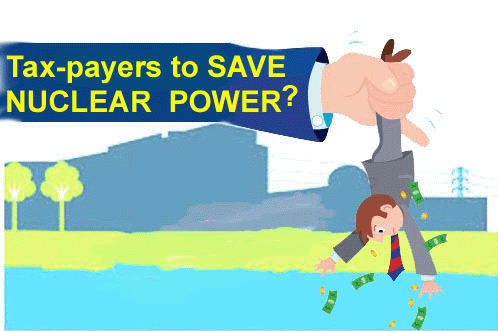
The U.S. Department of Energy said Tuesday that it will loan $1 billion to
help finance the restart of the nuclear power plant on Pennsylvania’s
Three Mile Island that is under contract to supply power to data centers
for tech giant Microsoft. The loan is in line with the priorities of
President Donald Trump’s administration, including bolstering nuclear power
and artificial intelligence.For Constellation Energy, which owns Three Mile
Island’s lone functioning nuclear power reactor, the federal loan will
lower its financing cost to get the mothballed plant up and running again.
The 835-megawatt reactor can power the equivalent of approximately 800,000
homes, the Department of Energy said.
Daily Mail 18th Nov 2025, https://www.dailymail.co.uk/wires/ap/article-15304171/Energy-Department-loans-1B-help-finance-restart-nuclear-reactor-Three-Mile-Island.html
Starmer’s nuclear revolution is about PowerPoints, not power
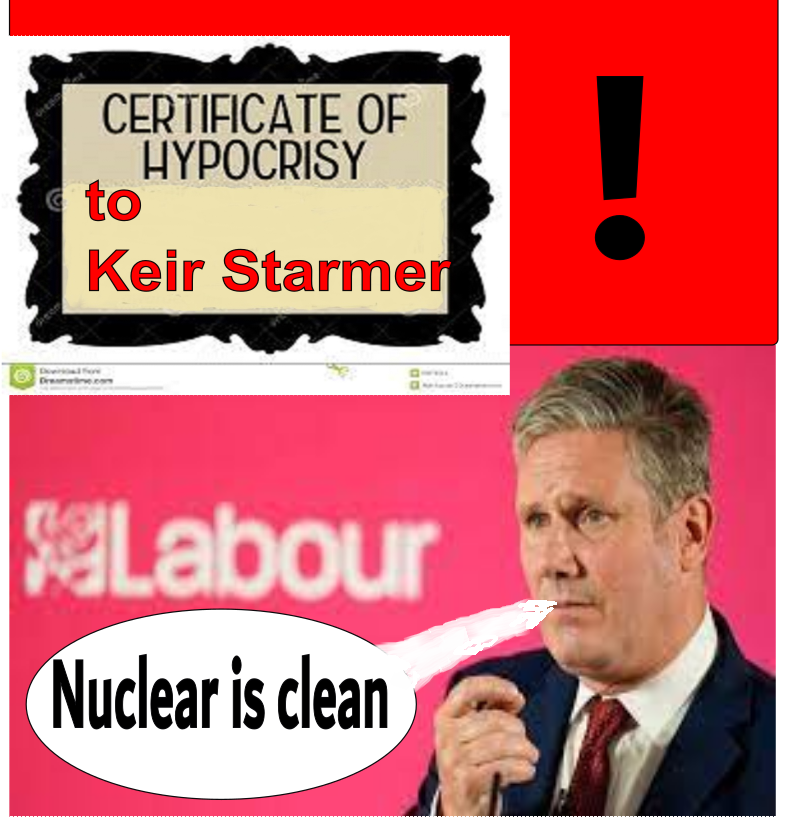
Government’s latest energy announcement is ‘going small as slowly as possible.
Another week and another lie from a government that only seems
capable of pulling defeat from the jaws of victory. Last week found Ed
Miliband, the Energy Secretary, trumpeting “the largest nuclear building
programme in Britain in half a century”.
But at the same time, the
Government is making promises to the people of North Wales – and to the
rest of the UK – that it can’t possibly fulfil. It will do nothing to
help us keep the lights on in 2030, after most of our existing nuclear
fleet has been shut down. “This isn’t ‘going big’ – it’s going
small as slowly as possible,” one industry source told me. “It’s
PowerPoints, not power,” one source fretted. The Government has approved
three new small modular nuclear reactors at the Wylfa site on Anglesey.
The implication is that spades will be in the ground very soon. But by choosing Rolls-Royce SMR, that cannot possibly happen. But Rolls-Royce was very late to the race and is trailing in the pack. Perhaps this will come as a surprise to some. But some of the coverage has been highly misleading.
Like this example: “Rolls-Royce is already world-leading when it comes to
making small modular reactors. It is just the ones they make currently go
into submarines,” Sam Dumitriu of the think tank Britain Remade told
readers of The Spectator last month. He’s the magazine’s go-to nuclear
expert.
Not only does Rolls-Royce not lead the world, being one of the last
to start its design process, but comparing military and civilian reactors
is like saying a horse is a slightly larger goldfish. They are completely
different creatures, adapted to different habitats.
Wylfa is the only site
in the UK that is currently licenced to accommodate a big, gigawatt-scale
reactor generating as much power as three SMR tiddlers. “Wylfa was our
best site for our next gigawatt nuclear plant, which is why I signed one
off there,” Claire Coutinho, the shadow energy secretary, told me.
“It’s big enough to do both small and large nuclear. It would be a huge
downgrade of ambition to only do small nuclear reactors there.”
Telegraph 17th Nov 2025,
https://www.telegraph.co.uk/business/2025/11/17/starmers-nuclear-revolution-is-about-powerpoints-not-power/
Trump Bets Big on a Nuclear Comeback

critics are not so certain that Westinghouse will be able to deliver on its promises due to the company’s poor track record.
The question now is, just how long will it take to achieve the U.S. nuclear renaissance? ……………………… The projects being funded by tech companies, which focus on the development of SMRs, are not expected to produce power until the next decade, and these are much smaller than conventional reactors.
By Felicity Bradstock , Oil Price- Nov 15, 2025, https://oilprice.com/Alternative-Energy/Nuclear-Power/Trump-Bets-Big-on-a-Nuclear-Comeback.html
- The Trump administration plans to quadruple U.S. nuclear capacity by 2050 and deploy 10 new large reactors by 2030, backed by major public funding and tech-sector investment.
- Westinghouse, Cameco, and international partners like Japan and the U.K. are central to the expansion push, though Westinghouse’s troubled track record raises concerns.
- Long development timelines, high costs, regulatory delays, and a diminished skills base make a rapid nuclear renaissance unlikely despite political momentum.
United States President Donald Trump is putting his money where his mouth is as he doubles down on efforts to accelerate the expansion of the country’s nuclear energy sector. The government will spend billions in public funding to reinvigorate U.S. nuclear power, following decades of underinvestment. Unlike renewable energy, Trump views nuclear power as key to expanding the U.S. electricity generation capacity and recently announced the target of quadrupling nuclear capacity by 2050.
In May, President Trump signed an executive order calling for the U.S. to develop 10 new large nuclear reactors by the end of the decade. In addition, several tech companies, including Alphabet, Amazon, Meta Platforms, and Microsoft, are providing billions in private funding to restart old nuclear plants, upgrade existing ones, and deploy new reactor technology to meet the growing demands from the data centres powering advanced technologies, such as artificial intelligence.
The U.S. Department of Energy’s (DoE) loan office will dedicate significant funds to the nuclear energy industry to support the development of new reactors. This week, the Energy Secretary Chris Wright stated, “We have significant lending authority at the loan programme office… By far the biggest use of those dollars will be for nuclear power plants — to get those first plants built.”
Wright expects the public support for the sector to encourage private actors to invest more heavily in nuclear power in the coming years. “When we leave office three years and three months from now, I want to see hopefully dozens of nuclear plants under construction,” said Wright.
In October, Trump came to an agreement with the owners of Westinghouse – uranium miner Cameco and Brookfield Asset Management – to invest $80 billion to build nuclear plants across the country. Westinghouse plans to construct large nuclear plants to be fitted with its modern AP1000 reactor design, which can power over 750,000 homes, according to the company. Cameco COO Grant Isaac suggested he would look to the DoE’s loans office to fund the development of the Westinghouse reactors.
However, critics are not so certain that Westinghouse will be able to deliver on its promises due to the company’s poor track record. The firm went bankrupt in 2017 after going over budget on large-scale nuclear projects in Georgia and South Carolina. Westinghouse will have to prove its ability to build the AP1000 on time and on budget to attract the investment it requires.
The Trump administration has developed various international partnerships to help develop its nuclear power sector in recent months. In September, Japan committed to investing in the Westinghouse nuclear project. The Asian country also agreed on an investment deal for Hitachi GE Vernova to build small modular reactors (SMRs).
Also in September, the U.S. signed a multibillion-dollar deal with the United Kingdom to expand nuclear power across both countries. The new Atlantic Partnership for Advanced Nuclear Energy is aimed at accelerating the construction of new reactors and providing reliable, low-carbon energy for high-demand sectors, such as data centres.
The question now is, just how long will it take to achieve the U.S. nuclear renaissance? It typically takes a decade or longer to develop a new nuclear power plant, and while adding additional reactors to existing plants can be faster, licensing and approval can take several years. In addition, after decades of stagnation in the sector, developing nuclear reactors in the U.S. can be extremely costly and slow, due to the lack of expertise, compared to rapidly growing nuclear powers, such as China.
In China, developing a new nuclear reactor now takes between five and six years on average, much faster than the decade-long timeline in most Western countries. This is supported by China’s strong regulatory system and tried-and-tested development methods. Meanwhile, in the U.S., just powering up a disused reactor, such as that of Three Mile Island, can take several years to achieve. The projects being funded by tech companies, which focus on the development of SMRs, are not expected to produce power until the next decade, and these are much smaller than conventional reactors.
The Trump administration hopes to speed up the development process through a range of measures. One executive order calls for the nuclear power industry’s safety regulator to approve applications in no more than 18 months. The recent funding announcement from the DoE’s loan office is expected to help overcome the biggest bottleneck – funding. Congress has also kept its tax breaks in place for nuclear development to attract private funding to the sector.
Thanks to greater political support and public financing, the U.S. nuclear energy sector could rapidly expand its power capacity over the coming decades. However, achieving the level of acceleration in nuclear development expected by the Trump administration is highly unlikely due to a range of challenges hindering development, from expertise to cost and manufacturing capacity. So, while a nuclear renaissance is possible, it is unlikely to be seen within the next decade.
Finally Some Accountability for Georgia’s Costly Nuclear Power Mistake

Vogtle stands as the only new nuclear reactor built in the last 30 years, and its fallout offers a bleak prognosis for any supposed “renaissance” and its supporters in statehouses across the country. We can look back to 2017 when the main contractor, Westinghouse, filed for bankruptcy due to the extreme cost overruns at Vogtle. At that critical moment, the Georgia PSC ignored its own staff, energy experts, and public outcry, choosing to burden ratepayers with the project’s continuation.
By Kim Scott.15 Nov 25 https://nuclearcosts.org/finally-some-accountability-for-georgias-costly-nuclear-power-mistake/
The story of Plant Vogtle’s two new nuclear reactors in Georgia is not a triumph of a “nuclear renaissance”; it’s a cautionary tale written in soaring electric bills and a growing political fallout. The people of Georgia are paying the price, literally, as their utility bills have skyrocketed by over 40% – and now, following last Tuesday’s Public Service Commission election in Georgia, it seems those that allowed this to happen in the first place are starting to feel the pinch as well. It’s about damn time!
Georgia voters delivered a stunning message by unseating two Republican utility commissioners, Tim Echols and Fitz Johnson, who rubber stamped and championed the costly mistakes leading to a 41% increase in Georgians’ electric bills. This election, which saw Democrats Alicia Johnson and Peter Hubbard championing fair rates, affordability and renewable energy, was a clear referendum on Plant Vogtle’s enormous price tag and more importantly, nuclear power as a not so clean future power resource both here in Georgia and elsewhere.
The stunning defeat of utility backed incumbents sends a powerful signal to utility regulators nationwide that consumers will not tolerate being forced to pay for multi-billion-dollar nuclear boondoggles. If they aren’t paying attention, Wall Street sure is, downgrading Southern Co.’s stock immediately following the election, citing the increased risk and the new difficulty the company will face in pushing through further rate hikes to pay for Plant Vogtle and other projects in their pipeline. Georgia customers will pay an additional $36 billion to $43 billion over the 60-80 year lifespan of the two Vogtle reactors compared to cheaper alternatives.
Vogtle stands as the only new nuclear reactor built in the last 30 years, and its fallout offers a bleak prognosis for any supposed “renaissance” and its supporters in statehouses across the country. We can look back to 2017 when the main contractor, Westinghouse, filed for bankruptcy due to the extreme cost overruns at Vogtle. At that critical moment, the Georgia PSC ignored its own staff, energy experts, and public outcry, choosing to burden ratepayers with the project’s continuation.
The consequences of those decisions, subsequent rate increases and soaring electric bills are not abstract—they are impacting the most vulnerable among us and the most overlooked i.e. middle class/working class Georgians. Disconnection rates for the inability to pay have soared by 30% in 2024. For retirees on fixed incomes, the rate increases to pay for Plant Vogtle mean the difference between making ends meet and falling into destitution. This summer, when brutal heat waves descended, vulnerable Georgians had their power shut off, creating life-threatening conditions because they could no longer afford to cool their homes.
The ratepayer backlash in Georgia is also being fueled by the projected massive energy demands of AI data centers, which are forcing utilities like Southern Co. to reckon with costly new generation and transmission projects. Instead of aggressively pushing nuclear power—as evidenced by the Trump administration’s recent $80 billion deal to buy reactors from Westinghouse, the same company bankrupted by Vogtle—we must demand that elected politicians focus on fast and affordable energy solutions like solar and battery energy storage systems.
The painful lesson learned in Georgia is that new nuclear power is simply too expensive and takes too long. The reality is that for half the cost and in less than a quarter of the time, we could have built more than twice the capacity using solar, wind, or battery storage technologies. But corruption won out and Vogtle is here for the foreseeable future. Georgians will be paying for this mistake for decades to come… I’m just glad there’s finally some accountability headed our way.
Kim Scott is Executive Director of Georgia WAND, is a native Georgian, and has a Chemical Engineering degree from Vanderbilt University in Nashville, TN.
UK’s New nuclear siting policy criticised by industry as ‘missed opportunity’
The highly anticipated National Policy Statement for Nuclear Energy
Generation EN-7, which will dictate where new nuclear reactors can be
deployed, has been published by the government, but it has been criticised
by the Nuclear Industry Association (NIA) as a “missed opportunity”.
New Civil Engineer 14th Nov 2025, https://www.newcivilengineer.com/latest/new-nuclear-siting-policy-criticised-by-industry-as-missed-opportunity-14-11-2025/
Why should Scotland pay billions for nuclear when renewables exist?
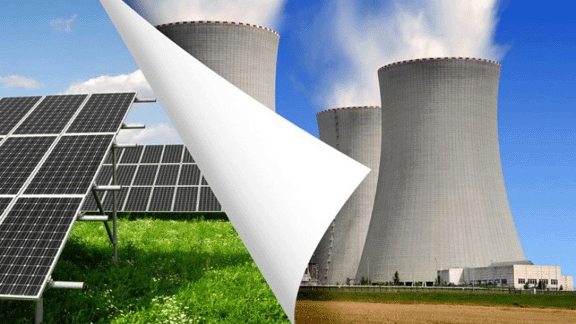
Dr Ian Fairlie: Why should Scotland pay billions for nuclear when
renewables exist?
Prime Minister Keir Starmer and Anas Sarwar this week
made further statements in support of more nuclear power in Scotland.
Scottish CND believe their claims about a “golden age of nuclear” are
pie in the sky and should be treated with a pinch (or more) of salt
A proper assessment of our energy situation requires us to look at what is
happening in the rest of the world. Last year, a record 582GW of renewable
energy generation capacity was added to the world’s supplies – but
there was almost no new nuclear. Indeed, each year, new renewables add
about 200 times more global electricity than new nuclear does.
Powerful economic arguments exist for renewables over nuclear. The main one is that the marginal (ie fuel) costs of renewable energy are next to zero, whereas nuclear fuel is extremely expensive. Nuclear costs – for both
construction and generation – are very high and rising, plus long delays
are the norm.
For example, the proposed Sizewell C nuclear station in
England is now predicted to cost £47 billion, with the UK Government and
independent experts acknowledging even this estimate may rise
significantly. And just this week, the Hinkley C station still under
construction in England added yet more costs to its anticipated huge bill.
Must Scotland follow these poor English examples? The reality is that new
nuclear power in Scotland would mean massive costs, a poisoned legacy to future generation and yet more radioactive pollution of our air and seas.
Given these manifest disadvantages, many independent commentators have questioned the UK Government’s seeming obsession with nuclear power.
The National 15th Nov 2025, https://www.thenational.scot/politics/25624042.scotland-pay-billions-nuclear-renewables-exist/
Nuclear for Wylfa the wrong way to go

Nuclear Free Local Authorities, 13th November 2025
Responding to today’s news that the UK Government intends to impose several so called ‘small modular reactors’ upon Wylfa, the Welsh NFLAs believe that this is the wrong way to go.
The money would be better spent on insulating Welsh homes to make them warmer and cheaper to run or used to develop more capacity in renewable technologies that can generate electricity cheaper and far quicker. And Ynys Mon can play a big part in that by becoming a centre of excellence for renewable technologies and so truly Wales’ ‘green energy’ island.
The Government’s nuclear delivery agency, Great British Energy – Nuclear recently concluded a ‘competition’ amongst SMR developers to select a preferred design. Unsurprisingly Rolls-Royce, which had already received a Government hand-out of £210 million during an earlier development stage and a Government hand-up by being fast-tracked onto the Generic Design Assessment process, won the competition. This was the equivalent of running a race with superior sports footwear, and starting the race much earlier, than the other participants. The company will now be awarded a further £2.5 billion of hard-pressed taxpayers money to build three pilot SMRs.
13th November 2025
Nuclear for Wylfa the wrong way to go
Responding to today’s news that the UK Government intends to impose several so called ‘small modular reactors’ upon Wylfa, the Welsh NFLAs believe that this is the wrong way to go.
The money would be better spent on insulating Welsh homes to make them warmer and cheaper to run or used to develop more capacity in renewable technologies that can generate electricity cheaper and far quicker. And Ynys Mon can play a big part in that by becoming a centre of excellence for renewable technologies and so truly Wales’ ‘green energy’ island.
The Government’s nuclear delivery agency, Great British Energy – Nuclear recently concluded a ‘competition’ amongst SMR developers to select a preferred design. Unsurprisingly Rolls-Royce, which had already received a Government hand-out of £210 million during an earlier development stage and a Government hand-up by being fast-tracked onto the Generic Design Assessment process, won the competition. This was the equivalent of running a race with superior sports footwear, and starting the race much earlier, than the other participants. The company will now be awarded a further £2.5 billion of hard-pressed taxpayers money to build three pilot SMRs.
Great British Energy – Nuclear also purchased the Wylfa and Oldbury sites off Horizon for £160 million for reuse as locations for these new SMRs, almost certainly at nil or minimal cost to the developer, and GNE – N recently advertised for a site manager with proficiency in the Welsh language letting slip that Wylfa was the preferred site.
The Government’s announcement refers to Wylfa becoming Britain’s first SMR ‘power plant’ with reactors plural, suggesting that the three initial reactors will all be co-located on the island. SMRs are an uncertain and unproven nuclear technology. The Rolls-Royce SMR design has yet to secure all the required regulatory approvals, no Rolls-Royce SMR have yet been built, let alone operated, and there is no experience of SMR modular assembly. Any reactor will not even come on stream until the 2030’s and even then will only deliver electricity for customers that is vastly more expensive than that generated by renewables. Nor has any permanent solution to the intractible problem of managing high-level radioactive waste been found, but there has been some academic research which indicates that many SMR designs create more waste per kilowatt generated than traditional gigawatt plants. And as Ukraine has demonstrated, nuclear power plants are obvious targets in any future conflict.
Wylfa is a particularly problematic location. The Horizon bid was rejected in part because of the damage it would cause to nature and the beautiful environment of Ynys Mon and its impact on the island’s linguistic heritage. But the bid failed largely because the developer felt they were not receiving enough financial support from the taxpayer. How will this be different? The price tag for a single SMR is likely to be at least £4 billion. Will a public subsidy of £2.5 billion be deemed sufficient to Rolls Royce to incentivise them to proceed with buiding three? How will electricity be transmitted across and out of the island? It is very likely that we shall see a sea of new pylons spring up across the green fields of Ynys Mon and beyond. If parts for a modular reactor are made off-site, how will they be transported onto the island? And with ‘First of a Kind’ experimental SMRs at Wylfa, and a military neighbour at RAF Valley, surely the UK Government is making Ynys Mons an even higher-priority target for terrorists or a hostile power in time of war. How will islanders be evacuated quickly and safely should there be an attack or an accident?
The promised thousands of jobs ‘for the local community’ must also be questionable. ………………………………………………………………………………………………
The Welsh NFLAs would rather see the £2.5 billion dedicated to SMR development at Wylfa redirected by the UK Government to reduce the energy bills of Welsh citizens and move closer to making Wales a wholly renewable electricity nation. How? By funding an emergency programme of retrofitting insulation to Welsh homes and into supporting renewable energy projects……………………………………………………………………………………………………………………… https://www.nuclearpolicy.info/news/nuclear-for-wylfa-the-wrong-way-to-go/
Wales Green Party responds to new nuclear power plans
by Green Party, https://greenparty.org.uk/2025/11/13/wales-green-party-responds-to-new-nuclear-power-plans/
Responding to the announcement of plans for new nuclear power generation on Ynys Môn, leader of Wales Green Party Anthony Slaughter, said:
“It’s Groundhog Day yet again. Gordon Brown declared a bold future for nuclear power back in 2009, showing us nuclear is of no help in fighting the climate crisis.
“New nuclear power at Wylfa would be nothing but an expensive distraction from the clean, fast and cheap renewables already available to us. We need to cut emissions fast, but even the most optimistic backers admit it’ll take a decade for new nuclear to be up and running.
“And there is still no answer to the safe disposal of nuclear waste.
“What Wales needs is a fast, ambitious roll-out of solar, wind and wave energy that will create jobs and cut energy bills.”
Zelensky – Embroiled in war and embattled at home

by beyondnuclearinternational, https://beyondnuclearinternational.org/2025/11/13/embroiled-in-war-and-embattled-at-home/
Can president Zelensky survive a kickback scheme involving the state nuclear company that enriched associates and possibly even ministers in his own government, asks Linda Pentz Gunter
If you live in Ohio, and possibly even in Illinois and South Carolina, you might be getting a bit of a déjà vu feeling reading the news coming out of Ukraine about a corruption scandal involving Energoatom, Ukraine’s nuclear energy company. That’s because two independent Ukrainian anti-corruption bodies have just uncovered a massive graft scandal involving kickbacks from nuclear power projects.
In July 2020, then Speaker of the Ohio House, Republican Larry Householder, was arrested along with four others for involvement in what was described as “the largest bribery money-laundering scheme ever perpetrated against the people of the state of Ohio.”
In a year-long covert investigation by the US Attorney’s office and the FBI, a plot was uncovered that involved $61 million in dark money that flowed from FirstEnergy into the pockets of Householder and others to ensure a favorable vote in the House that would guarantee a $1.5 billion bailout of the company’s Davis-Besse and Perry nuclear reactors to keep them running. Once uncovered, indictments followed. Householder is currently serving a 20-year prison sentence.
Similar scandals rocked Illinois and South Carolina, also connected to nuclear power plant schemes and also leading to indictments and prison sentences.
In Ukraine, the two investigating agencies — the National Anti-Corruption Bureau (NABU) and the Specialized Anti-Corruption Prosecutor’s Office (SAPO) — have just named at least eight individuals who have reportedly been charged with bribery, embezzlement, and illicit enrichment, netting around $100 million off contracts with Energoatom.
Details about precisely how the scheme operated and which contracts were involved have not fully emerged. However, some sources have suggested it involved a wide range of Energoatom’s private subcontractors who were allegedly forced to pay kickbacks of 10-15% to secure or maintain their supplier status and ensure timely payments.
These reportedly included work on constructing protective structures at the Khmelnytskyi nuclear power plant to defend against Russian air attacks, with Ukraine still struggling to defeat an invasion by Russia that began on February 24, 2022.
Both the Khmelnytskyi and Rivne nuclear power plants were hit with a major strike by the Russians on November 8, raising new fears of a catastrophic nuclear disaster. To date, most of the concern has centered around the six-reactor site at Zaporizhzhia, which is located in the region of heaviest fighting and has been occupied by Russian forces since March 4, 2022. Zaporizhzhia has undergone many close calls and was recently without offsite power for a month, provoking widespread anxiety since power is essential to cool reactors and their fuel pools even if they are shut down as the Zaporizhzia reactors presently are.
“Nuclear safety and security in Ukraine remains extremely precarious during the military conflict,” the International Atomic Energy Agency said in a social media posting. “Two operating NPPs – Khmelnitskyy and Rivne – had to reduce electricity output after overnight attack on electrical substation critical for nuclear safety.”
The participants in the Energoatom corruption scheme, who used code names, were heard in conversations recorded by the investigators evaluating the Khmelnytsky fortifications as a business opportunity.
Meanwhile the IAEA is at the COP30 climate summit in Brazil frantically peddling nuclear power as the answer to the climate crisis under its Atoms4Climate propaganda campaign while ignoring all the obvious safety and security risks so frighteningly on display in Ukraine, never mind the industry’s complete inability to deliver reactors in time or on budget.
Since the anti-corruption groups delivered their reports, two key ministers have resigned at President Volodymyr Zelensky’s request. They are Ukrainian Energy Minister Svitlana Grynchuk and Justice Minister German Galushenko. Galushenko, who preceded Grynchuk as energy minister, had already been suspended before he stepped down. Galushenko is reportedly implicated in the kickback scandal but has proclaimed his innocence.
The two agencies spent more than 15 months collecting evidence, including 1,000 hours of audio recordings and at least 70 searches. Zelensky had acted to curb the reach of NABU and SAPO several months earlier, prompting suspicions that he could have been aware that personal associates and his own ministers were about to be caught in their nets. Zelensky backed down then after being warned by the European Union that Ukraine’s bid to become a member would be in jeopardy if the corruption problem was not resolved.
European Commission president Ursula von der Leyen reportedly conveyed her strong concerns about Zelensky’s attempts to weaken the agencies’ powers. In a statement, a spokesperson for von der Leyen said: “The respect for the rule of law and the fight against corruption are core elements of the European Union. As a candidate country, Ukraine is expected to uphold these standards fully. There cannot be a compromise.”
The EU has spoken out again in light of the present revelations, urging Zelensky to clamp down on corruption, but has not withdrawn its support for the country’s war efforts against Russia’s invasion, now entering its 45th month.
According to an analysis in Kyiv Independent by Oleg Sukhov, the eight implicated also include Deputy Prime Minister Oleksiy Chernyshov, Rustem Umerov, former defense minister and current secretary of the National Security and Defense Council and Ihor Myroniuk, a former advisor to then Energy Minister Halushchenko.
Chernyshov allegedly financed the construction of high-end houses near Kyiv, echoing the way Householder used his bribery bonanzas to refurbish his second home in Florida.
The alleged ringleader, according to Sukhov and other news reports, is Zelensky’s close associate and former business partner, Timur Mindich, who has since fled the country, likely to Israel where he is a citizen and lending further credence to the charges. Mindich is a co-owner of the president’s Kvartal 95 production company. Zelensky transferred his stake to partners once he became president.
Chernyshov allegedly financed the construction of high-end houses near Kyiv, echoing the way Householder used his bribery bonanzas to refurbish his second home in Florida.
The alleged ringleader, according to Sukhov and other news reports, is Zelensky’s close associate and former business partner, Timur Mindich, who has since fled the country, likely to Israel where he is a citizen and lending further credence to the charges. Mindich is a co-owner of the president’s Kvartal 95 production company. Zelensky transferred his stake to partners once he became president.
Linda Pentz Gunter is the founder of Beyond Nuclear and serves as its international specialist. Her book, No To Nuclear. Why Nuclear Power Destroys Lives, Derails Climate Progress and Provokes War, can be pre-ordered now from Pluto Press.
Rare US Peace President: Warren G. Harding.
Walt Zlotow, West Suburban Peace Coalition, Glen Ellyn IL , 11 Nov 25
Growing up in the 50’s, we were taught by popular culture, even in school, that the worst president among America’s 34 thru Eisenhower, was Warren Gamaliel Harding (March 4, 1921 – August 2, 1923). Harding was ancient history to us school kids, having died in office 3 decades earlier in just his 29th month as president. We couldn’t be bothered seeking to understand his true governance.……………………………………………………..
it was in foreign affairs that Harding’s words and deeds of peace resonated worldwide. He not only didn’t initiate a single international intervention, he made strides toward reconciliation with foreign targets of US interference. More importantly, he promoted disarmament, which was both successful and lasted over a decade after his death, only done in by German and Japanese expansionism.
Harding was America’s first Good Neighbor to Latin America long before FDR coined the phrase. He withdrew US troops from Cuba his predecessors sent multiple times to protect US business interests. He criticized his predecessor’s endless interference in Haiti, Dominican Republic and Nicaragua as well. He achieved a treaty with Columbia that payed them $25 million in reparations for TR’s fomented revolution there to build the Panama Canal. He also worked with Mexican President Alvaro Abregon to reestablish diplomatic relations with Mexico that had been severed by Woodrow Wilson as part of Wilson’s several Mexican interventions.
But his greatest legacy was promoting what today’s America wouldn’t dream of: disarmament. He achieved the largest global-disarmament agreement ever at the November 1921 Washington Naval Conference he convened with Secretary of State Charles Evans Hughes including representatives from Japan, Britain, France, Italy, China, Belgium, Netherlands and Portugal. It negotiated the halt of new battleship construction for over a decade. It achieved reduction in dozens of warships by the US, Britain and Japan, pegging the Navy’s future strength to parity with Britain and Japan. A reporter remarked that the Harding-Hughes duo “sank in 35 minutes more ships than all of the admirals of the world have sunk in centuries.”
The conference produced six treaties and twelve resolutions on issues ranging from signatories agreeing to honor their respective territorial integrity in the Pacific, limiting tonnage of naval ships, and modernizing custom tariffs.
Back at home, Harding pardoned socialist presidential contender Eugene Debs, jailed by the anti free speech Woodrow Wilson for criticizing the WWI draft, and released 22 other antiwar dissidents as well. Julian Assange should have been so lucky to reveal America’s dirty foreign policy laundry under a President Harding.
A century after his death, only JFK, another short term president who pivoted to peace in just his last year, could arguably be judged as promoting such a profoundly peace agenda.
Wouldn’t the US be better off today if we had, occupying the Oval Office, a hard drinking, adulterous, poker playing president who promoted peace, instead of one with an infinitely more defective character who glories in prosecuting and provoking senseless war?
Invest in existing clean energy solutions, not nuclear fantasy.
By Lynda Williams, 31 Oct 25, https://www.staradvertiser.com/2025/10/30/editorial/island-voices/column-invest-in-existing-clean-energy-solutions-not-nuclear-fantasy/
In the last legislative session, Hawai‘i lawmakers approved Senate Concurrent Resolution 136, directing the Hawai‘i State Energy Office (HSEO) to convene a Nuclear Energy Working Group to study whether “advanced” nuclear power could help meet the state’s 100% renewable energy goal.
I serve on that Working Group as a physicist representing the environmental organization 350 Hawai‘i. Other members include representatives from HSEO, the Departments of Health and Land and Natural Resources, the Public Utilities Commission and the University of Hawai‘i, along with invited members from the U.S. Navy, nuclear power lobby groups and environmental groups. No Kanaka Maoli-led organizations such as the Office of Hawaiian Affairs or KAHEA were included — a serious oversight in any discussion of Hawai‘i’s energy future.
Nuclear power is not feasible in Hawai‘i because it faces insurmountable legal and technical barriers. Article XI, Section 8 of the Hawai‘i State Constitution prohibits the construction or operation of any nuclear-fission reactor without a two-thirds vote of each house of the Legislature — an exceptionally high bar without sweeping political change. Hawai‘i law also defines renewable energy as sources that are naturally replenished, such as solar, wind, ocean and geothermal — not technologies dependent on mining that produce radioactive waste. By legal definition, nuclear power cannot contribute to meeting the state’s renewable energy goals unless the law is changed.
Technical barriers are even higher. Despite growing hype around so-called “advanced” nuclear reactors, in reality, there are no operating “advanced” reactors anywhere in the world, no reliable timeline for when any might come online, and a decades-long record of cost overruns, cancellations and failed promises. Every design being promoted — from small modular reactors (SMRs) to molten-salt and thorium systems — is still a nuclear reactor that splits uranium atoms, generates radioactive waste and requires extensive cooling, shielding and waste-management infrastructure.
At our first meeting in September, there was discussion of whether Hawai‘i’s constitutional requirement for a two-thirds legislative vote to approve the construction of any nuclear-fission plant could somehow be avoided. That notion reflects a deep confusion driving this conversation: that “advanced” nuclear systems are fundamentally different from the fission reactors banned under Article XI. They are not. Some advocates even suggested that small “plug-and-play” SMRs could one day be shipped to Hawai‘i, used briefly and sent back to the continent — a concept that exists only in fantasy. Any nuclear reactor unit requires installation, grid connection and refueling — all of which constitute the operation of a nuclear-fission facility under Hawai‘i’s Constitution.
The first draft of HSEO’s report is due Nov. 5, with a final version to be submitted to the Legislature by the end of the year — a challenging timeline for such a complex report. How can anyone produce a thorough feasibility analysis — including cost, safety and environmental assessments — for a technology that doesn’t even exist? Even HSEO warned lawmakers in its testimony against this resolution that “given the current lack of cost, production, safety and nuclear waste-management information on SMRs, the formation of a nuclear energy task force is premature.”
Hawai‘i’s path forward in clean energy lies not in nuclear fantasies but in strengthening the laws protecting the islands and investing in what already works — solar and wind — and in exploring tidal and ocean energy resources to achieve clean, safe and independent power generation.
To read my full responses with citations to the Nuclear Energy Working Group survey, visit nuclearfreehawaii.substack.com.
Labour’s ‘national security threat’ attacks on Scottish National Party are hypocrisy 101

TO no one’s surprise, Anas Sarwar has lined up behind his UK bosses and doubled-down on claims that the Scottish Government is a “national security threat”. The Scottish Labour leader has meekly joined Defence Secretary John Healey, Deputy Prime Minister David Lammy, and Scottish
Secretary Douglas Alexander in deploying the inflammatory rhetoric against the SNP Government.
National security expert Professor Nick Ritchie pointed
out last week, Labour’s pro-nuclear rhetoric also undermines the international law that they are supposedly signed up to. The UK is a signatory to the nuclear Non-Proliferation Treaty (NPT), which obliges Britain to “pursue negotiations in good faith on effective measures” relating to nuclear disarmament.
But instead of uphold their obligations – which many top experts believe they are breaching – Labour ministers
are on the airwaves accusing the SNP of being a security threat for opposing nuclear weaponry.
The National 10th Nov 2025, https://www.thenational.scot/news/25611206.labours-national-security-threat-attacks-snp-hypocrisy-101/
Does Britain really need nuclear power? – Campaign for Nuclear Disarmament
, https://labouroutlook.org/2025/11/10/does-britain-really-need-nuclear-power-campaign-for-nuclear-disarmament/
With funding confirmed for a new nuclear power station in Suffolk, Dr Ian Fairlie, CND Vice-President and science adviser, and a leading consultant on radioactivity in the environment, questions whether we actually need this development and the technology in general.
In recent months, the government has continued to promote nuclear reactors. For example, the Energy Secretary is now asking GB Energy to assess sites to be used to host new nuclear reactors. And the Prime Minister continues to push for so-called Small Modular Reactors and has backed the US President’s wishful thinking of ‘a golden age of nuclear’.
But these announcements and proposals are mostly pie-in-the-sky statements and should be treated with a pinch (or more) of salt, as the reality is otherwise.
Let’s look at what is happening in the rest of the world. Last year, a record 582 GW of renewable energy generation capacity was added to the world’s supplies: almost no new nuclear was added.
Indeed, each year, new renewables add about 200 times more global electricity than new nuclear does.
Of course, there are powerful economic arguments for this. The main one is that the marginal (i.e. fuel) costs of renewable energy are close to zero, whereas nuclear fuel is extremely expensive. Nuclear costs – for both construction and generation – are very high and rising, and long delays are the norm. For example, the proposed Sizewell C nuclear station is now predicted to cost £47 billion, with the government and independent experts acknowledging even this estimate may rise significantly. The upshot is that new nuclear power means massive costs, a poisoned legacy to future generations, and whopping radioactive pollution.
iven these manifest disadvantages, independent commentators have questioned the government’s seeming obsession with nuclear power. It is not that nuclear provides a good solution to global warming: it doesn’t. The United Nations’ Intergovernmental Panel on Climate Change (IPCC) reports that renewables are now 10 times more efficient than new nuclear at CO2 mitigation. It’s not that AI centres will need nuclear: the International Energy Agency expects data centres will cause a mere 10% of global electricity demand growth to 2030. And it forecasts that the renewables will supply 10 to 20 times the electricity required for data-centre growth, with Bloomberg NEF predicting a 100-fold renewables expansion.
As for so-called Small Modular Reactors, the inconvenient truth is that these designs are all just paper designs and are a long way off. They would also be more expensive to run than large reactors per kWh – the key parameter. And as the former Chair of the US government’s Nuclear Regulatory Commission (NRC) says, SMRs will produce more chemical and radioactive waste per KW produced than large reactors.
Given a UK Treasury strapped for cash, the unsolved problem of radioactive nuclear waste, the spectre of nuclear proliferation, and it’s being a target in future wars, many wonder why the government is so fixated with nuclear power.
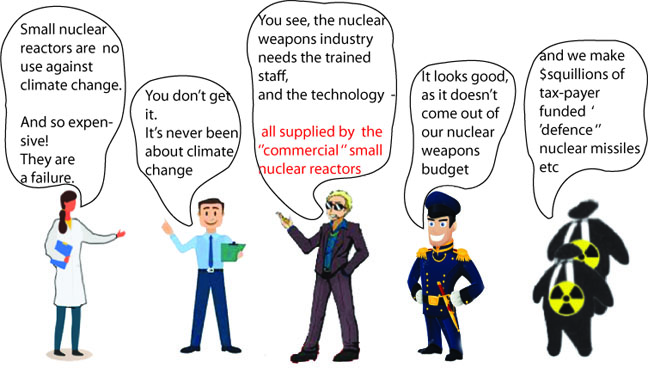
Well, the answer was supplied in 2023 by the Rishi Sunak administration which admitted that the main reason for its continued eye-watering financial support for civil reactors was that they provided needed technical support and expertise for the government’s nuclear weapons programme.
Nuclear power will get the most Energy Department loans, Chris Wright says
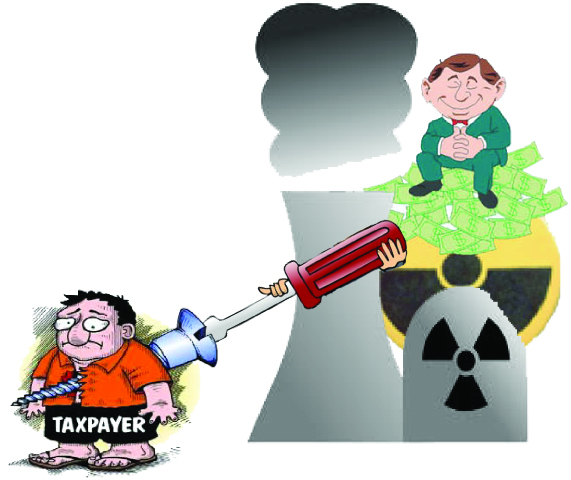
Mon, Nov 10 2025, Spencer Kimball, CNBC
Key Points
- Nuclear power plants will receive the bulk of the money from the Energy Department’s loan office, Secretary Chris Wright said.
- The Trump administration struck a deal last month with the owners of Westinghouse to invest $80 billion to build nuclear plants across the U.S.
Nuclear power will receive most of the money from the Energy Department’s loan office as the Trump administration pushes to quickly break ground on new reactors, Secretary Chris Wright said on Monday.
“We have significant lending authority at the loan program office,” the Secretary of Energy said at a conference hosted by the American Nuclear Society in Washington D.C. “By far the biggest use of those dollars will be for nuclear power plants — to get those first plants built.”
President Trump signed an executive order in May that called for the U.S. to break ground on 10 large nuclear reactors by 2030. Alphabet, Amazon, Meta Platforms and Microsoft are investing billions of dollars to restart old nuclear plants, upgrade existing ones, and deploy new reactor technology to meet the electricity demand from artificial intelligence data centers.
Wright said he expects electricity demand from AI to attract billions of dollars in equity capital to build new nuclear capacity from “very creditworthy providers.” The Energy Department could match those private dollars by as much as four to one with low cost debt financing from the loan office, he said………..
Westinghouse deal
The Trump administration struck a deal last month with the owners of Westinghouse to invest $80 billion to build nuclear plants across the U.S. Westinghouse is owned by uranium miner Cameco and Brookfield Asset Management…………………………….
Cameco Chief Operating Officer Grant Isaac said last week that the U.S. government has a number of options available to facilitate the financing of Westinghouse reactors, including the Energy Department’s loan office.
“We’re assured that there is a lot of interest in investing this minimum $80 billion in order to begin the process,” Isaac told investors on Cameco’s third-quarter earnings call.
Under the terms of the October deal, Westinghouse could spin out as a separate, publicly-traded company with the U.S. government as a shareholder.
But Westinghouse has struggled in the past to build the AP1000 on time and on budget. It went bankrupt in 2017 from cost overruns at big nuclear projects in Georgia and South Carolina.
Two AP1000 reactors entered service at Plant Vogtle in Georgia in 2023 and 2024, years behind schedule and billions of dollars over budget. The South Carolina project was cancelled. https://www.cnbc.com/2025/11/10/nuclear-power-energy-department-chris-wright-loan-westinghouse-ai-data-center.html
The dark side of Zelenskyy’s rule
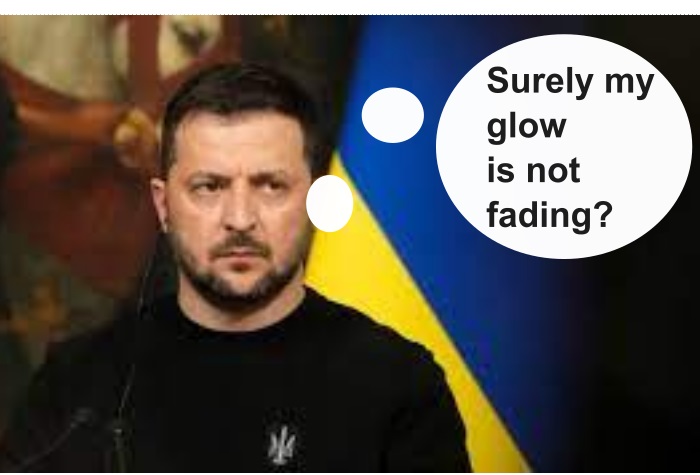
Opposition lawmakers and civil society activists say Ukraine’s leadership is using lawfare to intimidate opponents and silence critics.
Politico, October 31, 2025, By Jamie Dettmer
As Russia began its full-scale invasion of Ukraine nearly four years ago, Volodymyr Kudrytskyi, then head of Ukraine’s state-owned national power company Ukrenergo, was scrambling to keep the lights on.
Somehow, he succeeded and continued to do so every year, earning the respect of energy executives worldwide by ensuring the country was able to withstand Russian missile and drone strikes on its power grid and avoid catastrophic blackouts — until he was abruptly forced to resign in 2024, that is.
Kudrytskyi’s dismissal was decried by many in the energy industry and also prompted alarm in Brussels. At the time, Kudrytskyi told POLITICO he was the victim of the relentless centralization of authority that Ukrainian President Volodymyr Zelenskyy and his powerful head of office Andriy Yermak often pursue. He said he feared “corrupt individuals” would end up taking over the state-owned company.
According to his supporters, it is that kind of talk — and his refusal to remain silent — that explains why Kudrytskyi ended up in a glass-enclosed cubicle in a downtown Kyiv courtroom last week, where he was arraigned on embezzlement charges. Now, opposition lawmakers and civil society activists are up in arms, labeling this yet another example of Ukraine’s leadership using lawfare to intimidate opponents and silence critics by accusing them of corruption or of collaboration with Russia. Zelenskyy’s office declined to comment.
Others who have received the same treatment include Zelenskyy’s predecessor in office, Petro Poroshenko, who was sanctioned and arraigned on corruption charges this year — a move that could prevent him from standing in a future election. Sanctions have frequently been threatened or used against opponents, effectively freezing assets and blocking the sanctioned person from conducting any financial transactions, including using credit cards or accessing bank accounts.
Poroshenko has since accused Zelenskyy of creeping “authoritarianism,” and seeking to “remove any competitor from the political landscape.”
That may also explain why Kudrytskyi has been arraigned, according to opposition lawmaker Mykola Knyazhitskiy, who believes the use of lawfare to discredit opponents is only going to get worse as the presidential office prepares for a possible election next year in the event there’s a ceasefire. They are using the courts “to clear the field of competitors” to shape a dishonest election, he fears.
Others, including prominent Ukrainian activist and head of the Anti-Corruption Action Center Daria Kaleniuk, argue the president and his coterie are using the war to monopolize power to such a degree that it threatens the country’s democracy.
Kaleniuk was in the courtroom for Kudrytskyi’s two-hour arraignment, and echoes the former energy boss’s claim that the prosecution is “political.” According to Kaleniuk, the case doesn’t make any legal sense, and she said it all sounded “even stranger” as the prosecutor detailed the charges against Kudrytskyi: “He failed to show that he had materially benefited in any way” from an infrastructure contract that, in the end, wasn’t completed, she explained……………………………………………………………………………
for former Deputy Prime Minister Ivanna Klympush-Tsintsadze, the case “doesn’t look good from any angle — either domestically or when it comes to international partners.” The timing, she said, is unhelpful for Ukraine, as it coincides with Kyiv’s ongoing appeal for more European energy assistance ahead of what’s likely to be the war’s most perilous winter.
With Russia mounting missile and drone strikes on a far larger scale than before, Ukraine’s energy challenge is likely to be even more formidable. And unlike previous winters, Russia’s attacks have been targeting Ukraine’s drilling, storage and distribution facilities for natural gas in addition to its electrical power grid. Sixty percent of Ukrainians currently rely on natural gas to keep their homes warm.
Some Ukrainian energy executives also fear Kudrytskyi’s prosecution may be part of a preemptive scapegoating tactic to shift blame in the event that the country’s energy system can no longer withstand Russian attacks.
Citing unnamed sources, two weeks ago Ukrainian media outlet Ukrainska Pravda reported that former energy executives fear they are being lined up to be faulted for failing to do enough to boost the energy infrastructure’s resilience and harden facilities.
“They need a scapegoat now,” a foreign policy expert who has counseled the Ukrainian government told POLITICO. “There are parts of Ukraine that probably won’t have any electricity until the spring. It’s already 10 degrees Celsius in Kyiv apartments now, and the city could well have extended blackouts. People are already pissed off about this, so the president’s office needs scapegoats,” he said, speaking on condition of anonymity to discuss the matter freely.
“The opposition is going to accuse Zelenskyy of failing Ukraine, and argue he should have already had contingencies to prevent prolonged blackouts or a big freeze, they will argue,” he added……..https://www.politico.eu/article/dark-side-zelenskyy-rule-ukraine/
-
Archives
- February 2026 (240)
- January 2026 (308)
- December 2025 (358)
- November 2025 (359)
- October 2025 (376)
- September 2025 (258)
- August 2025 (319)
- July 2025 (230)
- June 2025 (348)
- May 2025 (261)
- April 2025 (305)
- March 2025 (319)
-
Categories
- 1
- 1 NUCLEAR ISSUES
- business and costs
- climate change
- culture and arts
- ENERGY
- environment
- health
- history
- indigenous issues
- Legal
- marketing of nuclear
- media
- opposition to nuclear
- PERSONAL STORIES
- politics
- politics international
- Religion and ethics
- safety
- secrets,lies and civil liberties
- spinbuster
- technology
- Uranium
- wastes
- weapons and war
- Women
- 2 WORLD
- ACTION
- AFRICA
- Atrocities
- AUSTRALIA
- Christina's notes
- Christina's themes
- culture and arts
- Events
- Fuk 2022
- Fuk 2023
- Fukushima 2017
- Fukushima 2018
- fukushima 2019
- Fukushima 2020
- Fukushima 2021
- general
- global warming
- Humour (God we need it)
- Nuclear
- RARE EARTHS
- Reference
- resources – print
- Resources -audiovicual
- Weekly Newsletter
- World
- World Nuclear
- YouTube
-
RSS
Entries RSS
Comments RSS
 nuclear-news