Chaos in Japan Restoration Party as leader backtracks on abolishing nuclear power
 Ishihara nuke flip-flop puts party in crisis Japan Times , 2 Dec 12 By ERIC JOHNSTON
Staff writer OSAKA — With the kickoff of the Dec. 16 Lower House election campaign
just one day away, Nippon Ishin no Kai (Japan Restoration Party) is in chaos after party leader Shintaro Ishihara declared Friday that he would revise a promise to abolish nuclear power by the 2030s. The
 former Tokyo governor’s declaration is adding to a growing sense in
and outside the party that the decision to merge with Osaka Mayor Toru
Hashimoto’s party was a mistake. Continue reading
Ishihara now ambivalent about nuclear power, and considers nuclear weapons for japan
Pro-nuclear Ishihara already wants to rewrite party platform
http://ajw.asahi.com/article/behind_news/politics/AJ201212010053
December 01, 2012 THE ASAHI SHIMBUN
Japan Restoration Party leader Shintaro Ishihara on Nov. 30 suggested
he will rewrite the party’s day-old campaign promises for the Dec. 16
Lower House election to better reflect his pro-nuclear stance.
In a debate among the chiefs of 11 political parties at the Japan National Press Club, Ishihara was asked about his party’s platform that said “nuclear power generation at existing reactors would fade out by the 2030s.”
Ishihara, a former Tokyo governor, suggested that he will review the platform that he and acting leader Toru Hashimoto, the popular Osaka mayor, announced just the previous day.
He said the party will “think about” stopping some nuclear reactors through simulations. Continue reading
Confusion in Japan over nuclear policies
Japan grapples with nuclear question, Ft.com 2 Dec 12 By Jonathan Soble in Tokyo Japanese voters hoping to use December’s election to cast a ballot for or against nuclear power – the most emotionally charged issue in the
country since the Fukushima disaster – are getting little help from mainstream politicians.
Over the weekend, Japanese lawmakers across the political spectrum suggested in televised debates that the leading parties had converged on something close to a consensus – but their comments left plenty of room for confusion.
“Saying you can achieve zero nuclear in ten years or something is like
selling bananas in the street,” said Toru Hashimoto, the mayor
governor and founder of the upstart Restoration party, referring to
the way Japanese supermarkets used to sell cheap bananas in front of
their stores to draw in customers.
In September, the Democratic Party of Japan – which polls suggest will
be ousted on December 16 – unveiled a plan to abandon nuclear power by
2040. But it contained big loopholes and Prime Minister Yoshihiko
Noda’s administration watered it down days later by promising
“flexible” implementation.
Since Fukushima, Japan has grappled with whether to abandon nuclear
power, which previously provided 30 per cent of its electricity.Politicians have been seeking to balance unresolved safety concerns
with warnings from business about the high cost of abandoning atomic
energy.
Mr Hashimoto’s comments illustrate how far some parties have travelled
to join the emerging consensus. The former Osaka governor gained
attention after Fukushima as one of the most vocal critics of the
nuclear industry, accusing power companies of “lying” about the need
to keep atomic plants running to avoid electricity shortages.
His Restoration party is polling in second place, slightly ahead of
the DPJ with about 15 per cent support. Its campaign platform promises
to uphold the target for eliminating nuclear power by 2040. But Mr
Hashimoto said at the weekend that the timeline was a “starting point”
for policy rather than a hard-and-fast promise…..
http://www.ft.com/cms/s/0/75d1540c-3c60-11e2-a6b2-00144feabdc0.html#axzz2E1TCQFJH.
France’s confidence in nuclear power is cracking
 First public debate on nuclear energy Oman daily Observer, 01 December 2012 By Muriel Boselli — For decades, the elite engineers turned out by Paris’s grand Corps des Mines academy were faithful followers of the pro-atomic creed that transformed their country into the most nuclear-reliant nation in the world. But a new generation of Mines graduates is starting to question that policy. It is a change of mindset that could aid efforts by President Francois Hollande to cut reliance on nuclear power from 75 per cent to 50 per cent of the electricity mix by 2025……
The Corps des Mines became an example of French post-war “dirigisme”
— the policy under which the state seeks to direct the economy —
determining how nuclear energy was used for civilian and military
purposes, with the development of France’s atomic bomb.
The construction of 58 nuclear reactors prompted successive French
governments to invest massively in electric heating to absorb the
supplies. France became the world’s top electricity exporter. Now some
Mines graduates say the heavy dependence on one energy form means
France struggles to cope with seasonal demand spikes…..
Alumni include Anne Lauvergeon, ex-head of nuclear giant Areva,
current head of France’s nuclear energy watchdog ASN, Pierre-Franck
Chevet, his predecessor Andre-Claude Lacoste, and Jacques Repussard of
the IRSN nuclear safety institute.
Socialism in Florida – taxpayers take finacial risks, nuclear company gets profits
Nuclear reactor tax puts unfair risk on customers By
Stephen Smith http://www.sun-sentinel.com/news/opinion/fl-sscol-oped1130-20121130,0,5749854.story
11:26 a.m. EST, November 30, 2012
A misguided state law that allows big power companies to shift costs
and financial risk to customers for new nuclear power generation is
the last thing Florida’s families and businesses need as they dig out
of the worst recession in recent memory.
In 2006, the Florida legislature passed a bill to promote the
construction of new nuclear reactors, but it did this by shifting all
the costs and financial risk from utility company shareholders to its
customers. It allows companies, such as Florida Power & Light to bill
customers for specific costs before new reactors are built.
The law essentially imposes a “nuclear tax” by forcing customers to
pay preconstruction costs, including a hefty return to power company
shareholders, through their utility bills. Customers are charged
before the reactor has even produced electricity. In fact, the law
allows a big power company to recover all of its construction costs
for a reactor project even if it chooses to abandon it. This could
leave FPL customers on the hook for billions of dollars.
Last year, the Florida Public Service Commission approved $196 million
in costs that were passed on to FPL customers for nuclear-related
projects, including proposed new reactors at Turkey Point, 25 miles
south of Miami. This year, FPL sought and was recently granted another
$150 million. What’s particularly stunning about this is FPL continues
to request and be granted recovery of these costs by the PSC without
ever expressing a clear commitment to build the proposed new reactors.
This law, while saddling customers with significant costs and risk,
turns traditional utility regulation on its head. Power company
shareholders typically shoulder the risk for the construction of power
plants because prior to this new law, utilities could not charge
customers for new plants until they delivered power to customers. In
return, the state allows them to earn a rate of return on their
investment in the plant.
But this law now socializes costs and all the risk of reactor
construction by shifting it to customers. Meanwhile it privatizes all
the reward to big power company shareholders, such as FPL — even
though they shoulder no risk. FPL has recently requested an 11.25
percent return for its shareholders as part of a base rate increase.
The FPL project, if ever completed, is estimated to cost upwards of
$20 billion. Clearly an 11.25 percent return on $20 billion is a sweet
return for FPL shareholders for a risk-free investment.
New york to prepare for closure of Indian Point nuclear power plant
New York tells Con Ed to prepare in case Indian Point shuts By Scott DiSavino Nov 28, 2012 (Reuters) – New York energy regulators told power companies in New York City to develop plans to keep the lights on in the Big Apple in
case the giant Indian Point nuclear power plant, which supplies about
a quarter of the city’s electricity, is forced to shut down.
New York Governor Andrew Cuomo wants the two reactors at Indian Point shut when their operating licenses expire in 2013 and 2015 in part because the nuclear plant is located in the New York metropolitan area, home to some 19 million people.
The governor has said even the most unlikely possibility of an accident is too much in the heavily populated area. U.S. power company
Entergy Corp, which owns Indian Point, says, however, the plant is safe, and the company is seeking to extend the reactors’ licenses for another 20 years.
The 2,063-megawatt (MW) Indian Point plant is about 40 miles north of
Manhattan along the Hudson River……
http://www.reuters.com/article/2012/11/28/us-utilities-entergy-indianpoint-idUSBRE8AR18Z20121128
Japan’s Prime Minister Yoshihiko Noda strengthens pledge to phase out nuclear power

The pledge amounted to a slight hardening of announcements made earlier this year when his cabinet said it would work towards scrapping nuclear power by the end of the 2030s
Japan goes to the polls on December 16, with most commentators expecting no party to gain overall control of the powerful lower house. A possibly shaky coalition government is seen as the likeliest outcome.
 Japan’s ruling party to phase out nuclear power Radio Australia, 28
 November 2012, Japan’s Prime Minister Yoshihiko Noda has promised to rid Japan of nuclear energy in coming decades as he set out his party’s platform before next month’s general election. Continue reading
Japan might get a new no-nuclear party, led by Shiga governor
Shiga governor mulls new no-nuclear party, Japan Times, 27 Nov 12 Move might rally others unwilling to bend on ‘third force’ objectives Kyodo OTSU, Shiga Pref. — Shiga Gov. Yukiko Kada is considering founding a new political party with the key goal of phasing out nuclear power, sources said Monday.
Although Kada didn’t make it official when she met the press in Otsu in the afternoon, her reported move to create a new party ahead of the Dec. 16 Lower House poll quickly drew attention from other small parties that aren’t fitting into the major “third
force” that has been evolving around Nippon Ishin no Kai (Japan Restoration Party) led by ex-Tokyo Gov. Shintaro Ishihara and Osaka Mayor Toru Hashimoto. Continue reading
Hinkley nuclear project needs to get more permissions
The granting of the licence does not provide full permission for the construction of the power station.
New nuclear clears licence hurdle for EDF-Centrica link2 David Thorpe, News Editor, 27 Nov 12, EDF, the French power company, and Centrica are closer to building the first new nuclear power station in Britain, following the granting of a Nuclear Site Licence (NSL) for Hinkley Point C by the Office for Nuclear Regulation (ONR). Continue reading
Powerful nuclear interests likely to prevail in Japanese elections
An LDP win would also signal successful lobbying by Japan’s “nuclear village”, a web of vested interests including utilities, bureaucrats and lawmakers that remains powerful despite the world’s worst radiation crisis in a quarter century.

Pro-nuclear party could win power in Japan TVNZ November 27, 2012, Japanese voters look likely to hand victory to a party that favours nuclear power in the first election since the March 2011 Fukushima radiation disaster.
But even if the main opposition Liberal Democratic Party (LDP) wins the December 16 election, it will not reflect any groundswell of popular support for nuclear power.
Instead, it would underline a lack of credible anti-nuclear political standard-bearers in Japan and the ability of the LDP to focus the debate on security matters and the stalled economy. Continue reading
Political turmoil in Japan as election date approaches
Asahi’s public opinion survey of major domestic economic issues showed that 50 percent of interviewees oppose the utilization of nuclear power, which has been a hot-button issue since the nuclear meltdowns
Japanese voters frustrated over political turmoil 2012-11-27 ByZHANG YUNBI (China Daily) Japanese dismay at domestic political turmoil and gloomy economic prospects were two of the top issues in the country’s latest public opinion polls, which outline the landscape leading up to Japan’s election next month.
Experts said the winner of the election will face key economic issues including tax hike bills and a ban on nuclear power. Continue reading
Nuclear free goal brings Japan’s small political parties together
Small parties join push for nuclear-free society The Yomiuri Shimbun, 27 Nov 12 Ichiro Ozawa’s People’s Life First party and a party jointly led by former farm minister Masahiko Yamada and Nagoya Mayor Takashi Kawamura have begun coordinating views to create a new party aimed at uniting smaller political forces advocating a nuclear-free society.
They want the new party to include Kuniko Tanioka, a House of Councillors member and coleader of Midori no Kaze, who supports the zero nuclear option.
The parties also have floated the idea of having Shiga Gov. Yukiko Kada, who has taken a cautious stance on restarting nuclear reactors, become leader of the new party, which according to Kawamura and other officials could be named “Nippon Mirai no To” (Japan Future Party).
Kada is expected to make her position clear on Tuesday….. http://www.yomiuri.co.jp/dy/national/T121126004153.htm
Nuclear money makes nuclear addicts of Japan’s towns
 Another example of a local community dependent on money related to nuclear facilities is in Rokkasho, Aomori Prefecture, formerly a poverty-stricken village where most of its 11,000 residents relied on agriculture and fisheries for their livelihood. The village is now called one of Japan’s wealthiest municipalities.
If the government’s plan to phase out nuclear power in Japan is to be implemented, the whole concept of a nuclear fuel cycle in this country would collapse, which in turn would deal a serious blow to Rokkasho’s fiscal foundation.
the system in which money flows from the nuclear community into host municipalities remains intact, and unless
the link is cut off, those municipalities will continue to rely on the nuclear industry.
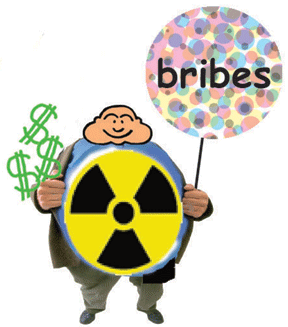 Municipal nuclear addiction, Japan Times, 26 Nov 12 Municipalities hosting nuclear power plants throughout Japan have received large amounts of central government subsidies, donations from utilities and lucrative business contracts Now, 1½ years after the Fukushima nuclear disaste rs, those municipalities realize how much their finances depend on the nuclear power-induced money.
“They’re like drug addicts cut off from supplies,” said a member of the assembly of Niigata Prefecture, which hosts Tokyo Electric Power Co.’s Kashiwazaki-Kariwa nuclear power plant on the Sea of Japan coast. All the reactors at the plant remain shut down after its No. 5 and 6 reactors went offline earlier this year……
Host prefectures and municipalities receive central government grants based on laws designed to promote development of power generation facilities. …. Continue reading
“Low Carbon” – UK government’s excuse for sneaking in nuclear subsidy
 EDF Nuclear Plan Gets Boost From U.K. Low Carbon Funds Bloomberg, By Sally Bakewell – Nov 23, 2012 The U.K.’s plan to collect 7.6 billion pounds ($12 billion) for low-carbon projects by 2020 would advance Electricite de France SA’s nuclear plants and add about a third to consumer electricity bills, analysts said.
The sum, announced today by the Department of Energy and Climate Change, will help pay for the 1.1 billion pounds of support a year needed to build two European Pressurized Reactors made by Areva SA (AREVA) for use at EDF sites in England, as well as renewable plants, according to Credit Suisse Group AG……..
Credit Suisse said Davey’s announcement was of particular importance for EDF Energy and Centrica Plc (CNA), which sought the arrangements.
A spokesman for SSE said, “We are pleased to see that the Levy Control Framework means that the U.K. will be building new power stations, including nuclear and renewables.”
hard questions to UK govt about its subsidies for nuclear power
 Questions over costs of nuclear http://www.scotsman.com/scotland-on-sunday/opinion/letters/questions-over-costs-of-nuclear-1-2658510 Richard Thomson, Ellon 25 November 2012 IF STUART Campbell is correct in his assertion that nuclear power stations in the UK have succeeded in paying their way without subsidy (Letters, 11 November), perhaps he could explain why it was necessary for the UK Government to nationalise a near-bankrupt British Energy, before selling it to EDF for just £12.5 billion without passing on any responsibility for future decommissioning of current sites to the new
owners?
That, however, is in the past. If it’s going to be different in the future, perhaps Mr Campbell could explain why EDF wants a guaranteed minimum electricity price for nuclear of £140 per MW/h – well in excess of what it costs to generate from fossil fuels and most renewables, whether in receipt of subsidy or not?
1 This Month
23-25 October – on Zoom – World BEYOND War’s annual global conferenc


Shut down the radiation-damaged Heysham nuclear reactors now
To see nuclear-related stories in greater depth and intensity – go to https://nuclearinformation.wordpress.com

Say No to NASA’s Reckless Nuclear Reactor on the Moon
Say No to NASA’s Reckless Nuclear Reactor on the Moon
-
Archives
- October 2026 (190)
- September 2026 (339)
- August 2026 (330)
- July 2026 (355)
- June 2026 (287)
- May 2026 (306)
- April 2026 (356)
- March 2026 (251)
- February 2026 (267)
- January 2026 (308)
- December 2025 (358)
- November 2025 (359)
-
Categories
- 1
- 1 NUCLEAR ISSUES
- business and costs
- climate change
- culture and arts
- ENERGY
- environment
- health
- history
- indigenous issues
- Legal
- marketing of nuclear
- media
- opposition to nuclear
- PERSONAL STORIES
- politics
- politics international
- Religion and ethics
- safety
- secrets,lies and civil liberties
- spinbuster
- technology
- Uranium
- wastes
- weapons and war
- Women
- 2 WORLD
- ACTION
- AFRICA
- Atrocities
- AUSTRALIA
- Christina's notes
- Christina's themes
- culture and arts
- Events
- Fuk 2022
- Fuk 2023
- Fukushima 2017
- Fukushima 2018
- fukushima 2019
- Fukushima 2020
- Fukushima 2021
- general
- global warming
- Humour (God we need it)
- Nuclear
- RARE EARTHS
- Reference
- resources – print
- Resources -audiovicual
- Weekly Newsletter
- World
- World Nuclear
- YouTube
-
RSS
Entries RSS
Comments RSS

