Six in 10 Americans Support US Participation in a Nuclear Agreement with Iran.
Chicago Council on Global Affairs, 30 Apr 25
Majorities of Democrats and Independents support a potential deal similar to the 2015 Joint Comprehensive Plan of Action, but only a minority of Republicans agree.
For the first time since the United States withdrew from the 2015 Joint Comprehensive Plan of Action (JCPOA), American and Iranian officials held direct talks to negotiate a new nuclear deal. These talks come amid reports of Iran’s rapid production of enriched uranium and acceleration of its nuclear weapons program.
A recent Chicago Council on Global Affairs-Ipsos survey, fielded April 18–20, 2025, finds a majority of Americans consider a nuclearized Iran unacceptable and believe the United States should negotiate a deal with Tehran to limit its development. While Democrats and Independents support a deal that would trade sanctions relief for limitations on Iranian nuclear enrichment, Republicans oppose such a tradeoff. However, they may end up following US President Donald Trump’s lead if current negotiations bear fruit.
Key Findings
- Eight in 10 Americans oppose Iran obtaining nuclear weapons (79%) and favor taking diplomatic steps (83%) or tightening economic sanctions (80%) to limit further nuclear enrichment.
- A smaller majority of Americans believe the United States should participate in an agreement that lifts some international economic sanctions against Iran in exchange for strict limits on its nuclear program (61%).
- Partisan differences on a nuclear agreement are striking: 78 percent of Democrats and 62 percent of Independents support US participation in a deal with Iran compared to just 40 percent of Republicans.
- If diplomacy or economic sanctions fail, many Americans are willing to take more forceful approaches: Six in 10 support the United States conducting cyberattacks against Iranian computer systems (59%), and half support conducting airstrikes against Iran’s nuclear facilities (48%).
- A majority oppose sending US troops to destroy Iran’s nuclear facilities (60%).
Americans Favor Diplomatic Approach to Iranian Nuclear Development
The 2015 JCPOA, or the Iran Deal, was a landmark agreement reached between Iran and the P5+1 (China, France, Russia, the United Kingdom, the United States, and Germany) that limited Iranian nuclear enrichment in exchange for sanctions relief and other provisions. While it was initially successful in limiting Iran’s stockpile of enriched uranium, the United States withdrew from the deal in 2018, as the first Trump administration considered it insufficient in curbing Iran’s ballistic missile program and protecting American regional interests. Upon the US withdrawal from the agreement, Iran promptly lifted the cap on its stockpile of uranium and increased its enrichment activities; it has since reached weapons-grade levels of enriched uranium.
…………………………………………………………………………………………………………………………………………………………………… Conclusion
Although US President Donald Trump has not ruled out using military action to stop Iran from obtaining a nuclear weapon, he said he favors a diplomatic agreement to address this issue. Recently, Trump administration officials have given contradictory remarks about current talks, and they have yet to specify how renewed negotiations will produce an agreement more stringent and impactful than its predecessor.
The pressure is on American diplomats to secure a deal that would limit Tehran’s nuclear enrichment without providing the sanctions relief that could potentially fund Iran’s efforts to further destabilize the Middle East or threaten the United States’ regional allies, including Israel. While the outcome of these negotiations remains to be seen, the public continues to express a preference for using diplomatic or economic coercion than direct military action. https://globalaffairs.org/research/public-opinion-survey/six-10-americans-support-us-participation-nuclear-agreement-iran?fbclid=IwY2xjawKA64xleHRuA2FlbQIxMQBicmlkETFISGV5ZEdSZW16a2ZnQzh3AR7iwwVkEnczI_DJHzOGHWvNWeSlg2xdd9YJCsBz0_OiQmJcM48Ujd0ZNX8ZNQ_aem_5kroZ8t3KQ5RgYf4EfYdDA
The Great British nuclear expansion is a project bound to fail.
With the government committed to a huge expansion of nuclear power to meet
our energy needs, Andrew Blowers and Stephen Thomas contend that this is an
uneconomic, unachievable and undesirable solution that is doomed to fail.
In 2022, the then Conservative government set a target of having 24GW
(gigawatts) of new nuclear capacity up and running by 2050, despite the
dismal history of cost and time over-runs experienced in developing the
existing plans. If achieved, this would be the equivalent of having eight
more Hinkley Point Cs.
The succeeding Labour government reaffirmed its
commitment to nuclear power in its manifesto, proclaiming that a scale
expansion ‘will play an important role in helping the UK achieve energy
security and clean power’ Neither government was prepared to recognise that
the Great British nuclear expansion is a project bound to fail.
TCPA (accessed) 28th April 2025,
https://www.tcpa.org.uk/sample-journal-content/
Utahns must think carefully about becoming the nation’s nuclear hub
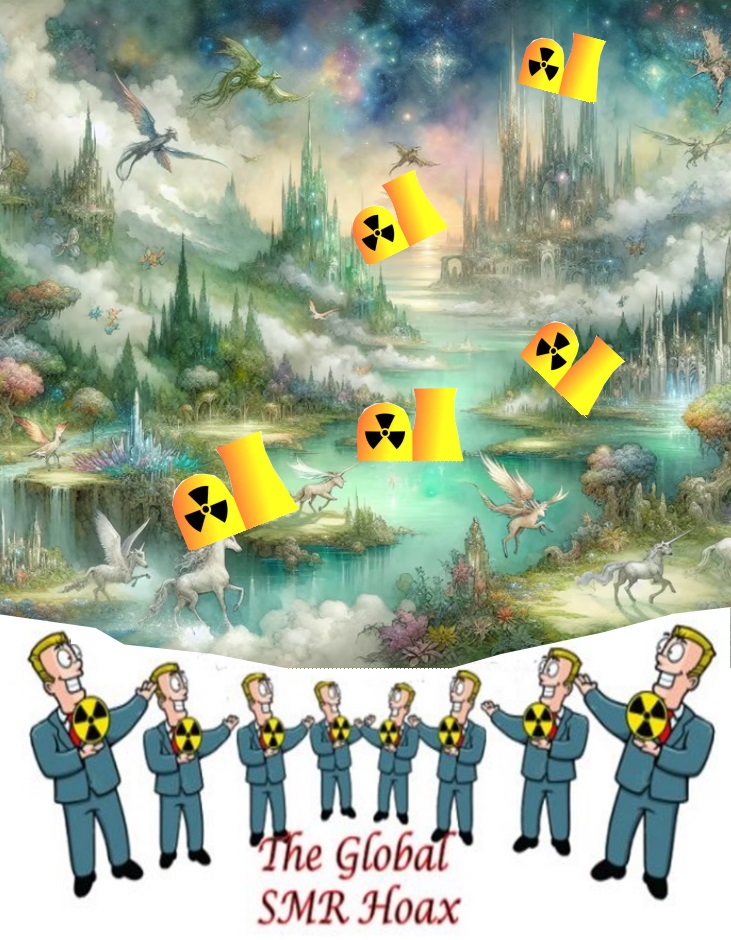
the risk of investing millions of taxpayer dollars in technology that’s yet to be implemented on a large scale. The investment required to develop nuclear power plants is massive. The state has lauded microreactors and SMRs as the stuff of the future.
We call on all Utahns to evaluate nuclear energy’s cost, timeline and environmental impacts
April 26, 2025, By Danielle Endres, Madi Sudweeks,
https://www.deseret.com/opinion/2025/04/26/utah-risks-of-nuclear-energy-hub/
Danielle Endres, Ph.D., is a professor at the University of Utah whose research focuses on energy democracy. Madi Sudweeks is a lifelong Utahn and a graduate student studying nuclear energy and environmental justice. The views expressed in this op-ed are their own and do not necessarily represent those of the University of Utah.
Utah’s Legislature has put hope in nuclear energy as a key component of our state’s future energy mix. At the start of the 2025 legislative session, Senate President Stuart Adams proclaimed that he wants Utah to be the “nation’s nuclear hub.” Governor Spencer Cox, likewise, included nuclear energy in Operation Gigawatt, an initiative aimed at doubling the state’s energy production over the next 10 years. With the passage of HB249, the state created the Nuclear Energy Consortium to advise nuclear energy development in Utah. Now we must consider whether nuclear energy is right for our state.
To ensure decisions about how we will power Utah’s future are as democratic as possible, all Utahns should be part of the deliberation. We call on Utahns, including our Legislature, governor and the Nuclear Energy Consortium, to evaluate nuclear energy’s cost, timeline and environmental impacts.
We have already seen how costly nuclear development can be here in Utah. In 2015, Utah Associated Municipal Power Systems (UAMPS) partnered with NuScale on a small modular reactor (SMR) project, planned to be at Idaho National Labs and provide power to several towns in Utah by 2030. The project was canceled in November 2023 after cost estimates increased from $3 billion to $9 billion.

This failed project reveals the risk of investing millions of taxpayer dollars in technology that’s yet to be implemented on a large scale. The investment required to develop nuclear power plants is massive. The state has lauded microreactors and SMRs as the stuff of the future. They claim new technology will make nuclear energy safer, easier to produce and cheaper. However, the electricity produced by UAMPS/NuScale project would have been more expensive than that produced by the most recent traditional nuclear power plant to come online in the U.S.
That project was not an exception. A 2013 Union of Concerned Scientists report shows that SMRs will be more expensive than traditional nuclear plants.
Developing nuclear power is costly and time-intensive. A 2014 study by Dr. Benjamin Sovacool and colleagues demonstrated that a sample of 175 nuclear reactors took on average 64% longer than projected. Dr. Arjun Makhijani argues that nuclear power is too slow and too costly to meaningfully reduce emissions, especially when renewables like solar and wind are ready now and cheaper than ever.
The state’s call to become a nuclear powerhouse is another iteration of the nuclear renaissance we saw in the early 2000s. However, calls for nuclear development in response to climate change then did not result in an increase in nuclear power. Nuclear consistently provides about 20% of electricity for the U.S. Skeptical public opinion, accidents at TMI and Chernobyl, cost, and long construction times have meant that only three new reactors have come online since the 1990s.
Now we’re seeing a new version of a call for a nuclear renaissance. In Utah, Adams said we need nuclear energy to meet the energy demand of Artificial Intelligence (AI). AI requires massive amounts of power and water; experts expect power demand to skyrocket with the computing power needed for AI. Because tech companies have committed to reducing greenhouse gases, they are looking to nuclear power to supply the increased demand because, proponents argue, it can supply stable electricity that intermittent solar and wind energy cannot. However, there are other ways to provide baseload or surgable electricity, including battery storage and geothermal.
Whether or not nuclear energy ends up powering AI, we should be asking ourselves if it is worth the cost and if Utah, already threatened by drought, should be seeking out such a water and energy-intensive industry. Our communities and our environment will continue to pay the price with our tax dollars, our water and our power.
There is no one energy source that is inherently good. Each requires resources and has an impact on its surrounding communities and environments. If Utah is going to consider nuclear power, we call for state leaders and Utahns to engage in a nuanced and research-based analysis of its benefits and risks. Our own analysis makes us skeptical that it’s the right energy source for Utah. And we’re not alone — a former nuclear engineer also recently made the case against nuclear power for Utah.
Remembering Chernobyl: Why not developing Wylfa B is a no-brainer.
26 Apr 2025, Robat Idris, https://nation.cymru/opinion/remembering-chernobyl-why-not-developing-wylfa-b-is-a-no-brainer/
26th April 2025 marks the 39th anniversary of the catastrophic nuclear explosion in Chernobyl, Ukraine – which, at the time, was part of the Soviet Union.
It’s worth reminding people of the effects of that horrific event. Tens of thousands of children and adolescents developed thyroid cancer in Ukraine, Belarus and Russia, and children from affected areas have been welcomed here for respite holidays.
Genetic problems have been observed in the wildlife of the area. The area around the nuclear plant is still uninhabited.
Moreover, the rain that fell in Wales following the explosion caused radioactive pollution, even though we were 1,600 miles away. As a result, there was a serious impact on the agricultural industry, with upland lamb being banned from entering the food chain until tests showed that the level of Caesium-137 radiation had been adequately reduced.
Restrictions were placed on 9,800 farms, most of them in Wales and Cumbria. The final restrictions were not lifted until 2012 – 26 years after the explosion.
Why mention this now?
Because Chernobyl is in a country that is in the middle of war; a country that contains other nuclear reactors such as Zaporizhzhia, the largest nuclear complex in Europe. Because a shell built over the reactor at Chernobyl in order to prevent radiation from escaping was hit by a drone on the 14th of February this year. Because it is the first war that is being fought in a country where there are active nuclear reactors.
And because this nightmare could happen to us.
War target
With all the talk of preparing for war by political parties in Westminster, the British State’s obsession with nuclear energy and nuclear weapons is extremely dangerous. Consider that Starmer wants to see nuclear plants all over the State! All would be a target in war. And all need to be protected by special police.
All of this is another reason for opposing nuclear, though there are enough already – the radioactive waste without a long-term solution; the fact that waste would be on site for over a century; the dangers of fire; the fact that it will not be possible to build enough nuclear to have an impact on climate change; the diversion of funds and resources from renewable energy; the environmental mess associated with uranium mining; the threat to the Welsh language by thousands of workers for a large station; the likelihood that relatively few workers would be needed for operating a Modular Reactor (SMR); the extreme cost.
No-brainer
Yet as reported in Nation Cymru, Llinos Medi, the Member of Parliament for Ynys Môn at Westminster, has claimed in the House of Commons on 8 April 2025 that the development of a site at Wylfa is a ‘no-brainer’.
We respectfully ask her to reconsider this statement, and see why NOT building Wylfa B is a ‘no-brainer’. Here are, in short, 10 additional reasons.
The people of Anglesey need work – Llinos and PAWB at least agree on this! Nevertheless, since Tony Blair’s Energy Review in 2006, the main political emphasis of all levels of government has been on supporting Wylfa B. Where is the evidence that nuclear work is what the people want? The portraying of nuclear power over so many years as essential is economic recklessness.
In a world where there is uncertainty about the relationship with the United States, shouldn’t we be as wary of American investment in infrastructure as we are with investments from China?
As there are no licensed Modular Reactors (SMR’s), wouldn’t it be foolish for Ynys Môn to be a laboratory for this untested technology? And where are the reliable figures for how many permanent jobs would be needed?
The link between civil and military nuclear is undeniable, and is recognized by none other than Rolls-Royce, which is in the race to build SMR’s. As a representative of Plaid Cymru, a party that opposes nuclear weapons, this should be an essential consideration. Llinos, to her credit, is in the Welsh tradition of raising a voice against war, as she has done for Gaza.
A nuclear power station at Wylfa would create more dependence on the Westminster government, as huge public funding would be required, not only for construction, but for eventual decommissioning for tens of years.
On the other hand, sustainable energy could not only create jobs, but also generate income. The marine energy project, Morlais, shows what is possible.
Energy ownership
Energy ownership is crucial – the profit from nuclear would be exported. Similarly, sustainable energy must be in our hands, or we will export the profits that we generate. Green energy in the right place, not on hundreds of agricultural acres for the benefit of multinational companies.
It must be asked in whose interests the Starmer Government is working. Large American companies such as BlackRock are favored to invest in infrastructure. It intends to undermine the right of local communities to oppose major plans. What democracy is this?
Why do companies like Microsoft, Amazon and Google have investments in nuclear energy? The reason is data centers, which use electricity on an enormous scale, and moreover require a large amount of water to keep them from overheating. 21% of Ireland’s electricity goes to data centres (2023). Water demand is at its peak when the weather is hot and dry – which is exactly when water is scarce in reservoirs. A warning to Ynys Môn!
The growth agenda – represented in Ynys Môn by Wylfa B – runs counter to the needs of the planet, and the needs of Ynys Môn and Wales. Sooner or later, politicians will have to recognize how dire the situation is before it’s too late.
Prosperous future
The challenge for Llinos Medi is to find a way to make a reality of what we ALL would fully support – a prosperous future for Ynys Môn and its people – but without a nuclear power station. After almost two decades of supporting Wylfa B, our economic situation is desperate. The legacy she wishes the children of the island to inherit are good and sustainable jobs, with the ability to afford to live here instead of having to leave. That’s our hope too.
PAWB (People Against Wylfa B), as ever, is ready to offer constructive ideas, as it did with the ‘Maniffesto Môn’ written by the late Dr Carl Clowes back in 2012. How about it, Llinos?
The Australian Labor Party is No Friend of the Nuclear-Free Cause.

https://theaimn.net/the-australian-labor-party-is-no-friend-of-the-nuclear-free-cause/ 26 Apr 25
I’m thinking that the nuclear lobby loves the ALP even more than it loves the Liberal Coalition opposition party.
Advance Australia, and the U.S-controlled Atlas Network are powerful and well-funded groups dedicated to molding public opinion on behalf of wealthy right-wing groups. They did a fine job in 2023 of destroying Australian support for the 2023 Australian referendum on the indigenous Voice to Parliament.
I was expecting them to pretty much run riot in support of the Liberal Coalition’s plan for a nuclear Australia. That does not seem to have happened. Why not?
Advance “kicked off with outright lies“, but has been rather quiet lately. And the Atlas Network is nowhere in sight, although its modus operandi is secretive anyway, spreading simplistic memes.
My conclusion is that Peter Dutton’s Liberal Coalition campaign is so inept, so incompetent, that it has turned out to be counter-productive to the party’s cause. There’s just so much evidence of this ineptitude – particularly when it comes to the estimated costs of setting up seven nuclear power plants around Australia. The latest of many examinations of these costs is – “Coalition’s nuclear gambit will cost Australia trillions – and permanently gut its industry.” Half-baked plans to keep old coal-power plants running for many years until nuclear is “ready”, no mention of plans for waste disposal, – the tax-payer to cop the whole cost. Even a suave sales magician like Ted O’Brien has not been able to con the Australian public. The party’s incompetence is on show in other ways, too, unconnected to the nuclear issue.
But what of Labor? They have been remarkably quiet on the nuclear issue – focussing on their own rather ha[f-baked plans for housing. It’s all cost-of-living issues – and I don’t deny that this is important. But nuclear rarely gets a mention – except when Labor finds it useful to mention the costs.
It doesn’t look as if Peter Dutton’s Liberal Coalition has a hope in hell of getting a majority win for its nuclear platform.
But does the nuclear lobby really care? I’m afraid not. You see, the Labor Party, supposedly opposed to the nuclear industry, has a long tradition of caving in on nuclear issues. From 1982 – a weak, supposed “no new uranium mines” policy became a “three mines uranium policy” 1984 then a pathetic “no new mines policy” in the 1990s. Backing for South Australia’s uranium mines further weakened Labor anti-nuclear policy.
Over decades, Labor luminary Gareth Evans has been acclaimed for his supposed stance against nuclear weapons. But he’s done a disservice to the nuclear-free movement, in his long-standing position in favour of “the contribution that can be made by nuclear energy capable of providing huge amounts of energy, and just as clean as renewables in its climate impact”. Evans has always been close to the International Atomic Energy Agency, in his complacency that nuclear power has nothing to do with nuclear weapons!
Labor has always been officially opposed to nuclear power, but at the Federal level, and some State levels, there have always been significant Ministers like Bob Hawke, and Martin Ferguson, who pushed for the nuclear industry. To his credit, Anthony Albanese for a long time held out against the nuclear industry. Even up until 2024, he was still trying .
But the crunch had already come – Albanese on Thursday, 16th September 2021 – “We accept that this technology [nuclear-powered submarines ] is now the best option for Australia’s capability.”
Why did Albanese agree to this deal, arranged between the Morrison Liberal government, and the USA and UK? Apparently, he did so, after just a two-hour briefing, with no documents provided, on the previous day. Labor Caucus was presented with it as a fait accompli. No vote was taken.
I can only conclude that Albanese’s decision was based on that time-honored fear of Labor looking “weak on security”.
In one fell swoop, Labor’s anti-nuclear policy was wrecked. The nuclear submarines will mean nuclear reactors on Australia’s coast. The will mean nuclear waste disposal in Australia, including foreign nuclear waste from the second-hand submarines. They will surely eventually mean nuclear weapons, as who can really tell if a nuclear-powered submarines has or has not got nuclear weapons? (The Chinese will be very wary about them.)
Since 2021, Australia’s nuclear submarine arrangement has been largely in the hands of Defence Minister Richard Marles, who worked with that dodgy company PWC to set it up, and who is a committed supporter of Australia’s solidarity with the USA.
March 2023 – Prime Minister Anthony Albanese, US President Joe Biden and UK Prime Minister Rishi Sunak unveiled the path to acquiring nuclear-powered submarines.
“In 2024, Australian Prime Minister, Anthony Albanese, made undisclosed “political commitments” with its AUKUS partners in an agreement for the transfer of naval nuclear technology to Australia, sparking concerns about the potential for high-level radioactive waste to be stored in the country. “
The global nuclear lobby works across national boundaries to promote its industry. It does well with Russia – as government clamp-down on dissent makes it easier to expand the industry in all its forms, and to market nuclear power to Asian ana African countries.
The nuclear industry is well aware of the problems in maintaining the belief that nuclear is clean, cheap, and climate friendly. But above all, it’s the nuclear-waste problem that its most expensive and difficult obstacle. Here’s where Australia has always looked appealing. All this nonsense about getting small nuclear reactors is just a distraction . The industry knows that small nuclear reactors are fraught with difficulties – too expensive, requiring too much security, public opposition at the local level, still needing too much water……… But to keep the global industry going, a nuclear-waste-welcoming country would be such a boost.
Well, it is early days, even for the prospect of those AUKUS nuclear submarines ever actually arriving. But in the meantime – the whole AUKUS thing has quietly introduced the Australian public to the idea that nuclear submarines are OK, and so are their wastes, and so are USA nuclear weapons based in Australia.
So, really, the Australian Labor Party has done a much better job of promoting the nuclear industry, than the fumbling Liberal Coalition could.
We are fortunate inn Australia to have proportional representation in our election. If you care about keeping Australia nuclear-free, you don’t have to vote for either of the big parties.
The Ever-Expanding War Machine
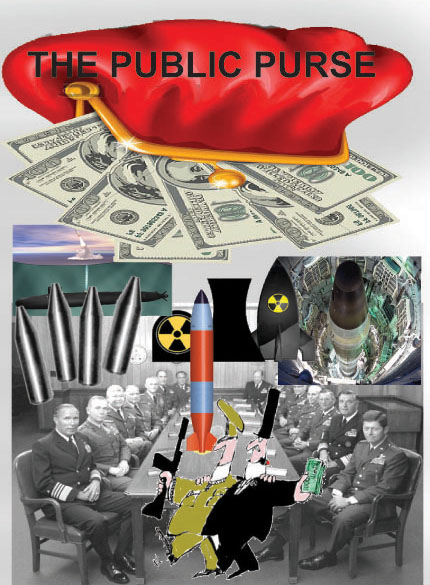
Dismantling the Government While Pumping Up the Pentagon
By William D. Hartung, April 22, 2025 https://tomdispatch.com/the-ever-expanding-war-machine/
Under the guise of efficiency, the Trump administration is taking a sledgehammer to essential programs and agencies that are the backbone of America’s civilian government. The virtual elimination of the U.S. Agency for International Development (USAID) and plans to shut down the Department of Education are just the most visible examples of a campaign that includes layoffs of budget experts, public health officials, scientists, and other critical personnel whose work undergirds the daily operations of government and provides the basic services needed by businesses, families, and individuals alike. Many of those services can make the difference between solvency and poverty, health and illness, or even, in some cases, life and death for vulnerable populations.
The speed with which civilian programs and agencies are being slashed in the second Trump era gives away the true purpose of the Department of Government Efficiency (DOGE). In the context of the Musk-Trump regime, “efficiency” is a cover story for a greed-driven ideological campaign to radically reduce the size of government without regard for the human consequences.
So far, the only agency that seems to have escaped the ire of the DOGE is — don’t be shocked! — the Pentagon. After misleading headlines suggested that its topline would be cut by as much as 8% annually for the next five years as part of that supposed efficiency campaign, the real plan was revealed — finding savings in some parts of the Pentagon only to invest whatever money might be saved in — yes! — other military programs without any actual reductions in the department’s overall budget. Then, during a White House meeting with Israeli Prime Minister Benjamin Netanyahu on April 7th, Trump announced that “we’re going to be approving a budget, and I’m proud to say, actually, the biggest one we’ve ever done for the military . . . $1 trillion. Nobody has seen anything like it.”
So far, cuts to make room for new kinds of military investments have been limited to the firing of civilian Pentagon employees and the dismantling of a number of internal strategy and research departments. Activities that funnel revenue to weapons contractors have barely been touched — hardly surprising given that Musk himself presides over a significant Pentagon contractor, SpaceX.
The legitimacy of his role should, of course, be subject to question. After all, he’s an unelected billionaire with major government contracts who, in recent months, seemed to have garnered more power than the entire cabinet combined. But cabinet members are subject to Senate confirmation, as well as financial disclosure and conflict-of-interest rules. Not Musk, though. Not only hasn’t he been vetted by Congress, but he’s been allowed to maintain his role in SpaceX.
A Hollow Government?
The Trump and Musk hollowing out of the civilian government, while keeping the Pentagon budget at enormously high levels of funding, means the United States is well on its way to becoming the very “garrison state” that President Dwight D. Eisenhower warned against in the early years of the Cold War. And mind you, all of that’s true before Republican hawks in Congress like Senate Armed Services Committee Chairman Roger Wicker (R-MS), who is seeking $100 billion more in Pentagon spending than its officials have asked for, even act.
What’s at stake, however, goes well beyond how the government spends its money. After all, such decisions are being accompanied by an assault on basic constitutional rights like freedom of speech and a campaign of mass deportations that already includes people with the legal right to remain in the United States. And that’s not to mention the bullying and financial blackmailing of universities, law firms, and major media outlets in an attempt to force them to bow down to the administration’s political preferences.In fact, the first two months of the Trump/Musk administration undoubtedly represent the most blatant power grab by the executive branch in the history of this republic, a move that undermines our ability to preserve, no less expand, the fundamental rights that are supposed to be the guiding lights of American democracy. Those rights have, of course, been violated to one degree or another throughout this country’s history, but never like this. The current crackdown threatens to erase the hard-won victories of the civil rights, women’s rights, labor rights, immigrant rights, and LGBTQ rights movements that had brought this country closer to living up to its professed commitments to freedom, tolerance, and equality.
Continue readingNew Brunswick government rethinks nuclear reactor plans.

COMMENT. Thanks to our Green Party leader MLA David Coon for stating the case against, as he has been doing for more than a decade now. The article mentions that the government is also considering another CANDU reactor, which is interesting. I think the push is on now to buy Canadian… Unfortunately for the New Brunswick economy, the current CANDU 6 reactor has been a financial nightmare.
Matthew McClearn , April 22, 2025, https://www.theglobeandmail.com/business/article-new-brunswick-government-rethinks-nuclear-reactor-plans/
Small modular nuclear reactors remain part of New Brunswick’s plans for future power generation, the province’s Energy Minister says, but it may select more conventional models – and build them later – than originally envisioned.
New Brunswick originally intended to construct one or two reactors by 2030 at its Point Lepreau Nuclear Generating Station, Atlantic Canada’s only nuclear power plant. It has started predevelopment work for up to 600 megawatts of generation capacity from new SMRs, which would be roughly equivalent to the output of its current lone reactor.
But René Legacy, who became energy minister and deputy premier in November after the Liberals defeated the Conservatives in the provincial election, has been tasked with drawing up a new energy plan.
In an interview, Mr. Legacy said SMRs remain attractive because their output is better matched with the province’s needs than those of large reactors. However, he added, the government is considering different models from those of its existing partners, and expects a delayed construction timeline.
The province and its wholly owned utility, New Brunswick Power, partnered in 2018 with ARC Clean Technology and Moltex Energy Canada Inc. Both promoted reactors featuring novel coolants, fuels or moderators that are not traditionally used in commercial power generation, and neither had built reactors previously. However, both companies struggled to raise sufficient funds and recruit the hundreds of employees typically required for reactor development.
“The original plan to have one or two of the reactors built for 2030, that time frame is probably not going to happen,” Mr. Legacy said, adding that first-of-a-kind reactors are expensive while acknowledging the province’s fiscal constraints.
“So we’re looking at, probably, different options.”
Adjustments to New Brunswick’s SMR strategy arrive at a moment of great uncertainty for the province’s energy sector. Premier Susan Holt has promised a far-ranging consultation concerning the future of NB Power, which has struggled unsuccessfully to reduce its debt burden and faces significant spending to replace or refurbish aging infrastructure. Point Lepreau spent most of the past year out of service during planned and unplanned outages.
Mr. Legacy said that while the 2030 deadline for constructing SMRs is likely not achievable, changing circumstances have afforded more breathing room for the province to select a reactor technology. A new gas-fired power plant is scheduled to begin operating in 2028, and the federal government recently announced up to $1-billion in funding for up to 670 megawatts of Indigenous-led wind projects. Amendments to federal regulations have afforded the province “a little bit of a longer runway” to convert its coal-fired Belledune Generating Station, in Gloucester County, to burn biomass.
“At the very latest, we’re going to need some shovels in the ground around 2035, because some of our assets are going to come close to end of life, and we’re going to have to replace that generation,” he said.
“So we’ll have to make a decision and start moving towards a technology now.”
Mr. Legacy said New Brunswick Power is studying reactors already being considered for deployment in other provinces. These include the BWRX-300, which was designed by GE Hitachi Nuclear Energy; Ontario Power Generation plans to construct the first one at its Darlington Nuclear Generating Station by 2028. Another candidate is Westinghouse Electric Co. LLC’s AP300, a proposed design Westinghouse based on its larger AP1000, several of which have been constructed worldwide.
Mr. Legacy said the province is also considering a Candu reactor, which implies large reactors are not off the table. (SMRs are typically defined as having capacities below 300 megawatts, but there are no Candus currently marketed in that range. Point Lepreau’s existing reactor, a 660-megawatt Candu-6, entered service in 1983.)
ARC is still in the running, Mr. Legacy added, but the company must find a financial partner. Also, its ARC-100 reactor would require high-assay low-enriched uranium (HALEU), which is not produced commercially in North America. (Russia is the lone major supplier.) This month, the U.S. Department of Energy committed to provide HALEU to five U.S. reactor developers, with deliveries beginning as early as this fall; ARC was not among them. Mr. Legacy said ARC must ensure fuel availability as “part of their package.
As for Moltex, the province remains interested in its Waste To Stable Salt technology, which contemplates reprocessing spent nuclear fuel into new reactor fuel. But “Moltex is probably more of a longer play” than ARC, he added.
David Coon, leader of the province’s Green Party, said the former Conservative government regarded SMRs as an economic development and hoped to export them globally. The new Liberal government isn’t looking to subsidize SMR development, preferring reactor models that have already been constructed elsewhere.
Mr. Coon said SMRs aren’t appropriate for New Brunswick because they’re “extremely costly” and produce radioactive waste. Better bets, he said, would include improved energy efficiency, utility-scale battery storage, more wind generation and increased sharing of electricity with neighbouring provinces.
“We can’t afford it, it’s not clean and we don’t need it,” he said of nuclear energy.
Drawing inspiration from Vaclav Havel..

https://www.artistespourlapaix.org/3-ans-de-souffrances-ukrainiennes/
Par Pierre Jasmin, Artiste pour la Paix, 21 février 2025


1 Vaclav Havel and the Art of Compromise
Unfortunately, I never knew Vaclav Havel personally, even though I gave masterclasses (except for one in Piešťany, Slovakia), concertos, and recitals in the Czech Republic for fourteen summers between 1991 and 2005. I therefore had the privilege of experiencing the miracle of the Velvet Revolution in a country as Eastern European as Ukraine. The ruling communist party, allied with the Soviet army that had bloodily halted Dubcek's revolution, sought out a humanist playwright from prison in 1989 and installed him in the presidential seat. The new Havel government accepted the separation of Czecho-Slovakia less than three years later, without a drop of bloodshed.

Five years after the first Minsk Treaty (UN), mistreated by our Minister Baird, an accomplice of the fascist Poroshenko, a similar hope arose in Ukraine with the election of the comedian Zelensky in May 2019. This unprecedented electoral moment unfolded in the first round with the defeat of the comfortable Russian gas option (to prevent the elderly from dying in their poorly insulated homes) represented by the succession of the corrupt President Yanukovych, deposed by the Maidan revolution in 2014, and then, in the second round, of the outgoing head of state, Poroshenko.

But unlike Havel, Zelensky, with 73.2% of the vote, surrounded himself with nationalist Bandera supporters who threatened his life to force him to bomb Donbass and join his country to the militaristic NATO, thus provoking the Russian invasion of his country. In a context of devastating war, he avoided running for re-election.

Our government, Radio-Canada, and professors like Dominique Arel, the only ones authorized to speak (Artists for Peace are censored), are imposing the obstinacy of unconditional Canadian support for this Zelensky, corrupted by Biden's weapons and money, against the imposition of a peace desired by the sacrificed young people in the trenches of Donbass, those who survived, and by the improbable Putin-Trump duo. Other arguments can be read in ().
This point 1 was an “opinion” sent to Le Devoir on Wednesday, which did not publish it. On February 20, Arel was among six university colleagues who cowardly avoided contradicting his pro-Zelensky propaganda, except for Frédérik Gagnon of UQAM: see point 7.
Lviv and its troubled history
Putin is blamed for having wanted to invade the whole of Ukraine as early as the end of February 2022 with his advance near Kyiv, which aimed to bomb the arms factories and munitions located in the capital and in Lviv. Why this former capital of Galicia, which also bore the Austrian name of Lwow, the German name of Lemberg, and the Polish name of Lvov? The answer lies in the murky history revealed in two books I read by Philippe Sands, “Return to Lemberg” and “The Line.” With a complacent ambiguity that delighted his far-right readers at Albin Michel, the Franco-British lawyer recounts the romanticized saga of Charlotte, the Nazi wife of Otto von Wächter. A member of the Nazi Party since 1923, the latter became, after the outbreak of the Second World War, governor of Krakow in Poland, then governor of the district of Galicia, two territories that were noted for the mass extermination of Jews whom he saw as allies of the Bolshevik Soviet Union. “Handsome Otto” praised Lemberg, a place far more welcoming to his family than Berlin and Krakow, as it fully shared Nazi ideology. He evaded justice until 1949, notably due to complicity in the Vatican.
Before his two questionable books, Sands had worked on the horrors of the Rwandan genocide, the Bosnian-Serb massacres, Guantanamo, and the invasion of Iraq by Blair and Bush, but not Jean Chrétien, following our mass demonstrations in Montreal motivated by the UN’s refusal to endorse the war, given the conclusions of the Swede Hans Blix exonerating Saddam Hussein of possessing weapons of mass destruction. We should also read Sands’s 2006 book, prophetic of the recent marginalization of the UN by Biden, Trump, Macron, etc., Lawless World, subtitled Torture Made in the USA (Music And Entertainment Books, 2009), in which he denounced the use of music at Abu Ghraib by CIA agents and the American army, sentenced last November to pay millions of dollars to compensate three victims (who were better defended than the thousands of others).
February 21: A Ukrainian historian exposes the “real” Zelensky
Hosted by Clark University (Atlanta), historian Marta Havryshko, a graduate and professor at the University of Lviv (!), received death threats for criticizing the Ukrainian far right, to which she retorted:
“Every day, we lose parts of our territory. Every day, we lose people. Every day, our children suffer from missile and drone attacks. And we don’t know the consequences.”
She commented for Aaron Maté on the destruction of her homeland by a proxy war waged between Russia and the United States, with Zelensky’s complicity:
“Those who want to continue this disaster, this hell,” she said, addressing the foreign warriors and those who criticized her for seeking peace, “ARE THEY READY TO SACRIFICE THEIR LIVES, and those of their brothers, sons, and other beloved family members, FOR THE ABSURD IDEA OF ACHIEVING VICTORY? “Russia is bigger, resourceful, with powerful friends. I cannot conceive that anyone who is not mentally disturbed can truly believe that Ukraine can change the situation on the front and reconquer the lost territories.”
Marta observed family members forced to fight and die in this proxy war. She showed Aaron Maté newsreels showing the army Ukrainian forces hunting and kidnapping men to force them to become conscripts to replace soldiers who are dying (or being sent to hospitals).
“Who will recapture these territories? Several of my friends, several of my relatives, are conscripted now. They suffer from suicidal thoughts, they suffer from despair or intense frustration. No one can replace them because of the problems with forced mobilization, and because we simply lack manpower.“
And she explains that everyone (except the neo-Nazis) blames Zelensky:
“His popularity has plummeted (even though television channels are censored). Ukraine under Zelensky is no longer a democracy.“
American Caitlin Johnstone adds that anyone who doesn’t support a ceasefire is a monster (of ignorance, I might add, to soften her attack).
4 abi Yar
Western censorship of Russian music, even that of a genius like Dmitri Shostakovich, is applied, for example, to the excellent Italian film The Rape. Fortunately, in 2019, the Montreal Symphony Orchestra and Nagano programmed his thirteenth symphony with the choir featuring the composer David Sela. Through a long poem by the Ukrainian Yevtuchenko (whose ex-wife, the poet Bella Achmadulina, I met in Moscow in 1978 and 1987), the Babi Yar symphony, his masterpiece, denounces the worst pogrom of all time, perpetrated by Ukrainian einsatzgruppen: 33,771 Jews murdered on the night of September 29-30, 1941. Why don’t pro-Netanyahu activists say a word about this humanist work? Because NATO supports Israel?
5 – Chrystia Freeland vs. Glenn Michalchuk
We won’t dwell on the nefarious role played since 2015 by the granddaughter of a Ukrainian Nazi, up until the horrific House of Commons ceremony that gave a standing ovation to Zelensky and the old Nazi soldier Hunka, much to the dismay of our dear friend Glenn Michalchuk, National President of the Association of United Ukrainian Canadians and a peace activist in Winnipeg, who spoke with the Artists for Peace on November 24 at the Pan-Canadian Justice and Peace Network Counter-Summit ().
6 – Colleague David Mandel
and Sachs, Guterres, Swanson, Rabkin, Philpot, Saul, Seymour, Maté, Lorincz, Stone, etc.
A full professor of political science at UQAM, David, who is Jewish, had a devastating experience following Ukraine’s breach of the UN treaty signed in Minsk in 2014: he spent his summers with trade unionists in the Ukrainian Donbass who were being bombed by the Azov Battalion; here’s a photo that triggers warnings from the Royal Canadian Mounted Police on my computer every time I share it, even though my intention is not to claim that the Nazification of Ukraine was a major phenomenon in the population.

(on the original of this photo, the man on the left is making a NAZI salute)
But here as elsewhere, for example in Germany on this election day where the AfD is increasing its support through a fierce campaign against immigrants and the illusion that more money for the army will solve the problems, the vociferous extreme right is taking an exaggerated position.
Supported by Professor Jeffrey Sachs of Columbia University, also an advisor to Antonio Guterres, David Swanson of World Beyond War writes: “NATO is not what its defenders imagine it to be. NATO is neither legal nor legalistic. It is a violation of the UN Charter for a group of nations to swear to join each other’s wars, and it does not legalize, authorize, legitimize, or sanctify a war.” Amen to the British-American wars in Iraq, Syria, and Afghanistan, at the cost of hundreds of thousands of deaths. A warning to journalists who still lie about the obvious.
7 – UQAM and the Raoul Dandurand Chair – Forum on February 20 at 12:30
Seven guests, including six university professors, spoke, repeating media nonsense. Third, then first in line to ask questions, the organizers (who know me) interrupted the presentation four minutes before the scheduled start time of 2:00 p.m. PAIX’s opinion is not welcome among intellectuals, who find it too simplistic…and, above all, anti-government.
The APLP really don’t like dictators Putin and Trump, but if they stop the war, on this point alone, we will congratulate them. The same goes for Elon Musk, if he succeeds in cutting the American military budget in half as he says he intends to do. Are the left-wing ideologues disowning us? We reassure them that as soon as these two objectives are achieved (?), we will collaborate in the fight for equality, fraternity and liberty…
8. Good news in Berlin with the award of a special prize on February 18th to the following film, which we loved for its objectivity on Hamas and the fate of civilians in the Gaza Strip following the Israeli bombings that decimated the family of this great humanist
ANNE LINDSEY DENOUNCES MARK CARNEY’S NUCLEAR TEMPTATIONS.

Article published on April 16 in the Winnipeg Free Press. https://www.artistespourlapaix.org/anne-lindsey-denonce-tentations-nucleaires-carney/
IN this “flag-waving” moment, where the U.S. government is threatening our sovereignty and economic well-being, it now appears the federal election is the Liberals’ to lose.
Amid the hype and adulation for Liberal Leader Mark Carney, however, the Liberals are promoting ideas that merit a closer look. Not least their plan to “make Canada the world’s leading energy superpower” announced in Calgary on April 9.
On the surface, it looks like the perfect recipe for self-reliance in energy and building a stronger Canada. It’s an industrial development strategy meant to exploit our natural mineral resources, build needed infrastructure and create jobs.
But what kind of energy and infrastructure? The plan includes many welcome and essential commitments to reducing emissions: investment in zero-emission vehicles, developing battery and smart grid technologies, reducing methane, and references to our “clean energy advantage.”
But there is also this nagging notion of “dominating the market in conventional energy” and building out pipelines… neither of which square with the looming climate emergency, regardless of (and exacerbated by) the external pressures from the south.
The “clean energy advantage” is not well defined. Conventional wisdom suggests it includes hydropower, renewables like solar, wind, and geothermal energy, along with energy efficiency. However, although Carney mentioned “more nuclear, both large scale and small modular” in his Calgary announcement, the word “nuclear” is absent from the written plan.
Why? Nuclear is a controversial energy technology, for good reason. It seems inevitable that nuclear power will play a starring role in Canada’s energy future but not one the Liberals want to highlight.
Nuclear’s proponents might be winning the semantic battle branding it as “clean,” despite its routine operations releasing a cocktail of radioactive substances, its waste products containing among the most dangerous elements on the planet, and its inextricable link to the manufacture and proliferation of nuclear weapons.
Federal Liberals (and for that matter, Conservatives) have always been pro-nuclear, even though no nuclear plants have been built in Canada for decades. The annual federal expenditure on Crown corporation Atomic Energy of Canada Limited is more than $1 billion, due in no small part to the massive liabilities of managing nuclear waste. Tax credits for nuclear companies already abound.
Just this year, in the month of March alone, the current Liberal government committed another nearly half a billion dollars to a variety of nuclear projects across the country. The plan may not talk, but money does.
Mark Carney himself, a former UN special envoy on climate change and finance, has said there is “no path to net zero without nuclear.” In 2022, he joined Brookfield Asset Management, a firm holding both renewable energy and nuclear portfolios that, together with uranium giant Cameco, purchased bankrupt reactor company Westinghouse, under his watch. No question that Carney has a strong pro-nuclear bent.
More nuclear energy is an inappropriate climate action response, for at least two reasons. First, reactors take decades to be licensed, constructed and connected to the grid. And that’s a luxury we can’t afford.
Business as usual while waiting for nuclear power to get online means we surpass the tipping points of global warming, a scenario we must avoid.
Second, nuclear is the costliest way to generate electricity. Studies by organizations from the Ontario Clean Air Alliance to Lazard show that nuclear is not competitive with renewable alternatives which continue to drop in price. As governments fund nuclear, there is a massive lost opportunity cost for developing cheaper and readily available renewable energy.
Nuclear is too slow and too expensive to address climate change. The IPCC shows nuclear to be inefficient in reducing emissions. This is not an ideological perspective. It is fact.
Besides, “new generation” reactors being touted in Canada (such as GE Hitachi’s BWRX300) carry a massive political liability, given current world events: most are American designs and all require enriched uranium fuel fabricated outside Canada.
Hardly a prescription for self-sufficiency. It’s a bit mysterious why “nuclear” does not appear in Liberal election plans while getting so much government (Liberal and Conservative) attention and money — unless we recognize the essential role of civilian nuclear infrastructure in maintaining weapons of mass destruction. Canada was instrumental in building the first atomic bombs and remains central to today’s U.S. defence/weapons supply chains for critical minerals, including uranium. Let’s keep that in mind as leaders negotiate trade and tariffs.
Canada should define itself not by becoming an “energy superpower” in the conventional and nuclear sense, but by disengaging from the defence industrial complex. We should use our critical minerals, ingenuity and workforce to pursue a decentralized, affordable, locally based renewable energy infrastructure leaning heavily into building and transportation efficiencies. We need to work together with Indigenous and remote communities, fully understand environmental and social impacts of developments and create smart grid interconnections that allow for maximum flexibility in energy sharing within Canada.
Anne Lindsey volunteers with the No Nukes MB campaign of the Manitoba Energy Justice Coalition and has been monitoring nuclear waste since the 1980s.
No Joke: US considering nuclear power for Saudi in grand bargain

Surprise — the Trump team’s latest bid for Saudi-Israel normalization goes way too far and appears to be a one-way street.
Ivan Eland, Apr 21, 2025, https://responsiblestatecraft.org/no-joke-us-considering-nuclear-power-for-saudi-in-grand-bargain/
The Trump administration is reportedly pursuing a deal with Saudi Arabia that would be a pathway to developing a commercial nuclear power industry in the desert kingdom and maybe even lead to the enrichment of uranium on Saudi soil.
U.S. pursuit of this deal should be scrapped because the United States would bear all the increased commitments, costs, and risks with very little in return.
In the Abraham Accords of 2020 and early 2021, the first Trump administration brokered bilateral agreements between Israel and the Middle Eastern countries of Bahrain, United Arab Emirates, Morocco, and Sudan to normalize diplomatic relations. The administration also attempted to get Saudi Arabia to recognize Israel as a sovereign state and open similar relations, to no avail.
The Biden administration carried the torch in this regard but it became even more difficult to get Riyadh on board after the 2023 Hamas attacks on Israel and ensuing war in Gaza. The rising civilian death toll and humanitarian crisis led to an elevation of the Palestinian cause and engendered region-wide animosity toward Israel. The Saudis demanded at that point that Israel commit to meaningful steps toward the creation of an independent Palestinian state before any normalization would occur.
That continued into this year as the Saudi government denied President Donald Trump’s assertion that it had dropped its demand for a Palestinian state in order to normalize relations with Israel.
Even though efforts aimed at ending the war in Gaza have been unsuccessful, the second Trump administration is seemingly now reviving its efforts toward brokering an Israel-Saudi rapprochement, albeit beginning with a new U.S.-Saudi agreement first, as hinted by U.S. Secretary of Energy Chris Wright.
The problem is that all the countries would benefit from such a grand bargain except the one brokering it — the United States, which would also absorb all of the costs. Israel and Saudi Arabia would gain the most. The Saudis have desperately wanted a nuclear power deal for some time. Meanwhile, if there is eventual normalization, Israel would neutralize what is now a powerful Arab rival and likely even gain a new ally in its quest to counter Iran (but it had better do it fast as Riyadh and Tehran have been approaching some level of detente for some time now).
Saudi Arabia has also sought formal security guarantees, which were reportedly on the table during the Biden administration. This would supplant the long-standing informal agreement between President Franklin Roosevelt and Saudi King Abdul Aziz Ibn Saud, which provided security for the desert kingdom in exchange for U.S. access to cheap oil supplies.
Yet, with a $37 trillion national debt, why would the United States take on another ward that doesn’t pay its fair share for security (a common Trump gripe about other U.S. allies)? With fracking, the United States is no longer running out of oil, as FDR assumed would be the case, and is again the world’s largest oil producer. A formal defense pact with Saudi Arabia would incur yet more costs, further entrench the U.S. in the region, and put our own troops in harm’s way if Washington is expected to defend and bail out Riyadh in any military dispute with its neighbors.
In addition, what could go wrong if Saudi Arabia was given a nuclear program? Talks on an Israel-Saudi agreement previously faltered when the Saudis opposed restrictions that would have prevented them from using a commercial nuclear program to build nuclear weapons (to counter any Iranian nuclear capability), or to assist other countries in obtaining them.
The truth is, the Saudis have wanted to be able to enrich uranium — perhaps to bomb-grade levels — on their own soil rather than import uranium already enriched only to a level capable of generating commercial energy, for some time.
Some in the United States insist that the Saudis could get nuclear technology from other nations like Russia or China, but if they resist safeguards to prevent them from getting a weapon, then it wouldn’t matter who gave them the technology that would allow them to do it.
Thus, the Trump administration should desist in reaching any such agreement with the Saudis in its (right now) futile quest for Israel-Saudi grand rapprochement. Normalization of relations between the two countries would be a fine aspiration for the region (if it is not merely to isolate and poke Iran), but the United States meeting the Saudis’ exorbitant demands to achieve it would come at too great a cost.
After all, bilateral normalization should be in the interest of both countries, so they should negotiate it on their own without being coddled by the United States.
Ukraine’s Extension Of Martial Law Exposes Zelensky’s Fear Of Losing Re-Election
Andrew Korybko, Apr 17, 2025, https://korybko.substack.com/p/ukraines-extension-of-martial-law
The US might pressure him to assemble a government of national unity on pain of once again suspending military and intelligence aid if he refuses to dilute his power in lieu of holding elections.
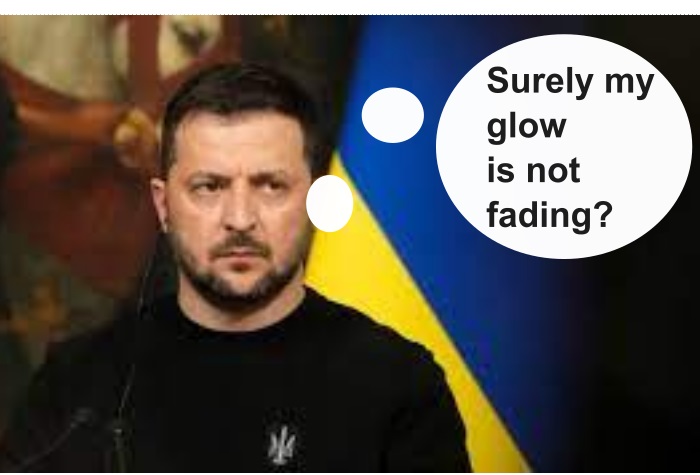
Ukraine extended martial law until 6 August following Zelensky’s request earlier this week, which will prevent elections from being held over the summer like The Economist claimed late last month was a scenario that he was considering in an attempt to give himself an edge over his rivals. This move therefore exposes his fear of losing re-election. It’s not just that he’s very unpopular, but he likely also fears that the US wants to replace him after his infamous fight in the White House.
To that end, the Trump Administration might not turn a blind eye to whatever electoral fraud he could be planning to commit in order to hold onto power, instead refusing to recognize the outcome unless one of his rivals wins. As for who could realistically replace him, Russia’s Foreign Intelligence Service claimed last May that the US had reportedly entered into talks with Petro Poroshenko, Vitaly Klitschko, Andrey Yermak, Valery Zaluzhny, and Dmytro Razumkov.
The New York Times (NYT) just ran a feature article on Poroshenko, who took the opportunity to propose a government of national unity (GNU) almost 18 months after this idea was first floated by Politico in December 2023, but even the article’s author felt obligated to inform readers that he’s unlikely to return to power. Citing unnamed political analysts, they assessed that “Mr. Poroshenko may be angling for an electoral alliance with General Zaluzhny…[who] has remained mostly silent about politics” till now.
Nevertheless, Poroshenko’s NYT feature article succeeded in raising wider awareness of the GNU scenario, which the Trump Administration might seek to advance over the summer. Zelensky continues to irritate Trump, most recently by alleging that Russia has “enormous influence” over the White House and accusing his envoy Steve Witkoff of overstepping his authority in talks with Putin. This comes as Ukraine continues dragging its heels on agreeing to the latest proposed mineral deal with the US.
From the US’ perspective, since the increasingly troublesome Zelensky can’t be democratically replaced through summertime elections, the next best course of action could be to pressure him into forming a GNU that would be filled with figures like Poroshenko who’d be easier for the US to work with. This could also serve to dilute Zelensky’s power in a reversal of the Biden Administration’s policy that saw the US turning a blind eye to his anti-democratic consolidation of power on national security pretexts.
The pretext could be that any Russian-US breakthrough on resolving the Ukrainian Conflict requires the approval of a politically inclusive Ukrainian government given Zelensky’s questionable legitimacy after remaining in power following the expiry of his term last May and the enormity of what’s being proposed. In pursuit of this goal, the US could threaten to once again suspend its military and intelligence aid to Ukraine unless Zelensky speedily assembles a GNU that’s acceptable to the Trump Administration.
The purpose would be to push through a ceasefire for lifting martial law, finally holding elections, and ultimately replacing Zelensky. The GNU could also help prevent the fraud that he might be planning to commit if he decides to run again under these much more politically difficult circumstances, especially if they invite the US to supervise their efforts, both before and during the vote. Through these means, the US could therefore still get rid of Zelensky, who might think that extending martial law will prevent this.
The removal of Trident must remain a core SNP policy
The British military and political establishments will always use their
substantial lobbying and networking resources to maintain their nuclear
posture even if the reality is that they are just US clients. They see it
as central to their international status. Independence threatens this
since Trident has no viable alternative base in England.
So, of course,
they will use these lobbying resources publicly and privately, especially
if they feel the threat of independence is not going away. One of their
main lines is that it would be only reasonable to give the UK a 10-year
lease of Faslane/Coulport. Assuming they got that, this lease could
constantly be renewed. Anyone in the SNP who wants to go along with the
British establishment should remember that opposition to nuclear weapons in
Scotland has been policy for 65 years and party members won’t let it be
changed.
It is entirely unclear how an independence-supporting party could
rationally allow UK nuclear weapons to operate in the Clyde in a
prospective sovereign Scotland. Would this mean nuclear convoys continuing
to run through our towns and cities on a regular basis? Would it mean
continued radioactive leakages into the Clyde, as have already been
reported? Or would it mean siphoning off chunks of Scotland for
unaccountable British military control, like the US currently does in
England? It should be obvious that none of these possibilities are remotely
acceptable in a potential independent Scotland. UK nuclear weapons on the
Clyde are not compatible with genuine Scottish sovereignty. Supporters of
independence must therefore keep a very close eye on the pro-indy
parties’ policies on nuclear weapons.
The National 18th April 2025, https://www.thenational.scot/politics/25099939.removal-trident-must-remain-core-snp-policy/
Ukrainian-born US lawmaker says Ukraine should cede land to Russia, demand Zelensky’s resignation
by The Kyiv Independent news desk April 7, 2025
Ukrainian-born U.S. lawmaker Victoria Spartz has said Ukraine should cede land to Russia, and its people should demand the resignation of President Volodymyr Zelensky.
In an interview with the Telegraph published on April 7, Spartz said Ukraine is not in a position to demand the return of all occupied territories. “If they were winning the war, that would be very different,” she added.
Spartz was born in Chernihiv Oblast and moved to the U.S. in 2000. She was elected to Congress three times, in 2020, 2022, and 2024, and represents Indiana’s 5th District.
Spartz initially supported U.S. aid for Ukraine and has often spoken about the war in personal terms.
However, she has also criticized the Ukrainian government, particularly Zelensky and his chief of staff, Andriy Yermak.
Spartz, who has been a critic of both the Biden administration and the Ukrainian government, supported U.S. President Donald Trump’s call to negotiate with Russian President Vladimir Putin.
“There are no easy solutions,” she said, placing blame on former President Joe Biden for what she sees as failed support.
“President Trump inherited it, so now he has to deal with it.”………………..
On April 4, 2024, The Wall Street Journal reported that Spartz would not support a new $60 billion Ukraine aid bill. She articulated “a lack of clear strategy” and the need for better oversight.
Spartz also said she has “largely moved on from focusing heavily on Ukraine.” In October 2023, Spartz also backed fellow Republican Jim Jordan’s calls for more accountability in Ukraine funding………………..
“To win wars, you need to have leaders who know how to win, not to try not to lose and become oligarchs themselves,” she said. Spartz also claimed Zelensky “took control of all Ukrainian media, prosecuted churches, businesses and volunteers.”https://kyivindependent.com/uss-only-ukrainian-born-lawmaker-says-ukraine-should-cede-land-to-russia-demand-zelenskys-resignation/
During Canada’s leaders’ debate, Carney praised a nuclear firm he bought while at Brookfield
Investment fund co-headed by Liberal leader acquired 51% of Westinghouse in 2023
Daniel Leblanc · CBC News ·Apr 17, 2025
During the first leaders’ debate on Wednesday, Liberal Leader Mark Carney praised nuclear energy and named two companies in the sector with which he did business during his tenure at Brookfield Asset Management.
In 2023, Brookfield formed a partnership with uranium mining firm Cameco to purchase the Westinghouse Electric Company. Brookfield Asset Management acquired 51 per cent of Westinghouse while Cameco got the rest, according to a news release.
The purchase was made within the Brookfield Global Transition Fund, an investment fund that was co-headed by Carney at the time. He was an executive at Brookfield Asset Management from 2020 until early 2025, when he entered politics and became leader of the Liberal Party and prime minister of Canada.
During Wednesday’s French-language leaders’ debate, Carney praised nuclear energy in response to a question from host Patrice Roy. In Canada, nuclear energy falls within the jurisdiction of the federal government, which invested hundreds of millions of dollars in the sector earlier this year.
“It’s a great opportunity,” responded Carney, adding it’s up to the provinces to decide whether or not to invest in nuclear power.
“We have a great advantage here in Canada. We have uranium, that’s one of the advantages. We have major nuclear companies including CANDU, Westinghouse and Cameco,” he said.
Carney then began talking about “small” modular reactor technology in which several firms including Westinghouse are active, but he was interrupted.
According to documents made public by Brookfield Asset Management, as of Dec. 31, Carney had stock options in the firm worth $6.8 million US.
Carney has repeatedly explained that he co-operated with the ethics commissioner when he entered politics to establish a blind trust to hold all of his assets except cash and his personal real estate holdings. In addition, Carney established anti-conflict of interest screens as prime minister to avoid intervening in matters affecting Brookfield.
Carney facing calls for more transparency
Political scientist Geneviève Tellier said she wonders whether some of Carney’s assets are still linked to his time at Brookfield, adding a clear answer should be provided before the federal election on April 28.
“To directly mention companies in a leaders’ debate, when he perhaps has interests in these companies or has benefited from these companies, I think that raises major ethical questions,” the University of Ottawa professor said.
“I understand the law does not require it, but morally and for the sake of transparency, we should have more information.”…………………………………
In a written statement issued Thursday, Conservative MP Michael Barrett criticized the Liberal leader’s failure to disclose whether or not he has an ongoing financial interest in Brookfield.
According to the Conservatives, Carney’s response during the debate was designed to “promote” nuclear energy and Westinghouse.
“If Westinghouse was to rake in billions of Canadian tax dollars, Mark Carney would almost certainly benefit financially,” Barrett said.
“[He] should come clean now and disclose all his assets and conflicts of interest before Canadians go to vote. If Carney has done nothing wrong and has nothing to hide, he should have no problem doing so.” https://www.cbc.ca/news/politics/during-leaders-debate-carney-praised-a-nuclear-firm-he-bought-while-at-brookfield-1.7513169
DOGE’s staff firing fiasco at the nuclear weapon agency means everything but efficiency
Bulletin, By Stephen Young | April 16, 2025
According to a recent press report, the Energy Department has identified 8,500 employees who are “nonessential” and therefore vulnerable to being laid off by Elon Musk’s chainsaw-welding wrecking crew known as the Department of Government Efficiency (DOGE). Of those 8,500 employees, 500 work in the National Nuclear Security Administration (NNSA), the agency responsible for maintaining the US nuclear weapons stockpile. This follows on from a chaotic period in February, when 177 NNSA employees were summarily fired by DOGE. Following a bipartisan uproar, DOGE reversed course, rehiring all but about 27 of the staff who had been laid off.
The media coverage of those forced-then-reversed departures was extensive, with the Washington Post and the New York Times each reporting later the details of the Trump administration operation. But all the coverage, including the latest news, misses two important aspects of this debacle.
Creating chaos in an agency responsible for the safety and security of nuclear weapons is already concerning; the early DOGE firing plan and any new layoffs are very inefficient ways to save taxpayers’ money. According to DOGE, the average salary of the Energy Department’s staff, including the NNSA, is $116,739. If the 500 “nonessential” employees are laid off and all those initially let go were not rehired, it would save approximately $79 million—or about one-third of a percent of the NNSA’s $25 billion budget.
More important, the United States could save tens to hundreds of billions of dollars if it had a sensible and sustainable nuclear modernization plan rather than one that seeks to replace every single weapon in the arsenal—and even create new ones. Such a plan would also have the benefit of removing fuel from the nuclear arms race that President Donald Trump himself has decried.
New security environment. Right now, the NNSA is in the middle of an unnecessary multi-billion-dollar effort to build new and expanded facilities that will produce plutonium pits for new nuclear weapons—the first being made since the end of the Cold War.
The push for new pits usually relies on two arguments—neither of which makes much sense even as they ignore the very high economic, environmental, and geopolitical risks of the path the United States is taking.
First, supporters of new nuclear weapons argue that, as plutonium pits age, they will stop working as expected. In the early 2000s, pit lifetime was estimated at 45 to 60 years. Given that pit production stopped in 1989, that estimate could be a cause for concern, if true. Fortunately, pit lifetime estimates were significantly updated in 2007, when JASON, the federal government’s independent science advisory committee, concluded that most plutonium pits “have credible minimum lifetimes in excess of 100 years as regards aging of plutonium” and that “those with assessed minimum lifetimes of 100 years or less have clear mitigation paths.”
In 2014, Congress passed legislation mandating pit production “driven by the requirement to hedge against technical and geopolitical risk and not solely by the needs of life extension programs.” The law called for demonstrating the capacity to make 80 pits per year by 2027. The “technical” risk highlighted appears tied to pit lifetime—an argument thoroughly refuted by JASON’s reassuring conclusions.
The geopolitical risk perception is more complicated………………………………………………………………………………………………….
DOGE’s arbitrary cuts in NNSA staffing were an ill-informed and very poor choice. The US government could save vastly more money by reconsidering the bloated defense programs that the NNSA is responsible for executing compared to the relatively insignificant savings from the haphazard elimination of staff critical for national security.
The NNSA firing debacle questions whether DOGE is serious about reducing wasteful government programs and promoting efficiency. But if Congress and the Trump administration are, they could easily find tens of billions of dollars to save from the NNSA budget so no more taxpayer is used for a new nuclear arms race that the president has said he does not want. https://thebulletin.org/2025/04/doges-staff-firing-fiasco-at-the-nuclear-weapon-agency-means-everything-but-efficiency/?utm_source=ActiveCampaign&utm_medium=email&utm_content=Behind%20the%20US-Iran%20talks&utm_campaign=20250417%20Thursday%20Newsletter
1 This Month
23-25 October – on Zoom – World BEYOND War’s annual global conferenc

To see nuclear-related stories in greater depth and intensity – go to https://nuclearinformation.wordpress.com

Say No to NASA’s Reckless Nuclear Reactor on the Moon
Say No to NASA’s Reckless Nuclear Reactor on the Moon
-
Archives
- October 2026 (160)
- September 2026 (339)
- August 2026 (330)
- July 2026 (355)
- June 2026 (287)
- May 2026 (306)
- April 2026 (356)
- March 2026 (251)
- February 2026 (267)
- January 2026 (308)
- December 2025 (358)
- November 2025 (359)
-
Categories
- 1
- 1 NUCLEAR ISSUES
- business and costs
- climate change
- culture and arts
- ENERGY
- environment
- health
- history
- indigenous issues
- Legal
- marketing of nuclear
- media
- opposition to nuclear
- PERSONAL STORIES
- politics
- politics international
- Religion and ethics
- safety
- secrets,lies and civil liberties
- spinbuster
- technology
- Uranium
- wastes
- weapons and war
- Women
- 2 WORLD
- ACTION
- AFRICA
- Atrocities
- AUSTRALIA
- Christina's notes
- Christina's themes
- culture and arts
- Events
- Fuk 2022
- Fuk 2023
- Fukushima 2017
- Fukushima 2018
- fukushima 2019
- Fukushima 2020
- Fukushima 2021
- general
- global warming
- Humour (God we need it)
- Nuclear
- RARE EARTHS
- Reference
- resources – print
- Resources -audiovicual
- Weekly Newsletter
- World
- World Nuclear
- YouTube
-
RSS
Entries RSS
Comments RSS

