A risky precedent – if ratepayers bail out Ginna nuclear plant

 Bailout of nuclear power plant would set bad precedent, Times Union By David O. Carpenter, March 30, 2015 The New York state Public Service Commissionand the Cuomo administration will soon decide whether ratepayers can be forced to bail out Exelon, the nation’s largest nuclear power plant operator, and its Ginna nuclear plant, one of the world’s oldest commercial reactors, built near Rochester in 1969. A bailout would set a costly, dangerous precedent with state and national implications.
Across New York and the U.S., as older nuclear plants age, their operating costs are rising while prices for electricity from competing sources are falling, making many of them uneconomical, including a third of Exelon’s fleet. So they seek shelter from market forces that increasingly favor cleaner, cheaper alternatives, including wind and solar.
Ginna is an important test case. It lost $100 million in the last three years. So Exelon negotiated a new purchase agreement withRochester Gas & Electric worth $735 million — $165 million above the market price for electricity — passing on its losses to customers by raising their rates.
Exelon threatens that without a bailout, it will close Ginna and other uneconomical reactors, undermining electricity supply. Supply fears are overblown — Ginna could be phased out and its power replaced more cost-effectively, including by improving substations and transmission lines. The PSC may be more worried about losing Ginna’s 600 jobs (though there would be hundreds of decommissioning jobs if the reactor shut down).
Meanwhile, many oppose the bailout. Physicians for Social Responsibility’s New York chapter opposes it because of growing public health and safety risks as Ginna ages. New York utilities and power producers oppose it because it violates established procedure for shuttering plants. A group of 60 large industrial, commercial and institutional energy consumers oppose it because it would distort electricity markets and trigger “potentially staggering” rate hikes. Alliance for a Green Economy opposes unjustly forcing consumers to subsidize Exelon and its obsolete reactor, which would also pre-empt better energy alternatives. It wants Ginna’s losses borne by RG&E, not ratepayers, and swift, orderly decommissioning.
New York City Mayor Bill de Blasio‘s administration opposes a Ginna bailout as bad precedent for other troubled plants, which might try to hold his city’s residents hostage to closure threats. For example, what if the aging, leaking Indian Point nuclear plant, which should be decommissioned, followed suit and demanded to be propped up through extortionate rate hikes?
These are all good reasons to say “no” to bailing out Ginna and other aging nuclear plants that might seek to follow in its wake…….. http://www.timesunion.com/tuplus-opinion/article/Bailout-of-nuclear-power-plant-would-set-bad-6168217.php
France struggles to save its financially strapped nuclear company AREVA
 France Renews Push for Nuclear Shake Up Economy Minister Emmanuel Macron urges stronger cooperation between the state-controlled businesses. By INTI LANDAURO April 2, 2015 PARIS—The French government has turned up the heat on the country’s biggest nuclear-power companies to restructure the industry to help stem multibillion-euro losses at state-controlled equipment maker Areva SA.
Economy Minister Emmanuel Macron has asked Eléctricité de France SA–the operator of France’s fleet of nuclear power stations which provide most of the country’s electricity—to come to the rescue of Areva by deepening their industrial and possibly financial ties.
EDF and Areva, which are both majority-owned by the French state, have to cooperate better over the construction of  nuclear reactors and tendering for international business, Mr. Macron said on Thursday. He said that he has asked both companies to make proposals in the coming weeks………
Changing international attitudes to nuclear power, notably after the Fukushima disaster in Japan in 2011, have complicated the task for the French government by crimping demand for new business at Areva………
For now, Areva is working on a plan to sell assets, cut costs, reduce capital expenditure and start talks with unions over possible job cuts after posting a €4.8 billion ($5.4 billion) net loss in 2014, the fourth loss in as many years.
The company faces major hurdles with its contract to build a reactor in Finland, which has suffered a series of delays and cost overruns, and has also made a poor investment in uranium mining,……..http://www.wsj.com/articles/french-government-pushes-areva-edf-to-make-tie-up-proposal-1427961063
Harry Reid led the charge to prevent another nuclear pollution of Nevada
 There will be a lot written about Harry’s advocacy on behalf of Nevada, and for those efforts he deserves a standing ovation. His actions will resonate for generations. Our grandchildren’s grandchildren will have been kept protected from the threats of nuclear waste. They won’t know who to thank, so on their behalf: Thank you, Harry.
They have considerably to celebrate, and we — and our youngsters and grandchildren — have considerably to be thankful for, including a legacy that will attain far into future generations of Nevadans.
The senator’s list of accomplishments, from preserving the environment to assisting bring overall health care to millions
with his championing of the Reasonably priced Care Act, will absolutely frame his legacy. But his everlasting accomplishment story will surely be his good results in staring down the nuclear power business and maintaining Nevada totally free of the highly radioactive nuclear waste that outsiders wanted to ship from distant states and bury inside Yucca Mountain. Continue reading
How Japan’s government financially props up TEPCO nuclear company
 After Fukushima: Japan’s ‘nuclear village’ is back in charge, Ecologist Jim Green28th March 2015 “…….Many have called for TEPCO to be nationalised, or broken up into separate companies, but the LDP government has protected and supported the company. The government has also greatly increased financial support for TEPCO.
For example in January 2014 the government approved an increase in the ceiling for interest-free loans the Nuclear Damage Liability Facilitation Fund is allowed to give TEPCO, from 5 trillion yen to 9 trillion yen (€39.0-70.2 billion)
The government will also cover some of the costs for dealing with the Fukushima accident which TEPCO was previously required to pay, such as an estimated 1.1 trillion yen (€8.6 billion) for interim storage facilities for waste from clean-up activities outside the Fukushima Daiichi plant.
The government has also amended the Electricity Business Act to extend the period for collecting decommissioning funds from electricity rates by up to 10 years after nuclear plants are shut down. The amendments also allow TEPCO to include in electricity rates depreciation costs for additional equipment purchased for the decommissioning of the Fukushima plant………http://www.theecologist.org/News/news_analysis/2810545/after_fukushima_japans_nuclear_village_is_back_in_charge.html
Ohio’s Senate Bill 310 props up Davis-Besse nuclear power plant, restricts renewables
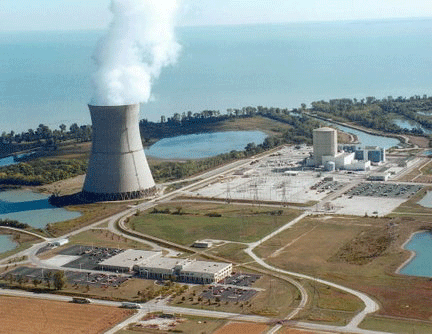 The case against the Davis-Besse nuclear power plant: Connie Kline By Other Voices http://www.cleveland.com/opinion/index.ssf/2015/03/the_case_against_the_davis-bes.html March 29, 2015 Aggressively lobbied by FirstEnergy Corp. and passed by the General Assembly in May 2014, Senate Bill 310, along with wind-turbine restrictions, decimated Ohio’s 2008 renewable-energy and energy-efficiency standards in order to force reliance on coal and nuclear power.
 Not coincidentally, in August 2014, FirstEnergy filed a rate case which, according to the Ohio Consumers’ Counsel and the Northeast Ohio Public Energy Council, could cost ratepayers up to $3 billion over 15 years to “bail out” FirstEnergy’s old, failing, noncompetitive Sammis coal plant and Davis-Besse nuclear reactor. The utility is threatening to close both plants if the Public Utilities Commission of Ohio denies its application.
According to a recent Pew Charitable Trusts’ report, in 2012, Ohio was number 13 in the country for new wind capacity and private investment in wind; this has virtually ceased due to SB 310.
August and September 2014 polls showed that Ohioans overwhelmingly favor efficiency and renewable energy over coal and nuclear.
According to NOPEC, construction of the Perry and Davis-Besse reactors caused “electric rates in northern Ohio to soar, becoming the highest in the state and among the highest in the nation and cost ratepayers “approximately $9 billion.”
Forty-year-old Davis-Besse has been plagued by near-catastrophes since its inception.
● Because it was built in a flood plain, a 1972 Lake Erie storm caused massive flooding of the entire construction site including the pre-operational reactor.
● In October 1977, a relief valve stuck.
● Uranium fuel must be submerged in water (coolant) at all times to prevent a meltdown. In June 1985, Davis Besse had a loss-of-feedwater accident. The Nuclear Regulatory Commission closed the plant for a year.
● A June 1998 tornado caused loss of external electric power.
● In March 2002, neglected, leaking boric acid in the coolant water had eaten through more than seven inches of the steel reactor lid, leaving only a 3/16″ liner to prevent radiation release. The plant closed for two years, costing ratepayers $600 million. Davis-Besse was fined $33.5 million, the largest in NRC history.
● The corroded lid was replaced before restart in 2004, but in 2010, cracks were found in this new lid, forcing its replacement in 2011.
● To replace aging, deteriorating, damaged parts, an unprecedented four large cuts have been made through the Davis-Besse concrete shield building which prevents release of radiation. Starting in 2011, cracks and voids were discovered in the building’s concrete.
● Davis-Besse’s steam generators were replaced in 2011 and 2014. A new tubing alloy was used.
Unprotected exposure to used reactor fuel can kill a person in minutes, yet no disposal solution exists for this waste which must be isolated from humans and the environment virtually forever. Funding for the permanent, deep-geological radioactive waste repository at Yucca Mountain, Nevada was canceled in 2011, making every reactor a de facto radioactive waste dump at the least environmentally suitable sites for potable water, in flood, erosion, and earthquake zones.
The industry claims that nuclear power does not contribute to climate change. In fact, the nuclear fuel cycle from mining and fabricating uranium to decommissioning reactors requires a significant amount of fossil fuel.
In January 2015, FirstEnergy commissioned a self-serving “study” by an industry group with a vested interest in the conclusion that Davis-Besse is economically beneficial. The study failed to consider energy efficiency or replacing Davis-Besse with renewable energy that typically provides more jobs per megawatt/hour than nuclear power. If Davis-Besse were truly a valuable asset, FirstEnergy wouldn’t be seeking up to $225 million a year in ratepayer subsidies to keep it operating.
According to the U.S. Department of Energy, nuclear power provides only 5 percent of Ohio’s generation. According to the World Nuclear Association, Davis-Besse’s lifetime capacity factor through 2012 was only 67.6 percent, one of the lowest in the country.
It’s time to stop throwing good money after bad and transition to safe, clean renewable energy. Davis-Besse should meet the fate of other U.S. reactors than have been permanently closed for safety and economic reasons.
Connie Kline, of Willoughby Hills, is former chairperson of the Ohio Sierra Club Nuclear Committee.
France’s nuclear industry now a liability, with AREVA’s down ward spiral
France’s Nuclear Decline Exposed as Areva Confronts Cash Crunch by Tara Patel, 27 Mar 15, (Bloomberg) — For decades France’s nuclear industry was seen as a source of economic strength, providing cheap power for factories, high-tech exports and tens of thousands of well-paid jobs. Today, it’s looking more like a liability.
Electricite de France SA, the world’s largest nuclear operator, must spend $63 billion over the next decade to keep the country’s aging fleet of 58 reactors running safely. More urgently, nuclear engineer Areva SA, touted as an export champion for a new atomic age, has lost billions from a project in Finland and investments in African uranium mines, raising the prospect of a state bailout…. The financial “sickness” at Areva could prove contagious to the whole nuclear industry, said Juan Camilo Rodriguez, an analyst at Alphavalue SAS…..
“The situation is difficult for Areva,” French Energy Minister Segolene Royal said Monday, just hours after the company shocked investors by saying losses for 2014 would be about 4.9 billion euros ($5.5 billion), more than its market capitalization……
Areva has been in a downward spiral since the meltdown at Fukushima’s atomic plant in Japan shook the global industry in 2011. The nuclear engineering company, which services existing reactors and supplies them with fuel, has lost about 75 percent of its value since as nations pulled back from atomic projects.
Last November, Areva’s credit rating was reduced to junk status by Standard & Poor’s after it abandoned financial targets. The company blamed its losses on construction of a new reactor on a Finnish island, delays in restarting Japanese plants and a worsening outlook for other export orders.
Before Fukushima, France’s atomic industry was readying for a nuclear energy renaissance. Former EDF Chief Executive Officer Pierre Gadonneix predicted France’s flagship reactor, the giant EPR model, would sell “like hotcakes” around the world.
Over Budget Fukushima ended the prospect of new reactors in many countries, including Italy and Switzerland, in addition to damping a number of potential export markets for Areva and EDF. Germany decided to shut all its nuclear reactors.
Not a single EPR has yet fired up as construction projects in France’s Normandy region as well as in Finland and China are behind schedule and mostly over budget…….
Against the backdrop of Areva’s financial uncertainty, a long-delayed law that would reduce France’s reliance on nuclear power is in the Senate. Prospects for Areva and EDF will be affected by the decision of lawmakers on whether to shut some reactors……http://www.bloomberg.com/news/articles/2015-02-27/france-s-nuclear-decline-exposed-as-areva-confronts-cash-crunch
St George city decides against getting electricity from NuScale’s Small Modular Nuclear Reactors
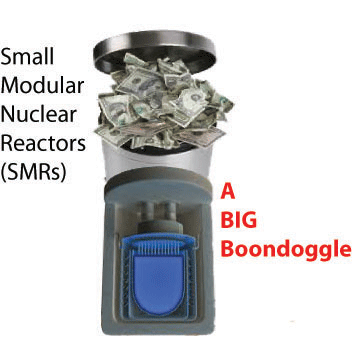 City opts to withdraw from nuclear power project, keep options open, St George News by Mori Kessler March 27, 2015 ST. GEORGE – City officials discussed the city’s future power generations needs during a City Council meeting Thursday. The city wants to keep its options open as far as those needs are concerned, and for the time being, is backing away from an experimental nuclear power option.
City staff recommended that the City Council hold off on committing to a project by NuScale Power. Based out of Oregon, NuScale proposes to build compact nuclear reactors that would be housed in a power plant built near Idaho Falls, Idaho. The compact reactors are designed to produce 40-50 megawatts of power.
A permit application for the proposed project is slated to be sent into the U.S. Nuclear Regulatory Commission for review, and could take until 2018 or longer to be approved. If approved, the power plant could be built and operational by 2024…….
Though St. George is one of UAMPS biggest utilities, city staff have recommended against committing to any binding agreements, saying they want the city to maintain flexibility over where it gets its power. The cost of being involved could run into the millions of dollars, said Laurie Mangum, the city’s energy services director……
Other sources of potential energy the city could tap into in the future include solar power or hydroelectric power generated along the Lake Powell Pipeline. Also, through its existing contracts and city-owned power-generation facilities, the city has 70 percent of its base load power needs covered up to around 2024-25, Esplin said.
“We’re in pretty good shape for the next eight-nine years,” Esplin said…….https://www.stgeorgeutah.com/news/archive/2015/03/27/mgk-city-opts-withdraw-nuclear-power-project-keep-options-open/#.VRXGyvyUcnk
Tea Party leader joins environmentalists to form GREEN TEA COALITION
 During the first 15 years of nuclear — nuclear subsidies from the federal government accounted for one percent of the federal budget. Despite all the talks about the subsidies solar has received, solar during its first 15 years has only accounted for one tenth of one percent of federal subsidy.
to these elected officials who want the solar tax credit to expire, I say let’s expire all of the direct and indirect subsidies and tax credits that coal, nuclear, and oil are receiving as well. If they want to continue with the fossil fuel tax credits and the nuclear tax credits, then they should continue with the solar and wind tax credits. For every Solyndra they can point to, you can point to a nuclear reactor that’s over budget.
Conservatives need to do their research. Do your research and you’re going to come to the same conclusion that I have, that we’ve been manipulated by groups with interests in fossil fuel into believing that green energy is bad
Why This Tea Party Leader Is Seeing Green on Solar Energy As a founder of the Tea Party movement, Debbie Dooley may be an unlikely advocate for renewable energy. But in an e360 interview, she explains why she is breaking ranks with fellow conservatives and promoting a Florida ballot initiative that would allow homeowners to sell power produced by rooftop solar. 26 MAR 2015: INTERVIEW Environment 360 by diane toomey
Debbie Dooley’s conservative credentials are impeccable. She was one of the founding members of the Tea Party movement and continues to sit on the board of the Tea Party Patriots. She also serves as chairperson of the Atlanta Tea Party.
But on the issue of solar power, Dooley breaks the mold. To the consternation of some of her fellow conservatives, she has teamed up with the Sierra Club and other environmental organizations, first in Georgia and now in Florida, to form the Green Tea Coalition. It’s an unlikely mix of conservative, environmental and other groups whose focus includes campaigning against the maintenance fees that utility companies charge solar customers. In Florida, the group is working to get an initiative on the ballot that would allow individuals and businesses to sell power directly to consumers.
Debbie Dooley: My foray into becoming a strong advocate for decentralized energy began with a fight with a government-created monopoly in Georgia, Georgia Power. I believed that they had far too much power. Continue reading
Dubious USA Bills – Small Nuclear Reactors, “education on nuclear”, nuclear as “renewable”
Nuclear power measures face questions CrossCut WEDNESDAY 25, MARCH 2015 by John Stang The big topic at the House Technology & Economic Development Committee hearing was whether Washington should find a place to build small modular reactors, which would be produced for utility customers. Sen. Sharon Brown, R-Kennewick, is sponsoring this proposal and the two other nuclear-related bills that the committee examined. The Senate passed the  small modular reactor bill 27-21, mostly along party lines.Tri-Cities leaders envision a Boeing-style assembly plant to build small modular reactors. This is a long-range plan and is predicted to take several years to develop……
The concept is still on the drawing board. No one has built a commercial small modular reactor yet……
At the hearing, critics cited the lack of any track record on cost or safety for small modular reactors, plus concerns over the nation’s lack of a permanent place to store used nuclear fuel.
“Small nuclear reactors are still in the prototype stage. … The prototype has never been tested in power production yet,” said Thomas Buchanan of Physicians for Social Responsibility.
“I don’t think that the Department of Commerce should work on this until it has a design that passes the NRC,” said Chuck Johnson of the same organization.
Johnson argued that a single small-modular reactor would not generate enough electricity to efficiently recover its construction and operating costs…..
Deborah Wolpoff of Olympia pointed to the cancelation of the nation’s proposed nuclear fuel repository inside Yucca Mountain, with no replacement lined up. “I think it is irresponsible to promote this technology that produces this waste that we have no solution for,” Wolpoff said.
Committee member Rep. Gael Tarleton, D-Seattle, wondered why the Legislature should support a new nuclear industry while Hanford’s Cold War nuclear wastes are decades from being cleaned up….
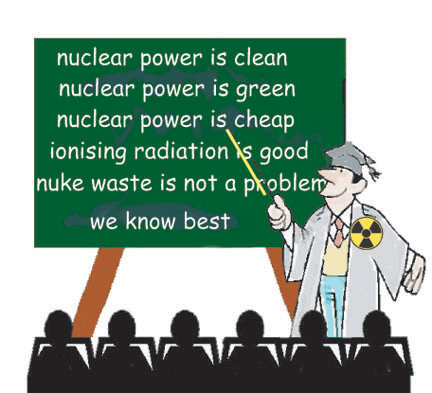 Another Brown bill, which the Senate passed 44-5, would create an education program aimed at providing nuclear science lessons to students in the eighth through 12th grades. Qualified American Nuclear Society members would be brought in for classroom sessions. Also, science teachers would receive instruction on nuclear science in order to teach the subject in the classrooms…….
Mary Hanson of Physicians Social Responsibility argued that the bill would give the nuclear industry influence over students, while other energy industries would not have the same access. She said American Nuclear Society members might be less versed in nuclear power’s health issues than its technical ones.
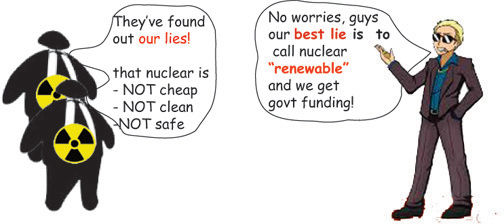
The third Brown bill, which the Senate passed 29-20, would add nuclear power to the list of alternative power sources that certain utilities can use to meet a state requirement to offer their customers voluntary participation in alternative energy purchases. The current list of green sources includes wind, solar, geothermal and biomass energy….
Physicians for Social Responsibility opposed it, contending nuclear energy is not a renewable power source….
http://crosscut.com/2015/03/nuclear-power-measures-face-questions/
Copper Consultancy PR firm helps UK govt to undemocratic management of nuclear wastes
Whose idea was it to scrap democracy in order to dump nuclear wastes? https://mariannewildart.wordpress.com/2015/03/23/whose-idea-was-it-to-scrap-democracy-in-order-to-dump-nuclear-wastes/ Radiation Free Lakeland and others are asking: Just whose idea was it to plan to scrap democracy in order to dump nuclear wastes? Was the bright idea given to Government by the PR firm Copper Consulting?
Copper Consultancy a PR firm with offices in London, Bristol, Suffolk and most recently Cumbria, told the Department of Energy and Climate Change that: “allowing local authorities to determine the outcome of a process which is designed to deliver a national Government policy may not be the most appropriate route.” This piece of work is a response to Cumbria County Council and the majority of Parish Councils’ saying no to geological disposal of nuclear wastes.
In their blog Copper Consulting go on to say that: “local authorities are consultees rather than decision makers. The final 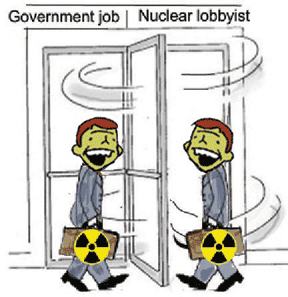 decision rests with the Planning Inspectorate and the Secretary of State. A logical conclusion might therefore be to classify the GDF as an NSIP”
There has always been a suspicion that nuclear is a PR strategy rather than an energy strategy, now we have proof. There is a revolving door between the NDA and Copper Consultancy a PR firm. Ivan Stone who was Executive Director of Copper Consultancy is now the Stakeholder Engagement and Communications Director – of the NDA/RWM (Radioactive Waste Management – a new arm of NDA) Copper Consultancy have also just been awarded the PR job of selling newnuclear build and new nuclear wastes at Moorside to the public. Continue reading
Significant actions by President Obama to address climate change
 The Emergence and Importance of President Obama’s Climate Policy, Huffington Post
…federal agencies over the next decade to cut their emissions by an average of 40 percent compared with their levels when he won office in 2008, and to increase their use of electricity from renewable sources by 30 percent.
This move is wholly within the president’s power as the nation’s chief executive and will have a significant impact on the market for energy efficiency and renewable energy goods and services. The federal government is the nation’s largest organization. It employs more people and buys more goods and services than anyone else. It is also a powerful role model for the private sector. As Ms. Davis observes:
…because the federal government is the largest user of energy in the United States economy — encompassing 360,000 buildings, 650,000 fleet vehicles and $445 billion in annual spending on goods and services — it has the potential to influence private companies to step up their emissions-cutting targets.
When coupled with EPA’s slow and steady progress to regulate greenhouse gas emissions under the Clean Air Act, this change in government’s own operations begins to resemble a meaningful federal climate policy………http://www.huffingtonpost.com/steven-cohen/the-emergence-and-importa_b_6922614.html?utm_hp_ref=green
Cost of Small Nuclear Reactors is greater than cost of large ones

Michael Marriotte exposes Senator Lamar Alexander’s nuclear fantasies
Actually, 100 new reactors not only seems high, it’s pure fantasy. With the experience of Vogtle, and the similar experience at two reactors under construction at the Summer site in South Carolina, no one is lining up to build new reactors. At this point, it’s unlikely even the four under construction will be online by 2020, much less 96 more new ones.
 Lamar Alexander’s nuclear fantasyland Green World, Michael Mariotte March 9, 2015 Back in 2008, when presidential candidate John McCain was calling for construction of 45 new reactors in the U.S. (and presidential candidate Barack Obama was calling for “safe” nuclear power), Tennessee Senator Lamar Alexander outdid his colleague: he issued a call for construction of 100 new nuclear reactors.
In 2008, the nuclear “renaissance” was in full swing. McCain’s call didn’t seem–at least to nuclear backers–far-fetched in the least. After all, the NRC at the time already had some 30 applications for licenses for new reactors.
Nearly seven years later, McCain doesn’t talk much about nuclear power. President Obama’s Department of Energy approved a taxpayer loan for two new reactors at Vogtle, a move DOE may be beginning to regret asconstruction costs spiral out of control and the schedule delays keep pushing the project further back. Otherwise, the president these days talks about promoting renewables.
Most people are able to adjust to reality–in this case the reality that the short-lived nuclear “renaissance” is long over.
But not Senator Alexander, who is now chair of the Senate Appropriations Subcommittee on Energy & Water Development. Continue reading
Exposing the nuclear lobby’s agenda for Australia
What does the nuclear lobby want, for South Australia?, Online Opinion,
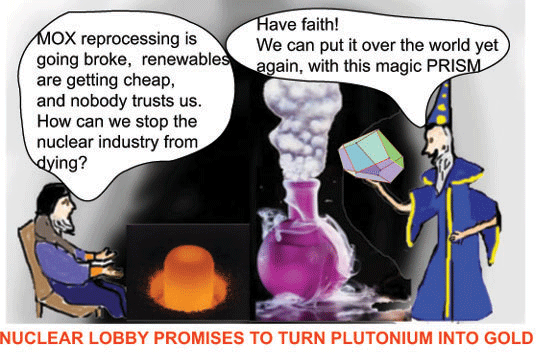
| By Noel Wauchope 19 March 2015 “….It is difficult to work out exactly what is planned in nuclear industry expansion for South Australia. The plans involve some or all of these industries: uranium enrichment, nuclear power, importation and storage of nuclear wastes, 4th Generation nuclear reactors, and expansion of uranium mining. However, we can be grateful to ABC Radio’s Ockham’s Razor programme, as it provided the nuclear lobby with a platform for setting out succinctly their intentions. Oscar Archer, a well -known voice for the nuclear industry, explains…… Australia should get a fleet of PRISM small nuclear reprocessing reactors – Archer’s plan is for “IFS+IFR: Intermediate Fuel Storage and Integral Fast Reactor, namely the commercially offered PRISM breeder reactor from General Electric Hitachi.”What he means here is the Power Reactor Innovative Small Module Archer then sets out the sequence of events that would lead to the establishment of this fleet. In Archer’s words “it goes like this. Australia establishes the world’s first multinational repository for used fuel – what’s often called nuclear waste” However, he notes that “This is established on the ironclad commitment [my emphasis] to develop a fleet of integral fast reactors to demonstrate the recycling of the used nuclear fuel”…… the sting in the tale of his plan is really exactly what he calls the first step – the overturning or weakening of Federal and State laws. The Federal Act protects against nuclear reprocessing and expanded nuclear industries. ARPANSA sets safety standards for exposure to ionising radiation. South Australian State Law would have to be overturned, too – under the Nuclear Waste Storage Facility (Prohibition) Act 2000 The central premise of Oscar Archer’s promotion of this nuclear chain of events is that Australia should go out on a limb – be the first country in the world to import nuclear wastes and to order a mass purchase of PRISM reactors….. The PRISM reactor exists only on paper and its development is decades away from completion. David Biello, in Scientific American comments “Ultimately, however, the core problem may be that such new reactors don’t eliminate the nuclear waste that has piled up so much as transmute it. Even with a fleet of such fast reactors, nations would nonetheless require an ultimate home for radioactive waste, one reason that a 2010 M.I.T. report on spent nuclear fuel dismissed such fast reactors.”
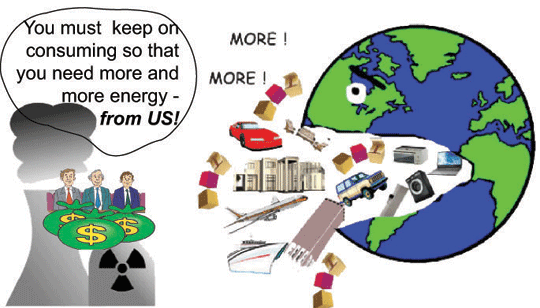
The PRISM can’t melt down in the way that conventional nuclear reactors can. However, its essential use of plutonium entails hazardous transport – vulnerability to terrorism and use as a “dirty” bomb. And – finally the PRISM reactor itself becomes radioactive waste requiring security and burial. There is another, underlying premise here that needs to be examined. This is the premise that it is OK for Australia and the world to continue to consume energy endlessly…….
The plan purports to reduce greenhouse emissions by means of thousands of little reactors, (and big ones) – but their development is so many decades away that it would be too late for climate change action. We are left with a plan that looks suspiciously as if the troubled nuclear industries of USA, Canada and UK have selected Australia as the guinea pig for a plan to reverse their industries’ present decline.
|

US Congress is urged not to sabotage Iran nuclear negotiations

 Iran nuclear talks: White House urges Congress to stand down, Guardian, Paul Lewis in Washington and Julian Borger in Lausanne, 16 Mar 15 Obama administration warns Republicans could ‘potentially prevent’ deal that has been years in the making and damage relations with allies across the world. The White House has warned that Republicans in Congress could “potentially prevent” a groundbreaking deal to stop Iran from obtaining a nuclear weapon, scuppering an agreement that has been years in the making and damaging relations with allies across the world.
Hours before talks were due to resume in Switzerland on Sunday, White House chief of staff Denis McDonough sent a letter to a senior Republican critic, urging him to shelve legislation that would clip the administration’s wings.
Bob Corker, chairman of the Senate foreign relations committee, is bringing a bill that would require Congress to vote on any deal with Iran and remove the waiver authority that allows President Barack Obama to suspend sanctions imposed by the legislature.
“The legislation would potentially prevent any deal from succeeding by suggesting that Congress must vote to ‘approve’ any deal, and by removing any existing sanctions waver authorities that have already been granted to the president,” McDonough said.
“We believe the legislation would likely have a profoundly negative impact on the ongoing negotiations – emboldening Iranian hardliners.”
Calling on Corker to hold off the bill until a deal is reached, McDonough also warned that if the US was blamed for negotiations falling apart, Washington would be unable to muster the international support needed to ratchet-up sanctions on Tehran.
“Put simply, it would potentially make it impossible to secure international cooperation for additional sanctions, while putting at risk the existing multilateral sanctions regime,” he said…….
A framework agreement between the international powers and Iran is supposed to set out the key element of a deal in which Iran accepts limits of its nuclear activities for a number of years (expected to be at least 10) in return for sanctions relief. The negotiators would then have until the end of June to complete detailed annexes on how the deal would be implemented and verified.
With days to go until the deadline for a framework deal, there are still said to be gaps remaining on the central issues of Iran’s future uranium enrichment capacity and the question of which sanctions will be lifted and when. Diplomats from all sides have voiced readiness to stay in Lausanne through the Persian New Year holiday, Nowruz, which begins next weekend, but western negotiators are reluctant to push the first deadline beyond the end of the month.
“We believe very much that there’s not anything that’s going to change in April or May or June that suggests that at that time a decision you can’t make now will be made then,” Kerry told CBS News before arriving in Lausanne.
“If it’s peaceful, let’s get it done. And my hope is that in the next days that will be possible.” http://www.theguardian.com/world/2015/mar/15/iran-nuclear-talks-white-house-warns-congress-stand-down
1 This Month
23-25 October – on Zoom – World BEYOND War’s annual global conferenc


Shut down the radiation-damaged Heysham nuclear reactors now
To see nuclear-related stories in greater depth and intensity – go to https://nuclearinformation.wordpress.com

Say No to NASA’s Reckless Nuclear Reactor on the Moon
Say No to NASA’s Reckless Nuclear Reactor on the Moon
-
Archives
- October 2026 (170)
- September 2026 (339)
- August 2026 (330)
- July 2026 (355)
- June 2026 (287)
- May 2026 (306)
- April 2026 (356)
- March 2026 (251)
- February 2026 (267)
- January 2026 (308)
- December 2025 (358)
- November 2025 (359)
-
Categories
- 1
- 1 NUCLEAR ISSUES
- business and costs
- climate change
- culture and arts
- ENERGY
- environment
- health
- history
- indigenous issues
- Legal
- marketing of nuclear
- media
- opposition to nuclear
- PERSONAL STORIES
- politics
- politics international
- Religion and ethics
- safety
- secrets,lies and civil liberties
- spinbuster
- technology
- Uranium
- wastes
- weapons and war
- Women
- 2 WORLD
- ACTION
- AFRICA
- Atrocities
- AUSTRALIA
- Christina's notes
- Christina's themes
- culture and arts
- Events
- Fuk 2022
- Fuk 2023
- Fukushima 2017
- Fukushima 2018
- fukushima 2019
- Fukushima 2020
- Fukushima 2021
- general
- global warming
- Humour (God we need it)
- Nuclear
- RARE EARTHS
- Reference
- resources – print
- Resources -audiovicual
- Weekly Newsletter
- World
- World Nuclear
- YouTube
-
RSS
Entries RSS
Comments RSS

