Canada’s Nuclear Regulator in reality a promoter of the industry
Council of Canadians chairperson Maude Barlow has said that “Stephen Harper is systematically wiping out decades of environmental protection and laws in order to promote unbridled resource extraction. No other government in the history of Canada has declared war on the environment in this way.”
 See you at the ribbon cutting? Federal panel approves nuclear dump on Lake Huron OLE HENDRICKSON |http://rabble.ca/columnists/2015/05/see-you-ribbon-cutting-federal-panel-approves-nuclear-dump-on-lake-huron MAY 8, 2015
A federal environmental assessment panel has just released its report approving a proposal by Ontario Power Generation (OPG) to bury nuclear waste on the shores of Lake Huron in a “Deep Geological Repository” (DGR). The panel’s conclusions come as no surprise to informed observers: the impartiality of the environmental assessment process had been in question for months.

The Canadian Nuclear Safety Commission (CNSC) has never been known as a friend of the environment. But when the Harper Conservatives won a majority government in 2008 they made sweeping changes to Canada’s environmental laws. One change was to remove responsibility for environmental assessment of nuclear projects from the Canadian Environmental Assessment Agency, and put the CNSC in charge.
Instead of conducting an objective assessment of OPG’s nuclear waste burial scheme, the CNSC acted as a strong proponent.
According to a September 2013 article in the Globe and Mail, CNSC and OPG jointly held “illegal and secret meetings” with local municipal officials. At one of those meetings, CNSC President Michael Binder said he hoped their next meeting “would be at a ribbon-cutting ceremony” for the DGR.
While the CNSC sucks up hundreds of millions of taxpayer dollars, its pretense of acting as an independent nuclear regulator is becoming less and less credible. In support of the license renewal request of SRB Technologies (Canada) Inc. (SRBT), a tritium light factory in Pembroke, Ontario, the CNSC recently posted the absurd claim on its website that measured environmental radioactivity is “within natural background levels” — even as the CNSC’s own scientists publish journal articles documenting widespread radioactive contamination in the Pembroke environment resulting from SRBT’s operations.
Although Article 9 of the Nuclear Safety and Control Act requires the CNSC “to disseminate objective scientific, technical and regulatory information to the public,” the CNSC is failing. Political interference in the Commission’s activities became a matter of routine when the Harper government fired CNSC President Linda Keen for trying to hold Atomic Energy of Canada Ltd. to account for failing to perform safety upgrades on the NRU reactor at the Chalk River Laboratories. In February the Harper government totally bypassed the normal regulatory process when it quietly ordered this same 57-year-old reactor to continue to run for two years past its scheduled 2016 shutdown — and seven years past its originally planned shutdown in 2011.
In the absence of a strong and independent nuclear regulator, protection of the public from the health and environmental risks of nuclear energy falls to active and informed members of the public who are willing to engage in the political process. This applies as well to risks associated with rail and pipeline shipments of oil, contaminated products from meat-packing plants, and use of toxic pesticides, to name only a few.
Aging nuclear reactors mean increased risks of a nuclear disaster. The need for an effective nuclear regulatory agency has never been greater. Do Canadians really want to run the risk of a nuclear meltdown, or permanent contamination of the Great Lakes? With a weak regulator that makes decisions based on crass economic and political considerations, these are the risks we are running.
Council of Canadians chairperson Maude Barlow has said that “Stephen Harper is systematically wiping out decades of environmental protection and laws in order to promote unbridled resource extraction. No other government in the history of Canada has declared war on the environment in this way.”
The recent DGR panel report is a virtual declaration of war on the Great Lakes. Dozens of Interveners at the panel hearings presented evidence of leaks and accidents at other facilities that have attempted to bury nuclear wastes. It is hard to imagine that any government would be so foolish as to put a permanent nuclear dump right next to the world’s largest inland water ecosystem.
In the unlikely event that this hare-brained scheme goes ahead, the CNSC’s Dr. Binder might find himself jointed by a large crowd of angry people at the ribbon-cutting ceremony.
Ole Hendrickson is a forest ecologist and current president of the Ottawa River Institute, a non-profit charitable organization based in the Ottawa Valley.
AREVA’s woes heralding a slippery global slope for the nuclear industry?

 French Nuclear Dynamo Stalls, NYT, By DAVID JOLLY and STANLEY REEDMAY 7, 2015 PARIS — For decades, France has been a been a living laboratory for atomic energy, getting nearly three-quarters of its electricity from nuclear power — a higher proportion by far than in any other country.
But in the last few years, the French dynamo has started to stall. New plants that were meant to showcase the industry’s most advanced technology are years behind schedule and billions of euros over budget. Worse, recently discovered problems at one site have raised new doubts about when, or even if, they will be completed……..
Alarmed by the French industry’s problems, the Socialist government of President François Hollande is expected soon to announce an industry overhaul. As the majority owner of the country’s two main nuclear companies — the reactor maker Areva and the big utility operator Électricité de France — the government will aim not only to put the companies on a firmer financial footing but to reorganize them in hopes of restoring the French industry’s role-model luster.
On Thursday, Areva took the first of those steps by announcing big cost-cutting plans. The move is likely to trim as many as 6,000 jobs from the company’s global work force of 45,000 — as many of 4,000 of those coming in France……….
With the French companies struggling, some nuclear experts see a slippery geopolitical slope. Continue reading
US Senate passes Bill to give Congress a stake in nuclear deal with Iran
S
 enate Passes Bill to Review Iran Nuclear Deal Maya Rhodan @m_rhodan TIME, 7 May 15 Bill to give Congress oversight of the nuclear plan passes Senate
Republicans and some Democrats in Congress have been pushing for oversight of the pending deal given that current proposals include relief from some of the sanctions placed on Iran by Congress. The bill that passed Thursday requires that Congress be able to review and possibly reject any deal the U.S. and world powers make with Iran regarding nuclear weapons. If Congress approves of the deal — or fails to disapprove within a certain timeframe — the President’s deal can move forward……
While the debate continues, however, some lawmakers have signaled their support for the President’s negotiations with Iran. In a letter first reported on by the Washington Post, 150 Democrats urged Obama to “stay on course” and commended the work of world powers so far in the process.
“The stakes are too great and the alternatives are too dire,” the letter reads. “If the United States were to abandon negotiations or cause their collapse, not only would we fail to peacefully prevent the nuclear-armed Iran, we would make that outcome more likely.”
The Washington Post reports that the letter could mean the President has enough Congressional support to override a veto should lawmakers vote to reject the deal once it is released in June. http://time.com/3850806/congress-iran-nuclear-deal/
Lake Huron is NOT the answer to Canada’s nuclear waste problem- Dr. Benishek
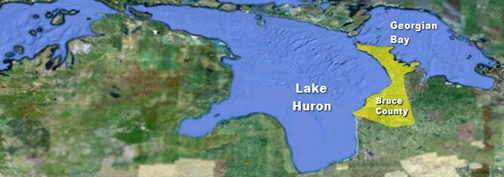 Dr. Benishek: Canada’s plan to store nuclear waste near Great Lakes unacceptable http://www.upnorthlive.com/news/story.aspx?id=1201537#.VUvfhY6qpHw 05.07.2015WASHINGTON D.C. –– More than seven million cubic feet of nuclear waste could be stored in less than a half of mile from Lake Huron.
A joint Review Panel in the Canadian government gave favorable recommendation Thursday on a proposal to place a permanent, underground, nuclear waste storage facility.
“The recommendation by the Canadian Joint Review Panel to approve a plan to bury waste from nuclear power plants less than a mile from Lake Huron is unacceptable,” said Dr. Benishek. “While I support the need to find long term storage solutions for nuclear waste, burying waste this close to the Lake Huron is not the answer. The Great Lakes play a tremendous role in our economy and way of life here in Northern Michigan and we must remain stewards of this natural resource. I am please there is bipartisan support in the House that is opposed to Canada’s plan, and I will continue to work with my colleagues to ensure that there is not permanent storage of nuclear waste in the Great Lakes Basin.”
South Asia likely to have a non nuclear future
In spite of the enormous political clout of South Asia’s nuclear authorities and the hold they have in moulding public attitudes, in the long run the demise of nuclear fission power production globally is likely.
With abundant sun and wind, South Asia has only begun its travel towards renewables. Cheaper by the day, small decentralised solar and wind units offer the best option for urban and village households.
Why South Asia needs a non-nuclear future , Sci Dev Net, 7 May 15
- Nuclear energy’s share of global energy production dwindled to 10 per cent in 2013
- Pakistan plans to install two 1,100 megawatt reactors in Karachi, a city of 20 million
- Expansion of solar and wind energy can hasten the decline of nuclear energy
- Risky nuclear energy can be replaced by safer and cheaper options in South Asia, writes Pervez Hoodbhoy.Considered risky by increasing numbers of people, nuclear energy is now no longer the eagerly sought panacea to the world’s energy problems. From its all-time high of 17 per cent in 1995, its share of world production dwindled to 10 per cent in 2013. The Fukushima nuclear disaster, even more than Chernobyl, has left Japan and most western countries deeply worried and suspicious. Japan’s 48 reactors remain shut, about 120,000 people are homeless, and the three reactors that experienced core meltdowns are still in deep crisis. They will need another 30—40 years to fully decommission.Some developing countries are also losing their former enthusiasm. Post-Fukushima, Indonesia’s civil society insisted that the country’s nuclear electricity programme be scaled back. Its demands were largely met. So, why has it been difficult for public opinion to compel any Pakistani or Indian government to similarly change course?
Opaque programmes The reason is clear. Both countries used opaque civilian nuclear programmes to make nuclear weapons, which then became objects of national veneration and symbols of power. Shrouded in secrecy, nuclear establishments became a force in their own right. They were not subject to any significant scrutiny of safety aspects. Nor did they feel the need to reveal their plans for disaster management or prove their adequacy. While environmental impact mitigation schemes became legally necessary, these were not to be taken seriously. No attempts were made to educate populations near a reactor about radiation hazards. Continue reading
Trident nuclear submarines – the sticky issue in UK election

 The nuclear dimension to UK election BBC 6 Mchray 15 Anthony Zurcher The British naval base in Faslane, Scotland, is home to four Vanguard submarines – and the source of a fierce debate that illustrates the sticky political issues presented by the rise of the Scottish National Party in this year’s general election……It’s become a common Conservative Party talking point in these last days of the campaign that the only way the Labour Party can return to power is by striking a deal with the SNP. Although it’s a charge Labour vehemently denies, the SNP will likely post major wins at Labour’s expense in Scotland’s 59 parliamentary seats. If that happens, one of the bargaining chips in any deal could become the Faslane submarines and their Trident nuclear missile systems.
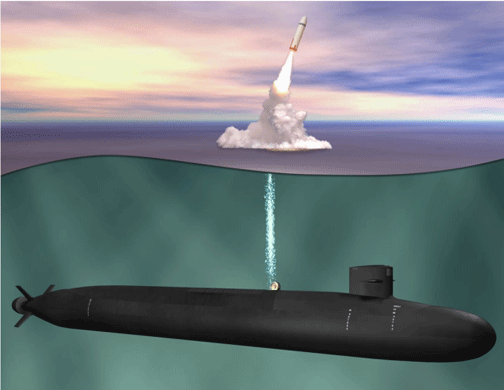
SNP leader Nicola Sturgeon has called defunding the Trident programme a non-negotiable “blood red line” and, in a Scottish leaders debate in Edinburgh Sunday night, refused to rule out voting down a Labour budget that includes maintaining the missiles.
Complicating all this is the fact the nuclear missile programme is aging – and will require additional moneys to stay operational. Coming on the heels of steep austerity cuts imposed after the 2008 recession, the estimated investment of at least £17.5bn is proving a bitter pill for many to swallow.
Labour leader Ed Miliband has said he wants to keep the UK a nuclear power, but he hasn’t ruled out reducing the number of submarines.
And so the Conservatives have pounced on Mr Miliband, whom they charge with threatening to forsake the protection provided by a nuclear deterrent…….
All of this is just “stale Westminster politics” and the bickering of “grey men in grey suits”, says Chris Higgins.
Higgins has a particularly unique view of the nuclear issue, as the Faslane navy base and its submarines are his neighbours. Since September, he’s been a resident of the Faslane Peace Camp, a brightly coloured collection of caravans, trailers and hand-constructed shelters that has been a permanent fixture just down the road from the base for more than 33 years………
“No sensible UK government would develop a nuclear weapons capability now if one didn’t exist,” SNP’s Robertson said, sounding a lot like one of the Faslane peace activists. “Therefore, a strong group of SNP MPs in a hung parliament, working with other progressive political forces, can bring common sense to bear now – and halt Trident renewal in its tracks.”……http://www.bbc.com/news/32601921
Finland’s very misguided nuclear obsession
The Finnish politicians have apparently not learned anything from Hiroshima, Nagasaki, Chernobyl, and Fukushima.
OL4 appears, thankfully, to have been shelved for the time being. But OL3, one of the ten most expensive construction projects in the world and beset by delays and astronomical costs, could end up as the world’s biggest nuclear mausoleum.
The Fennovoima project, however is still going ahead. But an active citizens’ movement has come together to oppose it, and they may yet succeed.
Finland’s new government (not yet appointed at the time of writing) will have the decision in its hands, as they will have to decide about the construction permit application that Fennovoima is to submit in July this year.
Petition: ‘Stop the Nuclear power plant in Pyhäjoki built by Fennovoima!‘
 Russian roulette? Finland’s inexplicable nuclear obsession, Ecologist Ulla Klötzer
1st May 2015 Does Finland suffer from a nuclear death wish? So it seems, writes Ulla Klötzer. Its government responded to the world’s two greatest nuclear disasters by … ordering a new nuclear plant. And as the Olkiluoto nuclear project descended into face and litigation over a disputed €5 billion, they resolved to build two more. This time, supplied by Russia’s nuclear weapon-maker Rosatom.
Finland was the first western country to decide to build a new nuclear power plant after the Chernobyl accident, as well as after the Fukushima catastrophe – despite of almost all opinion polls showing that a majority of Finns are critical to nuclear power.
The first project, decided upon in 2002, was at the existing Olkiluoto nuclear site – the OL3 European Pressurized Reactor (EPR), a ‘third generation’ pressurized water design.
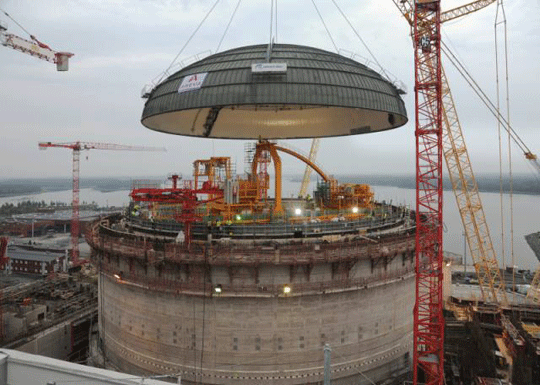 This 1.6 GW reactor, which is currently being built by the French company Areva for the Finnish energy supplier TVO, will be the biggest reactor in the world.
The construction work started in 2005 and the reactor was to be connected to the grid in 2009. The fixed turnkey-price was €3.2 billion. According to Areva, EPR is “a reactor with an unparalleled level of security, extremely resistant to both internal and external risks.”
Today, the price has soared to about €9 billion and the reactor is estimated to be completed only in 2018. According to the Helsinki Timesin November 2013, the OL3 reactor may upon completion become the most expensive building in the world. Continue reading
USA Republican Senators out to wreck Iran nuclear deal
Congressional review of Iran nuclear deal is threatened by GOP amendments LA Times, By PAUL RICHTER AND LISA MASCARO contact the reporters A bipartisan bill for Congress to review any nuclear agreement with Iran faced new danger Thursday as Republican senators sought to force votes on controversial amendments that leaders had hoped to avoid.
Senate Republican and Democratic leaders have worked all week to shield the bill from politically sensitive changes that are likely to drive away some Democratic supporters and sink its chances for passage.
Presidential campaign politics have complicated the process. One such amendment, from Sen. Marco Rubio (R-Fla.), a presidential candidate, would require Iran to recognize Israel’s right to exist, something all senators would like to see, but that Iran is unlikely to do. The issue was not on the table during more than 10 years of negotiations over Iran’s nuclear program.
But Republican senators pressed hard for their proposals……http://www.latimes.com/nation/la-na-iran-congress-20150501-story.html
Maine: democracy under threat – in the push for Small Modular Nuclear reactors
LePage Plan to Change Nuclear Power Rules Meets Resistance MPBN News, By Alanna Durkin, The Associated Press, 29 Apr 15
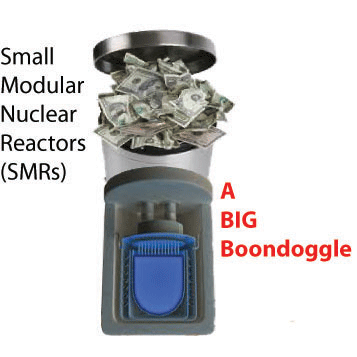
AUGUSTA, Maine – Republican Gov. Paul LePage’s proposal aimed at making it easier to bring small nuclear power plants to Maine is meeting fierce resistance because it would strip voters of their power to sign off on new plants.
Currently, Maine voters must approve the construction of any nuclear power plant. But LePage wants to remove that requirement for plants that generate 500 or fewer megawatts…….anti-nuclear activists said that removing voters’ right to decide whether Maine should build more potentially dangerous plants is wrong.
The state’s only nuclear power plant, Maine Yankee, closed in 1997.http://news.mpbn.net/post/lepage-plan-change-nuclear-power-rules-meets-resistance
Sweden accelerates its closure of its uneconomic nuclear industry
 Sweden to speed up nuclear reactors closure The Local, 28 Apr 2015 Sweden’s state-owned energy group Vattenfall on Tuesday said it planned to shut down two nuclear reactors in 2018 and 2010, up to seven years earlier than expected. Vattenfall said reactors 1 and 2 at the Ringhals plant in south-west Sweden were too costly to keep in production until 2025 as previously planned.
“Ringhals 1 and 2 may be closed down between the years 2018 and 2020 instead of, as previously announced, around 2025,” Vattenfall said in a statement.
“The reason is declining profitability and increased costs,” it said……The Swedish group has been struggling to improve profits for several years, suffering from weak demand and plunging electricity prices………http://www.thelocal.se/20150428/sweden-speeds-up-nuclear-reactors-closure
Clean energy set to beat nuclear in Japan
Japan Sees Clean Energy Edging Out Nuclear Power in 2030, Bloomberg, Chisaki Watanabe and Emi Urabe 28 Apr 15 Clean energy sources will supply as much as 24 percent of Japan’s electricity in 15 years, while atomic power will account for as much as 22 percent, according to a draft report from the Ministry of Economy, Trade and Industry on what Japan’s electricity mix should look like by 2030……
If all 24 nuclear reactors currently under review for a restart by the country’s nuclear watchdog are allowed to switch back on, they would still not be able to generate more than 16 percent of Japan’s power, Greenpeace estimates. At least 10 more reactor units need to resume operations to reach the government’s target for nuclear, the group said.
Such a mass-scale restart is unlikely, according to Shaun Burnie, a nuclear specialist at Greenpeace Germany.
“The scale of the challenges facing the nuclear industry are such that generation from reactors is likely to collapse during the coming decade,” Burnie said in the statement. “Many reactors will never restart, and most reactors over the coming years will be too old to operate.”…..http://www.bloomberg.com/news/articles/2015-04-28/japan-expects-renewable-energy-to-edge-out-nuclear-power-by-2030
Prime Minister Shinzo Abe muzzling critics in Japan’s media
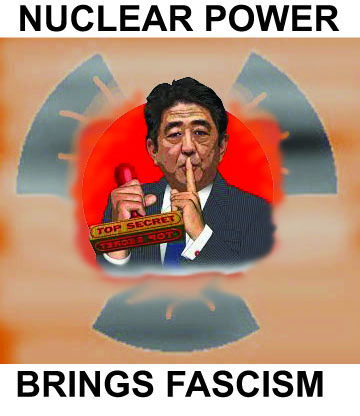 Effort by Japan to Stifle News Media Is Working, NYT By MARTIN FACKLER APRIL 26, 2015 TOKYO — It was an unexpected act of protest that shook Japan’s carefully managed media world: Shigeaki Koga, a regular television commentator and fierce critic of the political establishment, abruptly departed from the scripted conversation during a live TV news program to announce that this would be his last day on the show because, as he put it, network executives had succumbed to political pressure for his removal.
“I have suffered intense bashing by the prime minister’s office,” Mr. Koga told his visibly flabbergasted host late last month, saying he had been removed as commentator because of critical statements he had made about Prime Minister Shinzo Abe. Later in the program, Mr. Koga held up a sign that read “I am not Abe,” a play on the slogan of solidarity for journalists slain in January at a French satirical newspaper.
The outburst created a public firestorm, and not only because of the spectacle of Mr. Koga, a dour-faced former top government official, seemingly throwing away his career as a television commentator in front of millions of viewers. His angry show of defiance also focused national attention on the right-leaning government’s increased strong-arming of the news media to reduce critical coverage.
Mr. Abe’s efforts have had a chilling effect on coverage at a time when he is pushing ahead with a conservative agenda to dismantle the nation’s postwar pacifist consensus and put forth more positive portrayals of Japan’s World War II-era behavior. Experts warn that muzzling the press makes it easier for the government to make big changes that might not enjoy broad popular support, such as rewriting the pacifist Constitution, or even restarting the nation’s stalled nuclear industry.
“The Abe government is showing an obsession with the media that verges on paranoia,” said Keigo Takeda, a former editor in chief at Newsweek Japan who is now a respected freelance journalist. “I have never seen this level of efforts to micromanage specific newspapers and TV programs.”…..http://www.nytimes.com/2015/04/27/world/asia/in-japan-bid-to-stifle-media-is-working.html?smid=tw-share&_r=1
False claim that Hillary Clinton had the power to veto Russia uranium sale deal
No ‘Veto Power’ for Clinton on Uranium Deal, — Eugene Kiely, Fact Check, April 28, 2015
The author of “Clinton Cash” falsely claimed Hillary Clinton as Secretary of State had “veto power” and “could have stopped” Russia from buying a company with extensive uranium mining operations in the U.S. In fact, only the president has such power.
At the time of the sale, Clinton was a member of the Committee on Foreign Investments in the United States, which is required by law to investigate all U.S. transactions that involve a company owned or controlled by a foreign government. Federal guidelines say any one of nine voting members of the committee can object to such a foreign transaction, but the final decision then rests with the president.
“Only the President has the authority to suspend or prohibit a covered transaction,” the guidelines say.
Through a spokeswoman, author Peter Schweizer told us he meant that Clinton could have forced the issue to the president’s desk. But that’s not what he said when he appeared on “Fox News Sunday,” where he discussed the uranium deal and his upcoming book to be released on May 5.
Schweizer’s book — “Clinton Cash: The Untold Story of How and Why Foreign Governments and Businesses Helped Make Bill and Hillary Rich” — focuses on foreign donations to the Clinton Foundation, a nonprofit created by former President Bill Clinton. In his book, Schweizer, a former fellow at the right-leaning Hoover Institution, seeks to link some of those donations to the official actions taken by Clinton when she was Secretary of State…….
Schweizer is wrong when he says that Clinton had “veto power” and “could have stopped the deal.” At best, she could have forced the president to make a decision.
The committee, which is known by its acronym CFIUS, can approve a sale, but it cannot stop a sale.
- Even the president cannot prohibit a transaction without “credible evidence” that the “foreign interest exercising control might take action that threatens to impair the national security,” according to the regulation……..
The Clinton campaign told the Times that generally these matters did not reach the secretary’s level, so she may not have been involved at all. According to the Times, Jose Fernandez, a former assistant secretary of state, represented the department on the committee. He told the Times: “Mrs. Clinton never intervened with me on any C.F.I.U.S. matter.”
Schweizer raises legitimate questions about the Clinton Foundation and its donations. He simply goes too far when he says Clinton had “veto power” and “could have stopped” the uranium deal.http://www.factcheck.org/2015/04/no-veto-power-for-clinton-on-uranium-deal/
Nuclear industry embarks on a public advertising campaign
 Nuclear power industry hopes for a new era, Standard Times James Osborne, Apr 25, 2015“…….With high-profile advocates like former Environmental Protection Agency administrator Christie Whitman on board, the industry is embarking on a very public campaign arguing nuclear must be part of any national energy plan. To accomplish that, it wants to examine amending power and licensing regulations to encourage nuclear and speed up construction.
the industry will face opposition. Nuclear remains a divisive issue among environmentalists. Some support it as a proven means to cut carbon emissions out of the nation’s power supply.
But there are many see its potential contamination risks as just too great to make it sensible……..http://www.gosanangelo.com/news/state/nuclearpowerda_54975979
Maine’s Governor wants to remove voters’ rights on decisions on small nuclear reactors
LePage’s plan to negate rule on nuclear power plants could be radioactive. Observers wonder why his attention to the issue begins with an attempt to disempower Maine voters. 26 Apr. BY BILL NEMITZ COLUMNIST bnemitz@pressherald.com | @BillNemitz Consider yourselves warned, fellow citizens. Gov. Paul LePage is fiddling around with Maine’s nuclear hot button.
“We anticipated this might provoke a conversation,” noted Patrick Woodcock, director of the Governor’s Energy Office, in an interview on Friday.
Under LePage’s new plan, scheduled for a hearing Wednesday at 1 p.m. before the Legislature’s Energy, Utilities and Technology Committee, voters would no longer have a say on the creation of nuclear power plants with generating capacities of 500 megawatts or less.
(Just so you know, the Fukushima Daiichi Nuclear Power Plant’s Unit 1 reactor – one of three destroyed by Japan’s apocalyptic tsunami in 2011 – had a generating capacity of 460 megawatts.)
Let’s back up a little.
Considering the complexity and controversy bound to greet any talk of dusting off nuclear generation in Maine, why start with a bill that effectively tells voters they’re being cut out of the process?
Or, as longtime anti-nuclear activist Ray Shadis of Edgecomb put it on Friday, “You don’t start a conversation by throwing a hand grenade in the room.”
Shadis, who currently represents the lone remaining intervenor in the proposed relicensing of New Hampshire’s Seabrook nuclear plant, sees this week’s hearing as “the kind of rudeness we’ve come to expect from Gov. LePage.”
He also thinks the governor is dreaming if he thinks small modular reactors – the brainchildren of a new generation of nuclear engineers working mostly out of the Massachusetts Institute of Technology – can attract the investment capital needed to put them on the energy radar here in Maine or anywhere else, for that matter.
“The most rabid anti-nuclear crowd are the investors in the market,” Shadis noted. “It takes a long time to realize any return at all. And the entirety of what you invest can turn from an asset to a liability overnight. Why bother risking your money? So they don’t.”
Thus, he said, LePage’s bill at best “is impractical, it’s silly. Out there in the energy world, where people are really trading on this stuff, it will make Maine the laughingstock. It will make us look like patsies.”
1 This Month
23-25 October – on Zoom – World BEYOND War’s annual global conferenc


Shut down the radiation-damaged Heysham nuclear reactors now
To see nuclear-related stories in greater depth and intensity – go to https://nuclearinformation.wordpress.com

Say No to NASA’s Reckless Nuclear Reactor on the Moon
Say No to NASA’s Reckless Nuclear Reactor on the Moon
-
Archives
- October 2026 (170)
- September 2026 (339)
- August 2026 (330)
- July 2026 (355)
- June 2026 (287)
- May 2026 (306)
- April 2026 (356)
- March 2026 (251)
- February 2026 (267)
- January 2026 (308)
- December 2025 (358)
- November 2025 (359)
-
Categories
- 1
- 1 NUCLEAR ISSUES
- business and costs
- climate change
- culture and arts
- ENERGY
- environment
- health
- history
- indigenous issues
- Legal
- marketing of nuclear
- media
- opposition to nuclear
- PERSONAL STORIES
- politics
- politics international
- Religion and ethics
- safety
- secrets,lies and civil liberties
- spinbuster
- technology
- Uranium
- wastes
- weapons and war
- Women
- 2 WORLD
- ACTION
- AFRICA
- Atrocities
- AUSTRALIA
- Christina's notes
- Christina's themes
- culture and arts
- Events
- Fuk 2022
- Fuk 2023
- Fukushima 2017
- Fukushima 2018
- fukushima 2019
- Fukushima 2020
- Fukushima 2021
- general
- global warming
- Humour (God we need it)
- Nuclear
- RARE EARTHS
- Reference
- resources – print
- Resources -audiovicual
- Weekly Newsletter
- World
- World Nuclear
- YouTube
-
RSS
Entries RSS
Comments RSS

