Report of India’s Integrated Regulatory Review Services (IRRS) on Atomic Energy Board
India’s nuclear regulators have been audited, THE HINDU, MP RAM MOHAN ELS REYNAERS KINI , 3 JAN 16 But what’s the point? Parliament hasn’t passed the Nuclear Safety Regulatory Authority Bill 2015 as yet
Now, the full IRRS report has been made public and can be viewed on the AERB’s website. This is certainly one of the most significant transparency efforts initiated by the AERB in recent times. The authors believe this signals an important commitment to adopt a new public engagement model. At a substantive level, the IRRS team identified several good practices, but also areas warranting attention or in need of improvement, to enhance the overall performance of the regulatory system in India………
Many in civil society and the AERB itself in private communication maintain that its “de facto” independence should be cemented in a law “de jure” as well. That said, the IRRS mission observed that the “professionalism and integrity of the AEC, NPCIL and AERB senior staff towards ensuring the regulatory decision making processes/arrangements were completed independently and did not notice instances in which de facto AERB independence was compromised”.
Another important aspect that would need to be addressed is the grievance redress system or appeal procedure against decisions by the AERB. Currently, the constitution of the AERB states that appeals against decisions of the AERB shall be with the Atomic Energy Commission (AEC) whose decision shall be final. Here, the IRRS mission remained rather timid by merely referring to and not fully suggesting a more coherent appeal procedure which would be more in tune with a fully independent mechanism.
Addressing grievances
This is regrettable because one of the most important functions in any democratic system is the redressal of grievances, whether sought by an operator, a service provider, the public or anyone who has a role in an NPP activity. Moreover, the AERB constitution remains vague as to precisely who can appeal. These are aspects that also would need to be addressed more comprehensively to ensure that the public has faith in the nuclear regulatory system. The current redressal system also explains why people so far have generally opted to approach the courts with their grievances, rather than the AEC.
The DAE and the AERB should consider the IRRS mission review and many such suggestions of civil society in all earnestness, and thereby acknowledge that it is in the interest of the nation to make the regulatory system better, efficient and people-centric. It is important to remember what the Fukushima Nuclear Accident Independent Investigation Commission of Japan concluded: “The TEPCO Fukushima Nuclear Power Plant accident was the result of collusion between the government, the regulators and TEPCO, and the lack of governance by said parties. They effectively betrayed the nation’s right to be safe from nuclear accidents.”
The winter session of Parliament had in its agenda to consider the NSRA Bill 2015, but it didn’t see legislative light. The Bill going into hibernation again is a missed opportunity when the expansion of nuclear power is going ahead. …..
Mohan is an associate professor at TERI University; Kini is a partner at MV Kini & Co, Mumbai. The writers are members of the Nuclear Law Association, India. http://www.thehindubusinessline.com/opinion/indias-nuclear-regulators-have-been-audited/article8061473.ece
Wisconsin Republicans’ outrageous lies about nuclear power and renewable energy
These are the same Republicans who publicly deny the overwhelming scientific evidence of global warming, threaten to fire any state employee who even breathes the words, and vow to legally battle EPA clean energy standards to the death.
As soon as Walker and Republicans gained control of state government, they began blocking wind farms around Wisconsin.
 Joel McNally: They’re still lying about nuclear power, The CAP Times, Madison, Wisconsin JOEL McNALLY | state columnist Jan 2, 2016 I still remember the party that night in 1983 when Wisconsin voters passed a statewide referendum banning construction of new nuclear power plants until the nation created someplace to safely store deadly, radioactive nuclear waste. It was a victory for ordinary citizens over just about every powerful force in government, and industry united in condemning us as totally unreasonable and irresponsible.
Three decades later, we now know that was an outrageous lie.
Wisconsin was one of the first of 13 states to pass a moratorium. But even in states that ignored the threat to public safety, soaring costs soon brought new construction to a halt anyway.
And during those three decades, our political system still has failed to create a safe storage repository for radioactive nuclear waste that remains deadly for hundreds of thousands of years.
As a result, dangerous waste remains spread all over this country at nuclear sites that were abandoned years ago. Who knows how long we’ll even remember what went on there. Future archeologists uncovering our so-called civilization in, let’s say, just tens of thousands of years may be in for a deadly surprise.
There was nothing unreasonable or irresponsible about the Wisconsin anti-nuclear movement………
here’s the good news for Wisconsin. All those elected officials who kept pushing nuclear power weren’t telling the truth. We’ve never needed it. Continue reading
Are we satisfied to live with the nuclear sword of Damocles hanging over our heads forever?
 Imperial fascism and nuclear realities, delmarva now, MICHAEL O’LOUGHLIN December 31, 2015 Are we satisfied to live with the nuclear sword of Damocles hanging over our heads forever? The rhetoric of the dominant Republican candidates for president has become imperial fascism.
Fascist because it expresses an enthusiastic embrace of violence as the central instrument of U.S. power in foreign policy. Fascist as well because this entails a cavalier dismissal of basic standards of morality associated with human rights and international law.
Trump, Cruz and Christie recently took turns giving voice to this rhetoric, talking about “carpet bombing,” “killing families of terrorists,” “shooting down Russian planes,” making “the desert glow” and closing our borders to desperate people fleeing war because they are Arab Muslims.
The smell of fascism also rises with Trump’s talk of “energy,” “strength” and “will.”Opponents are cast aside as “weak” and “low energy,” in contrast to Trump’s claims he embodies “strength” and the “will” to “make America Great Again.” Policy content? Irrelevant. Trump’s sheer “will” conquers all problems before him. All we need do is “believe” in our leader…….
The rhetoric is “imperial” because it embraces the idea that the United States alone, indeed the president alone, has a right to engage unilaterally in war without end and no need for Congressional authority, UN Security Council consent or multilateral involvement of European allies.
Arrogant claims become commonplace. The oil resources of Middle Eastern countries are now “ours” and we will just “take it,” according to Trump. Central to the imperial perspective, national sovereignty belongs only to the imperious state. Other nations have no such rights…..
As journalist Walter Pincus recently wrote: “After Sept. 11, 2001, a very wise intelligence officer told me in 2002, ‘we have turned 16 clever al-Qaeda terrorists into a worldwide movement, seemingly more dangerous to Americans than the communist Soviet Union with thousands of nuclear missiles.’”
As of this date, the world has a stockpile of some 15,695 nuclear weapons, with the US and Russia armed with 93% of that stockpile, 7,200 and 7,500, respectively. In this respect, though some nuclear disarmament has been achieved, it remains the case that the greatest danger to the survival of the US, indeed, the world, is the continued existence of Russian warheads and our own.
Much hot air has been expelled on the real and imagined threat of non-state terrorism. Yet, where in the debates thus far have we heard serious discussion of moving faster towards a “nuclear free” world? Or are we satisfied to live with the nuclear sword of Damocles hanging over our heads forever?
Michael O’Loughlin is a member of the Peace Alliance of the Lower Shore http://www.delmarvanow.com/story/opinion/2015/12/31/column-oloughlin/78150212/
Price Anderson Act and other gifts to nuclear industry make it APPEAR to be economic
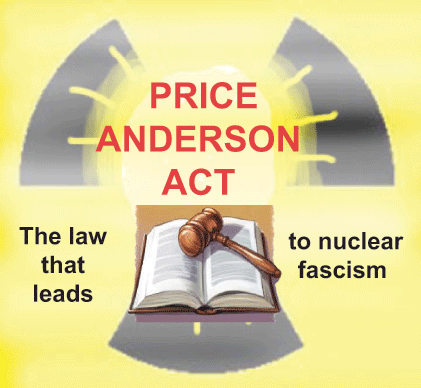 The Vermont Law School paper aptly sums up this picture with this conclusion:
“If the owners and operators of nuclear reactors had to face the full liability of a nuclear accident and meet the alternatives in competition that is unfettered by subsidies, no one would have built a nuclear reactor in the past, no one would build a reactor today, and anyone who owned one would exit the nuclear business as quickly as they could.” [page 69]
If we had a rational economic system, they surely would.
Indonesia pulling the plug on nuclear power construction, for now, at least
 Indonesia Vows No Nuclear Power Until 2050 http://jakartaglobe.beritasatu.com/business/indonesia-vows-no-nuclear-power-2050/ Banda Aceh. Indonesia will not resort to nuclear energy to meet its target of 136.7 gigawatt of power capacity by 2025 and 430 gigawatt by 2050, a minister said on Saturday.
The move means a previous $8-billion plan to operate four nuclear plants with a total capacity of 6 gigawatt by 2025 will be canceled.
“We have arrived at the conclusion that this is not the time to build up nuclear power capacity. We still have many alternatives and we do not need to raise any controversies,” Energy and Mineral Resources Minister Sudirman Said said on Saturday in Banda Aceh.
The minister spoke after the National Energy Council, a presidential advisory body, completed its latest National Energy Plan, which is to be signed by President Joko Widodo to become a presidential regulation.
The plan, last revised in 2006, lays down the ground rules and guidelines for energy development in Indonesia, as well as the country’s commitment to reduce greenhouse gas emissions.
The plan from 2006 still left room for nuclear energy, but the latest guidelines say Indonesia should increase the use of renewable energy sources to 23 percent of its total primary energy — from the current target of 5 percent — by 2025.
Energy from coal is slashed to 30 percent from 33 percent previously, but Indonesia will rely more on oil, which is set to account for 25 percent of energy in the next decade, from the previous target of 20 percent.
Natural gas will contribute the remaining 22 percent to reach the 2025 target, Sudirman said, without providing details on the energy mix target for 2050.
The minister added that Indonesia will continue to follow developments in the field of nuclear technology and that it would remain a last-resort option for possible use beyond 2050.
While having experimented with nuclear power since the 1950s, Indonesia currently only operates three small-scale reactors: a 100-kilowatt reactor in Yogyakarta, a 250-kW reactor in Bandung and a 30-MW reactor in Serpong, in Banten.
A previous proposal to build larger-scale plants on Central Java’s Muria peninsula and in Bangka-Belitung met with resistance from local residents who feared leaks on the scale of the Fukushima disaster in equally earthquake-prone Japan.
Another place that was under consideration to host a nuclear power plant was Kalimantan, where there are no volcanoes and the relatively large distance from tectonic fault lines means the chance of devastating earthquakes is limited.
US Chamber of Commerce backs the weakening of radiation safety standards
 US Chamber of Commerce Nov 19 15
 radiation hormesis is a phenomenon in which low doses of ionizing radiation can be beneficial, stimulating the activation of repair mechanisms and other adaptive responses that protect against adverse effects not activated in the absence of ionizing radiation…….
As Wylfa nuclear plant closes in Wales, delays continue for UK’s new nuclear stations
 Wylfa nuclear plant closes in Wales Station in Anglesey, Wylfa the oldest in the UK, shuts as focus is on energy provider EDF over its plans for new facilities at Hinkley Point, Guardian, Terry Macalister, 31 Dec 15 Britain’s oldest nuclear plant closed on Wednesday, leaving in its wake a £700m decommissioning bill and further questions about the UK’s ability to keep the lights on.
The closure of the Wylfa plant in Wales after 44 years of service puts more pressure on EDF Energy to take a final investment decision for new reactors at Hinkley in Somerset.
The station on the island of Anglesey generated enough electricity to power 1m homes, and with a capacity of 1,000MW was once the largest facility of its kind in the world. But after an earlier life extension scheme expired, the last of the 26 British-designed Magnox reactors was switched off by the private consortium that manages the plant for the Nuclear Decommissioning Authority (NDA)…….
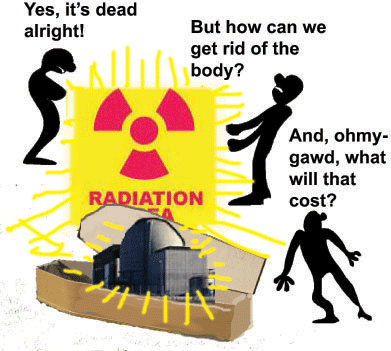 It will take another 10 years for the basic decommissioning to be undertaken at a cost of about £700m but the site cannot be redeveloped before the end of the century. High-level waste from Wylfa will remain on Anglesey until a national nuclear waste disposal facility is finally developed.
Britain still has a fleet of advanced cooled atomic reactors run by EDF but most of these will be retired by 2023 just as the government has also promised to halt all coal-fired power stations.
Hitachi of Japan is leading a Horizon Nuclear Power project to construct a new power plant at Wylfa, with a second earmarked for Oldbury in south Gloucestershire alongside a third facility planned in Cumbria. But the atomic industry’s revived fortunes ride primarily on the Hinkley C plant, which is expected to be the first new site since the Sizewell B station was completed in 1995.
The £18bn Somerset project has been repeatedly delayed but Chinese investors finally gave their support in the autumn while thegovernment promised the latest in a series of subsidies. EDF signalled in October that it would start work at Hinkley and it is expected to give the formal investment the go ahead within weeks before later saying it may not come until after Christmas.
Hinkley Point C, intended to provide about 7% of the UK’s total electricity, was originally scheduled for completion by 2018 but the latest date is 2025. Sceptics still question whether it will make that later date given the experiences of delays and cost overruns with a similar power project at Flamanville in Normandy, northern France.
There have also been problems at the new Olkiluoto nuclear plant in Finlandwhich is using the same plant design provided by EDF’s engineering partner Areva at Flamanville and planned for Hinkley………http://www.theguardian.com/environment/2015/dec/30/wylfa-nuclear-plant-closes-in-wales
Renewed calls to shut down aging Indian Point nuclear station
 New calls to shut Indian Point; plant’s critics cite age, proximity to cities, North Jersey.com , DECEMBER 27, 2015, BY SCOTT FALLON A nuclear power plant just 15 miles from North Jersey is at a crossroads as federal regulators determine whether to allow Indian Point in Westchester County to continue operating for another two decades in the face of fierce opposition from New York officials.
A series of mishaps this year, including one in which a reactor was shut down this month, has renewed calls by New York Gov. Andrew Cuomo to close the aging plant on the Hudson River. They come as an arm of the federal Nuclear Regulatory Commission continues to scrutinize Indian Point’s application to renew the licenses on its two reactors, a marathon process that began eight years ago.
In a scathing letter to the commission last month, a top Cuomo official called the 40-year-old reactors brittle and fatigued, and said the plant’s proximity to a major population center makes it impossible to have an effective evacuation plan.
“Given the deterioration of this aging plant, it should not be permitted to operate for another 20 years,” wrote Jim Malatras, director of state operations in New York.
A spokesman for Entergy Corp., which owns Indian Point, did not respond to a request for comment……
The reactors’ 40-year licenses have expired — Unit 2 in 2013 and Unit 3 on Dec. 12 — but they are allowed to operate while the renewal process continues…….
Evacuation zone
Indian Point has long been a concern of North Jersey officials because Bergen and Passaic counties sit just outside the plant’s federally designated 10-mile evacuation zone, which critics have long said is too small. New Jersey has developed emergency plans, including one to accept thousands of people from Rockland County if need be.
New Jersey has not weighed in on Indian Point’s future. The New Jersey Department of Environmental Protection has not submitted any comments to the NRC because it has “no regulatory role” over the plant, said Larry Hajna, an agency spokesman.
Indian Point’s relicensing saga comes during a relatively quiet time for New Jersey’s own nuclear industry. Three nuclear reactors have been approved to operate for several more decades while a fourth – Oyster Creek in Ocean County – is scheduled to close by the end of the decade. Although Governor Christie has called for another reactor to be built in New Jersey, plans by the state’s largest electric utility to build one in Salem County are on hold.
In New York, Cuomo is trying disrupt Indian Point’s relicensing efforts by denying a certification under the state’s Coastal Zone Management Plan. In a report sent to NRC last month, New York officials reiterated much of the criticism leveled at Indian Point through the years: That there is no way New York City and its densely populated suburbs could be adequately evacuated if a disaster occurred, the plant is vulnerable because it sits near two fault lines, and a billion fish and other marine organisms are killed annually when they are sucked from the Hudson River into the plant’s intake valves.
Some environmental advocates say the report could disrupt Indian Point’s license renewal. A New York court has said the plant is exempt from the state’s review. That decision is being appealed…….. http://www.northjersey.com/news/new-calls-to-shut-indian-point-plant-s-critics-cite-age-proximity-to-cities-1.1480825
UK govt prioritising nuclear, gas, oil, but removing support for renewables
Government U-turn on renewables shows gas, oil and nuclear are still favourites
 Now is not the time to pull the plug on supporting renewable energy. A few years of vital subsidies cannot make up for a century of support for fossil fuels. Guardian, Alasdair Cameron, 20 Dec 15
The entire global energy system is undergoing a clean revolution. The old certainties of centralised power and fossil fuels are falling apart before our eyes. In Paris last week world leaders set legally binding targets to decarbonise their economies in order to keep temperature rises at a maximum of 2C. The future is almost here.
It’s a future that is necessary and one that presents the economic opportunity of the century. Bloomberg NEFs New Energy Outlook for 2015 estimates that renewables alone will see more than $8tn of investment in the coming years with $3.7tn in solar alone.
Until recently the UK seemed to understand this, however imperfectly. In the second quarter of this year, the UK got 25% of its electricity from renewables and is aiming for 30% by 2020. The last two governments deserve credit for that.
Costs have fallen, with the latest ground-mounted solar and onshore wind now cheaper than new nuclear , and offshore wind – where the UK is a world leader – is not far behind.
The government’s line is that it’s time to pull the plug on supporting renewable energy – as if a few years of vital subsidies can make up for a century of economic and infrastructural support for fossil fuels. Renewable energy, like most industries, needs some government support to get going, and to realise the best results. Think of the tax breaksand research grants still given to oil and gas, the direct subsidies for nuclear, the publicly-funded roads that facilitate cars, or the national space programmes that eventually brought us the mobile phone.
The argument that this U-turn is about protecting consumers’ bills simply does not hold. Cuts to rooftop solar announced on Thursday will save just 0.9% off a yearly bill, by 2020.
Many of the alternatives the government is turning to are actually more expensive than renewables – Hinkley Point C would cost consumers twice the current wholesale price of electricity. And the single best thing that would cut bills – insulating homes – has seen just about all public support scrapped.
Endless delays – that’s the system for Hanford nuclear waste clean-up
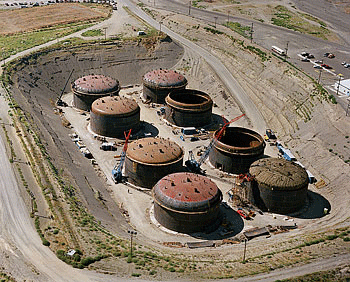 Will Hanford’s Big Clean-Up Ever Begin? Fifteen years past its originally scheduled start-up date, the nuclear facility’s glassification plant is way over budget and no one seems able to nail down a deadline. At fault, say critics, are mismanagement, frequent turnover in the top brass, and a culture that doesn’t take kindly to criticism. Seattle News Weekly, By John Stang , Dec 15 2015 “……….The story of Tamosaitis’ unheralded warnings is not the exception in the ongoing struggle to contain Hanford’s waste. Rather, this episode is just the latest in a litany of setbacks that has put the project over budget and off schedule again and again.
Officially, the reasons are that this is a first-of-its-kind project with difficult-to-perfect new technology.
In reality, the glassification project—like most of Hanford—resembles a giant Dilbert comic book. The culture is the culprit. There are immense corporate and social pressures to look good now and hope someone else is in charge when things go wrong later. These pressures include high turnover in upper management, bonuses to corporations, individual career advancement, and retaliation against those who rock the boat at inconvenient times. Continue reading
Donald Trump shows abysmal ignorance about USA’s nuclear weapons
TRUMP’S NUCLEAR HOWLER, Powerline, DECEMBER 15, 2015 BY PAUL MIRENGOFFTonight, Donald Trump delivered the biggest howler of the presidential campaign (at least on the GOP side). But don’t worry, the topic was a trivial one — nuclear weapons.
Hugh Hewitt asked Trump which part of our aging triad would be his priority as president. Trump answered, the nuclear side. But the triad, as Marco Rubio explained, is entirely nuclear. It consists of ships that can deliver nukes, planes that can deliver nukes, and silos from which nukes can be launched. In effect, then, Trump answered a question about which part of our nuclear triad is most important by saying the nuclear part.
Tom Elliott provides the text of this exchange at NRO’s Corner. Jonah Goldberg reminds us that Hugh asked Trump about the nuclear triad at great length in August, and he couldn’t answer it then, either. In the August exchange, Hugh told Trump that the “triad” is a nuclear triad. I guess Trump forgot.
The “triad” wasn’t Trump’s only bad moment. He defended his plan to kill the families of terrorists on the grounds that family members know about attacks in advance and that, though terrorists may not care about their own lives, they care about the lives of family members.
Put aside how outrageous Trump’s retaliatory murder idea is; it also displays a fundamental misunderstanding of the kinds of people we’re dealing with…….. http://www.powerlineblog.com/archives/2015/12/trumps-nuclear-howler.php
South Africa’s govt quietly confirms nuclear power deal

 Cabinet quietly endorses nuclear deal http://www.bdlive.co.za/business/energy/2015/12/15/cabinet-quietly-endorses-nuclear-deal BY NATASHA MARRIAN, 15 DECEMBER 2015, FINANCE MINISTER PRAVIN GORDHAN CONFIRMED ON MONDAY THAT A DECISION WAS TAKEN BY THE CABINET IN ITS MEETING LAST WEEK TO START THE NUCLEAR PROCUREMENT PROGRAMME.
This opens the path for the Department of Energy to call for proposals to provide 9.6GW of nuclear power without first doing a cost-benefit analysis. But Mr Gordhan was adamant on Monday the procurement would go head only if it was “affordable”. Mr Gordhan confirmed that the decision had been made, yet in a post-Cabinet statement and a media briefing last week, no mention was made of the procurement decision.
On Monday, Business Day reported on the decision and that was the first time it was mentioned in public.
Acting Cabinet spokeswoman Nebo Legoabe said on Monday she did not know why the information was not contained in the Cabinet statement. She had not been in the Cabinet meeting and was unaware of what was discussed.
Mr Gordhan said he was not in the Cabinet meeting either last week as he had been unwell, but confirmed the decision.
“There is, I think, a decision on Wednesday that we are going to move in that direction. Part of that decision … is that there will be a formal procurement process in accordance with South African law.’’
He reiterated that the Treasury would only proceed with plans that were affordable. We can’t spend money that we don’t have and we can’t make commitments when we know we are not going to get the money that is required to be spent in this particular regard,” the minister said.
Mr Gordhan added, however, that this did not mean it would never happen, just that it may have to wait.
Former finance minister Nhlanhla Nene has said repeatedly that nuclear energy would not be procured if SA could not afford it. The African National Congress has also expressed caution, passing a resolution at its national general council in October, calling for ‘‘a full, transparent and thorough cost-benefit analysis of nuclear power’’.
With Carol Paton
Unpalatable news for nuclear industry: reprocessing may be found to be ‘wasteful spending’
 Japan may review spending on plutonium fuel cycle http://www.japantoday.com/category/national/view/japan-may-review-spending-on-plutonium-fuel-cycle By Aaron Sheldrick and Linda Sieg DEC. 11, 2015 TOKYO —
Japan may review spending on reprocessing plutonium for use in nuclear reactors, a minister appointed to identify wasteful spending told Reuters, following years of government outlays on the controversial program that has yielded no results.
The minister’s comments come after the operator of Japan’s fast breeder reactor, designed to use plutonium extracted from spent reactor fuel, was declared unfit following decades of accidents, missteps and falsification of documents.
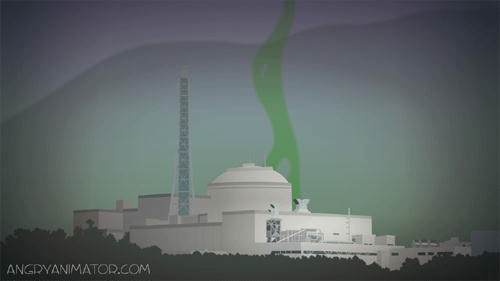 Costs for the Monju breeder reactor have ballooned to about 1 trillion yen ($8 billion) while Japan’s public debt is the highest among industrialized nations. Taro Kono, a ruling Liberal Democratic Party member who is a critic of the Monju facility and the nuclear industry in general, was appointed to examine government spending in a recent cabinet reshuffle by Prime Minister Shinzo Abe.
While Kono emphasized he cannot overturn government policy, he can review public projects and said Abe had told the cabinet that wasteful spending had to be taken “out of the budget.”
He has been reviewing part of the government budget request of 102 trillion yen for the fiscal year starting March, including a little-used ship carrying nuclear fuel and subsidies to towns that host nuclear power plants. “In my portfolio, I can ask them if the money is spent wisely and that’s what I have been doing and the nuclear fuel cycle is no exception,” the U.S.-educated Kono said.
He said next year’s review could be widened to include all government spending on nuclear projects, something that might resonate with voters after the Fukushima disaster in 2011 turned the public against atomic power. “If they are not doing a good job, the review next year will be all nuclear, maybe,” Kono said.
His comments could have implications for another costly nuclear project that is mostly in private hands but has strong government support and receives some public funds. The Rokkasho plutonium reprocessing facility in northern Japan is meant to provide fuel for Monju and some of Japan’s nuclear reactors, but completion was delayed for a 23rd time last month.
The plant has been beset with problems since the first concrete was laid in 1993 and costs have ballooned to 2.2 trillion yen ($18 billion) from 760 billion yen.
 Meanwhile, Japan’s plutonium stockpile has expanded to nearly 50 tons, with stocks held in Britain and France as well as in Japan. Recently, a group of 31 scientists wrote to Abe urging him to abandon reprocessing.
With all but two of Japan’s reactors shut down in the wake of the Fukushima disaster and no immediate use for the plutonium, there is little meaning to the costly exercise of extracting more from spent fuel, critics say.
“The PM’s directive is very clear. If we point out any items that are not spent well it has to be out of the budget,” Kono said. “That’s why a few ministers are not speaking to me right now,” he added, with a laugh.
The push for Small Modular Nuclear Reactors goes on in Idaho
E. Idaho eyed as site for small commercial nuclear reactors, Idaho Statesman, BY KEITH RIDLER Associated Press BOISE, IDAHO , 11 Dec 15
U.S. Department of Energy officials and an energy cooperative with members in eight states are negotiating a plan that could lead to the construction of small commercial nuclear reactors at an eastern Idaho federal nuclear site.

Officials with Utah Associated Municipal Power Systems said the 890-square-mile site containing the Idaho National Laboratory is their preferred choice for what are called small modular reactors…….
The Energy Department on Wednesday confirmed that the area is being considered but offered no details. The agency contracts with Battelle Energy Alliance to run the Idaho National Laboratory….
Oregon-based NuScale Power would build the reactors……. NuScale Chief Commercial Officer Mike McGough said said the company is in the process of completing an application to the Nuclear Regulatory Commission for the reactors. He described the application as a 12,000-page book that will undergo a 40-month review. If everything advances, work on the modules could begin before 2020…..
Cost is a big concern for Utah Associated Municipal Power Systems, said LaVarr Webb, company spokesman, Utah Associated Municipal Power Systems , noting that the group is relatively small compared to larger power suppliers in the region…..http://www.idahostatesman.com/news/business/article48867830.html
Tax-payer funding to go to Britain’s small nuclear reactor companies!
In pursuit of partners: the UK doubles down on small modular reactors, Power Technology 9 December 2015 At the end of November, the UK Treasury announced a doubling of nuclear funding alongside a design competition to “revive the UK’s nuclear expertise and position the UK as a global leader in innovative nuclear technologies”. With small modular reactors a particular focus, Taylor Heyman profiles the companies that will be looking to throw their hat in the ring.
In the run-up to the 2015 Paris climate talks, UK chancellor George Osborne announced funding of £250m over five years to put the UK at the forefront of world research and development of small nuclear reactors (SMRs)….
The autumn statement also included details of a design competition to be launched in early 2016 to find the “best value small modular reactor design for the UK”, the Treasury said in the spending review policy paper. The competition is the beginning of a government strategy to complete an SMR sometime in the 2020s…
UK SMR: the contenders
There are bound to be a number of big players clamouring for the opportunity to work with the UK government in developing the UK’s first SMRs. Last December, the National Nuclear Laboratory (NNL), in conjunction with a range of research organisations and companies, released a feasibility study focusing on SMRs in the UK, commissioned by the Department of Energy and Climate Change (DECC). The review found four financially and techically viable options for SMR designs, by China National Nuclear Corporation (CNNC), B&W and Bechtel, Westinghouse and NuScale.
CNNC’s ACP100 design is a 310MWt pressurised water reactor designed to produce between 100 and 150MWe. The IAEA began a safety review of the design in July 2015, assessing the reactor’s safety, environmental impact and other elements of the design.
The BWXT mPower™ from B&W and Bechtel is an integral 530MWt pressurised water reactor which will produce around 180MWe. The team won the first round of funding from the cost-sharing funding initiative with the U.S. Department of Energy (DOE), Tennessee Valley Authority (TVA) and Bechtel, but decided to scale back their funding in April 2014. This considerably slowed the pace and scale of development.
Westinghouse, a company well-established and employing over 1,000 people in the UK has already presented the British Government with its proposal to partner in deploying SMR technology throughout the UK. The Westinghouse SMR design is a 225MWe integral pressurized water reactor with all primary components located inside the reactor vessel.
The NuScale offering is a 160MWt reactor which operates using the principles of natural circulation rather than traditional pumps. It can produce 50MWA. The idea behind the smaller design is scalability; reactor units can be added or taken away depending on demand. NuScale Power won the second round of DOE funding in 2013, receiving $217m over five years in cost-share funds to develop, license and commercialise its SMR technology. The first is projected for 2024 in Idaho, US.
No doubt other contenders for the partnership will come to the fore once details of the January competition are released by DECC. Whichever company is chosen, NNL hopes to play a role in the development of SMRs for the UK. “We have a strong capability in reactor design, including SMRs,” says NNL’s director of external relations Adrian Bull. “So we feel we would be well-placed to carry out significant scope within the overall programme.” http://www.power-technology.com/features/featurein-pursuit-of-partners-the-uk-doubles-down-on-small-modular-reactors-4749180/
1 This Month
23-25 October – on Zoom – World BEYOND War’s annual global conferenc

To see nuclear-related stories in greater depth and intensity – go to https://nuclearinformation.wordpress.com

Say No to NASA’s Reckless Nuclear Reactor on the Moon
Say No to NASA’s Reckless Nuclear Reactor on the Moon
-
Archives
- October 2026 (160)
- September 2026 (339)
- August 2026 (330)
- July 2026 (355)
- June 2026 (287)
- May 2026 (306)
- April 2026 (356)
- March 2026 (251)
- February 2026 (267)
- January 2026 (308)
- December 2025 (358)
- November 2025 (359)
-
Categories
- 1
- 1 NUCLEAR ISSUES
- business and costs
- climate change
- culture and arts
- ENERGY
- environment
- health
- history
- indigenous issues
- Legal
- marketing of nuclear
- media
- opposition to nuclear
- PERSONAL STORIES
- politics
- politics international
- Religion and ethics
- safety
- secrets,lies and civil liberties
- spinbuster
- technology
- Uranium
- wastes
- weapons and war
- Women
- 2 WORLD
- ACTION
- AFRICA
- Atrocities
- AUSTRALIA
- Christina's notes
- Christina's themes
- culture and arts
- Events
- Fuk 2022
- Fuk 2023
- Fukushima 2017
- Fukushima 2018
- fukushima 2019
- Fukushima 2020
- Fukushima 2021
- general
- global warming
- Humour (God we need it)
- Nuclear
- RARE EARTHS
- Reference
- resources – print
- Resources -audiovicual
- Weekly Newsletter
- World
- World Nuclear
- YouTube
-
RSS
Entries RSS
Comments RSS

