Takahama town tries to stop its heavy dependence on the nuclear industry
 Town tries to shift away from heavy dependence on nuclear plant, Japan Times, 31 Jan 16 JIJI TAKAHAMA, FUKUI PREF. – In the wake of the disastrous nuclear accident in northeastern Japan nearly five years ago, the Fukui Prefecture town of Takahama has been seeking ways to reduce its heavy dependence on a nuclear power plant for its livelihood.
“It is true that we’ve depended on the nuclear industry,” said a local official responsible for community buildings in the municipality, home to Kansai Electric Power Co.’s Takahama nuclear plant.
The town and the nuclear power station have “become inseparable” since the plant’s No. 1 reactor started operations in 1974, according to the official.
The plant has provided jobs for the community, with the much of the town’s economy geared towards providing services for those who work at the facility.
On Friday, the plant’s No. 3 reactor was brought back online after a hiatus of nearly four years, becoming the third reactor in the nation to restart operations under the country’s new safety standards compiled after the March 2011 accident at Tokyo Electric Power Co.’s Fukushima No. 1 nuclear power plant. Kansai Electric plans to reactivate the No. 4 reactor at the plant in late February.
In fiscal 2014, which ended in March last year, the town’s revenues related to the nuclear plant, including subsidies and fixed-asset tax income, totaled ¥5,072 million, accounting for 51 percent of its total general-account revenue.
However, the Fukushima No. 1 plant accident changed the town’s way of thinking.
“We’ve come to think seriously that the town must not depend solely on the nuclear industry,” the town official said. “We are now aiming to reshape the town into a community that does not rely on nuclear power.”
As part of its effort, the town is looking to its beaches with their beautiful landscapes and pristine waters…… http://www.japantimes.co.jp/news/2016/01/31/national/town-tries-shift-away-heavy-dependence-nuclear-plant/#.Vq5u4tJ97Gh
Why the Nuclear Lobby and Australian Politicians want Australia as world’s radioactive trash dump
from CaptD 31 Jan 16 The first reason is MONEY and I mean BIG Money. Politicians are always gear for Nuclear  Payback*
* http://www.urbandictionary.com/define.php?term=Nuclear+payback
Those that support nuclear power because nuclear power somehow supports them; no matter what the health implications or other “costs” are for others.
The “other” reason is that the Nuclear Industry and their Utilities are desperate to create a radioactive waste dumping site for waste is that they are going to want to site Small Modular Reactors (SMRs) very soon, which companies like SD’s General Atomic are now working on. Since CA has a law that says no more nuclear reactors, until a waste site is developed, the lack of a disposal site is the biggest roadblock they face preventing them from deploying SMRs in CA.

I believe that most Utilities will want to phase out Nat. Gas fired Peaker plants and install SMR’s “because they don’t emit CO2.” That is, unless they are going to be making big money using nat. gas like SDG&E will be, since they already have a contract to import Nat. Gas from Mexico (which Sempra owns a share of, so they will be kind of buying Nat. Gas from themselves) for use in their two new state of the art Billion Dollar Peaker Plants that the CPUC just approved for them (despite the fact that the cost of Wind and Solar generation continues to drop almost monthly)!
SCE just had the CPUC decide against approving a Nat. Gas Peaker plant for them, so you can bet that they are now getting “very excited” about installing one or more SMR’s at San Onofre, since the grid wiring connection is already in place and they are going to be guarding that “nuclear waste” site for decades to come.
http://www.kpbs.org/news/2016/jan/08/oceanside-takes-stand-relocating-san-onofres-nucle/
BTW: All waste facilities should be run by the Government, that way they will always be responsible for it, since Big Waste Corp.’s can go out of business any time they want as as everybody knows Radiation is FOREVER since 50 or more than 100 years is forever to everyone living today.
Pierce County, USA not happy with DOE plan for a deep bore feasibility study for nuclear waste
 Rocky road for nuclear waste bore hole study, http://bismarcktribune.com/news/state-and-regional/rocky-road-for-nuclear-waste-bore-hole-study/article_7698d465-0316-5031-83e9-bc727d3592b9.html By Lauren Donovan, 29 Jan 16 A plan to explore deep ancient rock in Pierce County for its potential to store nuclear waste hit a bumpy road if not a rock wall in its first introduction to state officials Thursday.
The State Board of University and School Lands heard from the Energy and Environmental Research Center at Grand Forks that its team was awarded $35 million by the federal Department of Energy to drill 16,000 feet down into crystalline rock to learn whether the rock could suitably store spent nuclear fuels.
John Harju, project liaison, said the bore hole is for study purposes only, no waste would be stored there and that such storage isn’t even yet legal under federal rules.
Harju said the bore hole would be an opportunity to analyze rock core that’s rarely ever been looked at for minerals or geothermal properties. The chance to go that deep, into the oldest rock on the planet, “may never present itself again,” Harju said.
The issue was presented to the land board because EERC is proposing to drill on 20 acres of state-owned land about 15 miles south of Rugby.
Pierce County commissioners were at the meeting and said they were startled to read about the project before anyone from EERC even came to the county.
Commissioner Duane Johnston said, if the issue had come up at a local zoning meeting, “half the county would have been there to say no.” Commission chairman Dave Migler said it was tough to take calls from residents and not have much information to share. “It’d be nice to be in the loop,” he said.
While there was no formal application on the table, land board members didn’t hesitate to weigh in with worries that a federal project could become a federal mandate.
In the end, it was far from clear how the EERC would proceed with getting approval to use public land for the project in Pierce County, or perhaps anywhere in the state.
Afterward, Harju said he was a little surprised by his reception. “Plan B? We don’t have one. If the project is not able to proceed, the DOE will have to evaluate” alternatives, he said.
The five-year project was awarded to the Battelle Memorial Institute of Ohio, along with EERC and Schlumberger, a familiar drilling service company in the Bakken. The crystalline rock formation underlies much of the continent.
Bernie Sanders calls for total phaseout of nuclear energy

Protest repressed in India, as government panders to France, USA
the international nuclear industry has faced its worst crisis globally. The industry is looking at India as a big market where they can compensate for their losses and revive their fortunes. India has become an attractive market for global nuclear corporations

France Peddles Unsafe Nuclear Reactors to India, Drawing Protest , 29 January 2016 By Kumar 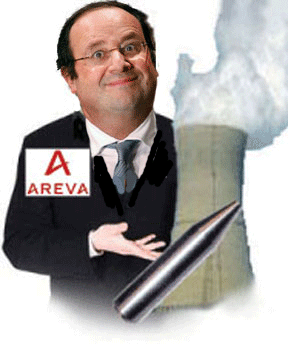 Sundaram, Truthout | News Analysis On January 26, French President François Hollande was the chief guest for India’s Republic Day ceremony, where India showcases its military hardware in a colonial-era parade in its capital. Meanwhile, in Jaitapur on India’s western coast, farmers and fisherfolk were protesting against Hollande’s visit, arguing that the nuclear reactors that India is importing from France threaten their lives, livelihoods and the local ecology.
The Joint Declaration: Localizing Risk, Siphoning Off Profit
In a joint declaration issued on January 25 in New Delhi, the two governments reaffirmed their commitment to go ahead with a long-pending nuclear deal. As per the declaration, the intense negotiations to finalize the commercial agreement are expected to conclude by the end of this year, and the construction of six European pressurized reactors (EPR) imported from France is to begin by early 2017.
The new twist in the declaration is the “maximum localization” of the project and “technology transfer” for the same. Although the government of Indian Prime Minister Narendra Modi seems to have proudly included these new terms and added a “Made in India” tag on the Jaitapur project, it actually means that the French industry would be transferring the burden of its most controversial reactor design at a time of its worst crisis.
The safety vulnerabilities of the reactor pressure vessel (RPV) – the huge iron core where radioactive fission takes place – came under serious questions, raised by France’s own nuclear safety regulator Autorité de Sûreté Nucléaire (ASN) in April 2015. Later in 2015, Areva, the French reactor builder, had to ask the US Nuclear Regulatory Commission to suspend certification review for EPR design. The United States has been postponing certification for EPR since 2007. The Finnish regulator has taken Areva to court on this issue, and Finland has canceled the order for its second EPR. Just two days after the publication of ASN’s report, Modi reaffirmed the EPR deal from France during his visit to Paris in April 2015. It is exactly this controversial component – the RPV – that an Indian private company L&T will now be building, with no experience in the nuclear sector at all.
The current phase of negotiations on Jaitapur is about the price of reactors, which remains a major sticking point. Although the former chief of India’s Atomic Energy Commission promised a tariff of a maximum of 10 US cents per unit for the electricity produced in Jaitapur, independent experts have claimed it will be much higher (20 to 30 cents per unit). This means the government of India would use taxpayers’ money to keep the price competitive. If we go by the cost of EPRs in the United Kingdom, each Indian reactor may cost as much as $8.9 billion. Two reactors in Jaitapur’s first phase will cost as much as India’s total expenditure on science and technology (including the departments of space, science and technology, biotechnology, and research for the entire country). A diplomatic cable revealed by WikiLeaks quoted the general manager of the Nuclear Power Corporation (NPCIL), saying that India is paying a “high” price for Jaitapur………….
The Indian government has managed to acquire land for the project by pressuring farmers and luring a handful of landlords. Despite land acquisition, the farmers in Jaitapur continue to resist. Most villagers either work on others’ land or provide rural services to the agrarian community and do not get any compensation when villages are dislocated for “development” projects. Tabrez Soyekar, a young fisherman, was killed in an indiscriminate police shooting in April 2011, during a peaceful protest. Hundreds of activists and eminent citizens, including the former Navy chief of India and retired justice of the Supreme Court of India, were detainedduring a protest march.
Thirteen village councils in Jaitapur passed unanimous resolutions against the project as recently as November 2015. It is utterly hypocritical for both countries to laud each other’s democratic credentials for international diplomacy if the democratically elected village councils are neglected violently……..
Independent energy experts in India, including a former top official in the Ministry of Power, have argued for a decentralized energy framework that would suit India better, as the majority of its population still lives in villages scattered across the country and transmission losses in centralized Indian grids are staggering.
The 2015 World Nuclear Industry Status Report concludes that, after the Fukushima accident, the international nuclear industry has faced its worst crisis globally. The industry is looking at India as a big market where they can compensate for their losses and revive their fortunes. India has become an attractive market for global nuclear corporations, where the government is mortgaging its financial and environmental health to welcome them. This includes channeling the accident liability to the public; undermining environmental, geological and safety laws; and ignoring the measured advice of independent experts.
Besides Jaitapur, massive and intense anti-nuclear protests have arisen in Koodankulam, Mithi Virdi and Kovvada, where Russian and US corporations are setting up nuclear power plants. Local communities in other places like Chutka, Fatehabad and Mahi Banswara have also been agitating against the nuclear projects. The government has resorted to brutal crackdowns and repression against these consistently peaceful protests. More than 8,000 people in Koodankulam are facing fabricated police cases under colonial-era sedition laws and charges of waging war against the Indian state. The police have killed, arrested and harassed villagers indiscriminately, including women and children. They surrounded the Idinthakarai village in 2012 and disrupted its vital supply lines that deliver goods, including food and milk for children and medicines, to force the village to surrender. One of the first steps that the new government under Modi took in 2015 was to come up with a “confidential” report by the Intelligence Bureau, naming Greenpeace, the Coalition for Nuclear Disarmament and Peace, and other anti-nuclear and environmentalist organizations “anti-national.”http://www.truth-out.org/news/item/34627-france-peddles-unsafe-nuclear-reactors-to-india-drawing-protest
Japan: secret use of consumer’s money to fund pro nuclear political campaign
Utilities secretly buy tickets for pro-nuclear minister’s fund-raisers http://ajw.asahi.com/article/behind_news/politics/AJ201401270057 January 27, 2014 THE ASAHI SHIMBUN
Using money paid by consumers, nuclear plant operators have secretly bought tickets worth several million yen a year for fund-raising parties of Akira Amari, a pro-nuclear Cabinet minister, since 2006, The Asahi Shimbun learned.
The utilities have kept each ticket purchase at 200,000 yen ($2,000) or less to prevent their names from appearing in the political fund reports of Amari, the minister in charge of economic revitalization, sources said.
It was already reported that directors of electric power companies have made individual donations to the ruling Liberal Democratic Party, but the utilities were found for the first time to have bought fund-raising party tickets with electricity fees paid by consumers.
Amari, an LDP lawmaker with economic and industrial interests, exerts strong influence on energy policy and advocates reactivating idled nuclear reactors.
In July, he sought Niigata Governor Hirohiko Izumida’s approval of Tokyo Electric Power Co.’s application for safety screening in preparation for restarting two reactors at its Kashiwazaki-Kariwa nuclear plant.
Amari’s office told The Asahi Shimbun it handles and reports political funds appropriately. It declined to discuss details beyond those entered in reports.
Nine regional utilities that operate nuclear plants bought tickets for Amari’s parties in 2006, when he became minister of economy, trade and industry, according to senior officials of electric power companies. The electric power industry falls under the jurisdiction of that minister.
The companies together spent about 1 million yen for each party. Their share was determined based on the size of company operations, the sources said.
The arrangement was maintained for the following years, and affiliates of the utilities sometimes joined.
TEPCO dropped out of the framewor
Crapo’s crap nuclear amendment passed by USA Senate
 Senate overwhelmingly approves Crapo nuclear energy legislation http://www.clearwatertribune.com/news/online_only_news/senate-overwhelmingly-approves-crapo-nuclear-energy-legislation/article_0ceb9f8e-c6c2-11e5-b5cf-871b59e94614.html
Washington, D.C. – The U.S. Senate today approved overwhelmingly legislation written by Idaho Senator Mike Crapo that would increase nuclear research efforts at the Idaho National Laboratory and other national labs through new partnerships between the public and private sectors. The vote of 87 to 4 to approve the amendment makes it a part of a larger energy policy reform bill before the Senate.
Crapo, along with Senators Jim Risch, Sheldon Whitehouse, (D-Rhode Island), Cory Booker (D-New Jersey) and Orrin Hatch (R-Utah), Mark Kirk (R-Illinois) and Dick Durbin (D-Illinois) originally introduced the Nuclear Energy Innovation Capabilities Act (NEICA), which was the foundation of the Crapo amendment voted on today. The legislation, S. 2461, directs the U.S. Department of Energy (DOE) to prioritize partnering with private innovators on new reactor technologies and the testing and demonstration of reactor concepts. Under the agreement today, the Nuclear Regulatory Commission (NRC) would report to Congress on any barriers that would prohibit the licensing of new reactors within a four-year time period……….. (registered readers only )
Psychology and Culture: the Pitfalls for Nuclear Deterrence
The nuclear deterrence game: Promises and pitfalls , BY AT EDITOR on JANUARY 29, 2016 in ASIA TIMES NEWS & FEATURES By Michael Rühle ………….Perhaps the most common mistake in thinking about nuclear deterrence is the belief that the larger your nuclear arsenal, the more credible your deterrent. This is way too simplistic. Since a state will only take nuclear risks in defense of existential interests, an opponent may still resort to force if he concludes that the issue at stake is not existential to the defender.
That’s why allies of nuclear powers constantly need to be reassured by their protector that he considers their security a truly vital interest. Or, as former British Defense Secretary Denis Healy aptly noted, during the Cold War it took only 5% credibility to deter the Soviet Union but 95% to assure one’s allies.
 Psychology. A stable deterrence regime requires all actors to adhere to a “rational” cost-benefit calculus. Thus, nuclear deterrence cannot work against actors that are “irrational” to begin with, e.g. suicidal fanatics.
Deterrence may also fail when rationality evaporates, for example, when ideological beliefs make certain leaders adopt risky offensive strategies.
However, the most likely scenario in which rationality could disappear is defensive. Since humans fear suffering losses more than they value gains, the fear of losing something valuable will make leaders take far greater risks than the opportunity of changing the status quo in their favor.
Hence, as much as one would want to have the upper hand in a crisis, one should still avoid pushing a nuclear adversary into a corner.
 Culture. Deterrence may be a universal concept, but its practical application may well be culture-specific. For example, a culture which attaches great value to sacrifice or martyrdom will be much harder to deter by the prospect of military punishment than a “post-heroic” society. This is not to say that certain states cannot be deterred, yet their cost-benefit calculus might be so different as to render the defender’s deterrence message ineffective.
To ensure that an adversary understands one’s deterrence message, one needs to have a fairly good grasp of his “strategic culture”: historical experiences, values, core beliefs, and military traditions. Obtaining such a thorough understanding of one’s adversary is extremely difficult. But simply hoping that an impressive nuclear arsenal will deter just by its mere existence would be a dangerous gamble. In the deterrence business, ignorance isn’t bliss — it might well be fatal.
Michael Rühle heads the Energy Security Section of NATO’s Emerging Security Challenges Division http://atimes.com/2016/01/the-nuclear-deterrence-game-promises-and-pitfalls/
Experts concerned in debate on Wisconsin lifting moratorium on new nuclear stations
Energy Experts Are Split On Whether Wisconsin Should Lift Ban On New Nuclear Power Plants Earlier This Month, Assembly Passed A Bill That Would Make It Easier To Bring Nuclear Facilities To State WPR, By Scottie Lee Meyers Wednesday, January 27, 2016 Energy experts are taking different sides on whether Wisconsin should pass new legislation that would allow for the construction of new nuclear power plants.
Earlier this month, the state Assembly passed a measure that would effectively lift Wisconsin’s ban on new nuclear power plants by eliminating two essential clauses. The clauses stipulate that nuclear power would be proven to be a cheaper source of energy to residents and requires a federal repository site for spent nuclear waste. ……..
energy experts like Al Gedicks, of the Wisconsin Resources Protection Council, said they would rather see the state invest in renewable energy systems. While Gedicks said he agrees that nuclear energy is better than coal, natural gas and oil in terms of overall greenhouse gas emissions, he worries that nuclear plants take years to construct and get operating — years we can’t afford to spend when faced with such devastating consequences of climate change. Moreover, he said he fears extreme weather incidents could disrupt radioactive waste stored at nuclear power plants.
Gedicks also believes the bill would open the door to Wisconsin itself becoming a federal repository site.
“If you lift the restriction on no nuclear power plants without a waste disposal site, you are setting up the state of Wisconsin to become if not the first, then certainly the second nuclear waste repository,” he said.
Wisconsin already was targeted by the U.S. Department of Energy as a potential repository site to compliment Yucca Mountain back in the 1980s, according to Gedick. But massive opposition, including from four tribal nations, eventually led for the federal agency to look elsewhere. Soon after, Wisconsin implemented the moratorium.
Gedick said Wisconsin could remain an attractive location for a waste dump site because of granite rock formations in the northern part of the state.
“Wisconsin was high on the list in the 1980s and it is still high on the list now,” Gedlick said. “We are essentially going into this blindfolded because we haven’t had a discussion on whether this is what the citizens of Wisconsin want if they lift that nuclear power moratorium.”…… http://www.wpr.org/energy-experts-are-split-whether-wisconsin-should-lift-ban-new-nuclear-power-plants
The nuclear revolving door: Former Labour MP appointed boss of nuclear industry trade body
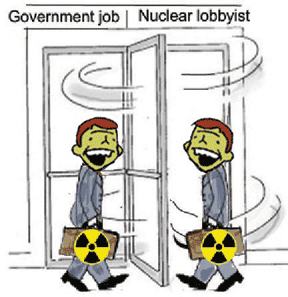
STV News 27 Jan 16 A former Labour MP has been appointed chief executive of the trade body for the civil nuclear industry.Ex-MP for Rutherglen and Hamilton West Tom Greatrex will take up the post at the Nuclear Industry Association next week, succeeding Keith Parker.
Mr Greatrex was an opposition spokesman on energy until he lost his seat in last May’s general election.
He said: “I am delighted to be joining the Nuclear Industry Association at such an exciting time……http://news.stv.tv/west-central/1340504-former-labour-mp-appointed-boss-of-nuclear-industry-trade-body/
North Carolina Environment Chief aims to restrict solar power, promote nuclear power!
NC environmental chief backs restriction on solar farms, incentives for nuclear plants. WRAL.com By Laura Leslie 28 Jan 16 RALEIGH, N.C. — The solar industry has blossomed in North Carolina since lawmakers granted solar farms tax breaks nine years ago as part of renewable energy standards that require utilities to get a portion of their power from renewable sources.
Brian O’Hara, senior vice president of Chapel Hill-based Strata Solar, said the state and other stakeholders have already drafted a model ordinance to help local officials negotiate. He said the solar industry wasn’t consulted about the proposed state permit.
Chatham County homeowner Sharon Garbutt, who lives 17 miles from the Shearon Harris nuclear plant in southwest Wake County, told the panel
South Afric a’s nuclear corporation in a mess
Step one: Sort out the mess at the nuclear corporation, Times Live The Times Editorial | 28 January, 2016
Power struggles, factionalism and claims of impropriety at state institutions have become so commonplace they are losing their shock value. “…….The latest public entity to be affected is the Nuclear Energy Corporation of SA, which is involved in two court actions over allegations of corporate governance breaches.
Phumzile Tshelane, the corporation’s chief executive and a supporter of the Zuma administration’s nuclear ambitions, is centrally involved in both cases.
The Nuclear Energy Corporation, meanwhile, is reportedly in disarray.
According to Business Day, it has yet to finalise its financial statements for the 2014-2015 financial year and is without a full board.
Several independent directors resigned, or left after their terms ended last year, after reportedly clashing with Energy Minister Tina Joemat-Pettersson. It would be tempting to dismiss the ructions at the corporation as just another public entity gone awry.
But the fact is that this is the institution that will play a key role in the government’s controversial plan to procure eight nuclear power reactors at a cost, experts warn, that could exceed R1-trillion.
Moreover, the government has decided to go ahead with the procurement and proceed to the next step, which is to invite tenders, even though the nuclear building programme has not been properly costed.
Surely the mess at the nuclear corporation needs to be sorted out before we take a single step further down the nuclear road.http://www.timeslive.co.za/thetimes/2016/01/28/Step-one-Sort-out-the-mess-at-the-nuclear-corporation
EDF in a’panic’ over decision to be made on UK’s Hinkley nuclear power station
 Hinkley Point: EDF set for decision on nuclear plant amid claims of board ‘panic’, The Independent, Sources in France say decision on whether to give the green light to controversial project would be made on Wednesday Geoffrey lean , 24 Jan 16
- The final decision on whether to build Britiain’s first nuclear power station in decades is set to be made by energy giant EDF this week, amid claims of “panic” among the French firm’s board over the viability of the £18bn project.
- Sources in France said the decision on whether to give the green light to its controversial plant at Hinkley Point, Somerset – on which ministers are depending to “kick-start a major new generation of nuclear power stations” – would be made on Wednesday. But the largely state-owned company refused to comment, or even to confirm or deny that the meeting is taking place.
This secrecy reflects the extreme sensitivity about the decision with practicalities and politics pulling in opposite directions. The project suffered a serious blow last week when French regulators delayed a decision on what to do about safety flaws in a similar reactor. But cancelling it would be a huge humiliation for British ministers, and could cause a cross-Channel diplomatic row.
- The “final investment decision” by EDF’s board – repeatedly delayed over the past two years – is the project’s only remaining hurdle.
Last October the government persuaded China to invest heavily in the plant, filling a funding shortfall, and the Energy Secretary Amber Rudd is awaiting the decision before signing a deal to allow the company to charge double the present price for the electricity generated from Hinkley’s twin reactors. Three similar European Pressurised Reactor (EPR) projects are planned for Britain if it succeeds…….
- there are signs of last minute jitters. Union leaders are reportedly warning the company of “financial, industrial and legal risks” in the project, while the French financial journal Boursier.com has suggested that there is “panic on board”.
Last week the French nuclear regulator delayed until the end of the year a decision on what to do about “very serious” weaknesses detected in the pressure vessel of a similar EPR being built at Flamanville, Normandy. The same fault – which could lead to a nuclear accident – was detected in the vessels for the Hinkley reactors, which had been built and will now have to be replaced.
- The Flamanville plant is five years behind schedule and its cost has trebled, while the only other EPR being built in Europe, in Finland, is almost a decade late, and the cost has more than doubled. Two other EPRs being built in China are also thought to be over-running while the cost of Hinkley has already soared.
EDF’s share price has plunged to record lows, and the company is considering selling billions of pounds of assets to fund building Hinkley. On top of all that, Austria is taking Britain to the European Court, alleging it is subsidising the plant illegally.Some British experts believe that, faced with all these difficulties, EDF will defer a final decision again. http://www.independent.co.uk/news/uk/home-news/hinkley-point-edf-set-for-decision-on-nuclear-plant-amid-claims-of-board-panic-a6830456.html
Wisconsin won’t get nuclear power, whether or not they lift the moratorium
 Tom Still: Repeal nuclear moratorium — but don’t expect new power plants in Wisconsin, Madison.com TOM STILL | Wisconsin Technology Council president, 24 Jan 16
It’s hard to find a more knowledgeable advocate of nuclear energy than Michael Corradini, a professor of engineering physics at UW-Madison, a past president of the American Nuclear Society and a longtime advisor to governments at home and abroad.
But if you ask Corradini whether a bill lifting a 1983 moratorium on building nuclear plants in Wisconsin will make a tangible difference any time soon, his answer is a starkly practical “no.”
The reasons for his pessimism reflect the reality of the costs of building such a plant in a state where incentives to do so are virtually non-existent. Barriers include the low global cost of oil and natural gas, decades of planning and approval time, continued opposition by most environmental groups and a state regulatory structure that doesn’t allow owners of a nuclear plant to recover costs in any reasonable amount of time.
Toss in the fact that energy demand in Wisconsin is relatively stagnant – the result of conservation efficiencies as well as economic trends – and the prospects for a “next-generation” nuclear power plant popping up in the Badger state are dimmer than a candle in a coal mine……..
- Some utility companies are adopting wind and solar power more quickly than others as they strive to stay a step ahead of current regulations, not to mention those they may face if President Obama’s Clean Power Plan and international standards take hold. Costs are falling for wind and solar, although low oil and gas costs are slowing adoption in some cases.
- Breakthroughs in energy storage technologies can help smooth out the bumps in intermittent energy sources such as wind and solar. Mechanical, thermal, compressed air and other technologies can make it possible to efficiently store electricity produced when the wind is blowing and the sun is shining…….. http://host.madison.com/wsj/business/tom-still-repeal-nuclear-moratorium-but-don-t-expect-new/article_4af610da-8dbc-55e7-a720-1ffb0f82f3af.html
Trans Pacific Partnership lets corporations override environmental laws
the TPP would give foreign corporations like TransCanada broad power to demand compensation for policies that do not conform to their “expectations.”
In other words, any time our government takes an “unexpected” step to protect our air, our water, our economy, or the health of our families from dangerous projects like Keystone XL, corporations could use that as a reason to ask a tribunal to order the government to pay.
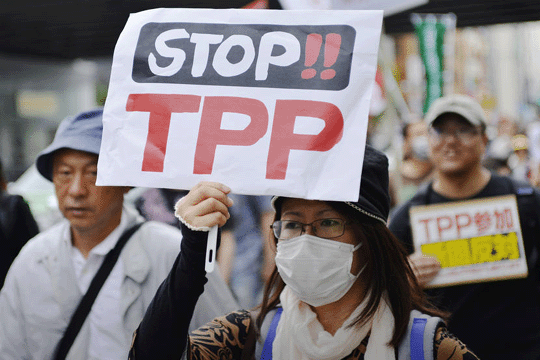
TPP provisions would undermine environmental efforts http://www.msnbc.com/msnbc/opinion-tpp-provisions-would-undermine-environmental-efforts?utm_content=buffer4500f&utm_medium=social&utm_source=twitter.com&utm_campaign=buffer 01/21/16 03 By Michael Brune For years the Sierra Club has warned that international trade deals could be used by corporations to undermine U.S. environmental protections. Now the Canadian oil company TransCanada is attempting to do exactly that in response to President Obama’s rejection of its Keystone XL tar sands pipeline.
This dispute won’t be settled in a normal court of law, though. Instead, it will be argued in a trade tribunal with no accountability to any domestic legal system — a private legal system that is outside U.S. law. No judge will hear the case. Instead, three private lawyers will issue a binding ruling that cannot be appealed. Many of these tribunal lawyers actually rotate between rendering judgments and representing corporations in their cases against governments. Therefore, it’s no great surprise when corporations come out on top and ordinary people either foot the bill or lose environmental and health protections.
This is unfair and unjust, pure and simple. We should be doing all we can to defend the environmental and health safeguards that keep us safe — not make them even more vulnerable to corporate attacks. Why would we want to lower our environmental standards to a lowest-common denominator dictated by the expectations of corporations who have proven they’d put profits before people?
Furthermore, at a time when virtually the entire world just agreed at the Paris climate talks that we must keep dirty fuels in the ground to avoid climate disaster, giant fossil fuel corporations see toxic trade agreements like the TPP as a way to trump the health and environmental protections that can keep dirty fuels in check and promote clean energy.
Luckily, opposition to the TPP is steadily growing, just as it did for the Keystone XL pipeline. Environmental groups, labor unions, public health advocates, and an array of diverse constituencies are voicing their opposition, whether because of investor-state dispute settlement provisions or one of the sweeping deal’s other controversial provisions. Many members of Congress from both parties are already saying no to the TPP.
We’ve seen what can happen when we come together to say no to a bad idea. We defeated the Keystone XL pipeline, and we can defeat the Trans-Pacific Partnership. We need a new model of trade that puts the health and safety of people before the profits of big corporations that are already polluting our air and water.
Michael Brune is the executive director of the Sierra Club, the nation’s largest grassroots environmental organization. Brune is the author of “Coming Clean — Breaking America’s Addiction to Oil and Coal.”
1 This Month
23-25 October – on Zoom – World BEYOND War’s annual global conferenc

To see nuclear-related stories in greater depth and intensity – go to https://nuclearinformation.wordpress.com

Say No to NASA’s Reckless Nuclear Reactor on the Moon
Say No to NASA’s Reckless Nuclear Reactor on the Moon
-
Archives
- October 2026 (160)
- September 2026 (339)
- August 2026 (330)
- July 2026 (355)
- June 2026 (287)
- May 2026 (306)
- April 2026 (356)
- March 2026 (251)
- February 2026 (267)
- January 2026 (308)
- December 2025 (358)
- November 2025 (359)
-
Categories
- 1
- 1 NUCLEAR ISSUES
- business and costs
- climate change
- culture and arts
- ENERGY
- environment
- health
- history
- indigenous issues
- Legal
- marketing of nuclear
- media
- opposition to nuclear
- PERSONAL STORIES
- politics
- politics international
- Religion and ethics
- safety
- secrets,lies and civil liberties
- spinbuster
- technology
- Uranium
- wastes
- weapons and war
- Women
- 2 WORLD
- ACTION
- AFRICA
- Atrocities
- AUSTRALIA
- Christina's notes
- Christina's themes
- culture and arts
- Events
- Fuk 2022
- Fuk 2023
- Fukushima 2017
- Fukushima 2018
- fukushima 2019
- Fukushima 2020
- Fukushima 2021
- general
- global warming
- Humour (God we need it)
- Nuclear
- RARE EARTHS
- Reference
- resources – print
- Resources -audiovicual
- Weekly Newsletter
- World
- World Nuclear
- YouTube
-
RSS
Entries RSS
Comments RSS

