South Africa: Nuke RFP Delayed in Order to Give Eskom Greater Say and Avoid Parliamentary Scrutiny http://allafrica.com/stories/201609300697.html By Gordon Mackay, 30 Sep 16 At a cabinet briefing today, Minister in the Presidency, Jeff Radebe, confirmed that it was highly unlikely that the nuclear RFP would be issued tomorrow as announced by the Minister of Energy, Tina Joemat-Pettersson, three weeks ago in Parliament.
Minister Radebe also suggested that the delay in issuing the RFP is largely due to a decision by cabinet to strip the Department of Energy of its role as government’s designated procurement agent in favour of Eskom.
This must be seen for what it is – a blatant attempt by the Zuma administration to:
- side-line parliamentary oversight of the nuclear new build programme;
- block public debate on the need for additional nuclear capacity;
- create a veil of secrecy around the procurement process which would now be subject to internal Eskom processes and procedures;
- give President Jacob Zuma greater control of the nuclear procurement process.
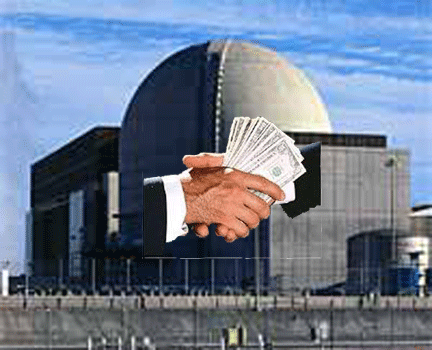
Designating Eskom as the procuring agent of the state will fundamentally limit the role and capacity of Parliament to oversee the nuclear deal and, in doing so, increase the potential of corruption surrounding the trillion rand deal.
The DA rejects any attempt to designate Eskom, headed by CEO and Zupta buddy, Brian Molefe, as the procuring agent for nuclear. Eskom has proven with Medupi and Kusile that it is unfit to manage mega-projects. It has also proven that its governance procedures are lax and the Supreme Court of Appeal has found its Board Tender Committee to be corrupt.
The DA is further concerned that the nuclear new build programme will further be subject to undue influence by the President, who is the Chair of the SOE Co-ordinating Committee.
We will use every mechanism available to us to ensure that this deal – which we do not need and cannot afford – is not pushed through without proper parliamentary oversight and scrutiny.
October 1, 2016
Posted by Christina Macpherson |
politics, South Africa |
Leave a comment
 Signs of a great rift over Zuma’s nuclear programme, Rand Daily Mail, RAY HARTLEY 30 SEPTEMBER 2016 In another indication of President Jacob Zuma’s dimishing influence, his headlong rush to build a ‘fleet’ of nuclear reactors has been halted. And there are signs that it is going to be cut down to size, if it goes ahead at all.
October 1, 2016
Posted by Christina Macpherson |
politics, South Africa |
Leave a comment
 Hillary Clinton Is More ‘Dovish’ Than Obama on Nukes, Hacked Audio Suggests, NY Mag, By Eric Levitz ” ……………his (Obama’s) administration is pursuing a $1 trillion nuclear “modernization” program, which many experts think will only heighten the risk of atomic war.
The president’s plan involves breaking up America’s existing nuclear stockpile into smaller, more reliable weapons, including cruise missiles with nuclear tips. This allows Obama to maintain his pledge to create no “new nuclear weapons,” while developing a sleek, modern arsenal that will, somehow, further deter enemy nations from attacking the United States.
There are a few problems with this plan. For one thing, building more precise nuclear cruise missiles only makes their use “more thinkable,” in the words of former vice-chairman of the Joint Chiefs of Staff James E. Cartwright. What’s more, the move threatens to kick off a new round of nuclear proliferation, as Stephen Kinzer, a scholar of international relations at Brown University,
recently observed:…….
Finally, there’s the program’s exorbitant cost. At a time when deficit politics are constraining our government’s ability to invest in basic social services and infrastructure improvements, do we really need to spend $1 trillion on renovating weapons we don’t ever want to use?
Hillary Clinton, for one, thinks not.
Earlier this week, the Washington Free Beacon published an audio recording of a fundraiser Clinton held back in February, which was gleaned from the hack of a campaign staffer — reportedly, as part of the same hack that exposed DNC emails.
In that audio, Andrew C. Weber, a former Defense Department official, asks Clinton if she would cancel the nuclear-cruise-missile project, were she elected president.
“I certainly would be inclined to do that,” she replied. “The last thing we need are sophisticated cruise missiles that are nuclear-armed.”
Clinton went on to suggest that such weapons would likely encourage a nuclear arms race, and praised former Defense secretary William J. Perry for his public opposition to the modernization program.
“This is going to be a big issue,” Clinton added. “It’s not just the nuclear-tipped cruise missile. There’s a lot of other money we’re taking about to go into refurbishing and modernization … Do we have to do any of it? If we have to do some of it, how much do we have to do? That’s going to be a tough question, so I will look to people like you and Bill Perry to help me answer that question.”
Elsewhere in the recording, Clinton took a more “hawkish” stance on cybersecurity, suggesting the United States must deter attacks from China and Russia through retaliatory measures. ……http://nymag.com/daily/intelligencer/2016/09/clinton-to-the-left-of-obama-on-nukes-hacked-audio-suggests.html
October 1, 2016
Posted by Christina Macpherson |
USA elections 2016 |
Leave a comment
 Hillary Clinton ‘Inclined To’ Cancel Nuclear Cruise Missile, Aviation Week Sep 30, 2016 by Lara Seligman in Ares As the Pentagon moves ahead with a trillion-dollar modernization of its nuclear arsenal, Democratic presidential nominee Hillary Clinton seems to be breaking with the Obama administration’s posture, signaling she might cancel a planned replacement of the legacy nuclear-tipped cruise missile.
Reports emerged this week that Clinton broke her silence on the administration’s planned modernization of strategic submarines, bombers and siloed intercontinental ballistic missiles (ICBM ), expressing doubts during a February fundraiser about whether the U.S. should go forward with the overhaul.
“The last thing we need are sophisticated cruise missiles that are nuclear armed,” Clinton said, according to reports of an audio recording of the fundraiser that appeared on the website of The Washington Free Beacon.
During the event, Clinton was asked about the modernization effort and whether she, as president, would cancel the replacement for the legacy Air-Launched Cruise Missile (ALCM), dubbed the Long-Range Standoff (LRSO) weapon.
“I certainly would be inclined to do that,” she answered. “The last thing we need are sophisticated cruise missiles that are nuclear-armed.”
LRSO may be the most vulnerable piece of the Pentagon’s nuclear arsenal. In her opposition to the new cruise missile, which will arm Northrop Grumman’s B-2s and next-generation B-21 bombers, Clinton joins a chorus of dissenters from Sens. Elizabeth Warren of Massachusetts and Bernie Sanders of Vermont to former defense secretary William Perry. Warren and Sanders, along with several other senators, called on Obama in July to cancel LRSO, saying it “would provide an unnecessary capability that could increase the risk of nuclear war.”………http://aviationweek.com/blog/hillary-clinton-inclined-cancel-nuclear-cruise-missile
October 1, 2016
Posted by Christina Macpherson |
USA elections 2016 |
Leave a comment
This has drawn attention to South Africa’s status as a global model for renewable energy, and raises new question about why the country is pursuing nuclear when renewables look so promising.
South Africa has the fastest growing green economy in the world, according to credit rating agency Moody’s.
“South Africa was the continent’s largest renewables market in 2015 in terms of asset finance for utility-scale projects and it saw the highest year-on-year growth globally,” said Christopher Bredholt, a Moody’s vice president, in a Sept. 16 report. Asset finance is usually used by businesses to lease equipment without having to buy it outright, according to Finance & Leasing Association.
South Africa had the highest growth globally for asset finance in 2015 at 300 percent, representing $4.5 billion, according to Moody’s.
Continue reading →
October 1, 2016
Posted by Christina Macpherson |
politics, renewable, South Africa |
Leave a comment
 South Africa: Nuclear Plan On Ice As Eskom May Take Ownership AllAfrica.com 30 Sept 16 Early indications are that Eskom may ultimately be responsible for the management and implementation of South Africa’s nuclear plan and not the Department of Energy as had originally been planned.
At the same time the much anticipated request for proposal for the nuclear plan won’t be issued on Friday as mooted by Energy Minister Tina Joemat-Pettersson earlier this month.
Jeff Radebe, Minister in the Presidency responsible for Planning and Monitoring, reiterated at a cabinet briefing on Thursday that more consultations need to take place before a request for proposal (RFP) can be issued on 30 September 2016.
Joemat-Pettersson issued a statement a few hours after Radebe’s briefing, confirming this………..
At the time of the previous cabinet meeting on the issue of nuclear in December 2015, nuclear was going to be led by Energy,” Radebe said during question time on Thursday.
“But recently there are references made to Eskom. That’s why I’m talking about issues of consultation. Those types of consultations must unfold before the RFP is issued. The instituting authority must be clearly defined.”
State-owned nuclear firm Necsa could also play a bigger role in the process. “Necsa has had discussions with government officials and Eskom – and there are clear indications that Necsa will play a major role as the primary nuclear centre of the country,” Necsa chair Kelvin Kemm told Fin24 on Thursday.
Asked during question time if he meant that Eskom instead of the DoE would be driving South Africa’s nuclear build programme, Radebe responded, saying when cabinet previously deliberated on the nuclear process in December 2015, the decision was that the Department of Energy would be driving the process. “If there is a change it will have to come back to cabinet for deliberation,” he said.
Radebe also repeated that the RFP would not be issued on Friday, despite previous assertions by Joemat-
Pettersson that the RFP was due for Friday. “There was no contradiction,” Radebe said with reference to Pandor’s statement on Tuesday.
“My understanding is that what minister Pandor was saying, due to the processes of consultation [and the fact that] processes had not completed, the RFP will only be issued after all those issues of consultation have been concluded and being brought back to cabinet. So I do not envisage that tomorrow on the 30 of September the RFP will be issued by the Department of Energy,” Radebe said.Source: Fin24 http://allafrica.com/stories/201609300935.html
October 1, 2016
Posted by Christina Macpherson |
politics, South Africa |
Leave a comment
Pakistan is running full speed to develop tactical nukes in their continuing hostility with India’
U.S. Democratic presidential nominee Hillary Clinton has expressed concern over the possibility of Pakistan’s nuclear weapons falling into the hands of jihadists, which she said was “a threatening scenario,” according to a media report.
“Pakistan is running full speed to develop tactical nukes in their continuing hostility with India,” the former Secretary of State told a close door fundraiser in Virginia in February, The New York Times reported, citing 50-minute audio audio hacked from the Democratic Party’s computers.
“But we live in fear that they’re going to have a coup, that jihadists are going to take over the government, they’re going to get access to nuclear weapons, and you’ll have suicide nuclear bombers. So, this could not be a more threatening scenario,” the daily quoted Ms. Clinton as saying in the audio that appeared on The Washington Free Beacon website.
During the fund raiser, responding to a question on modernisation of nuclear weapons, the daily said, Ms. Clinton went beyond the question to warn of an emerging nuclear arms race, naming Russia and China as well as Pakistan and India.
“This is one of the most dangerous developments imaginable.”
October 1, 2016
Posted by Christina Macpherson |
USA elections 2016 |
Leave a comment
NO DEALS SIGNED YET ON SA NUCLEAR PROGRAMME – RADEBE http://ewn.co.za/2016/09/30/No-deals-signed-yet-on-SA-nuclear-programme Minister Jeff Radebe says the request for proposals will clarify if the country can afford nuclear power.Clement Manyathela | JOHANNESBURG – Minister in the Presidency Jeff Radebe says no deals have been signed for the nuclear build programme and says the request for proposals will clarify if the country can afford it or not.
Energy Minister Tina Joemat-Petterssen was meant to issue a request for proposals for the nuclear build programme as part of the procurement process today but this has now been postponed to allow more time for further consultation.
Radebe says the request for proposal will be issued after consultations.
“The Minister of Energy issued a statement confirming that the request for proposals is not going to be issued until such time that we’ve concluded those consultation processes.”
He says it will also advise government on whether or not it can afford nuclear power.
“That’s precisely the reason why the proposal is going to be issued in order to understand whether, as the country, we’re going to be affording it in terms of testing the market.”
October 1, 2016
Posted by Christina Macpherson |
politics, South Africa |
Leave a comment
South Africa will delay tendering for new nuclear power stations after requests for consultation and discussion made it impossible to start the process by the end of September as initially planned, the energy minister said on Thursday.
A statement said energy minister Tina Joemat-Pettersson remained “fully committed” to plans for nuclear procurement. http://www.reuters.com/article/us-safrica-nuclear-idUSKCN11Z1SW
September 30, 2016
Posted by Christina Macpherson |
politics, South Africa |
Leave a comment
 HOW DONALD TRUMP IS REVIVING GENERAL DOUGLAS MACARTHUR’S NUCLEAR GAMEPLAN, Newsweek, BY JEFF STEIN ON 9/29/16 . Trump has said on multiple occasions that he would use nuclear weapons, possibly dropping on ISIS. Nothing else Trump has said—about Muslims, women, protesters, immigrants and so on—has chilled the political, military and media establishment more than his glib pronouncements on nuclear weapons. If we’re not going to use them, Trump told MSNBC’s Chris Matthews in a typical remark last March, “then why are we making them?” He said he might drop one on the Islamic State group, known as ISIS, or Europe. “You want to be unpredictable,” he said. A year ago, people thought such statements would disqualify him.
Whether he knew it or not, though, Trump was expressing standard U.S. policy since the dawn of the Cold War. But it’s one thing for President Barack Obama or his mostly even-keeled predecessors to have the nuclear codes. It’s another thing to hand them to a man whose narcissistic, grandiose and impulsive personality “is certainly extreme by any standard, and particularly rare for a presidential candidate,” as the psychologist Dan McAdams, a student of presidential minds,wrote in The Atlantic. A Trump presidency “could be highly combustible,” McAdams added. “He could be a daring and ruthlessly aggressive decision maker who…never thinks twice about the collateral damage he will leave behind.”…………http://www.newsweek.com/2016/10/07/donald-trump-nuclear-weapons-general-macarthur-harry-truman-503979.html
September 30, 2016
Posted by Christina Macpherson |
USA elections 2016 |
Leave a comment
 Hinkley Point nuclear deal signed as Government admits gas would be cheaper, Telegraph, Emily Gosden, energy editor 29 SEPTEMBER 2016
The Hinkley Point C nuclear plant will saddle UK consumers with higher energy bills than building gas power stations, the Government has admitted, as it signed a legally-binding contract to subsidise the £18bn project.
An official assessment claimed the Franco-Chinese project to build Britain’s first nuclear plant in a generation represented “value for money”, despite being more expensive than gas, because it would help meet climate change targets.
A series of deals signed between the Government, France’s EDF and China’s state nuclear firm CGN at a ceremony in London marked the final go-ahead for the Somerset power plant and also fired the formal starting gun on Chinese efforts to build their own reactor in Essex………
Earlier this month the Government opted to press ahead with the project with some new security safeguards but leaving the controversial subsidy deal underpinning Hinkley unchanged.
Under a deal first agreed in 2013 Hinkley will be paid a fixed price of £92.50/MWh for the power it produces for 35 years, funded through levies on energy bills. The National Audit Office has said it could cost up to £30bn in subsidies.
Among hundreds of pages of documents issued on Thursday afternoon – some heavily redacted – ministers faced a series of questions over a cursory three-page assessment concluding that the deal would add £12 to energy bills in 2030 but was “value for money”.
The assessment said Hinkley was “cost-competitive to other options for delivering power” despite its own assessment that the “comparable cost” of new gas in the 2020s could be as low as £45/MWh, solar as low as £65/MWh and onshore wind as low as £49/MWh.
If Hinkley was delayed by three years and gas plants built instead then by 2030 the UK would be £3.2bn better off and energy bills would be “£6 cheaper per year”, it concluded……..
John Sauven, executive director of Greenpeace, accused the Government of obfuscation and providing “no evidence anywhere in the documents to back up their assumptions”.
“The numbers speak for themselves. In the unlikely event Hinkley is working sometime in the second half of the next decade, renewable energy will be much cheaper, yet British consumers will still be forced to pay over the odds for nuclear power,” he said.
Another document underlined the lasting impact the decision will have on UK energy policy for more than a century to come, forecasting that the spent fuel for the plant would not be disposed of until the year 2138.
EDF Energy said Hinkley would “kickstart Britain’s nuclear revival” and that it had “been shown to offer consumers value for money”.
The Government said the signing of the deal marked “a significant step forward for a new era of nuclear power in the UK”. http://www.telegraph.co.uk/business/2016/09/29/hinkley-point-nuclear-plant-gets-final-go-ahead-as-government-si/
September 30, 2016
Posted by Christina Macpherson |
business and costs, politics, UK |
Leave a comment
 Why the nuclear first-use debate matters in the 2016 race, MSNBC 09/29/16 By Steve Benen
It’s difficult to choose the single most alarming thing Donald Trump said about foreign policy and national security at this week’s presidential debate, in part because there are
so many unsettling comments to choose from.
The Republican seemed to believe ISIS has been around for much of Hillary Clinton’s adult life, which isn’t even close to being true. Trump suggested China should invade North Korea. He took credit for NATO policies that he had nothing to do with, while suggesting the NATO alliance itself should be considered as some kind of protection racket.
Trump also insisted, as he has before, that the United States should have stolen Iraq’s oil – which would have been illegal – in order to deny ISIS the resources it’s actually getting from Syria.
But as Rachel noted on the show the other day, the real gem has to be Trump’s woeful understanding of nuclear policy. Moderator Lester Holt asked an excellent question: “On nuclear weapons, President Obama reportedly considered changing the nation’s longstanding policy on first use. Do you support the current policy?”
Trump rambled a bit before eventually saying:
“I would like everybody to end it, just get rid of it. But I would certainly not do first strike.
“I think that once the nuclear alternative happens, it’s over. At the same time, we have to be prepared. I can’t take anything off the table.”
He then rambled some more, straying between a variety of loosely related topics, including his opposition to the international nuclear agreement with Iran.
But for those paying attention, the real problem was with Trump’s obvious contradiction. Policymakers can adopt a “no-first-use” policy or they can endorse a “nothing-is-off-the-table” position, but Donald Trump is one of those rare politicians who wants to take both sides simultaneously.
This followed a GOP primary debate in December at which Trump appeared to have no idea what the nuclear triad referred to. The Republican could have taken advantage of that opportunity, recognizing the importance of getting up to speed on the nuclear basics, but instead Trump seems to have done no homework on the issue at all.
That remained true in the intervening months……..http://www.msnbc.com/rachel-maddow-show/why-the-nuclear-first-use-debate-matters-the-2016-race
September 30, 2016
Posted by Christina Macpherson |
USA elections 2016 |
Leave a comment
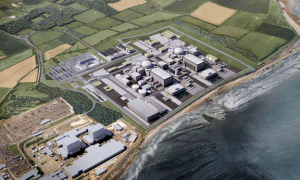 Hinkley Point: ministers sign go-ahead for nuclear power plant Representatives of British, Chinese and French governments attend ceremony giving final authorisation for power station, Guardian, Rowena Mason, 30 Sept 16, The UK has signed its £18bn contract with France and China to build the Hinkley Point C nuclear power station, giving the final go-ahead for construction at the site in Somerset.
The deal was finalised at a low-key ceremony in London, just two months afterTheresa May alarmed her French and Chinese counterparts by putting the entire project under review. EDF, the French nuclear contractor, and its Chinese partners had to cancel their previous plans for a signing ceremony at the last minute when the review was announced in July.
The project finally got approval this month, after Greg Clark, the business secretary, announced there would be some new restrictions on future investments in critical infrastructure if there were national security concerns.
Clark attended the signing ceremony on behalf of the UK, alongside Jean-Bernard Lévy, the chairman of EDF, and He Yu, chair of China General Nuclear…….
Greenpeace said it was “no wonder the UK government has opted for a ‘champagne-free’ signing ceremony away from public view”.
The environmental group said: “With a stroke of the pen ministers are signing away billions of pounds of billpayers’ money to a project they know is plagued by legal, financial and technical problems. In the unlikely event Hinkley is working some time in the second half of the next decade, renewable energy will be much cheaper, yet British consumers will still be forced to pay over the odds for nuclear power. It’ll be like being locked into an expensive fixed-rate mortgage as interest rates plummet.”…….https://www.theguardian.com/uk-news/2016/sep/29/hinkley-point-ministers-sign-go-ahead-for-nuclear-power-plant
September 30, 2016
Posted by Christina Macpherson |
politics, UK |
1 Comment
Eskom may take charge of SA’s nuclear power build, IOL 29 September 2016, Emsie Ferreira Cape Town – Government will not be issuing a call for proposals for its nuclear power expansion programme to allow for more time for consultations, which could mean shifting responsibility for the project from the department of energy to Eskom, Presidency Minister Jeff Radebe confirmed on Thursday……..
Radebe was asked about conflicting statements from Energy Minister Tina Joemat-Pettersson and her science and technology counterpart, Naledi Pandor, as to whether the request for proposals from prospective partners would still proceed as planned on Friday.
Pandor this week indicated it would not, contradicting the energy minister.
But Radebe confirmed that government could not invite proposals while an integrated resource plan had not been finalised, and that Pandor had been right in saying Cabinet’s economic cluster first needed to meet to do so.
Eskom chief executive officer Brian Molefe last week told MPs and the media that concerns about whether the country could afford procuring the capacity to add 9,600 megawatt of nuclear energy to the grid were overwrought.
He said given the roughly 80-year lifespan of nuclear plants, the programme would pay for itself over those decades. Molefe was adamant that renewable energy could not be considered a viable alternative as it was not sufficiently reliable.
And earlier this week, Eskom’s head of generation Matshela Koko suggested that the nuclear utility could pay for the nuclear build programme because it would have accumulate cash reserves of R150 billion over the next decade.
The Democratic Alliance said on Thursday that allowing Eskom to lead the process would mean it being less open to parliamentary scrutiny, and President Jacob Zuma having greater control over the procurement process.
“Designating Eskom as the procuring agent of the state will fundamentally limit the role and capacity of Parliament to oversee the nuclear deal and, in doing so, increase the potential of corruption surrounding the trillion rand deal,” DA energy spokesman Gordon Mackay said. http://www.iol.co.za/news/politics/eskom-may-take-charge-of-sas-nuclear-power-build-2074416
September 30, 2016
Posted by Christina Macpherson |
politics, South Africa |
Leave a comment
Environmentalists say there is no need to move spent nuclear fuel off of atomic power plant sites. They contend it can be stored safely. Transporting it to a disposal area near Barnwell would increase risks to the public, they said
Plan surfaces for new nuclear disposal ground in SC Casks of spent nuclear fuel are stored above ground at many atomic energy plants because there is no national disposal site for the material U.S. Nuclear Regulatory Commission BY SAMMY FRETWELL AND JEFF WILKINSON\ sfretwell@thestate.com,jwilkinson@thestate.com, COLUMBIA, SC
A plan has surfaced to establish another nuclear waste disposal ground in South Carolina, a state with a history of taking atomic refuse from across the country.
An organization called the Spent Fuel Reprocessing Group wants federal approval to open a disposal area near Barnwell and the Savannah River Site nuclear weapons complex. Spent fuel, a type of highly radioactive waste, would be moved from the state’s four nuclear power plant sites and stored indefinitely at the new facility, records show.
The U.S. Nuclear Regulatory Commission in July received notice of the plan. The proposal is a long way from becoming reality, but if eventually approved by the federal government, it would create a place for nuclear waste disposal that is likely to draw opposition.
Several environmental groups said this week they are preparing to fight any effort to create what they called an atomic waste dumping ground. Politicians, including Gov. Nikki Haley, also expressed reservations Monday. The subject of nuclear waste disposal is a touchy one in South Carolina because many people say the state has shouldered more than its share of the nuclear waste burden.
South Carolina already stores highly radioactive material from around the country and world at the Savannah River Site. It also has a low-level waste dump in Barnwell County that was used for decades to bury nuclear garbage from power plants across the country. That site has leaked radioactive tritium into groundwater.
Now, the government is being asked to allow an interim disposal site for high-level nuclear waste from power plants in South Carolina. The site would be near the Barnwell low-level waste dump, environmentalists said Monday. The site would be considered an interim disposal ground that would hold the nuclear waste while the government figures out what to do with it in the long run…….
Environmentalists say there is no need to move spent nuclear fuel off of atomic power plant sites. They contend it can be stored safely. Transporting it to a disposal area near Barnwell would increase risks to the public, they said. If a permanent disposal site were eventually developed nationally, the material would have to be transported again from the interim South Carolina site, according to Savannah River Site Watch, the S.C. League of Women Voters and the state Sierra Club.
“Packaging of the spent fuel for transport, unloading it at the consolidated storage site and eventually repackaging it to transport to a federal facility would unnecessarily pose a high economic cost and a logistical nightmare, both of which can be avoided if the spent fuel is left where it is now stored until such time as a geologic facility is available,’’ according to the groups…….
September 28, 2016
Posted by Christina Macpherson |
politics, USA, wastes |
Leave a comment