Abe’s Nuclear Japan Goals Face More Ballot-Box Battles in 2017, Bloomberg Stephen Stapczynski October 19, 2016
-
Anti-nuclear candidates win in Niigata, Kagoshima prefectures
-
Three gubernatorial races next year in regions facing restarts
“Even as the Abe administration remains committed to including nuclear power as part of Japan’s energy mix, implementing this vision will require overcoming ever-more-dogged resistance from local communities and their representatives,” Tobias Harris, a vice president with Teneo Intelligence in Washington D.C., said in a note Monday. “The restart process will continue to proceed unevenly at best.”
Almost all the country’s reactors remain shut because of new safety regulations and public opposition following the 2011 Fukushima disaster. Only 2 of Japan’s 42 operable reactors are producing power commercially as of Oct. 6, when Kyushu Electric Power Co. shut its Sendai No. 1 unit for maintenance.
Local Approval
Sendai’s return to service may be delayed due to the recently elected Kagoshima governor’s strong opposition to its operation. Local government approval — including endorsement from the governor — is traditionally sought by Japanese utilities before returning plants to service.
Elections will be watched closely as support from local governments are crucial to get more nuclear reactors back online, according to Syusaku Nishikawa, an analyst at Daiwa Securities Co. About 57 percent of the Japanese public oppose restarts, according to an Asahi newspaper poll earlier this month. Lawsuits have also threatened reactor operations.
Public opposition and the slow pace of returning reactors will be a challenge to Abe’s goal of having nuclear power provide at least 20 percent of Japan’s electricity by 2030, Harris said.
Gubernatorial races are held within about 30 days of when the current term ends, which will happen in 2017 in the following prefectures, according to the local-government websites and data compiled by Bloomberg:
-
Shizuoka…….
-
Miyagi……
-
October 19, 2016
Posted by Christina Macpherson |
Japan, politics |
Leave a comment
 Japan election key to world’s biggest nuclear plant and Abe’s energy policy, Reuters By Kentaro Hamada Additonal reporting by Osamu Tsukimori; Writing by Aaron Sheldrick; Editing by William Mallard and Nick Macfie NIIGATA, JAPAN, 14 OCT 16,
A regional election north of Tokyo between candidates most Japanese have never heard of may decide the fate of the world’s biggest nuclear plant and mark a turning point for an industry all but shut down after the Fukushima disaster.
The campaign for governor of Niigata Prefecture has boiled down to two men and one issue: whether to restart the seven-reactor Kashiwazaki-Kariwa Nuclear Power Station.
Reviving the seven-reactor giant, with capacity of 8 gigawatts, is key to saving Tokyo Electric Power, which was brought low by the 2011 Fukushima explosions and meltdowns, and then the repeated admissions of cover-ups and safety lapses after the world’s worst nuclear disaster since Chernobyl in 1986.
Tepco, as the company supplying about a third of Japan’s electricity is known, is in turn vital to Prime Minister Shinzo Abe’s energy policy, which relies on rebooting more of the reactors that once met about 30 percent of the nation’s needs.
But Ryuichi Yoneyama, 49, an anti-nuclear doctor-lawyer who has never held office and is backed by mostly left-wing parties, has made a tight race for governor of Niigata against an initially favored veteran politician from Prime Minister Shinzo Abe’s pro-nuclear party, Japanese media say.
In a sign that Abe’s Liberal Democratic Party also sees a tough contest, party heavyweights were dispatched to campaign for Tamio Mori, 67. The former mayor and construction ministry bureaucrat is seen more likely to allow Kashiwazaki-Kariwa to restart.
Distrust of Tepco, put under government control in 2012, is so high in Niigata that this election has become a litmus test for nuclear safety and put Abe’s energy policy and Tepco’s handling of Fukushima back under the spotlight.
RADIATION LEAKS
Only two of Japan’s 42 reactors are running more than five years after Fukushima, but the Niigata plant’s troubles go back further.
Several reactors at Kashiwazaki-Kariwa have been out of action since an earthquake in 2007 caused radiation leaks and fires in a disaster that prefigured the Fukushima calamity and Tepco’s bungled response.
A Tepco spokeswoman said the company could not comment on the election and was committed to boosting safety at the plant.
On the campaign trail in Niigata, help for Tepco is in short supply.
Yoneyama has promised to continue the outgoing governor’s policy of refusing to allow a restart unless Tepco provides a fuller explanation of the Fukushima disaster.
He has run for local office unsuccessfully four times but says this time he feels different, as the public supports his anti-nuclear, anti-Tepco message.Yoneyama, who has worked as a radiological researcher, says Tepco doesn’t have the means to prevent Niigata children from getting thyroid cancer in a nuclear accident, as he says has happened in Fukushima. And he says the company doesn’t have a solid evacuation plan.
“As I go from town to town and village to village, I hear the same thing: ‘We want you to protect this town. We want you to protect our hometown, our lives and our children’s future,'” he told a crowd in Nagaoka this week……..http://www.reuters.com/article/us-japan-nuclear-election-idUSKBN12E12D
October 15, 2016
Posted by Christina Macpherson |
Japan, politics |
Leave a comment
German power firms to shift funds in landmark nuclear deal , Reuters 14 Oct 16
* Bill of 23.6 billion euros for waste storage – draft law
* Utilities can pay in instalments to 2026
* First payment must be 20 pct of total sum
* Shares in E.ON, RWE, EnBW rise on clarity (Recasts, adds funding breakup, details)
By Markus Wacket BERLIN, Germany’s leading utilities will start contributing next year to a 23.6 billion euro ($26.4 billion) fund as a condition for shifting liability for nuclear waste storage to the government, giving investors greater clarity over their future finances.
The new legislation, seen by Reuters on Friday, will remove uncertainty about the costs of storing waste — the most complex and costly aspect of nuclear decommissioning — which has been a major drag on German utility stocks.
The utilities will remain responsible for dismantling the country’s nuclear plants, the last of which will be shut down in 2022 as part of Germany’s abandonment of the technology, a decision triggered by Japan’s Fukushima disaster five years ago.
The German cabinet is set to approve the law on Oct. 19, bringing to an end lengthy negotiations between Berlin and the country’s four major energy groups — E.ON, RWE , EnBW and Vattenfall — on a waste storage deal proposed in April.
With a combined liability of about 16.7 billion euros, E.ON and RWE will have to stump up most of the funds. E.ON has said it might carry out a share sale to raise about 2 billion euros to help achieve this……..
The utilities had been pushing to get favourable terms from the government, arguing they have been hammered by plunging power prices, a shift towards renewable energy and Germany’s nuclear exit, which has taken its toll on their finances…….http://www.reuters.com/article/germany-nuclear-waste-idUSL8N1CK1X4
October 15, 2016
Posted by Christina Macpherson |
business and costs, Germany, politics |
Leave a comment
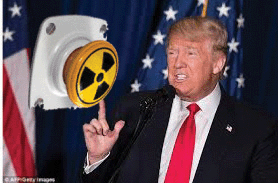 Former nuclear launch officers sign letter: Trump ‘should not have his finger on the button’ WP By Carol Morello October 13
Ten former nuclear launch control officers who once held the keys needed to fire on the president’s order have signed an open letter saying they think Donald Trump should not be entrusted with the nation’s nuclear codes.
The letter, issued Thursday, says the decision to use nuclear weapons requires “composure, judgment, restraint and diplomatic skill” — all qualities that the former Air Force officers who signed it said Trump lacks.
“On the contrary, he has shown himself time and again to be easily baited and quick to lash out, dismissive of expert consultation and ill-informed of even basic military and international affairs — including, most especially, nuclear weapons,” the letter says. “Donald Trump should not be the nation’s commander-in-chief. He should not be entrusted with the nuclear launch codes. He should not have his finger on the button.”
[Read the full letter here]
The letter is the latest in an extraordinary series of missives signed this year by diplomats and national security experts warning of the dangers they think a Trump presidency would pose. Last month, in a break from the trend, 88 retired military leaders endorsed the Republican presidential nominee. But most of the letters have reflected the views of those who consider Trump unfit to be commander in chief.
The former missileers who signed Thursday’s letter served at the nation’s four underground launch centers in the Great Plains from as long ago as the 1960s to, most recently, 2013. They do not endorse Democratic nominee Hillary Clinton, or even mention her name, in the letter………
If a president orders a missile launch, Blair said, five crews are equipped with keys used to fire a total of 50 missiles. Although the keys are interconnected, the missiles can be launched if just two crews carry out the order.
“Only the president can order a nuclear launch,” the letter states. “That order cannot be vetoed and once the missiles have been launched, they cannot be called back. The consequences of miscalculation, impulsive decision-making or poor judgment on the part of the president could be catastrophic.”
Blair said the officers are trained to put aside any personal doubts and trust in the system and the leadership.
“The presumption is, the commander in chief is acting in the national interest, and his decision should be grounded in knowledge and good advice,” he said. “Everyone would have to assume that, even though they had doubts — very strong doubts, if Trump were president.” https://www.washingtonpost.com/world/national-security/10-former-nuclear-launch-officers-sign-letter-trump-should-not-have-his-finger-on-the-button/2016/10/13/eef68fde-2468-4305-84d4-86033df53b3f_story.html
October 14, 2016
Posted by Christina Macpherson |
USA elections 2016 |
Leave a comment

 Here’s why many young voters see climate change as THE issue in 2016, PRI, October 12, 2016 Lucía Oliva Hennelly “…….This year’s elections will have a far larger impact on the world for many reasons — but the biggest, at least for me, is that time has run out on climate change.
Santa Fe is my hometown. The people who have lived here — from the First Nations to present-day residents — have always been mindful of the limited water supply, but it wasn’t until college that I learned just how precarious the situation is. Climate change, population growth and other factors could lead to a severe
water shortage by the middle of this century.
Santa Fe’s very existence is jeopardized by climate change, and it’s hardly alone. Climate change has intensified the drought in California, which has left many wells in California’s agricultural Central Valley without water.
Communities vulnerable to flooding have the opposite problem, as we saw in Louisiana last month when 7.1 trillion gallons of rain fell in one week. Worldwide, average temperature records are broken month after month, with increasingly adverse effects the world over. And rising sea levels are already causing more destructive and dangerous storm surges, as we witnessed with Hurricane Matthew last week.
Climate change will affect my career, my family, my community, my everything. For my generation, millennials, it is so much more than the “environmental” issue previous generations understood it to be.
How should young women think about family planning in places like Florida, when faced with the increased threat of Zika virus? If we do have kids, where will we raise them when communities like my hometown are running out of water? Should we even consider a career move to San Francisco or New York (not to mention Miami or New Orleans), when cities along the ocean face stronger storm surges, hurricanes and sea level rise?
Climate change makes this presidential election terrifyingly urgent for someone my age — we cannot afford a leader who will allow irreparable harm to the home we share.
That’s why I work with Defend Our Future, a climate change initiative engaging young voters, as part of my work at the Environmental Defense Fund. We work with young people across the political spectrum — Republicans, Democrats, independents and everyone else — to push solutions to climate change. Right now, we’re registering millennials throughout the country to vote so they can champion environmental action and stewardship in the face of climate change……… http://www.pri.org/stories/2016-10-12/here-s-why-many-young-voters-see-climate-change-issue-2016
October 14, 2016
Posted by Christina Macpherson |
USA elections 2016 |
Leave a comment
 Russian Lawmaker Says Americans Should Vote Trump or Risk Nuclear War, By Jack Phillips, Epoch Times , 13 Oct 16 An ally of Russian leader Vladimir Putin issued a warning of sorts to Americans regarding next month’s presidential election, urging them to vote for Republican Donald Trump or risk starting a nuclear war.
Vladimir Zhirinovsky, a legislator, who has been described as an ultra-nationalist ally of Putin known for his bold claims, told the Reuters news agency that Trump would be able to reduce tensions between the United States and Russia—amid disagreements and veiled threats lodged by both countries amid the war in Syria.
Zhirinovsky, who often makes outlandish claims and isn’t considered credible by a number of Russians, said Hillary Clinton could spark World War III. According to Reuters, he is used to float radical opinions to test the public’s reaction, as he is considered a stalwart political insider who has sat in the Duma for two decades
For example, he called on the Kremlin to arm the Russian population to shoot down migrant birds to prevent bird flu from spreading. And following the 2013 Chelyabinsk meteor, he said it was “not meteors falling” but “it’s the test of a new weapon by the Americans.”
This week, speaking in his office, he told Reuters: “Relations between Russia and the United States can’t get any worse. The only way they can get worse is if a war starts.”. ……. http://www.theepochtimes.com/n3/2171664-russian-lawmaker-says-americans-should-vote-trump-or-risk-nuclear-war-with-russia/
October 14, 2016
Posted by Christina Macpherson |
USA elections 2016 |
Leave a comment
 Cuomo wrong on nuclear plant bailout: View, Lohud.com Michael Shank October 12, 2016
New York state sets a trap with its plan to boost upstate nuclear plants by tacking on a fee to utility customers’ bills Bailouts are common in government — at the federal and state level and regardless of political party — and that’s what is happening now in New York for the nuclear industry.
New York’s nuclear bailout is merely the latest example of business getting off scot-free while taxpayers pick up multi-billion-dollar tabs. Gov. Andrew Cuomo is planning to bail out the aging and money-losing Ginna, FitzPatrick and Nine Mile Point nuclear plants, some of America’s oldest nuclear plants owned by Exelon and Entergy, with nearly $8 billion of New Yorkers’ hard-earned money (and another $2.8 billion if energy prices fall).
That decision was made after Exelon alone spent $430,000 in lobbying Albany over the past two years. In the same amount of time, Entergy spent $1.7 million lobbying New York state. Money talks…….
The New York nuclear bailout falls into the same trap that riddled financial industry and auto industry bailout schemes. There’s little corrective action that’s encouraged, or regulated, and so the industry is allowed to continue making the same mistakes — all at a significant cost to our economy. Nothing could be more inefficient. The most common nuclear industry bailout props up companies operating old plants — in desperate need of repair, emitting radioactive waste, leaking toxic material often and keeping cooling systems that kill massive amounts of marine life — with no conditions. And it’s done using taxpayer dollars to prop up companies — such as Fortune 100 Company Exelon with $34 billion in annual revenues — that aren’t in need of extra revenue……
Neither New York’s nuclear industry nor the utilities industry should be passing on these costs to taxpayers, nor should state governments be picking up the corporate tab. These are costs that companies should cover, not citizens. http://www.lohud.com/story/opinion/contributors/2016/10/12/cuomo-nuclear-plant-bailout/91945160/
October 14, 2016
Posted by Christina Macpherson |
business and costs, politics, USA |
Leave a comment
Is time up for nuclear power in Switzerland?, Swisssinfo ch, By Luigi Jorio , 13 Oct 16
Banning construction of nuclear power plants and limiting to 45 years the use of existing ones: that’s what a people’s initiative from the Green Party, to be voted on in November, proposes. It has not been endorsed by the cabinet or by parliament.On March 11, 2011, dramatic footage from Japan showed the destruction caused by an earthquake and tsunami. The coastal nuclear power plant at Fukushima sustained severe damage. There was worldwide concern, and a few weeks later the Swiss government announced its historic decision that “existing nuclear power plants [in Switzerland] should be decommissioned at the end of their safe operational lifespan and not be replaced by new nuclear power plants”.
According to the government, the lifespan of nuclear power plants, based on technical safety criteria, is “about 50 years”. This was too long for the Greens, who want to walk away from nuclear power without any shilly-shallying. In May 2011 they launched a people’s initiative “For a planned phase-out of nuclear energy”, which they handed in with well over 100,000 signatures in November 2012. As a result, the people will now have to decide on the future of Switzerland’s nuclear power plants in a nationwide vote.
‘Permanent state of emergency’
The initiative calls for Swiss power plants – which supply on average 35% of the country’s electricity – to be shut down after no more than 45 years of operation. This would mean that the stations Beznau I and II (in canton Aargau) and Mühleberg (Bern) should shut down in 2017, Gösgen (Solothurn) in 2024 and Leibstadt (Aargau) in 2029.
“Switzerland has the oldest nuclear power plants in the world. Beznau I has been going for 47 years,” points out Regula Rytz, president of the Swiss Greens and co-chair of the Alliance for a planned phase-out of nuclear power. Using data from the International Atomic Energy Agency, the committee to support the initiative notes that the 151 nuclear power plants that had been closed around the world as of late 2015 had reached an average age of less than 26 years.
“Nuclear energy puts us in a state of permanent emergency. This is a high-risk technology, and its negative consequences are going to be around for thousands of years,” warns Rytz, referring to accidents at Windscale (Britain, 1957), Three Mile Island (US, 1979), Chernobyl (Ukraine, 1986) and Fukushima.
What will replace nuclear power? While supporting the basic principle of the initiative, the Swiss government opposes the constitutional amendment put forward by the Greens. Fixing a time limit, it says, means having to implement “too hurried a shut-down of Swiss nuclear plants, thus requiring major imports of electricity from abroad”. The government is instead holding to the “orderly and step-by-step” phase-out detailed in its Energy Strategy 2050, which was recently endorsed by parliament.
Energy Minister Doris Leuthard, one of the key players in the energy shift announced five years ago, warns that if the initiative is accepted, the country will not be ready with renewable energies. “We will have to import power from abroad, produced by coal- and gas-fired stations. Is this really what the Greens want?” she asks.
As far as advocates of the initiative are concerned, however, finding a clean alternative to nuclear power is not likely to be a problem. Renewable sources (water, wind and sun) and progress in energy efficiency will pick up the slack from nuclear power, they maintain.
About 40,000 clean energy projects have applied for incentive funding from the government, notes Rytz. “On their own, these could provide electricity equivalent to the output of Mühleberg and Beznau I and II.”
Billions to phase out power plants
One thing bothering the government is the likelihood of steep demands for compensation from the operators of nuclear power plants that would be facing early closure. Former head of the Axpo electricity company Heinz Karrer, quoted in the daily Neue Zürcher Zeitung, has said compensation could amount to billions of francs.
As part of the price-tag for phasing out nuclear power, the business lobby economiesuisse – currently headed, as it happens, by Heinz Karrer – points to the costs of dismantling the stations and managing the waste……..http://www.swissinfo.ch/eng/november-27-vote_is-time-up-for-nuclear-power-in-switzerland-/42506884
October 14, 2016
Posted by Christina Macpherson |
politics, Switzerland |
Leave a comment

 Eskom will finance South Africa’s R1 trillion nuclear plans: minister, Business Tech By Staff Writer, October 11, 2016 Energy minister Tina Joemat-Pettersson has told Parliament that South Africa’s ambitious and controversial nuclear energy plans will be entirely funded by Eskom, with no money coming from National Treasury.
The minister was briefing Parliament’s energy oversight committee on Tuesday.
The process around South Africa’s nuclear plans, which will see 9,600MW of nuclear power added to the grid, has been a mysterious one, where the DoE has not revealed any of the details surrounding the project – including its cost.
Conservative estimates have put the build at R500 billion, while experts have noted – taking into consideration the country’s much-delayed Medupi and Kusile power station builds – that costs may balloon to well over R1 trillion.
 According to Joemat-Pettersson, Eskom will fund the entire build off its own balance sheet, and the funding process will be handled in the same way as the Medupi and Kusile projects.
No funds will come from Treasury or the fiscus, she said, with Eskom turning to global markets to raise money it needs.
Eskom’s handling of Medupi and Kusile have drawn much criticism as both projects have seen massive delays, labour issues and come in billions of rands over budget………
DA shadow minister of energy, Gordon Mackay, said that Pettersson’s announcement “is nothing short of an elaborate sleight of hand aimed at muddying the water and subverting effective parliamentary oversight over the R1 trillion nuclear deal”.
Mackay said that in designating Eskom as the procuring agent for the nuclear new build the following must be considered:
- The tender will be subject to Eskom’s board tender committee, the very same tender committee found to be corrupt by the Supreme Court of Appeal.
- The tender will be subject to internal Eskom processes, effectively shielding the nuclear deal from direct parliamentary oversight.
- A nuclear deal not directly subject to parliamentary oversight will cost more and be subject to greater levels of corruption, in the same way as Kusile and Medupi have been with regard to their association with Hitachi.
- While tax payers will not be directly liable for the build costs of the new build programme – like the costs of Kusile and Medupi – they will be passed onto consumers via higher electricity prices. Higher energy costs will kill economic growth and jobs.
“Far from providing much needed clarity and assurance, the Minister has created greater uncertainty and has all but ensured that Zuma and his cronies will enrich themselves at South Africa’s expense,” the DA’s energy lead said. http://businesstech.co.za/news/energy/139651/eskom-will-finance-south-africas-r1-trillion-nuclear-plans-minister/
October 12, 2016
Posted by Christina Macpherson |
business and costs, politics, secrets,lies and civil liberties, South Africa |
Leave a comment

 Swiss ban new nuclear reactors http://reneweconomy.com.au/2016/swiss-ban-new-nuclear-reactors-39247 By Craig Morris on 11 October 2016 Energy Transition
Another setback for the “nuclear renaissance”: Switzerland voted on Friday to focus more on renewables and efficiency. For the first time ever, new nuclear plants are officially off the table—though admittedly, none were planned. The Swiss just “adopted the Energiewende,” writes the Neue Züricher Zeitung. Is no one paying attention? Craig Morris has the details.
Now here’s a news item you probably haven’t heard, at least judging from what I can gather on the internet: Switzerland’s new Energy Act (Energiegesetz, PDF) of 30 September 2016. You would think that, given its scope and Switzerland’s central role in Europe’s power sector, the following contents would have warranted a mention at, say, Reuters, CNN, Bloomberg, and Co.:
- The generation of non-hydro renewable power is to grow from 1.7 TWh last year (PDF in German and French) to 4.4 TWh by 2020 and 11.4 TWh by 2035 (nearly tenfold).
- “Per capita energy consumption” is to shrink by 16 percent from 2000 to 2020 and by 43 percent by 2035. “Per capita” is an important caveat in a small country whose population can easily grow quickly. (Switzerland’s is up around 10 percent over the past decade, like even smaller Norway’s.) Unfortunately, the law does not specify the most important aspect here: final or primaryenergy?
- Power consumption is to drop by 3 percent by 2020 and 13 percent by 2035.
- The law also, confusingly, speaks of “expanding” hydropower to 37.4 TWh by 2035 – even though it came in at 39.5 TWh last year. (If any readers know how to dissect this, please drop us a comment below.)
- It amends the 2003 Nuclear Energy Act (here’s the old one) to ban permits for new nuclear reactors. It also bans the reprocessing and export of spent fuel rods for reprocessing (except for research purposes with the consent of the Bundesrat). And “changes may not be made to existing nuclear plants.”
There’s a lot more in the law, much of which deals with the policy mechanisms (level of feed-in tariffs, etc.). But what’s above is a real breakthrough. So why has it gone unreported in English?
One reason may be that a referendum could change everything, as the Swiss press explains (in German). But the report also suggests there is little support for such a referendum in industry, so the referendum may not even take place; in other words, the Swiss business world is happier with renewables and efficiencythan with old-school energy production, consumption, and waste.
Another referendum will be held on 27 November 2016: the one for a closure of the existing reactors (in German). It does not necessarily stand a good chance of passing; parliamentarians overwhelmingly reject it (it’s an idea of the Swiss Greens). On the other hand, a recent survey of the public revealed support for a total phaseout by 2029 (basically, a limited service life of 45 years per reactor). This idea may have as much as 58 percent public support (in German)—possibly another example of politicians out of touch with the people. The first reactor to be shut down would then go offline in 2019. Leibstadt, the youngest, would be the last to go in 2029.
Opponents of the phaseout referendum will reportedly not try to reject the idea of a nuclear phaseout outright. Instead, they will try to win over the “silent majority” of undecided voters in the middle of the political spectrum by simply arguing that setting a specific date or service life for all reactors makes no sense. This clever tactic is likely to succeed, but a quick comparison with the historic debate in Germany over a nuclear phaseout suggests something less savory for nuclear supporters. Remember that slippery slope? By the time you resort to the tactic of “setting a date for a phaseout makes no sense,” you have reached the bottom of it. There is no way back up the slope for nuclear at that point.
Oddly, the Swiss press outlets all report that the new law is part of the government’s “Energy Strategy 2050” even though “2050” is never even mentioned in the new Act. This law is in fact just a starting point. By the end of this year, we will probably know what direction the country is headed.
One wonders when the international media will catch on. Maybe never—or did you know that Switzerland implemented a nuclear phaseout (by 2034) in the wake of Fukushima back in 2011?
October 12, 2016
Posted by Christina Macpherson |
opposition to nuclear, politics, Switzerland |
Leave a comment
Nuclear energy: Government to push for JVs in light water reactor projects, Economic Times By PTI | Oct 09, 2016, NEW DELHI: To meet the high cost of Light Water Reactors, the government has decided to bring in such projects, which currently involve foreign collaborators, as joint ventures (JVs)with public sector undertakings (PSUs).
October 10, 2016
Posted by Christina Macpherson |
business and costs, India, politics |
Leave a comment
VPs raise energy, then drop it like a hot piece of coal, Evan Lehmann, E&E reporter ClimateWire: Wednesday, October 5, 2016 The candidates for vice president rushed into energy issues last night during their only debate before the election. In their opening answers, Democrat Tim Kaine, the Virginia senator, mentioned climate change, and Republican Mike Pence, Indiana’s governor, objected to a “war on coal.”
Then those issues evaporated, as the running mates defended the positions of Hillary Clinton and Donald Trump on issues like the proliferation of nuclear weapons, diplomacy with Russia and the role of government in abortion.
Instead, the arguments over climate change largely took place outside the debate hall at Longwood University in Farmville, Va.
Hours before the debate, Sen. Bernie Sanders (I-Vt.) urged undecided voters in Minneapolis to support Clinton based on her plan to address rising temperatures. That dovetails with the Clinton campaign’s efforts to attract young voters who supported Sanders in the primary race, but who have resisted committing to Clinton.
“So I say to anyone out there who is wavering as to whom they may want to support for president, think about your kids, think about your grandchildren, think about future generations and understand that we cannot elect a president of the United States who believes that climate change is a hoax,” Sanders said, referring to Trump. “We need to elect a president who is going to be aggressive in transforming our energy system, and that candidate is Hillary Clinton.”
Former Vice President and climate activist Al Gore is also planning to campaign on Clinton’s behalf to shore up her flagging support among millennials, a key demographic that is showing signs of splitting for third-party candidates. CNN and The Washington Post first reported Gore’s involvement.
The Clinton campaign has in recent weeks taken advantage of Trump’s previous comments questioning the existence of climate change. Trump has called global warming a “hoax” and said it’s “bullshit,” a position that roughly half of Republicans agree with, according to polls.
Yesterday, Clinton took aim at Pence. Hours before last night’s debate, the campaign released an online video describing Pence as “a divisive, anti-woman, anti-worker extremist.” The video also highlighted a Pence campaign web page from 2000 that described climate change as a liberal invention to advance the Kyoto Protocol.
“Global warming is a myth,” Pence said on the website, according to the Clinton campaign. “The global warming treaty is a disaster. There, I said it. Just like the ‘new ice age’ scare of the 1970’s, the environmental movement has found a new chant for their latest ‘chicken little’ attempt to raise taxes and grow centralized governmental power. The chant is ‘the sky is warming! the sky is warming!'”
Kaine, who has led the campaign’s climate attacks, has been using Trump’s views to help mobilize young Democrats to vote.
“Do you believe in climate science, or don’t you?” Kaine said recently in Houston. “If you do, you should vote for Hillary and Tim, because the other guys are against you.”
He also mentioned Pence specifically…….http://www.eenews.net/stories/1060043857
October 7, 2016
Posted by Christina Macpherson |
USA elections 2016 |
Leave a comment
Trump punts on Yucca nuclear waste site, The Hill, By Timothy Cama – 10/06/16 Donald Trump isn’t taking a position for the time being on the highly contentious, decades-old proposal to build a federal nuclear waste repository in Nevada.
Speaking late Wednesday with Las Vegas television station KSNV, the Republican presidential nominee acknowledged the controversial nature of the Yucca Mountain proposal, and said he would eventually stake out a position on it.
“I’m going to take a look at it, because so many people are talking about it. I came into town and everyone’s talking about it. So I will take a very strong look at it, and the next time you interview me, we’ll talk about it for five minutes,” Trump said in an interview………
Clinton told the Las Vegas Sun in January that Yucca should be permanently “off the table” as a nuclear dump……..http://thehill.com/policy/energy-environment/299575-trump-punts-on-yucca-nuclear-waste-site
October 6, 2016
Posted by Christina Macpherson |
USA elections 2016 |
Leave a comment
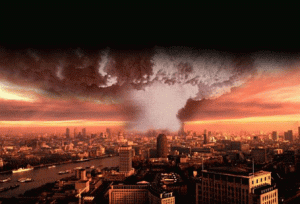 On Nuclear Policy, Trump and Clinton Agree: Armageddon Is an Option
While you were up watching reruns of Seinfeld, the first presidential debate turned into Dr. Strangelove. The Nation , By Andrew J. Bacevich, 5 Oct 16,
You may have missed it. Perhaps you dozed off. Or wandered into the kitchen to grab a snack. Or by that point in the proceedings were checking out Seinfeld reruns. During the latter part of the much hyped but excruciating-to-watch first presidential debate, NBC Nightly News anchor Lester Holt posed a seemingly straightforward but cunningly devised question. His purpose was to test whether the candidates understood the essentials of nuclear strategy.
A moderator given to plain speaking might have said this: “Explain why the United States keeps such a large arsenal of nuclear weapons and when you might consider using those weapons.”
What Holt actually said was: “On nuclear weapons, President Obama reportedly considered changing the nation’s longstanding policy on first use. Do you support the current policy?”
The framing of the question posited no small amount of knowledge on the part of the two candidates. Specifically, it assumed that Donald Trump and Hillary Clinton each possess some familiarity with the longstanding policy to which Holt referred and with the modifications that Obama had contemplated making to it………
Cruelly, the moderator invited Trump to respond first. The look in the Republican nominee’s eyes made it instantly clear that Holt could have been speaking Farsi for all he understood……..
in the arcane theology of nuclear strategy, “first strike” and “first use” are anything but synonymous. “First strike” implies a one-sided, preventive war of annihilation. The logic of a first strike, such as it is, is based on the calculation that a surprise nuclear attack could inflict the “nuclear alternative” on your adversary, while sparing your own side from suffering a comparable fate. A successful first strike would be a one-punch knockout, delivered while your opponent still sits in his corner of the ring.
………..The Republican nominee promptly revoked his “no first strike” pledge by insisting, in a cliché much favored in Washington, that “I can’t take anything off the table.”……..
It was now Clinton’s turn to show her stuff…..
What followed was vintage Clinton: vapid sentiments, smoothly delivered in the knowing tone of a seasoned Washington operative. During her two minutes, she never came within a country mile of discussing the question Holt had asked or the thoughts she evidently actually has about nuclear issues……..
What do our presidential candidates talk about when they don’t want to talk about nuclear war? The one, in a vain effort to conceal his own ignorance, offers rambling nonsense. The other, accustomed to making her own rules, simply changes the subject.
October 5, 2016
Posted by Christina Macpherson |
USA elections 2016 |
Leave a comment
 Nuclear power lobby names new CEO, The Hill, By Timothy Cama – 10/04/16 The Nuclear Energy Institute (NEI) has tapped Maria Korsnick, a veteran of the nuclear industry, to be its new CEO.
Korsnick, currently the chief operating officer at NEI, will start her new role Jan. 1, when Marv Fertel, the current CEO, retires.
She has previously held executive positions at Constellation Energy Nuclear Group and Exelon Corp……..
The changes come at a crucial moment for the nuclear sector. Numerous plants are expected to close in the coming years amid competition from cheap natural gas and renewables, and increasing safety and security requirements.
A small handful of new plants or reactors are under construction domestically as well.
NEI is working on various major policy priorities, like getting a tax credit renewed for newly built plants, trying to get the Yucca Mountain nuclear waste site built and reforming the Nuclear Regulatory Commission. http://thehill.com/policy/energy-environment/299158-nuclear-lobby-names-new-ceo
October 4, 2016
Posted by Christina Macpherson |
politics, USA |
Leave a comment