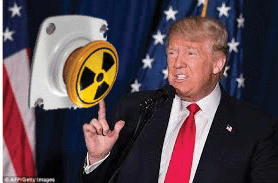
HOW DONALD TRUMP IS REVIVING GENERAL DOUGLAS MACARTHUR’S NUCLEAR GAMEPLAN, Newsweek, BY JEFF STEIN ON 9/29/16 .Trump has said on multiple occasions that he would use nuclear weapons, possibly dropping on ISIS. Nothing else Trump has said—about Muslims, women, protesters, immigrants and so on—has chilled the political, military and media establishment more than his glib pronouncements on nuclear weapons. If we’re not going to use them, Trump told MSNBC’s Chris Matthews in a typical remark last March, “then why are we making them?” He said he might drop one on the Islamic State group, known as ISIS, or Europe. “You want to be unpredictable,” he said. A year ago, people thought such statements would disqualify him.
Whether he knew it or not, though, Trump was expressing standard U.S. policy since the dawn of the Cold War. But it’s one thing for President Barack Obama or his mostly even-keeled predecessors to have the nuclear codes. It’s another thing to hand them to a man whose narcissistic, grandiose and impulsive personality “is certainly extreme by any standard, and particularly rare for a presidential candidate,” as the psychologist Dan McAdams, a student of presidential minds,wrote in The Atlantic. A Trump presidency “could be highly combustible,” McAdams added. “He could be a daring and ruthlessly aggressive decision maker who…never thinks twice about the collateral damage he will leave behind.”…………http://www.newsweek.com/2016/10/07/donald-trump-nuclear-weapons-general-macarthur-harry-truman-503979.html
Hinkley Point nuclear deal signed as Government admits gas would be cheaper, Telegraph, Emily Gosden, energy editor 29 SEPTEMBER 2016
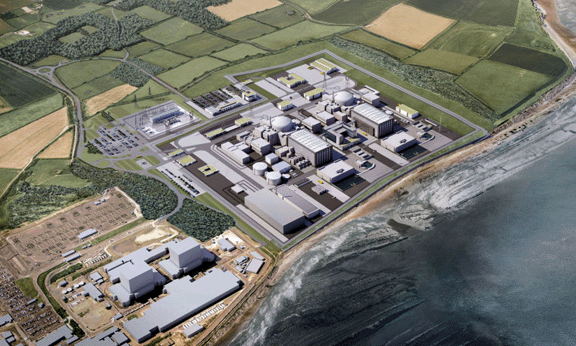
The Hinkley Point C nuclear plant will saddle UK consumers with higher energy bills than building gas power stations, the Government has admitted, as it signed a legally-binding contract to subsidise the £18bn project.
An official assessment claimed the Franco-Chinese project to build Britain’s first nuclear plant in a generation represented “value for money”, despite being more expensive than gas, because it would help meet climate change targets.
A series of deals signed between the Government, France’s EDF and China’s state nuclear firm CGN at a ceremony in London marked the final go-ahead for the Somerset power plant and also fired the formal starting gun on Chinese efforts to build their own reactor in Essex………
Earlier this month the Government opted to press ahead with the project with some new security safeguards but leaving the controversial subsidy deal underpinning Hinkley unchanged.
Under a deal first agreed in 2013 Hinkley will be paid a fixed price of £92.50/MWh for the power it produces for 35 years, funded through levies on energy bills. The National Audit Office has said it could cost up to £30bn in subsidies.
Among hundreds of pages of documents issued on Thursday afternoon – some heavily redacted – ministers faced a series of questions over a cursory three-page assessment concluding that the deal would add £12 to energy bills in 2030 but was “value for money”.
The assessment said Hinkley was “cost-competitive to other options for delivering power” despite its own assessment that the “comparable cost” of new gas in the 2020s could be as low as £45/MWh, solar as low as £65/MWh and onshore wind as low as £49/MWh.
If Hinkley was delayed by three years and gas plants built instead then by 2030 the UK would be £3.2bn better off and energy bills would be “£6 cheaper per year”, it concluded……..
John Sauven, executive director of Greenpeace, accused the Government of obfuscation and providing “no evidence anywhere in the documents to back up their assumptions”.
“The numbers speak for themselves. In the unlikely event Hinkley is working sometime in the second half of the next decade, renewable energy will be much cheaper, yet British consumers will still be forced to pay over the odds for nuclear power,” he said.
Another document underlined the lasting impact the decision will have on UK energy policy for more than a century to come, forecasting that the spent fuel for the plant would not be disposed of until the year 2138.
EDF Energy said Hinkley would “kickstart Britain’s nuclear revival” and that it had “been shown to offer consumers value for money”.
Why the nuclear first-use debate matters in the 2016 race, MSNBC 09/29/16 By Steve Benen
It’s difficult to choose the single most alarming thing Donald Trump said about foreign policy and national security at this week’s presidential debate, in part because there are so many unsettling comments to choose from.
The Republican seemed to believe ISIS has been around for much of Hillary Clinton’s adult life, which isn’t even close to being true. Trump suggested China should invade North Korea. He took credit for NATO policies that he had nothing to do with, while suggesting the NATO alliance itself should be considered as some kind of protection racket.
Trump also insisted, as he has before, that the United States should have stolen Iraq’s oil – which would have been illegal – in order to deny ISIS the resources it’s actually getting from Syria.
But as Rachel noted on the show the other day, the real gem has to be Trump’s woeful understanding of nuclear policy. Moderator Lester Holt asked an excellent question: “On nuclear weapons, President Obama reportedly considered changing the nation’s longstanding policy on first use. Do you support the current policy?”
“I would like everybody to end it, just get rid of it. But I would certainly not do first strike.
“I think that once the nuclear alternative happens, it’s over. At the same time, we have to be prepared. I can’t take anything off the table.”
He then rambled some more, straying between a variety of loosely related topics, including his opposition to the international nuclear agreement with Iran.
But for those paying attention, the real problem was with Trump’s obvious contradiction. Policymakers can adopt a “no-first-use” policy or they can endorse a “nothing-is-off-the-table” position, but Donald Trump is one of those rare politicians who wants to take both sides simultaneously.
This followed a GOP primary debate in December at which Trump appeared to have no idea what the nuclear triad referred to. The Republican could have taken advantage of that opportunity, recognizing the importance of getting up to speed on the nuclear basics, but instead Trump seems to have done no homework on the issue at all.
Hinkley Point: ministers sign go-ahead for nuclear power plant Representatives of British, Chinese and French governments attend ceremony giving final authorisation for power station, Guardian, Rowena Mason, 30 Sept 16, The UK has signed its £18bn contract with France and China to build the Hinkley Point C nuclear power station, giving the final go-ahead for construction at the site in Somerset.
The deal was finalised at a low-key ceremony in London, just two months afterTheresa May alarmed her French and Chinese counterparts by putting the entire project under review. EDF, the French nuclear contractor, and its Chinese partners had to cancel their previous plans for a signing ceremony at the last minute when the review was announced in July.
The project finally got approval this month, after Greg Clark, the business secretary, announced there would be some new restrictions on future investments in critical infrastructure if there were national security concerns.
Clark attended the signing ceremony on behalf of the UK, alongside Jean-Bernard Lévy, the chairman of EDF, and He Yu, chair of China General Nuclear…….
Greenpeace said it was “no wonder the UK government has opted for a ‘champagne-free’ signing ceremony away from public view”.
The environmental group said: “With a stroke of the pen ministers are signing away billions of pounds of billpayers’ money to a project they know is plagued by legal, financial and technical problems. In the unlikely event Hinkley is working some time in the second half of the next decade, renewable energy will be much cheaper, yet British consumers will still be forced to pay over the odds for nuclear power. It’ll be like being locked into an expensive fixed-rate mortgage as interest rates plummet.”…….https://www.theguardian.com/uk-news/2016/sep/29/hinkley-point-ministers-sign-go-ahead-for-nuclear-power-plant
Eskom may take charge of SA’s nuclear power build, IOL 29 September 2016, Emsie Ferreira Cape Town – Government will not be issuing a call for proposals for its nuclear power expansion programme to allow for more time for consultations, which could mean shifting responsibility for the project from the department of energy to Eskom, Presidency Minister Jeff Radebe confirmed on Thursday……..
Radebe was asked about conflicting statements from Energy Minister Tina Joemat-Pettersson and her science and technology counterpart, Naledi Pandor, as to whether the request for proposals from prospective partners would still proceed as planned on Friday.
Pandor this week indicated it would not, contradicting the energy minister.
But Radebe confirmed that government could not invite proposals while an integrated resource plan had not been finalised, and that Pandor had been right in saying Cabinet’s economic cluster first needed to meet to do so.
Eskom chief executive officer Brian Molefe last week told MPs and the media that concerns about whether the country could afford procuring the capacity to add 9,600 megawatt of nuclear energy to the grid were overwrought.
He said given the roughly 80-year lifespan of nuclear plants, the programme would pay for itself over those decades. Molefe was adamant that renewable energy could not be considered a viable alternative as it was not sufficiently reliable.
And earlier this week, Eskom’s head of generation Matshela Koko suggested that the nuclear utility could pay for the nuclear build programme because it would have accumulate cash reserves of R150 billion over the next decade.
The Democratic Alliance said on Thursday that allowing Eskom to lead the process would mean it being less open to parliamentary scrutiny, and President Jacob Zuma having greater control over the procurement process.
“Designating Eskom as the procuring agent of the state will fundamentally limit the role and capacity of Parliament to oversee the nuclear deal and, in doing so, increase the potential of corruption surrounding the trillion rand deal,” DA energy spokesman Gordon Mackay said. http://www.iol.co.za/news/politics/eskom-may-take-charge-of-sas-nuclear-power-build-2074416
Environmentalists say there is no need to move spent nuclear fuel off of atomic power plant sites. They contend it can be stored safely. Transporting it to a disposal area near Barnwell would increase risks to the public, they said
Plan surfaces for new nuclear disposal ground in SC Casks of spent nuclear fuel are stored above ground at many atomic energy plants because there is no national disposal site for the material U.S. Nuclear Regulatory Commission BY SAMMY FRETWELL AND JEFF WILKINSON\ sfretwell@thestate.com,jwilkinson@thestate.com, COLUMBIA, SC
A plan has surfaced to establish another nuclear waste disposal ground in South Carolina, a state with a history of taking atomic refuse from across the country.
An organization called the Spent Fuel Reprocessing Group wants federal approval to open a disposal area near Barnwell and the Savannah River Site nuclear weapons complex. Spent fuel, a type of highly radioactive waste, would be moved from the state’s four nuclear power plant sites and stored indefinitely at the new facility, records show.
The U.S. Nuclear Regulatory Commission in July received notice of the plan. The proposal is a long way from becoming reality, but if eventually approved by the federal government, it would create a place for nuclear waste disposal that is likely to draw opposition.
Several environmental groups said this week they are preparing to fight any effort to create what they called an atomic waste dumping ground. Politicians, including Gov. Nikki Haley, also expressed reservations Monday. The subject of nuclear waste disposal is a touchy one in South Carolina because many people say the state has shouldered more than its share of the nuclear waste burden.
South Carolina already stores highly radioactive material from around the country and world at the Savannah River Site. It also has a low-level waste dump in Barnwell County that was used for decades to bury nuclear garbage from power plants across the country. That site has leaked radioactive tritium into groundwater.
Now, the government is being asked to allow an interim disposal site for high-level nuclear waste from power plants in South Carolina. The site would be near the Barnwell low-level waste dump, environmentalists said Monday. The site would be considered an interim disposal ground that would hold the nuclear waste while the government figures out what to do with it in the long run…….
Environmentalists say there is no need to move spent nuclear fuel off of atomic power plant sites. They contend it can be stored safely. Transporting it to a disposal area near Barnwell would increase risks to the public, they said. If a permanent disposal site were eventually developed nationally, the material would have to be transported again from the interim South Carolina site, according to Savannah River Site Watch, the S.C. League of Women Voters and the state Sierra Club.
“Packaging of the spent fuel for transport, unloading it at the consolidated storage site and eventually repackaging it to transport to a federal facility would unnecessarily pose a high economic cost and a logistical nightmare, both of which can be avoided if the spent fuel is left where it is now stored until such time as a geologic facility is available,’’ according to the groups…….
Trump Campaign Equivocates on Climate as Debate Fallout Continues
Common Dreams, September 27, 2016 Campaign chief claims Trump believes global warming exists, but not caused by humans, as VP pick Mike Pence breaks with stance altogether by Nadia Prupis, staff writer
Among Republican presidential nominee Donald Trump’s many debate gaffes Monday night, one of the most blatant was his claim that he never said climate change was a hoax.
Trump’s manager challenged on climate change position
At the Hofstra University debate, Democratic nominee Hillary Clinton challenged Trump’s stance on the environment stating, “Donald thinks that climate change is a hoax perpetrated by the Chinese. I think it’s real.” Trump quickly interrupted her with “I did not, I do not say that.”
Not only was this a lie—one social media users quickly fact-checked—but Trump has also said that, if elected, he would implement a decidedly anti-climate platform that includes weakening the U.S. Environmental Protection Agency (EPA); abolishing President Barack Obama’s Clean Power Plan, without which the U.S. has little chance of meeting its Paris climate pledge; promoting increased fossil fuel exploration; and employing oil and gas executives, including high-profile climate skeptic Myron Ebell, to lead his cabinet.
The outcry from Trump’s many denials prompted his campaign manager, Kellyanne Conway, to tellCNN‘s Alisyn Camerota that the GOP nominee does, in fact, believe in climate change—he just doesn’t believe it’s caused by humans.
“He believes that global warming is naturally occurring,” Conway said. “There are shifts naturally occurring.”
That, too, is scientifically false. In fact, 97 percent of scientists agree that climate change is real and man-made.
In fact, Trump’s climate stance appears to be too unrealistic for even his running mate to get behind. Vice presidential nominee and Indiana Governor Mike Pence, who is well known for his staunchly right-wing policies, said Tuesday there is “no question” that human activity affects the environment.
In a separate appearance on CNN, Pence said, “Let’s follow the science…There’s no question that the activities that take place in this country and in countries around the world have some impact on the environment and some impact on climate.”
Donald Trump made a $1 trillion error about nuclear weapons during the first presidential debate, Business Insider, PAUL SZOLDRASEP 28, 2016, Donald Trump made a $1 trillion error when talking about the US military’s nuclear arsenal during Monday’s presidential debate.
After Lester Holt asked whether he would be against using a “nuclear first strike” — the idea of using nukes preemptively — the Republican presidential nominee first answered by criticising the US military’s existing nuclear weapons programs.
“Russia has been expanding their — they have a much newer capability than we do. We have not been updating from the new standpoint. I looked the other night. I was seeing B-52s, they’re old enough that your father, your grandfather could be flying them. We are not — we are not keeping up with other countries.”
He went on to say that he would not do a nuclear first strike, but then said he wouldn’t “take anything off the table.”
But the idea that the US is not keeping up with Russia, or any other country in regards to nuclear weapons, is wrong.
One trillion dollars wrong.
That’s because in November 2015, a fighter jet dropped an unarmed “nuclear gravity bomb” at a Nevada test range called the B61-12, a new weapon costing around $8.1 billion.
The pricey new bomb is actually less than 1% of a $1 trillion push to keep the US nuclear arsenal up-to-date. Officials also say the program will actually help reduce the number of nukes in the world.
WILL JOEMAT-PETTERSSON ISSUE REQUEST FOR PROPOSALS FOR PROCUREMENT OF NUCLEAR POWER? The request for proposals would mark the official start of South Africa’s nuclear build programme. Eyewitness News, Gaye Davis , 27 Sept 16 CAPE TOWN – Doubt has been cast on whether the request for proposals for the procurement of nuclear power will be issued on Friday as promised by Energy Minister Tina Joemat-Pettersson.
The request for proposals would mark the official start of South Africa’s nuclear build programme, which President Jacob Zuma has made a top priority but which has been shrouded in secrecy and is the subject of much controversy.
Science and Technology Minister Naledi Pandor says she doesn’t believe Joemat-Pettersson will be able to go ahead because the government’s Integrated Resource Plan (IRP) has yet to be updated.
The IRP forecasts the country’s energy demand, spells out generation plans and determines the required mix of energy sources.
Pandor was answering questions at a briefing by economics cluster ministers this afternoon.
Joemat-Pettersson told Parliament on 7 September the nuclear programme would kick off this Friday with the formal issuing of a request for proposals. But Pandor told journalists this afternoon she wasn’t certain the call for proposals could proceed this week.
Fears mount over true motivations for SA’s planned nuclear deal, Mail and Guardian, Hartmut Winkler27 Sep 2016 Nuclear energy in South Africa is a very contentious issue. The decision on whether to proceed with the construction of a fleet of nuclear power plants is destined to become the financially most far-reaching and consequential defining moment of the Jacob Zuma presidency.
There is widespread public mistrust of the nuclear expansion process. Its roots lie in the extraordinary announcement in 2014 that the Russian nuclear agency Rosatom had secured therights to build the new South African nuclear plants. The South African government played down the announcement, claiming that it was inaccurate.
But this precipitated a series of media investigations. These uncovered evidence that individuals close to the president and groups linked to the ruling ANC have significant financial interests in the matter.
Civil society organisations are taking government to court in an attempt to have the deal declared illegal. Their attempts to have details of the Russian agreement released are being resisted. This is likely to strengthen their case, and sway public opinion further.
It appears that those with a stake in the nuclear build are hoping to fast-track the process in the face of growing public opposition. This is evident from revelations that, bizarrely, contracts are being awarded, even though a formal process has not been set in motion by government.
The most recent revelation was that a member of a business family with close links to President Jacob Zuma has been awarded a massive R171 million tender for a nuclear build programme management system.
The meaning of this is unclear. It has largely confirmed the fears that the nuclear build is being driven for the benefit of the politically connected rather than the national good.
Burning questions
The debate surrounding the nuclear project centres on three highly contested questions:
Is the country’s future energy generating potential and demand such that an expensive nuclear power station build is effectively unavoidable?
Can South Africa afford the associated costs and debt, especially in view of massive funding demands in other sectors such as education?
If approved, would the nuclear build lead to massive overspends, corruption and beneficiation ofpolitically connected individuals?…….
it is difficult to understand why the renewable fraction is not being increased further, and why the national power utility Eskom, under the leadership of Brian Molefe, a nuclear disciple, now opposes new renewable energy developments.
The promotion of nuclear energy at the expense of renewables bucks global trends………
The ANC’s internal nuclear war
The often obscure processes and overhasty developments require an insight into the present machinations within the governing party.
Tensions within the ruling party have escalated to the point where calls for the president’s resignation are now made openly. And even party leaders acknowledge that factions in their ranks are thriving on corruption.
The organisational fracture is equally evident in attitudes towards the nuclear build. Tensions over the issue have been cited as the major reason for Zuma’s dismissal of the financially prudent former Finance Minister Nhlanhla Nene in December 2015.
The official position…….
the legitimacy of the procurement process has already been undermined.
Looking ahead, actual construction would need to be preceded by the closure of funding agreements, the settling of legal disputes and further public engagement. This takes time.
In the unlikely event that the nuclear build actually does come to fruition, it will not commence any time soon.
Presidential Debates Commission Makes Outrageous Statement: Fact Checking Is Off The Table, Bipartisan Report By Sarah MacManus –September 25, 2016, In a mind-boggling statement on CNN’s Reliable Sources on Sunday, Janet Brown, executive director of the Commission on Presidential Debates told host Brian Stelter that fact checking isn’t the duty of the moderator. In fact, she said candidates should fact check each other.
With the issue of honesty being such an influential factor in the 2016 election, it’s difficult to believe that the chief is taking this stand. Both candidates have been accused of and found to have issues with twisting the truth, and Donald Trump is a particularly egregious example.
Brown’s reasoning is even more confusing:
‘I think personally if you start getting into fact checking, I’m not sure. What is a big fact? What is a little fact? And if you and I have different sources of information does your source about the unemployment rate agree with my source? I don’t think it’s a good idea to get the moderator into essentially serving as the Encyclopedia Britannica.’
But recently, both candidates have been called to the carpet for serial falsehoods. Donald Trump, the Republican nominee, was analyzed by POLITICO and found to lie every three minutes and 15 seconds over “nearly five hours of remarks.” By tallying up the approximate amount of time that Trump spoke and was interviewed, four hours and 43 minutes, they found he issued 87 separate falsehoods.
POLITICO also fact checked Hillary Clinton, the Democratic nominee, and found that her falsehoods usually only involved herself and her own behavior, including her handling of her pneumonia scare on September 11. POLITICO clocked Clinton in at 96 minutes of speaking, with eight falsehoods.
The $1 trillion price tag of modernizing America’s nuclear weapons falls to the next president, Business Insider Yeganeh Torbati, Reuters “………..-budget constraints almost certainly will force the next president to decide whether and how quickly to proceed with the Obama administration’s plans to maintain and modernize the US nuclear arsenal.
Crunch time
The crunch comes in the next decade as American ballistic missile submarines, bombers, and land-based missiles – the three legs of the nuclear triad – reach the end of their useful lives.
The Congressional Budget Office estimates the total cost of nuclear forces through 2024 at $348 billion, but that does not include some of the costliest upgrades, scheduled for the latter half of the next decade. Independent estimates have put the cost of maintaining and modernizing the arsenal at about $1 trillion over 30 years.
“There’s a bipartisan commitment to doing that upgrade, so we have to assume those funds will come through,” Energy Secretary Ernest Moniz told Reuters on Sept. 20. “But it will be a significant budget increase, especially in the next decade.”
The Energy Department shares responsibility with the Pentagon for the nuclear arsenal, and some of its research and production facilities are 73 years old.
The next administration could abandon or delay some aspects of modernization to cut costs. Or it could raise taxes, increase the budget deficit, or cut domestic programs, all unpopular steps with American voters.
The most vulnerable elements of the modernization plans are a long-range standoff weapon, or LRSO – a nuclear-capable cruise missile launched from an aircraft – and new land-based intercontinental ballistic missiles (ICBMs).
Ten US senators, including Elizabeth Warren of Massachusetts and Bernie Sanders of Vermont, called on President Barack Obama in July to cancel the LRSO, saying it “would provide an unnecessary capability that could increase the risk of nuclear war.”
A vote today for Hillary Clinton is a vote for endless, stupid war https://wikileaks.org/hillary-war/ 9 Feb 16 by Julian Assange Hillary didn’t just vote for Iraq. She made her own Iraq. Libya is Hillary’s Iraq and if she becomes president she will make more.
I have had years of experience in dealing with Hillary Clinton and have read thousands of her cables. Hillary lacks judgement and will push the United States into endless, stupid wars which spread terrorism. Her personality combined with her poor policy decisions have directly contributed to the rise of ISIS.
Pentagon generals objected to destroying the Libyan state. They felt Hillary did not have a safe post-war plan. Hillary Clinton went over their heads. Libya has been destroyed. It became a haven for ISIS. The Libyan national armory was looted and hundreds of tons of weapons were transferred to jihadists in Syria. Hillary’s war has increased terrorism, killed tens of thousands of innocent civilians and has set back women’s rights in the Middle East by hundreds of years. Having learned nothing from the Libyan disaster Hillary then set about trying do the same in Syria.
Hillary publicly took credit for the destruction of the Libyan state. On hearing that the country’s president had been killed by her handiwork, she became wild-eyed and gloated “We came, we saw, he died!”. In the momentary thrill of the kill, she had aped, of all people, Julius Ceaser.
Hillary’s problem is not just that she’s war hawk. She’s a war hawk with bad judgement who gets an unseemly emotional rush out of killing people. She shouldn’t be let near a gun shop, let alone an army. And she certainly should not become president of the United States.
Nuclear and fracking: the economic and moral bankruptcy of UK energy policy, Ecologist, Peter Strachan & Alex Russell, 27th September 2016 With its choice of Hinkley Point C – a £100 billion nuclear boondoggle – its enthusiastic support for expensive and environmentally harmful fracking, and its relentless attack on renewable energy, the UK government’s energy policy is both morally and economically bankrupt, write Peter Strachan & Alex Russell. It must urgently reconsider this folly and embrace the renewable energy transition
As Prime Minister Theresa May and EDF prepare to sign the Hinkley Point C contract, and Scotland sees the first shipment of fracking gas from the United States, it is perhaps timely to reflect on recent developments in UK energy policy.
Both new nuclear build and UK onshore shale gas and oil extraction fail key environmental, safety and economic tests.
The UK has recently committed to a nuclear renaissance, with Greg Clark, the Secretary of State for Business, Energy and Industrial Strategy (BEIS) at Westminster, describingthe “dawning of a new age of nuclear”.
But by commissioning French and Chinese companies to build the first UK nuclear power station in a generation, the Hinkley Point C deal has come in for almost universal condemnation.
Theresa May clearly buckled under economic pressure from China and has backed nuclear power as the panacea to combat the electricity crunch that we face. Her questionable decision means the UK is committed to a long-term very expensive project that comes with national securityand many other concerns.
Empty promises
In 2007 the Chief Executive of EDF’s UK arm effectively cooked his own goose by claiming that Brits would be cooking their Christmas turkeys using nuclear power generated from Hinkley Point C by 2017. Now EDF are claiming that they won’t go over budget, when the new power plant is delivered some time in 2025.
If ongoing experience in France and Finland is anything to go by, and with apparently few financial penalties in place for late delivery, there are serious doubts that the project can be completed in the revised timescale and on budget.
Turning to the financials, the costs of the project are just enormous. Some have claimed that Hinkley Point C will end up being the most expensive physical object ever built. The project is a £100 billion boondoggle. The construction costs alone are in the region of £18-£25 billion. Then there are the subsidies that will amount to a conservative £1 billion plus per year, for at least 35 years.
The deal penned is inflation linked at more than twice the cost of current wholesale electricity prices. The plant will then operate for a further 30 years. It has a potential life span of around 65 years and it will continue to be a drain on public finances even after the initial lucrative contract has expired.
Then try to add into the calculus the unstated decommissioning and radioactive waste management costs, and it soon becomes apparent these super-burdensome costs and risks are incalculable.
If Sellafield in Cumbria, England, is used as a baseline, such costs are just eye watering. Indeed, bucket loads of money amounting to tens of billions of pounds have already been spent, trying to make safe the UK’s nuclear legacy. Based on the available evidence one can only conclude that cheap and clean nuclear power is a myth.
Fuel poverty for future generations
In terms of what Hinkley Point C will mean for household budgets, it is estimated that it will push up individual electricity bills by around £50 per annum. But this is just the start of such price rises as Hinkley Point C is the first of a number of new nuclear projects.
It is only around 3 GW of a 16 GW plus plan. Electricity bills will spiral out of control, as they did a few years ago when there were regular inflation busting price increases. The new nuclear age described by Greg Clark will surely set us on a path to fuel poverty for decades.
Even if households and business can afford such future hideous electricity bills, it might be 2030 before we see the plant operational – more than a decade later than was initially planned. Its promise to generate up to 7% of the UK’s electricity demand will be delivered around a decade too late to meet the 2020 electricity crunch that the UK faces…….
Glittering prizes or fracking folly?……..
Can we have more renewables please?
Most people don’t realise that renewables now supply around 25% of UK electricity and in Scotland it is over 50 per cent. Their market share has grown rapidly in recent years, trebling between 2010 and 2015.
Renewables now supply more electricity to the national grid than nuclear power and coal. They are very popular with the general public, cost-effective, and can be deployed very quickly, compared to the nuclear and shale options just outlined. They are also cleaner energy sources, and given all of these positives should surely be deployed to address the looming electricity crunch that threatens the UK.
But for the past two years the renewables industry has been under attack by the Conservative government. Changes to financial support mechanisms and the planning regime are now bringing onshore wind to a standstill. Solar support is being killed off. And while there is much rhetoric around offshore wind, it is actually progressing at a snail’s pace.
Another emerging and detrimental effect has been to undermine local community initiatives. In addition to supplying much needed electricity and investment in local assets such as community halls, churches and youth projects, community owned renewable projects encourage energy conservation, and have wider and important public education benefits.
If ever we needed some sign of reprieve for UK renewables, it is now.
A call to action
Westminster must get back on course and harness the heat of the sun, and the (gale) force of our wind, and the power of our waves and tides. It should fully embrace the energy transition from fossil fuels and nuclear power, to a renewable energy future.
Germany, Europe’s strongest economy, gets it and is making huge strides with their ‘Energiewende‘ strategy. The Scottish Parliament at Holyrood also gets it, and to pinch a phrase from former First Minster Alex Salmond, we have the potential to become the“Saudi Arabia of Renewables“.
The future of humanity depends on an all-encompassing global acceptance of the replacement of fossil fuels and nuclear power by renewables. If there is still a perception that British moral values lead where the world follows then its status is at best precarious.
Theresa May and Greg Clark must step up to the plate and nail the renewables flag to the top of UK energy policy. Nuclear power and fossil fuels have no economic or moral right to a long-term place in UK energy policy.
Peter Strachan is Professor of Energy Policy, Robert Gordon University. He tweets@ProfStrachan.
Professor Alex Russell is Chair of the Oil Industry Finance Association.
Authors’ note: The opinions expressed in this article are those of the authors and not those of the Robert Gordon University or Affiliates.
US Congress Bill Bans President From Launching ‘First Use’ Nuclear Strike,https://sputniknews.com/us/20160927/1045761657/bill-ban-us-nuclear-strike.html, Newly-introduced legislation would ban the US commander-in-chief from authorizing a nuclear attack without approval from the legislative branch, Congressman Ted Lieu and Senator Ed Markey said in a press release on Tuesday. WASHINGTON — The release claimed that the issue of “nuclear first use” is even more critical in light of the fact that a majority of Americans do not trust Republican presidential nominee Donald Trump with the US nuclear arsenal.
“This legislation would prohibit the [US] President from launching a nuclear first strike without a declaration of war by Congress,” the release stated. On Monday, US Democratic presidential nominee Hillary Clinton during the campaign’s first debate argued that Trump’s position on nuclear weapons runs contrary to longstanding US policy given he has repeatedly said he did not care if other countries possessed them.
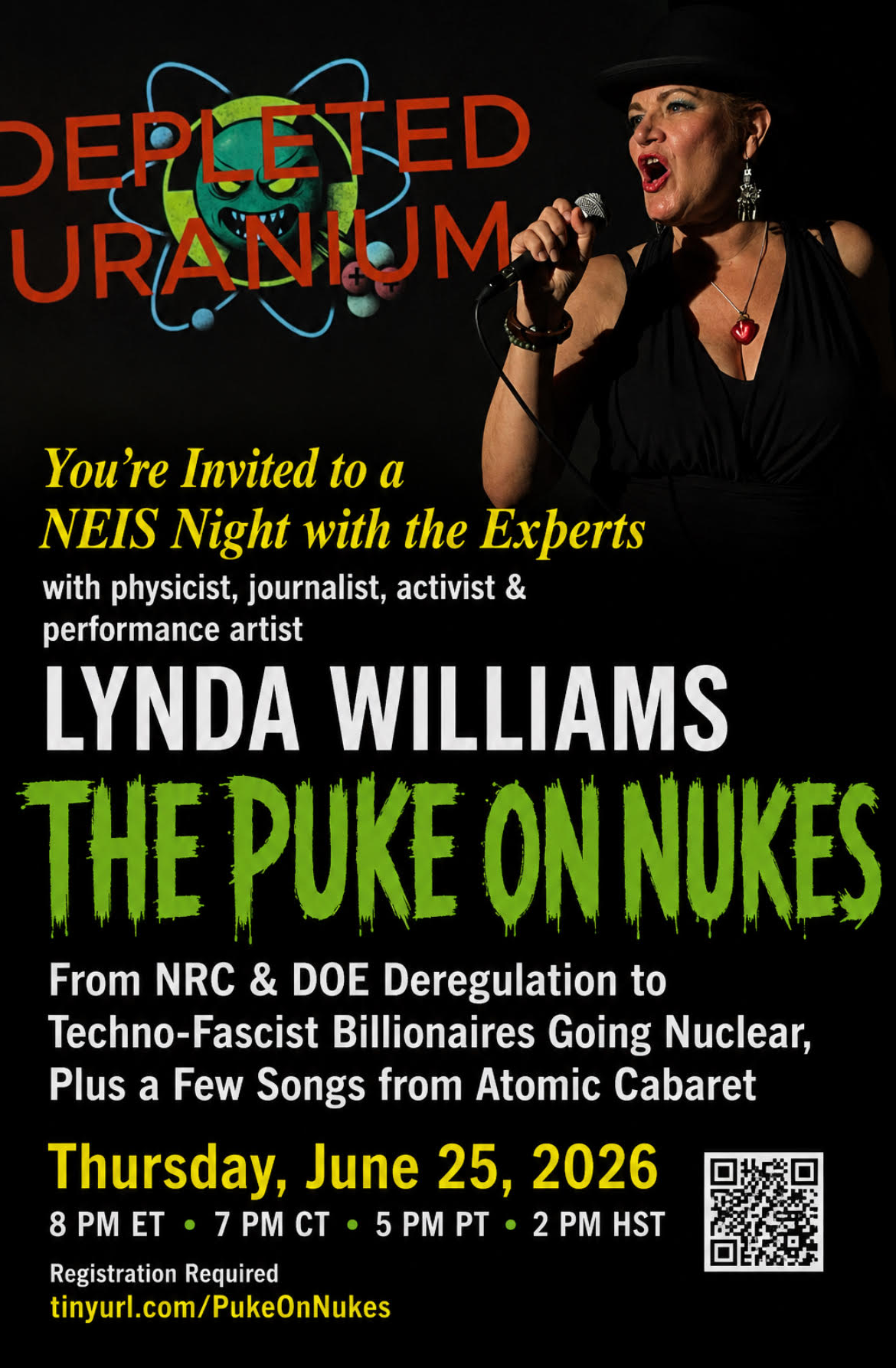
7pm Central Time (8pm ET, 6pm MT, 5pm PT) UTC – 5 From NRC & DOE Deregulation to Techno-Fascist Billionaires Going Nuclear, Plus a Few Songs from Atomic Cabaret REGISTER









 nuclear-news