Tillerson Backs Paris Climate Agreement At Confirmation Hearing http://oilprice.com/Latest-Energy-News/World-News/Tillerson-Backs-Paris-Climate-Agreement-At-Confirmation-Hearing.htmlBy Irina Slav Oilprice.com Jan 12, 2017, Secretary of State nominee Rex Tillerson said during his Senate confirmation hearing that the U.S. would be better off sticking with the Paris agreement to tackle climate change. His position stands in contrast to President-elect Donald Trump’s stated opposition to the agreement and his intention to break away from the agreement when he enters office.
Climate change was among the topics on which a 21-senator panel grilled Tillerson yesterday, and was also one of the topics on which his stance differed from that of Trump. Also among these were nuclear proliferation, and to a certain extent, Iran.
Asked to comment on Trump statements that he would not object if U.S. allies such as Japan, South Korea, and Saudi Arabia obtained nuclear weapons, Tillerson said that hardly anyone would advocate the global proliferation of nuclear weapons.
As for the Iran deal that several Western governments closed with Iran last year to deter the country from building its own nuclear weapons, Tillerson was wary in his approach, telling the Foreign Relations Committee he would recommend “a full review” of the deal.
Tillerson was also measured in his responses to questions concerning Russia and bilateral relations. Urged by Republican senator – and former Trump rival for the Republican presidential nomination – Marco Rubio to agree that Russia’s President Putin was a war criminal because of Russia’s involvement in Syria, Tillerson declined, saying these were “serious charges to make,” adding that he needed more information before reaching that determination.
Back to climate change and more specifically Exxon’s role in it and its alleged attempt to hide knowledge about the effect of human activity on climate, Tillerson referred the panel to Exxon itself. Asked whether he was unwilling to answer or rather lacking the knowledge that would allow him to do so, Tillerson responded with “A little of both.”
Copeland by-election goes nuclear By Ross HawkinsPolitical correspondent, BBC Radio 4 Today 12 January 2017 “……. Conservatives are putting Jeremy Corbyn at the centre of their Copeland by-election campaign.
His image is all over Tory leaflets, and their logic is very simple. Copeland relies on the nuclear industry and Jeremy Corbyn has opposed new nuclear power stations.
It means that when a by-election date is set, the contest in Cumbria could reveal a lot about how national politics will play out in the coming months. Tories will highlight an issue that divides Mr Corbyn and his colleagues……..
The economy revolves around Sellafield, and job numbers are set to fall there as reprocessing work ends. A new nuclear power station is proposed. Labour backs new nuclear energy, and local politicians certainly do. But Mr Corbyn has made plain in the past that he disagrees.
A policy document for his leadership campaign in 2015 says plainly: “I am opposed to fracking and to new nuclear on the basis of the dangers posed to our ecosystems.”
In a 2011 speech in the wake of the Fukushima disaster he went further, suggesting existing nuclear power stations should be decommissioned………
If it’s successful, a Labour strategy of responding to relentless attacks on Mr Corbyn with an equally relentless focus on the NHS may provide a model for the opposition in the years ahead.http://www.bbc.com/news/uk-politics-38589306
China Is Building Britain ANOTHER Nuclear Reactor, Daily Caller ANDREW FOLLETT Energy and Science Reporter 12 Jan 17 Britain’s nuclear regulators are considering whether another Chinese-funded and designed nuclear reactor should be built in Bradwell, Essex.
The reactor would be funded and designed by the state-controlled China General Nuclear Power Corporation (CGN) and the French power company Électricité de France (EDF). It could take British authorities up to four years to formally approve or reject the new reactor.
“The robust independence of the UK’s regulators is seen across the world as a key strength for nuclear in Britain,” Zhu Minhong, General Manager of CGN in Britain, told Reuters. “CGN and EDF will bring to this enterprise their joint experience in China, Britain and France over many years.”
The U.K.’s previous attempt to build a nuclear power plant with the exact same Chinese company didn’t got well.
British Prime Minister Theresa May almost cancelled a previous China-backed nuclear power plant at Hinkley Point due to its high costs and environmentalist opposition. The U.S. charged the Chinese company behind the Hinkley Point plant with nuclear espionage in August.
A columnist for a Chinese state-run media outlet called May’s reluctance to approve of the Hinkley Point nuclear power project a result of “China-phobia.” CGN agreed to pay about $8 billion of the reactor’s $24 billion dollar cost.
China’s ambassador to Great Britain issued an ultimatum over the delay earlier in August, pointing out Chinese companies have invested more in the U.K. over the past five years than in France, Germany and Italy combined.
Gov. Cuomo is expected to announce an agreement with the plant operators on Tuesday Indian Point nuclear power plant, less than 30 miles from New York City, will close by April 2021 under an agreement New York State reached this week with the utility company that owns the plant, according to several news reports.
One of the reactors will permanently shut downby April 2020, followed by the rest of the plant, which sits on the east bank of the Hudson River, the following year.
Gov. Andrew Cuomo, who supports nuclear power plants in the upper region of the state, has long requested that the Westchester County plant cease operations.
“Why you would allow Indian Point to continue to operate defies common sense, planning and basic sanity,” Cuomo said in June, The New York Times reported.
New York’s Department of State said the Indian Point plant is in violation of state coastal management regulations and that it poses a risk to the 17 million people who live within 50 miles, The Wall Street Journal reported.
However, Cuomo hasn’t confirmed the win for his administration.
“There is no agreement — Governor Cuomo has been working on a possible agreement for 15 years and until it’s done, it’s not done,” spokesman for the governor, Richard Azzopardi, said. “Close only counts for horseshoes, not for nuclear plants.”
The governor is expected to make the announcement in his home county of Westchester on Tuesday, the New York Daily News reported.
The replacement for the energy the plant provides for New York City and Westchester County isn’t clear; the power plant generates more than 2,000 megawatts — 25 percent of the region’s electricity.
Cuomo previously suggested alternative power options, including power from nearby wind farms and hydropower from Quebec.
In 2015, Cuomo’s administration opposed the 20-year recertification request by the plant’s owner, Entergy, citing ecological concerns. The objection stated that the reactor, located near “two active seismic faults,” kills marine life by using 2.5 billion gallons of water of day for cooling and puts drinking water at risk, according to the advocacy group Riverkeeper.
In his 2004 report “Chernobyl on the Hudson? The Health and Economic Impacts of a Terrorist Attack at the Indian Point Nuclear Plant,” Edwin S. Lyman of the Union of Concerned Scientists “found that a core meltdown and radiological release at one of the two operating Indian Point reactors could cause 50,000 near-term deaths from acute radiation syndrome and 14,000 long-term deaths from cancer.”
When asked if New York City’s safety will be affected by the plant closure, Raul Contreras, a spokesman for Mayor Bill de Blasio, said, “The closing of Indian Point must be coupled with a clear understanding of the risks and impact its replacements will have on air quality, energy affordability and reliability.”
A representative from Entergy told Metro on Saturday that the company has no comment at this time on the closure.
byPETE DOLACKThe ongoing environmental disaster at Fukushima is a grim enough reminder of the dangers of nuclear power, but nuclear does not make sense economically, either. The entire industry would not exist without massive government subsidies.
Quite an insult: Subsidies prop up an industry that points a dagger at the heart of the communities where ever it operates. The building of nuclear power plants drastically slowed after the disasters at Three Mile Island and Chernobyl, so it is at a minimum reckless that the latest attempt to resuscitate nuclear power pushes forward heedless of Fukushima’s discharge of radioactive materials into the air, soil and ocean.
There are no definitive statistics on the amount of subsidies enjoyed by nuclear power providers — in part because there so many different types of subsidies — but it amounts to a figure, whether we calculate in dollars, euros or pounds, in the hundreds of billions. Quite a result for an industry whose boosters, at its dawn a half-century ago, declared that it would provide energy “too cheap to meter.”
Taxpayers are not finished footing the bill for the industry, however. There is the matter of disposing radioactive waste (often borne by governments rather than energy companies) and fresh subsidies being granted for new nuclear power plants. None of this is unprecedented — government handouts have the been the industry’s rule from its inception. A paper written by Mark Cooper, a senior economic analyst for the Vermont Law School Institute for Energy and the Environment, notes the lack of economic viability then:
“In the late 1950s the vendors of nuclear reactors knew that their technology was untested and that nuclear safety issues had not been resolved, so they made it clear to policymakers in Washington that they would not build reactors if the Federal government did not shield them from the full liability of accidents.” [page iv]
“Despite the profoundly poor investment experience with taxpayer subsidies to nuclear plants over the past 50 years, the objectives of these new subsidies are precisely the same as the earlier subsidies: to reduce the private cost of capital for new nuclear reactors and to shift the long-term, often multi-generational risks of the nuclear fuel cycle away from investors. And once again, these subsidies to new reactors—whether publicly or privately owned—could end up exceeding the value of the power produced.” [page 3]
The many ways of counting subsidies
Among the goodies routinely given away, according to the Concerned Scientists, are: Continue reading →
NTPC’s efforts to get into nuclear power have slowed down even as the public sector power generation behemoth is focussing more on renewable energy.
A senior company official said the uncertainty due to higher tariff cost, along with some earlier ‘legislative hurdles’ are the reasons for lesser excitement for nuclear power projects.
The Parliament cleared the amendment to the Atomic Energy Act 1962 on December 31, 2015. This allowed the joint venture PSUs (public sector undertakeings) to build and operate nuclear power plants.
Impact of delay
NTPC officials BusinessLine spoke to said that ASHVINI — the joint venture between NTPC and Nuclear Power Corporation of India — was to be allocated the 2×700 MW Gorakhpur Haryana Anu Vidyut Pariyojana (GHAVP) project in Haryana. But due to delays in the amendment to the law, NPCIL decided to go ahead and build the plant itself.
In 2010, the then Department of Atomic Energy (DAE) Secretary, Srikumar Banerjee, had said that one of the sites identified by the DAE for the 2×700 MW plant would go to a NTPC and NPCIL joint venture company.
In 2011, NTPC-NPCIL formed the Anushakti Vidhyut Nigam Ltd (ASHVINI) with the objective of building nuclear power plants.
But the JV could not begin building nuclear power plants as the Atomic Energy Act did not allow joint ventures of PSUs for the same.
NTPC officials say that the expected power tariff from GHAVP is likely to be close to ₹10/kWh. Further, the plant will be commissioned in another 10 years.
High cost a concern
Assessing the subdued price of power in the country and the low price of renewable energy, officials said that the high tariff cost will be of concern when the plant is commissioned.
Considering that amendments to the Atomic Energy Act have been approved, it is now the prerogative of the DAE to allocate GHAVP to ASHVINI, according to NTPC officials.
In 2014, the estimated cost of the entire project of 28 GW, to be built in two phases, was envisaged at ₹20,594 crore.
Why solar power poses a very tricky problem for Donald Trump, The Week, RyanCooper , 6 Jan 17 The worst imaginable president for climate change might be about to take power, but solar is still a bright spot. The technology and business infrastructure of solar panel manufacturing has been getting better at a blistering pace, and the latest estimates conclude that solar will surpass coal as the cheapest electricity source within a single decade — and in many places, it already has.
This raises the question of what President Trump will do about the solar business. Most Republicans, Trump included, are heavily committed to filth-spewing power sources like coal and natural gas, and deny the science of climate change. But while Republicans will no doubt want to use regulations and subsidies to prop up fossil fuels and keep down renewables, Trump has shown a bizarre fixation with U.S.-based manufacturing jobs that might just redound to solar’s benefit.
The latest estimate of solar panels’ economic viability comes via Bloomberg New Energy Finance. The price of solar power has plummeted by 62 percent merely since 2009. Taking into account current trends and planned technological developments, they estimate solar will be on average the world’s cheapest power source by about 2026, without subsidies of any kind.
That average hides much variability, of course — in some sunny regions, solar is already astoundingly cheap:…….
Republicans will likely respond to the growth of solar by trying to stamp it out by allowing fossil fuels to pollute to their heart’s content (thus granting them a huge implicit subsidy), and passing burdensome new regulations on renewables. On the face of it, this fits well with Donald Trump’s campaign, which was all about valorizing traditionally masculine jobs, particularly in manufacturing and manual labor. In the conservative shorthand, coal is tough and cool, while renewables are for sissy Prius-drivers.
But on the other hand, this stereotype is wildly at odds with the actual reality of the solar business. Solar panels must be manufactured (as of 2015, there were about 30,000 such jobs in the United States) and installed by manual laborers (120,000 jobs as of 2015). That number has no doubt grown substantially in the past year, as solar jobs have been consistently increasing in number by about 20 percent per year……..
Stamping out solar would kill an order of magnitude more jobs than that. If Trump got wind of some policy that would strangle American solar — or worse yet, force the company to pick up and move to Europe or China — there is a genuine chance he’ll go on one of his Twitter rampages and force the Republican Congress to back down.
Conversely, it will be genuinely difficult to revive coal jobs, which have been in long-term decline since the 1970s. Big Coal has been all but killed off by competition with fracked natural gas and, increasingly, renewables. It is smaller than solar and shrinking fast. Stark hypocrisy is basically the Republican motto, but even they might struggle with the large and increasing subsidies necessary to prop up an ever-more-obsolete marketplace loser.
No deal on closing Indian Point, Gov. Cuomo says after shutdown reports http://pix11.com/2017/01/06/no-deal-on-closing-indian-point-gov-cuomos-office-says/, JANUARY 6, 2017, BY ALIZA CHASAN BUCHANAN, N.Y. — No agreement has been reached to close the Indian Point nuclear plant in Westchester County despite reports the plant would close its two units by 2021, Gov. Andrew Cuomo’s office said Friday.
“There is no agreement,” a spokesman for Cuomo’s office said. “Governor Cuomo has been working on a possible agreement for 15 years and until it’s done, it’s not done. Close only counts for horseshoes, not for nuclear plants.”
The plant has been at the center of potential disasters over recent years and Cuomo has repeatedly called for its shutdown, saying it poses an environmental threat to the Hudson River and a threat to New Yorkers.
“Indian Point is antiquated and does not belong on the Hudson River in close proximity to New York City, where it poses a threat not only to the coastal resources and uses of the river, but to millions of New Yorkers living and working in the surrounding community,” Gov. Cuomo said in November.
Inspectors found hundreds of faulty bolts within the reactor at the Indian Point Unit 2 Plant in March. There was also a 600 gallon oil spill in 2016. Only a small portion of the spill reached the discharge canal.
Entergy, the operator of Indian Point, declined to comment.
The license for Indian Point’s Unit 2 expired in 2013, but can operate as long as the relicensing process continues under the U.S. Nuclear Regulatory Commission. Unit 3’s license expired in 2015, but it remains in operation while the relicensing application is pending. Unit 1 was permanently closed in 1974.
Entergy has applied for a 20-year license renewal for Units 2 and 3.
Indian Point is a key source of energy for the New York area. It has a generating capacity of 2,000 megawatts of clean electricity, according to Entergy. It provides power to about 2 million homes along with businesses and municipal systems.
Indian Point Nuclear Power Plant to Close by 2021 NYT, By VIVIAN YEE and PATRICK McGEEHANJAN. 6, 2017The Indian Point nuclear plant will shut down by April 2021 under an agreement New York State reached this week with Entergy, the utility company that owns the facility in Westchester County, according to a person with direct knowledge of the deal.
The Indian Point nuclear plant will shut down by April 2021 under an agreement New York State reached this week with Entergy, the utility company that owns the facility in Westchester County, according to a person with direct knowledge of the deal.
Under the terms of the agreement, one of the two nuclear reactors at Indian Point will permanently cease operations by April 2020, while the other must be closed by April 2021. The shutdown has long been a priority for Gov. Andrew M. Cuomo, who — though supportive of upstate nuclear plants — has repeatedly called for shutting down Indian Point, which he says poses too great a risk to New York City, less than 30 miles to the south.
“Why you would allow Indian Point to continue to operate defies common sense, planning and basic sanity,” Mr. Cuomo told reporters in June……..
In exchange, the state and Riverkeeper will drop safety and environmental claims against Indian Point they had previously filed with federal regulatory agencies.
Entergy, which is based in New Orleans, has been seeking a 20-year renewal of its license from the federal Nuclear Regulatory Commission since 2007. But New York State officials have challenged that renewal on several fronts and have refused to grant permits that they say the plant needs to continue operating.
US delays cleanup rule at uranium mines amid GOP criticism
Federal GOP legislators from Wyoming have said a rule was an unnecessary burden for the uranium industry NBC5 Jan 5, 2017 CHEYENNE, Wyo. —
Federal officials withdrew a requirement for companies to clean up groundwater at uranium mines across the U.S. and will reconsider a rule that congressional Republicans criticized as too harsh on industry.
The plan that the U.S. Environmental Protection Agency put on hold Wednesday involves in-situ mining, in which water containing chemicals is used to dissolve uranium out of underground sandstone deposits. Water laden with uranium, a toxic element used for nuclear power and weapons, is then pumped to the surface. No digging or tunneling takes place.
The metal occurs in the rock naturally but the process contaminates groundwater with uranium in concentrations much higher than natural levels. Mining companies take several measures to prevent tainted water from seeping out of the immediate mining area…….
Along with setting new cleanup standards, the rule would have required companies to monitor their former in-situ mines potentially for decades. The requirement was set for implementation but now will be opened up for a six-month public comment period.
EPA officials didn’t immediately respond to a request for comment Thursday.
Environmentalists and others say uranium-mining companies have yet to show they can fully clean up groundwater at a former in-situ mine. Clean groundwater should not be taken for granted, they say, especially in the arid and increasingly populated U.S. West.
“We are, of course, disappointed that this final rule didn’t make it to a final stage,” said Shannon Anderson with the Powder River Basin Resource Council. “It was designed to address a very real and pressing problem regarding water protection at uranium mines.”
The EPA rule is scheduled for further consideration in President-elect Donald Trump’s administration.
Labour chiefs urge voters to ignore Jeremy Corbyn’s nuclear views ahead of Copeland by-election, Mirror UK, BYBEN GLAZE5 JAN 2017 The Labour leader is a veteran anti-nuclear campaigner, which could be a problem for him in Copeland in Cumbria Labour chiefs are quietly urging voters to ignore Jeremy Corbyn’s anti-nuclear views in a crunch by-election.
The Labour leader, a veteran anti-nukes campaigner, faces his biggest electoral test when voters go to the polls in Copeland, Cumbria.
The constituency is home to the Sellafield nuclear plant and next-door to Barrow-in-Furness, home to the shipyard building the Navy’s new Trident nuclear submarines.
Labour is defending a slim 2,564 majority in the vote triggered by the resignation of MP Jamie Reed.
The Tories are favourites to win.
Senior Labour figures fear the Conservatives will highlight Mr Corbyn’s lifelong opposition to nuclear power and weapons. The Labour leader will “absolutely” visit the constituency during the campaign, according to party sources.
Copeland council’s Labour group leader Lena Hogg, who voted for Mr Corbyn in his successful leadership campaigns, hoped he would accept nuclear was popular locally.
Pro-nukes Mrs Hogg told the Mirror: “We have got it and it’s staying and people are quite happy about the fact we have had it since 1952.
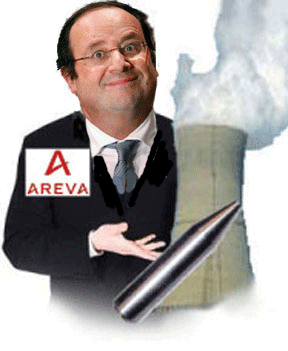
France ready to save nuclear group Areva, regardless of election outcome, Globe and Mail, GEERT DE CLERCQ, PARIS — Reuters, Jan. 04, 2017 A government-led rescue of French nuclear group Areva and the wider atomic-energy industry may cost the state as much as €10-billion ($13.94-billion Canadian), but political support is almost certain whoever wins the presidential election in May.
While taxpayers will ultimately pick up the huge bill, the main election contenders – from the Socialists and conservatives to the far-right National Front – broadly back the bailout, which involves splitting up Areva.
On top of its dire financial state, Areva is beset by technical, regulatory and legal problems. But given its importance to a nuclear industry that generates three quarters of France’s electricity and employs 220,000 people, the next government probably has little choice but to stand by the scheme hatched under outgoing Socialist President Francois Hollande.
France has a small but fierce anti-nuclear movement and some critics oppose investing billions in extending the life of aging reactors. Nevertheless, nuclear energy is broadly accepted, even though neighbouring Germany has decided to ditch it altogether following the 2011 disaster at Japan’s Fukushima plant…….
The nuclear industry rescue also involves a cash injection for power utility EDF, which operates France’s 58 nuclear reactors and will buy part of Areva’s business. But for all the domestic support, Brussels must also rule on whether the bailout complies with European Union rules on state aid………
Once the champion of France’s nuclear industry, 87-per-cent state-owned Areva has seen its equity wiped out by years of losses. Among its biggest problems is a nuclear plant it is building in Olkiluoto, Finland. Work is almost a decade behind schedule and huge cost overruns have led to Finnish utility TVO and Areva claiming billions from each other.
A similar project in Flamanville, France is also running years late, with costs spiralling. Areva has also had to take heavy writedowns on its African uranium mines while foreign orders have generally slumped since the Fukushima accident.
On top of this, U.S. and other regulators are investigating possible safety problems related to the suspected falsification of documents at Areva’s Le Creusot plant, which makes components for reactors worldwide.
In a restructuring that means an end to Areva as an integrated nuclear group, the firm will sell its reactor unit Areva NP to EDF. The French state will effectively nationalize the Olkiluoto liabilities and Areva will receive a mainly state-funded cash injection of €5-billion to refloat it as a uranium mining and nuclear fuel group.
— In the last days of the Obama Administration, the U.S. Environmental Protection Agency is about to dramatically increase allowable public exposure to radioactivity to levels thousands of times above the maximum limits of the Safe Drinking Water Act, according to documents the agency surrendered in a federal lawsuit brought by Public Employees for Environmental Responsibility (PEER). These radical rollbacks cover the “intermediate period” following a radiation release and could last for up to several years. This plan is in its final stage of approval.
The documents indicate that the plan’s rationale is rooted in public relations, not public health. Following Japan’s Fukushima meltdown in 2011, EPA’s claims that no radioactivity could reach the U.S. at levels of concern were contradicted by its own rainwater measurements showing contamination from Fukushima throughout the U.S. well above Safe Drinking Water Act limits. In reaction, EPA prepared new limits 1000s of times higher than even the Fukushima rainwater because “EPA experienced major difficulties conveying to the public that the detected levels…were not of immediate concern for public health.”
When EPA published for public comment the proposed “Protective Action Guides,” it hid proposed new concentrations for all but four of the 110 radionuclides covered, and refused to reveal how much they were above Safe Drinking Water Act limits. It took a lawsuit to get EPA to release documents showing that –
The proposed PAGs for two radionuclides (Cobalt-60 and Calcium-45) are more than 10,000 times Safe Drinking Water Act limits. Others are hundreds or thousands of times higher;
According to EPA’s own internal analysis, some concentrations are high enough to deliver a lifetime permissible dose in a single day. Scores of other radionuclides would be allowed at levels that would produce a lifetime dose in a week or a month;
The levels proposed by the Obama EPA are higher than what the Bush EPA tried to adopt–also in its final days. That plan was ultimately withdrawn; and
EPA hid the proposed increases from the public so as to “avoid confusion,” intending to release the higher concentrations only after the proposal was adopted. The documents also reveal that EPA’s radiation division even hid the new concentrations from other divisions of EPA that were critical of the proposal, requiring repeated efforts to get them to even be disclosed internally.
“To cover its embarrassment after being caught dissembling about Fukushima fallout on American soil, EPA is pursuing a justification for assuming a radioactive fetal position even in cases of ultra-high contamination,” stated PEER Executive Director Jeff Ruch, noting that New York Attorney General Eric Schneiderman has called for the PAGs to be withdrawn on both public health and legal grounds. “The Safe Drinking Water Act is a federal law; it cannot be nullified or neutered by regulatory ‘guidance.’”
Despite claims of transparency, EPA solicited public comment on its plan even as it hid the bulk of the plan’s effects. Nonetheless, more than 60,000 people filed comments in opposition.
“The Dr. Strangelove wing of EPA does not want this information shared with many of its own experts, let alone the public,” added Ruch, noting that PEER had to file a Freedom of Information Act lawsuit to force release of exposure limits. “This is a matter of public health that should be promulgated in broad daylight rather than slimed through in the witching hours of a departing administration.”
The “madman theory” of nuclear war has existed for decades. Now, Trump is playing the madman.VOX, by Nicole Hemmer Jan 4, 2017, Is Donald Trump a madman? Or, at least, would he like foreign leaders to think he might be just a little unstable? Such questions are being batted around in papers like the Boston Globe and the Washington Post in response to the president-elect’s foreign policy moves: his provocations toward China, his attacks on NATO and the UN, his warm overtures toward Rodrigo Duterte and Vladimir Putin.
Across the pundit-sphere, analysts are asking, is he crazy, or crazy like a fox?
In no context is the question more pertinent than Trump’s position on nuclear weapons. His comments both as candidate and president-elect show a more cavalier attitude toward their proliferation and use than any president in the past 30 years. “You want to be unpredictable,” Trump said last January on Face the Nation when asked about nuclear weapons. More recently, he tweeted that it was time for the US to start stockpiling nukes again. The comments prompted instant parallels to Richard Nixon’s “madman theory” of foreign relations: the idea that the president couldn’t be controlled — including where America’s nuclear arsenal was concerned — so foreign leaders should do everything in their power to appease him.
The madman question is so important here because madness has been a mainstay of nuclear culture since the atomic age flashed into being in the Jornada del Muerto desert in 1945. The bomb, carefully engineered by some of the 20th century’s most brilliant scientists, able to raze cities and civilizations, has always spanned rationality and irrationality, logic and madness.
The brightest minds created the most destructive force, and then leaders spent years working out rationales for its world-ending use. It was a madness begot by logic. But that madness doesn’t always present in the same way, which is why the history of nuclear madness has to precede our understanding of the Trump-as-madman debate…….
A brief, terrifying history of America’s nuclear mishaps
four years after Hiroshima and Nagasaki, the Soviets tested their own nuclear bomb, and the race was on for more powerful bombs, for better strike capability, for the ability to annihilate the other side before it could return fire. By the mid-1950s, the arms race had reached its illogically logical endpoint: If one side struck, everyone would be wiped out. Mutual assured destruction. MAD.
The acronym stuck, perhaps because of the horrific absurdity of it all. The logical conclusion, the position to which the world had been brought by the combined education and expertise of scientists and strategists, was the verge of obliteration………
As time passed, Mutually Assured Destruction came to seem — MAD……….
Maybe it was the exhaustion of the arms race, or the terror of the missile crisis, or the apocalyptic consequences of MAD, but by 1964 the idea of ever using nuclear weapons was considered insane. If the outcome truly was mutual assured destruction, then it would take an act of self-destructive madness to press the button………
World leaders understand that nations with nuclear weapons are treated differently than those without, and so there is a rational reason for pursuing nuclear technology. At the same time, the use of nuclear weapons against an enemy would make a nation-state into a global pariah. It would be insane.
Enter Donald Trump. The president-in-waiting is schooled in none of these particulars, claiming to believe only in strength and the desire to use it. His loose talk about nukes has re-raised the long-dormant question: Is he crazy enough to actually press the button?
Here, the history of nuclear madness may be as much a trap as a guide. Because the questions now shouldn’t be about Trump’s madness but his impulsivity and ignorance. Whatever one thinks of Nixon and Kissinger’s madman theory, it was a calculation. Kissinger was steeped in game theory and Nixon had a deep knowledge of international affairs. Reagan was a foreign policy autodidact with experienced ideological advisors. Their administrations could tell a hawk from a handsaw. (Admittedly, some of these comforting thoughts were only fully evident in hindsight.)
Trump doesn’t share his predecessors’ considered strategic thinking and mastery of geopolitics, but that doesn’t make him a madman. The madness is in the weapons themselves, powerful enough to obliterate entire countries, entire peoples, and in the logics that grew up around them to govern their disuse. The only hope is that, as with Nixon and Reagan before him, Trump’s time in office makes clear how badly things can go in an atomic age, and how important it is to continue the push to contain, if not eliminate, the madness in our midst.
The biggest environmental battles facing the Trump administration Some flashpoints for environmental activists relating to climate change that are likely to erupt in the first few months of Donald Trump’s presidency, Guardian, Mazin Sidahmed, Nicole Puglise and Oliver Milman, 6 Jan 17,Donald Trump is likely to face unprecedented opposition from environmental groups during his presidency as activists prepare to battle the new administration on a number of fronts across the US.
While environmentalists clashed with Barack Obama over the Keystone and Dakota Access oil pipelines, these fights could pale in comparison to the array of grievances Trump will face overwater security, fracking and climate change.
The president-elect has vowed to approve the Keystone pipeline, which Obama blocked, and “very quickly” resolve the Dakota Access project, currently held up by the federal government after months of protests by Native Americans. Trump has pledged to remove “roadblocks” to oil, gas and coal developments and threatened to end all climate and clean energy spending.
Opposition to this agenda has already begun in earnest, following a prediction by former vice-president Al Gore that there will be a “huge upsurge” in environmental activism, stoked by the new administration’s plans to cut science funding, remove the US from the Paris climate deal and appoint Scott Pruitt as administrator of the Environmental Protection Agency – an agency he has sued multiple times as Oklahoma attorney general.
What will be the first actions Trump takes as president?
350.org, an international environmental organization, pledged to make January a month of a resistance against Trump’s cabinet picks. On 9 January, the organization will mobilize its chapters in all 50 states to stage protests at senators’ district offices. It will be the beginning of what they say will be a sustained protest throughout the year.
In New York City in December, the Sierra Club protested Pruitt’s nomination by projecting an image of rising seas and the words “Don’t Trump the planet” on to the side of the Trump Building on Wall Street. It’s the opening salvo of what is likely to be a war of attrition waged by America’s largest environmental group, which has drawn in more monthly donors in the weeks since Trump’s election than it has in the past four years.
“If Trump keeps choosing to drag us backwards to the dirty energy of the past, he will find unfettered opposition every step of the way,” said Michael Brune, executive director of the Sierra Club.
Here are some of the flashpoints for environmental activists protesting issues relating to climate change happening around the country now and likely to erupt in the first few months of Trump’s presidency:
Eminent domain in Iowa
South of Standing Rock, the sprawling Dakota Access pipeline faces another dispute. Landowners in Iowa are challenging the government seizure of their land to build the pipeline………
Divestment movement on campus
Campuses across the country have been pushing universities to divest from from the fossil fuel industry over the past few years. Organizers are hoping the environmental threats posed by Trump’s cabinet nominations of energy industry leaders will further galvanize the movement……..