Failing New Nuclear Programme should be Scrapped No2NuclearPower, No.93 March 2017
GMB national secretary for energy Justin Bowden reiterated his call for the government to bankroll the project. “It is time for government to show leadership and take over the reins at Moorside,” said Bowden. “The fiasco with Toshiba shows exactly why relying on foreign companies for our energy needs is just plain stupid.” Tim Yeo, a former minister and chairman of New Nuclear Watch Europe, a pro-nuclear group, said Moorside provided a “prime opportunity” for Theresa May’s administration to demonstrate its industrial strategy with support for the UK nuclear supply chain. He said that with lingering doubts over the viability of Hinkley Point and Wylfa “the only way forward is if the government is willing to participate”. This could involve the government taking a minority stake, or providing loans that would be repaid after construction was complete, added Mr Yeo. (17) The GMB says Moorside is vital as Sellafield’s workforce starts shrinking. By 2020 up to 3,000 jobs could be lost as the Thorp nuclear fuel facility closes and reprocessing of Magnox fuel ends. (18)
Ministers should also actively encourage investment from nuclear companies in China, South Korea and Russia where the industry is relatively insulated from the challenges faced by European companies thanks to strong state backing, says Yeo – there is a real danger that the pipeline of nuclear projects will fail to come on stream before 2030 unless Government agrees to intervene. The existing support regime, which guarantees a fixed price for each megawatt of power produced, does not go far enough to help investors who face billions in construction costs before the nuclear plant begins producing power. The Government should offer loans to developers which can be paid back once the plant comes on stream, or take an equity stake in the project which could be sold off to investors when construction is complete. “In neither case would the Government’s support constitute a permanent subsidy. It would directly cut the cost of electricity produced by the new plant because the Government’s borrowing costs will be lower than those of any private investor,” says Yeo. (19)
Right on cue, says Greenpeace Policy Director, Doug Parr, stories have begun to appear in the press saying that government is thinking about or even “under pressure” to inject huge amounts of taxpayers cash into new reactors in order to get them built. “Neither proposed plant (Moorside and Wylfa) is crying out as a good bet for a private investor” says Parr. “So why would it be a better investment for a government? Or for British taxpayers?” If the UK government takes stakes in these projects, it would be expensive. A 25% share in both Moorside and Wylfa on Anglesey could cost over £7 billion – and that’s before taking into account the cost overruns synonymous with nuclear projects. That would still leave over £20bn to find from other investors, but is a substantial commitment of public money. So it is worth spending a few No2NuclearPower nuClear news No.93, March 2017 6 moments to consider why direct government funding of these nuclear stations is such an eccentric and ill-conceived idea. (20)
First, why do these projects need public funding? The obvious answer is that private investors think they are too risky and too poor a return, even at the high price of £92.50 (2012 prices) that EDF got for their Hinkley Point plant. So why are they risky? Well, one of key reasons Toshiba is in such deep financial trouble is that its reactor design, the AP1000, has never been completed and operated, and is actually more costly and difficult to build than it thought. Its four AP1000 reactors now under construction in the US are ruinously late and over-budget.
Tens of billions of taxpayers’ money are at risk as pressure mounts to spend billions more on new nuclear, according to Dr Dave Toke, reader in energy politics at Aberdeen University. Giant portions of the public spending could be poured down a nuclear black hole as calls for the Government to make direct investments into new nuclear power plant intensify. Ultimately the sums at risk would be much larger than the Government’s own estimates of the cost of Trident. There has been a flurry of demands for government investment in new nuclear projects in the wake of the near bankruptcy of Toshiba. In fact nuclear power is proving to be virtually undeliverable and ruinously expensive in western countries. Despite the manifest bankruptcy of the technology, rather than question whether it is right to continue with the new nuclear programme, its supporters are in effect wanting us all to bet the British economy on it. If the Treasury are forced against their will to sanction ‘equity’ stakes in new nuclear reactors, the losses and., eventually, all the liabilities will fall on the taxpayer. (21)
Companies vying to build nuclear power stations in the UK have been told they must offer a price for their electricity sharply lower than the £92.50/MWh approved for Hinkley Point C, according to the FT. Prices 15-20% lower are seen as crucial to maintaining political support for new nuclear plants. “One of the biggest factors pushing up the strike price is the cost of capital. If government wants a low strike price, it is pretty clear that government has to think about a different kind of [financing] solution,” said one of the industry leaders. The FT says the government remains cautious about the idea of investing taxpayers’ money in nuclear power. One source told the FT there were signs the government wanted to pit NuGen and Horizon against each other in a competitive process, with no guarantee that both would go ahead. (22)
The Sunday Times said ministers are poised to admit that taxpayer cash will be used to fund a new fleet of nuclear power stations – reversing years of government opposition to direct public subsidy. Industry sources claim the business and energy secretary, Greg Clark, accepts that the hands-off approach cannot persist if the plants are to be built. They say Whitehall is preparing to launch a consultation, possibly this summer, on the government taking minority equity stakes in new nuclear projects to kick-start their construction. British taxpayer cash will probably be matched with funds from the Japanese government, possibly via the Japan Bank for International Co-operation and Nippon Export and Investment Insurance. Japan’s Hitachi, which is behind the Wylfa project, is locked in talks with the British and Japanese governments over how to fund the 2.7-gigawatt station. The consultation on state equity is likely to be launched alongside an outline deal on funding Wylfa. Sources said the deal and the consultation are not certain and could yet collapse. (23)
Treasury officials are still hostile to the direct state subsidy idea but Chancellor Philip Hammond, and business secretary, Greg Clark, have both taken part in talks over support for Wylfa and Moorside. Any deal would have to overcome opposition from parts of the Treasury, which has for decades
March 4, 2017
Posted by Christina Macpherson |
politics, UK |
Leave a comment
 NIA’s SMR conference: great discussion, now we need action, The Alvin
  Weinberg Foundation. March 3rd, 2017 by Suzanna Hinson
On Monday, the Nuclear Industry Association held its Small Modular Reactor conference. Weinberg Next Nuclear were delighted to attend and our director Stephen Tindale was one of the many speakers.
The conference was opened by Tom Wintle, deputy director of SMRs, decommissioning and waste at the department of Business, Energy and Industrial Strategy. Though he spoke very eloquently about the importance of nuclear, and SMRs to the government, particularly in regards to the Industrial Strategy’s aims of home grown industries, developing skills, regional rejuvenation and a stronger economy for the growth areas of tomorrow, he would not be drawn on the real issues the audience clearly wanted to hear about: the much delayed SMR competition and the question of public funding at Moorside.
Instead, he highlighted changing priorities of the government, with a renewed focus on energy security, consumer bills and the potential for driving exports and capturing a global SMR market in a post Brexit UK. He would also not be drawn on the future relationship with Euratom, saying it was too early to speculate but repeating it was a non-negotiable aspect of exiting the EU, a decision many we spoke to think is premature and will lead to huge hurdles for British nuclear in the future………
When asked about government plans he said the Government have spent enough time building a vision; now, we need action. The action we need to see, Stephen recommended, was the Government telling the Nuclear Decommissioning Authority to release sites for advanced nuclear and instructing the Office for Nuclear Regulation to undertake Generic Design Assessments for advanced reactors, expanding their capacity to do so if necessary. …….
This panel, comprising Fiona Reilly from Atlantic Superconnection LLP, Anurag Gupta from KPMG LLP and Gareth Price from Allan & Overy LLP, also argued that BEIS were putting too much hope into an export market as with bigger contributors emerging like China and the US, it is unlikely that the UK will be able to compete…….
they made a strong statement for state-led nuclear power incorporating the private sector at a later stage of development if possible…..
the clear mood is that talking and discussion are not being paralleled with policy progress. The sector desperately needs to see some action from government, to progress with the SMR review, provide certainty for Moorisde and clarify the terms of Euratom membership. http://www.the-weinberg-foundation.org/
March 4, 2017
Posted by Christina Macpherson |
business and costs, politics, UK |
Leave a comment
Hinkley C (3.2GW planned) will cost over £24 billion according to the European Commission. The reactors at Moorside and Wylfa, assuming they cost similar amounts, would thus make the taxpayer responsible for around £50 billion of debt. People will claim that the Government is ‘only’ taking a minority equity stake. That’s how it will start, and then would represent an enormous amount of state spending and liabilities. After all one quarter of £24 billion is still £6 billion. But it won’t end there, as sure as night follows day, not with the construction costs as well as the rest. It never does with nuclear power!Normally of course under the Government’s ‘low carbon’ programme, project raise their own finance and the project owners earns their money from premium price contracts (CfDs) awarded through the Government. That is always the case with renewable energy projects. They find their own money. Electricity consumers pay a premium price to enable this on their bills. But now for nuclear to go ahead, so it is said, not only will the consumers have to pay a high premium price, but taxpayers will have to fund at least part of the construction as well. This is money, please note, that will disappear from the Government’s coffers as the plant is built – it is not something that will be shuffled onto future generations like decommissioning
The fact that the Government is effectively financing the building will produce a conflict of interests with the Government negotiating with itself in setting the CfD price. No doubt a ‘lower’ CfD price will be set (that is less than the notorious Hinkley C price) when in fact it will be the taxpayer that will end up paying out countless billions for the projects.
Annual spending on primary education is around £26 billion. Hence building just Moorside will give the Government liabilities (which are likely to be paid by the Government) which will rival this spending.
But then to listen to some people, you’d think building Moorside was more important than closing down all primary schools for a year.
It isn’t.
Some sources:
http://www.bbc.co.uk/news/election-2015-scotland-32236184
http://www.telegraph.co.uk/business/2017/02/25/yeo-treasury-needs-pour-billions-nuclear-projects/
March 4, 2017
Posted by Christina Macpherson |
politics, UK |
Leave a comment
 Bipartisan group of senators introduce Nuclear Energy Innovation and Modernization Act, Wyoming Business Report ,WBR Staff, Mar 2, 2017
March 4, 2017
Posted by Christina Macpherson |
politics, USA |
Leave a comment
 No2Nuclear Power nuClear news No.93, March 2017
The Hinkley Point C nuclear plant is risky and poor value for money, according to a House of Lords committee that urged the government to set out a “plan B” in case the £18 billion project is not built on time. (1)
In a damning report on energy policy, the Lords economic affairs committee said that household energy bills had already soared by 58% since 2003 and the risk of blackouts had increased, in part due to “poorly designed government interventions, in pursuit of decarbonisation”. Ministers should abandon plans to award subsidies to future nuclear plants through bilateral deals like that given to Hinkley, the committee said. Instead such projects should be forced to compete against wind farms, solar power farms and gas-fired power stations to find the cheapest way of keeping the lights on and cutting emissions. The committee said that the government should ensure that “the security of the UK’s energy supply is the priority of its energy policy” and suggested that climate change targets be “managed flexibly”. Lord Hollick, the committee’s chairman, highlighted Hinkley – which was signed off by Theresa May in September – as “a good example of the way policy has become unbalanced and affordability neglected”, and described it as “very, very expensive”. (2)
The total cost to consumers for Hinkley Point C is estimated to be £30bn. The committee called for an independent Energy Commission to advise Government on how to achieve an optimum balance of its three key objectives to keep the lights on at low cost while cutting carbon. “It would not be entirely different to the role that the OBR plays with regards to the Treasury. What it would do is provide a degree of transparency, not only for the Government itself to make its decisions but for industry and observers and analysts so that there is a greater degree of accountability as opposed to confusion,” he said. (3)
On the other hand the report was slammed by some environmentalists and renewable energy advocates for calling for decarbonisation to be relegated in favour of security of affordable supply. Critics said its conclusions were ‘out of touch’ and ‘backward-looking’. The report was accused of arguing that generation of electricity from fossil fuels is cheaper than renewable sources and that subsidies provided to clean energy generation have resulted in considerably higher costs for consumers…….. http://www.no2nuclearpower.org.uk/nuclearnews/NuClearNewsNo93.pdf
March 4, 2017
Posted by Christina Macpherson |
politics, UK |
Leave a comment
No2Nuclear Power nuClear news No.93, March 2017 A footnote in the Parliamentary Bill published on 26th January to authorise Brexit confirmed that the UK intends to leave EURATOM as well as the European Union. (1) Up until that point this was a grey area with disagreements over whether Brexit meant the UK would also have to leave EURATOM……..
The decision has wide-ranging implications for Britain’s nuclear industry, research, access to fissile materials and the status of approximately 20 nuclear co-operation agreements that it has with other countries around the world. The UK is going to have to strike new international agreements with all these countries to maintain access to nuclear power technology – crucially with the US because several of the UK’s existing and planned nuclear reactors use US technology or fuel. A new bilateral agreement will also be needed with the International Atomic Energy Agency. Nuclear co-operation agreements can take considerable time to agree and ratify. It may not be possible to complete them before Britain leaves the EU in 2019
New Reactors in Jeopardy? The concern now in the UK nuclear industry is that leaving EURATOM will complicate and delay the UK’s plans to build a new generation of nuclear power stations. “The new wave of British nuclear power stations was in jeopardy” said the Times. Withdrawal could cause “major disruption” according to the Nuclear Industry Association (NIA) particularly for Horizon and Nugen, which are developing plans for reactors on Anglesey and in Cumbria because their plans involve co-operation with US nuclear companies. Former Labour MP Tom Greatrex, now chief executive of the NIA, said: “The UK nuclear industry has made it crystal clear to the government before and since the referendum that our preferred position is to maintain membership of EURATOM.” (3) Although Horizon, whose reactors would use US nuclear fuel, says it is reassured by the government’s commitment to put new regulatory arrangements in place quickly. (4)
The Hinkley Point C station in Somerset could also face renewed problems….. http://www.no2nuclearpower.org.uk/nuclearnews/NuClearNewsNo93.pdf
March 4, 2017
Posted by Christina Macpherson |
politics, UK |
Leave a comment
 New Ohio ‘bailout’ request shakes up nuclear/carbon debate, Midwestern Energy news, Kathiann M. Kowalski, 2 Mar 1 7, The growing debate over nuclear power’s role in curbing emissions is running headlong into an ongoing controversy over “bailouts” for Ohio’s largest utility.
FirstEnergy, which has previously sought support for noncompetitive power plants, is now asking Ohio lawmakers for “zero emission credits” for its aging nuclear plants. Environmental and consumer advocates say the plan is just another bid for more subsidies.
After FirstEnergy president and CEO Chuck Jones reported “excellent results in distribution and transmission service reliability and plant operations” during a February 22 earnings call with financial analysts, he said the company wants a zero-emission nuclear, or “ZEN,” program to support the company’s Davis-Besse and Perry nuclear generating plants in Ohio.
“The ZEN program is intended to give state lawmakers greater control and flexibility to preserve valuable nuclear generation,” Jones said. A bill to implement the program will be introduced soon, he said.
“This attempted bailout does nothing to move Ohio forward, and would hold us back from a rapidly evolving clean energy transition that is creating a lot of new opportunity, more sustainable jobs, and cutting edge technologies,” said Trish Demeter of the Ohio Environmental Council.
“Our recommendation to policymakers has been to secure for millions of Ohioans the benefits of lower electric prices that can result from competition under Ohio’s 1999 deregulation law,” said Molly McGuire, spokesperson for Ohio Consumers’ Counsel Bruce Weston. “Unfortunately, what has happened over the last sixteen years is utility dependence on government-approved subsidies–$14.5 billion to date–funded by Ohio families and businesses. These subsidies should end for the protection of Ohio consumers and the competitive markets that serve them.”…….
The Davis-Besse power plant in Oak Harbor and the Perry nuclear plant in North Perry are now valued at about $1.5 billion, including the value of their nuclear fuel. “The debt is significantly higher than that,” Jones noted. “Absent something to raise the value of these units and make them attractive to a buyer, there’s only one way for us to exit this business.”
In response to a question about how decommissioning of the plants would work in case of a bankruptcy, FirstEnergy counsel Leila Vespoli said that would be the responsibility of the license owner at the time, not FirstEnergy. Unless and until a sale occurs, though, the responsible party would be First Energy Solutions, or FES…….
The Public Utilities Commission of Ohio ruled last spring that it would allow extra charges to guarantee sales of all power from the Davis-Besse plant and certain coal plants. When federal regulators said they would require strict scrutiny of the deal, FirstEnergy dropped references to power purchases but still asked for the rider, which critics said would have cost ratepayers $4 billion. The company’s funding requests grew over the ensuing months.
Last fall the PUCO ruled that ratepayers would instead have to pay a “distribution modernization rider” of $200 million per year. Despite the name, the money collected is not for any specific grid projects. Instead, it’s supposed to boost FirstEnergy’s credit rating to make it easier for the company to borrow money as and when it eventually does any such work.
Back in the fall, FirstEnergy claimed the money would not be enough. Now the company is asking lawmakers for more………
“FirstEnergy’s two nuclear plants are old, and we are asking why Ohioans should be paying for a nuclear subsidy when other resources are less risky, less expensive and much better for the environment overall,” said Demeter at the Ohio Environmental Council.
“Not all zero-emissions sources are alike,” she stressed. “Nuclear energy carries with it a heavy toll when evaluating this resource cradle-to-grave.” In Demeter’s view, it makes much more economic sense to invest heavily in renewables, which avoid those risks.
“Once a wind turbine or solar panel is installed, there is no fuel that must be extracted from the ground, and there is no waste to deal with afterwards,” she noted. And combining them with innovative technologies like battery storage “will make renewables virtually unstoppable as the primary energy source we rely on in the near future.”
Demeter also distinguished FirstEnergy’s ZEN proposal from the state’s renewable portfolio standard.
“Ohio’s RPS is a market mechanism to ensure we’re maximizing clean energy opportunities in Ohio, and diversifying our energy portfolio in a responsible way,” she explained. “What FirstEnergy is asking for is a direct subsidy of two nuclear power plants that appear to be losing money in the regional energy markets.”
“The company is seeking ratepayer protection for these plants, but shareholders, not ratepayers, should be on the hook for the bet the company made on nuclear plants,” Demeter said. http://midwestenergynews.com/2017/03/02/new-ohio-bailout-request-shakes-up-nuclearcarbon-debate/
March 4, 2017
Posted by Christina Macpherson |
politics, USA |
Leave a comment
http://www.miamiherald.com/opinion/op-ed/article135578328.html BY RACHEL SILVERSTEIN rachel@miamiwaterkeeper.org As a nonprofit organization that works to safeguard South Florida’s clean water, we’ve been hearing a lot of public concerns about Florida Power & Light’s plans for Turkey Point. FPL has been trying to expand its nuclear power plant, with the addition of two new reactors — Units 6 and 7 — for many years. However, FPL has not yet received a Combined Operating License from the federal government’s Nuclear Regulatory Commission (NRC), which authorizes FPL to operate the plant.
Licensing and constructing a nuclear power plant is an arduous process. No new nuclear plants have been built in the United States since the 1990s, although a handful are under construction and have been for many years. It’s so risky, in fact, that most banks will no longer finance the licensing and construction of such plants, shifting costs to ratepayers who shoulder the risks instead.
Florida’s Public Service Commission (PSC) has, for almost a decade, allowed FPL to charge the public, via rate increases, for the cost of licensing and permitting these new reactors. If the reactors are never approved or built, FPL simply keeps the public’s money. So far, FPL has charged its ratepayers more than $280 million for its anticipated construction of the new reactors at Turkey Point. The total cost of the new reactors is now estimated to be between $13 billion and $20 billion.
In order for the PSC to approve such rate increases through this advanced cost recovery process, FPL must demonstrate each year that their proposed reactors are still feasible. This burden just got a lot more difficult, if not impossible, to meet. In late December, technology giant Toshiba made public its mounting financial woes. These woes, it is now clear, are related to problems with its nuclear reactor business — a business it runs through a global nuclear power plant construction company called Westinghouse.
In February, Toshiba reported $6 billion in losses, accrued over time from its involvement in the nuclear construction business. These losses are largely attributable to problems with Westinghouse’s current construction of its model AP1000 nuclear reactors in South Carolina and Georgia. As a result, Toshiba announced that Westinghouse would be leaving the nuclear reactor construction business. Why should this matter to Miami? It matters because the new reactors at Turkey Point are supposed to be Westinghouse designed and constructed AP1000 reactors.
In short, Westinghouse will not be building FPL’s new reactors. So the plan, already beset by environmental and safety concerns, has been put in even more jeopardy. Amazingly, we are still paying for the construction of these new plants — that, it is now clear, will never be constructed as planned.
The PSC should immediately stop funneling advanced cost recovery funds from our wallets into FPL’s pocket. This project is likely no longer feasible, and as ratepayers, we should not be footing the bill. The PSC and the NRC must investigate how Westinghouse’s collapse will affect FPL’s plans for new reactors at Turkey Point. In the meantime, all licensing and permitting at the state and federal level should be suspended. FPL owes it to ratepayers, at an absolute minimum, to report on the feasibility of this project to the PSC and to cease charging Floridians for a project that looks less and less likely to be built.
March 4, 2017
Posted by Christina Macpherson |
business and costs, politics, USA |
Leave a comment
Green MSP hits out at Hunterston B nuclear decision, Energy Voice, 1 Mar 17 Alan Shields A Scottish politician has criticised the UK’s Office for Nuclear Regulation (ONR) over changes to safety regulations for the Hunterston B power station in Ayrshire. THE ONR has ruled that a periodic safety review by operators EDF is “adequate”.
As a result the UK atomic agency has relaxed the safety case regarding the plant’s graphite core.
The revised safety case provides new limits and conditions of operation in response to keyway root cracking of the graphite in the core.
This is an expected part of the aging process as reactors get closer to their end of life. Acceptance of the safety case is also reliant on a revised inspection and monitoring strategy.
But Ross Greer, Scottish Green MSP for Wwest of Scotland, last night hit out at the lack of public consultation on the matter.
In January, Greer championed a report authored by an independent expert on nuclear safety, which concluded that despite it being probably illegal under international law, the Scottish public were being denied a say in the decision to keep Scotland’s oldest nuclear power station running.
The MSP said: “News that EDF are to be allowed more cracking within Hunterston’s reactor will concern residents across North Ayrshire, the West of Scotland and further afield. The lack of public consultation is simply unacceptable.
“It’s disappointing that the Scottish Government have not spoken out on the issue. European law says all ageing nuclear power stations should have an environmental impact assessment comparing their continued operation against alternative sources of energy such as renewables, and that the public should be involved, but that hasn’t happened.
“We should be putting efforts into building our renewables capacity and the secure, long term jobs which come with it, reducing demand through energy efficiency measures and ensuring a jobs transition for nuclear workers at sites such as Hunterston.”…….. https://www.energyvoice.com/otherenergy/133089/green-msp-hits-hunterston-b-nuclear-decision/– 0 2/
March 4, 2017
Posted by Christina Macpherson |
politics, safety, UK |
Leave a comment
Senate Bill 11 would amend statutes to change the requirement that facilities have means of permanent disposal of nuclear waste. Instead they would only be required to have a plan for its safe storage, and that the plans be approved by the Nuclear Regulatory Commission.
It would also eliminate several other obstacles to the construction and maintenance of nuclear facilities……..
Senate Bill 11 was approved on a 27-8 vote and now goes the House of Representatives for consideration. http://floydcountytimes.com/news/9961/nuclear-power-bill-receives-approval-from-senate
March 4, 2017
Posted by Christina Macpherson |
politics, USA |
Leave a comment

 The nuclear fallout from Brexit When Britons voted to leave the EU few realised the implications for its nuclear industry. Financial Times, 2 Mar 17 by: Andrew Ward and Alex Barker Perched on a remote stretch of coastline in north-west England is Europe’s most dangerous building. Inside the innocuous-sounding Product Finishing and Storage Facility at the Sellafield nuclear plant is enough plutonium for about 20,000 nuclear bombs.
It is the world’s largest stockpile of civilian plutonium — one of the most toxic substances on the planet — accumulated from decades of reprocessing nuclear fuel from power stations not only in the UK but also Germany, France, Sweden and other countries. When Britain voted to leave the EU last June few voters contemplated what the decision would mean for this deadly stash of radioactive material. Yet, as officials in Whitehall and Brussels prepare to negotiate Brexit, regulation of nuclear energy is emerging as one of the most difficult and pressing issues to resolve. One senior negotiator simply called it “a nightmare”.
Britain’s plutonium stockpile is overseen by inspectors from Euratom, the pan-European body that regulates the use of nuclear energy. The organisation has a permanent presence at Sellafield and owns the cameras, seals and testing laboratory used to monitor Europe’s largest nuclear facility. Brexit threatens to upend this decades-old arrangement because the UK’s departure from the EU will require withdrawal from Euratom, a separate legal entity but one governed by EU institutions. At stake is not just the safeguarding of Sellafield but also critical pillars of UK energy security, scientific research and even medicine.
All trading and transportation of nuclear materials by EU countries, from fuel for reactors to isotopes used in cancer treatments, is governed by Euratom. The UK now faces a scramble to assemble a new regulatory regime to uphold safety standards, while negotiating dozens of international agreements needed to maintain access to nuclear technology. Rupert Cowen, a nuclear specialist at Prospect Law, a London law firm, told a parliamentary hearing this week that the UK was “sleepwalking” to disaster. “If we do not get this right, business stops,” he said. “If we cannot arrive at safeguards and other principles which allow compliance [with international standards] no nuclear trade will be able to continue.” The potential consequences of failure — from the shutdown of nuclear power stations to the loss of radiotherapy for cancer patients — seem implausible, but coming up with a fix will not be easy. British ministers must renegotiate a relationship with Euratom where no template for close co-operation with outsiders exists. They must pass legislation to set up a new safeguarding system, then find, hire and train the personnel needed to do the job in an industry known for its chronic skills shortage. And Britain must strike up to 20 deals to re-establish the basis on which it engages with other countries, such as the US and Japan, outside of Euratom.
“There is a plethora of nuclear agreements that would have to be struck . . . before we could begin to move not only materials but also intellectual property, services, anything in the nuclear sector,” Dame Sue Ion told MPs. She is chair of the Nuclear Innovation and Research Advisory Board, which advises the UK government. “We would be crippled without [these deals] in place,” she added. All this potentially must be done by 2019, when the UK is due to leave the EU. There is a safety valve — remaining part of Euratom for a transition period — but the EU will demand that European courts oversee the arrangement, which crosses one of the red lines in the UK’s negotiating strategy. Little wonder industry is rattled………
Today, Euratom’s 160-strong nuclear inspectorate spend about a quarter of their time focused on British facilities.
Critical to replacing the Euratom regime will be a bilateral deal with the International Atomic Energy Agency, which oversees global nuclear safety and security. Euratom reports into the IAEA on behalf of its members and the UK would need to replicate this relationship. One option would be for IAEA inspectors to replace those of Euratom in the UK, although industry leaders questioned whether the global body would want its resources diverted from its non-proliferation monitoring in places such as Iran.
Yukiya Amano, the IAEA director-general, told the Financial Times that a rapid deal with the UK was possible. But he added a catch. “It depends very much on the progress on the UK-Euratom, UK-EU side. UK-IAEA negotiations [do not] go ahead of the UK-Euratom negotiations, we always follow,” he said. “If negotiations with UK-Euratom go fast, we can fix this issue fast.” However, if Britain sticks to an expected exit date of 2019, at best the UK may have 18 months or a year to re-secure its place in the international nuclear market. “There is a chicken and egg situation,” says one official involved in Brexit preparations. “You have to move seamlessly from one regime to another. But you can’t do that without a new safeguarding regime that [other countries] are satisfied with.” Britain has little experience of negotiating nuclear agreements. It took four years of “lengthy and difficult” negotiations in the 1990s to agree an upgrade to the Euratom-US co-operation agreement, which was due to lapse. And even then the deal could not be ratified on time by the US Senate. The wait caused a three-month hiatus when all transatlantic nuclear trade stopped dead. That is something the UK would not want to risk today. …….
Asked by MPs whether new arrangements could be put in place within two years, Dame Sue said: “I do not think it is possible.” One option to buy time would be to carry on paying Euratom to provide safeguarding services. But it is run by the European Commission, the EU’s executive, rather than as an independent agency which would have given Britain political cover. Perhaps more importantly, it relies on the European Court of Justice to give teeth to its intrusive inspection powers. Britain is determined to leave ECJ jurisdiction. But the nuclear area is where the EU will be most reluctant to split legal authority; the powers are too important, and the potential consequences and liabilities too big. “The only framework we are comfortable with is the existing framework,” says one EU official preparing for talks. “It works rather well.”………..
https://www.ft.com/content/9b99159e-ff2a-11e6-96f8-3700c5664d30
March 3, 2017
Posted by Christina Macpherson |
politics, UK |
Leave a comment
 Trump Again Attacks Media as White House Bars NYT, CNN & BBC from Gaggle
  https://www.democracynow.org/2017/2/27/headlines/trump_again_attacks_media_as_white_house_bars_nyt_cnn_bbc_from_gaggle
President Trump again escalated his self-declared war on the media, while speaking at CPAC, the Conservative Political Action Conference, on Friday.
President Donald Trump: “A few days ago, I called the fake news the enemy of the people. And they are. They are the enemy of the people, because they have no sources. They just make them up when there are none.”
That’s Trump, speaking the same day the White House took the unprecedented act of barring The New York Times, CNN, Politico, the Los Angeles Times, the BBC and several other news organizations from an off-camera briefing known as a gaggle. Several right-wing news outlets were allowed to attend, including Breitbart, The Washington Times and One America News Network.
March 1, 2017
Posted by Christina Macpherson |
media, politics, USA |
2 Comments
NY Times rips into Trump: ‘An inept White House led by a celebrity apprentice’http://thehill.com/blogs/blog-briefing-room/news/320231-ny-times-rips-into-trump-an-inept-white-house-led-by-a BY NIKITA VLADIMIROV – 02/18/17 The New York Times on Saturday published a blistering assessment of President Trump’s performance, blasting him for a lack of meaningful accomplishments.
“It’s with a whiff of desperation that President Trump insists these days that he’s the chief executive Washington needs, the decisive dealmaker who, as he said during the campaign, ‘alone can fix it,’ ” The Times wrote in its editorial.
“What America has seen so far is an inept White House led by a celebrity apprentice.”
The newspaper’s editorial board argued that Trump’s executive orders are not achievements and that the president has not yet been able to spearhead any meaningful reform effort.
The editorial board claimed that Trump’s adviser Steve Bannon writes his script while Reince Priebus, the White House chief of staff, “crashes meetings to which he has not been invited.”
“The White House is a toxic mix of ideology, inexperience and rivalries; insiders say tantrums are nearly as common as the spelling errors in the press office’s news releases,” the Times said.
“If there is any upside here, it is that the administration’s ineptitude has so far spared the nation from a wholesale dismantling of major laws, including the Affordable Care Act, though he may yet kill the law through malign neglect.”
The Times also criticized the president for planning to partially dismantle top government agencies, including the Environmental Protection Agency, which employs a vast team of specialists and experts.
“Indeed, unless Mr. Trump can bring some semblance of order to his official household and governing style, the only element of his famous campaign pledge that may prove accurate is the ‘alone’ part,” the newspaper concluded.
March 1, 2017
Posted by Christina Macpherson |
media, politics, USA |
Leave a comment
 UK nuclear power stations ‘could be forced to close’ after Brexit Leaving Euratom treaty will shut down nuclear industry if international safety agreements are not made in time, MPs told, Guardian, Adam Vaughan, 1 Mar 17, Nuclear power stations would be forced to shut down if a new measures are not in place when Britain quits a European atomic power treaty in 2019, an expert has warned.
Rupert Cowen, a senior nuclear energy lawyer at Prospect Law, told MPs on Tuesday that leaving the Euratom treaty as the government has promised could see trade in nuclear fuel grind to a halt.
The UK government has said it will exit Euratom when article 50 is triggered. The treaty promotes cooperation and research into nuclear power, and uniform safety standards.
“Unlike other arrangements, if we don’t get this right, business stops. There will be no trade. If we can’t arrive at safeguards and other principles that allow compliance [with international nuclear standards] to be demonstrated, no nuclear trade will be able to continue.”
Asked by the chair of the Commons business, energy and industrial strategy select committee if that would see reactors switching off, he said: “Ultimately, when their fuels runs out, yes.” Cowen said that in his view there was no legal requirement for the UK to leave Euratom because of Brexit: “It’s a political issue, not a legal issue.”
The UK nuclear industry would be crippled if new nuclear cooperation deals are not agreed within two years, a former government adviser told the committee.
“There is a plethora of international agreements that would have to be struck that almost mirror those in place with Euratom, before we moved not just material but intellectual property, services, anything in the nuclear sector. We would be crippled without other things in place,” said Dame Sue Ion, chair of the Nuclear Innovation and Research Advisory Board, which was established by the government in 2013.
She said movement of the industry’s “best intellectual talent” was made easier by the UK’s membership of Euratom…….
Over the weekend, the GMB union called on ministers to reconsider their “foolhardy rush” to leave the treaty, claiming it could endanger the “UK’s entire nuclear future”…….
Norman also promised a decision was due soon on the next stage of a delayed multimillion-pound government competition for mini nuclear reactors, known as small modular reactors. “I love the projects and ideas but I want to be shown the value,” he told the peers. https://www.theguardian.com/business/2017/feb/28/british-nuclear-power-stations-could-be-forced-to-close-after-brexit
March 1, 2017
Posted by Christina Macpherson |
politics, UK |
Leave a comment
 Energy Department issues scathing evaluation of nuclear project WP, By Steven Mufson February 28
 The Energy Department has delivered a blunt assessment of the work done by one of the world’s biggest companies in the nuclear business: “Unsatisfactory.”
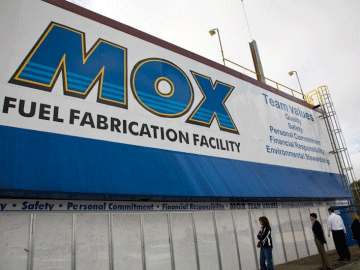
For a decade, CB&I Areva MOX Services has been under contract with the Energy Department’s National Nuclear Security Administration to design, build and operate a facility near the Savannah River in Aiken, S.C.
Yet the project — designed to convert weapons-grade plutonium and uranium into a mixed oxide fuel for commercial nuclear power plants — has been running far beyond budget and way behind schedule. Estimates now put the price tag at $17 billion.
On Dec. 5, the NNSA completed a scathing evaluation that branded several of the company’s claims about the state of the project “misleading” and “inaccurate.” The agency said CB&I Areva’s claims that the project is 70 percent complete “are patently false.” A separate September 2016 Energy Department report said construction was only 28 percent complete……
CB&I Areva is a venture created as a combination of Chicago Iron & Steel and the French nuclear giant Areva. The company did not return calls for comment……
One of the project’s sharpest critics Tom Clements, director of the public interest group Savannah River Site Watch, obtained the December NNSA assessment through a Freedom of Information Act request. He called the evaluation “devastating.”
“I have never seen an asessment like that. It all but calls them liars,” he said……
the Obama administration continued to say the MOX plant at Savannah River wasn’t practical. What started as a $620 million project in 1999 with a 2006 starting date has become a $17 billion project still decades away from a start state. By some estimates, it would require a $1 billion a year appropriation, which the Obama administration said was unlikely at best…..
The assessment said that while the contractor boasted of “zero order non-compliance,” in fact the NNSA found evidence of non-compliance.
Overall, the NNSA awarded nothing from the $2.7 million available for a bonus payment to the contractors. It said, “there continued to be a lack of transparency and openness in external communications with key project stakeholders by the contractor including continued release of misleading and inaccurate project information.” https://www.washingtonpost.com/business/economy/energy-department-issues-scathing-evaluation-of-nuclear-project/2017/02/28/8af4d11a-fd2c-11e6-99b4-9e613afeb09f_story.html?utm_term=.4b6e8e136ee6
March 1, 2017
Posted by Christina Macpherson |
politics, technology, USA |
Leave a comment