
 GOP climate resolution deserves wider support APRIL 5, 2017 PHILLY.COM by John C. Dernbach
It has already been a tough year for those who want bipartisan leadership on climate change.
President Trump’s recent executive order is intended to unwind much of the Obama administration’s work on climate change. Trump wants to cut funding by a third for the Environmental Protection Agency (EPA), which has a major role in reducing greenhouse gas emissions, and he appointed Scott Pruitt, who has openly questioned the reality of climate change, to lead EPA.
But even in the face of hostility for climate action from the Republican leadership in Washington, there are signs of positive change within the party.
Seventeen Republican lawmakers – including Pennsylvania Congressmen Ryan Costello, Brian Fitzpatrick, and Patrick Meehan – just introduced the Republican Climate Resolution. It states that it is “a conservative principle to protect, conserve, and be good stewards of our environment.” It also calls for Congress to commit to economically viable solutions to climate change………
This House resolution on climate change is the latest sign that more Republicans are changing their tune on this and other environmental protection issues. Earlier this year, nine Republicans broke with their party on a vote to repeal an Obama-era rule to protect waterways from coal mining runoff. And 11 Republicans voted against a repeal of a rule to reduce greenhouse gas emissions from the oil and gas industry.
It is little wonder that Republicans are increasingly willing to buck special interests on the issue. Lawmakers are seeing more and more climate change-related impacts in their home districts. The economic opportunities provided by climate action are enormous. And their constituents are calling for solutions.
That is certainly the case in Pennsylvania……….
It was a Republican state senator from Delaware County, Ted Erickson, who sponsored the Climate Change Act of 2008, which calls for state impact assessments and a climate change action plan. A Republican chief justice of the state Supreme Court, Ronald Castille, wrote the 2013 opinion upholding the Environmental Rights Amendment of the Pennsylvania Constitution.
The House resolution does not make specific policy recommendations for preventing future climate disruptions. And more signers are needed before the caucus will have the votes necessary to command the respect it needs. But this is real progress.
Costello, Fitzpatrick, and Meehan recognize that everyone has much to gain if we act on climate change, regardless of political affiliation. Let’s hope they convince more of their GOP colleagues to join them. And those of us who live in other districts represented by Republicans can do our part by asking them to join this resolution.
John C. Dernbach is the commonwealth professor of environmental law and sustainability and the director of the Environmental Law and Sustainability Center at Widener University Commonwealth Law School. jcdernbach@widener.edu http://www.philly.com/philly/opinion/commentary/20170405_Commentary__GOP_climate_resolution_deserves_wider_support.html
April 7, 2017
Posted by Christina Macpherson |
climate change, politics, USA |
1 Comment
 Britain’s secret Brexit nuke http://www.newindianexpress.com/opinions/2017/apr/06/britains-secret-brexit-nuke-1590353–1.html By Tom Arms 6th April 2017
May’s attempt to link trade and security sets a dangerous precedent for the world. Will she now offer N-protection to Saudi Arabia?
British Prime Minister Theresa May has linked Britain’s nuclear deterrent to Brexit negotiations. And in doing so she has pointed the way for India and other nuclear weapons states to use their irradiated umbrellas to secure their own lucrative trade deals.
Until now it has been accepted that nuclear weapons are the ultimate deterrent, and are to be used only in that capacity. Linking them to trade, as May has done, has added a new and dangerous level to the nuclear playing field.
The link came in the British prime minister’s letter to the European Commission triggering Article 50 of the Lisbon Treaty and the start of Brexit negotiations. In just one letter, she explicitly linked economic concessions with security issues nine times.
Alright, the n-word has yet to be dropped on a public stage, but it is being talked about behind closed Whitehall doors. The whispers have been loud enough for me to hear them and to contact the UK’s Department for Brexit negotiations. I pointedly asked them, “Is the government considering offering a nuclear deterrent—probably incollaboration with the French—to EU countries in return for trade concessions?” The reply was neither a confirmation nor a denial but an email pointing me to the links in May’s Brexit letter and a speech in which the British PM said, “The third … reason I believe we can come to the right agreement is that cooperation between Britain and the EU is needed not just when it comes to trade but when it comes to our security too.”
“Britain and France are Europe’s only two nuclear powers. … Britain’s armed forces are a crucial part of Europe’s collective defence.”
“… After Brexit, Britain wants to be a good friend and neighbour in every way, and that includes defending the safety and security of all of our citizens.”
Quick phone calls to embassies and European ministries of foreign affairs elicited a wall of no comments, until I came to the Poles where a spokesperson said, “Yes that’s right.”
But if the negotiating ploy is successful in Europe, what is to stop the British from offering the same protection to other regions of the world? Does Britain strike a deal with Saudi Arabia and the Gulf states to protect them from Iran? The British have just reopened a permanent naval base in Bahrain. How about East Africa? The Americans lease Diego Garcia but the British still own it. London has great relations with Singapore, an excellent base for an Asian presence.
And what about other nuclear weapon states? What is to stop India, Pakistan, France, Russia, China, and the US from using their nukes to extract trade concessions. It will cost more but the trade deals, or should I say protection money—should more than cover the costs, with a profit—adding a new and dangerous element to the problem of nuclear non-proliferation.
A stronger nuclear Britain willing to flex its muscles fits in nicely with the Trump view of the world. During his campaign, The Donald shocked analysts by floating the cost-cutting proposal that America supply nukes to Japan and Saudi Arabia. And although the US is making more positive noises about the NATO, the initial talk of obsolescence has left Europeans deeply worried.
Beefing up the British nuclear deterrent and tying it closer to Europe would save America money. However, it would also put several more links in the defensive chain that ties the US to the protection of Europe.
Trump may favour such a change, but it is not in the interests of either side of the Atlantic. Two World Wars have proven that. In both, the US adopted a hands-off role at the start. However, the fact is their interests were so intertwined with the European democracies that Washington was eventually forced to intervene to protect its national interests.
It is the growing American isolationism that makes it possible for May to test thendangerous nuclear waters. The EU is worried about losing its American nuclear umbrella. The UK is worried about losing their European market. Britain has nuclear weapons. The EU has markets. There is a clear fit.
Dr Ian Lesser, vice president at the German Marshall Fund, said it is “not incredible” that Britain is considering using its nuclear deterrent as part of the Brexit negotiations. He added, “But it would certainly be controversial.”
Trump’s foreign policy has prompted widespread calls for greater European defence cooperation, including—at the suggestion of the Polish Prime Minister Jaroslaw Kaczynski—a German-funded European nuclear deterrent. This was firmly and immediately rejected by Chancellor Angela Merkel.
April 7, 2017
Posted by Christina Macpherson |
politics, UK |
Leave a comment

 ZUMA’S CABINET RESHUFFLE OPENS DOOR FOR SA NUCLEAR DEAL, EyeWitness News, 1 April 17 Hartmut Winkler is professor of physics, University of Johannesburg.This article first appeared on The Conversation.
South Africa has just witnessed a game-changing Cabinet reshuffle with the firing of five ministers and several deputy ministers. This included the Finance Minister Pravin Gordhan and his second-in-charge Mcebisi Jonas.
The three ministries with the most critical impact on the energy sector have all been affected, significantly increasing the chances of the country opting for a highly controversial nuclear energy programme. Continue reading →
April 3, 2017
Posted by Christina Macpherson |
politics, South Africa |
Leave a comment

 Treasury shoots down nuclear deal allegations http://www.news24.com/SouthAfrica/News/treasury-shoots-down-nuclear-deal-allegations-20170402 Jenna Etheridge, News24 Cape Town – National Treasury on Sunday set the record straight on news that was circulating on social media of a nuclear deal allegedly signed by incoming Finance Minister Malusi Gigaba.
ANC member Sibusisiwe Mngadi had alleged on Facebook earlier on Sunday that “the nuclear deal deadline was last night” and that Gigaba had signed it.
She also alleged that President Jacob Zuma’s nephew Khulubuse Zuma would benefit from nuclear plants being built.
“Khulubuse Zuma is the SA holding company for the Nuclear plants. The next 20yrs Khulubuse Zuma will be making more than 50billion. Congratulations, mission accomplished,” she alleged on the post.
Mngadi listed her occupations as a researcher and part-time lecturer at University of KZN in Pietermaritzburg, and an area manager at Msunduzi Municipality.
Some of her followers asked her for proof to support her claims. She replied that people should do their own digging, alluding only to a “parliament document that was signed yesterday”.
Former ANC MP Vytjie Mentor also entered the fray on her personal Facebook profile page, seeming to support the allegations.
“Gigaba signed the Nuclear Deal Last night. It will be R6 trillion with over-runs. All South Africans are now Officially slaves of the Russians, and thus will be the case for the next 100 years,” Mentor alleged.
National Treasury issued a series of tweets on the matter on Sunday night. “The Minister arrived (on) Friday and has not yet gone beyond boardrooms where he met management and later had a telecon with rating agencies,” the treasury account stated.
“He is formally occupying his office tomorrow and will have a briefing meeting with the outgoing Minister Pravin Gordhan in the morning. There are no documents of deals ready for signature on nuclear. Therefore the reports are misleading and mischievous.”
Gigaba’s spokesperson Mayihlome Tshwete also took to Twitter to say he had signed “not a single thing”, not even to sign off for the printing of his business cards. He said Gigaba had not even received any documents from the Director-General.“Sadly, we must now release a statement to deny fake news, then the story will be about the denial,” he lamented.
In government’s updated Integrated Resource Plan (IRP) 2016, which is still under discussion, it intends to add 20 385MW units of nuclear power to the national grid, Fin24 reported.
This will make up approximately one-third of South Africa’s total generation mix.
On December 20, 2016, Eskom, which has taken over from the Department of Energy as owner and operator of the proposed nuclear build programme, issued a Request for Information (RFI) for the procurement of nuclear energy. Comment is currently open for the Request for Proposal (RFP) until April 28.
The RFP is expected to be issued to the market place by the middle of the year and in 2018 Eskom and the Nuclear Energy Corporation SA (Necsa) will choose their preferred bidders and negotiate and finalise contracts.
April 3, 2017
Posted by Christina Macpherson |
politics, politics international, South Africa |
Leave a comment
 Gordhan said to have spooked Russian connection on nuclear deal http://www.iol.co.za/news/politics/gordhan-said-to-have-spooked-russian-connection-on-nuclear-deal-8459357
2 April 2017 Staff Reporter Johannesburg – Former finance minister Pravin Gordhan said the masses should be worried when top ANC officials admitted that they didn’t know where a decision was made.
Professor Njabulo Ndebele said the country was in a “deep political and moral crisis” characterised by power and greed.
Zuma’s spokesperson Dr Bongani Ngqulunga said the president was not involved “in the planning of the memorial service and in the cancellation thereof. Any impression created that the president cancelled or ordered the cancellation is erroneous and unfortunate.”
Meanwhile, while Gordhan was doing the presentations in London there was a gentleman called Chenkov who kept on asking many questions about South Africa. He wanted to know if the South African government was looking at developing nuclear energy. Gordhan quickly quashed the idea of nuclear and repeatedly confirmed that the South African government would never develop this energy.
Chenkov had no further questions. After the presentation Chenkov called someone and spoke in Russian but whoever he was speaking to was not impressed and angrily dropped the phone.
It is believed that this person immediately called President Jacob Zuma and threatened him that if he did not immediately trigger the process of changing the finance minister and sign the nuclear deal, as commission had already been paid, he would be taught a lesson.
A shaken Zuma immediately called the minister back home. “You obviously know what happened!”
April 3, 2017
Posted by Christina Macpherson |
politics, politics international, Russia, secrets,lies and civil liberties, South Africa |
Leave a comment
Congress should be a voice of caution and restraint. Any marginal benefit of this legislation is outweighed by the risk of giving an impulsive president license to take steps that could undermine a deal that is working, isolate the United States, and put U.S. troops at risk.
Dear Senators: Push Back Against Iran, but Not at the Expense of the
Nuclear Deal, Foreign Policy, BY ANTONY J. BLINKEN, AVRIL HAINES, COLIN  KAHL, JEFF PRESCOTT, JON FINER, PHILIP GORDON, ROBERT MALLEY MARCH 31, 2017 – During our time in government, there were few issues on which it was easier to build a bipartisan consensus in Congress than the need to contend with the range of threats posed by Iran. Congress played a critical role in penalizing Iran for supporting terrorism, providing support to U.S. partners in the region threatened by Iran, and establishing the sanctions regime that, combined with tough diplomacy, led to a deal that prevents Iran from developing or acquiring nuclear weapons. Momentum is again building in Congress to impose additional sanctions on Iran, including with the introduction last week of the Iran’s Destabilizing Activities Act of 2017 by Sen. Bob Corker, the chairman of the Senate Foreign Relations Committee, and Sen. Robert Menendez. The bill has already garnered more than two-dozen cosponsors. Unfortunately, as currently drafted, this bill would do more harm than good.
Thanks in large part to Congress’s support — including some difficult votes — the United States and our partners were able to address the most immediate and consequential threat posed by Iran. Under the Joint Comprehensive Plan of Action (JCPOA), Iran has dismantled much of its nuclear infrastructure: removing two-thirds of the centrifuges it had installed (well over 10,000 centrifuges), shipping out 98 percent of its stockpile of enriched uranium, decommissioning a reactor capable of producing plutonium for a bomb, and putting all of its nuclear facilities under strict international monitoring.
Iran has committed in writing that, pursuant to the Nuclear Non-Proliferation Treaty, it will never seek a nuclear weapon and has put all key elements of its program under close surveillance. Most important of all: The deal is working.
By all accounts — including those of International Atomic Energy Agency, inspectors we have trained, and our own intelligence community — Iran is complying with its commitments. In other words, we were able to eliminate a potential threat to our allies and our nation without firing a shot — and the only price we paid was a relaxation of those international sanctions whose very purpose was to enable us to address the nuclear threat at the negotiating table. Non-nuclear sanctions, on matters like ballistic missiles, terrorism, and human rights violations, remain in place. And Iran essentially paid for the nuclear deal with its own money, which the international community had frozen in banks around the world, to increase pressure on Iranian leaders to make a deal. In short,
President Donald Trump has inherited an Iran policy that leaves us significantly safer than when his predecessor took office. This context is important in evaluating the potential upsides — and downsides — of new legislation to impose additional sanctions on Iran.
Many senators will be tempted to support the Corker-Menendez legislation, which at first glance seems to accomplish a rare feat in Washington these days: bringing together bipartisan support to address a known national-security threat. We share concerns about threats from Iran to the United States and our allies, including the challenges posed by Iran’s ballistic missile program and support for terrorism. But when it comes to an arrangement as complex as the JCPOA, the details matter, and this legislation, in its current form, includes several significant risks that could undermine the nuclear deal.
First, the bill adds new conditions that must be met before Washington can lift sanctions on certain Iranian parties in the future, including sanctions we are already committed to remove if Tehran continues to comply with the nuclear deal……..
Second, the legislation would, most likely, lead the president to designate Iran’s Revolutionary Guards (IRGC) as a terrorist group. …….
Third, by mandating sanctions on any person or entity that “poses a risk of materially contributing” to Iran’s ballistic missile program, the bill introduces a standard that is overly broad and vague. Such a loose definition could potentially be used to impose sanctions in violation of the JCPOA — particularly when in the hands of an administration that is overtly hostile to the deal.
………Congress should not take any steps that our international partners might view as violating a deal that, so far, has fulfilled its goals. Rather than containing Iran, such steps would isolate the United States.
……..Trump promised during his campaign that his “number one priority is to dismantle” the deal. On February 2, then-National Security Advisor Michael Flynn publicly, and vaguely, put Iran “on notice,” followed the next day by Trump declaring on Twitter that Iran was “playing with fire.” Trump’s team has not since publicly outlined any overall approach to Iran policy, engaged openly with Iranian diplomats, or publicly committed to working with our closest allies in keeping the nuclear deal intact. In this uncertain environment, Congress should be a voice of caution and restraint. Any marginal benefit of this legislation is outweighed by the risk of giving an impulsive president license to take steps that could undermine a deal that is working, isolate the United States, and put U.S. troops at risk. http://foreignpolicy.com/2017/03/31/dear-senators-push-back-against-iran-but-not-at-the-expense-of-the-nuclear-deal/
April 1, 2017
Posted by Christina Macpherson |
politics |
Leave a comment
If Congress sends Trump this legislation, our new president will be granted the tools and the greenlight from Congress to unravel the Iran deal and put us back on the path to a war with Iran. Unless Democratic senators stand up against this bill soon, opponents of the Iran nuclear deal may wipe away Obama’s diplomatic legacy with Iran faster than even they thought was possible.
Why Give Trump The Keys To War With Iran? https://www.niacouncil.org/give-trump-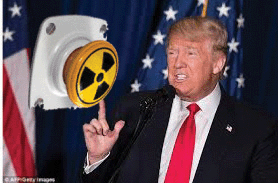
keys-war-iran/ When Trump won the elections, many worried that it could lead to war between the United States and Iran, due to his desire to kill the Iran nuclear deal. Now, thanks to the U.S. Senate, we may be one step closer to this nightmare scenario: The Senate is poised to pass legislation that will place President Trump’s trigger-happy finger on the ignition switch of a deadly conflict with Iran.
Introduced to coincide with the annual American Israel Public Affairs Council (AIPAC) conference that concludes today, the Countering Iran’s Destabilizing Activities Act of 2017 (S. 722) would give Trump new tools to violate the Iran nuclear deal. Perhaps most shockingly, a small group of Senate Democrats have joined Republicans to grant Trump some of the most dangerous authorities that would put the U.S. and Iran back on the path to war. The list of sponsors includes many of the usual suspects ― the consummate Iran hawks who worked to block Obama’s diplomacy with Iran and many of whom have sworn to “rip up” the nuclear deal: Robert Menendez (D-NJ), Bob Corker (R-TN), Marco Rubio (R-FL), Tom Cotton (R-AR), and Ted Cruz (R-TX). But the list of sponsors also includes Ben Cardin (D-MD) ― who opposed the nuclear deal but has said the U.S. should still abide by it ― as well as Bob Casey (D-PA), Richard Blumenthal (D-CT), Michael Bennet (D-CO), Chris Coons (D-DE), and Joe Donnelly (D-IN) who supported the deal.
Yet now these senators are signed onto legislation that requires non-nuclear certifications that would block the president from removing sanctions that are set to expire in later stages of the nuclear agreement. Why would Democratic senators who support the nuclear deal sign on to a measure that would violate the agreement? Because, they have argued, the bill gives the president a case-by-case waiver for the deal-killing provisions. That means that these senators are trusting Donald Trump with new deal-killing authorities and abdicating to him whether the U.S. honors the nuclear deal or “rips it to shreds.”
The bill also enables Trump to re-impose sanctions on Iranian entities that were de-listed pursuant to the accord. And it mandates sanctions that would broadly target any person or entity that ― knowingly or unknowingly ― contributes to Iran’s ballistic missile program, including universities that conduct research and banks that process payments for the government. This would amount to a trickle-down reimplementation of sanctions on much of Iran ― and a violation of the nuclear accord. Finally, the bill would designate the Islamic Revolutionary Guard Corps (IRGC), an elite branch of the Iranian military, as a terrorist group ― a major escalation. The IRGC is a highly problematic organization that has benefitted from years of a sanctions economy at the expense of Iran’s people. It is not unusual for individuals within the IRGC to be sanctioned if they are believed to have connections to Iran’s ballistic missile program. However, designating a foreign military branch as a terrorist organization is an extremely dangerous provocation that Pentagon leaders in multiple administrations have advised against. AIPAC has urged for the IRGC designation for the past decade, yet Barack Obama and even George W. Bush resisted. But now, with Donald Trump in the White House, AIPAC is pressing ahead with its proposal.
If this legislation is passed the U.S. can expect a negative response from Tehran that will undermine moderates in Iran’s upcoming May elections and empower anti-U.S. hardliners. The ranking member of Iran’s Parliament, Alaeddin Boroujerdi, has already signaled that Iranian lawmakers will consider designating the U.S. Army as a terrorist organization in retaliation. It is naïve to assume this exchange will be limited to words. U.S. special forces and IRGC units are currently fighting ISIS on the same front in Mosul. Despite some evidence that IRGC units targeted U.S. troops with IEDs during the height of the Iraq War, there have been no such incidents since U.S. soldiers reentered Iraq in the summer of 2014. In effect, the IRGC and the U.S.-backed coalition have agreed to stay out of each other’s way as they fight a mutual enemy in ISIS. This bill could change that reality by removing any incentive for Iran not to attack U.S. troops in Iraq, forbidding any cooperation with IRGC-backed militias against ISIS, and placing our Iraqi allies in a diplomatic catch-22. It is for this very reason that back in 2007, President Bush’s Pentagon opposed an SDGT designation for the IRGC.
With thousands of AIPAC supporters on Capitol Hill to lobby senators on behalf of the bill, there is a strong chance that this bill could obtain filibuster-proof levels of support. If every Republican supports the bill, and just one more Democrat signs on, AIPAC’s bill will hit 60 votes. If that happens, and Congress sends Trump this legislation, our new president will be granted the tools and the greenlight from Congress to unravel the Iran deal and put us back on the path to a war with Iran. Unless Democratic senators stand up against this bill soon, opponents of the Iran nuclear deal may wipe away Obama’s diplomatic legacy with Iran faster than even they thought was possible. This piece originally appeared in The Huffington Post.
April 1, 2017
Posted by Christina Macpherson |
Iran, politics, politics international, USA |
Leave a comment
 Groups Make Last Ditch Effort To Stop NY Nuclear Plant Bailout, WAMC 1 Apr 17 Midnight Friday is not just the deadline for the New York state budget to be finished. It’s also the date for an $8 billion state bailout of some upstate nuclear power plants to begin. More than 80 local government leaders are making a last ditch effort to stop a plan that they say will cost electric utility ratepayers billions of dollars.
In the summer of 2016, Governor Andrew Cuomo’s Public Service Commission announced that they’d reached a deal to provide nearly $8 billion to help Exelon, which owns two upstate nuclear power plants, buy a third one and keep them all running for another twelve years.
Cuomo announced the deal to cheering plant workers in Oswego, who would all be able to keep their relatively high-paying jobs for another dozen years.
“And keep it producing nuclear power for years and years to come,” Cuomo said, in August of 2016…….
The downside of the deal, say opponents, is that electric rates will go up for many rate payers in vast regions of New York.
More than 80 local government leaders, mainly from municipalities who would also have to pay the higher electric rates, came to the Capitol to ask for a moratorium on the deal, until there’s more time to study the consequences. Carl Chipman, supervisor of the town of Rochester, in Ulster County in the Hudson Valley, says the plan was enacted in a hasty and secretive manner, with no chance for the public to weigh in.
“We urge Governor Cuomo to halt the planned Public Service Commission mandate,” said Chipman, “Until a comprehensive and transparent evaluation of the available alternatives is conducted and made available for public comment.”
Jean Kessner, Syracuse City Councilor At-Large, says her city will be paying part of the estimated $2 billion in additional electric fees to help finance the bail out.
“It is not fair,” Kessner said. “If somebody sent you a bill for something you didn’t buy, you wouldn’t pay it.”
The plan has also angered some environmentalists. The New York Public Interest Research Group is one of the organizations opposed to the bailout. NYPIRG’s Blair Horner says nuclear power is not the best bridge fuel to use in achieving greener energy sources.
“It’s multi billions of dollars the state is going to spend to give to one company to keep Vietnam War-era power plants open for twelve years, and then close them down,” Horner said. “We think the money is better invested in 21st century, renewable and safe technology.”
Governor Cuomo has a different policy for nuclear power plants located downstate. In January, he announced a deal to close the Indian Point nuclear power plant along the Hudson River in Westchester County by 2021……http://wamc.org/post/groups-make-last-ditch-effort-stop-ny-nuclear-plant-bailout
April 1, 2017
Posted by Christina Macpherson |
politics, USA |
Leave a comment
Climate Converts: The Conservatives Who Are Switching Sides on Warming
It’s hardly being noticed, given the current political atmosphere in Washington. But a small yet growing number of Republicans, conservatives, and libertarians are starting to push for action on climate. Yale Environment 360 BY MARC GUNTHER • MARCH 30, 2017 As liberal Democrats and conservative Republicans pull farther apart in the long-running, increasingly polarized debate over climate change, Jerry Taylor is a rare bird — an advocate who has switched sides.
For two decades, as an energy and environment expert with the conservative American Legislative Exchange Council and the libertarian Cato Institute, Taylor challenged the scientific consensus on climate change and argued that decarbonizing the energy sector would impose intolerable costs on the U.S. economy. “I was an enthusiastic and convinced champion of the idea that climate change is an overblown problem,” he says.
Today, as the founder and president of the Niskanen Center, a libertarian think tank, Taylor embraces the scientific consensus on climate change and argues that a carbon tax is “the most efficient and least costly means of achieving greenhouse gas emissions reductions and hedging against climate risk.” He makes the conservative case for carbon pricing in footnoted position papers, on Capitol Hill, and to the media, with unbridled passion. “If you believe in free markets, how are those ends advanced by burning the planet?” he asks.
Taylor has joined a small but growing cohort of Republicans, conservatives, and libertarians who are bucking Republican Party orthodoxy on climate — even as President Trump has moved briskly to roll back the Obama administration’s major climate initiatives. Loosely organized and sometimes called the eco-right, they include GOP stalwarts James Baker and George Shultz and the former treasury secretary Hank Paulson; Ted Halstead of the Climate Leadership Council, a newly formed research and advocacy group that supports a revenue-neutral carbon tax; Eli Lehrer of the R Street Institute, a right-leaning Washington think tank that supports carbon taxes; and Lynn Scarlett, a former Bush administration official and director of the libertarian Reason Foundation who now directs global public policy at The Nature Conservancy. ……..http://e360.yale.edu/features/climate-converts-the-conservatives-who-are-switching-sides-on-climate-change
April 1, 2017
Posted by Christina Macpherson |
climate change, politics, USA |
Leave a comment
I think that sooner or later the white working-class constituency will recognize, and in fact, much of the rural population will come to recognize, that the promises are built on sand. There is nothing there.
Maybe scapegoating, saying, “Well, I’m sorry, I can’t bring your jobs back because these bad people are preventing it.” And the typical scapegoating goes to vulnerable people: immigrants, terrorists, Muslims and elitists, whoever it may be. And that can turn out to be very ugly.
I think that we shouldn’t put aside the possibility that there would be some kind of staged or alleged terrorist act, which can change the country instantly
 Chomsky: If Trump Falters With Supporters, a ‘Staged or Alleged’ Terrorist Attack Could Follow, truth dig, Mar 29, 2017 By Jan Frel / AlterNet It’s March 2017 , and the political process and the media in the U.S. are a depressing mess, on top of an ever-growing pile of issues that are not remotely being addressed, much less resolved by society: inequality, climate change, a global refugee crisis, you name it.
Donald Trump presents a new problem on top of the old familiar ones; a toxic multifront political disaster whose presence in the White House is doing damage to the national psyche on a daily basis. But in the first few months of his presidency it appears he is unwilling or unable to carry out almost any of the campaign promises he made to his base. Repealing Obamacare was supposed to be a cinch—well, that was a total disaster for Trump and the Republican party; the first big legislative rollout of his presidency, and it didn’t even make it to a vote. What about canceling TPP? Trump did do that, right?
In a recent interview with the renowned intellectual and public commentator Noam Chomsky, he told me TPP was dead on arrival regardless of who was elected. What about scrapping NAFTA? Chomsky said he was doubtful Trump would be able to do much there either. What Trump appears to be doing, Chomsky observed, is ramming through the standard GOP wish list: tax cuts, corporate welfare, climate change denial. How would Trump’s voters react to that? What we need to worry about, Chomsky says, is the potential for the Trump administration to capitalize on a “staged or alleged” terrorist attack. The text of our interview follows.
Jan Frel: Do you observe any meaningful signs of the key power factions in Washington aligning against Trump? Noam Chomsky: Well, the so-called Freedom Caucus, which is a Tea Party outgrowth, has been refusing, so far, to go along with the health plan that he has advocated. There are other indications of the Tea Party-style far-right, separating themselves from Trump’s proposals.
On the other hand, if you take a look at what is actually happening in Washington, apart from the rhetoric and what appears in Sean Spicer’s press conferences and so on, the old Republican establishment is pretty much pushing through the kinds of programs that they have always wanted. And now they have a kind of open door that is Trump’s cabinet, which draws from the most reactionary parts of the establishment. It doesn’t have much to do with Trump’s rhetoric. His rhetoric is about helping the working man and so on, but the proposals are savage and damaging to the constituency that thinks that Trump is their spokesperson.
JF: Do you think there will ever be a moment of awakening, or a disconnect for Trump’s supporters of his rhetoric and what he’s been doing in Washington, or can this just keep going?
NC: I think that sooner or later the white working-class constituency will recognize, and in fact, much of the rural population will come to recognize, that the promises are built on sand. There is nothing there.
And then what happens becomes significant. In order to maintain his popularity, the Trump administration will have to try to find some means of rallying the support and changing the discourse from the policies that they are carrying out, which are basically a wrecking ball to something else. Maybe scapegoating, saying, “Well, I’m sorry, I can’t bring your jobs back because these bad people are preventing it.” And the typical scapegoating goes to vulnerable people: immigrants, terrorists, Muslims and elitists, whoever it may be. And that can turn out to be very ugly.
I think that we shouldn’t put aside the possibility that there would be some kind of staged or alleged terrorist act, which can change the country instantly…….http://www.truthdig.com/report/item/chomsky_if_trump_falters_with_supporters_a_staged_terrorist_20170329
March 31, 2017
Posted by Christina Macpherson |
politics, USA |
Leave a comment
Westinghouse wins UK reactor approval from nuclear regulator, Reuters, 30 Mar 17 , By Susanna Twidale and Nina Chestney | LONDON Toshiba’s (6502.T) Westinghouse, which filed for bankruptcy on Wednesday, has won approval for its AP1000 reactor design, Britain’s nuclear regulator said on Thursday.The Office for Nuclear Regulation (ONR) approval is needed before the design can be used at NuGeneration Ltd’s (NuGen) Moorside new nuclear project in north west England, which consists of three AP1000 units.
“The closure of our assessment of the generic design of the AP1000 reactor is a significant step in the process, ensuring the design meets the very high standards of safety we expect,” Richard Savage, ONR’s chief nuclear inspector, said.
“We will now focus our regulatory attention on site specific assessments, and NuGen’s application for a nuclear site license,” he added in a statement.
Westinghouse’s bankruptcy filing has raised questions over whether it will be able to complete capital intensive projects……
Britain ……has struggled to get large projects built, especially nuclear, due to the costs involved.EDF’s (EDF.PA) 18 billion pound ($22.5 billion) Hinkley Point C nuclear project in southwest England got the final go-ahead in 2016 after several years of delay, but only after securing backing from the French government.
NuGen, a joint venture between Toshiba and French utility Engie (ENGIE.PA) has also come under doubt since Japan’s Toshiba said last month it planned to pull out of the construction work at the British plant after posting a $6.3 billion writedown on Westinghouse, which has been hit by billions of dollars in cost overruns at new nuclear plants……http://www.reuters.com/article/us-toshiba-westinghouse-britain-idUSKBN1711E6
March 31, 2017
Posted by Christina Macpherson |
politics, UK |
Leave a comment
 Trump has launched a blitzkrieg in the wars on science and Earth’s climate Skeptical Science 28 March 2017 by dana1981Today, Trump signed executive orders taking aim at America’s climate policies. On the heels of a report finding that the world needs to halve its carbon pollution every decade to avoid dangerous climate change, Trump’s order would instead increase America’s carbon pollution, to the exclusive benefit of the fossil fuel industry.
Trump’s anti-climate executive orders
One part of the executive order tells the EPA to review and revise (weaken) its Clean Power Plan and methane regulations. However, revising these regulations isn’t so simple. It requires proceeding through the same years-long rulemaking process the EPA used to create the rules in the first place. This involves considering the scientific evidence, crafting draft rules, responding to millions of public comments, and defending the new plan in court. Environmental attorneys are confident “this is another deal President Trump won’t be able to close.”
A second part of the executive order tells the EPA to ignore the government’s estimated price on carbon pollution. The Republican Party wants to lower the current estimate, but most evidence indicates the government is dramatically underestimating the cost of carbon pollution. Trump gets around this inconvenient evidence by ordering the EPA to simply deny the existence of those costs.
A third part of the executive order ends a moratorium on new coal leases on public lands before a review is completed to determine if taxpayers are being shortchanged due to the lands being sold too cheaply. Environmental groups are set to immediately challenge this order. Regardless, lifting the moratorium would have little effect on coal production or mining jobs.
EPA administrator Scott Pruitt would undoubtedly be happy to follow Trump’s orders. In his previous job as Oklahoma Attorney General and fossil fuel industry puppet, one of Pruitt’s 14 lawsuits against the EPA was aimed at the Clean Power Plan. However, the Clean Air Act requires the government to cut carbon pollution. Trump and Pruitt may not like it, but the law, scientific evidence, and public opinion fall squarely against them.
Trump’s anti-science budget
A few weeks ago, Donald Trump released his first proposed budget, and it’s also fiercely anti-science and anti-climate………https://www.skepticalscience.com/trump-blitzkrieg-wars-on-science-climate.html
March 31, 2017
Posted by Christina Macpherson |
climate change, politics, USA |
Leave a comment
UK nuclear plans could be hit by Westinghouse financial crisis https://www.theguardian.com/business/2017/mar/28/uk-nuclear-westinghouse-bankruptcy-toshiba-us
Toshiba’s US subsidiary, which has technology in about half world’s reactors, expected to file for bankruptcy protection, Guardian, Adam Vaughan, 29 Mar 17, A financial crisis at a major nuclear energy business is threatening to deal a blow to the UK’s atomic energy programme.
Toshiba’s US nuclear subsidiary Westinghouse Electric is believed to be on the brink of filing in the US for bankruptcy protection from creditors. A UK expert said the collapse would leave a considerable hole in Britain’s new nuclear ambitions as Toshiba is a key player behind plans for a new power station at Moorside in Cumbria.
Westinghouse is a behemoth in the world of nuclear vendors, with its technology in about half the world’s reactors. But it is facing a writedown of billions of dollars over its acquisition of a nuclear construction and services business. In 2015 Toshiba bought CB&I Stone & Webster, the company managing the construction of new reactors Plant Vogtle in Georgia and Virgil C Summer in South Carolina, both of which are over budget and behind schedule.
Westinghouse filing for Chapter 11 protection would potentially limit future losses for its owner Toshiba. The move will also trigger complex negotiations between the Japanese conglomerate, its American unit and creditors, and could embroil the US and Japanese governments, given the scale of the collapse and US government loan guarantees for new reactors.
The US utilities that operate the two nuclear plants are among Westinghouse’s biggest creditors, owed for work that has yet to be completed and potential penalties, sources have said. The bankruptcy filing will allow Westinghouse to renegotiate or break the construction contracts, although the utilities that own the projects would likely seek damages.
Credit rating agency Moody’s said it welcomed the prospect of bankruptcy because it could limit Toshiba’s liabilities.
Anti-nuclear campaigners said the episode showed the world should build renewable energy rather than new nuclear. Doug Parr, policy director at Greenpeace UK, said: “The world is watching the meltdown of a major corporation and questioning the cost of new nuclear. Declaring bankruptcy in the USA might shield Toshiba from Westinghouse’s debt, but as Toshiba’s share price ricochets and its multibillion-dollar losses escalate, the beleaguered nuclear industry is being shaken to the core again.”
Dr Paul Dorfman, a nuclear expert at UCL in London, told the Guardian: “Toshiba has fallen on its sword and this has significant consequences for the UK’s plans for new nuclear. Kepco of South Korea may come and buy into NuGen [the consortium behind the UK’s Moorside plant]. But you can’t necessarily sell off the bad bits of a nuclear corporation and keep the good bits.”
Kecpo last week ruled out buying Westinghouse but said it was in talks to take a stake in NuGen. However, Dorfman said: “While Kepco may wish to buy into NuGen they may find it both legally and financially problematic.”
He added that any unravelling of Nugen as a result of Westinghouse filing for bankruptcy would “leave a considerable hole in UK nuclear plans”.
The AP1000 reactor design of the two US plants is the same as the three planned for the Moorside power station. Within days the UK nuclear regulator is expected to approve a “generic design assessment” for the AP1000, the end of a four-year approval process.
This year Toshiba has twice delayed publishing its financial results for the third quarter of 2016, which will reveal the scale of the impairment it faces with regards to CB&I Stone & Webster. In January, chief executive Satoshi Tsunakawa said that while Toshiba would continue to maintain and operate its existing nuclear plants: “It is unlikely that we will carry out construction work for future nuclear power plant projects, in order to eliminate risk.”
But NuGen has said that while Toshiba may not build Moorside, the Japanese corporation was still committed to developing the Moorside power station. The possibility of a Westinghouse bankruptcy also raises questions over its impact on the Springfields nuclear fuel plant in Lancashire. The company owns the site on a 150-year lease from the UK government’s Nuclear Decommissioning Authority.
In the US, the reactors that Westinghouse is building are due to be completed within the next three years.
March 29, 2017
Posted by Christina Macpherson |
business and costs, politics, UK |
Leave a comment
Stabenow, Peters, Kildee Introduce Resolution Opposing Nuclear Waste Storage Site in Great Lakes Basin https://www.stabenow.senate.gov/news/stabenow-peters-kildee-introduce-resolution-opposing-nuclear-waste-storage-site-in-great-lakes-basin, March 15, 2017 U.S. Senators Debbie Stabenow (D-MI), Gary Peters (D-MI) and Congressman Dan Kildee (MI-05) today introduced resolutions, in both the House and Senate, expressing opposition to construction of a nuclear waste repository less than a mile from Lake Huron in Ontario.

“Canada is facing a critical decision that will impact generations in both our countries,” said Senator Stabenow. “A nuclear waste spill near the Great Lakes could have a devastating impact on our health and environment and threaten our Michigan way of life. Given what is at stake, I urge our Canadian neighbors to make the right choice and shelve plans for this site once and for all.”
“The Canadian proposal to build a permanent nuclear waste repository less than a mile from Lake Huron could cause significant, lasting damage to the Great Lakes and undermine the progress we have made cleaning up the water quality in the Great Lakes Basin,” said Senator Peters. “President Trump and Secretary of State Tillerson should make every effort to prevent the Canadian government from moving forward with this proposal and work to find an alternative solution that does not jeopardize the health of the Great Lakes.”
“Permanently storing nuclear waste less than a mile from Lake Huron just doesn’t make sense and poses a great risk to our Great Lakes,” said Congressman Kildee. “From Detroit to Toronto, a growing number of people – in both the U.S. and Canada – have voiced opposition to this dangerous plan. Surely in the vast land mass that comprises Canada, there must be a better place to permanently store nuclear waste than on the shores of Lake Huron.”
U.S. Senators Amy Klobuchar (D-MN), Kirsten Gillibrand (D-NY), Sherrod Brown (D-OH), Al Franken (D-MN), and Dick Durbin (D-IL) are also original co-sponsors of the Senate resolution. Mike Bishop (MI-08), Debbie Dingell (MI-12), David Joyce (OH-14), Marcy Kaptur (OH-09), Louise Slaughter (NY-25), Mark Pocan (WI-02), David Trott (MI-11), Jackie Walorski (IN-02), Luis Gutiérrez (IL-04), Sander Levin (MI-09), Paul Mitchell (MI-10), Brian Higgins (NY-26), Jan Schakowsky (IL-09), and John Moolenaar (MI-04) are also original co-sponsors of the House resolution.
Over 40 million people in Canada and the United States get their drinking water from the Great Lakes and the highly toxic waste could take tens of thousands of years to decompose to safe levels. Ontario Power Generation is currently seeking approval from the Canadian Ministry of Environment to build a deep geologic repository to permanently store 7 million cubic feet of low- and intermediate-level radioactive waste. The facility would be located less than 1 mile from Lake Huron in Kincardine, Ontario.
The resolution urges the President and Secretary of State to work with their counterparts to prevent a permanent nuclear waste repository from being built within the Great Lakes Basin. It further states that the U.S. and Canada should develop a safe and responsible solution for the long-term storage of nuclear waste.
March 27, 2017
Posted by Christina Macpherson |
politics, USA, wastes |
Leave a comment
 Energy Costs http://www.no2nuclearpower.org.uk/news/energy-costs-25-3-17/ Molly Scott Cato, Green MEP for the South West, has accused the government of failing consumers and the environment over energy policy. The accusation follows new projections from the Department for Business, Energy and Industrial Strategy (BEIS) which estimate that onshore wind and solar will be as cheap or cheaper than gas by 2020 [1]. BEIS now acknowledge an increased role for renewables, particularly due to potential improvements in battery storage. Molly Scott Cato said:
“Having hammered the renewables sector for ideological reasons, the government now discovers that wind and solar are set to become the cheapest ways to generate electricity. Government energy policy supposedly seeks to deliver secure, affordable and low carbon energy. They have failed on all three counts. But in particular we now see that by failing to pursue a transition to renewable energy they have missed the opportunity to provide electricity for the consumer at the lowest cost.”
Green Party 23rd March 2017 read more »
A long-awaited report exploring the complex cost implications of different energy technologies has finally been released, offering a series of recommendations on how government should manage a grid that is transitioning to cleaner sources of power. The report from consultancy Frontier Economics was originally commissioned by former Energy and Climate Change Secretary Ed Davey in response to a wide-ranging debate about whether the government was accounting for the full cost of renewable energy technologies. Business Green 24th March 2017
March 27, 2017
Posted by Christina Macpherson |
ENERGY, politics |
Leave a comment









 nuclear-news