Reuters 29th Sept 2017, Britain’s Nuclear Decommissioning Authority (NDA) has given a notice of
termination to Cavendish Fluor Partnership (CFP) for its management and
decommissioning of the country’s 12 Magnox nuclear power reactors and
research sites, it said on Friday.
The termination notice was effective
from Sept. 1 and allows for a 24-month notice period, ending CFP’s
contract on Aug. 31, 2019.
Reuters Staff, PARIS (Reuters) 27 Sept 17, – The French government plans to invest 20 billion euros in an energy transition plan, including 9 billion euros towards improved energy efficiency, 7 billion for renewables and 4 billion to precipitate the switch to cleaner vehicles.
The environment-related investments, drafted by economist Jean Pisani-Ferry and presented by Prime Minister Edouard Philippe on Monday, are part of a 57 billion-euro investment plan to run from 2018 to 2022.
Buildings are responsible for 20 percent of greenhouse gas emissions, so the government plans a 9 billion-euro thermal insulation programme that will focus on low-income housing and government buildings, the government said in a statement.
“The number of badly insulated low-income housing and social housing will be divided by two, and a quarter of government buildings will be renovated in line with environmental norms,” it said.
The programme aims at financing the renovation of 75,000 dwellings per year, or 375,000 over the government’s five-year term.
The government will also invest 7 billion euros ($8.31 billion) to boost the growth of French renewable energies by 70 percent over the next five years.
Poll: Far more trust generals than Trump on N. Korea, while two-thirds oppose preemptive strike, WP, By Scott Clement and Philip RuckerSeptember 24, 17, Two-thirds of Americans oppose launching a preemptive military strike against North Korea, with a majority trusting the U.S. military to handle the escalating nuclear crisis responsibly but not President Trump, a new Washington Post-ABC News poll finds.
Roughly three-quarters of the public supports tougher economic sanctions on North Korea in an attempt to persuade it to give up its nuclear weapons, while just about one-third think the United States should offer the isolated country foreign aid or other incentives.
The Post-ABC poll finds 37 percent of adults trust Trump either “a great deal” or “a good amount” to responsibly handle the situation with North Korea, while 42 percent trust the commander in chief “not at all.” By comparison, 72 percent trust U.S. military leaders, including 43 percent saying they trust them “a great deal.”
A scant 8 percent of Americans surveyed think North Korean leader Kim Jong Un can act responsibly.
The large gap in confidence between Trump and the U.S. military, as measured in the new poll, comes as Defense Secretary Jim Mattis, Secretary of State Rex Tillerson and other national security officials have emphasized a diplomatic approach to North Korea. Although Mattis has made clear that the United States is prepared and willing to retaliate to any attack with overwhelming force, he also has shied away from the rhetorical bombast employed by his boss……The large gap in confidence between Trump and the U.S. military, as measured in the new poll, comes as Defense Secretary Jim Mattis, Secretary of State Rex Tillerson and other national security officials have emphasized a diplomatic approach to North Korea. Although Mattis has made clear that the United States is prepared and willing to retaliate to any attack with overwhelming force, he also has shied away from the rhetorical bombast employed by his boss………https://www.washingtonpost.com/politics/poll-far-more-trust-generals-than-trump-on-n-korea-while-two-thirds-oppose-preemptive-strike/2017/09/23/5cc4377c-9fbb-11e7-8ea1-ed975285475e_story.html?utm_term=.3996af118419
No2 Nuclear Power 25th Sept 2017, A new report by Emeritus Professor of Energy Policy, Steve Thomas, says it
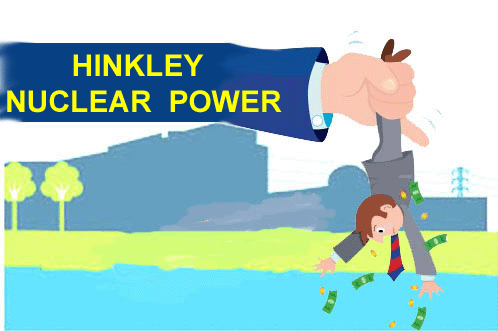
is time to cancel Hinkley Point C. EDF and the French and UK governments
may try to suggest that it’s too late to stop and will talk up the costs
which have already been incurred. But the start of construction, when the
first structural concrete is poured, is still between 2 and 4 years away.
Preliminary works are conspicuous but relatively cheap. EDF Energy will
have incurred expenses since signing the deal with the UK Government in
October 2016 and some of these may be compensatable. But these costs would
be dwarfed by the costs of going ahead. http://www.no2nuclearpower.org.uk/news/campaign-update/time-to-cancel-hinkley-point-c/
BBC 22nd Sept 2017, Labour would consider scrapping the Hinkley Point C nuclear plant, if it
won power. Critics of the deal have warned of escalating costs, including
in the so-called “strike price” – the guaranteed amount that consumers will
pay for the electricity generated. The UK government has guaranteed EDF a
fixed price for the electricity it produces for 35 years.
Asked whether Britain’s new nuclear power station should go ahead, Mr Corbyn said: “You
have to look at the strike price, you have to look at the long term
implications of it. “The government has not yet concluded on that.”
However, asked whether he would pull the plug if Labour came to power after
the station had been built, he said: “If it’s already built and in
operation then of course not.”But I do want to see, I must say, a much
greater diversity of energy generation.” http://www.bbc.co.uk/news/uk-politics-41359590
But in reality, the Trump administration is changing many of the nitty-gritty but vital things the federal government does that affect the quality of life of anyone living or working in the United States. As became clear during Trump’s first 100 days, the administration is systematically dismantling consumer, labor, and environmental protections, as well as de-funding studies that might make the case for new rules. In July it said that it plans to suspend, discontinue, or change 860 rules and regulations, many of which were proposed at the tail-end of Barack Obama’s presidency.
A new onslaught may be on the way. Yesterday (Sept. 21), Trump appointed a new head of the Consumer Product Safety Commission (CPSC): Dana Baiocco, a lawyer who built her career on defending companies against lawsuits on asbestos deaths and airline crashes. The commission’s former head, Eliot Kaye, had refused to follow an early White House order to eliminate two regulations for every new one passed, because it “would be counter to our safety mission.” If Trump’s past appointees are an indicator, Baiocco, who starts her new job on Oct. 27, is less likely to have such qualms……..
As the changes pile up, we’re keeping track of what’s been rolled back and what seems in danger of being weakened or eliminated. Here are the most important changes so far.
Worker protections…..
Fair wages…….
Health and safety……..
Consumer protections…..
Environmental Protections…….
Polluting the air. In March, Trump repealed Obama’s “Clean Power Plan,” which required states to slash carbon emissions from power plants. (He did this after naming coal industry-backed lawyers and talking heads to his cabinet.) The plan was crafted to prevent climate change, but it would also have prevented thousands of premature deaths due to air pollution, the EPA calculated, and prevented 90,000 asthma attacks a year.
America’s ‘doomsday’ plane will be Donald Trump’s HQ if nuclear war breaks out with North Korea, news.com.au , 21 Sept 17 TAKE a look on board the “doomsday” plane which will protect Donald Trump’s team if nuclear war becomes a reality. THESE incredible photos reveal the inner workings of the ‘Doomsday’ planes — America’s secretive set of jets designed to wage nuclear war from the skies.
The specially-designed aircraft follow President Donald Trump wherever he travels in Air Force One in case nuclear war erupts, reports The Sun.
Known officially as National Airborne Operation Centres, they allow US leaders and wartime hawks to issue directives and wage war from the sky.
The Boeing E-4Bs costs around $A311 million each to create and $A201,000 per hour to operate.
They also feature a vast array of defence mechanisms, including the ability to withstand electromagnetic pulses.
The jets’ crews also use traditional analog flight instruments to navigate as they are less susceptible to cyber attack.
De Smog Blog, By Itai Vardi September 19, 2017 President Trump’s nominee to head the Federal Energy Regulatory Commission (FERC) has, as a corporate attorney, personally represented a host of energy and utility companies, many of which do business that is directly impacted by FERC’s decisionmaking. According to Kevin McIntyre’s financial disclosure — obtained by DeSmog and published here for the first time — these include major utilities, fracking companies, pipeline builders, and international energy corporations.
McIntyre is a lawyer who co-leads the global energy practice for the legal and lobbying firm Jones Day, and is currently awaiting final Senate confirmation of his appointment to the nation’s top energy regulatory body. That confirmation may come as soon as this week.
McIntyre’s financial disclosure, submitted recently to the Office of Government Ethics, reveals that in the past two years alone he has represented various energy and utility companies. Some of these companies are regulated by FERC or have projects seeking FERC approval.
The list includes the following entities:
Ameren Corporation, a St. Louis, Missouri-based utility and power generation company. Ameren delivers electricity and distributes gas to over 1 million customers in Missouri and Illinois. The company owns several power-generating plants running on coal, gas, and oil. It also operates nuclear, hydroelectric, and renewable facilities.
American Electric Power Service Corporation (AEP), a large Columbus, Ohio-based electric utility supplying customers throughout the Midwest and Southwest US. The company owns about 60 power generating facilities, of which coal-fueled plants account for approximately 47 percent of AEP’s generating capacity, while natural gas represents 27 percent and nuclear 7 percent.
Lakeside Energy LLC, a Chicago-based energy holding firm that targets independent power generating and renewables industries.
Navajo Transitional Energy Company, a Farmington, New Mexico-based coal mining company owned by the Navajo Nation. The company supplies coal to the nearby Four Corners power plant.
SCANA Corporation, a Cayce, South Carolina-based energy holding company engaged primarily in electric and gas utility operations in the Carolinas and Georgia. The company also owns nuclear, hydroelectric, coal, and renewable power generating facilities.
TECO, a Tampa-based electric and gas utility providing services to customers in Florida and New Mexico. TECO is a subsidirary of Canadian energy and services giant Emera, which owns $29 billion in assets in North America and the Caribbean.
Traverse Midstream Partners, an Edmond, Oklahoma-based pipeline company with stakes in the Rover pipeline and Ohio River System pipeline. In both pipelines, Traverse partners with Energy Transfer Partners, the company behind the Dakota Access pipeline.
Ascent Resources, an Oklahoma City-based oil and gas exploration and production company that focuses on fracking in the Utica and Marcellus shales in Ohio and West Virginia.
Enable Midstream Partners, an Oklahoma City-based oil and gas gathering, processing, and transmitting company with operations in Oklahoma and Arkansas. One of Enable’s current proposed pipeline projects, the Central Arkansas Pipeline Expansion (CAPE), will require FERC approval.
EDF Energy Services LLC, a Houston-based subsidiary of French utility EDF, the company provides electricity, natural gas products and services to large-scale, energy-intensive commercial and industrial consumers in the US and Canada.
PT. Xintia Indonesia, an Indonesian company providing drilling equipment and services to the oil and gas industry.
SOCAR Trading S.A., a Geneva Switzerland-based company which is the marketing and development subsidiary of SOCAR, the state oil company of Azerbaijan. SOCAR Trading markets the bulk of Azeri crude exports.
Total Petrochemical & Refining USA, Inc., a Houston-based subsidiary of French oil and gas major Total involved in the production of various petrochemical materials with facilities in Texas and Louisiana.
Iberdrola Renovables Mexico S.A. de C.V., a Mexican subsidiary of Spanish electric utility giant Iberdrola, focusing on renewable energy investments in Mexico.
Concern Over Industry Ties
After a number of resignations and term expirations, as of this past June the FERC‘s bench had dwindled down to one single commissioner. The Trump administration has nominated four new candidates to restore the quorum needed for FERC to make key decisions.
Industry representatives lauded the reestablishment of a quorum on the commission, which can now approve the logjam of pending energy projects.
Critics, however, have sounded the alarm about some of the new appointees’ industry ties. Protesters with the group Beyond Extreme Energy had disrupted two Senate confirmation hearings in recent months.
They’ve pointed out that the newest FERC appointees Neil Chatterjee and Rob Powelson have ties to fossil fuel companies and utilities. While Chatterjee previously worked as an energy policy advisor to Senate Majority Leader Mitch McConnell (R-KY), Powelson developed a close relationship with the industry as a state utilities regulator.
Kevin McIntyre’s financial disclosure adds fuel to these concerns. McIntyre did not respond to a request for comment.
Tyson Slocum, director of the energy program at the government watchdog group Public Citizen, says the disclosure is cause for further concern. “I do think FERC has had problems of not accommodating the public interest as much as is spelled out in its statutory requirements,” Slocum says. “And McIntyre’s list of clients does not appear to include public interest clients, whereas today there is much opportunity for lawyers to represents such clients as well.”
Slocum adds that as co-lead of Jones Day’s energy practice, McIntyre is probably privy to other kinds of key information about energy clients, beyond those entities listed as the ones he personally represented at the firm.
“This complicates the question of potential conflicts beyond the list he provided in the disclosure since there’s uncertainty as to that kind of information he may hold,” Slocum says.
Theresa May under growing pressure to sign UN anti-nuclear treaty
Campaigners urge the Prime Minister to back global treaty calling for the total ban of nuclear weapons, Inde[endent Lizzy Buchan Political Correspondent, 17 Sept 17 Pressure is mounting on Theresa May to sign up to a UN treaty calling for the eventual elimination of nuclear weapons.
More than 120 nations endorsed the global treaty at a summit in July, which warns that a complete ban is the only way to prevent the “catastrophic humanitarian consequences” of the use of nuclear weapons.
Britain and other nuclear nations opposed the move, but critics have called on the Prime Minister to change course this week when the treaty will be opened for signatures at the UN’s annual general assembly.It comes amid escalating tensions between the US and North Korea, after a string of nuclear tests from the pariah state and war-like rhetoric from Donald Trump.
Anti-nuclear campaigners called on Britain to take the lead on disarmament, or risk offering a “blank cheque” to other nations seeking to boost their nuclear arsenal.
The UK and other nuclear powers support a non-proliferaton treaty, which prevents the spread of nuclear weapons – but the pact has previously attracted criticism for being ineffective.
Green Party co-leader Caroline Lucas said the Government had “utterly failed” in its commitment to nuclear disarmament, and urged the Prime Minister to back the UN treaty, in which signatories agree not to develop, test, buy or possess nuclear weapons………
Andrew Smith, of the Campaign Against Arms Trade, said: “For far too long, UK foreign policy has been guided by an unbending commitment to militarism and interventionism. Trident has been right at the heart of it.
“Despite this, there is a growing international consensus against nuclear weapons.
“It’s time for Trident-owning countries like the UK to take a lead, and take a crucial step towards a nuclear-free world.
“To continue doing otherwise will only provide an excuse and a blank cheque for every other country that seeks nuclear proliferation.”
Nuclear power plants may not keep Britain’s lights on, say Lib Dems
Party raises concerns over nuclear costs as Vince Cable says record low wind power prices should lead to ‘radical reappraisal’, Guardian, Adam Vaughan and Jessica Elgot, 16 Sept 17, New nuclear power stations may not be the best option for keeping Britain’s lights on and meeting the country’s carbon targets, the Liberal Democrats have said.
“Nuclear power should be kept open as an option – but there is a risk that it may not be able to keep the lights on and that it may not be the lowest-cost option,” said the Lib Dems in a new report, authored by the former coalition minister Lynne Featherstone.
Vince Cable, the party’s leader, said this week that the breakthrough low subsidy prices for offshore windfarms should prompt a “radical reappraisal” of how Britain is powered.
“A Duty to Warn” and the Dangerous Case of Donald Trump Renowned psychiatrist says despite “Goldwater Rule,” mental health experts have unique responsibility when someone in power may be dangerous, Common Dreams by Bill Moyers, Robert Jay Lifton , 15 Sept 17
There will not be a book published this fall more urgent, important, or controversial than than The Dangerous Case of Donald Trump, the work of 27 psychiatrists, psychologists and mental health experts to assess President Trump’s mental health. They had come together last March at a conference at Yale University to wrestle with two questions. One was on countless minds across the country: “What’s wrong with him?” The second was directed to their own code of ethics: “Does Professional Responsibility Include a Duty to Warn” if they conclude the president to be dangerously unfit?
As mental health professionals, these men and women respect the long-standing “Goldwater rule” which inhibits them from diagnosing public figures whom they have not personally examined. At the same time, as explained by Dr. Bandy X Lee, who teaches law and psychiatry at Yale School of Medicine, the rule does not have a countervailing rule that directs what to do when the risk of harm from remaining silent outweighs the damage that could result from speaking about a public figure — “which in this case, could even be the greatest possible harm.” It is an old and difficult moral issue that requires a great exertion of conscience. Their decision: “We respect the rule, we deem it subordinate to the single most important principle that guides our professional conduct: that we hold our responsibility to human life and well-being as paramount.”
Hence, this profound, illuminating and discomforting book undertaken as “a duty to warn.”
Here is my interview with Robert Jay Lifton — Bill Moyers………
“And that’s what I call malignant normality. What we put forward as self-evident and normal may be deeply dangerous and destructive. I came to that idea in my work on the psychology of Nazi doctors — and I’m not equating anybody with Nazi doctors, but it’s the principle that prevails — and also with American psychologists who became architects of CIA torture during the Iraq War era. These are forms of malignant normality. For example, Donald Trump lies repeatedly. We may come to see a president as liar as normal. He also makes bombastic statements about nuclear weapons, for instance, which can then be seen as somehow normal. In other words, his behavior as president, with all those who defend his behavior in the administration, becomes a norm. We have to contest it, because it is malignantnormality. For the contributors to this book, this means striving to be witnessing professionals, confronting the malignancy and making it known”……..
“the only reality he’s capable of embracing has to do with his own self and the perception by and protection of his own self. And for a president to be so bound in this isolated solipsistic reality could not be more dangerous for the country and for the world. In that sense, he does what psychotics do. Psychotics engage in, or frequently engage in a view of reality based only on the self. He’s not psychotic, but I think ultimately this solipsistic reality will be the source of his removal from the presidency.”………https://www.commondreams.org/views/2017/09/15/duty-warn-and-dangerous-case-donald-trump
As Nation Reels from Disasters, 300+ Groups Endorse Sweeping Climate Bill
“Disaster after climate-induced disaster is proving that we can’t fail to address our rampant burning of fossil fuels—too much is at stake.” Common Dreams, by Jessica Corbett, staff writer, 15 Sept 17
In the wake of massive storms that scientistsagree were made much worse by global warming, more than 300 national, state, and local groups have endorsed the OFF Act, proposed legislation that’s been called “the strongest climate bill ever.“
The Off Fossil Fuels for a Better Future Act, or OFF Act, was introduced this month by Rep. Tulsi Gabbard (D-Hawaii), who said the proposal “paves the way for the United States to replace fossil fuels with 100 percent clean energy generation and use by 2035.”
The coalition backing the legislation—which includes Food & Water Watch, Progressive Democrats of America, National Nurses United, Our Revolution, Physicians for Social Responsibility, Friends of the Earth, the Center for Biological Diversity, and hundreds of others—sent a joint letter to lawmakers explaining why the bill is more necessary than ever.
“We are in a climate emergency. The threat of climate chaos from global warming is real, and the evidence continues to mount,” the groups stated. “The OFF Act will stop fossil fuel projects, create tens of thousands of new jobs while transforming our energy economy, begin to address environmental injustices, and put us on the path towards the national mobilization necessary to address the climate crisis.”
Donna Smith, executive director of Progressive Democrats of America, said the number of organizations coming together is reflective of the concerns shared by millions of Americans. “From small communities and large urban areas,” Smith said, “Americans understand that in order to address the climate emergency with an appropriate level of urgency, we must take effective, rapid action to get off fossil fuels.”……https://www.commondreams.org/news/2017/09/14/nation-reels-disasters-300-groups-endorse-sweeping-climate-bill
Tory MPs back Hinkley Point yet block wind turbine developments. This week’s auction of government subsidies for energy show clearly that not only have the Tories been undermining our chances of transitioning to a renewable energy future, they are also forcing up our energy bills.
Two big offshore wind farms came in at £57.50 per megawatt hour and a third at £74.75. These “strike prices” compare with a guaranteed price for electricity from Hinkley of £92.50. This is the price the government agreed in order to persuade the French and Chinese to build the new nuclear plant. So effectively, consumers and businesses will be forced to pay a premium of 60 per cent for the privilege of receiving electricity from Hinkley; a premium that will increase further as the price of renewables falls further over the next six years, up until Hinkley comes on grid – if it ever does.
It is clear that only a government suffering from an acute dose of economic illiteracy would continue with this project. Unless, of course, there are other reasons for continuing this madness.
No one doubts that Hinkley is an economic disaster, but it has been kept alive by a dubious subsidy regime. As a “mature technology”, nuclear should never receive a subsidy, which is why there are ongoing legal challenges on this point. By contrast, the dramatic fall in the cost of offshore wind, and other renewable technologies, prove the value of subsidising “infant industries” until they are mature enough to survive and thrive subsidy-free.
But it’s not just dodgy economics that have kept the Hinkley white elephant staggering on. It is also a warped anti-renewables, pro-nuclear ideology, something highly evident in my own constituency of the South West.
It would appear there were no applications for subsidies to build offshore wind in the South West. Why would there be when our region is stalked by Tory dinosaurs who will fight their planning proposals; destroying opportunities for local people, pushing up their energy bills, and denying us the clean energy future we deserve in the process?
Since I became an MEP, there have been two exciting large scale offshore wind proposals in the South West. The Navitus off-shore wind development in Dorset could have secured enough energy to power 700,000 homes, while the Atlantic Array off the North Devon coast, was forecast to power 900,000 homes. Both were ditched in no small part due to dogmatic opposition to wind power.
In both examples, some of the most active opponents were local Tory MPs. In the case of Navitus Bay, where local Tories allegedly opposed the development on the grounds of its potential impact on the Jurassic Coast World Heritage Site, Private Eye pointed out that local MP and vociferous opponent of Navitus, Conor Burns. received regular payments from an engineering firm connected with the oil and gas industry (it is listed in his register of interests). Navitus was proposed in an area off the Dorset coast thought to be suitable for oil and gas drilling. Conor Burns has never spoken out against plans to drill for oil and gas in the area.
As for Atlantic Array, the campaign group Slay the Array was led by none other than Steve Crowther, interim leader of Ukip. His party’s policies for the 2017 general election included the repeal of the 2008 Climate Change Act. Interestingly, they promised to support renewables when they could be delivered at competitive prices. Given that is now clearly the case, perhaps Mr Crowther would like to reconsider his staunch ideological opposition to Atlantic Array?
Lest we think it is just the Tories and Ukip standing in the way of a genuine transformation to cheaper, greener energy, Labour too has refused to ditch nuclear. The party is still trumpeting the thousands of jobs new nuclear, including Hinkley, can deliver. This view is deeply flawed. Evidence suggests that renewables create around three times as many jobs as nuclear for every £1m invested.
It is not only operating and servicing renewable energy projects that create jobs. There is also huge potential for job creation through the manufacture of components to support the renewables sector. Siemens in Hull provides a good example of what is possible. The company hasinvested £310m in wind turbine production and installation facilities, creating more than a thousand jobs.
Back in 2015, I commissionedareportwhich demonstrated the potential we have in the South West to generate in excess of 100 per cent of our energy from renewables. The report concluded that we could create 122,000 jobs across the region and add over £4bn a year to the economy. This is not unique to the South West; other areas of the UK could also be energy self-sufficient and reap the economic rewards. And the report was of course written before offshore wind was so much cheaper than nuclear.
Now is the time to end our affair with the dangerous and expensive technologies of the past and usher in a new green industrial revolution. There is an opportunity for political unity against Hinkley and in favour of renewables.
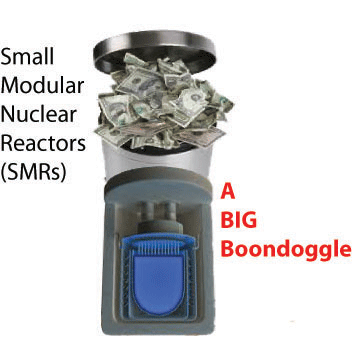
City AM 10th Sept 2017,A consortium developing small modular reactors is expected to urge the
government to push forward with a plan to develop so-called baby reactors
to secure the UK’s energy needs after the decommissioning of older
nuclear power stations. The government launched a competition to find the
best value SMR reactor design for the UK in 2016, and this week a
consortium led by Rolls-Royce will publish a report in Westminster which
claims it can generate electricity at £60 per megawatt hour, which is
two-thirds the price of recent large-scale nuclear plants. http://www.cityam.com/271732/mps-review-baby-nuclear-reactor-plans-cheaper-source-secure
No nuclear weapons in South Korea, says President Moon,By Paula Hancocks and James Griffiths, CNN September 14, 2017
Story highlights
Moon said South Korea needs to advance its military, but would not go nuclear
The South Korean President brushed aside possible tensions with US leader
Seoul South Korean President Moon Jae-in has dismissed the possibility of deploying nuclear weapons in his country, warning it could “lead to a nuclear arms race in northeast Asia.”
“I do not agree that South Korea needs to develop our own nuclear weapons or relocate tactical nuclear weapons in the face of North Korea’s nuclear threat,” he told CNN Thursday in his first televised interview since North Korea’s sixth nuclear test.
Though he was not supportive of deploying or pursuing nuclear weapons, Moon said South Korea “needs to develop our military capabilities in the face of North Korea’s nuclear advancement.”
Earlier this month, South Korea’s defense minister suggested it was worth reviewing the redeployment of US tactical nuclear weapons on the peninsula in order to deter threats from the North, something conservative US Sen. John McCain said should be “seriously considered.”
A recent Gallup Korea poll found 60% of respondents were in favor of South Korea having its own nuclear weapons, with 35% opposed.
“To respond to North Korea by having our own nuclear weapons will not maintain peace on the Korean Peninsula and could lead to a nuclear arms race in northeast Asia,” Moon said.
US-South Korea relations
Next week, Moon will travel to New York for the United Nations General Assembly. His visit comes amid speculation over a growing rift between Seoul and Washington, after US President Donald Trump accused Moon of seeking “appeasement” with North Korea……..http://edition.cnn.com/2017/09/14/asia/south-korea-moon-nuclear/index.html