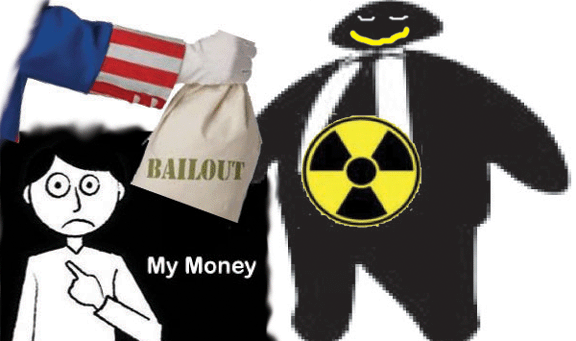
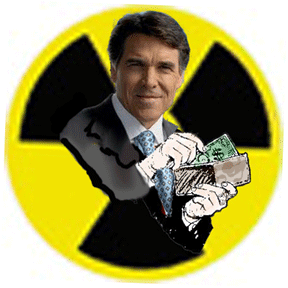
Department of Energy (DOE) Secretary Rick Perry just proposed a massive bailout for coal and nuclear power plants. The radical and unprecedented move is couched under a false premise that power plants with fuel located on site are needed to guarantee the reliability of the electricity system. The proposal relies on a mischaracterization of DOE’s own recent study of electricity markets and reliability (discussed here), which if anything demonstrated that this kind of proposed action is not justified.
If adopted, the proposal would essentially ensure that coal and nuclear plants in regions encompassing most of the country continue to run even where they are too expensive to compete in the energy market. It would saddle utility customers with higher costs, while posing obstacles to the electricity system integration of cleaner and less risky energy sources such as solar and wind.
NRDC is still carefully analyzing the proposal, but below is a very preliminary take:
The proposal would bail out expensive and uncompetitive coal and nuclear plants
The proposal asks the Federal Energy Regulatory Commission (FERC) to take action within 60 days that would financially prop up “fuel-secure resources,” which must have “a 90-day fuel supply on site enabling [them] to operate during an emergency, extreme weather conditions, or a natural man-made disaster.” This requirement is aimed squarely at coal and nuclear power plants, which would generally be able to satisfy these criteria.
Many coal and nuclear units are very expensive and are having trouble competing in the wholesale electricity market (as discussed here). So the proposal asks FERC to bail out these power plants by essentially guaranteeing them profits and insulating them from competitive market forces. The proposal amounts to a massive subsidy that would ensure the plants continue to operate, rather than being economically retired when they are more expensive than other units (including wind and solar) that sell electricity at lower cost.
The proposal would radically reshape electricity regulation for most of the country
The rule would have a massive scope, covering regional wholesale markets where electricity is bought and sold to serve most of the nation’s customers. It would apply to areas where the electricity system is operated by regional entities known as Regional Transmission Operators (RTOs) or Independent System Operators (ISOs), which administer competitive markets for electricity. The RTOs tell the more expensive plants not to operate when there’s cheaper electricity available from other plants.
As shown in the map, [on original] RTOs cover most of California, the Midwest and southern states in the middle of the country, as well as the mid-Atlantic and Northeast. The Electric Reliability Council of Texas (ERCOT) is not subject to FERC jurisdiction and would not be covered by the proposed rule, if adopted.
Secretary Perry’s proposal would be a radical departure from the way FERC currently regulates electricity prices in these regions. Under FERC’s system, electricity prices in RTOs are governed by competitive market forces. A power plant is only insulated from this system by FERC under extremely limited circumstances, where a detailed examination of the grid reveals that the plant is needed for reliability purposes. The plant is then guaranteed its costs of operating, but only on a temporary basis, until a replacement can be constructed.
The proposal would lead to higher energy bills and more pollution
Customers across the country would ultimately foot the bill for supporting these more expensive plants. While no credible analysis has been conducted of the costs (which can’t even be done given the vagueness of the proposed rule), it is safe to assume that the toll would be many billions of dollars.
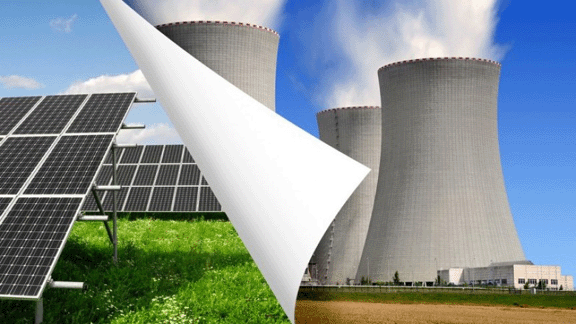
The proposal also would favor more expensive and risker power plants over cleaner and safer energy sources such as wind and solar power. Coal power plants emit a massive amount of pollution. They are one of the largest sources of greenhouse gases causing climate change. Coal plants also cause an array of other problems, such as acid rain and asthma. And while low-carbon, nuclear energy poses myriad health and safety risks (discussed here).
The proposal is unjustified
The purported basis for the proposal is that “[t]he resiliency of the nation’s electric grid is threatened by the premature retirements of power plants that can withstand major fuel supply disruptions caused by natural or man-made disasters.”
But DOE’s own reliability report found that all regions of the country have excess supply of energy resources needed to meet demand. Furthermore, while it included a brief discussion of the potential benefits of on-site fuel supply, it also highlighted examples of power plants with on-site fuel supply failing, such as coal plants that could not operate during the 2014 Polar Vortex when their fuel supplies froze in the extreme cold.
The lesson that no type of power plant is immune to weather-related disruptions was clear during the recent hurricanes. Nuclear power plants had to be taken off-line in preparation for Hurricane Irma. Natural gas plants and pipelines suffered disruptions during Hurricane Harvey, and the onsite coal pile at a W.A. Parish plant in Texas became so saturated with rainwater that the coal could not be delivered into storage silos, forcing the plant to switch to natural gas for the first time in eight years.
Ultimately, the proposal’s justification is as flimsy as Secretary Perry’s initial suggested basis for subsidizing coal and nuclear—that “baseload” is necessary for the system, a myth that has been thoroughly debunked (as discussed here and here).
DOE is asking FERC to rush to judgment
FERC has already adopted detailed regulations to ensure the reliability of the grid, and follows established processes to consider any necessary tweaks. As DOE’s own report explained, these systems have worked to meet the industry’s high reliability standards even as the mix of generation serving customers’ needs has changed dramatically.
DOE is asking FERC to sidestep that normal process by adopting its radical proposal in a mere 60 days, a timeline that would make it impossible to conduct any of the rigorous analysis that would surely be necessary before making such extreme changes. DOE’s proposal is so vague that FERC could not possibly adopt it as is, making it hard to see how FERC could possibly advance it in a manner that complies the procedural requirements for a formal rulemaking proposal.
FERC should reject Secretary Perry’s proposal
Perhaps the only silver lining in Secretary Perry’s proposal is that DOE has no independent authority to adopt this proposed rule, which is already eliciting pushback from leaders like NY Attorney General Eric Schneiderman. As discussed here, FERC, not DOE, is the agency primarily responsible for regulating electricity markets. FERC should reject Secretary Perry’s outrageous and poorly thought out request.
Rick Perry proposes sweeping new steps to support coal and nuclear plants, WP, By Steven Mufson and Chris MooneySeptember 29 2017,Energy Secretary Rick Perry took sweeping steps on Friday to buttress a pair of financially-strapped nuclear plants under construction and redefine how coal and nuclear plants are compensated for the electricity they provide — a move that, if agreed to by independent federal energy regulators, could tilt some of the nation’s complex power markets away from renewables and natural gas.
Perry announced the Energy Department would provide $3.7 billion in loan guarantees to three Georgia utilities struggling to complete a pair of nuclear reactors at the Alvin W. Vogtle generating plant. These loan guarantees come on top of $8.3 billion in loans the department has already given to the project, but they still might fall short of what will be required to complete the costly reactors.
The nuclear project has been running far over-budget and behind schedule, and the utilities have been scrambling to come up with financing after the main engineering company, Westinghouse, declared bankruptcy earlier this year.
NRDC’s report America’s Clean Energy Frontier: The Pathway to A Safer Climate Future lays out a clean energy pathway for cutting U.S. greenhouse gas pollution 80 percent from 1990 levels by 2050. These emissions cuts are necessary to avoid the most devastating impacts of climate change. Our analysis shows that the U.S. can reach its 2050 carbon goals even with a steep decline in U.S. nuclear power as American reactors age and the economics of new nuclear reactors remain extremely challenging.
NRDC’s plan relies on existing technologies to cost-effectively achieve a clean, low-carbon future. Energy use is cut by 50 percent through efficiency and electric investments, with our cars achieving an average of 100 mpg. Wind and solar energy grow 13-fold from today’s levels, with renewables providing at least 80 percent of our power, allowing us to electrify buildings and cars to run with renewable energy. And a stronger, smarter and more resilient electricity grid supports the integration of these clean energy resources. By 2050, nuclear power provides just 3% of U.S. electricity, down from about 20% today, as aging U.S. nuclear power plants reach the end of their operating licenses.
Modeling a Potential for U.S. Nuclear Decline
The reduced role of nuclear power in NRDC’s pathway model primarily stems from the economic challenges facing the nuclear industry and the aging of the existing U.S. nuclear fleet. Our core scenario has only 20 gigawatts (GW) of nuclear power plant capacity operating in 2050: an 80 percent decline from today. Due to the high cost of constructing new nuclear power plants and the current wave of nuclear retirements before the expiration of their Nuclear Regulatory Commission (NRC)-issued licenses, NRDC’s modeling assumed that only four nuclear reactors would be built between now and 2050 (and that may be optimistic).
The United State has 99 operating nuclear power reactors, but early retirement plans have been announced for seven reactors because of economic pressures. In addition, most U.S. nuclear power plants were built in the 1960s, 70s, and 80s. These reactors have 60-year extended operating licenses, most of which will have ended by 2050—the target date for reaching an 80 percent reduction in greenhouse gas emissions. Some may be able to get and to use an additional 20-year extension—but we assumed that only about one in five existing plants would operate beyond 60 years due to economic and safety challenges. Our plan shows increased renewable energy deployment more than makes up for the lost low-carbon benefit of nuclear generation.We are also skeptical of the role of what is called “advanced nuclear” for generating the electricity to run our homes and businesses in the time frame to mid-century—acknowledging that other researchers have projected a significant contribution from advanced nuclear in their modeling of 80% carbon reduction by 2050. We believe that a crucial challenge for advanced nuclear is that no working prototypes of such reactor designs exist or are firmly planned, and thus deployment at scale is generally uncertain but highly unlikely in the first half of this century.
This isn’t ideological hostility to nuclear power; it is pragmatic skepticism. NRDC is not opposed in principle to nuclear power, and acknowledges its beneficial low-carbon attributes in a warming world. However, we take seriously the significant safety, global security, environmental, and economic risks that use of this technology imposes on society. They include: environmental harms from uranium mining; safety and security of nuclear plant operations; nuclear weapons proliferation impacts; and spent fuel disposal. This demands more stringent, improved policy and regulation of the complete nuclear fuel cycle, beginning with the mining and milling of uranium and ending with the final disposal of radioactive wastes. Until these risks are properly mitigated, expanding nuclear power should not be a leading strategy for diversifying America’s energy portfolio and reducing carbon pollution.
Reinforcing this perspective, nuclear power is uneconomical compared to alternate forms of low-carbon electricity generation—even without considering those risks. Faced today with the seemingly irreversible decline of nuclear energy in the United States, and the enormous potential to scale up energy efficiency and renewable energy on a stronger electric grid, NRDC’s analysis concludes we can meet our U.S. climate goals even with a much-reduced nuclear fleet…..
Conclusion
NRDC’s analysis and recommendations focus on the time period from today to 2050. Between now and 2050, it is likely that the majority of today’s nuclear power plants will retire based on economics and license expiration alone. NRDC’s modeling and analysis shows that, if such is the case, we can replace nuclear generation with clean, renewable energy instead. Nevertheless, deep geologic storage of spent fuel and nuclear weapons proliferation will remain important problems for the United States along a pathway to a safer climate future in 2050. Whether new forms of nuclear power emerge and play a role after 2050 remains to be seen. https://www.nrdc.org/experts/matthew-mckinzie/nrdc-analysis-nuclear-energy-and-safer-climate-future
Perry is trying “to essentially end competition in U.S. power markets in order to force customers to pay billions of dollars for uneconomic coal and nuclear plants they don’t want or need,” Mark Kresowick, an expert on FERC rules, told ThinkProgress. Kersowick called the move “unprecedented.”
Perry wants to stop cheaper, cleaner renewables like solar and wind from shutting down more dirtier and more expensive plants like coal (and nuclear).
Significantly, Germany has one of the most reliable electric grids in the world, with 10 times fewer minutes of grid outages a year than the United States. In the morning of May 8, 2016, a whopping 95 percent of Germany’s electricity was provided by renewables.
JOE ROMM, In a brazen move, Energy Secretary Rick Perry has ignored the findings of his own grid study and proposed a new federal rule that would effectively force Americans to buy dirtier, more expensive power.The Department of Energy (DOE) announced Friday morning that Perry has “formally proposed that the Federal Energy Regulatory Commission (FERC) take swift action to address threats to U.S. electrical grid resiliency.” FERC oversees the U.S. grid and regulates interstate electricity transmission.To make his case, Perry has fabricated an economic threat to U.S. grid reliability from cheap renewables and then proposed a rule to account for the imaginary reliability benefit of other electricity sources — all the while ignoring the actual health and environmental costs of carbon pollution from burning coal that aren’t priced in to the market yet.
Perry is trying “to essentially end competition in U.S. power markets in order to force customers to pay billions of dollars for uneconomic coal and nuclear plants they don’t want or need,” Mark Kresowick, an expert on FERC rules, told ThinkProgress. Kersowick called the move “unprecedented.”
Oops: Rick Perry may have stumbled upon the solution to going 100 percent renewable
Buried in his grid study is how electric cars and smart control systems will enable deep penetration of solar and wind energy
In the notice of proposed rule-making, Perry says FERC should “issue a final rule requiring its organized markets to develop and implement reforms that would fully price generation resources necessary to maintain the reliability and resiliency of our nation’s grid” within 60 days. FERC is an independent commission and not obligated to take up Perry’s proposal.
In the simplest terms, Perry wants to stop cheaper, cleaner renewables like solar and wind from shutting down more dirtier and more expensive plants like coal (and nuclear).
This is an especially brazen move because Perry’s own grid study, the one he asked DOE staff for back in April, totally undercuts any rationale for such a move. That study concluded that renewables have not harmed grid reliability and that myriad strategies exist to allow deep penetration of renewables.
In fact, the leaked draft of the staff report (before political appointees were able to massage it) had actually pointed out that “the power system is more reliable today”– even with far greater use of renewables — and that “high levels of wind penetration can be integrated into the grid without harming reliability.”
Trump officials rewrite Energy Dept. study to make renewables look bad, fail anyway
Rick Perry-commissioned study finds renewables don’t hurt grid reliability but do help stabilize prices.
Even the final version of the study, which was cut back, found that renewable energy “performs a price stabilizing roll” and can “improve the month-to-month manageability of customer bills.” But Perry apparently doesn’t want US consumers to enjoy stable prices.
Perry’s move is also brazen because it is an attempt to literally fight the future. All the other major countries in the world are shifting towards renewables (see chart – on original).
Bloomberg New Energy Finance chair Michael Liebreich reported on the remarkable surge in non-hydro renewables around the world in his “state of the clean energy industry” keynote last week at BNEF’s Future of Energy Summit in London.
As you can see from the chart, while the United States has tripled the penetration of new renewables from 3 percent to 9 percent in the past decade, Japan is at 12 percent, the UK is at 25 percent and Germany is at 29 percent. These are, respectively, the world’s third-largest, fifth-largest. and fourth-largest economies. Even China has more renewables than we do.
Significantly, Germany has one of the most reliable electric grids in the world, with 10 times fewer minutes of grid outages a year than the United States. In the morning of May 8, 2016, a whopping 95 percent of Germany’s electricity was provided by renewables.
Somehow, the U.S. needs “swift action” to address the imaginary problems associated with a mere penetration of new renewables of 9 percent.
NRDC Analysis: Nuclear Energy and a Safer Climate Future Natural Resources Defense Council ·September 29, 2017Matthew McKinzie “……….NRDC Recommendations on Nuclear Energy
Our report puts forward three nuclear-related recommendations that logically follow from NRDC’s climate and energy policy analysis and projections:
Regulators should explore approaches for replacing retiring nuclear units with zero-carbon resources and protecting the livelihoods of workers and host communities. As U.S. nuclear plants reach the end of their operating licenses or becomes uneconomical to run, growing numbers of reactors are likely to be retired. Regulators and other stakeholders will need to avoid abrupt closures, which could result in carbon emission increases from replacement generation. They should instead plan for shutdowns with sufficient time to ensure the lost power is reliably replaced with clean energy, and the livelihoods of workers and nearby communities are protected. The Joint Proposal to replace California’s only remaining nuclear power plant, the two Diablo Canyon reactors in San Luis Obispo, provides a model of an appropriate transition plan.
The Environmental Protection Agency (EPA), NRC, and states should address existing nuclear safety and fuel issues. The EPA and NRC should adopt stronger regulations to address the environmental impacts of uranium mining as well as the safety and security risks associated with nuclear plant operations. The federal regulations governing the decommissioning of nuclear power reactors need to be fundamentally overhauled. Rather than relitigate unworkable ideas like the Yucca Mountain site in Nevada, the federal government should develop a scientifically defensible and publicly accepted consent-based siting process for geologic disposal of spent nuclear fuel. Accordingly, Congress should amend the Atomic Energy Act of 1954 to remove its express exemptions of radioactive material from environmental laws, thus creating a regulatory role for the EPA and the states in nuclear waste disposal.
The federal government should continue to fund research into nuclear energy. Long-term federal investment in energy technologies is a key aspect of federal energy policy, including DOE programs that support R&D for nuclear fuel cycle and reactor designs. Government spending on advanced nuclear R&D must prioritize the analysis of severe accident scenarios and security vulnerabilities. While cost estimates for advanced nuclear designs should be rigorously examined early in their R&D cycle, the cost and reliability assessments can only be realistically understood based on the performance of an advanced nuclear prototype and a first-of-a-kind commercial reactor. Highly expensive projects should be evaluated as public-private partnerships to judge market viability for a given advanced nuclear design. Nuclear weapons proliferation impacts should also be addressed early in the R&D cycle; advanced nuclear designs that require a closed nuclear fuel cycle to reprocess spent nuclear fuel should be rejected outright given the associated proliferation risk, high cost and production of secondary nuclear wastes…………https://www.nrdc.org/experts/matthew-mckinzie/nrdc-analysis-nuclear-energy-and-safer-climate-future
Business Green 27th Sept 2017,Jeremy Corbyn has closed this year’s Labour Party Conference by aiming
fierce criticism for US President Donald Trump over his plans to withdraw
the US from the Paris climate change agreement, arguing the President is
wrong to think climate action comes at the expense of economic growth.
$9 Billion Nuclear Scrapyard: New Aerial Photos of SCE&G’s Abandoned V.C. Summer Nuclear Project Reveal Disarray
Reactor Building and Components Left Unprotected; Most Cranes Removed, Friends of the Earth, 27 Sept 17 COLUMBIA, S.C. – Newly obtained aerial photographs of the abandoned V.C. Summer nuclear reactor construction site reveal that there is no protection of installed reactor components from the weather. (See notes on original for links to photos.)
The photos provided to Friends of the Earth are being released in the middle of the political firestorm in South Carolina about the terminated project. It has become clear that South Carolina Electric & Gas (SCE&G) and its partner, Santee Cooper, withheld key information for years about the faltering project and were finally forced to simply walk away from on-going construction with no site shut-down plan in place.
The photos of the debacle, on which $9 billion was wasted, confirm that when work was abruptly halted on July 31, no preparation had been made to protect buildings and key components associated with reactor units 2 and 3. One existing reactor, visible in the photos, has operated at the site since 1982.
The photos, taken on September 18, reveal that nuclear reactor modules installed inside the open containment vessels are exposed to the weather. The partially finished ‘shield buildings,’ in which the reactors are located, lack roofs and sit fully exposed to the elements. Construction was only about 37% complete when the work was halted and had been continuing at a snail’s pace.
“Almost two months after the project was halted the V.C. Summer reactor construction site still looks like it was abruptly abandoned with no shut-down plan,” said Tom Clements, senior adviser to Friends of the Earth. “Not only was SCE&G grossly negligent during construction of the project, but the photos of the site reveal that the company also exhibited imprudent behavior in abandoning the project without proper closure plans. The forlorn site looks like a nuclear ghost town best suited for a Hollywood movie set,” added Clements. (Duke Energy’s abandoned nuclear reactor project in Cherokee County, South Carolina, was used as a set for the science fiction film The Abyss in 1989.)
Years of weathering will ravage the unprotected reactor components and partially constructed shield buildings and turbine buildings, according to Friends of the Earth. The turbine buildings, located adjacent to the reactors, sit without roofs and with open walls. A large number of white tent-like temporary buildings are visible and, according to information provided by site workers to Friends of the Earth, protect unused components. The short lifespan of the shelters will necessitate long-term plans if components are to be retained and not sold off.
The push now is for the industry to receive special subsidies to remain economically viable
Nuclear power has been doomed by cost escalation, while gas, efficiency, and renewables continue to get cheaper. And subsidizing nuclear plants isn’t popular in the states where ratepayers would have to foot the bill
Simply put, political intervention in the U.S. electric power system distorts the market and is bad energy policy.
The “nuclear renaissance” that we have long waited for is falling short. In the wake of the 2011 Fukushima disaster, the number of new projects has drastically dropped. Among other things, they’ve been plagued by huge cost overruns, lower cost competitors, public fear, an aging workforce, rare required materials, and often unmanageable waste problems.
According to the World Nuclear Industry Status Report, the number of construction starts of nuclear reactors worldwide has sunk from a high of 15 in 2010, to 10 in 2013, to 8 in 2015, to 3 in 2016, and to just 1 in the first half of 2017. And most tellingly, premature nuclear shutdowns are occurring in even the richest nations.
Here in the U.S., a massive supply of low cost natural gas from shale, established low and stable cost coal fleets, and mushrooming wind and solar farms have left many nuclear plants unprofitable. Down from 104 just a few years ago, there are now 99 nuclear reactors in the country. It’s a rapidly aging fleet, with the average age for a U.S. nuclear plant now 36 years. This is obsolete by modern technology standards and closing in on the end of 40-year operating licenses. In fact, nearly 20% of our nuclear fleet is over 42 years old.
On March 29, 2017, Westinghouse, the only company that was actually building nuclear plants in the country, declared bankruptcy. And in July, after $9-10 billion had already been spent on construction, two South Carolina utilities abandoned two new Westinghouse reactors that were just 40% complete.
Even the two states proudest of their anti-CO2 agenda, which as I document here and hereare inevitably turning to more natural gas, are joining in. California has shuttered San Onofre Nuclear Generating Station in the South, and Diablo Canyon nuclear power plant in the north will close by 2025. New York will shut down the Indian Point nuclear plant near NYC by 2021.
The push now is for the industry to receive special subsidies to remain economically viable. The idea really started in Illinois, where Exelon said that without subsidies, it would have to shutter three nuclear plants after the company lost $700 million in the last few years operating the plants.
And Exelon has also threatened to close other nuclear units in New York and its Three-Mile Island nuclear plant in Pennsylvania, which became infamous with a partial meltdown in 1979. It’s become uncompetitive: Three-Mile Island didn’t clear PJM capacity auction in May and has lost $300 million over the last eight years.
Legislatures in New York and Illinois have approved as much as $10 billion in special subsidies through zero-emission credit programs to keep older nuclear plants operational. Pennsylvania, Ohio, New Jersey, and Connecticut are considering similar special subsidies.
Naturally, competitors have filed lawsuits claiming that nuclear subsidy schemes intrude on federal authority over wholesale energy prices. Subsidies give an unfair, seemingly manufactured advantage to nuclear generators in regional wholesale markets. Zero-Emission Credits distort energy price formation and increase uncertainty.
And we know that state and/or federal governments “choosing winners and losers” through direct subsidies bring higher utility bills for our homes and businesses. One study here finds that higher utility costs from the nuclear subsidy program in Illinois would eliminate 43,000 jobs in the state by 2030 and slash state revenues by $420 million.
All across our energy space, American homes and businesses win when there’s more free market competition, not less. This helps explain why at 12-13 cents per kWh, we enjoy some of the lowest power rates in the world and why nearly two-thirds of the states have deregulated electricity and/or natural gas in recent years. While gas will continue to remain abundant with low prices (I document that here), nuclear subsidies could continue to grow as plants inevitably age: U.S. nuclear capacity has been flat in the 105 gigawatt range since 1990.
Nuclear power has been doomed by cost escalation, while gas, efficiency, and renewables continue to get cheaper. And subsidizing nuclear plants isn’t popular in the states where ratepayers would have to foot the bill. Recent headlines tell the story:
“Subsidies for Nuclear Reactor Projects Waste Taxpayer Money,” U.S. News & World Report, August 17, 2017 (here)
“Poll: Overwhelming majority of Pennsylvanians oppose nuclear bailout by Legislature,” The Beaver County Times, August 16, 2017 (here)
“Nuclear Subsidies Distort Competition And Increase Power Prices,” Investors.com, May 31, 2017 (here)
“Manufacturers oppose proposed $7 billion nuclear power subsidy,” Albany Business Review, August 1, 2016 (here)
Simply put, political intervention in the U.S. electric power system distorts the market and is bad energy policy. Carnegie Mellon University’s Electricity Industry Center has documented this fact for years, here. Now our main source of electricity, the fast growing incremental market share of gas is mostly why U.S. CO2 emissions are at their lowest levels in decades (here). Since 2000, gas has about doubled its total generation to 1,200 TWh, while nuclear has stagnated in the 750-800 TWh range. Indeed, the Federal Energy Regulatory Commission’s mission to be “fuel neutral” speaks against nuclear subsidies. This would support gas because it’s the most affordable of the most reliable sources (see Figure below on original ).
Trump govt offers nuclear plant $3.7B support Market Watch : Sept 29, 2017The Trump administration on Friday offered an additional $3.7 billion in loan guarantees to a troubled nuclear power plant project in Georgia that is billions over budget and years behind schedule, raising the total federal loan guarantees to $12 billion.
Energy Secretary Rick Perry said it was important for the U.S. government to support the Alvin W. Vogtle Electric Generating Plant, which would be the first new nuclear reactors built in the country in more than three decades…….
It is the only remaining nuclear plant under construction in the U.S., after Scana Corp. in July pulled the plug on a similar project using Westinghouse reactors in South Carolina. That facility also encountered delays and cost increases, which raised its projected completion costs above $25 billion…….http://www.marketwatch.com/story/trump-govt-offers-nuclear-plant-37b-support-2017-09-29
Cheap Offshore Wind Won’t Make UK Give Up on Nuclear, Nukes to play “an important role for many years to come,” says the government. Greentech Media, by Jason DeignSeptember 29, 2017 A pricing record for offshore wind this month won’t change Britain’s nuclear plans, government sources confirmed.
“We need a diverse energy mix to ensure that demand for energy can always be met, and both nuclear and renewables will play an important role in this for many years to come,” a spokesperson for the U.K. Department for Business, Energy & Industrial Strategy said.
The statement follows widespread speculation about the future of the U.K.’s new nuclear program in the wake of an auction that saw offshore wind prices drop to just £57.50 (USD $76.34) per megawatt-hour.
That’s almost 38 percent below what the U.K. government has agreed to pay for nuclear generation at Hinkley Point C, a contentious 3.2-gigawatt plant slated for construction in Somerset, southwest England.
The project, which has already been criticized for increasing costs, was called into question after the renewables auction result, which awarded 11 competitive projects that ranged from offshore wind to waste-to-energy conversion.
As renewable energy becomes more affordable, the government’s decision on the new nuclear project may come under additional scrutiny,” Bloomberg reported.
Since Hinkley Point C was approved in September 2015, developer Électricité de France has increased the cost estimate for the project from £18 billion ($24 billion) to more than £20 billion ($27 billion), said Bloomberg.
In contrast, said Giles Dickson, CEO of industry body WindEurope: “Offshore wind has now shown it provides excellent value for taxpayers’ money.”
“In light of these latest price reductions, we call on the U.K. and other European governments to make ambitious commitments on future deployment volumes for offshore wind. To sustain these cost reductions, the industry needs to be able to plan ahead,” said Dickson.
Caught off-guard by the auction result, the nuclear industry hit back against the narrative…….
It remains to be seen whether Hinkley Point C will make it into that [energy] mix. The project, based on a French design which has seen cost and schedule overruns in France and Finland, has been beset by other problems.
National Assembly for Wales (accessed) 28th Sept 2017,
Petition “We call on the National Assembly for Wales to urge the Welsh
Government to direct Natural Resources Wales to suspend the licence it has
granted to NNB Genco, which permits up to 300,000 tonnes of radioactively
contaminated material, dredged from the seabed at the Hinkley Point Nuclear
power station site, to be dumped into Welsh inshore waters.
We further request that the suspension of the licence is used to ensure that a full
Environmental Impact Assessment, complete radiological analysis and core
sampling are carried out under the auspices of Natural Resources Wales, and
that a Public Inquiry, a full hearing of independent evidence and a Public
Consultation take place before any dump of the Hinkley sediments is
permitted.” https://www.assembly.wales/en/gethome/e-petitions/Pages/petitiondetail.aspx?PetitionID=1243
Politics Home 28th Sept 2017, A powerful trade union has labelled Clive Lewis “anti-working class” after
he launched an extraordinary attack on their defence of the nuclear
industry. The GMB said the former Shadow Cabinet member’s remarks were
“offensive to our members”.
Speaking at a fringe event at the Labour party
conference, Mr Lewis said the unions, and the GMB in particular, had become
“the voice of big business”. He also accused them of fighting “to the
bitter end” for the arms industry, but failing to speak up for the
renewable energy sector because it didn’t generate union members.
The Labour MP for Norwich South said: “One of the problems with where trade
unions are at the moment is that they have been so weakened that I think
they have become, and have been used by big business as, a voice for big
business.
“Because big business understands that if you have a unionised
workforce they also become spokespeople for you. They create a situation
where you have a wide and broad spectrum politically of people supporting
your particular position.
Reuters 29th Sept 2017, Britain’s Nuclear Decommissioning Authority (NDA) has given a notice of
termination to Cavendish Fluor Partnership (CFP) for its management and
decommissioning of the country’s 12 Magnox nuclear power reactors and
research sites, it said on Friday.
The termination notice was effective
from Sept. 1 and allows for a 24-month notice period, ending CFP’s
contract on Aug. 31, 2019.
Reuters Staff, PARIS (Reuters) 27 Sept 17, – The French government plans to invest 20 billion euros in an energy transition plan, including 9 billion euros towards improved energy efficiency, 7 billion for renewables and 4 billion to precipitate the switch to cleaner vehicles.
The environment-related investments, drafted by economist Jean Pisani-Ferry and presented by Prime Minister Edouard Philippe on Monday, are part of a 57 billion-euro investment plan to run from 2018 to 2022.
Buildings are responsible for 20 percent of greenhouse gas emissions, so the government plans a 9 billion-euro thermal insulation programme that will focus on low-income housing and government buildings, the government said in a statement.
“The number of badly insulated low-income housing and social housing will be divided by two, and a quarter of government buildings will be renovated in line with environmental norms,” it said.
The programme aims at financing the renovation of 75,000 dwellings per year, or 375,000 over the government’s five-year term.
The government will also invest 7 billion euros ($8.31 billion) to boost the growth of French renewable energies by 70 percent over the next five years.
Poll: Far more trust generals than Trump on N. Korea, while two-thirds oppose preemptive strike, WP, By Scott Clement and Philip RuckerSeptember 24, 17, Two-thirds of Americans oppose launching a preemptive military strike against North Korea, with a majority trusting the U.S. military to handle the escalating nuclear crisis responsibly but not President Trump, a new Washington Post-ABC News poll finds.
Roughly three-quarters of the public supports tougher economic sanctions on North Korea in an attempt to persuade it to give up its nuclear weapons, while just about one-third think the United States should offer the isolated country foreign aid or other incentives.
The Post-ABC poll finds 37 percent of adults trust Trump either “a great deal” or “a good amount” to responsibly handle the situation with North Korea, while 42 percent trust the commander in chief “not at all.” By comparison, 72 percent trust U.S. military leaders, including 43 percent saying they trust them “a great deal.”
A scant 8 percent of Americans surveyed think North Korean leader Kim Jong Un can act responsibly.
The large gap in confidence between Trump and the U.S. military, as measured in the new poll, comes as Defense Secretary Jim Mattis, Secretary of State Rex Tillerson and other national security officials have emphasized a diplomatic approach to North Korea. Although Mattis has made clear that the United States is prepared and willing to retaliate to any attack with overwhelming force, he also has shied away from the rhetorical bombast employed by his boss……The large gap in confidence between Trump and the U.S. military, as measured in the new poll, comes as Defense Secretary Jim Mattis, Secretary of State Rex Tillerson and other national security officials have emphasized a diplomatic approach to North Korea. Although Mattis has made clear that the United States is prepared and willing to retaliate to any attack with overwhelming force, he also has shied away from the rhetorical bombast employed by his boss………https://www.washingtonpost.com/politics/poll-far-more-trust-generals-than-trump-on-n-korea-while-two-thirds-oppose-preemptive-strike/2017/09/23/5cc4377c-9fbb-11e7-8ea1-ed975285475e_story.html?utm_term=.3996af118419