the majority of people seem to have adopted denial as a way to excise the present danger from their consciousness.
In March 2015, Asami reported that doctors undertook paediatric thyroid operations while denying any correlation (inga kankei 因果関係) with radiation exposures. They also urged their patients to keep their thyroid cancer a secret to enhance their employment or marriage prospects, although it would be difficult to conceal the post-operation scar
While radiation contamination is clearly a health and environmental issue, state-corporate methods deployed by executives to protect (transnational) financial, industry and security interests and assets also make it a political issue.
information and communication control appears to be widespread. After 3.11, the central government hired advertising companies Dentsū and Hakuhōdō (formerly McCann Ericson Hakuhodo) to run a ‘public acceptance’ campaign.
Informal Labour, Local Citizens and the Tokyo Electric Fukushima Daiichi Nuclear Crisis: Responses to Neoliberal Disaster Management, ANU, Adam Broinowski, 7 Nov 17
“…..Local Responses to State–Corporate Suppression and Lack of Public Health Protection
Faced with the post-3.11 reality of government (and corporate) policy that protects economic and security interests over public health and well-being, the majority of the 2 million inhabitants of Fukushima Prefecture are either unconscious of or have been encouraged to accept living with radioactive contamination. People dry their clothes outside, drink local tap water and consume local food, swim in outdoor pools and the ocean, consume and sell their own produce or catches. Financial pressure after 3.11 as well as the persistent danger of social marginalisation has made it more difficult to take precautionary measures (i.e. permanent relocation, dual accommodation, importing food and water) and develop and share counter-narratives to the official message. Nevertheless, some continue to conceal their anxiety beneath a mask of superficial calm.
As Fukushima city resident Shiina Chieko observed, the majority of people seem to have adopted denial as a way to excise the present danger from their consciousness. Her sister-in-law, for example, ignored her son’s ‘continuous nosebleeds’, while her mother had decided that the community must endure by pretending that things were no different from pre-3.11 conditions.75 Unlike the claim that risk is evenly distributed, it is likely that greater risk is borne by those who eat processed foods from family restaurants and convenience stores, as well as infants, children and young women who are disproportionately vulnerable to internal radiation exposures. Most mothers, then, have an added burden to shield their children while maintaining a positive front in their family and community.
Some, such as Yokota Asami (40 years old), a small business owner and mother from Kōriyama (60 km from FDNPS), demonstrated initiative in voluntarily evacuating her family. She decided to return (wearing goggles and a mask, she joked) in September 2011 when her son’s regular and continuous nosebleeds (in 30-minute spells) subsided. The Yokotas found themselves the victims of bullying when they called attention to radiation dangers, and were labelled non-nationals (hikokumin 非国民) who had betrayed reconstruction efforts. Her son was the only one to put up his hand when he was asked along with 300 fellow junior high school students if he objected to eating locally produced school lunches. He also chose not to participate in outdoor exercise classes and to go on respite trips instead. When it came time to take the high school entrance exam, he was told by the school principal that those who took breaks could not pass. He took the exam and failed. When he asked to see his results he found that he had, in fact, enough points to pass (the cut-off was 156 while he received 198 out of 250 points). The Yokotas decided that it was better to be a ‘non-national’ and protect one’s health. Their son moved to live in Sapporo.76
In March 2015, Asami reported that doctors undertook paediatric thyroid operations while denying any correlation (inga kankei 因果関係) with radiation exposures. They also urged their patients to keep their thyroid cancer a secret to enhance their employment or marriage prospects, although it would be difficult to conceal the post-operation scar.77Yokota also indicated she knew of students having sudden heart attacks and developing leukaemia and other illnesses.78
This seems to be supported by Mr Ōkoshi, a Fukushima city resident, whose two daughters experienced stillbirths after 3.11. While Ōkoshi found that doctors have regularly advised women in the area to abort after 3.11, presumably to avoid miscarriages and defects, they do not discuss direct causes. He also observed regular illnesses experienced by many of his friends, and some sudden deaths. After a friend (62 years old) started saying strange things, he was diagnosed with brain dysfunction. He died quickly. Another friend (53 years old) was advised by a doctor to monitor a polyp in her breast. When she sought second opinions, she discovered she had accumulated an internal dose of 22 mSv and had a rapidly developing liver cancer. She also died quickly.79 There are many more such stories that are being actively ignored by the authorities. As Shiina put it, ‘we’re getting leukaemia and cataracts and we die suddenly. The TEPCO registrar has been inundated with complaints’.80
While radiation contamination is clearly a health and environmental issue, state-corporate methods deployed by executives to protect (transnational) financial, industry and security interests and assets also make it a political issue.81As things do not change by themselves, rather than turning one’s frustration inward in self-blame, turning to prayer or deceiving oneself into returning to pre-3.11 lifeways in contaminated areas, Shiina states that people, particularly those most affected, must develop political consciousness.
To achieve this ambitious objective is not as complicated as it might sound. Nishiyama Chikako (60 years old), for example, returned to Kawauchi village to run for the local assembly after the mandatory order was lifted in December 2011. She found, as she commented in her blog, a link between TEPCO and the tripling of the Kawauchi budget post-3.11. Subsequently, she reported that her blog was shut down by unknown hackers on several occasions.82
This sort of information and communication control appears to be widespread. After 3.11, the central government hired advertising companies Dentsū and Hakuhōdō (formerly McCann Ericson Hakuhodo) to run a ‘public acceptance’ campaign. Young teams were dispatched nationwide to conduct ‘public opinion guidance’ (yoron yūdō 世論誘導). The teams consisted of casual labour (earning 2,000–4,000 yen per hour) hired under a confidentiality clause (shuhi gimu 守秘義務) to manipulate information (jōhō kōsaku 情報工作) and harass internet users.83
Media professionals have been subjected to similar tactics. The Asahi TV journalist Iwaji Masaki (Hōdō Station), one of the few mainstream journalists covering the Fukushima Daiichi nuclear accident in depth, for example, was intimidated by police for interviewing (December 2012) informal nuclear workers who showed shoddy decontamination practices that entailed contaminated waste disposal rather than removal and the mother of a child with thyroid cancer. Airing the program was delayed until August 2013. Before he could complete his planned segments on the US$1 billion class action for compensation for unusual and serious illnesses filed against TEPCO, General Electric, Hitachi and Tōshiba in 2015 by sailors from the USS Ronald Reagan (which provided assistance quickly after the disaster, and among whose crew 250 were ill and three had died),84 on 29 September 2013, Iwaji was reportedly found dead in his apartment (having suffered carbon monoxide poisoning in a sealed room as he slept). Much speculation followed on social media, including both plausible reasons for suicide and testimonies from friends that knew him well that Iwaji himself stated he would never commit suicide, but the story was conspicuously ignored by major news channels.85
The former mayor of Futaba village Idogawa Katsuichi was harassed on social media for calling attention to illnesses and for the resettlement of pregnant women and children. When Kariya Tetsu characterised Idogawa in his popular manga series (Oishinbo 美味しんぼ), and depicted the manga’s main character as suffering from nosebleeds after visiting Fukushima, Kariya’s editors shut the series down following accusations of ‘spreading rumours’ from some readers, media commentators and high-level politicians. Similarly, Takenouchi Mari, a freelance journalist and mother who evacuated from Fukushima in 2011, received thousands of slanderous messages and threats to her two-year-old son and her property after criticising the co-founder of Fukushima ETHOS on her blog in mid-2012. She too reported that her internet account was suspended and her request for a police investigation ignored. She was counter-sued for harassment and subjected to a criminal investigation and civil law suit.86
Among the activists who have been arrested for anti-nuclear protests, the academic Shimoji Masaki of Hannan University (9 December 2012) was arrested by Osaka Prefectural Police and charged with ‘violating the Railway Operation Act’ for walking through an Osaka station concourse while participating in a demonstration against radioactive waste incineration (17 October 2012). Shimoji had reiterated that residents, due to radioactive incineration (which was due to commence in Osaka in February 2013), would be forced to bear the burden of air, food and water contamination.87
Despite such obstacles to developing a political consciousness as well as the obvious difficulties in permanently resettling large populations, it has been not only evacuees who have had to think about their fundamental life priorities after the Fukushima Daiichi nuclear distaster. Some have adopted real (not only psychological) self-protection mechanisms. The voluntary Fukushima Collective Health Clinic (Fukushima Kyōdō Shinryōjo 福島共同診療所), for example, is founded on three principles: respite (hoyō 保養), treatment (shinryō 診療) and healing (iryō 医療). Co-founder Dr Sugii, advocates a return to the 1 mSv/y limit, and seeks to inform those who for whatever reason cannot move from contaminated areas in Fukushima Prefecture.88 This is modelled on Belrad, the independent health clinic in Belarus run by Alexey Nesterenko, which prioritises knowledge, safety and open information on radiation and its health impacts.
To counteract the misinformation residents were exposed to post-Chernobyl, over time and with limited resources, Belrad and other organisations have disseminated information and organised respite trips for children in affected areas. In 2015, for example, subsidised respite trips were organised for 50,000 children, and results have shown that over two continuous years of respite those who accumulated 25–35 Bq/kg had reduced the amount to 0 Bq/kg. Unlike the flat limit of 100 Bq/kg of Caesium in food in Japan (50 Bq/kg for milk and infant foods, 10 Bq/kg for drinking water), Belrad recommends an internal radiation limit of 10–30 Bq/kg in the body (although it advises below 10 Bq for infants to avoid lesions and heart irregularities).89 It should be noted that these limits do not guarantee safety against the effects of repeating internal radiation exposure from consuming contaminated foods, which is relative to the length of time the radiation remains and its location in the body.
While some communities, such as the town of Aketo in Tanohama, Iwate Prefecture, have struggled to block the siting of nuclear waste storage facilities,90 others are also organising to reduce radio-accumulation in their children through respite trips,91 as well as concentrating on indoor activities, measuring hotspots and decontaminating public areas and pathways, pooling funds for expensive spectrometers to monitor internal exposure and food and water, incorporating dietary radioprotection, as well as finding ways to reduce anxiety.
Many local farmers cannot admit the already near-permanent damage to their land (which may continue for hundreds of years) because it would imply the devaluation of their property and produce as well as threatening their ancestral ties to the land, commitments and future plans. While many are keenly aware of their responsibilities, the push by the Fukushima and central governments to identify and gain access to markets for produce from irradiated areas would make it easier to overlook uncomfortable factors. Some have argued that given the reassurances of safety from the highest authorities, these offical figures should therefore relocate to contaminated areas and consume these products regularly. Despite the fairness of this statement, a more utilitarian logic has prevailed. In the name of reconstruction and revitalisation of Fukushima and the nation, the dilution of Fukushima produce with unirradiated produce to return measurements just under the required limits, radiation spikes in soil and food or the mutation of plants as Caesium replaces potassium (K40), for example, tend to be minimised. In this climate, the distribution and relabelling of Fukushima produce for urban and international markets (i.e. in a black market of cut-price bulk produce picked up by yakuza and other brokers) is likely to continue.
To date, the majority of evacuees have refused to return to (de)contaminated areas. Some claim they are yet to receive accurate information to justify it. Independent specialists such as Hosokawa Kōmei (Citizens’ Commission on Nuclear Energy), who develops models for transition to renewable alternatives, anticipate an increase in evacuee populations as they predict increased resettlement of Fukushima residents over 20–30 years.92 As some evacuees recognise the potential for second or third Fukushimas, they have sought to strengthen their collective identities and rights. Through local organisation and alternative life practices, whether in micro-scale ecovillages and transition towns93 with communal occupancies and squats, parallel currencies and local exchange systems (roughly 70 substantive projects), organic food co-ops, self-sufficient energy systems, local production and recycling, carpools and free kindergartens, such groups are seeking to reconstruct and model core social priorities, focusing on clean food, health and community cooperation rather than the internalised and dreary competition for material accumulation.
Although the accountability of authorities with prior knowledge has yet to be properly investigated, one of the largest groups of collective legal actions to be mounted in Japanese history includes some 20 lawsuits by 10,000 plaintiffs. The Fukushima genpatsu kokuso-dan (Group of Plaintiffs for Criminal Prosecution 福島原発告訴団), formed on 20 April 2012, filed a criminal case (lodged 3 September 2013, Fukushima District Court) against 33 previous and present officers of TEPCO, government officials and medical experts for ‘group irresponsibility’ and the neglect of duty of care, environmental damage and harm to human health. Mutō Ruiko, one of the key plaintiffs, declared the main aim to be symbolic: to publicly record injury, reclaim the victims’ sense of agency and protect the next generation. In short, they were seeking recognition of wrong and harm done rather than primarily financial redress. This moderate aim was undoubtedly tempered by recognition of regulatory capture: those who were cavalier with safety procedures ‘were now in charge of restarts; those responsible for the “safety” campaign were now in charge of the Health Survey; [there has been] no responsibility for the SPEEDI cover-up; and TEPCO is not being held responsible for [faulty] decontamination’.94
The judgement of this case was handed down at the Tokyo District Court on the same day as the announcement of Tokyo’s successful Olympics bid (9 September 2013). The case was dismissed on the grounds that the disaster was beyond predictability (sōteigai 想定外), which made negligence hypothetical.95 A citizens’ panel (Committee for inquest of Prosecution) overturned the dismissal and renewed the claim against three TEPCO executives on 18 December 2013. They demanded, alongside a ruling of negligence against three former TEPCO executives, the inclusion of physical, economic, social and psychological harms: illness, paediatric underdevelopment (radiation exposures, excessive isolation indoors), financial losses (unemployment, loss in property value, rental costs of two homes, relocation, travel, etc.), family and community division, ijime (bullying いじめ) and stress. Many plaintiffs also claimed that their disrupted reliance upon nature,96 as inviolable and precious,97 should be recognised as harm. This too was dismissed and again a citizen’s panel found against the three TEPCO executives.98In May 2015, 10 groups of plaintiffs formed a network named Hidanren (被弾連, Genpatsu Jiko Higaisha Dantai Renrakukai) comprising 20,000 people. The Fukushima kokuso-dan again made a claim to another citizens’ panel, which found in July 2015 in favour of indicting the three TEPCO executives for trial.99 In addition, a civil case filed in June 2015 by 4,000 plaintiffs from Iwaki seeking to prove negligence and not just harm sought to use previously withheld evidence to show fair warning of a 3.11-type scenario was given. This case focused the court on the operator’s calculation of risk probability of a tsunami of that size and, rather than aiming at financial compensation, it sought to deter nuclear operators from future negligent practices if ruled in favour. In anticipation of out-of-court settlements, the Japanese Government increased the budget for compensation payments to 7 trillion yen (US$56 billion)….http://press-files.anu.edu.au/downloads/press/n2335/html/ch06.xhtml?referer=2335&page=11
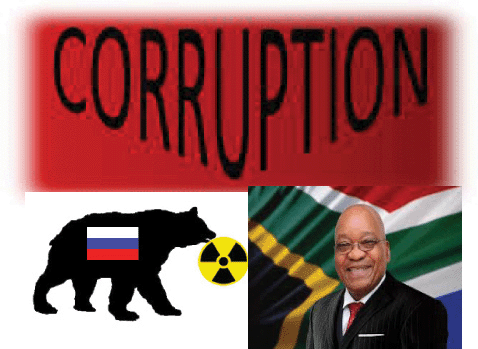
His recent dramatic push to fast-track an expensive and highly controversial nuclear power station build is therefore very much out of character. But Zuma’s advocacy of the nuclear build needs to be understood in terms of another hallmark of his presidency – state capture. This expression refers to the systematic takeover of state institutions by presidential allies and the resulting exploitation of institutions for commercial advantage and profit by his benefactors.
It’s already become clear who is likely to benefit from South Africa pursuing the option to build nuclear power stations. The list includes the Gupta brothers and Zuma’s son Duduzane through their links to the Shiva uranium mine.
And then there’s Zuma himself. Speculation about why the president appears to be favouring a deal with Russian company Rosatom ranges from allegations of grand scale individual kickbacks to alleged commitments linked to funding for the African National Congress.
The controversy around the nuclear power option was precipitated three years ago when it emerged that the government had signed an agreement with Russia that paved the way for the use of Russian technology in planned new nuclear power stations. The problem was that there’d been a complete lack of due process – no costing, no public consultation, no proper proclamation and no competitive bidding. It was no surprise that the courts declared the awarding of the nuclear build to Russia illegal.
On top of this a very strong case has been mounted against South Africa pursuing nuclear power. Reasons include the fact that it can’t afford it, and doesn’t need nuclear in its energy mix.
Despite all of these developments, and the growing controversy and mounting opposition to the deal, Zuma appears determined to get it done before his term as president of the ANC ends in December. In the last of the reshuffles he appointed one of his closest allies, David Mahlobo, to the energy portfolio. This is generally seen as a last ditch attempt to roll out the nuclear build in the face of now massive opposition.
Reports suggest that this reshuffle was occasioned by Russian displeasure over what they see as a broken promise to award the building contract to Rosatom.
The energy minister’s next steps
Mahlobo appears to have devoted his first few weeks in office entirely to furthering the nuclear project. He has been active in the media declaring the nuclear build as a given – and necessary.
Mahlobo’s next steps are likely to be:
He is reported to be planning to release – in record time – a new energy plan. This, some suspect, will be biased towards nuclear.
The issuing of a request for proposals to build the nuclear plants to potential developers like Rosatom. Most observers expect the evaluation to favour Rosatom regardless of the merits of the other bidders.
Signing an agreement with Rosatom. This could mirror the USD$30 billion deal Russia signed with Egypt which, on the surface, will appear attractive because it would offer favourable terms such as annual interest of only 3% and the commencement of repayments after 13 years. But when scaling the 4.8 GW Egyptian agreement up to the 9.6 GW envisioned for South Africa, the total cost then already exceeds R1 trillion. Annual repayments from year 14 to year 35 then amount to about 5% of South Africa’s annual fiscus. Any cost overruns, which are common in many other nuclear builds, would vastly increase the debt further.
What’s changed
The global energy landscape has changed dramatically since South Africa first mooted the idea of supplementing its power mix with more nuclear. Major developments and changes include:
Nuclear plants are major long term investments, and these projects will not survive lengthy construction and operation periods without broad public support. There is definitely a lack of public support in South Africa.
The Zuma-Mahlobo work plan will face major opposition by other parties, civil society and even critics within the ruling party. Lengthy court challenges will query the validity of the energy plan process, the public consultation, the regulatory aspects, the site selection and the constitutionality of the entire process. Public protests highly effective in other spheres would now be directed against the nuclear build. The ruling party would probably abandon the scheme if it proves politically costly.
The danger is, however, that huge funds will have been wasted in coming to this realisation.
The stakes are high. Zuma’s efforts to promote this unpopular nuclear project are weakening him politically. Even party comrades perceived to be in his inner circle – like newly appointed Finance Minister Malusi Gigaba – recognise that going ahead with the programme at this stage would cripple the country economically. Repeated ministerial reshuffles to sideline his critics has further damaged Zuma’s standing in the ruling party and in broader society.
The Brothers Who Bought South Africa, The continent’s most important economy now appears to function for the benefit of one powerful family. Bloomberg, By Matthew Campbell and Franz Wild, 9 Nov 17
“….– Since Nene’s firing, long-standing questions about the scale of the Guptas’ power in South Africa have exploded into the most severe political and economic crisis since the end of apartheid. The family has been accused by activists and opposition politicians of stacking the leadership of powerful state companies, rigging bids in favor of suppliers it controls, and even helping orchestrate a planned $70 billion nuclear-power deal with Russia, for which it could supply vast quantities of uranium—all while using an alliance with Zuma to neuter law enforcement agencies that would otherwise shut down its efforts. Blue chip companies including McKinsey, KPMG, and SAP have been embroiled in what’s fast becoming a global scandal……..
In 2005 the brothers began putting Zuma’s family on their payroll. They hired his son Duduzane, then in his early 20s, as an IT specialist; appointed Duduzane’s twin sister, Duduzile, as a company director; and made one of Zuma’s wives (polygamy is legal in South Africa, and Zuma currently has four) a communications officer.
Over the years, Duduzane became an integral node in the Guptas’ empire, both as a shareholder in uranium and coal mines and a director in a string of other companies. …….
There was at least one more avenue by which money might flow from Eskom to Gupta-connected companies. In 2010 the family’s investment company borrowed about 250 million rand from a state bank to buy a South African uranium mine. It was a curious purchase—there was no real buyer for the uranium, because South Africa has only one aging nuclear plant. In 2014, however, Zuma’s administration laid out a grand plan that would make the mine’s value soar: He proposed building six massive nuclear plants for Eskom at an ultimate cost that could exceed $70 billion.
The idea was controversial from the start. In addition to immense reserves of coal, South Africa has a vibrant renewable-energy sector and no obvious need for nuclear power.
Zuma has dismissed the criticism, arguing the country needs to diversify its energy sources—and strategic alliances. In 2014, he and President Putin agreed that Russia’s state nuclear agency, Rosatom Corp., would provide technology for the plants.
The next summer, Zuma was back in Russia for an economic summit, joined by his senior ministers—including Nene, the then-finance chief. Toward the end of the conference, according to two officials who were present, Zuma cornered Nene in a briefing room about the nuclear deal. The president and several other ministers demanded that Nene provide financial guarantees that would allow Eskom and Russia’s relationship to move ahead. Nene refused; even under the most optimistic projections, he said, a nuclear project of the scale Zuma envisioned would severely strain South African finances.
Zuma complained bitterly about Nene’s resistance, the summit officials say. Not long afterward, Nene’s deputy, Jonas, found himself in the Guptas’ sitting room at Saxonwold, being offered his boss’s job…….
The Flagstaff City Council officially opposed the transportation of uranium ore and other radioactive materials through the city and neighboring communities at its meeting Tuesday night.
The resolution, however, will have no ability to control the route trucks hauling the material will take. At a meeting last month, City Attorney Sterling Solomon and Assistant to the City Manager Caleb Blaschke said the city is preempted from regulating the transportation of uranium ore and all hazardous materials by the U.S. Department of Transportation.
The council voted 6-1 on a resolution stating the city’s opposition to the transportation of uranium ore and reaffirming Flagstaff as a “nuclear free zone.” Councilman Scott Overton was the lone “no” vote on the resolution.
At Tuesday’s meeting, 15 members of the public, including a representative from the Havasupai Tribal Council and state Representative Wenona Benally, spoke. All public speakers voiced their support for the resolution and some asked the council to take the move a step further and craft a legally binding ordinance to stop the transportation of uranium ore through Flagstaff…….
The council also directed the city staff to lobby the federal government to change its policy preempting local control over the material’s transportation.
Members of the public, including many from a group called “Haul No,” filled the council chambers Tuesday evening and erupted into thunderous applause when the resolution passed.
Evans said other towns and cities in northern Arizona look to Flagstaff to set an example as the largest city in northern Arizona.
“I believe the legacy of uranium mining in northern Arizona is unjust,” she said.
Rick Perry’s Coal And Nuclear Subsidy Could Cost The U.S. Economy $10.6 Billion Per Year, Forbes, Silvio Marcacci, 6 Nov 17, The U.S. Department of Energy’s Notice of Proposed Rulemaking (NOPR) directing the Federal Energy Regulatory Commission (FERC) to subsidize coal and nuclear generation is opposed by nearly every side of America’s electricity industry – from market operators and conservative analysts to a bipartisan group of former FERC commissioners – except for those who would directly benefit from it.
Reasons for opposing the NOPR range from potentially destroying wholesale power markets, to free trade principles, or insufficient review time, but beyond Rick Perry suggesting the proposal’s price was equal to “the cost of freedom,” DOE hasn’t quantified the NOPR’s economic impact or which plants it would subsidize.
The comments from Nuclear Regulation Authority Chairman Toyoshi Fuketa suggest Japan may not make headway in meeting its electricity generation targets. By 2030, the country was expecting nuclear to power about one-fifth of its generation. However, utilities are having difficulty grappling with tougher rules on protecting reactors from natural disasters in the earthquake-prone country.
Following the Fukushima nuclear disaster in 2011, the world’s worst since Chernobyl in 1986, the NRA was set up in 2012 to draft new safety standards that have been described as among the world’s toughest.
Since then, 12 reactors at six nuclear plants have passed the safety requirements needed to restart, but only four reactors are currently operating. One more reactor that resumed operations after meeting the requirements has been shut down for scheduled maintenance.
Most of the approvals have been for reactors in western Japan and not on the east coast where Tokyo Electric Power Company Holdings Inc.’s Fukushima No. 1 station is located. The plant suffered multiple reactor meltdowns after an earthquake on the northeast coast caused a tsunami that swamped the site.
“We have accumulated experience in safety reviews, but comparatively speaking, many of the plants in eastern Japan that we are reviewing now have difficult natural conditions,” Fuketa, 60, said in the interview. “It’s doubtful the pace of approvals would quicken.”
A majority of Japanese oppose nuclear power after Fukushima, and restarts are a delicate political issue rather than just a matter of meeting technical safety requirements.
When asked if he could place a number of how many reactors may be approved for a resumption of operations in the next five years, Fuketa said: “I honestly do not know.”
About a dozen other reactors are going through safety checks as part of a relicensing process under the new rules.
Fuketa is known for taking tough positions during safety reviews of reactors and has been instrumental in directing the clean-up of the wrecked Fukushima plant.
The government set an energy mix plan in 2015 that forecasts relying on nuclear power to generate between 20 to 22 percent of the country’s electricity in 2030. That requires having about 30 reactors operating by then.
The nation’s nine regional power utilities and a wholesaler, Japan Atomic Power Co., have 42 nuclear reactors for commercial use, with a total generating capacity of 41,482 megawatts.
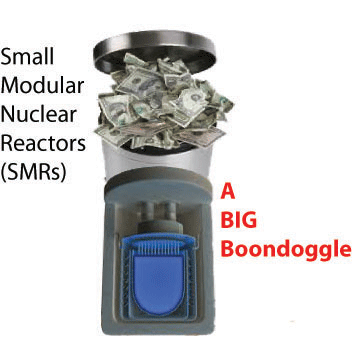
FT 7th Nov 2017,British ministers are preparing to revive the UK’s faltering effort to
create a new generation of small-scale nuclear power plants in spite of an
official analysis that cast doubt on the economic case for the technology.
Talks have intensified in recent weeks between government officials and
companies including Rolls-Royce, the UK engineering group, over potential
public funding to support development of so-called small modular reactors
(SMRs).
Greg Clark, business secretary, is keen to put the UK at the
forefront of technology seen as a more affordable alternative to
large-scale nuclear reactors such as those under construction at the £20bn
Hinkley Point C plant in south-west England.
Development of SMRs is regarded as crucial to the future of the nuclear industry as it struggles
to remain competitive against the rapidly falling cost of renewable wind
and solar power. The UK faces competition from the US, Canada and China in
its effort to establish a leading position in the technology.
Support for SMRs is expected to be part of a wider commitment to nuclear engineering in
a new industrial strategy to be unveiled by the government this month.
However, the enthusiasm has been complicated by a technology assessment, commissioned by the business department and carried out by EY, the accounting firm, which reached a negative verdict on the cost-effectiveness of SMRs. The findings are expected to be published in the coming weeks and
will confront the government with awkward questions about why public money
should be used to help commercialise the unproven technology. https://www.ft.com/content/bddfda80-c314-11e7-b2bb-322b2cb39656
DOE Plan to Prop Up Coal and Nuclear Gets Little Support, NRDC, November 07, 2017Miles Farmer
The clock is ticking for the Federal Energy Regulatory Commission (FERC), the agency in charge of national electricity markets, to make a decision on a rushed proposal from the Trump-run Department of Energy (DOE) to massively subsidize underperforming coal and nuclear power plants, costing consumers billions. Today marks the close of the very short public comment period on the bailout, which has generated an overwhelmingly negative reaction.
Groups across the energy industry are responding to one another’s initial comments submitted two weeks ago in response to DOE’s proposal to FERC, which plans to make its decision by Dec. 11 (our initial comments are discussed here). NRDC is joining with Earthjustice, Environmental Defense Fund, Sierra Club and others in these “reply” comments (a link will be posted here after they are filed). As our comments emphasize, while a handful of interested parties linked to the coal and nuclear industries supported the proposal, none successfully countered its fundamental flaw: it orders customers to pay coal and nuclear plants extra money simply because they can keep 90 days’ worth of energy supply onsite (a requirement designed precisely because it benefits coal and nuclear), notbecause they are necessary to provide reliable or “resilient” grid service.
DOE’s proposal is a distraction
As my colleague Jennifer Chen laid out in a separate set of initial comments from NRDC (discussed here), a real process to investigate resilience would entail defining the term in a way that distinguishes it from reliability already accounted for by market rules, establishing metrics to measure it, and allowing resources to compete to deliver it in a technology-neutral manner.
The data indicates that resilience primarily depends on power delivery infrastructure like substations and power lines, so bailing out coal and nuclear units is the wrong approach. ……..
The best next steps? Just say no
Ultimately, DOE’s proposal is nothing more than an illegal plan to advance an expensive and ineffective solution to solve a non-existent crisis. Consumers, grid operators, and major sectors of the energy industry have overwhelmingly rejected the DOE’s blatant attempt to prop up uncompetitive coal and nuclear power. The proposed rule’s few supporters have failed to provide any evidence that FERC should move forward with this ill-considered scheme.
* France drops 2025 target for reducing share of nuclear
* Hulot says new target to be drawn up in coming year
* Aim remains to reduce share of nuclear to 50 pct
* Greenpeace says Hulot giving in to nuclear lobby (Adds Hulot comments, background)
By Geert De Clercq and Michel Rose PARIS, Nov 7 (Reuters) – President Emmanuel Macron’s government on Tuesday postponed a long-held target to reduce the share of nuclear energy in France’s electricity generation.
Environment Minister Nicolas Hulot said it was not realistic to cut nuclear energy’s share in the power mix to 50 percent by 2025 from 75 percent now and said doing so in a hurry would increase France’s CO2 emissions, endanger the security of power supply and put jobs at risk.
He did not set a new deadline, but said that over the next year the government would draw up a “pluri-annual energy programme” to reach the 50 percent target “as soon as possible”.
“It will be difficult to maintain the target of reducing the share of nuclear to 50 percent by 2025,” Hulot told reporters following a cabinet meeting.
Hulot said that while the timing is delayed for now, in a year’s time the government would have a clear programme based on rational criteria to decide which reactors to close and when.
In 2015, the previous government of Socialist Francois Hollande had voted an energy transition law which set a target of reducing the share of nuclear in the power mix to 50 percent by 2025 from the current 75 percent. But Hollande had taken no concrete steps towards closing any reactors.
Centrist Macron, elected in May, had promised to respect this target and Hulot, France’s best-known environmentalist, said in July France might have to close up to 17 of its 58 reactors by 2025 to achieve the target.
Widely seen as the guardian of the Macron government’s green credentials, the popular Hulot – a former television documentary maker turned environmentalist – had in recent months repeatedly said France needed to close several nuclear plants.
But he received little public support from Macron, a strong supporter of nuclear, or Prime Minister Edouard Philippe, a former employee of state-owned reactor builder Areva.
Two weeks before the government was formed in mid-May, a source close to Macron told Reuters he was considering delaying the target for reducing France’s reliance on nuclear.
State-owned utility EDF, the world’s biggest operator of nuclear plants, has long said it made no sense to shut down functioning reactors and instead wanted to extend the lifespan of its nuclear fleet from 40 to at least 50 years.
EDF shares were up 1.2 percent after Hulot’s announcement, outperforming a flat French bourse.
EDF stock had plunged as much as 7 percent on the day Hulot was appointed environment minister on the expectation that he would push for less nuclear and more renewables. nL8N1IJ43S]
Hulot, who had made a failed bid to become the green candidate in the 2012 presidential election, had been courted by both Hollande and his conservative predecessor Nicolas Sarkozy to become environment minister.
Hulot told French daily Le Monde last month that he had given himself a year to see whether he could reform French energy and agricultural policies.
Greenpeace said Hulot had already shown weakness in fighting fossil fuel and was now jeopardising France’s energy transition.
“He should be a bulwark against the oil and nuclear lobbies,” the NGO said in a statement. (Reporting by Geert De Clercq and Michel Rose; Editing by Ingrid Melander and Edmund Blair)
Veterans in Congress speak out against invading North Korea, Jerick Sablan, jpsablan@guampdn.com Pacific Daily News. ChT Nov. 6, 2017 Veterans in Congress are concerned about the possibility of a ground invasion of North Korea, which they said could kill millions of people. They have asked President Trump to tone down his rhetoric.
“It could kill millions of South Koreans and put troops and civilians in Guam and Japan at risk,” they stated Monday.
California Rep. Ted Lieu, D-California, along with 15 fellow veterans from the House and Senate, issued the bipartisan joint statement.
Commonwealth of the Northern Mariana Islands Del. Gregorio Sablan is one of the congressmen who joined in the statement.
The statement comes after a letter from the Joint Chiefs of Staff and a report from the Congressional Research Service on the military action against North Korea. …….
Veterans in Congress are concerned about the possibility of a ground invasion of North Korea, which they said could kill millions of people. They have asked President Trump to tone down his rhetoric.
“It could kill millions of South Koreans and put troops and civilians in Guam and Japan at risk,” they stated Monday.
California Rep. Ted Lieu, D-California, along with 15 fellow veterans from the House and Senate, issued the bipartisan joint statement.
Commonwealth of the Northern Mariana Islands Del. Gregorio Sablan is one of the congressmen who joined in the statement.
Donald Trump accused of obstructing satellite research into climate change https://www.theguardian.com/science/2017/nov/05/donald-trump-accused-blocking-satellite-climate-change-research Republican-controlled Congress ordered destruction of vital sea-ice probe, Guardian, Robin McKie, 6 Nov 17, President Trump has been accused of deliberately obstructing research on global warming after it emerged that a critically important technique for investigating sea-ice cover at the poles faces being blocked.
The row has erupted after a key polar satellite broke down a few days ago, leaving the US with only three ageing ones, each operating long past their shelf lives, to measure the Arctic’s dwindling ice cap. Scientists say there is no chance a new one can now be launched until 2023 or later. None of the current satellites will still be in operation then.
The crisis has been worsened because the US Congress this year insisted that a backup sea-ice probe had to be dismantled because it did not want to provide funds to keep it in storage. Congress is currently under the control of Republicans, who are antagonistic to climate science and the study of global warming.
“This is like throwing away the medical records of a sick patient,” said David Gallaher of the National Snow and Ice Data Center in Boulder, Colorado. “Our world is ailing and we have apparently decided to undermine, quite deliberately, the effectiveness of the records on which its recovery might be based. It is criminal.”
The threat to the US sea-ice monitoring programme – which supplies data to scientists around the world – will trigger further accusations at this week’s international climate talks in Bonn that the Trump administration is trying to block studies of global warming for ideological reasons.
Earth’s sea ice has shrunk dramatically – particularly in the Arctic – in recent years as rising emissions of greenhouse gases have warmed the planet. Satellites have been vital in assessing this loss, thanks mainly to America’s Defence Meteorological Satellite Programme (DMSP), which has overseen the construction of eight F-series satellites that use microwaves sensors to monitor sea-ice coverage. These probes, which have lifespans of three to five years, have shown that millions of square kilometres of sea ice have disappeared from the Arctic over the past 20 years, allowing less solar energy to be reflected back into space – and so further increasing global temperatures – while also disrupting Inuit life and wildlife in the region.
At present three ageing satellites – DMSP F16, F17 and F18 – remain in operation, though they are all beginning to drift out of their orbits over the poles. The latest satellite in the series, F19, began to suffer sensor malfunctions last year and finally broke down a few weeks ago. It should have been replaced with the F20 probe, which had already been built and was being kept in storage by the US Air Force. However it had to be destroyed, on the orders of the US Congress, on the grounds that its storage was too costly.
Many scientists say this decision was made for purely ideological reasons. They also warn that many other projects for monitoring climate change, including several satellite missions, face similar threats from the Trump administration and Congress.
Such losses have serious consequences, say researchers. “Sea-ice data provided by satellites is essential for initiating climate models and validating them,” said Andrew Fleming of the British Antarctic Survey. “We will be very much the poorer without that information.”
We’ll interdict any nuclear deal – DA Fin 24 Nov 05 2017 Liesl Peyper Cape Town – The Democratic Alliance (DA) says it is ready to interdict any attempt by Energy Minister David Mahlobo to force through a nuclear deal.
The party’s energy spokesperson Gordon Mackay said in a statement the DA will use “every legal and Parliamentary tool at its disposal” to ensure that South Africans won’t be “shackled” to the massive debt that will flow from an unaffordable and unnecessary nuclear deal, estimated at around R1trn.
City Press reported on Sunday that officials at the Energy Department have been forced to work overtime, including weekends, to complete the Integrated Resource Plan (IRP) by November 14 – four weeks ahead of schedule.
The IRP, which will determine the energy mix the country needs, was expected to be finalised in February next year, but will now be finished in the next two weeks………
Last week, Finance Minister Malusi Gigaba told City Press that nuclear energy was neither affordable for the sluggish economy, nor immediately necessary.
The stance was repeated by National Treasury deputy director general Michael Sachs who told Parliament on Friday that neither South Africa’s budget nor the country can afford nuclear.
Sachs said National Treasury in 2015 already said 9.6GW of nuclear energy would have a negative effect on the total debt burden and the balance of payments.
“It would not be prudent to proceed with that prior to the stabilisation of national debt and that stabilisation has been pushed out. All I can say over medium term we haven’t allocated resources. Our view is that it’s not affordable at present. I can’t give categorical commitments, but we don’t foresee it being affordable over the current medium term expenditure framework.”
Mahlobo, however, who has been in his new job for just more than two weeks after three years as state security minister, has contradicted Gigaba and National Treasury about South Africa’s pursuit of a nuclear build programme……….
Mahlobo was appointed Energy Minister early in October during a surprise Cabinet reshuffle, which some commentators took as a sign that SA wanted to fast-track its nuclear ambitions.
Mahlobo rushes nuclear deal, News 24, Setumo Stone, 5 Nov 17, As Energy Minister David Mahlobo forces his nuclear power plans into action, officials at his department are working weekends to finalise the country’s reviewed integrated energy resource plan – four months ahead of schedule.
The plan to determine the energy mix the country needs was expected to be finalised in February next year, but will now be finished in the next two weeks.
“We would have been talking February, but now we are talking November 14,” said an insider, vouching for the level of hard work the minister was putting into his job.
This would enable Mahlobo to make projections of the country’s future energy demands based on “empirical evidence”.
Last week, Finance Minister Malusi Gigaba told City Press that nuclear energy was neither affordable for the sluggish economy, nor immediately necessary. Mahlobo, who has been in his new job for just more than two weeks after three years as state security minister, is now on a collision course with Gigaba and Treasury.
The nuclear energy plan is expected to cost South Africa about R1 trillion, an amount that economists and politicians from across the spectrum – including the ANC – say the country’s struggling economy cannot afford. ……..
The countries with the leading technology are France, Russia, the US, South Korea and China. Companies from these countries as well as their governments have been aggressively wooing South Africa’s decision-makers and working to sway public opinion their way. But many believe that President Jacob Zuma’s cosy relationship with his Russian counterpart Vladimir Putin, as well as Mahlobo’s own close ties to the Kremlin and its security establishment, has already tilted the scales in that country’s favour.
When Mahlobo’s predecessor Mmamoloko Kubayi was moved out of the department in the Cabinet reshuffle last month, there was widespread speculation that it was because she was not moving with haste on the nuclear programme……….
While Eskom waits for its R1.5 billion from Trillian and McKinsey and company, thousands of people who installed solar geysers under the solar geyser home incentive scheme remain out of pocket.
The real number is unknown at this stage and the cessation of the programme – believed to be since January 2016 – speaks directly to Eskom’s appeal to the National Energy Regulator of South Africa to approve its request for a 19.9% price hike.
Eskom has become a victim of its own successful campaign during the rolling blackouts to use as little of its product as possible.
Now, it is producing surplus electricity – 5 600MW at peak in January – and is hell-bent on making as many people as possible pay for electricity to use its product.
It had 162 104 customers connected to the grid between January and October, and it appears the organisation is more focused on turning bucks than in green targets.
Meanwhile, the Independent Power Producer Procurement Programme has said: “South Africa has a high level of renewable energy potential and in line with the national commitment to transition to a low carbon economy, 17 800MW of the 2030 target (according to the IRP 2010) of newly generated power to be developed are expected to be from renewable energy sources, with 5 000MW to be operational by 2019 and a further 2 000MW (i.e. combined 7 000MW) operational by 2020.”
The question is why does Eskom and the department of energy (DE) not make surplus electricity available at a cheaper rate, for economic development.
The answer lies perhaps in an article on The Conversation by University of Johannesburg professor of physics Hartmut Winkler.
Winkler has postulated that two powerful lobbies against renewable energy were at work. “One is pro-coal, the other pro-nuclear. This has made the success of the renewable energy projects a target for attacks from interested parties in both,” said Winkler.
“Disrupting the renewable energy sector would ensure that the coal sector remains dominant. And that, over time, it is gradually displaced by nuclear,” he wrote.
“The lobby groups attached to coal and nuclear appear to have had powerful allies on the state utility’s board. There is mounting evidence that they have been furthering the interests of a group linked to the Gupta family,” Winkler claimed.
All the dithering, corruption and cover-ups have consequences for ordinary folk. Meanwhile, Eskom said the organisation has established the National Solar Water Heating programme on behalf of the DE.
For more than a week, Saturday Citizen has attempted to obtain answers from the DE, but its spokesperson, Johannes Mokobane, kept referring us to the website. – amandaw@citizen.co.za
Commentary on nuclear energy sparks debate over risks, safety Straits Times, NOV 5, 2017, S’pore is not ready, say experts, following ST Opinion contributor’s article advocating it Sue-Ann Tan
Singapore is not ready to tap nuclear energy – this is the stance of the Government and experts in the field whom The Sunday Times spoke to.
Their responses come after a debate in the past two weeks between writers to The Straits Times Forum page and ST Opinion contributor Lim Soon Heng…….
Forum writers argued that nuclear reactors carried the risk of accidents, which would have vast consequences for a small country like Singapore. Letter writer Teoh Woi Khon suggested Singapore should adopt a “wait-and-see approach” instead of rushing into harnessing nuclear energy……