PSEG said that its two nuclear plants account for between 40 and 50 percent of electricity production in New Jersey, but are in danger of becoming financially unviable within two years. They said that would cost the state 1,600 jobs.
Netherlands tax-payers up for costs of nuclear maintenance, including for research reactor
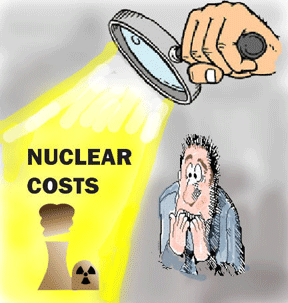 Updating and cleaning up Dutch nuclear industry could cost state €400m http://www.dutchnews.nl/news/archives/2017/12/updating-and-cleaning-up-dutch-nuclear-industry-could-cost-state-e400m/ Updating the Netherlands nuclear industry could cost the state up to €400m, according to a review by four senior civil servants and quoted in Tuesday’s Volkskrant. Officials from the economic affairs, health, environment and finance ministries were asked to assess the cost of the clean-up and update by previous health minister Edith Schippers.
They say the biggest financial hit will come from demolishing the Dodewaard nuclear power station which was shut down in 1997. The government has insisted until now that the bill is paid by the power station’s shareholders, which include Vattenfall, the Volkskrant points out. However, the report indicates civil servants now assume the shareholders will default and put the cost of that project to the state at up to €200m.
A further €100m will be needed to deal with nuclear waste created at the Petten reactor – which makes medical isotopes. That waste is currently stored above ground near the Borselle nuclear power station and the state has paid €200m towards disposing of Petten’s waste over the past 20 years, the report says. In addition, the officials say that a ‘rough estimate’ of €60m to €100m will be needed to build a new reactor at Petten – another issue which the state has always assumed will be privately funded.
Confidential The Volkskrant says the report is notable because it is virtually identical to one sent to parliament in July, although that report did not contain the financial details. At the time, a finance ministry spokesman told the paper the figures were confidential. However, the paper has now been published on the website containing all the documents used during the formation of the current government and was spotted by anti-nuclear power group Laka. Laka spokesman Dirk Bannink said the report shows that the nuclear industry cannot exist without state support. ‘The government has to step in every time,’ he said.
EDF keen to market nuclear to Asia, demands tax-payer support to build new nuclear reactors
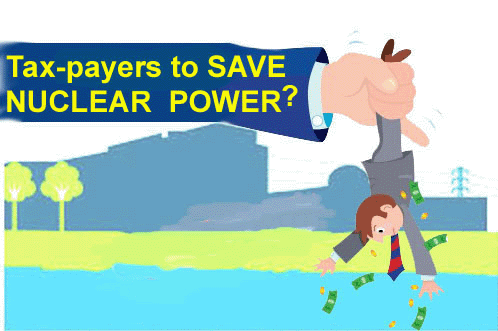
 MEDIA-EDF says no new nuclear reactors in France without state support-Ouest France, https://www.reuters.com/article/edf-nuclearpower/media-edf-says-no-new-nuclear-reactors-in-france-without-state-support-ouest-france-idUSL8N1OF3EP Reporting by Geert de Clercq, Editing Dominique Vidalon,Reuters Staff, 15 Dec 17,
** French state-controlled utility EDF’s CEO Jean-Bernard Levy tells Ouest France daily that EDF can no longer build new nuclear reactors in France without state support.
Asked when EDF could build new reactors at home, Levy says “Henceforth, we cannot build new reactors without adequate regulation providing guaranteed income”. He said that Flamanville was launched at a time of high power prices and that now all power sources, nuclear as well as renewable, need to get the same visibility on sales prices.
** For its project to build two EPRs in Hinkley Point, Britain, EDF has obtained an EU-approved state-guaranteed price of 92.5 pounds per megawatt-hour over 35 years, which is way above current market prices.
** The centrist government of French President Emmanuel Macron is not talking about building new nuclear reactors, but about closing old reactors in order to reduce the share of nuclear energy in French power generation to 50 percent by around 2035 from 75 percent today.
** Asked when the first Areva-designed EPR reactor could start up, Levy said ”that should be in a few weeks in China. The start-up will be gradual, to make sure everything works well.
** Levy said EDF expects to get approval to charge nuclear fuel in its Flamanville reactor at the end of 2018. He said that once operational, Flamanville will be a good showcase to sell nuclear reactors in Asia.
UK’s Office for Nuclear Regulation approves nuclear power plans for Wylfa, Anglesey. Now where’s the funding?

 Plans for major nuclear power station in Wales win green light, Office for Nuclear Regulation approves design for new reactor at Horizon Nuclear Power’s plant at Wylfa, Anglesey, Guardian, Adam Vaughan, 13 Dec 17, Plans for a major new nuclear power station in Wales have taken a crucial step forward as UK regulators approved the project.
The Office for Nuclear Regulation and two other government bodies gave the green light on Thursday for the Japanese reactor design for Horizon Nuclear Power’s plant at Wylfa, marking the end of a five-year regulatory process……
Attention will now turn to financing the Hitachi-backed project on the island of Anglesey, which was the site of Britain’s oldest nuclear plant until it closed two years ago.
During a visit by UK ministers to Japan last December, it emerged that London and Tokyo were considering public financing for Wylfa. This would be a significant break with the UK government’s previous approach.
Hitachi has already spent £2bn on development. Last week the consortium said it needed a financial support package by mid-2018 or it could stop funding development.
Japan’s Toshiba has bowed out of the race to build nuclear plants in the UK, confirming last week that a South Korean nuclear firm had been chosen to buy its venture to build a plant in Cumbria.
Does Georgia even need two additional nuclear reactors?
 Critics Of Plant Vogtle Say Georgia Doesn’t Need New Nuclear, WABE, • Next week, Georgia regulators will decide on the future of the country’s only nuclear power construction project.
One big issue is how much completing the expansion at Plant Vogtle will cost, after years of delays, rising prices and the bankruptcy of the lead contractor – and how much of that cost Georgia Power ratepayers are likely to bear.
But another question is, does Georgia even need two additional nuclear reactors?………
the demand for energy didn’t grow as much as Georgia Power projected when it began the Vogtle expansion. The Great Recession took a bite out of business growth and the ensuing expected energy need. Increasing use of energy-efficient appliances has made a difference, too, according to energy consultant Matt Cox, CEO of the Greenlink Group.
“Georgia’s GDP has been growing pretty healthily for the past several years while our electricity consumption has not been doing the same,” Cox said.
According to Cox’s calculations, Georgia Power could get by without the Vogtle expansion. He said the company could boost energy efficiency, add more renewables and buy power from other companies.
Cox testified this week at the Georgia Public Service Commission’s hearings on Plant Vogtle on behalf of critics of the project…….
Georgia is the only state in the nation with active nuclear power construction. Earlier this year, South Carolina utilities canceled a similar expansion project. That leaves Vogtle as the only project left of what was supposed to be a “nuclear renaissance.”
“No one in their right mind would start a new nuclear plant from scratch today. It’s twice as expensive as other ways of providing the same energy needs,” said Peter Bradford, a professor at Vermont Law School who served on the U.S. Nuclear Regulatory Commission. He also testified on behalf of Vogtle critics at the hearings this week.
“Even half-finished, it’s not at all clear that it isn’t cheaper to cancel and meet the needs some other way,” he said.
The Georgia Public Service Commission will vote Thursday on whether to allow construction on the two nuclear reactors to continue. https://www.wabe.org/critics-plant-vogtle-say-georgia-doesnt-need-new-nuclear/
Bill to Help Rescue New Jersey Nuclear Plants Is Unveiled
New Jersey’s electric utilities would be required to purchase credits from nuclear power plants to help rescue the industry under new legislation. U.S. News, By MICHAEL CATALINI, Associated Press, 15 Dec 17 TRENTON, N.J. (AP) — New Jersey‘s electric utilities would be required to pay for credits from nuclear power plants under legislation lawmakers unveiled Friday as part of an effort the state’s largest energy company says is needed to rescue a major source of power in the state’s energy grid.
Why New Jersey really doesn’t need a nuclear industry bailout
 New Jersey’s considering a nuclear bailout. Here’s why we don’t need it. http://blogs.edf.org/energyexchange/2017/12/12/new-jerseys-considering-a-nuclear-bailout-heres-why-we-dont-need-it/
We don’t need a nuclear bailout, especially since the utility acknowledges that its plants are profitable. To approve subsidies for PSEG’s power plants during this time would be misguided because the company hasn’t provided any proof that their facilities are in need of financial assistance to serve customers or what, if anything, customers would get out of the deal.
Where’s the proof?
There is no proof that PSEG needs subsidies. PSEG has refused to release any information or analysis that supports the idea that their nuclear plants are struggling financially. Has PSEG opened its books so independent market analysis can be conducted, or considered how its request will affect people’s electricity bills? Has the legislature considered how this will impact clean energy investments, or jobs and economic development? The answer is no.
Who pays for what?
Bailing out these plants would surely pad PSEG’s bottom line, but what about the customers who would foot the bill?
PSEG has 2.2 million electricity customers throughout New Jersey. If this bill is passed, customers could pay $350 to $400-million dollars a year within the next 10 years. New Jersey residents and businesses will be ill-served if the focus of this debate remains solely on PSEG’s corporate strategy.
To protect customers’ interest in the future, we must consider this bailout in context, not isolation. If the bailout PSEG is requesting is granted solely to support uneconomic nuclear plants, how will that impact state investment in other clean energy alternatives like energy efficiency and solar?
How is PSEG double-dipping?
The New Jersey legislature isn’t the only venue in which PSEG is seeking a bailout. PSEG was one of a few electric utilities that submitted comments in support of U.S. Energy Secretary Rick Perry’s proposed rulecurrently before the Federal Electricity Regulatory Commission (FERC) to prop up aging coal and nuclear plants, rather than allowing market competition.
Secretary Perry’s proposal has attracted nearly universal opposition – from gas, solar and wind companies, Democrat and Republican members of Congress, conservative organizations, environmental and consumer advocacy groups, free-market advocates, and others in the business community. It’s not an exaggeration to say the only groups that support the Department of Energy’s proposal are those in the coal or nuclear industry who stand to benefit or those lobbying on their behalf. In fact, several utility companies that own fossil fuel assets came out against the DOE proposal because they believe in competitive markets.
Where do we go from here?
Let’s slow down. There are legitimate reasons to be concerned about the premature retirement of these plants, including the loss of low carbon-emitting energy sources before the transition to clean energy is complete and the loss of jobs and contributions to the local tax base. But the issues are complex and can’t be considered in a rushed lame duck legislative session.
Before the debate continues, and certainly before there’s any decision on whether or not to provide subsidies, PSEG must provide proof that its plants are in financial distress, and an independent analysis using all available market data must be conducted.
Moving in favor of PSEG’s proposed bailout now would put the state’s economy and energy future on the wrong course. These issues are too complex and too important to be rammed through.
America’s trillions of dollars militaristic economy
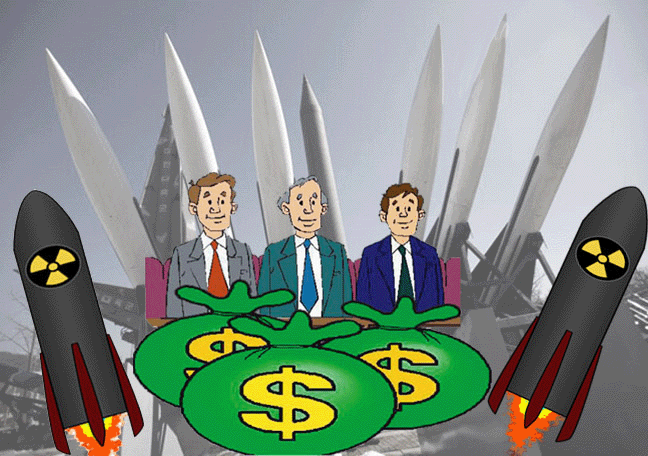
The US Military Is the Biggest “Big Government” Entitlement Program on the Planet , December 10, 2017, By JP Sottile, Truthout |The US economy is caught in a trap. That trap is the Department of Defense: an increasingly sticky wicket that relies on an annual, trillion-dollar redistribution of government-collected wealth. In fact, it’s the biggest “big government” program on the planet, easily beating out China’s People’s Liberation Army in both size and cost. It is not only the “nation’s largest employer,” with 2.867 million people currently on the payroll, but it also provides government benefits to 2 million retirees and their family members. And it actively picks private sector winners by targeting billions of dollars to an elite group of profit-seeking contractors.
The top five overall recipients collectively pulled in $109.5 billion in FY2016, and their cohorts consistently dominate the government’s list of top 100 contractors. They reap this yearly largesse through a Rube-Goldberg-like system of influence peddlers, revolving doors and wasteful taxpayer-funded boondoggles. Finally, it is all justified by a deadly feedback loop of perpetual warfare that is predicated on a predictable supply of blowback.
But this belligerent cash machine doesn’t just produce haphazard interventions and shady partnerships with a motley assortment of strongmen, proxies and frenemies. It also has Uncle Sam caught in a strange cycle of taxpayer-funded dependence that may ultimately be the most expensive — and least productive — jobs program in human history………
Too Big to Fail?
The US stands alone as a globe-spanning empire with 787 overseas bases, “lily pad” deployments and host country facilities in 88 nations and territories, according to the most recent accounting by scholar David Vine. At home, a Google Maps search reveals another 603 bases, depots, arsenals and assorted military facilities peppered around the 50 states. The US dominates the land, sea and skies, and is moving to dominate space…….
taxpayers’ only end product is a larger military with more bases and more weapons. However, without a serious shift toward non-defense government priorities, cutting the defense budget would mean, in the immediate term, many Americans losing their jobs. In the absence of non-military jobs programs and other forms of robust social spending, these workers depend on military tax dollars to fund their livelihoods, their health care and their kids’ educations. Tax dollars sustain the military-driven local and regional economies within which they live and work. Not coincidentally, this misallocated investment in a “war and weapons-based economy” is, as Major Gen. (Ret.) Dennis Laich and Col. (Ret.) Lawrence Wilkerson write, also reflected in the inherent “unfairness” that feeds off the “all-volunteer force.”……….
So, what are the options now that the US finds itself stuck in this paradigmatic trap? There are three possible alternatives.
One is to simply slash the budget. The downside is that it will dislocate millions of people who rely directly and indirectly on defense spending. The upside is that it will force an immediate retreat from both empire and military Keynesianism. This also could stoke some economic growth if the half to three-quarters of a trillion in annual savings was “returned” to taxpayers in the form of a rebate check. Basically, Americans would finally get the “peace dividend” almost 30 years after the Cold War ended.
The second option is the post-WWII demobilization model. That influx of manpower was met with the GI Bill, tax breaks for new homeowners and investments in infrastructure. This is a truly Keynesian solution. Infrastructure jobs and educational subsidies would provide relief to Americans currently reliant on military Keynesianism for their livelihoods. The original GI Bill “returned $7 to the American economy for every $1 invested in the GI Bill,” notes Jared Lyon of the Institute for Veterans and Military Families. And a study by Costs of War Project determined allocating resources to “clean energy and health care spending create 50 percent more jobs than the equivalent amount of spending on the military,” and “education spending creates more than twice as many jobs” as defense spending.
Frankly, either of these two solutions is far better than the third option, which is to continue to misallocate hundreds of billions in precious capital away from the productive economy while wreaking havoc at home and abroad. And that’s the ultimate no-win situation for a militarized economy that has manufactured its share of bloody, no-win situations since the end of World War II. http://www.truth-out.org/news/item/42829-the-us-military-is-the-biggest-big-government-entitlement-program-on-the-planet
Britain’s plans to become a leader in Small Modular Nuclear Reactors
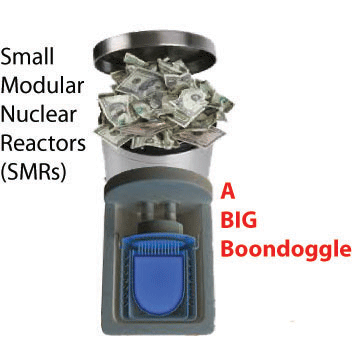 The government has announced up to £56m in funding for the development of
mini-nuclear plants. The money will be available over the next three years
to assess the potential of designs of advanced and small modular reactors
(SMRs). It will also support early access to regulators in order to build
the capability and capacity needed to assess and licence SMRs and will
establish an expert finance group to advise how small reactor projects
could raise private investment in the UK. The first round of funding
comprises up to £4m for feasibility studies and up to £7m to further
develop their capability. Should these efforts prove successful, up to
£40m will be made available for R&D projects to bring the technology into
the mainstream. The government said it wanted the UK to become a world
leader in developing the next generation of nuclear technologies.
Engineering & Technology 8th Dec 2017
It looks as if Saudi Arabia wants uranium enrichment etc as prelude to nuclear weapons development
Beyond Nuclear 6th Dec 2017, Saudi Arabia’s Energy Minister Khalid al-Falih is extending invitations
to the U.S. nuclear industry to launch the Gulf Region’s most ambitious
nuclear power program. The Saudi atomic energy plan is to build as many as
17 nuclear power plants by 2032. The Saudi Arabia government has stated
that its atomic power program will be “self-sufficient” in the
production of nuclear fuel at 5% enriched uranium-235 and purely directed
for civilian power development.
The pronouncement comes as Saudi energy officials remain silent on their past refusal to not pursue high-grade
uranium enrichment and plutonium reprocessing technologies as military
weapons production facilities. In any case, the introduction of nuclear
materials will significantly increase instability and tensions in the
region. http://www.beyondnuclear.org/home/2017/12/6/us-nuclear-companies-invited-to-help-launch-saudi-arabias-da.html
South Africa’s Energy Minister – nuclear build will push ahead, regardless of the correct planning system
 Nuclear will happen, Fin 24, Dewald van Rensburg Johannesburg -South Africa would procure several thousand megawatts of new nuclear power generation capacity, new Energy Minister David Mahlobo declared this week.
He would not say exactly how much, but seemingly intends for nuclear to be 20% of the local power supply by 2030……..
This will result in anything between R25 billion and R50 billion more being spent per year on power in South Africa by 2030 – compared with what would happen under a “least cost” strategy involving no new nuclear and no new coal stations, said Bischof-Niemz.
The wide range is due to the question mark over the cost of nuclear.
Having 20% of power come from nuclear was always the plan and was never really up for consultation, Mahlobo said this week.
On Tuesday, he subjected nongovernmental organisations to a two-hour lecture, and then proceeded to give journalists almost the same lecture at a bizarre and hastily arranged energy indaba on Thursday.
This apparent repudiation of South Africa’s existing system for planning energy investments was presented as obvious and uncontested.
Everyone else just misunderstood South Africa’s energy policy, said the former security minister who inherited the energy portfolio after President Jacob Zuma’s Cabinet reshuffle last month.
Mahlobo used the indaba to quietly announce that the long-awaited Integrated Resource Plan (IRP) had already been approved by Cabinet and that there would be no more consultations on it.
This was not said in the main plenary attended by more than 700 people, but told to journalists at a press conference afterwards that was mostly attended by Mahlobo’s staff, who applauded his answers to the journalists’ questions…….
The official programme was a strange mishmash of presentations and then parallel “commissions” to separately discuss coal, renewable energy, gas, liquid fuels and nuclear.
In the commission on renewable energy, the room was awkwardly silent when moderator Nelisiwe Magubane started the session by instructing everyone that “this is not a platform to discuss the IRP”.
There were chuckles and sighs in the room.
When she asked why no one had any questions, there were murmurs: “They’re all about the IRP!”
When a delegate pointed out that the IRP was central to the discussion, Magubane said that it could not be discussed because “the minister had a meeting with civil society and indicated this is not part of the consultation on the IRP”.
At this point, no one in the room knew that Cabinet had already approved the IRP and precluded any further consultations anyway.
Cabinet spokesperson Phumla Williams confirmed this, and said it was not mentioned in the normal Cabinet statement issued this week because it was felt that Mahlobo should announce it.
The news turns the long battle around energy policy on its head and will almost certainly lead to a new court challenge from environmental groups, which earlier this year succeeded in getting the old decision to procure 9 600MW of nuclear scrapped in court.
Up to now, the expectation had been that a new draft IRP would be produced and offer various options and scenarios for future power investments, followed by extensive public consultations.
Not so, said Mahlobo.
According to the minister, the original IRP of 2010 is still in effect and the apportionment of power sources set in 2010 remains the target.
All that will have changed from the original 2010 IRP is the overall forecast of national power demand, Mahlobo said.
This has two major effects – it demotes renewables back down to 9% of the mix and promotes nuclear back up to 20%.
Modelling done early this year with the latest technology costs created a “least cost” outcome that excludes nuclear and massively scales up renewables, which have become far cheaper in recent years……
A draft IRP released late last year was pilloried for setting arbitrary limits on renewables, which had the effect of putting nuclear back into the energy mix the mathematical model proposes.
The department of energy has since refused to provide documentation on how it modelled the cost of nuclear or to justify its limits on renewables, fuelling speculation that the IRP was being rigged to facilitate a nuclear deal.
“Nuclear, we are going to do it,” Mahlobo told journalists.
According to the minister, there will be new nuclear plants in the Western Cape and the Eastern Cape…….https://www.fin24.com/Economy/nuclear-will-happen-20171210-2
Horizon nuclear venture wants direct tax-payer funding for its Wylfa nuclear station project
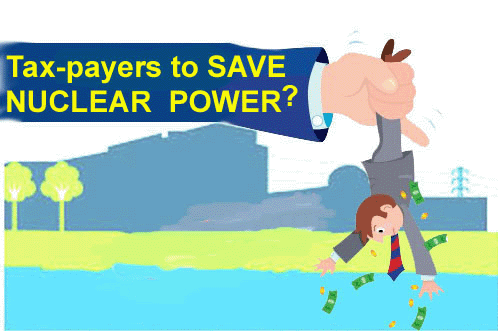
Times 8th Dec 2017. Hitachi could stop funding the development of a new nuclear plant on
Anglesey unless the government agrees a viable financial support package by
the middle of next year, the head of the project has warned.
Duncan Hawthorne, chief executive of the Horizon venture, said that its Japanese
owners had already spent £2 billion and would not keep “throwing a
bottomless pit of cash at a project without some certainty it can get to a
successful conclusion”.
Horizon is in talks with the UK and Japanese governments about possible direct state funding for its proposed plant at
Wylfa Newydd. Ministers appeared yesterday to move closer to agreeing
direct funding as the Nuclear Industry Council, a joint industry-government
body that is co-chaired by Richard Harrington, the energy minister,
recommended looking at models including the government taking an equity
stake in projects.
The National Audit Office has said that such models
could significantly reduce the cost to consumers compared with Hinkley
Point C, Britain’s first new plant in a generation. In further nuclear
industry developments yesterday The Nuclear Industry Council set targets
for reducing the costs to consumers of nuclear plants by up to 30 per cent
by 2030. The head of the Nugen venture developing reactors in Cumbria said
that its proposed acquisition from Toshiba by South Korea’s Kepco, which
plans to use its own reactor design, could delay its first power until
2030.
The government announced a fresh review into ways of financing small
nuclear reactors, and £4 million funding for feasibility studies into
other early-stage technologies. Mr Hawthorne acknowledged that the
government as a whole was yet to be convinced on the idea of direct
financing, with the Treasury concerned about anything that would put a
plant on its balance sheet, but said time was running out. He told The
Times: “We have been saying we need to have some confidence that the basis
of a transaction exists and we need to see some documentary evidence of
that. By the middle of 2018, we need to have something tangible to show to
our shareholders that allows them to keep funding.”
https://www.thetimes.co.uk/edition/business/hitachi-will-stop-anglesey-nuclear-plant-funds-without-deal-mbjzk6jj2
New Jersey Governor plans multi $billion subsidy for nuclear power stations
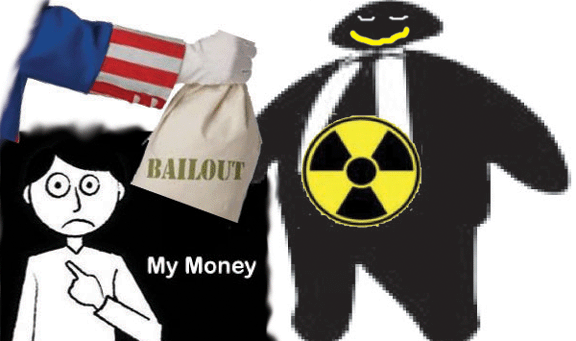 Christie’s Last-Minute Nuclear Bailout Plans for New Jersey NRDC In the latest move to ram through a multibillion-dollar subsidy package for the state’s (currently thriving) nuclear plants, outgoing Governor Chris Christie is signaling that he won’t consider legislation that includes provisions to protect taxpayers and preserve New Jersey’s ability to continue to grow its clean energy businesses. If the New Jersey Legislature passes a bill to subsidize those plants before Gov.-elect Phil Murphy takes office on January 16, it will not protect consumers, employees, communities or the environment.
That’s not good for New Jersey.
There is broad support for keeping two plants open—Salem and Hope Creek, both in Salem County. The only question is whether we need to do this now—without a deliberate, thoughtful and transparent plan that narrowly tailors any financial support; truly protects workers and communities; and avoids hamstringing Governor-elect Murphy’s ambitious clean energy agenda.
If you’re wondering why we’re even talking about this, see my previous blog Transitioning From Uneconomical Nuclear Power in New Jersey.
Opposition to the process
Citizens across the state are up in arms. The NRDC Action Fund has engaged over 10,000 constituents; Environment New Jersey, Environmental Defense Fund and AARP members are also out in force. People are horrified at the secretive process. It is December 8, and we haven’t seen a bill. Yet Christie—who currently enjoys the lowest approval rating of any sitting U.S. governor—and PSEG seem to be moving forward in full force to secure this bailout in hopes that everyone is distracted with holiday festivities. A frequent snicker at Monday’s hearing, without a bill to even discuss: “We could all go to Washington if we wanted to be treated so shabbily.”
Reported substance is even worse
The substance is even worse than the process. To recap, the proposal—as it is well understood by insiders, since only those writing the legislative language have seen it—is a standalone subsidy for existing nuclear plants. PSEG set out a few particulars at the hearing:
- The subsidy will cost consumers about $400 million per year;
- The state regulator—the Board of Public Utilities—will review the company’s claim that the plants require a subsidy to continue operation;
- The board will adjust the subsidy to reflect increased revenue to the plants should New Jersey join the Regional Greenhouse Gas Initiative, as Governor-elect Murphy has pledged; and
- The subsidy will be reviewed every three years.
What should be included
There was no hint of any provision to minimize costs, or to protect workers, host communities, and the environment when these plants eventually do close because nuclear power is not economical in today’s energy landscape……..https://www.nrdc.org/experts/dale-bryk/christies-last-minute-nuclear-bailout-plans-new-jersey
Women Leaders Aren’t Making Enough Foreign Policy Decisions, and it’s a Problem
While women are leading the resistance, the halls of power in D.C. and states across the country lag pathetically behind. We saw this perhaps most vividly when Trump gathered an all-male group of politicians at the White House to discuss his efforts to gut women’s health care. In a single photograph, the gross underrepresentation of women’s voices in government and on issues directly impacting their lives was crystal clear.
And it was exactly that photograph — and the utterly out-of-sync gender dynamics it laid bare — that stuck in our minds this month as we sat in a hearing of the Senate Foreign Relations Committee on Trump’s unrestrained power to wage nuclear war. A committee with a 20:1 male-to-female ratio heard testimony from three men on whether one man should have total, unchecked power to start a nuclear war and blow up the planet. This is a system that, as Senator Ed Markey (D-MA) said, “boggles the rational mind.”
Apparently, the Senate has a one-woman limit when it comes to foreign policy.
To read the full article at Teen Vogue, https://www.teenvogue.com/story/women-leaders-arent-making-enough-foreign-policy-decisions-and-its-a-problem
Nuclear propagandist Michael Shillenberger running for Governor of California
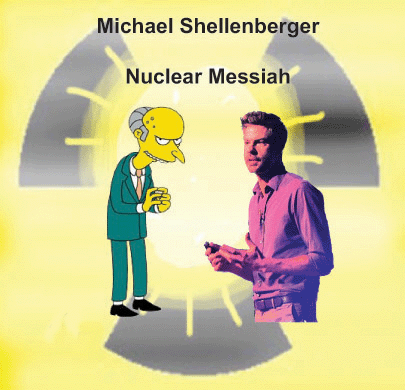 Pro-nuclear activist running for governor on pledge to reform utilities commission http://www.sandiegouniontribune.com/news/politics/sd-me-cpuc-candidate-20171201-story.html Jeff McDonaldContact Reporter
An environmental activist from Northern California has announced his candidacy for governor and his top campaign platform is to break up the troubled state utilities commission.
Michael Shellenberger, founder of the pro-nuclear group Environmental Progress, said Gov. Jerry Brown and the California Public Utilities Commission are responsible for creating some of the highest energy rates in the United States.
He also blames Brown and the utility regulators he appointed for the “corrupt” deal that assigned customers $3.3 billion in costs related to the premature shutdown of the San Onofre nuclear plant and said he wants to secure a cleaner energy future by promoting nuclear power.
Shellenberger listed eight key pledges he said would lower energy costs, reduce poverty, improve education and promote cleaner sources of power. His first pledge is: “Break up the corrupt California Public Utilities Commission (CPUC), release secret emails and prosecute the criminals.”
The commission was the subject of a criminal investigation by former Attorney General Kamala Harris, although it’s unclear where the probe stands under her successor, Xavier Becerra. The investigation centered on emails showing potentially improper communications between regulators and the utility companies they are supposed to oversee. San Diego consumer attorney Mike Aguirre has a number of lawsuits against the commission, including one demanding release of more emails.
A resident of Berkeley, Shellenberger is the founder and president of Environmental Progress, a nonprofit group that  advocates for nuclear power across the country and world. The group is committed to preserving the Diablo Canyon nuclear plant on California’s central coast that has been scheduled for closure.
A resident of Berkeley, Shellenberger is the founder and president of Environmental Progress, a nonprofit group that advocates for nuclear power across the country and world. The group is committed to preserving the Diablo Canyon nuclear plant on California’s central coast that has been scheduled for closure.
USA: Republicans in Congress losing interest in getting tax credits for nuclear power industry

 South Carolina’s failed nuclear site means less push for nuke tax credit in Congress, By Jamie Lovegrove and Andrew Brown jlovegrove@postandcourier.com abrown@postandcourier.com
-
Archives
- October 2026 (112)
- September 2026 (339)
- August 2026 (330)
- July 2026 (355)
- June 2026 (287)
- May 2026 (306)
- April 2026 (356)
- March 2026 (251)
- February 2026 (267)
- January 2026 (308)
- December 2025 (358)
- November 2025 (359)
-
Categories
- 1
- 1 NUCLEAR ISSUES
- business and costs
- climate change
- culture and arts
- ENERGY
- environment
- health
- history
- indigenous issues
- Legal
- marketing of nuclear
- media
- opposition to nuclear
- PERSONAL STORIES
- politics
- politics international
- Religion and ethics
- safety
- secrets,lies and civil liberties
- spinbuster
- technology
- Uranium
- wastes
- weapons and war
- Women
- 2 WORLD
- ACTION
- AFRICA
- Atrocities
- AUSTRALIA
- Christina's notes
- Christina's themes
- culture and arts
- Events
- Fuk 2022
- Fuk 2023
- Fukushima 2017
- Fukushima 2018
- fukushima 2019
- Fukushima 2020
- Fukushima 2021
- general
- global warming
- Humour (God we need it)
- Nuclear
- RARE EARTHS
- Reference
- resources – print
- Resources -audiovicual
- Weekly Newsletter
- World
- World Nuclear
- YouTube
-
RSS
Entries RSS
Comments RSS

