Israel finally admitted it destroyed a Syrian reactor in 2007 — and set off a battle of egos, WP, By Ruth EglashMarch 22 JERUSALEM — Israel’s admission Wednesday that it was behind a mysterious attack on a suspected nuclear reactor in Syria more than a decade ago has caused a storm.
But not in the way one might think.
Within hours of the Israeli military censor permitting local media to publish most of the details of the 2007 air attack on a secret desert facility in northeastern Syria, as well as releasing blurry black-and-white video footage, former political and military leaders went to war over who should be credited for the operation.
In Israel’s eyes, the operation was a resounding success. It prevented its northern neighbor from obtaining nuclear capabilities. Ultimately, it also ensured that the Islamic State militant group would not possess nuclear weapons when it took over the region several years later.
But since Israel’s confirmation of its role in the airstrike, a battle has played out on Israeli television and radio and online, pitting two former Israeli prime ministers, Ehud Olmert and Ehud Barak; a former Mossad chief; and a former military intelligence chief against one another.
Israeli Defense Minister Avigdor Liberman later said he regretted allowing the material to be published.
MP calls for sanctions on nuclear materials trade, Cambrian Newsby Alex Jones – Meirionnydd, Arfon & Dwyfor reporter @alexj_cn alexj@cambrian-news.co.uk
DWYFOR Meirionnydd’s MP has challenged the prime minister about nuclear materials following the suspected attempted murder of a former Russian double agent and his daughter.
Sergei Skripal and his daughter Yulia were in Salisbury earlier this month when both were found in a critical condition on a public bench.
It has since transpired that both had been inflicted with a nerve agent which has left both, and a police officer who attended, fighting for their lives.
The incident has sparked a marked decline in UK and Russian relations.
It has been suggested that Russian involvement was “the only plausible explanation” but the Kremlin has denied responsibility.
In a meeting in the House of Commons last week, Theresa May gave an update on the situation, prompting MP Liz Saville Roberts to challenge the Prime Minister regarding trade of nuclear materials with the former Cold War adversary.
Mrs Saville Roberts said: “Alongside many colleagues in the House, I speak on behalf of my party in calling for a robust and immediate response.
“Sources inform us that Russia is the UK’s biggest weapons-grade nuclear substances export market, despite several attempts at a moratorium on depleted uranium by the European Parliament and the United Nations.
“Will the Prime Minister confirm whether the UK is still exporting nuclear substances to Russia?
Nikkei Asian Review 18th March 2018 Another
setback looms for Tokyo’s infrastructure export drive. A Japan-led nuclear
power plant project in Turkey looks to cost more than twice as much as
initially projected, highlighting challenges for Tokyo’s push to export
Japanese infrastructure.
The Japanese and Turkish governments agreed on the
public-private project in 2013. The estimated total cost, pegged at around
2 trillion yen ($18.8 billion at current rates) at the time, has since
ballooned to more than 5 trillion yen, according to sources close to the
matter, due largely to the need to meet tougher safety standards
implemented after the March 2011 meltdowns at Tokyo Electric Power Co.
Holdings’ Fukushima Daiichi plant.
The plan is to build four reactors with
a total output of 4,500 megawatts in the Black Sea coastal city of Sinop,
using Atmea1 reactors Japan’s Mitsubishi Heavy Industries is developing
with France’s Areva.
Though the goal is to put the first reactor into
service in 2023, in time for Turkey’s centennial, the cost problem could
cause that date to slip.
Japan views nuclear power as an integral part of
efforts to export infrastructure around the world. As Mitsubishi Heavy and
the others hash out the Turkish project, a group led by Hitachi is putting
the finishing touches on plans to build two nuclear reactors in the U.K.,
on the Welsh coast.
Yet the Fukushima accident still casts long shadows over the nuclear industry, and hurdles are growing higher. Vietnam has
cancelled orders for Japanese nuclear facilities amid financial concerns
and local opposition. Partly because of the rising cost of safety measures,
the financial risks of building nuclear plants abroad have grown too large
for companies alone to bear.
So Japan’s government has stepped in with
public financing and other aid, eager to support infrastructure exports,
which it considers a key economic growth strategy. Pursuing projects abroad
is in effect the only way for such companies as Mitsubishi Heavy and
Hitachi to maintain and profit from their nuclear technologies.
Cortez Masto seeks details on Yucca spending since Trump’s election, The Nevada Independent, Humberto Sanchez , March 19th, 2018 , Sen. Catherine Cortez Masto has called on Energy Secretary Rick Perry to provide details on how the White House would spend funds requested for the Yucca Mountain nuclear waste repository, as well as how money has been spent since President Donald Trump was elected.
In a letter to Perry dated Monday, Cortez Masto, an opponent of the controversial project, noted that while the president has requested $120 million in both of his fiscal year (FY) 2018 and 2019 budget blueprints, with regard to the Department of Energy (DOE), neither of the budget documents provides a detailed account of how funding will be, or has been, spent.
“The FY 2019 Budget Justification, like the FY 2018 Budget Justification, provides little meaningful information on how DOE would actually spend these funds to participate in U.S. Nuclear Regulatory Commission licensing activities for the Yucca Mountain nuclear waste repository,” the letter said. “Moreover, neither of these budget documents provide any information on DOE expenditures from the Nuclear Waste Fund for Yucca Mountain activities during FY 2017 and FY2018.”
Cortez Masto wants Perry to disclose what the unobligated balances were in DOE’s Defense Nuclear Waste Disposal and Nuclear Waste Disposal accounts at the beginning of FY 2017, which started on Oct. 1, 2016, as well as for FY 2018.
She also wants to know how much was spent from these accounts during FY 2017 and 2018 for Yucca licensing activities; pension fund and related obligations for retired Yucca Mountain workers; administration of the Nuclear Waste Fund, financial audits; investment guidance; maintenance of records and technical and scientific information, including preservation and security of geologic samples. ……..https://thenevadaindependent.com/article/cortez-masto-seeks-details-on-yucca-spending-since-trumps-election
NGO Safecast co-founder Pieter Franken explains to schoolgirls how to assemble a Geiger counter kit in their classroom in Koriyama City, Fukushima Prefecture.
Tracking Fukushima’s radiation , https://www.shine.cn/feature/lifestyle/1803181780/Source: AFP Editor: Fu RongBeneath the elegant curves of the roof on the Seirinji Buddhist temple in Japan’s Fukushima region hangs an unlikely adornment: a Geiger counter collecting real-time radiation readings.
The machine is sending data to Safecast, an NGO born after the March 2011 Fukushima nuclear disaster that says it has now built the world’s largest radiation dataset, thanks to the efforts of citizen scientists like Seirinji’s priest Sadamaru Okano.
Like many, Okano lost faith in the government after the nuclear meltdown seven years ago.
“The government didn’t tell us the truth, they didn’t tell us the true measures,” he said.
Okano was in a better position than most to doubt the government line, having developed an amateur interest in nuclear technology 20 years earlier after the Chernobyl disaster. To the bemusement of friends and family, he started measuring local radiation levels in 2007.
“The readings were so high, 50 times higher than natural radiation,” he said of the post-disaster data. “I was amazed. The news told us there was nothing, the administration was telling us there was nothing to worry about.”
That dearth of trustworthy information was the genesis of Safecast, said co-founder Pieter Franken, who was in Tokyo with his family when disaster hit. Franken and friends had the idea of gathering data by attaching Geiger counters to cars and driving around.
“Like how Google does Street View, we could do something for radiation in the same way,” he said. “The only problem was that the system to do that didn’t exist and the only way to solve that problem was to go and build it ourselves. So that’s what we did.”
Within a week, the group had a prototype and got readings that suggested the 20-kilometer exclusion zone declared around the Fukushima plant had no basis in the data, Franken said.
“Evacuees were sent from areas with lower radiation to areas with higher radiation” in some cases, he said.
The zone was eventually redrawn, but for many local residents it was too late to restore trust in the government.
Okano evacuated his mother, wife and son while he stayed with his flock.
A year later, based on his own readings and after decontamination efforts, he brought them back. He learned about Safecast’s efforts and in 2013 installed one of their static counters on his temple.
“I told them: ‘We are measuring the radiation on a daily basis… so if you access the (Safecast) website you can choose (if you think) it’s safe or not’.”
Norio Watanabe has been a Safecast volunteer since 2011. In the days after the disaster evacuees flocked to Koriyama, which was outside the evacuation zone. He assumed his town was safe.
He sent his children away, but stayed behind to look after his mother, a decision he believes may have contributed to his 2015 diagnosis of thyroid cancer.
“As a scientist, I think the chance that it was caused by the Fukushima accident might be 50-50, but in my heart, I think it was likely the cause,” he said.
His thyroid was removed and is now healthy, but Watanabe worries about his students, who he fears “will carry risk with them for the rest of their lives.”
“If there are no people like me who continue to monitor the levels, it will be forgotten.”
Safecast now has around 3,000 devices worldwide and data from 90 countries. Its counters come as a kit that volunteers can buy through third parties and assemble at home.
American Foreign Policy Has A Masculinity Problem, Huffington Post, Lauren Sandler, Columnist 15 Mar 18
Foreign policy has always had a masculinity issue: gender shapes war, gender shapes intervention and gender shapes peacekeeping. In regard to military foreign policy, women and men are divided “always and everywhere,” according to a 2013 Pew Research Center study. Not only are women rarely part of diplomatic negotiations, but a statistical chasm exists where global security is concerned. From drone strikes to nuclear armament, women tend to disagree with men’s support of offensive strategies.
With few exceptions, foreign policy, especially in its highest echelons, is a man’s territory. But even in a realm governed by a formal rotation of masculine superegos, American foreign policy has never been in the hands of such a male id. Last week’s surprise announcement of a meeting by May between President Trump and North Korean leader Kim Jong Un highlights, yet again, the perils of letting fragile male egos run the world. The prospect of the summit would be comic ― a Trey Parker and Matt Stone musical number ― were millions of lives, and perhaps ultimately the planet itself, not on the line………..
Diplomacy’s masculinity problem is nothing new, though every new Republican leader seems to inject it with fresh testosterone. Consider the Bush Doctrine, which arrived under cover of so much World Trade Center smoke. It sold two wars packaged in unequivocally masculine rhetoric, using the language of strength and dominance to distract from ― in the case of the Iraq War ― a lack of evidence of weapons of mass destruction or of Iraqi involvement in the 9/11 attacks. As analysts at the Brookings Institution described Bush’s aggressive “revolution” in foreign policy, “other countries will either follow or get out of the way.” But such rhetoric, and indeed a defense of American manhood itself, led us as surely into the Spanish American War more than a century earlier, according to historian Kristin Hoganson. Stunningly little has changed since that war began, in 1898. ……..
Of course, what makes our situation even more dangerous is that it’s not just Trump who is operating from a place of defensive masculinity. “From the outside, it is easy to underestimate how much of North Korea’s threats and bizarre expressions of aggression reflect its sense of vulnerability and wounded pride,” Evan Osnos wrote in The New Yorker this week. It’s essentially a therapist’s diagnosis of the pain underlying toxic manhood.
We now find ourselves at the mercy of two insecure grown-up boys pretending to be men, who might deploy defensive machismo by any nuclear means necessary. Each is led baldly by fear of failing to be the alpha male. And it’s a zero sum game: There’s only one alpha allowed. Who is going to rule the locker room? And who, when hazed, will punish the world for it? https://www.huffingtonpost.com/entry/opinion-sandler-foreign-policy-trump
Paris Normandie 17th March 2018, [Machine Translation]“They are not ready. “Monday morning, at the end of acommittee of health, safety and working conditions of the plant, trade unionists of the CGT are circumspect. EDF agents have just visited the future Local Crisis Center (CCL), one of the “post-Fukushima” equipment whose vocation is to ensure the management of crises.
“They’re supposed to be up and running in two weeks, but we’re far from it …” After seven
years of delay and a construction cost that has tripled to reach 10.5
billion euros, the commissioning of the EPR, this new generation nuclear
reactor under construction in Flamanville, is scheduled for May 2019. The
goal is to be able to load the fuel into the tank in December.
But the context remains tense for this site which accumulated the setbacks: the
problems recently discovered on the tank lid – which will have to be
changed before 2024 when it is normally every 20 or 30 years – or on the
secondary circuit welds leave an uncertainty about the authorization that
could give – or not – the ASN, the “policeman” nuclear.
PeterBanks Blog 17th March 2018,It has been a busy time lately. BANNG has attended a number of meetings and
Prof. Andy Blowers has been involved as an expert in the Geological Disposal Facility (GDF) consultation process. And on top of that the weather has thrown a wobbly which has potential implications on the decisions for energy policies.
There have been two important meetings. One concerned the Government’s consultation on reviewing the siting criteria
for new nuclear power stations. For all of us concerned about the Government’s headlong rush towards more ridiculous nuclear development it is vital to respond to this consultation.
Clearly the Government is attempting to extend the time period allocated for selecting potential new nuclear sites. The sites included in the previous consultation on the siting criteria in 2008 should have had power stations generating by 2025 and even Hinkley Point C (HPC) has only a remote chance of being up and running by then.
BANNG also had an important strategic meeting with the Nuclear New Build departments of the Office for Nuclear Regulation (ONR) and the Environment Agency (EA). This event was co-chaired by BANNG’s Andy Blowers and the EA’s Simon Barlow. The meeting was attended by senior representatives from the EA and ONR and 6 from BANNG. Andy Blowers once again was also able to represent Colchester Borough Council. http://banksyboy.blogspot.co.uk/2018/03/the-other-beast-from-east.html
GOP governor hopeful says his rivals are tainted by nuclear cash, BY JAMIE SELF, jself@thestate.com, March 15, 2018
A Republican running for governor says his rivals have something he lacks: a tie to the utilities responsible for a failed multi billion-dollar effort to build two nuclear reactors in Fairfield County.
Greenville real-estate lender John Warren is calling on his rivals to return campaign contributions they have received from the utilities, Cayce-based SCANA and officials tied to state-owned Santee Cooper.
“Their judgment is clouded by special interests, but I have a plan to address the V.C. Summer crisis that starts with cleaning house,” said Warren on Tuesday in a statement.
Warren’s main targets in the attack are Republican Catherine Templeton, who has received $15,000 in contributions from board members of Santee Cooper, and S.C. Gov. Henry McMaster, who received at least $115,000 in contributions from SCANA, its employees and leaders before the utility’s announcement last July that it was abandoning efforts to build two nuclear reactors at its V.C. Summer Nuclear Station.
After that announcement, McMaster became a vocal critic of SCANA, saying its customers either should get the two nuclear reactors they were promised or their money back. The governor also has called for the sale of Santee Cooper, SCANA’s junior partner in the deal, and forced the release of a damning report about the nuclear project.
……. Templeton has received at least $15,000 in campaign donations from Santee Cooper board members and their families, including $3,500 from former Santee Cooper board chairman Leighton Lord……On Day 1 as governor, Warren says he will fire the entire Santee Cooper board and push legislation to stop utilities involved in the nuclear project from continuing to charge their customers for it. He also says he would call for a forensic audit and valuation of Santee Cooper, push for the preservation of the two unfinished V.C. Summer reactors and encourage the sale of equipment on the site. Reporter Avery G. Wilks contributed.; Jamie Self: 803-771-8658, @jamiemself http://www.thestate.com/news/politics-government/article204896769.html
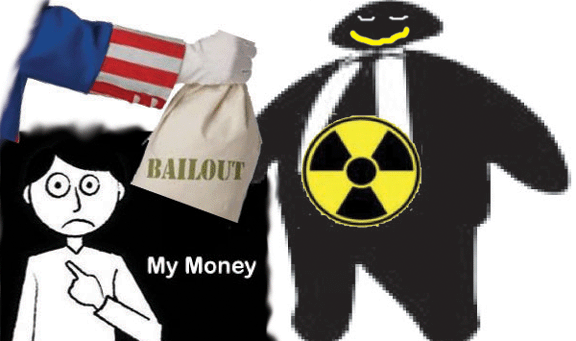
An independent government agency saved Americans from a massive de facto tax hike.
Energy Secretary Rick Perry had proposed a multibillion-dollar bailout of failing coal and nuclear power plants. He wanted to give these plants taxpayer-funded subsidies to keep them afloat. Luckily, the Federal Energy Regulatory Commission (FERC) made the right call and quashed the plan.
Sec. Perry’s proposal — commonly called the notice of proposed rulemaking, or NOPR — would have granted government subsidies to any power plants capable of storing 90 days’ worth of fuel supply on-site. The only electricity generators that fit this description are coal and nuclear plants. Natural gas and renewables plants don’t store their fuels on site.
The secretary’s goal was to keep nearly bankrupt coal and nuclear plants operating, so they can produce electricity in case natural disasters or cyberattacks disrupt America’s energy grid.
Fears of an electricity shortage are overblown — the power grid is already resilient. According to Sec. Perry’s own department, America’s energy grid reliability is “adequate today despite the retirement of 11 percent of the generating capacity available in 2002.”
Natural gas plants, in particular, are dependable. A recent Brattle Group study found natural gas “relatively advantageous” compared to other energy sources in terms of power grid reliability. It’s relatively easy for these plants to ramp up or slow down electricity generation in response to changing demand or emergency situations.
A DOE report released in August concluded as much. It did not find that the closure of failing coal and nuclear plants would lead to electricity shortages — even though Sec. Perry hoped for such a conclusion to justify a coal and nuclear bailout.
Extending a financial lifeline to failing coal and nuclear plants wouldn’t have been cheap. Sec. Perry’s bailout would have cost taxpayers $10.6 billion a year.
These subsidies would have helped just a handful of lucky corporations. Ninety percent of NOPR funds dedicated to nuclear energy would have been divvied up between five or fewer companies.
Regular Americans oppose this crony capitalism. Seventy-seven percent of voters in Pennsylvania, where lawmakers are trying to bail out nuclear company Exelon, agree that regulators shouldn’t offer special treatment to specific corporations.
Sec. Perry tried to strangle free-market innovation by picking winners and losers. Such cronyism would thwart the continued rise of natural gas, which is now abundant thanks to the advent of hydraulic fracturing and other drilling technologies. In 2016, America generated more electricity from natural gas than from coal for the first time.
That’s good news for the environment. Replacing coal with natural gas has helped reduced greenhouse emissions to levels not seen since 1988. It has also resulted in lower electricity prices for consumers.
The proposed coal and nuclear bailout was a terrible deal for taxpayers. FERC should be commended for refusing to funnel billions of our hard-earned dollars to prop up dying industries.
David Williams is president of the Taxpayers Protection Alliance.
Dave Toke’s Blog 14th March 2018, How Labour can really put the wind up the Tories. Labour is well placed to
embarrass the Tories by attacking the Government’s war on the onshore
wind industry in the UK.
Despite onshore wind now being the cheapest widely
available electricity source the Government is actively sabotaging the
industry by refusing to allow long term contracts to be issued to wind
developers. Meanwhile large subsidies are being offered to gas, coal and
nuclear power stations.
Under the last Labour Government incentives were
given to build up a large increase in onshore wind power, which now
supplies around a tenth of UK’s electricity supply, with offshore wind
and solar farms now supplying around another ten per cent of UK
electricity.
But right wing English Tory pressure has prevented any move
towards enabling long term contracts to be issued so that new windfarms can
be financed. Meanwhile the UK risks becoming increasingly dependent on
supplies of gas from places like Russia and Qatar.
The Labour frontbench is beginning to realise that young people in particular want to see green
energy being given a chance, and, for example, John McDonnell has recently
attacked the Tories for failing to doing anything to revive support for the
feed-in tariff scheme that helped people install solar panels on their
roofs.
But attention ought also to be turned to promoting onshore
windfarms. Doing so would embarrass the Government and also sow division
inside the Tory ranks. More practically, it would offer hope to people who
are working in the industry that they might have a future.
Places like Grimsby are benefitting from offshore wind projects which are still being
built, but onshore wind factories are being closed down, the latest being
the Glasgow based Gaia Wind. The Minister of State for Energy, Claire
Perry, has, in recent months, been making some encouraging noises about
providing some ‘contracts for differences’, but appears to lack the
required political clout to do much that changes anything, especially to
overcome the vocal hostility of the climate-and-wind sceptical group of
Tory MPs. http://realfeed-intariffs.blogspot.co.uk/2018/03/how-labour-can-really-put-wind-up-tories.html
As President Donald Trump steps up efforts to engage North Korea in nuclear disarmament talks, the State Department is in the most turmoil since the president’s inauguration.
The latest upheaval came Tuesday with the sudden firing of Secretary of State Rex Tillerson, who was dismissed with few details provided by the White House. Trump picked CIA Director Mike Pompeo to be the next secretary of state.
The moves followed Trump’s abrupt announcement last week of a yet-to-be-arranged meeting with North Korean leader Kim Jong Un.
But the prospects for any diplomatic breakthrough are clouded by senior State Department vacancies, including a permanent U.S. ambassador to South Korea. The Trump administration has also yet to fill other positions critical to any talks with North Korea, including a permanent undersecretary for arms control and international security affairs, as well as a permanent assistant secretary for East Asian and Pacific Affairs.
Dozens of other key diplomatic jobs remain unfilled, including ambassadors to key U.S. allies such as Germany, Australia and Saudi Arabia.
More than two dozen ambassador posts are waiting for nominations to be put forward; nominees for more than a dozen others are waiting for confirmation.
The vacancies have strained ties with key U.S. allies. On Tuesday, Germany’s Deputy Foreign Minister Michael Roth tweeted that Tillerson’s firing won’t help.
“The dismissal of Rex #Tillerson does not make anything better,” Roth said in a tweet.
Tillerson’s departure also adds to ongoing uncertainty about Trump’s promised reorganization of the State Department. Last fall, the senior official charged with overseeing that effort stepped down after less than four months on the job amid widespread criticism from current and former American diplomats.
Rumors about friction between Trump and Tillerson began circulating last year. In October, NBC News reported that Tillerson called the president a “moron,” something Tillerson never directly denied. Tillerson continued to insist his relationship with the president was solid and brushed off rumors of strain between them.
His departure is just the latest in a high-velocity revolving door that has dogged the Trump administration. Last week chief White House economic advisor Gary Cohn resigned after a heated dispute over Trump’s announcement of steep steel and aluminum tariffs, a move Cohn opposed.
Blair Horner: Fukushima Anniversary And NY’s Subsidies Of Nuclear Power, WAMC, ByBLAIR HORNER • MAR 12, 2018 “……..The power plants in Fukushima are of the same design as some in New York State, which are located on Lake Ontario. While no one would expect the same scenario to occur, those plants have been the focus of state policies in recent years.
The plants, built in the 1960s, have exceeded their expected useful lifetimes. Generally, plants of that design and era are expected to be used for roughly 40 or so years. Yet those plants continue to operate under a deal negotiated largely outside of public view.
In the summer of 2016, negotiators from the Cuomo Administration and the plant owners agreed to a multi-billion dollar bailout of the plants – which were slated for closure. At that time, the state did not reveal the estimated costs, but subsequent analyses estimated that the costs could run anywhere from $2.9 billion to $7.6 billion over a 12-year period. The negotiation contained no new safety requirements for the plants, just a guarantee that virtually all New Yorkers would be required to pay to make the nuke plants profitable – whether they received power from the plants or not – to keep them open.
The safety records of the plants came under new scrutiny in a report issued last week by the Alliance for a Green Economy, an upstate New York nuclear watchdog organization. The report analyzed recent inspection reports and Nuclear Regulatory Commission (NRC) documents and identified three issues of concern:
The group identified regulatory violations without penalties: 18 violations of Nuclear Regulatory Commission regulations were reported between March 2017 and February 2018 for the four Upstate reactors, but no penalties or fines were assessed.
The group identified examples of weakened regulations at the request of nuclear operators. For example, at the request of one of the plant’s owners, the National Regulatory Commission changed the requirement for what constitutes an “unusual event” regarding Lake Ontario flooding. As we all know, there had been extensive flooding last year in the Lake Ontario area.
Lastly, the group identified missed deadlines for fixing known safety and maintenance issues: one plant near Oswego does not have a containment vessel likely to be able to contain the pressure and radiation released by a meltdown and installation of a required vent has been delayed; the plant’s owner is behind schedule for fixing numerous maintenance issues.
New York State should learn the lessons of the dangers of relying on nuclear power and follow the path set by California: move to shut down these aging facilities, and instead move toward greater reliance on solar, wind and geothermal power.
Those power generators have been starved of adequate support since so much of the state’s wealth is tied up in propping up the Lake Ontario plants. New York energy efficiency programs are anemic and lag far behind neighboring states and currently solar only generates about 1 percent of the power for the state. Instead of mandating that New Yorkers subsidize aging, inefficient, 20th century nuclear plants, that money should be redirected to 21st century conservation and renewable energy programs. Blair Horner is executive director of the New York Public Interest Research Group.http://wamc.org/post/blair-horner-fukushima-anniversary-and-ny-s-subsidies-nuclear-power
In anearly morning tweet, President Trump fired Secretary of State Rex Tillerson and announced that Mike Pompeo, CIA director and unofficial third Koch brother, would be taking over. In other words, a guy who believes climate change is merely an “engineering problem” is being replaced by someone who probably doesn’t think it’s even real.
Pompeo’s environmental record is pretty damning:
In a 2013 interview with C-SPAN’s Washington Journal, he argued that there’s considerable debate within the scientific community about the causes of global warming. There isn’t.
Since 2009, he has accepted more than a million dollars from the oil and gas industry while campaigning for Congress.
He was the largest recipient of Koch Industries campaign money in 2010. And soon afterward, as a newly elected Kansas representative, he hired a former Koch lawyer to be his chief of staff.
It looks like the Koch brothers, who’ve played a huge part in galvanizing the Republican Party against climate change, have Pompeo exactly where they want him.
And why is it important for our secretary of state to understand the basics of climate change? For one, climate change poses a “growing geopolitical threat” to national security — a threat that Pompeo appears quite unequipped to tackle.
What the president and his supporters really mean, of course, is that experts have not shown the proper deference to people who do not understand anything about the world around them. The president seems to believe that no one shows him the proper deference.
Trump and the new Know-Nothings who support him are exploiting this for short-term political gain, but in the longer run, these policies will hurt the very people who voted for Trump in the first place.
Trump is delivering what he promised: A government with no experts, Washington Post, By Tom NicholsMarch 8 Tom Nichols is a professor at the Naval War College and the Harvard Extension School and the author of “The Death of Expertise.”
President Trump kept an important campaign promise this week. Not the one about tariffs — that was incidental — but the one where he vowed to give his supporters the satisfaction of seeing him ignore experts.
The president has plunged ahead with his plans to reverse 70 years of U.S. policy, against the advice of his secretaries of defense and state. His top economic adviser, Gary Cohn — who was unfazed by Trump’s equivocation about Nazis but has found his personal red line on trade policy, apparently — also advised against the tariffs and has now walked out in defeat.
None of this really has very much to do with actual policy. By the time Trump announced the details of the steel and aluminum tariffs on Thursday, his facile public statements about how trade wars are easy to win had already made it clear that he has no actual grasp of what a trade war is, or what it could mean for the United States to start one.
But like so many Trump positions (the wall, the Muslim ban, gun control) the actual content of the policy is irrelevant. His presidential campaign, at its core, operated on a simple premise of social revenge, a notion that only Donald Trump could get even with the shadowy experts who run (and ruin) the lives of ordinary Americans. He vowed to push the eggheads out of the way — not because they are wrong, but because they are eggheads, and nobody likes eggheads……….
Since taking office, however, intelligent people in the administration have been trying to pad the sharp corners around the West Wing in an attempt to prevent these campaign promises from becoming ill-advised realities that could harm both the country and the administration. So with the chaotic point the White House has now reached, the president’s supporters are finally going to get what they want: Their rallying cry all along has been to let Trump be Trump and to ignore people who actually know what they’re doing. ………..
They [the pro Trump expert advocates] are smart enough to know that this campaign against expertise is a sham. They are leading the charge now not only because it is profitable, but also perhaps because they hope that when all this is over, the Jacobins will come for them last.
What the president and his supporters really mean, of course, is that experts have not shown the proper deference to people who do not understand anything about the world around them. The president seems to believe that no one shows him the proper deference. But others have a point, at least about workers who have been hurt by globalization. Experts do lack a certain empathy when it comes to these issues. We tend to be the people who, when asked a question by someone who’s just lost their job, point to low unemployment rates — as though that matters to a recently jobless person. We might be right, but it rankles nonetheless.
This is why the attack on experts appeals both to Trump and his voters: It scratches a deep itch of resentment that has nothing to do with intelligent policy and everything to do with feeling ignored by the people who have to make things work every day.
In the same way that the president fulminates at being told that his ideas might be flawed or wrong, a fair number of Americans now bristle when told that they have to do anything they don’t like: vaccinate their children, eat a healthy diet, put down their phones while driving. None of this is really about steel imports or fortified borders or Muslim travelers; it is about regaining a sense of empowerment.
The world is a complex place. It frightens people to think how much of their daily life is in the hands of their fellow citizens. This has been true since the beginning of the 20th century, and life in the 21st century is not going to get any less dizzying or complicated. Trump and the new Know-Nothings who support him are exploiting this for short-term political gain, but in the longer run, these policies will hurt the very people who voted for Trump in the first place.
Gary Cohn could probably explain all this to the president, if he were still around.