UK Labour would factor climate change risk into economic forecasts
Labour vows to factor climate change risk into economic forecasts
Shadow chancellor John McDonnell to say ‘overwhelming challenge of climate change’ must be addressed from very centre of government, Guardian, Jessica Elgot, 14 Nov 17, The risk posed by climate change would be factored into projections from the government’s independent economic forecaster if Labour took office, the shadow chancellor will announce on Tuesday.
John McDonnell will highlight the human and economic costs of manmade climate change, calling it the “greatest single public challenge” and say the government should include the fiscal risks posed by global warming in future forecasts.
The landmark change would, for the first time, put climate change on an equal footing with other complex challenges affecting the public finances such as demography.
Under a Labour government, the Office for Budget Responsibility would be given total independence, McDonnell will announce, saying the forecaster would report directly to parliament rather than the Treasury.
Speaking at the Institute for Public Policy Research on Tuesday, McDonnell will say that meeting the challenges of climate change will require “a transformation of our institutions and how our economies are run”.
McDonnell said that Labour “wants to ensure that the overwhelming challenge of climate change is addressed from the very centre of government. This includes the potential losses to the public finances.
“The public deserve to know what impacts we might expect on the national purse from the degradation of our environment. Sound, responsible economic management should already be accounting for this.”…..https://www.theguardian.com/environment/2017/nov/13/labour-vows-to-factor-climate-change-risk-into-economic-forecasts
Who’s Really Driving Nuclear-Weapons Production? Follow the money.
By William D. Hartung [This piece has been updated and adapted from William D. Hartung’s “Nuclear Politics” in Sleepwalking to Armageddon: The Threat of Nuclear Annihilation, edited by Helen Caldicott and just published by the New Press.] The Nation, 14 Nov 17
French government considers changing focus of EDF from nuclear to renewables
FT 14th Nov 2017, France is considering changing the governance of state-owned utility EDF to
shift its focus from nuclear to renewable energy as Emmanuel Macron’s
government seeks to cut the country’s reliance on atomic power — the
backbone of its energy policy for five decades. Nicolas Hulot, energy and
environment minister, told the Financial Times the country’s largest
electricity producer needed to embrace a transition towards environmentally
friendly energy rather than “resist” it. The process may require
revisiting the structure of the company, in addition to a plan to close up
to 35 of the 58 nuclear reactors it operates across France within the next
15 years.
https://www.ft.com/content/132f512a-c89f-11e7-ab18-7a9fb7d6163e
Nuclear power on welfare now – an unnecessary drain on the public purse

you can’t advocate for nuclear reactors without indirectly advocating for nuclear weapons and radioactive waste. That’s because nuclear reactors are producers of both weapons material and radioactive waste. Ike was a nuclear conman. ‘Atoms for Peace’ have always been Atoms for War.
The Real Nuclear Triad: Energy, Weapons and Waste NOVEMBER 7, 2017 “……..Nukes on the Dole – Radioactive Welfare Queens
…………. some strange recent developments.
Nuclear utilities are in trouble, fighting for life against – as Amory Lovins once predicted – ‘a massive overdose of market forces’ and the surging economics of renewables.
But wait. Whatever happened to ‘”the wisdom of the ‘free market’?” Around the country, as aging reactors reach the end of their operational and economic lives, some states like Wisconsin, Vermont, Massachusetts, and Nebraska are letting them die a dignified natural death. But other states, like New York and Illinois are putting their moribund reactors on life support at public expense. Projections suggest that state-sponsored electric ratepayer handouts in the two states could total as much as $10 billion over 12 years.
Tim Judson, Director of Nuclear Information and Resource Service (NIRS), warns that if other states follow New York and Illinois, “The price would be outrageous. If reactor subsidies go nationwide, it could cost $130-$280 billion by 2030.”
Earlier this year NukeWatch.org Directpr John LaForge reported on CounterPunch,
Bailout legislation for dilapidated reactors is now pending: in Connecticut, for Millstone 2 & 3; in New Jersey, for Salem 1 & 2 and Hope Creek; in Texas, for South Texas 1 & 2 and Comanche Peak 1 & 2; in Maryland, for Calvert Cliffs 1 & 2; and for nine reactors in Pennsylvania including Beaver Valley 1 & 2, Three Mile Island 1, Susquehanna 1 & 2, Limerick 1 & 2, and Peach Bottom 2 & 3.
Meanwhile America’s Trillion dollar nuclear arsenal upgrade goes forward, even as an overwhelming majority of United Nations states sign on to a treaty declaring the possession, use or threatened use of nuclear weapons illegal under international law.
In the face of the spreading renewed nuclear crackpotism noted above, the International Campaign to Abolish Nuclear Weapons (ICAN), has been the driving force behind the UN Treaty to Prohibit Nuclear Weapons. ICAN will receive the Nobel Peace Prize Dec 10.
Atoms for Peace War
All of which suggests, you can’t advocate for nuclear reactors without indirectly advocating for nuclear weapons and radioactive waste. That’s because nuclear reactors are producers of both weapons material and radioactive waste. Ike was a nuclear conman. ‘Atoms for Peace’ have always been Atoms for War.
And, as Bennett Ramberg showed conclusively in his prescient, but tragically ignored, 1984 book Nuclear Power Plants as Weapons for the Enemy: An Unrecognized Military Peril, its also because every nuclear reactor and radioactive waste storage site in the world are themselves nuclear-weapons-in-place for any enterprising terrorist.
Concluded Ramberg, “Because nuclear energy facilities contain such large inventories of biologically threatening radionuclides, they can make potentially useful radiological weapons when manipulated for strategic purposes.”https://www.counterpunch.org/2017/11/07/the-real-nuclear-triad-energy-weapons-and-waste/
Nuclear power – dying a slow, painful and wildly expensive death.
 Nuclear Power’s Existential Crisis, New Matilda, By Jim Green on November 12, 2017
Nuclear power is dying a slow, painful and wildly expensive death, writes Jim Green. This year has been catastrophic for nuclear power, and just when it seemed the situation couldn’t get any worse for the industry, it did. There are clear signs of a nuclear slow-down in China, the only country with a large nuclear new-build program.
 China’s nuclear slow-down is addressed in the latest World Nuclear Industry Status Report and also in an August 2017 article by former World Nuclear Association executive Steve Kidd.
China’s nuclear program “has continued to slow sharply”, Kidd writes, with the most striking feature being the paucity of approvals for new reactors over the past 18 months. China Nuclear Engineering Corp, the country’s leading nuclear construction firm, noted earlier this year that the “Chinese nuclear industry has stepped into a declining cycle” because the “State Council approved very few new-build projects in the past years”.
Kidd continues: “Other signs of trouble are the uncertainties about the type of reactor to be utilised in the future, the position of the power market in China, the structure of the industry with its large state-owned enterprises (SOEs), the degree of support from top state planners and public opposition to nuclear plans.”
Over-supply has worsened in some regions and there are questions about how many reactors are needed to satisfy power demand. Kidd writes: “[T]he slowing Chinese economy, the switch to less energy-intensive activities, and over-investment in power generation means that generation capacity outweighs grid capacity in some provinces and companies are fighting to export power from their plants.”
Kidd estimates that China’s nuclear capacity will be around 100 GW by 2030, well below previous expectations. Forecasts of 200 GW by 2030, “not unusual only a few years ago, now seem very wide of the mark.” And even the 100 GW estimate is stretching credulity ‒ nuclear capacity will be around 50 GW in 2020 and a doubling of that capacity by 2030 is highly unlikely in the context of the slow-down.
Kidd states that nuclear power in China may become “a last resort, rather as it is throughout most of the world”. The growth of wind and solar “dwarfs” new nuclear, he writes, and the hydro power program “is still enormous”.
Chinese government agencies note that in the first half of 2017, renewables accounted for 70 per cent of new capacity added (a sharp increase from the figure of 52 per cent in 2016), thermal sources (mainly coal) 28 per cent and nuclear just 2 per cent. And just in the past week, Beijing announced plans to stop or delay work on 95 GW of planned and under-construction coal-fired power plants.
Crisis in the US and malaise elsewhere
 The plan to build two AP1000 reactors in South Carolina ‒ abandoned in July after A$11.5‒13.3 billion was spent on the partially-built reactors ‒ is now the subject of multiple lawsuits and investigations including criminal probes.
Westinghouse, the lead contractor, filed for bankruptcy protection in March. Westinghouse’s parent company Toshiba is selling its most profitable business (memory chips) to stave off bankruptcy.
Pro-nuclear commentator Dan Yurman discussed the implications of the decision to abandon the VC Summer project in South Carolina in a September 11 post:
“It is the failure of one of the largest capital construction projects in the U.S. Every time another newspaper headline appears about what went wrong at the VC Summer project, the dark implications of what it all means for the future of the nuclear energy industry get all the more foreboding…. Now instead of looking forward to a triumph for completion of two massive nuclear reactors generating 2300 MW of CO2 emission free electricity, the nation will get endless political fallout, and lawsuits, which will dominate the complex contractual debris, left behind like storm damage from a hurricane, for years to come.”
The only other nuclear new-build project in the US ‒ two partially-built AP1000 reactors in Georgia ‒ is hanging on by a thread. Georgia’s Public Service Commission is reviewing a proposal to proceed with the reactors despite the bankruptcy filing of the lead contractor (Westinghouse), lengthy delays (5.5 years behind schedule) and a doubling of the cost estimate (the original estimate was A$17.9 billion and the latest estimates range from A$32.5‒38.4 billion for the two reactors).
Indicative of their desperation, some nuclear advocates in the US (and to a lesser extent the UK) are openly acknowledging the contribution of nuclear power (and the civil nuclear fuel cycle) to the production of nuclear weapons and using that as an argument to sharply increase the massive subsidiesthe nuclear power industry already receives.
Elsewhere, the nuclear industry is in deep malaise and has suffered any number of setbacks this year. Pro-nuclear lobby groups are warning about nuclear power’s “rapidly accelerating crisis“, a “crisis that threatens the death of nuclear energy in the West“, and noting that “the industry is on life support in the United States and other developed economies”.
 The French nuclear industry is in its “worst situation ever“ according to former EDF director Gérard Magnin. The only reactor under construction in France is six years behind schedule, the estimated cost has escalated from A$5 billion to A$16 billion, and the regulator recently announced that the pressure vessel head of the reactor will need to be replaced by 2024 following a long-running quality-control scandal. The two French nuclear utilities face crippling debts (A$56.5 billion in the case of EDF) and astronomical costs (up to A$151 billion to upgrade ageing reactors, for example), and survive only because of repeated government bailouts.
 In South Africa, a High Court judgement on April 26 ruled that much of the country’s nuclear new-build program is without legal foundation. There is little likelihood that the program will be revived given that it is shrouded in corruption scandals and President Jacob Zuma will leave office in 2019 (if he isn’t ousted earlier).
 Public support for South Korea’s nuclear power program has been in free-fall in recent years, in part due to a corruption scandal. Incoming President Moon Jae-in said on June 19 that his government will halt plans to build new nuclear power plants and will not extend the lifespan of existing plants beyond 40 years.
 In June, Taiwan’s Cabinet reiterated the government’s resolve to phase out nuclear power by 2025.
In the UK, nuclear industry lobbyist Tim Yeo says the compounding problems facing the industry “add up to something of a crisis for the UK’s nuclear new-build programme”. The estimated cost of the only two reactors under  construction was recently increased to A$46.2 billion (A$23.1 billion each) and they are eight years behind schedule.
India’s nuclear industry keeps promising the world and delivering very little ‒ nuclear capacity is 6.2 GWand  nuclear power accounted for 3.4 per cent of the country’s electricity generation last year.
In Japan, Fukushima clean-up and compensation cost estimates have doubled and doubled again and now  stand at A$245 billion. Only five reactors are operating in Japan, compared to 54 before the March 2011 Fukushima disaster.
 In Russia, Rosatom’s deputy general director Vyacheslav Pershukov said in June that the world market for new nuclear power plants is shrinking, and the possibilities for building new large reactors abroad are almost exhausted. He said Rosatom expects to be able to find customers for new reactors until 2020‒2025 but “it will be hard to continue”.
 In Switzerland, voters supported a May 21 referendum on a package of energy policy measures including a ban on new nuclear power reactors. Thus Switzerland has opted for a gradual nuclear phase-out and all reactors will probably be closed by the early 2030s, if not earlier (while all of Germany’s reactors will be closed by the end of 2022 and all of Belgium’s will be closed by the end of 2025)……. https://newmatilda.com/2017/11/12/nuclear-powers-existential-crisis/
Nuclear Weapons industry relies on Nuclear Power industry, which obviously subsidises it.
 The Real Nuclear Triad: Energy, Weapons and Waste NOVEMBER 7, 2017 Clear and Present Danger
Never before has the unbreakable connection between nuclear energy, weapons and waste been so blatantly obvious to the public eye…yet, with so little notice.
Although President Trump has threatened to obliterate North Korea and its 25 million people ‘with fire and fury the like of which the world has never seen,’ the NYT is reporting that America’s Asian allies doubt Washington’s ‘resolve’ to defend them with nuclear weapons and they want their own – an idea recently also floated by Trump himself.
In a new twist on the last century’s discredited ‘Atoms for Peace’ meme, the new nuclear delusion seems to be that the more countries that have nuclear weapons (Iran and North Korea excepted), the more ‘secure’ the world will become.
Speaking recently at Minot Air Force Base in North Dakota, Trump’s VP Mike Pence, a self-declared devout Christian who ‘gave my life to Jesus,’ declared “… there’s no greater force for peace in the world than the United States nuclear arsenal.”
Implication: every country should feel safer if they have a nuclear arsenal of their own. That seems precisely Kim Jong-Un’s own calculus, given his country’s previous horrific carpet-bombing experience with the US – “we… eventually burned down every town in North Korea,” Gen. Curtis LeMay told Congress – not to mention the recent history of Iraq, Libya and Syria.
Nuclear Circular Firing Squad
As agitation reportedly builds in South Korea and Japan for building their own nuclear arsenals, the Times reveals that, as a result of the radioactive waste output of their already existing nuclear energy reactor fleets, each of these tiny countries has accumulated enough weapons-grade plutonium to produce – respectively – 4,600 and 6,000 nuclear bombs.
How about that? Nations without their own ‘commercial power’ nukes must certainly take note.
Never mind the fact that such a triangle of nuclear-armed, mutually hostile, neighboring states would be like, say, New York, New Jersey and Connecticut each having their own nuclear arsenals, all pointing at each other. Talk about a circular firing squad. It’s the very definition of an ‘everybody loses’ situation.
Nuclear Triplets Joined at the Hip
But, while this is clearly an illustration of a new epidemic of nuclear crackpot madness spreading around the world, it is also the latest of several clear illustrations – and blatant, though veiled, public admissions – that the DNA-destroying nuclear triplets of energy, weapons and radioactive waste are inseparably joined-at-the-hip.
In the UK:
“Military Nuclear Industry to be Supported by Payments from Electricity Consumers”
In Britian, reports the Guardian, “The government is using the “extremely expensive” Hinkley Point C nuclear power station to cross-subsidize Britain’s nuclear weapon arsenal, according to senior scientists.”
The Guardian story continues,
In evidence submitted to the influential public accounts committee (PAC), which is currently investigating the nuclear plant deal, scientists from Sussex University state that the costs of the Trident programme could be “unsupportable” without “an effective subsidy from electricity consumers to military nuclear infrastructure.”
Prof Andy Stirling and Dr Phil Johnstone from the Science Policy Research Unit at the university write that the £19.6bn Hinkley Point project will “maintain a large-scale national base of nuclear-specific skills” without which there is concern “that the costs of UK nuclear submarine capabilities could be insupportable.”
Their evidence suggests that changes in the government’s policy on nuclear power in recent years will effectively allow Britain’s military nuclear industry to be supported by payments from electricity consumers…….https://www.counterpunch.org/2017/11/07/the-real-nuclear-triad-energy-weapons-and-waste/
UK’s “Hidden Subsidy” for Nuclear Weapons
The Real Nuclear Triad: Energy, Weapons and Waste NOVEMBER 7, 2017 “……..“Hidden Subsidy” for Nuclear Weapons
In their report, entitled Some Queries over Neglected Strategic Factors in Public Accounting for UK Nuclear Power: evidence to the House of Commons Public Accounts Committee Inquiry on Hinkley Point C (HPC), Stirling and Johnstone state that their “evidence submits that an undetermined part of the full costs of this expensive, controversial – but officially highly-prioritized – military infrastructure are in effect (without clear public acknowledgement or justification), being loaded into electricity prices. With costs of alternative large-scale domestic low-carbon energy resources like offshore wind power confirmed as significantly more favorable than HPC, it seems a hidden subsidy is being imposed on electricity consumers.”
They point out that, “If UK pursuit of uncompetitive nuclear power is partly justified as a means to sustain these shared civil-military specialized nuclear capacities, then availability of lower cost domestic low-carbon power means electricity prices are higher than would otherwise be the case…. It is this that would amount to an effective subsidy from electricity consumers to military nuclear infrastructures.”
They conclude, “Remarkably, this civil-military link is well documented in defense debates, but entirely neglected in energy policy discussion.” (emphasis added.)…..
Senate hearing to examine Trump’s ‘authority to use nuclear weapons’
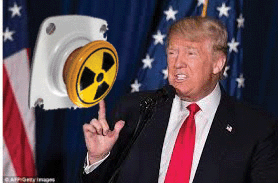 Corker announces Senate hearing to examine Trump’s ‘authority to use nuclear weapons’ https://www.cnbc.com/2017/11/09/senate-hearing-to-probe-trumps-authority-to-use-nuclear-weapons.html Christina Wilkie | @christinawilkie 8 Nov 17
- Sen. Bob Corker, R-Tenn., announced Wednesday that the Senate Foreign Relations Committee will hold a hearing Nov. 14 to examine the president’s “authority to use nuclear weapons.”
- Corker is one of Trump’s fiercest critics within his own party. The hearing represents a significant escalation of Corker’s concerns about the president’s temperament and fitness for office.
- The hearing was announced less than a day after Trump delivered a speech in which he called the nuclear-armed North Korean dictatorship a “dark fantasy” and a “military cult.”
After months of questioning President Donald Trump’s temperament and fitness for office, Sen. Bob Corker, R-Tenn., announced Wednesday that he would convene a hearing to examine the president’s authority to use nuclear weapons.
The announcement of the Nov.14 hearing before the Senate Foreign Relations Committee, which Corker chairs, amounts to a significant escalation of what has so far been a war of merely words between the powerful Republican and his party’s standard-bearer.
“A number of members both on and off our committee have raised questions about the authorities of the legislative and executive branches with respect to war making, the use of nuclear weapons, and conducting foreign policy overall,”Corker said in a statement Wednesday.
After months of questioning President Donald Trump’s temperament and fitness for office, Sen. Bob Corker, R-Tenn., announced Wednesday that he would convene a hearing to examine the president’s authority to use nuclear weapons.
The announcement of the Nov.14 hearing before the Senate Foreign Relations Committee, which Corker chairs, amounts to a significant escalation of what has so far been a war of merely words between the powerful Republican and his party’s standard-bearer.
“A number of members both on and off our committee have raised questions about the authorities of the legislative and executive branches with respect to war making, the use of nuclear weapons, and conducting foreign policy overall,” Corker said in a statement Wednesday.
“This continues a series of hearings to examine those issues and will be the first time since 1976 that this committee or our House counterparts have looked specifically at the authority and process for using U.S. nuclear weapons. This discussion is long overdue, and we look forward to examining this critical issue,” Corker said.
The announcement came less than a day after Trump delivered a combative speech aimed at North Korean leader Kim Jong-Un, in which the president called North Korea a “dark fantasy” and a “military cult.” Speaking in South Korea, Trump accused the hermit kingdom of being founded on “a deranged belief in the leader’s destiny to rule as parent-protector over a conquered Korean Peninsula and an enslaved Korean people.”
Trump’s insistence on engaging in brinkmanship with the nuclear-armed dictator has stunned many military and foreign policy professionals, who fear the president’s ego could lead the country down a path to war.
Some of those professionals are scheduled to testify at Tuesday’s hearing. One, Brian McKeon, is the former Acting Under Secretary for Policy at the Department of Defense under President Barack Obama, and a critic of Trump’s approach to nuclear-armed North Korea.
Another witness is retired Air Force General Robert Kehler, a former commander of the U.S. Strategic Command and an expert in nuclear weapons and the capabilities of America’s nuclear arsenal.
The third witness is Peter Feaver, a former director for Defense Policy and Arms Control at the National Security Council during the George W. Bush administration. In 2016, Feaver was one of nearly 50 Republican national security officials who signed a letter opposing Trump’s candidacy for president. Since then, Feaver has made no secret of the fact that he views Trump as a potential threat to national security.
“In a crisis, for instance with a nuclear-armed North Korea, Trump’s temperament could be problematic and could lead to dangerous escalation, whereas another President with better self-control might be able to manage it more safely,” Feaver told the Duke University Chronicle in August of last year.
A White House spokesman did not immediately respond late Wednesday to a request for comment on the hearing.
Feaver’s view is one that Corker has expressed repeatedly, not least when he called the White House “an adult day care center” last month in response to attacks from Trump.
Is it still possible for the Zuma administration to bag the nuclear energy programme?
ZUMA’S ALLIES ARE GUNG-HO ABOUT NUCLEAR. WILL THEY GET THEIR WAY? http://ewn.co.za/2017/11/10/analysis-zuma-s-allies-are-again-gung-ho-about-nuclear-will-they-get-their-way South Africa’s nuclear build programme seems to be back on the agendaafter earlier indications that it was dead. Recent comments by President Jacob Zuma and his new Minister of Energy David Mahlobo signal a final push to bag the nuclear deal while Zuma is still in power. In December Zuma’s term as president of the African National Congress will come to an end when the ruling party elects a new leadership. His term as president of the country ends in 2019. The Conversation Africa’s business and economy editor Sibonelo Radebe asked Keith Gottschalk to assess the situation.
Is it still possible for the Zuma administration to bag the nuclear energy programme?
The worsening financial plight of the state and its parastatals makes the estimated R1 trillion cost of the proposed nuclear build programme increasingly unaffordable. The new Finance Minister Malusi Gigaba said as much. Slow economic activity is squeezing the tax revenue base while social expenditure demands keep rising. This has caused the deficit indicators to rise, a cause for serious concern. It’s ludicrous for government to insist on adding the humongous nuclear build programme into such a dire state of public finances.
It’s also important to consider that government’s atomic ambitions go far beyond the 9,600 MW of extra nuclear power stations. It also wants to rebuild a uranium enrichment plant that dates back to former apartheid-era President PW Botha in the 1980s. South Africa gave up its nuclear capability in 1989. It was the only country in Africa that had the ability to make a nuclear bomb.
Zuma’s administration wants to regain some of the lost nuclear capacity. It wants to construct a fuel element fabrication factory. It has talked of a nuclear fuel reprocessing plant. All these also bear steep price tags.
What can stop it? It’s been reported that Mahlobo, the former State Security Minister turned Energy Minister, wants to rush through the new process of guiding the nuclear energy plan to fruition. So it’s not going to be easy to stop it.
But South Africa’s nuclear ambitions face stiff opposition from different directions. These include environmentalist critics of nuclear power generation who use a blend of media, street theatre, objections at public consultation processes, and lawfare to try and stop the government’s ambitions.
The SA Faith Community Environmental Initiative group won an important victory earlier this year when the Cape High Court ruled that the government had not followed due process in its nuclear energy plans, and that they had to be halted. This effectively sent government back to square one.
Opposition parties have also been active, using parliamentary channels. They’re also considering taking the legal route to halt the nuclear juggernaut.
And there is palpable opposition within the ANC itself. A number of ANC branches sent motions critical of the costs of nuclear electricity to the ANC’s national policy conference. That conference’s report censored out all these motions.
The administration seems to be pulling out all the stops to bag this programme: What’s at stake? By now, scandal-weary South Africans will react by saying: follow the money. In December 2016 the government dropped the bombshell that the procurement of its nuclear build programme would be taken away from the Department of Energy and done instead through Eskom.
The reason became clear when months of media headlines revealed that Eskom’s procurement mechanisms had been infiltrated and subverted by the Gupta family conglomerate to become a corporate feeding trough. With close ties to Zuma, the Guptas stand accused of operating an elaborate mission to capture state business with a keen eye on the nuclear energy build programme.
Every nuclear build contract, from “consulting” to turbines, would be inflated by one-fifth to build in the kickbacks to the corrupt middlemen tenderpreneurs.
Does South Africa need nuclear energy at this stage?
South Africa does not need nuclear energy at any stage.About a decade ago, the government argued that South Africa’s economic growth was 5% per year every year, and that the resultant increase in electricity demand necessitated building 9,600 MW of new nuclear power stations. Critics pointed out that these figures were inaccurate.
Economic growth has shrunk significantly since then together with future projections of electricity demand. But the government still insist that the 9,600 MW of nuclear power proposition is backed by economic fundamentals. Clearly, this is a political decision uncoupled from economic realities.
On top of this, the most cost-effective generation of electricity would be a blend of imported hydro, imported gas, solar and wind. But these avenues seem to have been blocked by nefarious agendas.
In 2010, the Department of Energy proudly announced a 5,000 MW solar park to be built outside Upington. It hosted an international investors’ conference to kickstart progress. Since then, nothing has happened.
In 2014 the department proudly put up on the internet a slide show of how Zuma and the DRC’s President Kabila had signed a treaty guaranteeing South Africa over 10,000 MW of imported hydropower once the Inga dams were constructed.
By December 2016 the department had effectively airbrushed these out of its presentations. Clearly, political power had been applied to compel the department to drop Eskom’s renewable division, and to suck up to its nuclear division. Which political power this was became exposed this week when Zuma smeared opponents of his nuclear plans as western puppets.
What are global trends saying about nuclear energy?
The building of new nuclear power stations in developed countries is drastically declining. The UK is alone in signing a contract to build a new one. Nuclear vendors have stepped up their sales campaigns in developing countries to compensate.
Keith Gottschalk is a political scientist, University of the Western Cape.
Information control, and denial of health and environmental effects of Fukushima nuclear catastrophe
the majority of people seem to have adopted denial as a way to excise the present danger from their consciousness.
In March 2015, Asami reported that doctors undertook paediatric thyroid operations while denying any correlation (inga kankei 因果関係) with radiation exposures. They also urged their patients to keep their thyroid cancer a secret to enhance their employment or marriage prospects, although it would be difficult to conceal the post-operation scar
While radiation contamination is clearly a health and environmental issue, state-corporate methods deployed by executives to protect (transnational) financial, industry and security interests and assets also make it a political issue.
information and communication control appears to be widespread. After 3.11, the central government hired advertising companies Dentsū and Hakuhōdō (formerly McCann Ericson Hakuhodo) to run a ‘public acceptance’ campaign.
 Informal Labour, Local Citizens and the Tokyo Electric Fukushima Daiichi Nuclear Crisis: Responses to Neoliberal Disaster Management, ANU, Adam Broinowski, 7 Nov 17
“…..Local Responses to State–Corporate Suppression and Lack of Public Health Protection
Faced with the post-3.11 reality of government (and corporate) policy that protects economic and security interests over public health and well-being, the majority of the 2 million inhabitants of Fukushima Prefecture are either unconscious of or have been encouraged to accept living with radioactive contamination. People dry their clothes outside, drink local tap water and consume local food, swim in outdoor pools and the ocean, consume and sell their own produce or catches. Financial pressure after 3.11 as well as the persistent danger of social marginalisation has made it more difficult to take precautionary measures (i.e. permanent relocation, dual accommodation, importing food and water) and develop and share counter-narratives to the official message. Nevertheless, some continue to conceal their anxiety beneath a mask of superficial calm.
As Fukushima city resident Shiina Chieko observed, the majority of people seem to have adopted denial as a way to excise the present danger from their consciousness. Her sister-in-law, for example, ignored her son’s ‘continuous nosebleeds’, while her mother had decided that the community must endure by pretending that things were no different from pre-3.11 conditions.75 Unlike the claim that risk is evenly distributed, it is likely that greater risk is borne by those who eat processed foods from family restaurants and convenience stores, as well as infants, children and young women who are disproportionately vulnerable to internal radiation exposures. Most mothers, then, have an added burden to shield their children while maintaining a positive front in their family and community.
Some, such as Yokota Asami (40 years old), a small business owner and mother from Kōriyama (60 km from FDNPS), demonstrated initiative in voluntarily evacuating her family. She decided to return (wearing goggles and a mask, she joked) in September 2011 when her son’s regular and continuous nosebleeds (in 30-minute spells) subsided. The Yokotas found themselves the victims of bullying when they called attention to radiation dangers, and were labelled non-nationals (hikokumin 非国民) who had betrayed reconstruction efforts. Her son was the only one to put up his hand when he was asked along with 300 fellow junior high school students if he objected to eating locally produced school lunches. He also chose not to participate in outdoor exercise classes and to go on respite trips instead. When it came time to take the high school entrance exam, he was told by the school principal that those who took breaks could not pass. He took the exam and failed. When he asked to see his results he found that he had, in fact, enough points to pass (the cut-off was 156 while he received 198 out of 250 points). The Yokotas decided that it was better to be a ‘non-national’ and protect one’s health. Their son moved to live in Sapporo.76
In March 2015, Asami reported that doctors undertook paediatric thyroid operations while denying any correlation (inga kankei 因果関係) with radiation exposures. They also urged their patients to keep their thyroid cancer a secret to enhance their employment or marriage prospects, although it would be difficult to conceal the post-operation scar.77Yokota also indicated she knew of students having sudden heart attacks and developing leukaemia and other illnesses.78
This seems to be supported by Mr Ōkoshi, a Fukushima city resident, whose two daughters experienced stillbirths after 3.11. While Ōkoshi found that doctors have regularly advised women in the area to abort after 3.11, presumably to avoid miscarriages and defects, they do not discuss direct causes. He also observed regular illnesses experienced by many of his friends, and some sudden deaths. After a friend (62 years old) started saying strange things, he was diagnosed with brain dysfunction. He died quickly. Another friend (53 years old) was advised by a doctor to monitor a polyp in her breast. When she sought second opinions, she discovered she had accumulated an internal dose of 22 mSv and had a rapidly developing liver cancer. She also died quickly.79 There are many more such stories that are being actively ignored by the authorities. As Shiina put it, ‘we’re getting leukaemia and cataracts and we die suddenly. The TEPCO registrar has been inundated with complaints’.80
While radiation contamination is clearly a health and environmental issue, state-corporate methods deployed by executives to protect (transnational) financial, industry and security interests and assets also make it a political issue.81As things do not change by themselves, rather than turning one’s frustration inward in self-blame, turning to prayer or deceiving oneself into returning to pre-3.11 lifeways in contaminated areas, Shiina states that people, particularly those most affected, must develop political consciousness.
To achieve this ambitious objective is not as complicated as it might sound. Nishiyama Chikako (60 years old), for example, returned to Kawauchi village to run for the local assembly after the mandatory order was lifted in December 2011. She found, as she commented in her blog, a link between TEPCO and the tripling of the Kawauchi budget post-3.11. Subsequently, she reported that her blog was shut down by unknown hackers on several occasions.82
This sort of information and communication control appears to be widespread. After 3.11, the central government hired advertising companies Dentsū and Hakuhōdō (formerly McCann Ericson Hakuhodo) to run a ‘public acceptance’ campaign. Young teams were dispatched nationwide to conduct ‘public opinion guidance’ (yoron yūdō 世論誘導). The teams consisted of casual labour (earning 2,000–4,000 yen per hour) hired under a confidentiality clause (shuhi gimu 守秘義務) to manipulate information (jōhō kōsaku 情報工作) and harass internet users.83
Media professionals have been subjected to similar tactics. The Asahi TV journalist Iwaji Masaki (Hōdō Station), one of the few mainstream journalists covering the Fukushima Daiichi nuclear accident in depth, for example, was intimidated by police for interviewing (December 2012) informal nuclear workers who showed shoddy decontamination practices that entailed contaminated waste disposal rather than removal and the mother of a child with thyroid cancer. Airing the program was delayed until August 2013. Before he could complete his planned segments on the US$1 billion class action for compensation for unusual and serious illnesses filed against TEPCO, General Electric, Hitachi and Tōshiba in 2015 by sailors from the USS Ronald Reagan (which provided assistance quickly after the disaster, and among whose crew 250 were ill and three had died),84 on 29 September 2013, Iwaji was reportedly found dead in his apartment (having suffered carbon monoxide poisoning in a sealed room as he slept). Much speculation followed on social media, including both plausible reasons for suicide and testimonies from friends that knew him well that Iwaji himself stated he would never commit suicide, but the story was conspicuously ignored by major news channels.85
The former mayor of Futaba village Idogawa Katsuichi was harassed on social media for calling attention to illnesses and for the resettlement of pregnant women and children. When Kariya Tetsu characterised Idogawa in his popular manga series (Oishinbo 美味しんぼ), and depicted the manga’s main character as suffering from nosebleeds after visiting Fukushima, Kariya’s editors shut the series down following accusations of ‘spreading rumours’ from some readers, media commentators and high-level politicians. Similarly, Takenouchi Mari, a freelance journalist and mother who evacuated from Fukushima in 2011, received thousands of slanderous messages and threats to her two-year-old son and her property after criticising the co-founder of Fukushima ETHOS on her blog in mid-2012. She too reported that her internet account was suspended and her request for a police investigation ignored. She was counter-sued for harassment and subjected to a criminal investigation and civil law suit.86
Among the activists who have been arrested for anti-nuclear protests, the academic Shimoji Masaki of Hannan University (9 December 2012) was arrested by Osaka Prefectural Police and charged with ‘violating the Railway Operation Act’ for walking through an Osaka station concourse while participating in a demonstration against radioactive waste incineration (17 October 2012). Shimoji had reiterated that residents, due to radioactive incineration (which was due to commence in Osaka in February 2013), would be forced to bear the burden of air, food and water contamination.87
Despite such obstacles to developing a political consciousness as well as the obvious difficulties in permanently resettling large populations, it has been not only evacuees who have had to think about their fundamental life priorities after the Fukushima Daiichi nuclear distaster. Some have adopted real (not only psychological) self-protection mechanisms. The voluntary Fukushima Collective Health Clinic (Fukushima Kyōdō Shinryōjo 福島共同診療所), for example, is founded on three principles: respite (hoyō 保養), treatment (shinryō 診療) and healing (iryō 医療). Co-founder Dr Sugii, advocates a return to the 1 mSv/y limit, and seeks to inform those who for whatever reason cannot move from contaminated areas in Fukushima Prefecture.88 This is modelled on Belrad, the independent health clinic in Belarus run by Alexey Nesterenko, which prioritises knowledge, safety and open information on radiation and its health impacts.
To counteract the misinformation residents were exposed to post-Chernobyl, over time and with limited resources, Belrad and other organisations have disseminated information and organised respite trips for children in affected areas. In 2015, for example, subsidised respite trips were organised for 50,000 children, and results have shown that over two continuous years of respite those who accumulated 25–35 Bq/kg had reduced the amount to 0 Bq/kg. Unlike the flat limit of 100 Bq/kg of Caesium in food in Japan (50 Bq/kg for milk and infant foods, 10 Bq/kg for drinking water), Belrad recommends an internal radiation limit of 10–30 Bq/kg in the body (although it advises below 10 Bq for infants to avoid lesions and heart irregularities).89 It should be noted that these limits do not guarantee safety against the effects of repeating internal radiation exposure from consuming contaminated foods, which is relative to the length of time the radiation remains and its location in the body.
While some communities, such as the town of Aketo in Tanohama, Iwate Prefecture, have struggled to block the siting of nuclear waste storage facilities,90 others are also organising to reduce radio-accumulation in their children through respite trips,91 as well as concentrating on indoor activities, measuring hotspots and decontaminating public areas and pathways, pooling funds for expensive spectrometers to monitor internal exposure and food and water, incorporating dietary radioprotection, as well as finding ways to reduce anxiety.
Many local farmers cannot admit the already near-permanent damage to their land (which may continue for hundreds of years) because it would imply the devaluation of their property and produce as well as threatening their ancestral ties to the land, commitments and future plans. While many are keenly aware of their responsibilities, the push by the Fukushima and central governments to identify and gain access to markets for produce from irradiated areas would make it easier to overlook uncomfortable factors. Some have argued that given the reassurances of safety from the highest authorities, these offical figures should therefore relocate to contaminated areas and consume these products regularly. Despite the fairness of this statement, a more utilitarian logic has prevailed. In the name of reconstruction and revitalisation of Fukushima and the nation, the dilution of Fukushima produce with unirradiated produce to return measurements just under the required limits, radiation spikes in soil and food or the mutation of plants as Caesium replaces potassium (K40), for example, tend to be minimised. In this climate, the distribution and relabelling of Fukushima produce for urban and international markets (i.e. in a black market of cut-price bulk produce picked up by yakuza and other brokers) is likely to continue.
To date, the majority of evacuees have refused to return to (de)contaminated areas. Some claim they are yet to receive accurate information to justify it. Independent specialists such as Hosokawa Kōmei (Citizens’ Commission on Nuclear Energy), who develops models for transition to renewable alternatives, anticipate an increase in evacuee populations as they predict increased resettlement of Fukushima residents over 20–30 years.92 As some evacuees recognise the potential for second or third Fukushimas, they have sought to strengthen their collective identities and rights. Through local organisation and alternative life practices, whether in micro-scale ecovillages and transition towns93 with communal occupancies and squats, parallel currencies and local exchange systems (roughly 70 substantive projects), organic food co-ops, self-sufficient energy systems, local production and recycling, carpools and free kindergartens, such groups are seeking to reconstruct and model core social priorities, focusing on clean food, health and community cooperation rather than the internalised and dreary competition for material accumulation.
Although the accountability of authorities with prior knowledge has yet to be properly investigated, one of the largest groups of collective legal actions to be mounted in Japanese history includes some 20 lawsuits by 10,000 plaintiffs. The Fukushima genpatsu kokuso-dan (Group of Plaintiffs for Criminal Prosecution 福島原発告訴団), formed on 20 April 2012, filed a criminal case (lodged 3 September 2013, Fukushima District Court) against 33 previous and present officers of TEPCO, government officials and medical experts for ‘group irresponsibility’ and the neglect of duty of care, environmental damage and harm to human health. Mutō Ruiko, one of the key plaintiffs, declared the main aim to be symbolic: to publicly record injury, reclaim the victims’ sense of agency and protect the next generation. In short, they were seeking recognition of wrong and harm done rather than primarily financial redress. This moderate aim was undoubtedly tempered by recognition of regulatory capture: those who were cavalier with safety procedures ‘were now in charge of restarts; those responsible for the “safety” campaign were now in charge of the Health Survey; [there has been] no responsibility for the SPEEDI cover-up; and TEPCO is not being held responsible for [faulty] decontamination’.94
The judgement of this case was handed down at the Tokyo District Court on the same day as the announcement of Tokyo’s successful Olympics bid (9 September 2013). The case was dismissed on the grounds that the disaster was beyond predictability (sōteigai 想定外), which made negligence hypothetical.95 A citizens’ panel (Committee for inquest of Prosecution) overturned the dismissal and renewed the claim against three TEPCO executives on 18 December 2013. They demanded, alongside a ruling of negligence against three former TEPCO executives, the inclusion of physical, economic, social and psychological harms: illness, paediatric underdevelopment (radiation exposures, excessive isolation indoors), financial losses (unemployment, loss in property value, rental costs of two homes, relocation, travel, etc.), family and community division, ijime (bullying いじめ) and stress. Many plaintiffs also claimed that their disrupted reliance upon nature,96 as inviolable and precious,97 should be recognised as harm. This too was dismissed and again a citizen’s panel found against the three TEPCO executives.98 In May 2015, 10 groups of plaintiffs formed a network named Hidanren (被弾連, Genpatsu Jiko Higaisha Dantai Renrakukai) comprising 20,000 people. The Fukushima kokuso-dan again made a claim to another citizens’ panel, which found in July 2015 in favour of indicting the three TEPCO executives for trial.99 In addition, a civil case filed in June 2015 by 4,000 plaintiffs from Iwaki seeking to prove negligence and not just harm sought to use previously withheld evidence to show fair warning of a 3.11-type scenario was given. This case focused the court on the operator’s calculation of risk probability of a tsunami of that size and, rather than aiming at financial compensation, it sought to deter nuclear operators from future negligent practices if ruled in favour. In anticipation of out-of-court settlements, the Japanese Government increased the budget for compensation payments to 7 trillion yen (US$56 billion)….http://press-files.anu.edu.au/downloads/press/n2335/html/ch06.xhtml?referer=2335&page=11
South Africa’s President Zuma determined to push through a nuclear power deal
 Zuma’s last ditch effort to ram through a nuclear power deal https://mg.co.za/article/2017-11-09-zumas-last-ditch-effort-to-ram-through-a-nuclear-power-deal, President Jacob Zuma’s term of office has been characterised by an absence of vision and associated initiatives. Zuma is instead known for his inaction and overt stalling tactics. Examples include delays in setting up the State Capture Commission of Inquiry, announcing a new board for the state broadcaster, and delaying the release of a report on the future of university fees.
His recent dramatic push to fast-track an expensive and highly controversial nuclear power station build is therefore very much out of character. But Zuma’s advocacy of the nuclear build needs to be understood in terms of another hallmark of his presidency – state capture. This expression refers to the systematic takeover of state institutions by presidential allies and the resulting exploitation of institutions for commercial advantage and profit by his benefactors.
It’s already become clear who is likely to benefit from South Africa pursuing the option to build nuclear power stations. The list includes the Gupta brothers and Zuma’s son Duduzane through their links to the Shiva uranium mine.
And then there’s Zuma himself. Speculation about why the president appears to be favouring a deal with Russian company Rosatom ranges from allegations of grand scale individual kickbacks to alleged commitments linked to funding for the African National Congress.
On top of this a very strong case has been mounted against South Africa pursuing nuclear power. Reasons include the fact that it can’t afford it, and doesn’t need nuclear in its energy mix.
Despite all of these developments, and the growing controversy and mounting opposition to the deal, Zuma appears determined to get it done before his term as president of the ANC ends in December. In the last of the reshuffles he appointed one of his closest allies, David Mahlobo, to the energy portfolio. This is generally seen as a last ditch attempt to roll out the nuclear build in the face of now massive opposition.
Reports suggest that this reshuffle was occasioned by Russian displeasure over what they see as a broken promise to award the building contract to Rosatom.
The energy minister’s next steps
Mahlobo appears to have devoted his first few weeks in office entirely to furthering the nuclear project. He has been active in the media declaring the nuclear build as a given – and necessary.
- He is reported to be planning to release – in record time – a new energy plan. This, some suspect, will be biased towards nuclear.
- Heightened public lobbying. This could include verbal attacks on nuclear critics as already initiated by the President.
- The issuing of a request for proposals to build the nuclear plants to potential developers like Rosatom. Most observers expect the evaluation to favour Rosatom regardless of the merits of the other bidders.
- Signing an agreement with Rosatom. This could mirror the USD$30 billion deal Russia signed with Egypt which, on the surface, will appear attractive because it would offer favourable terms such as annual interest of only 3% and the commencement of repayments after 13 years. But when scaling the 4.8 GW Egyptian agreement up to the 9.6 GW envisioned for South Africa, the total cost then already exceeds R1 trillion. Annual repayments from year 14 to year 35 then amount to about 5% of South Africa’s annual fiscus. Any cost overruns, which are common in many other nuclear builds, would vastly increase the debt further.
What’s changed
The global energy landscape has changed dramatically since South Africa first mooted the idea of supplementing its power mix with more nuclear. Major developments and changes include:
- Growing mistrust in nuclear energy in the wake of the 2011 Fukushima disaster;
- A dramatic fall in the cost of renewable energy and;
- Lower than expected growth in energy demand in South Africa.
Not even government’s own recent energy plans have promoted nuclear.
A 2013 draft energy plan argued against immediate nuclear growth. (The plan was never formally adopted).
The last draft plan released in 2016 went as far as declaring new nuclear unnecessary until 2037.
Will it happen?
Nuclear plants are major long term investments, and these projects will not survive lengthy construction and operation periods without broad public support. There is definitely a lack of public support in South Africa.
The Zuma-Mahlobo work plan will face major opposition by other parties, civil society and even critics within the ruling party. Lengthy court challenges will query the validity of the energy plan process, the public consultation, the regulatory aspects, the site selection and the constitutionality of the entire process. Public protests highly effective in other spheres would now be directed against the nuclear build. The ruling party would probably abandon the scheme if it proves politically costly.
The danger is, however, that huge funds will have been wasted in coming to this realisation.
The stakes are high. Zuma’s efforts to promote this unpopular nuclear project are weakening him politically. Even party comrades perceived to be in his inner circle – like newly appointed Finance Minister Malusi Gigaba – recognise that going ahead with the programme at this stage would cripple the country economically. Repeated ministerial reshuffles to sideline his critics has further damaged Zuma’s standing in the ruling party and in broader society.
Hartmut Winkler, Professor of Physics, University of Johannesburg
This article was originally published on The Conversation. Read the original article.
How the Gupta brothers and the nuclear industry bought South Africa
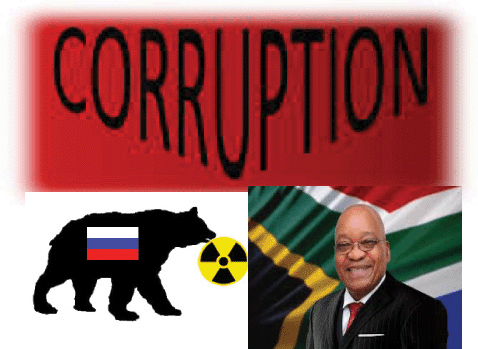
The Brothers Who Bought South Africa, The continent’s most important economy now appears to function for the benefit of one powerful family. Bloomberg, By Matthew Campbell and Franz Wild, 9 Nov 17
“….– Since Nene’s firing, long-standing questions about the scale of the Guptas’ power in South Africa have exploded into the most severe political and economic crisis since the end of apartheid. The family has been accused by activists and opposition politicians of stacking the leadership of powerful state companies, rigging bids in favor of suppliers it controls, and even helping orchestrate a planned $70 billion nuclear-power deal with Russia, for which it could supply vast quantities of uranium—all while using an alliance with Zuma to neuter law enforcement agencies that would otherwise shut down its efforts. Blue chip companies including McKinsey, KPMG, and SAP have been embroiled in what’s fast becoming a global scandal……..
In 2005 the brothers began putting Zuma’s family on their payroll. They hired his son Duduzane, then in his early 20s, as an IT specialist; appointed Duduzane’s twin sister, Duduzile, as a company director; and made one of Zuma’s wives (polygamy is legal in South Africa, and Zuma currently has four) a communications officer.
The idea was controversial from the start. In addition to immense reserves of coal, South Africa has a vibrant renewable-energy sector and no obvious need for nuclear power.
The next summer, Zuma was back in Russia for an economic summit, joined by his senior ministers—including Nene, the then-finance chief. Toward the end of the conference, according to two officials who were present, Zuma cornered Nene in a briefing room about the nuclear deal. The president and several other ministers demanded that Nene provide financial guarantees that would allow Eskom and Russia’s relationship to move ahead. Nene refused; even under the most optimistic projections, he said, a nuclear project of the scale Zuma envisioned would severely strain South African finances.
Zuma complained bitterly about Nene’s resistance, the summit officials say. Not long afterward, Nene’s deputy, Jonas, found himself in the Guptas’ sitting room at Saxonwold, being offered his boss’s job…….
The Guptas’ apparent grip on politics is resilient, but their freedom of movement has been significantly reduced—and doing business with them now carries potentially fatal risks…….. https://www.bloomberg.com/news/features/2017-11-09/the-brothers-who-bought-south-africa
An Arizona Town Council passes resolution against uranium transport
 Flagstaff council passes resolution against uranium transport, Arizona Daily Sun CORINA VANEK Sun Staff Reporter, Nov 8, 2017
$10.6 Billion Per Year: estimated cost of Rick Perry’s Coal And Nuclear Subsidy
 Rick Perry’s Coal And Nuclear Subsidy Could Cost The U.S. Economy $10.6 Billion Per Year, Forbes, Silvio Marcacci, 6 Nov 17, The U.S. Department of Energy’s Notice of Proposed Rulemaking (NOPR) directing the Federal Energy Regulatory Commission (FERC) to subsidize coal and nuclear generation is opposed by nearly every side of America’s electricity industry – from market operators and conservative analysts to a bipartisan group of former FERC commissioners – except for those who would directly benefit from it.
Reasons for opposing the NOPR range from potentially destroying wholesale power markets, to free trade principles, or insufficient review time, but beyond Rick Perry suggesting the proposal’s price was equal to “the cost of freedom,” DOE hasn’t quantified the NOPR’s economic impact or which plants it would subsidize.
New research from Energy Innovation (EI) and the Climate Policy Initiative (CPI) finds DOE’s NOPR could cost up to $10.6 billion annually, and would be paid by U.S. businesses and residents . This subsidy would flow to roughly 10 companies and 90 power plants, and harm cheaper generation from natural gas and renewables.
Wrecking U.S. power markets won’t improve grid resilience
DOE’s NOPR is the latest Trump Administration attempt to prop up older, inefficient coal and nuclear generation that utilities find increasingly uneconomic to operate against cleaner, cheaper generation and efficiency resources…..https://www.forbes.com/sites/energyinnovation/2017/11/06/rick-perrys-coal-and-nuclear-subsidy-could-cost-10-billion-per-year-is-america-great-again-yet/#30790c3530db
Japan’s restart of nuclear power will not happen quickly – regulators
Japan nuclear watchdog says restart approval pace unlikely to speed up https://www.japantimes.co.jp/news/2017/11/07/national/japan-nuclear-watchdog-says-restart-approval-pace-unlikely-speed/, BY OSAMU TSUKIMORI AND AARON SHELDRICK, REUTERS The pace of approvals for nuclear reactor restarts in Japan, where most plants remain shut following the 2011 Fukushima disaster, is unlikely to pick up in the coming years, the new head of Japan’s nuclear regulator said in an interview on Tuesday.
The comments from Nuclear Regulation Authority Chairman Toyoshi Fuketa suggest Japan may not make headway in meeting its electricity generation targets. By 2030, the country was expecting nuclear to power about one-fifth of its generation. However, utilities are having difficulty grappling with tougher rules on protecting reactors from natural disasters in the earthquake-prone country.
Following the Fukushima nuclear disaster in 2011, the world’s worst since Chernobyl in 1986, the NRA was set up in 2012 to draft new safety standards that have been described as among the world’s toughest.
Since then, 12 reactors at six nuclear plants have passed the safety requirements needed to restart, but only four reactors are currently operating. One more reactor that resumed operations after meeting the requirements has been shut down for scheduled maintenance.
Most of the approvals have been for reactors in western Japan and not on the east coast where Tokyo Electric Power Company Holdings Inc.’s Fukushima No. 1 station is located. The plant suffered multiple reactor meltdowns after an earthquake on the northeast coast caused a tsunami that swamped the site.
“We have accumulated experience in safety reviews, but comparatively speaking, many of the plants in eastern Japan that we are reviewing now have difficult natural conditions,” Fuketa, 60, said in the interview. “It’s doubtful the pace of approvals would quicken.”
A majority of Japanese oppose nuclear power after Fukushima, and restarts are a delicate political issue rather than just a matter of meeting technical safety requirements.
When asked if he could place a number of how many reactors may be approved for a resumption of operations in the next five years, Fuketa said: “I honestly do not know.”
About a dozen other reactors are going through safety checks as part of a relicensing process under the new rules.
Fuketa is known for taking tough positions during safety reviews of reactors and has been instrumental in directing the clean-up of the wrecked Fukushima plant.
The government set an energy mix plan in 2015 that forecasts relying on nuclear power to generate between 20 to 22 percent of the country’s electricity in 2030. That requires having about 30 reactors operating by then.
The nation’s nine regional power utilities and a wholesaler, Japan Atomic Power Co., have 42 nuclear reactors for commercial use, with a total generating capacity of 41,482 megawatts.
1 This Month

of the week– Nuclear Reactor Information Task Force

14 May – online event From Bombs to Data Centres: the Face of Nuclear Colonialism
To see nuclear-related stories in greater depth and intensity – go to https://nuclearinformation.wordpress.com
-
Archives
- May 2026 (102)
- April 2026 (356)
- March 2026 (251)
- February 2026 (268)
- January 2026 (308)
- December 2025 (358)
- November 2025 (359)
- October 2025 (376)
- September 2025 (257)
- August 2025 (319)
- July 2025 (230)
- June 2025 (348)
-
Categories
- 1
- 1 NUCLEAR ISSUES
- business and costs
- climate change
- culture and arts
- ENERGY
- environment
- health
- history
- indigenous issues
- Legal
- marketing of nuclear
- media
- opposition to nuclear
- PERSONAL STORIES
- politics
- politics international
- Religion and ethics
- safety
- secrets,lies and civil liberties
- spinbuster
- technology
- Uranium
- wastes
- weapons and war
- Women
- 2 WORLD
- ACTION
- AFRICA
- Atrocities
- AUSTRALIA
- Christina's notes
- Christina's themes
- culture and arts
- Events
- Fuk 2022
- Fuk 2023
- Fukushima 2017
- Fukushima 2018
- fukushima 2019
- Fukushima 2020
- Fukushima 2021
- general
- global warming
- Humour (God we need it)
- Nuclear
- RARE EARTHS
- Reference
- resources – print
- Resources -audiovicual
- Weekly Newsletter
- World
- World Nuclear
- YouTube
-
RSS
Entries RSS
Comments RSS
 nuclear-news