Trump’s budget bill gives tax credits to save Vogtle nuclear plant expansion, and promote Small Modular Nuclear Reactors
Platts 9th Feb 2018, The budget bill President Donald Trump signed Friday morning to avert a shutdown of the US government includes a broadening of production tax credits for nuclear projects critical for the completion of two reactors at Georgia Power’s Vogtle station and designed to spur development of 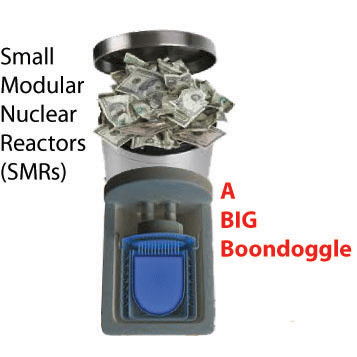 the first commercial small modular reactors in the US.
The 2,300-MW Vogtle plant expansion in Waynesboro, Georgia, has experienced delays and cost overruns that threatened its completion. The Georgia Public Service Commission gave the go-ahead for rate recovery, which Georgia Power had said was crucial for completing the nuclear generating units. But the production tax credits were also a key element of the project’s economic case, Georgia Power officials have said.
https://www.platts.com/latest-news/electric-power/washington/us-budget-bill-includes-credits-for-georgia-nuclear-21293499
Warning to South Africa – on nuclear dependence to Russia
Chasing nuclear energy could lead to capture – expert https://www.iol.co.za/news/politics/chasing-nuclear-energy-could-lead-to-capture-expert-13222078 11 FEBRUARY 2018 Cape Town – A leading oil and gas lawyer and African entrepreneur has warned South Africa against pursuing nuclear energy, saying any proposed deal might come with political pressure which could lead to “capture”.
NJ Ayuk, who is widely recognised as one of the top influential businessman in the sector globally, said there was no reason for South Africa to consider nuclear energy and instead it should invest in clean renewable energy to create jobs and grow its economy.
Ayuk said the consideration for nuclear could lead to the country succumbing to external pressures.
“We need to stop having short-term fixes to our challenges. If we continue to look to other powers for solutions, we will have to succumb to what they want. Is that what South Africa wants?” he asked.
With South Africa’s bid for a non-permanent seat on the UN’s Security Council this year, Ayuk warned if the country were to consider nuclear energy and partner with another country, this would diminish its position on the influential body.
Speculation about South Africa seeking partnership with Russia has come to the fore over the past year, with the government denying that a deal had been made.
“Do you want a member of the Security Council that’s dependent on another country for its energy security and needs? Africa needs a representative that will articulate its views and not one that will be perceived to be captured by another strong power,” he said.
For decades South Africa relied on coal for electricity and synthetic fuel production but needs to look at other energy sources to meet its climate change commitments.
Recent studies have also shown a decline in global demand for coal.
“Renewable energy must be the core part of the energy mix as it has the potential to alleviate poverty. We need to put in the right investment in it. It will create jobs and allow small businesses to participate in the sector,” he said.
He said the country and other African countries endowed with mineral resources should start looking at establishing an enabling environment for investments and growth in the sector.
Ayuk said the political change in South Africa gave hope that there would be a re-focus on the energy sector and that “homegrown” solutions for energy problems would be found.
“We have to be futuristic. It doesn’t help any country to have big projects and the skills cannot be found within it because jobs are not created or if they are they are low skilled jobs”, Ajuk said.
He also advocated better management of mineral resources throughout the continent and better frameworks to “empower communities”.
“Africa needs to start thinking of sharing skills and expertise to create intra-trade. We have the technology in most of the countries, we need to enhance what we already have.”
UK’s “Central Government Supply Estimates 2017-18” promises a massive future bailout for the nuclear industry

 – excitingly entitled “Central Government Supply Estimates 2017-18” – detailing changes to planned public expenditure since last Autumn’s
Budget 2017. At pages 162-64 you can find the Business, Energy and Industrial Strategy (BEIS) extra expenditure requests and clarification of
perceived liabilities.
These include several covering the privately-owned commercial nuclear industry sector. Below are the sections on nuclear, and
the most common read-out message is how often the liabilities for which the taxpayer is expected to take long term financial responsibility are
described as “unquantifiable.”
That is accurate, but what is omitted is the numbers are – based on accumulated experience to date, likely to be astronomically huge. This worryingly unacceptable situation,- whereby one industry (nuclear) of the electricity generating sector is being promised a massive future bailout from its liabilities- really should be examined in detail by our elected Parliamentarians and peers in several relevant committees and in the Estimates Debate on the floor of the Commons.
http://drdavidlowry.blogspot.co.uk/2018/02/nuclears-unquantifiably-huge-future.html
USA budget will benefit the nuclear industry
 Congress To Pass Budget Deal Benefitting Biofuels And Nuclear Sectors https://oilprice.com/Latest-Energy-News/World-News/Congress-To-Pass-Budget-Deal-Benefitting-Biofuels-And-Nuclear-Sectors.html,
President Trump has, last night, signed a budget deal to raise spending and reopen the government. In its current form, the biofuels and nuclear power industries are set to benefit from the compromise deal.
A two-year agreement would provide tax incentives for the two energy sectors as well as credits for energy efficient car purchases of models manufactured in 2017. Another $1-a-gallon tax credit applies to refiners who mix biofuel in their products. Cellulosic ethanol, produced from garbage, algae, and corn stover, will also get an extension on its $1.01 per gallon credit.
An energy production tax credit for Southern Co.’s nuclear plants in Georgia will help the facilities there get off the ground.
In the last 20 years, the U.S. has seen only one new nuclear reactor that is functional, constructed by a government entity – the Tennessee Valley Authority. Further, the Nuclear Regulatory Commission shows that there are only four reactors currently under construction in the entire country. Two would be at the Alvin W. Vogtle station in Georgia, and two at the Virgil C. Summer plant in South Carolina.
These projects are implementing reactors manufactured by Westinghouse. Construction on all four are currently delayed over three years and are billions over-budget. Westinghouse itself was one of the last private companies to be commissioned for the manufacture of nuclear reactors—before over-budget, inefficient projects such as these pushed them into ruin. So far, Westinghouse remains committed to completing the projects.
Southern Co. also recently abandoned a coal-gasification plant project in Mississippi, which countered President Donald Trump’s plans to increase clean coal’s grip on the American energy mix.
“They’ve got the conundrum of having spent billions of dollars [on nuclear projects],” Glenrock Associates analyst Pail Patterson told Bloomberg over the phone. “That’s why abandonment in the middle of a project usually looks unattractive.”
Idaho politics – differences between governor candidates on nuclear issues

 Gov. candidates weigh in on nuclear cleanup deal, Post Register, Idaho, February 8, 2018 , By NATHAN BROWN nbrown@postregister.com
France must redouble its efforts if it wants to achieve the goals it has set in terms of “green” energy.
to many of its neighbors, the Hexagon must redouble efforts if it wants to
achieve the goals it has set in terms of “green” energies. “Let’s
accelerate the growth of renewable energies in the face of the climate
emergency. The theme chosen for the 19th annual conference of the Union of
Renewable Energy (SER), Thursday, February 8 in Paris, summarizes the
situation of an economic sector in the middle of the ford. A laggard
compared to many of its neighbors, France must redouble its efforts if it
wants to achieve the goals it has set in terms of “green” energy.
http://www.lemonde.fr/planete/article/2018/02/08/la-france-peut-elle-rattraper-son-retard-dans-les-renouvelables_5253487_3244.html
Good news: White House withdraws environmental nomination of fossil fuel shill Kathleen Hartnett White
Trump’s environmental good news, Religion News, | The good news out of Washington is that the White House has withdrawn the nomination of Kathleen Hartnett White to head the President’s Council of Environmental Quality. A leading shill for the carbon industry, the one-time chair of the Texas Commission on Environmental Quality would have joined Energy Secretary Rick Perry and EPA Administrator Greg Pruitt in a troika of climate change deniers driving the Trump Administration’s environmental policies.
Hartnett White’s confirmation hearing in November did not go well, and although President Trump resubmitted her nomination last month, it can be presumed that he reversed course in the face of threats from at least a couple of Senate Republicans to vote her down……….
while the cause of climate change is hardly restricted to religious folks, it is perhaps the most religiously motivated of all progressive social causes today. Leading the way has been Pope Francis, with his great 2015 encyclical Laudato Si’. But it is a cause that has enlisted the full spectrum of the religious community — Jews and Muslims, Eastern Orthodox and Mainline Protestant, Hindu and Buddhist.
Except for white evangelicals. Outliers, they are now in thrall to a political party that over the past decade has increasingly opposed all efforts to address climate change. Their religious rationalization is that they are standing with a God who promised no more floods against pagan “Earth worshippers.”
“Slavery degrades the Religious Activity of the People,” preached Boston’s leading abolitionist minister Theodore Parker on July 4, 1858. Today it is climate change denial that is degrading the religious activity of the evangelical people. https://religionnews.com/2018/02/06/trumps-environmental-good-news/
U.S. Senator Lindsey Graham keen for “nuclear renaissance”
 Sen. Lindsey Graham wants ‘nuclear renaissance,’ thinks Republican memo has no Mueller consequence
He also said he would put up “one hell of a fight” to keep MOX at SRS, Aiken Standard, By Colin Demarest cdemarest@aikenstandard.com
UK government funds £7.5 million National College for Nuclear
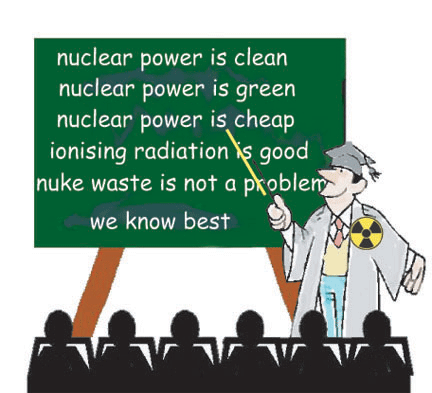 Carlisle News and Star 7th Feb 2018, The £7.5 million National College for Nuclear is due to be officially
opened today. The college, at Lillyhall, near Workington, will train
thousands of technicians and engineers to support Britain’s future
nuclear programmes, create cleaner energy and provide a highly skilled
workforce.
The National College for Nuclear will have hubs in Cumbria and
Somerset and facilities which include virtual, simulated laboratories. It
is one of five national colleges being established by government as part of
its Industrial Strategy.
http://www.newsandstar.co.uk/news/business/75-million-National-College-for-Nuclear-due-to-open-today-0a0f3e9b-7c2d-4320-8b08-55c9b28c51d6-ds
United Arab Emirates moves on in plan to develop nuclear power
Board approves project to ensure building national capacity in the nuclear sector, Gulf News, February 8, 2018 Abu Dhabi: The board of management of the UAE’s Federal Authority for Nuclear Regulation (FANR) has approved the 2018 operational plan, which focuses on ensuring safe, secure and peaceful nuclear and radiation programmes in the UAE……..http://gulfnews.com/news/uae/government/nuclear-authority-board-approves-2018-operational-plan-1.2170675
A new arms race – for the Middle East? Saudi Arabia’s nuclear power plan is not economic
 How a Saudi nuclear reactor could accelerate an arms race. https://www.economist.com/news/middle-east-and-africa/21736575-kingdoms-nuclear-ambitions-make-little-economic-sense-how-saudi-nuclearThe kingdom’s nuclear ambitions make little economic sense, 8 Feb 18
IN THE desert 220km (137 miles) from Abu Dhabi, the capital of the United Arab Emirates (UAE), a South Korean firm is close to finishing the Arab world’s first operational nuclear-power reactor. The project started ten years ago in Washington, where the Emiratis negotiated a “123 agreement”. Such deals, named after a clause in America’s export-control laws, impose tough safeguards in return for American nuclear technology. When the UAE signed one in 2009, it also pledged not to enrich uranium or reprocess spent fuel into plutonium. Both can be used to make nuclear weapons. Arms-control wonks called it the gold standard of 123 deals.
Saudi Arabia only wants bronze. The kingdom has its own ambitious nuclear plans: 16 reactors, at a cost of up to $80bn. But, unlike the UAE, it wants to do its own enrichment. Iran, its regional rival, is already a step ahead. The most controversial provision of the nuclear deal it signed with world powers in 2015 allows it to enrich uranium. Iran did agree to mothball most of the centrifuges used for enrichment, and to process the stuff only to a level far below what is required for a bomb. Still, it kept the technology. The Saudis want to have it, too.
Lawmakers in Washington are worried. Granting the Saudis such a deal could prompt other countries, such as the UAE, to ask for similar terms. It may undermine global efforts at non-proliferation. Indeed, critics of the Iran deal fear that a Saudi enrichment programme would compromise their effort to impose tighter restrictions on Iran. But Donald Trump, America’s president, is less concerned. He has close ties with the Saudis. He has also pledged to revitalise America’s ailing nuclear industry. Among the five firms bidding for the Saudi project is Westinghouse, an American company that filed for bankruptcy last year. It would not be able to join the project without a 123 agreement.
Even some critics of the proposed deal concede that it may be the least bad option, because it would give America influence over the Saudi programme. The kingdom has other suitors. One is Rosatom, Russia’s state-owned nuclear-power company, which is pursuing a frenetic sort of nuclear diplomacy in the Middle East. In December it signed a $21.3bn contract to build Egypt’s first power reactor. Jordan inked a $10bn deal with the Russians in 2015. Despite their differences, particularly over Syria, the Saudis are keen to have closer ties with the region’s resurgent power. King Salman spent four days in Moscow in October, the first such visit by a Saudi ruler.
Yet nuclear energy does not make much economic sense for the kingdom. Saudi Arabia burns 465,000 barrels of oil per day for electricity, forgoing $11bn in annual revenue. But the last nuclear reactors will not go online until the 2030s. They will generate less than one-sixth of the 120 gigawatts needed during periods of peak demand. In a country with vast deserts, it would make more sense to use gas and invest in solar energy. Today the kingdom generates almost none: its largest solar farm, at the headquarters of the state oil company, powers an office building.
Russia postponing new nuclear reactors because of costs

 Nucnet 5th Feb 2018, Russia’s state nuclear energy corporation Rosatom is ready to postpone
the commissioning of two nuclear power units for two years in an effort to
slow down increases in energy prices, the state-owned Tass news agency
said.
said commissioning of Novovoronezh 2-2, planned for January 2019, would be
postponed by a year, and commissioning of Leningrad 2-2, planned for
February 2020, by two years.
a government-regulated fixed power supply agreement with wholesale
consumers, any return on nuclear investment must be at least 10.5%, which
would mean electricity prices for the consumers would increase to meet the
target.
2008 to guarantee returns on investment in generating capacity. The final
wholesale prices are usually higher than the prevailing market price to
compensate costs incurred by the investor during construction. The
agreements include government-regulated price levels for various types of
consumer, dependent on their maximum consumption. Neither Tass nor Rosatom
gave details, although Tass said postponing commissioning of the units will
lead to a reduction in the rate of electricity price growth in 2019 from
12.9% to 11.1%. https://www.nucnet.org/all-the-news/2018/02/05/russia-ready-to-postpone-commissioning-of-two-nuclear-plants-says-official-agency
Britain’s costly gamble with Hinkley point C nuclear project, as the renewables revolution gather speed
there will be no room in this new world of flexible, decentralised generation for large, rigid nuclear reactors. “There are going to be increasingly frequent periods when we have too much power,” says Mr Burke. “But if you are the energy minister, how do you explain to people why you are having to switch off cheap renewables in order to use the much more expensive nuclear power which you have committed to pay for over the next 35 years?”

FT 4th Feb 2018, The UK’s Hinkley Point C has become a critical test of developers’ ability to compete with cheap gas and renewables. Across an expanse of scarred earth the size of 250 football pitches beside the Bristol Channel in south-west England, 3,000 workers are building what will be, by some estimates, the most expensive structure on the planet.
At a cost of almost £20bn, the Hinkley Point C power station in Somerset is the first nuclear plant to be built in the UK since the 1990s. Clusters of cranes and cement silos loom over a warren of earthworks crawling with excavators and
100-tonne dumper trucks. At the centre of the site, foundations are taking shape for two 1.6 gigawatt reactors intended to meet 7 per cent of UK electricity demand, with a target for completion by the end of 2025.
Hinkley is crucial to UK energy security as the country faces the closure of old coal and nuclear plants accounting for about 40 per cent of the country’s reliable electricity generating capacity by 2030. But it also has wider significance as a test of the industry’s ability to compete in a rapidly changing energy landscape. Nuclear power has been under threat
since the meltdown at the Fukushima plant in Japan in 2011 revived safety fears.
But the biggest threat is now economic as the spiralling cost of building new reactors collides with a world of cheap and plentiful gas and renewable power. The UK is now one of the few western countries committed to renewing its ageing reactors. More than 70 per cent of the 448 reactors around the world are in the OECD club of wealthy nations, and more than half of them are at least 30 years old.
Many will reach the end of their operational lives in the next two decades, yet the prospects of replacing
them are uncertain, at best, in countries such as the US, Japan and France, while others including Germany, Switzerland and South Korea are planning to phase out nuclear power altogether. The days of networks dominated by a few large, centralised power stations are drawing to a close, according to many analysts. In their place will come more dispersed sources of renewable generation. Battery storage and digital “smart grid” technology will help smooth out supply and demand, and increase efficiency.
Tom Burke, chairman of E3G, an environmental think-tank, says there will be no room in this new world of flexible, decentralised generation for large, rigid nuclear reactors. “There are going to be increasingly frequent periods when we have too much power,” says Mr Burke. “But if you are the energy minister, how do you explain to people why you are having to switch off cheap renewables in order to use the much more expensive nuclear power which you have committed to pay for over the next 35 years?”
Progress at Hinkley, therefore, is being watched as closely in Beijing as in Paris and London. A repeat of the delays at Olkiluoto and Flamanville could sign the death warrant for western reactor developers, while dealing a setback for
China’s international expansion. Mr Rossi is aware of the high stakes: “We need to make sure that Britain will be happy about the choice it made.” https://www.ft.com/content/8307c266-066b-11e8-9650-9c0ad2d7c5b5
The USA nuclear lobby is now trying to tie up longterm tax-payer funding for Small Modular Nuclear Reactors
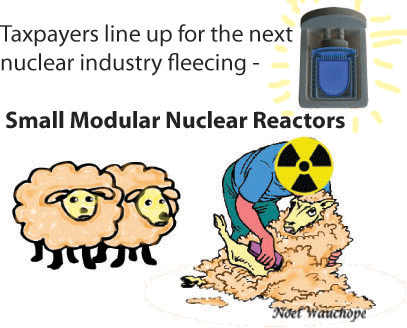
Report Urges Long-Term Power Agreements for SMRs at Federal Sites , Nuclear Energy InstituteFeb. 1, 2018—A new study funded by the U.S. Department of Energy recommends that federal agencies (such as DOE and the Defense Department) be allowed to enter into 30-year power purchase agreements with utility operators of small modular reactors (SMRs).
Typically defined as reactors having a generating capacity smaller than 300 megawatts-electric, SMRs are a good fit for sites like DOE’s 17 national laboratories, the study says.
For example, the Oak Ridge National Laboratory is the largest consumer of electricity among the agency’s sites and is engaged in several critical, round-the-clock defense and research-related activities………
“Leveraging the federal government’s strong credit standing as a purchaser of the power and its continual need for baseload power is important in the development of SMRs. Federal agency purchasers can help to set the market and offer more certainty to other initial buyers,” the study says.
“By creating an authority that permits federal agencies to purchase power for up to 30 years, SMR developers will be able to use traditional financing to repay a project financed project or a long-term bond over an up to 30-year term, making the financing more affordable.”
Currently, only the Department of Defense has the authority to enter into power purchase agreements of 30 years in duration, in certain circumstances.
The Tennessee Valley Authority (TVA) is currently going through the Nuclear Regulatory Commission early site permit process for developing two or more SMRs at the Clinch River Site.
The study urges moving the pilot project at Clinch River forward to completion……..
Another example of collaboration between a small modular reactor developer and a national laboratory is NuScale Power, of which the Utah Associated Municipal Power Systems (UAMPS) is planning to build up to 12 at the Idaho National Laboratory. Under this project, DOE or other federal entities could enter into power purchase agreements with UAMPS or its associated utilities. ……
Another example of collaboration between a small modular reactor developer and a national laboratory is NuScale Power, of which the Utah Associated Municipal Power Systems (UAMPS) is planning to build up to 12 at the Idaho National Laboratory. Under this project, DOE or other federal entities could enter into power purchase agreements with UAMPS or its associated utilities. ……
The report, conducted by Kutak Rock and Scully Capital for DOE’s Office of Nuclear Energy, builds on a January 2017 report which studies the options available to federal agencies looking to buy power from SMRs. https://www.nei.org/News-Media/News/News-Archives/2018/Report-Urges-Long-Term-Power-Agreements-for-SMRs-a
South Africa’s nuclear power should end -five reasons
 Five facts that prove South Africa’s nuclear power plan should die https://mg.co.za/article/2018-02-01-five-facts-that-prove-south-africas-nuclear-power-plan-should-die
Under the presidency of Jacob Zuma, South Africa has been trying to implement a massive new nuclear programme. The initiative stood against a growing body of evidence pointing to the fact that nuclear isn’t needed, is too costly and is hard to finance. There is also the fact that the case for renewables looks increasingly favourable than nuclear. And last year, civil society groups secured a court order that halted the nuclear build programme temporarily on grounds that government had not followed due consultative process.
But Zuma has insisted on the nuclear programme, going so far as to appoint a minister to the energy portfolio who continues to argue that the country needs nuclear energy. But the facts are still against him, as they were against the previous four ministers who failed to deliver Zuma’s nuclear project.
The argument against nuclear energy can be broken down into five key themes.
1. Large chunks of new power aren’t needed
South Africa has surplus energy capacity. Along with new capacity that is coming online, the country does not need nuclear power to meet electricity demand for many years, despite the scheduled closure of some old coal plants. In fact, demand has fallen in South Africa and is lower than it was a decade ago.
This is not simply a result of slow economic growth. Steep hikes in electricity prices have accelerated investments in energy efficiency and electricity savings.
The structure of South Africa’s economy is also changing with the energy-intensive primary sector declining and the tertiary and services sector accounting for a larger share of the economy.
2. Good news on renewables
At the same time, renewable energy prices have plummeted globally and rival or even undercut the operating costs of many existing nuclear or fossil-fuelled power stations. Within just one year (2016), world costs for new onshore windpower fell by 18%, for offshore wind by 28%, and for utility-scale photovoltaics (PV) by 17%, while low bids fell 37% for Mexican PV and 43% for EU offshore wind. In South Africa, transparent auctions have already cut solar PV electricity prices by close to 80% and wind energy by nearly 50%.
Government’s nuclear policy consistently cites as its analytic basis the Integrated Resource Plan(IRP) for Electricity 2010 to 2030, formally published in May 2011 and updated several times since then. But over this time, the economic rationale for nuclear, never particularly strong, has weakened considerably. So much so that nuclear energy is not picked in any South African modelling scenarios, other than one where artificial constraints are placed on how much solar and wind energy can be built and where additional carbon budget limits are imposed. Even in this extreme scenario, nuclear energy might only be required after 2039.
Instead, the models favour solar and wind plus gas as the cheapest option for sustainable electricity supply. Renewables also perform well on the question of reliability. A recent engineering studyconfirms that the South African power system will be sufficiently flexible to handle very large amounts of wind and solar power generation to cope with increased flexibility requirements.
3. Nuclear power is dying globally
Global nuclear enterprise is slowly dying from an incurable attack of market forces. Financial distress stalks vendors, with cascading insolvencies spreading in the past two years. Construction cost and delays keep rising worldwide.
The global nuclear industry continues to suffer major risks of project failure or abandonment. For example, of 259 US nuclear units ordered between 1955-2016, 128 (49%) were abandoned before start-up and 34 (13%) prematurely closed later. Of the 97 units (37%) operating in mid-2017, 49 were deemed uneconomic to run; 35 suffered 45 year-plus safety-related outages. And only 28 units (11%) remain economically viable.
By contrast, renewable energy is dominating new investment in power generation worldwide. Bloomberg New Energy Finance estimates renewable energy will capture 72% of global power generation investment by 2040 as costs drop by a further 66% for solar power, 47% for onshore wind, and 71% for inshore wind plants.
China has generated more wind power than nuclear electricity since 2012. India has quadrupled its renewables target and is planning 100 GW of solar power (now cheaper than coal power) by 2022. Over three billion people now get more non-hydro renewable than nuclear electricity, in three of the world’s four top economies (China, Germany, Japan) and in Brazil, India, Mexico, Holland, Spain, and the United Kingdom.
4. Renewable energy is good for business
The International Renewable Energy Agency has found that worldwide, doubling renewables’ energy share by 2030 could raise global GDP up to 1.1%, improve welfare up to 3.7%, and support over 24 million renewable-energy jobs.
In South Africa, important economic benefits have already been seen due to renewable energy initiatives. These have created a total of 32 532 job years.
Renewable energy projects also aid development in previously marginalised and disadvantaged groups and communities. Thanks to novel economic development criteria built into South Africa’s world-recognised renewable energy independent power producer programme. Black South Africans own, on average, 31% of projects that have reached completion. Black local communities further own on average 11% of the equity of projects.
5. The Russians can’t be trusted
The above facts demonstrate that nuclear lacks a business case for South Africa, whichever country provides the technology. But there is special cause for concern about South Africa’s proposed nuclear deal with Russia. During a series of private presidential meetings over the past seven years, South Africa concluded an unusually strong and specific nuclear agreement with Russia, since struck down by the courts.
Concerns are several. Firstly, a deal which makes South Africa dependent on Russia for a large share of electricity supply – as well as for nuclear safety – must raise serious questions about South African national sovereignty and independence.
Additionally, Russia is facing economic challenges, sliding in terms of rated world economies to number 15, below Mexico. Sovereign debt is a real concern and low oil prices and Western sanctions in response to Russia’s aggression towards the Ukraine and other areas are making matters worse.
Russia wants to build nuclear power plants but needs huge amounts of capital to finance its nuclear commitments around the world. It hardly appears to be a stable financial partner.
A rational choice is needed
South Africans deserve reliable and affordable electrical services. At issue is how much money, time, and opportunity for national advancement will be lost before the country finally abandons the folly of procuring new nuclear power plants.
Amory Lovins, chief scientist at Rocky Mountain Institute, co-authored this article.
Anton Eberhard, Professor at the Graduate School of Business, University of Cape Town
This article was originally published on The Conversation. Read the original article.
1 This Month

of the week– Nuclear Reactor Information Task Force

14 May – online event From Bombs to Data Centres: the Face of Nuclear Colonialism
To see nuclear-related stories in greater depth and intensity – go to https://nuclearinformation.wordpress.com
-
Archives
- May 2026 (102)
- April 2026 (356)
- March 2026 (251)
- February 2026 (268)
- January 2026 (308)
- December 2025 (358)
- November 2025 (359)
- October 2025 (376)
- September 2025 (257)
- August 2025 (319)
- July 2025 (230)
- June 2025 (348)
-
Categories
- 1
- 1 NUCLEAR ISSUES
- business and costs
- climate change
- culture and arts
- ENERGY
- environment
- health
- history
- indigenous issues
- Legal
- marketing of nuclear
- media
- opposition to nuclear
- PERSONAL STORIES
- politics
- politics international
- Religion and ethics
- safety
- secrets,lies and civil liberties
- spinbuster
- technology
- Uranium
- wastes
- weapons and war
- Women
- 2 WORLD
- ACTION
- AFRICA
- Atrocities
- AUSTRALIA
- Christina's notes
- Christina's themes
- culture and arts
- Events
- Fuk 2022
- Fuk 2023
- Fukushima 2017
- Fukushima 2018
- fukushima 2019
- Fukushima 2020
- Fukushima 2021
- general
- global warming
- Humour (God we need it)
- Nuclear
- RARE EARTHS
- Reference
- resources – print
- Resources -audiovicual
- Weekly Newsletter
- World
- World Nuclear
- YouTube
-
RSS
Entries RSS
Comments RSS
 nuclear-news