Crown Prince Mohammed bin Salman launches nuclear project in Saudi Arabia
 Bin Salman launches Saudi Arabia’s first nuclear plant project, Aljazeera, 6 Nov 18
Crown Prince Mohammed bin Salman launches project to build the first nuclear research reactor in the kingdom. Saudi Arabia‘s crown prince has launched a project to build the first nuclear research reactor in the kingdom, the Saudi Press Agency reported.
Crown Prince Mohammed bin Salman, also known as MBS, launched seven strategic projects in renewable energy, atomic energy, water desalination, genetic medicine and the aircraft industry during his visit to King Abdulaziz City for Science and Technology on Monday.
The two most significant projects include a nuclear research reactor and a centre for the development of aircraft structures.
In March, MBS announced his country’s readiness to develop nuclear weapons in the event that Iran heads in that direction………
Nuclear power
Last year, the International Atomic Energy Agency said the Saudi government had invited proposals for the construction of two nuclear power reactors to boost the country’s energy mix.
The kingdom is considering building 17.6 gigawatts (GW) of nuclear capacity by 2032, the equivalent of about 17 reactors, making it one of the biggest projects globally…….https://www.aljazeera.com/news/2018/11/bin-salman-launches-saudi-arabia-nuclear-plant-project-181105192827938.html
Local opposition to restart of Tokai nuclear station, but it is cleared to start by Japan’s nuclear watchdog
|
Aging Tokai nuclear plant outside Tokyo cleared to restart, THE ASAHI SHIMBUN, November 7, 2018 The nation’s nuclear watchdog on Nov. 7 formally approved a 20-year extension of the only nuclear reactor in the Tokyo metropolitan area, although local communities will have the final say on the restart.Operator Japan Atomic Power Co. will need the consent of the Ibaraki prefectural government, as well as six local municipalities, including the village of Tokai, where its aging Tokai No. 2 nuclear plant is located.
The company faced having to prepare to decommission the plant’s 40-year-old reactor if it failed to meet a Nov. 27 deadline on revised and more stringent safety standards implemented by the Nuclear Regulation Authority in the aftermath of the 2011 nuclear disaster in Fukushima Prefecture. After the triple meltdown at the Fukushima No. 1 nuclear plant, the operational life of nuclear reactors was set at up to 40 years in principle. But power companies can continue to operate their facilities for an additional 20 years if their reactors pass the NRA screening. So far, all requests to the NRA to extend the operating life of old reactors have been approved. The reactor at the Tokai No. 2 plant is the fourth to clear the NRA for extended operations since the Fukushima disaster. It is located about 120 kilometers from the heart of Tokyo. The 1.1-gigawatt boiling water reactor is the only unit at the Tokai No. 2 plant and is of the same design as the crippled reactors at the Fukushima No. 1 nuclear plant. The Tokai No. 2 plant was also affected by the tsunami generated by the magnitude-9.0 Great East Japan Earthquake on March 11, 2011. It is the first time for a reactor affected by the tsunami to be approved for an operational extension. It is also the first boiling water reactor to gain such approval. The NRA examined the reactor’s pressure vessel and other equipment, and concluded that the unit could operate safely until November 2038. But it remains unclear if Japan Atomic Power can restart the plant under its earliest time frame of 2021, due to local opposition. In October, Mayor Toru Umino of Naka, one of the six municipalities around the plant, announced his opposition to the extension. The city assembly of Mito, another municipality, adopted a resolution against the extension in June. About 960,000 people live within a 30-km radius of the plant, making it the most densely populated site among the nation’s nuclear facilities. After the Fukushima disaster, municipalities in close proximity to a nuclear plant were required to craft an evacuation plan to respond to a nuclear emergency. But only three of the 14 municipalities around the Tokai No. 2 nuclear plant within that range have done so due to the difficulty of arranging transportation for such a large number of people. Bringing the reactor back online is expected to cost Japan Atomic Power at least 174 billion yen ($1.54 billion), a sum that includes construction of a seawall and other safeguard measures. The company hopes to have those measures in place by the end of March 2021. It may well also have to spend tens of billions of yen in the future to meet a new requirement that nuclear facilities are able to contain damage from a terrorist attack. TIMELINE OF KEY EVENTS …….http://www.asahi.com/ajw/articles/AJ201811070061.html |
|
Iran is not likely to restart its nuclear weapons programme any time soon
 Despite sanctions, Iran unlikely to restart nuclear program—yet, Bulletin of the Atomic Scientists, By Kelsey Davenport, November 5, 2018 Iran’s commitment to the 2015 nuclear deal will face another test starting November 5, when US sanctions targeting the country’s oil sector come back into effect. When Tehran concluded the agreement with six world powers—the United States, Russia, China, France, Great Britain, and Germany—it agreed to stringently limit nuclear activities in exchange for sanctions relief. The government of President Hassan Rouhani, and millions of ordinary Iranians, hoped this would bring major economic benefits by allowing foreign companies to do business with Iran. Despite the fact that Iran was complying with the terms of the deal—as documented by the International Atomic Energy Agency and the US State Department—the Trump administration decided on May 8 that it would reimpose the lifted sanctions, violating the agreement and dealing a harsh blow to Iran’s economy. That left Iran with a decision to make: Continue to comply with the agreement—known as the Joint Comprehensive Plan of Action, or JCPOA—which still had the support of the five other parties and the European Union? Or resume and expand nuclear activities the deal had restricted?
Fortunately, Washington’s unilateral decision to withdraw from the deal, and even the cut in oil exports that will kick in November 5, are unlikely to trigger a drastic shift in Iran’s approach to the nuclear agreement. Most likely it will continue to adhere to JCPOA terms—at least in the short term. It has had time to adjust to the expected cut in exports. And, given the tightening in the oil market and Iran’s willingness to sell oil at a discounted rate, it is unlikely that the Trump administration will succeed in pushing Tehran’s oil exports to zero. India and China, Iran’s two largest oil customers, communicated to the United States that a complete cut is unrealistic at this time. Additionally, Iran’s past history with sanctions demonstrates a high tolerance for economic pain, and Tehran appears poised to wait out the Trump administration.
Iran’s decision, though, is not solely dependent on sanctions, and could shift down the road. Recognizing how important it is to keep Iran from developing nuclear weapons, the European Union, Russia, and China are trying to find ways to preserve the economic benefits of the deal. Policymakers in the United States, meanwhile, still have a critical role to play. They can help keep the path open for a US return to the JCPOA, and prevent tensions from unnecessarily escalating over Iran’s nuclear rhetoric.
First, do no (more) harm. The Trump administration’s decision to reimpose sanctions—despite acknowledging Iran’s compliance with the JCPOA—dealt a serious blow to US credibility and significantly undermined the deal’s benefits to Iran. But US policymakers can still mitigate further negative impacts. This should start with reclaiming the narrative surrounding the deal and emphasizing its nonproliferation value.
The Trump administration has painted the deal as a failure because it did not “fix” Iran’s policies in areas beyond the nuclear program. But the JCPOA was only ever negotiated to block Iran’s pathways to nuclear weapons, and Tehran is clearly complying with the new restrictions and obligations. Trump’s blatant attempts to characterize the deal as a disaster must not go unchallenged, and policymakers supportive of its goals cannot wait for the next attack to defend it. The JCPOA put in place more intrusive, permanent, inspection provisions, and limits ensuring that for a decade, it would take Iran more than 12 months to produce enough fissile material for one bomb.
Furthermore, Iran may be more willing to continue adhering to the nuclear agreement—even without the full hoped-for economic benefit—if supporters of the deal in the United States continue to assert its security benefits, foreshadowing a return to US compliance under a different administration……..https://thebulletin.org/2018/11/despite-sanctions-iran-unlikely-restart-nuclear-program-yet/
Trump’s Energy Secretary Rick Perry accidentally told the truth about Yucca Mt, contradicting Trump

 Think Progress 31st Oct 201*Yucca Mountain** One thing that unites Nevadans is opposition to President Donald Trump’s effort to turn the state into a huge nuclear waste dump. That’s why many
were surprised when Trump suggested he might abandon that policy after
touring the state recently with GOP Senator Dean Heller, who is in a tight
reelection race against Democrat Jacky Rosen.
But Trump’s Energy Secretary, Rick Perry, admitted on Friday the administration still supports
building the Yucca Mountain nuclear waste repository outside of Las Vegas.
In doing so, Perry effectively spoiled Trump’s effort to help Heller, as
Jon Ralston, editor of the Nevada Independent, explained to Bloomberg:
“Poor Rick Perry didn’t get the memo and accidentally told the
truth.”
https://thinkprogress.org/rick-perry-accidentally-told-the-truth-about-dumping-nuclear-waste-in-nevada-roiling-senate-race-c3945ba499d9/
The Twin Threats of Climate Change and Nuclear Annihilation- new documentary with Noam Chomsky
 New Documentary by ChomskySpeaks.org with Noam Chomsky Challenges Establishment over Twin Threats of Climate Change and Nuclear Annihilation https://www.prnewswire.com/news-releases/new-documentary-by-chomskyspeaksorg-with-noam-chomsky-challenges-establishment-over-twin-threats-of-climate-change-and-nuclear-annihilation-300743226.html
Renowned public intellectual calls out Democrats and Republicans for escalating nuclear dangers and decries Republican Party “dedicated to the destruction of life” NEWS PROVIDED BY
ChomskySpeaks.org
Nov 02, 2018 BOSTON, Nov. 2, 2018 /PRNewswire/ — Executive Producer Randall Wallace and Director Patrick Jerome launch the online documentary, “Noam Chomsky: Internationalism or Extinction” on the website: http://ChomskySpeaks.org. Based on a lecture by the public intellectual who is often described as the “most quoted living intellectual,” the documentary brings both the activist energy and desperate concerns of climate change and nuclear escalation that are causing mass extinctions.
Against these dire realities, Noam Chomsky surveys “the internationalism” of inter-state cooperation and social movements as solutions. He notes the complicity of both Democratic and Republican parties in escalating nuclear tensions and nuclear proliferation. At the same time, he condemns the Republican Party for profit-driven policies leading to climate-altering, carbon pollution. The documentary is a compelling and urgent warning explaining such ideas and tools as “the Anthropocene,” “the Doomsday Clock,” “species extinction,” “internationalism,” “denialism,” “non-proliferation,” “NATO expansion,” “climate accords,” and “climate debt” among many others.
Many non-partisan organizations collaborated in organizing the original lecture upon which the documentary is based; several also supported the production of the documentary as a starting point for further analysis. These included peace movement organizations in collaboration with the Boston-based movement-building center, encuentro5 (http://encuentro5.org) and the democracy movement’s Liberty Tree Foundation for the Democratic Revolution (http://LibertyTreeFoundation.org). The video adds to their efforts at expanding the public conversation about vital issues of the day. A grant from the Wallace Action Fund supported the documentary.
Chomsky concludes his lecture with sober reflection on the urgent challenges facing humanity: “The tasks ahead are daunting and they cannot be deferred.” Media Contact:
Suren Moodliar
617-968-0880
204337@email4pr.com SOURCE ChomskySpeaks.org, Related Links http://chomskyspeaks.org
UK’s Sellafield nuclear decommisioning ‘a misuse of public funds’
 CORE 31st Oct 2018 The findings of the spending watchdog’s latest report on the status of
Sellafield’s clean-up projects and costs makes yet more dreary reading
for the UK taxpayer – the costs described as ‘a misuse of public
funds’ by a spokesman for the report’s authors the Government’s
Public Accounts Committee (PAC).
criticism of the way the Nuclear Decommissioning Authority (NDA) is
managing many of the major projects needed to clean up Sellafield. The site
currently receives some £2Bn of public money every year and, over the next
100+ years of decommissioning is expected to cost a total of £91Bn.
raises the spectre of the UK’s plutonium stockpile (40% of the world’s
global stock) and the latest thinking by Government on its long-term
plutonium management options. [An NDA FoI response to CORE (29.10.18)
suggests an update on its plutonium plans is currently being finalised by
the NDA and could be published in the next month or so]
http://corecumbria.co.uk/briefings/spendthrift-sellafield-wayward-governance-and-the-latest-plutonium-view/?doing_wp_cron=1541014253.9727599620819091796875
French hypocrisy in decision to cancel decree of closure of Fessenheim NPP
Council of State, Thursday, October 25, to cancel the decree of closure of
the nuclear power plant Fessenheim reveals, according to the speaker of
this forum, the hypocrisy of an energy system on which the political power
has no hold.
https://reporterre.net/Fessenheim-est-le-symbole-de-l-hypocrisie-energetique-francaise
The vexed problem of who will pay if Japan has another nuclear disaster
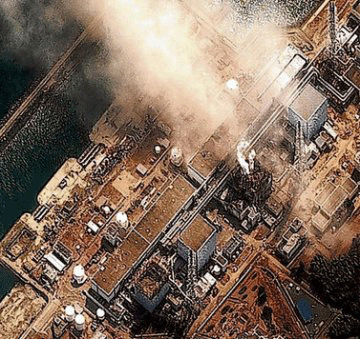 So who will foot the bill if another nuclear disaster strikes Japan? http://www.asahi.com/ajw/articles/AJ201811010019.html So who will foot the bill if another nuclear disaster strikes Japan? http://www.asahi.com/ajw/articles/AJ201811010019.html
November 1, 2018, The government is trying to wriggle out of overhauling the way compensation should be paid out for damages caused by a nuclear accident. A working group of the government’s Atomic Energy Commission had been considering ways to bolster the system, including raising the amount of losses covered by insurance, but failed to produce a formal proposal. The commission apparently failed to obtain support for these ideas from the electric power and insurance industries. The panel started reviewing the system in the aftermath of the 2011 Fukushima nuclear disaster. Nearly eight years have passed since the catastrophic triple meltdown at the Fukushima No. 1 nuclear power plant, yet serious problems and flaws remain unaddressed with the current system. The government clearly has no intention of tackling them anytime soon. The Abe administration and the power industry are pushing to restart offline reactors, which is a very irresponsible move. The current system for compensation requires operators of nuclear plants to sign contracts with both private-sector insurers and the government to finance payouts related to nuclear accidents. But these contracts are good for only up to 120 billion yen ($1.06 billion) per nuclear plant. This is way too small, given that compensation payments related to the Fukushima disaster have already surpassed 8 trillion yen. In the case of Tokyo Electric Power Co., the operator of the Fukushima facility, it quickly became clear that the company could not raise the necessary funds on its own. This prospect prompted the government to create a makeshift program to support such payouts. Under this system, the government first pays compensation and then recovers the money over a period of decades from TEPCO and other major electric utilities. The government’s rationale is that utilities must work together to fork up funding for the system in light of the massive sums required. This system is supposed to swing into action if another major nuclear accident occurs. But it is hard to claim that a system based on mutual aid among competitors is sustainable, given the growing competition due to the liberalization of the power retail market. It is time to find an answer to the weighty, complicated question of how the financial burden of preparing for nuclear accidents and paying compensation for losses should be shared among electric power companies, their stakeholders and the government. Operators of nuclear power plants have an obligation to provide against nuclear emergencies. As a first step, insurance coverage for accident-caused losses should be sharply raised. The government needs to continue working with related industries to work out a specific plan. It should also consider how to deal with the prospect of a power company going under in the event of a serious accident. If such a thing were to happen, the government would probably have to play the leading role in paying compensation. But it would still need to get the shareholders and financial institutions involved to cough up their fair share of the burden. Increased insurance premiums paid by major electric utilities could cause electricity bills to rise. But it would help make more accurate assessments of the real costs of nuclear power generation, which both the government and the power industry have claimed to be lower than those of alternative energy sources. At the root of the troubled history of policy efforts to address the issue of compensation is the ambiguous nature of the government’s nuclear power policy. This is borne out by the way it took the initiative in promoting nuclear power plants operated by private-sector companies. Should nuclear power generation continue despite the potential risks and social costs? If another severe nuclear accident occurs, who should take the responsibility for dealing with the aftermath and in what ways? These are just some of the fundamental questions about nuclear power policy raised by the need to revamp the compensation system.
|
|

Czech government might delay its nuclear power expansion plans
Reuters 29th Oct 2018 The Czech government may delay its decision for state-controlled utility
CEZ to build new reactors at its two nuclear power plants, Industry
Minister Marta Novakova was quoted as saying on Monday.
“The decision about building nuclear units can’t be done under pressure and we don’t
want to be put under pressure from suppliers or other entities,” Novakova
said in an interview published by Bloomberg. “The Finance Ministry is
also analyzing the risk of potential court disputes.” The project to
expand CEZ’s nuclear power plant fleet is the biggest investment ever
into Czech energy. CEZ operates two plants at Dukovany and Temelin that
together covered 38 percent of Czech energy needs last year.
https://uk.reuters.com/article/us-czech-nuclearpower/minister-czechs-may-delay-plan-to-boost-nuclear-power-capacity-bloomberg-idUSKCN1N31GF?rpc=401&
USA’s new Federal Energy Regulatory Commission Chairman vows to reject political influence
Facing Trump coal and nuclear push, new energy panel chief swears off politics, Washington Examiner, by Josh Siegel, October 31, 2018
New Federal Energy Regulatory Commission Chairman Neil Chatterjee vowed Wednesday to protect the independent body from political influence as it considers how to handle the growing number of retirements of coal and nuclear plants.
“We should be separate an
d apart from any political influence on either side,” Chatterjee said. “I intend to do everything in my power.”
“I have made very clear to all of the staff at the agency that the agency’s independence from political influence will continue,” Chatterjee, a sitting GOP commissioner, told reporters at a briefing one week after the White House designated him chairman, replacing Kevin McIntyre, a fellow Republican who is suffering from health issues.
Chatterjee sought to rebut critics who fear, because of his political background representing a coal-friendly state, that he may be more sympathetic to the Trump administration’s interest in saving uneconomic coal and nuclear plants by subsidizing their continued existence……….
FERC in January voted unanimously to reject a proposal from Energy Secretary Rick Perry to provide special payments to struggling coal and nuclear plants in the name of resilience and reliability, saying the grid faces no immediate risk without them.
McIntyre and Chatterjee both opposed the Perry plan.
FERC, in rejecting Perry’s plan, directed regional transmission operators to submit information on resilience challenges in their markets. The commission is reviewing those responses and could act on its own. President Trump has repeatedly pressed for action to save coal and nuclear plants, but the White House has reportedly stalled over an effort to use emergency executive authority.
Any potential action would likely come through FERC.
Chatterjee said he would follow the “rule of law” on any decision on the matter and take action, or no action if the evidence does not support it, based on facts.
“This won’t be a politically influenced decision,” he said. “My actions will be taken by the record, facts, and the rule of law.”
The new FERC chairman also said he would not veer from the commission’s other priorities…… https://www.washingtonexaminer.com/policy/energy/facing-trump-coal-and-nuclear-push-new-energy-panel-chief-swears-off-politics
France’s people turning away from nuclear power

 French public opinion growing against nuclear power https://www.connexionfrance.com/French-news/French-public-
 opinion-is-growing-against-nuclear-power-as-awareness-of-environment-and-renewable-energy-growsThe French public is becoming less and less in favour of nuclear power, as awareness and concern for the environment grows, according to a new study.
The change in opinion has been attributed to the growth and improvement in renewable energy sources, and the rising awareness of the public towards the environment.
The safety of nuclear reactors has also been in question recently, after a spike in breakdowns, and more and more people living within 80 km of a central reactor.
Environmental campaigner Greenpeace, said: “We have gone from a world in which French society believed that nuclear was the only choice. The public thought it was bad, but a necessary evil. But now, with the rise in renewable energy, with sun and wind, we can bypass nuclear completely.”
Concern over the environmental impact of nuclear power has also played a role, it suggested.
The statement continued: “We are waking up to the fact that when we turn on a light or a toaster at home, we are producing radioactive waste that is going to remain on Earth for thousands of years. We are starting to ask ourselves if this is a clean source of energy.”
Despite this, however, the same poll found that just 28% of people would be willing to pay more for their energy to fix the nuclear problem.
UK Law changed so nuclear waste dumps can be forced on local communities
|
Law changed so nuclear waste dumps can be forced on local communities https://www.theguardian.com/environment/2015/apr/05/law-changed-so-nuclear-waste-dumps-can-be-forced-on-local-communities?fbclid=IwAR19RWY6_PDJsDLIDLGhunei
Legislation rushed through in the final hours of parliament allows local planning laws to be bypassed, seriously alarming anti-nuclear campaigners, Juliette Jowit, Mon 6 Apr 2015, Last modified on Thu 15 Feb 2018 Objectors worry that ministers are desperate to find a solution to the current radioactive waste problem to win Nuclear waste dumps can be imposed on local communities without their support under a new law rushed through in the final hours of parliament.Under the latest rules, the long search for a place to store Britain’s stockpileof 50 years’ worth of the most radioactive waste from power stations, weapons and medical use can be ended by bypassing local planning. Since last week, the sites are now officially considered “nationally significant infrastructure projects” and so will be chosen by the secretary of state for energy. He or she would get advice from the planning inspectorate, but would not be bound by the recommendation. Local councils and communities can object to details of the development but cannot stop it altogether. The move went barely noticed as it was passed late on the day before parliament was prorogued for the general election, but has alarmed local objectors and anti-nuclear campaigners. Friends of the Earth’s planning advisor, Naomi Luhde-Thompson, said: “Communities will be rightly concerned about any attempts to foist a radioactive waste dump on them. We urgently need a long-term management plan for the radioactive waste we’ve already created, but decisions mustn’t be taken away from local people who have to live with the impacts.” Objectors worry that ministers are desperate to find a solution to the current radioactive waste problem to win public support to build a new generation of nuclear power stations. Zac Goldsmith, one of the few government MPs who broke ranks to vote against the move, criticised the lack of public debate about such a “big” change. “Effectively it strips local authorities of the ability to stop waste being dumped in their communities,” he said. “If there had been a debate, there could have been a different outcome: most of the MPs who voted probably didn’t know what they were voting for.” Labour abstained in the vote, indicating that a future government will not want to reverse the change of rules. However, the shadow energy minister, Julie Elliott, has warned that the project is expected to take 27 years to build even after a preferred site was identified and would cost £4bn-5.6bn a year to build, plus the cost of running it for 40 years. Since the Royal Commission on Environmental Pollution found in 1976 that it was “morally wrong” to keep generating nuclear waste without a demonstrably safe way of storing the waste, there have been at least four attempts to find the right site, all of them shelved after strong protest. There are now 4.5m cubic metres of accumulated radioactive waste kept in secure containers at sites across Britain, though only 1,100m3 of this is the most controversial high-level waste, and 290,000m3 is intermediate-level waste. It costs £3bn a year to manage the nuclear waste mountain, of which £2bn comes from taxpayers. The most recent proposal for a more permanent solution was to ask local authorities to volunteer to examine whether they could host the development. Initially, a coalition of Cumbria county council and Copeland and Allerdale borough councils put their names forward, but the policy stalled in 2013 when the county council pulled out. Last year, the Department for Energy and Climate Change (DECC) published a white paper which said ministers would prefer to work with public support, but reserved the right to take more aggressive action on planning if “at some point in the future such an approach does not look likely to work”. The day before parliament rose, MPs voted in an unusual paper ballot to implement a two-page statutory instrument which adds nuclear waste storage to the list of nationally significant infrastructure projects in England, via the 2008 Planning Act. Officials have said approval depends on a “test of public support” and any site would undergo extensive geological safety tests. Copeland borough council, one of the two areas most affected by any such development at Sellafield, said it was pleased with the government’s change to planning rules. Radiation-Free Lakeland – set up to block the Sellafield proposal because they claim there is no evidence deep storage is safe or that the geology of Cumbria is suitable – claimed, however, “the test of public support is a fig leaf: the government hast’t said what the public support will be”. The only existing high-level radioactive underground waste storage, in New Mexico, USA, has been closed since last year following two accidents. Germany has put similar plans for burying high-level waste on hold and four other countries, including France and Japan, are examining the idea. |
|
Energy Secretary Rick Perry and Donald Trump saying different things about Yucca nuclear waste dump plan
| Energy Secretary Says White House Still Backs Nevada Nuke Dump, Financial Express, By: Bloomberg October 27, 2018
Energy Secretary Rick Perry said the White House still supports construction of a planned repository for nuclear waste in Nevada, despite President Donald Trump’s suggestion over the weekend that he was reconsidering. When asked if the Trump administration still supports Yucca Mountain, Perry swiftly said “Yes.” “I’m making this presumption by looking at a budgeting process and there was money in the president’s budget to manage Yucca,” Perry said, after giving remarks at the department’s Brookhaven National Laboratory in Upton, New York. Trump requested $120 million in his budget proposal for the geologic repository 90 miles north of Las Vegas. ……….Trump told a Nevada television station he was reconsidering his support after campaigning last weekend with Senator Dean Heller, an embattled Republican senator who opposes the project and is in a tight re-election battle. “I think you should do things where people want them to happen, so I would be very inclined to be against it,” Trump said in Oct. 20 interview with KRNV-News 4. “We will be looking at it very seriously over the next few weeks, and I agree with the people of Nevada.”…….. https://www.financialexpress.com/world-news/energy-secretary-says-white-house-still-backs-nevada-nuke-dump/1363704/
|
USA’s subsidy to coal and nuclear power stalled, but still a possibility
|
Coal And Nuclear Subsidy Still Alive Despite Stall, Wyoming Public Media By COOPER MCKIM • OCT 26, 2018, Coal-fired power plants are closing down in unprecedented numbers, many of which are Wyoming coal customers. In June, President Trump took a step to change that. Taylor Kuykendall, a coal reporter with S&P Global Market Intelligence, gives context to the coal and nuclear plant subsidy introduced last June.
TK: The basic idea is that the Department of Energy would like to intervene into the energy markets and basically either order grid operators to buy electricity from struggling coal nuclear plants or they would provide some sort of an incentive to do so. And currently, a lot of those units are retiring because it’s cheaper to get energy from elsewhere. And so, what the DOE is doing here is making a national defense or a national security argument that basically gives wide deference to the administration that would allow them to come in and intervene in those markets and put their thumb on the scale in support of coal and nuclear plants that otherwise might not dispatch. …….
I think one of the things to keep in mind is that even all of the even before the opposition is stacked against the proposal any sort of legal battles is going to be a very protracted process. …..there’s a lot of kind of a top-down political drive to move this thing forward……..
this is probably going to be a very costly proposal and anything that we’ve seen so far doesn’t really detail who’s going to pay for it or how they’re going to pay for it. ……. someone’s got to pay for it and that’s going to be pretty politically damaging…….http://www.wyomingpublicmedia.org/post/coal-and-nuclear-subsidy-still-alive-despite-stall#stream/0
|
|
Taiwan’s phaseout of nuclear power
Taiwan on right rack to phase out nuclear power: German envoy, Focus Taiwan, 2018/10/28 Taipei, Oct. 28 (CNA) By Joseph Yeh Taiwan’s government is on the right track to install more capacity for renewable energy as it moves toward phasing out nuclear power by 2025, Germany’s new top envoy to Taiwan told CNA during a recent interview.
During an interview conducted on Wednesday, Thomas Prinz, the new director general of German Institute Taipei, told CNA that based on his understanding, the Taiwan government’s plan to substitute nuclear energy is “very realistic and can be achieved.”
The German government decided to close down all the country’s nuclear power stations in the wake of the Fukushima accident in Japan on March 11, 2011, when the Fukushima No. 1 nuclear plant was hit by a tsunami after a magnitude 9 earthquake knocked out power to its cooling systems sending its reactors into meltdown.
“However, it is not only the decommissioning which is interesting, when you shut down nuke plants you have to find other sources of energy. That is where your government is so far on the right track to install more capacity for renewable energy,” he added.
President Tsai Ing-wen’s (蔡英文) administration has set itself the goal of phasing out nuclear energy in Taiwan by 2025. An amendment to the Electricity Act was approved by the Legislative Yuan on Jan. 11, 2017 requiring all nuclear power operations to end by 2025.
-
Archives
- October 2026 (92)
- September 2026 (339)
- August 2026 (330)
- July 2026 (355)
- June 2026 (287)
- May 2026 (306)
- April 2026 (356)
- March 2026 (251)
- February 2026 (267)
- January 2026 (308)
- December 2025 (358)
- November 2025 (359)
-
Categories
- 1
- 1 NUCLEAR ISSUES
- business and costs
- climate change
- culture and arts
- ENERGY
- environment
- health
- history
- indigenous issues
- Legal
- marketing of nuclear
- media
- opposition to nuclear
- PERSONAL STORIES
- politics
- politics international
- Religion and ethics
- safety
- secrets,lies and civil liberties
- spinbuster
- technology
- Uranium
- wastes
- weapons and war
- Women
- 2 WORLD
- ACTION
- AFRICA
- Atrocities
- AUSTRALIA
- Christina's notes
- Christina's themes
- culture and arts
- Events
- Fuk 2022
- Fuk 2023
- Fukushima 2017
- Fukushima 2018
- fukushima 2019
- Fukushima 2020
- Fukushima 2021
- general
- global warming
- Humour (God we need it)
- Nuclear
- RARE EARTHS
- Reference
- resources – print
- Resources -audiovicual
- Weekly Newsletter
- World
- World Nuclear
- YouTube
-
RSS
Entries RSS
Comments RSS

