L’usine Nouvelle 28th Nov 2018 Ongoing reflection on EDF’s structure could lead to the creation of a
public holding company at the head of two major subsidiaries, with the
group’s nuclear fleet on one side and the sale of its production on the
other a group of activities that are most concerned by the energy
transition.
EDF could be reorganized into three blocks, with a central
public holding company controlling two major subsidiaries, one dedicated to
nuclear power and the other to energy transition. The aim would be to
secure the financing and operation of the group’s power stations by
protecting them from the vagaries of the market, which would amount to
making nuclear power an “essential asset” for France, in particular to
justify the operation. to the European Commission.
December 1, 2018
Posted by Christina Macpherson |
France, politics |
Leave a comment
FT 28th Nov 2018, If you think Britain has a tough job replacing its ageing fleet of nuclear
reactors, spare a thought for France. The world champion of atomic energy
is approaching a cliff edge in its electricity production.
The bulk of its fleet of 58 nuclear reactors was built in a remarkable 15-year burst of
construction in the 1980s and 1990s. France has not brought on stream a new
reactor for 20 years. Even if the lives of its plants were extended from 40
to 60 years, in itself an expensive proposition, 75 per cent of its nuclear
generating capacity would be gone by 2050.
The French government’s 10-year energy plan unveiled on Tuesday by President Emmanuel Macron was supposed
to set a clear framework allowing EDF, the monopoly nuclear operator, to modernise its fleet and for renewables to take a bigger slice of electricity production.
In the end, Mr Macron deferred many of the hard choices – but it was still a good result for EDF. One of the big choices was how quickly to scale back nuclear, which accounted for 71 per cent of electricity generation last year.
Environmentalists want faster decommissioning of older plants to encourage renewables. Some experts say
plants should be taken offline sooner rather than later, to avoid leaving EDF with the monumental task of decommissioning scores of them at the same time.
https://www.ft.com/content/c7421fbe-f326-11e8-9623-d7f9881e729f
December 1, 2018
Posted by Christina Macpherson |
France, politics |
Leave a comment
 World Nuclear News 29th Nov 2018, The start of regular electricity generation at the Olkiluoto 3 (OL3) EPR has been pushed back by a further four months and is now expected to begin
in January 2020, Finnish utility Teollisuuden Voima Oyj (TVO) announced
today.
Last month, the plant’s supplier – the Areva-Siemens consortium –
announced it wanted to update the schedule for completing the unit as
commissioning tests were taking longer than planned. TVO said it has been
informed by the Areva-Siemens consortium that fuel will now be loaded into
the reactor core in June 2019, with grid connection to take place next
October, and the start of regular electricity generation scheduled for
January 2020.
Under the previous schedule provided by the plant supplier in
June this year, fuel loading was expected in January 2019, grid connection
in May and the start of regular electricity production in September.
http://www.world-nuclear-news.org/Articles/New-delay-in-start-up-of-Finnish-EPR
December 1, 2018
Posted by Christina Macpherson |
business and costs, Finland, politics |
1 Comment
 The Crown Prince May Build Himself a Nuclear Kingdom https://nationalinterest.org/blog/middle-east-watch/crown-prince-may-build-himself-nuclear-kingdom-37292 The Trump administration should keep a close eye on Saudi Arabia’s nuclear connections and activities. by Ronen Dangoor, 28 Nov 18
The horrific murder of Jamal Khashoggi shed light on the reckless and dangerous decisionmaking process of Saudi Arabia’s Crown Prince Mohammad Bin Salman (MbS). In addition to the latest crisis The New York Times recently published a story about how the prince’s closest security personnel sought to hire private foreign companies to assassinate senior Iranian officials—an act that could have trigger a regional military conflict. This conduct follows a string of other bizarre events in the last few months, initiated by MbS.
The crown prince has demonstrated arrogant, cruel, amateur and capricious behavior. His aggression has been left almost unmonitored by checks and balances inside the Saudi hierarchy. Indeed, MbS has constrained all his potential rivals and has taken full controlof Saudi Arabia’s security and intelligence bodies. As the Khashoggi scandal has proven—such power enables dictators to secretly execute dangerous operations. In parallel, he managed to become the darling of the West after he initiated economic reforms and launched his so called modern 2030 vision .
Now add Saudi’s long history of nuclear ambitions to the mix. For years, Saudi officials have warned that Saudi Arabia will not curb its nuclear ambitions if it will sense a threat to its national security, or if Iran advances in its nuclear program. Rumors were that Pakistan was obliged to provide the Saudis a ready-for-use nuclear weapon if and when the time comes. Things only got more complicated once the nuclear agreement (JCPOA) with Iran was signed in 2015, practically legitimizing Iran’s rights to maintain and develop its uranium enrichment capabilities. At the beginning of November 2018, the crown prince participated in the opening ceremony marking the launch of construction of Riyadh’s first research reactor . It’s still early days and only a symbolic act—the Saudis lack knowhow, technicians, infrastructure and academic expertise—but the country has both enough ambition and funds to advance anyway. Shortly after that the Saudi energy minister said the kingdom launches uranium exploration program.
Over the last decade, purchasing sixteen nuclear power reactors—later scaled back to two reactors—plus uranium enrichment capabilities preferably from the United States, has
featured prominently on the Saudi agenda. The official rationale is the country’s future needs to supply energy —with self-sufficient nuclear materials. While having enrichment capabilities can serve to counterbalance Iran, it may also constitute a future military nuclear program. During previous negotiations with Saudi officials, the Obama administration insisted that Saudi Arabia must comply with the “ gold standard ,” reflective of the conditions imposed on the UAE when it agreed to buy U.S. reactors in 2009. This standard requires a commitment not to enrich uranium or to produce plutonium as a strict condition for any agreement to sell nuclear reactors. According to current Secretary of State Mike Pompeo, the Trump administration has maintained this policy . In an interview with CBS in March 2018, MbS maintained that “without a doubt, if Iran developed a nuclear bomb, we would follow suit as soon as possible.”
Following the murder of Khashoggi, Senate members urged the Trump administration to curb any intention to sell nuclear reactors to the Saudi regime. This move is certainly necessary, but not nearly enough. An American refusal to his demands can push the prince to seek an alternative option elsewhere, with producers that will be all too happy to assist—for the right price.
Much of MbS’s current conduct lies parallel to previous experience with three other Middle East tyrants: former Iraqi president Saddam Hussein, Libya’s leader Muammar el-Qaddafi, and Syrian president Bashar al-Assad. These cynical dictators have a common denominator in their infinite ambitions, which ultimately led them to secretly promote a nuclear weapons program. They all relied heavily on their security systems in initiating these plans. Libya and Syria had no sufficient nuclear infrastructure, so they bought a turnkey nuclear project from Pakistan’s A.Q. Khan Network, and in the Syrian case from North Korea .
The Saudi nuclear issue has placed a challenge before the administration. If the prince is successful in surviving the current crisis, then that could prompt him to make even riskier decisions, including taking the nuclear path. Much like in Iraq, Libya and Syria, all the necessary components for that are now in place: A de facto dictator with delusions of grandeur and poor judgment, full control over the security services, unlimited funds for the purpose, a national sense of isolation, an acute threat, and a long-term nuclear vision. As Iran seems to be complying with the JCPOA, a Saudi move could instigate a nuclear arms race in the Middle East. To avoid this, the Trump administration should warn and restrict the Saudi heir. It should also keep a very close eye on Saudi Arabia’s nuclear connections and activities.
Ronen Dangoor is the former deputy head of the research and analysis division at the Israeli prime minister’s office.
November 29, 2018
Posted by Christina Macpherson |
politics, Saudi Arabia, weapons and war |
1 Comment

 France to close 14 nuclear reactors by 2035 an all coal-fired power plants by 2022, The Local 28 Nov 18 President Emmanuel Macron said on Tuesday that France would shut down 14 of the country’s 58 nuclear reactors currently in operation by 2035, of which between four and six will be closed by 2030.
The total includes the previously announced shutdown of France’s two oldest reactors in Fessenheim, eastern France, which Macron said was now set for summer 2020.
He also announced that France would close its remaining four coal-fired power plants by 2022 as part of the country’s anti-pollution efforts……
Macron said France would aim to triple its wind power electricity output by 2030, and increase solar energy output fivefold in that period.
He added that he would ask French electricity giant EDF to study the feasibility of more next-generation EPR nuclear reactors, but will wait until
2021 before deciding whether to proceed with construction.
EDF has been building the first EPR reactor at Flamanville along the Atlantic coast of northwest France — originally set to go online in 2012 — but the project has been plagued by technical problems and budget overruns. https://www.thelocal.fr/20181127/france-to-close-14-nuclear-reactors-by-2035
November 29, 2018
Posted by Christina Macpherson |
France, politics |
Leave a comment
 Reuters 22nd Nov 2018 , Vietnam’s National Assembly voted on Tuesday to abandon plans to build
two multi-billion-dollar nuclear power plants with Russia and Japan, after
officials cited lower demand forecasts, rising costs and safety concerns.
The estimated investment needed for the projects had doubled since 2009 to
nearly 400 trillion dong ($18 billion), state media Tien Phong quoted Le
Hong Tinh, vice chairman of the National Assembly’s science, technology
and environment commission, as saying earlier this month.
https://www.reuters.com/article/us-vietnam-politics-nuclearpower-idUSKBN13H0VO
November 25, 2018
Posted by Christina Macpherson |
politics, Vietnam |
Leave a comment
Anti-nuclear group undeterred by passing of pro-nuclear referendum http://m.focustaiwan.tw/news/aipl/201811250029.aspx By Wu Hsin-yun, Ku Chuan and Evelyn Kao Taipei, Nov. 25 (CNA) Taiwanese on Saturday voted against the government’s policy of phasing-out nuclear power by 2025, prompting an environmental group opposed to nuclear power to reaffirm its support for the phasing out of all nuclear power plants.
The anti-nuclear group National Nuclear Abolition Action Platform said in a statement issued Sunday that it is wrong to return to nuclear power and promised to continue to campaign for an end to the use of nuclear power in Taiwan.
The statement came after Taiwanese voted in 10 referendums alongside Saturday’s local government elections, including one that asked: “Do you agree with abolishing the first paragraph of Article 95 of the Electricity Act, which means abolishing the provision that ‘all nuclear-energy-based power-generating facilities shall cease to operate by 2025’?”
As a result, 5,895,560 votes were cast in favor of repealing the nuclear phase-out, and 4,014,215 against the initiative, according to the Central Election Commission.
For a referendum to pass, the number of voters in favor of a proposition must exceed the number who vote against it, and reach a minimum of 4,939,267 votes, or one quarter of the 19,757,067 voters eligible to cast votes in the referendums.
Commenting on the referendum result, the anti-nuclear group said that not all those who voted in favor of stopping the nuclear phase-out are unconditional supporters of nuclear power, but rather some lack confidence in Taiwan’s energy transformation.
The result does not mean those who voted in favor of repealing the nuclear phase-out do not support the government’s nuclear-free, carbon reduction and renewable energy policy, the group said.
Currently, the decommissioning of the No. 1 and No. 2 nuclear power plants in New Taipei is underway and cannot be reversed according to the law, the group said.
The result of the referendum is most likely to impact the No. 3 nuclear plant in Pingtung and possibly postpone its decommissioning, it added.
However, as the No. 3 nuclear plant is near the active Hengchun fault line, the group said the geological environment is not suitable for extending the operational life of the nuclear plant to be or installing new units at the plant.
Taiwan can not withstand a nuclear disaster and the passage of the referendum does nothing to guarantee safety, the group noted.
The group stressed Taiwan is on the path to a nuclear-free homeland and carbon reduction and should not return to nuclear power and coal-fired plants.
Under the Referendum Act, a law repealed in a referendum has to be rescinded three days after the result is officially announced by the Central Election Commission, Cabinet spokeswoman Kolas Yotaka said Sunday.
This means the first paragraph of Article 95 of the Electricity Act will be removed.
However, “the government’s goal of making Taiwan a nuclear-free homeland by 2025 remains unchanged,” Kolas said, adding that in practice it may not be possible to postpone the phase-out of the No. 1, No. 2 and No. 3 nuclear plants.
According to the law, applications for postponement are required to be submitted 5-10 years before the scheduled retirement dates of nuclear plants, Kolas said, adding that any such applications cannot be made within the statutory time period.
As to whether the currently-mothballed No. 4 nuclear power plant will start commercial operations, Kolas said it is estimated any such reversal would take 6-7 years and cost NT$68.8 billion (US$2.22 billion).
Even if the nuclear plant is activated in 2019, it would not be ready to begin commercial operations in 2025, when the government’s goal of a nuclear-free homeland will be achieved, at which point Taiwan will have no need for nuclear power, she noted.
November 25, 2018
Posted by Christina Macpherson |
politics, Taiwan |
Leave a comment
 Climate report: Trump administration downplays warnings of looming disaster
Democrats ramp up pressure to act in wake of most sobering government analysis yet, Guardian, Oliver Milman@olliemilman Sun 25 Nov 2018
Report: climate change ‘will inflict substantial damages’ The Trump administration attempted to downplay the stark findings of its own climate change assessment, as Democrats sought to pressure the White House to avert looming economic and public health disaster.
The US National Climate change assessment, the work of 300 scientists and 13 federal agencies, was released on Friday afternoon. It found that wildfires, storms and heatwaves are already taking a major toll on Americans’ wellbeing, with climate change set to “disrupt many areas of life” in the future.
The voluminous report, which warns of hundreds of billions of dollars lost, crop failures, expanding wildfires, altered coastlines and multiplying health problems, represents the most comprehensive and sobering analysis yet of the dangers posed to the US by rising temperatures……….
A White House spokeswoman, however, said the assessment was “largely based on the most extreme scenario, which contradicts long-established trends by assuming that, despite strong economic growth that would increase greenhouse gas emissions, there would be limited technology and innovation, and a rapidly expanding population”.
The spokeswoman added the next report, due in four years’ time, will “provide for a more transparent and data-driven process”.
Katharine Hayhoe, a climate scientist at Texas Tech University and a report co-author, said the White House’s statement was “demonstrably false”.
She added on Twitter: “I wrote the climate scenarios chapter myself so I can confirm it considers ALL scenarios, from those where we go carbon negative before end of century to those where carbon emissions continue to rise.”
The climate assessment galvanized Democrats, who will control the House of Representatives next year.
“The days of denial and inaction in the House are over,” said Frank Pallone, a New Jersey congressman set to chair the energy and commerce committee. “House Democrats plan to aggressively address climate change and hold the administration accountable for its backward policies that only make it worse.”
Alexandria Ocasio-Cortez, a newly elected representative from New York City who has become a standard-bearer for the left, tweeted: “People are going to die if we don’t start addressing climate change ASAP. It’s not enough to think it’s ‘important’. We must make it urgent.”
Authors of the report, which is mandated by Congress, echoed the sense of urgency and lamented the timing of its release on the day after Thanksgiving, which is usually the busiest shopping day of the year.
“This report makes it clear that climate change is not some problem in the distant future – it’s happening right now in every part of the country,” said Brenda Ekwurzel, a co-author and director of climate science at the Union of Concerned Scientists, in a statement.
“When people say the wildfires, hurricanes and heatwaves they’re experiencing are unlike anything they’ve seen before, there’s a reason for that and it’s called climate change.”……..
The president took a trip last week to see the aftermath of California’s deadliest ever wildfires, a phenomenon experts say is worsened by warming temperatures. During a visit to the town of Paradise, which was wiped out by the so-called Camp fire, Trump said he wanted “a great climate”. But he has largely blamed forest management for the blaze.
He has repeatedly disparaged or dismissed climate science in the past…….https://www.theguardian.com/environment/2018/nov/24/climate-change-report-trump-administration-democrats-reaction
November 25, 2018
Posted by Christina Macpherson |
climate change, politics, USA |
Leave a comment


|
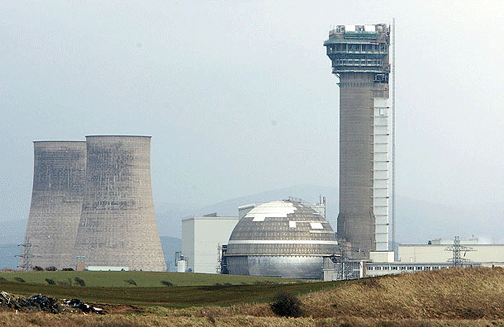
There are strong parallels between THORP and the proposed £20bn Hinkley Point C nuclear power plant. Powerful arguments were put forward against the construction of both plants, but the Government and the Nuclear Industry continued to stubbornly pursue these massively expensive and dangerous projects.
 NuClear News, December 2018, The House of Commons Public Accounts Committee (PAC) says while the Nuclear Decommissioning Authority (NDA) and Sellafield Limited have made progress with reducing delays and expected cost overruns on 14 major projects at Sellafield, with a combined lifetime cost estimate of £6 billion, there is still a long way to go. NuClear News, December 2018, The House of Commons Public Accounts Committee (PAC) says while the Nuclear Decommissioning Authority (NDA) and Sellafield Limited have made progress with reducing delays and expected cost overruns on 14 major projects at Sellafield, with a combined lifetime cost estimate of £6 billion, there is still a long way to go.
Most major projects at Sellafield are still significantly delayed, with expected combined cost overruns of £913 million. The NDA has not systematically reviewed why these projects keep running into difficulties, or analysed properly the constraints it says prevent them from making faster progress.
Until this work is completed, the Committee will remain sceptical about the long-term strategy to decommission Sellafield. And despite this Committee’s recommendation nearly five years ago, the Department for Business, Energy & Industrial Strategy has still not decided what to do with the plutonium stockpile currently stored at Sellafield.
Given the scale and unique challenges at Sellafield, the NDA must have a firm grip of the work that takes place on the site. This was not the case with the NDA’s recently failed contract to decommission its Magnox sites.
PAC Deputy Chair, Sir Geoffrey Clifton-Brown MP said:
“The Government’s oversight of the NDA’s performance could and should be much better,
particularly on projects at Sellafield that cost a considerable amount of public money. BEIS needs
to seriously get a grip on its oversight of nuclear decommissioning in this country.”
The Committee’s findings make yet more dreary reading for the UK taxpayer says Cumbrians
Opposed to a Radioactive Environment (CORE). The costs described as ‘a misuse of public funds’
by a spokesman for the report’s authors the Government’s Public Accounts Committee (PAC).
The PAC report pulls few punches in its criticism of the way the NDA is managing many of the
major projects needed to clean up Sellafield.
The site currently receives some £2bn of public money every year and, over the next 100+ years
of decommissioning is expected to cost a total of £91bn. In a slight but revealing departure from
the pattern of previous reports, PAC raises the spectre of the UK’s plutonium stockpile (40% of
the world’s global stock) and the latest thinking by Government on its long-term plutonium
management options. CORE says an update on its plutonium plans is currently being finalised
by the NDA and could be published soon.
The PAC report reveals the following:
Major projects are expected to cost over £900 million more than originally budgeted and be subjected to delays of over 13 years.
The NDA has cancelled three projects since 2012 after spending £586 million of taxpayers’ money on them.
Two of the above projects – the silo direct encapsulation project and the box transfer facility were cancelled after the NDA projected a combined cost increase of £2.1 billion and a combined delay of nine years
. The NDA’s programme to deal with the plutonium stockpile in the near term is late and its costs are increasing.
The concerning discovery last year (NAO report 20.6.18) that some plutonium canisters have been decaying faster than expected is made worse by the fact that the NDA’s project to repackage these canisters is at least two years late and expected to cost over £1.5 billion, £1 billion more than it first expected
. The series of contingency arrangements to manage these decaying canisters are shortterm fixes for a long-term problem and BEIS has yet to set out clearly what its strategy is and the associated costs to the taxpayer.
BEIS has still not decided between the two plutonium management options available – its long-term storage prior to final disposal as waste in a geological disposal facility (GDF) that has yet to be located or constructed, or its reuse as fuel in new nuclear power stations – but has told the PAC Committee that ‘it is not comfortable with any of the potential options for managing plutonium other than disposing it in the GDF’ (2)
Meanwhile the controversial Thermal Oxide Reprocessing Plant (THORP) at Sellafield has started work on processing its final batch of waste fuel after operating for only 24 years. (3) THORP opened in 1994 to reprocess spent fuel from the UK’s newer reactors – like Hinkley Point B – and overseas customers. Reprocessing is a chemical process which separates out plutonium and unused uranium from spent nuclear fuel.
There are strong parallels between THORP and the proposed £20bn Hinkley Point C nuclear power plant. Powerful arguments were put forward against the construction of both plants, but the Government and the Nuclear Industry continued to stubbornly pursue these massively expensive and dangerous projects. This Stop Hinkley Campaign briefing asks whether there are any lessons we can learn from the THORP experience to help us to evaluate the merits of continuing to build Hinkley Point C.
Currently, the ground-works for Hinkley Point C aren’t even finished so, in theory, it should be straightforward not to go ahead with the project, if it looks like full construction and operation would be a mistake. In fact not going ahead with the plant could save electricity consumers between £27bn and £50bn over the 35 years that the plant would have operated. (4)
The construction of THORP was very controversial and was the subject of a Public Inquiry in 1977, which ran for one hundred days. It was argued that the Inquiry would be a way of rationally weighing up all the evidence in order to come up with the correct decision on whether or not to give the plant the go-ahead. However, Professor Brian Wynne has argued that the Inquiry was in fact a charade, meant only to give the impression of rational decision making. (5)
At the Inquiry it was argued that THORP would be needed to supply plutonium for a new type of reactor – the Fast Breeder Reactor. Justice Parker, the Inquiry Inspector, concluded that THORP should go ahead and the Government agreed. It was built in the 1980s and switched on in the 1990s. Within a week of THORP starting up, the prototype Fast Reactor at Dounreay in the north of Scotland was shut down – ending the whole UK Fast Breeder programme. (6)
By 1992 the original rationale for THORP had all but disappeared before it even opened so the Government decided to commission the consulting firm Touche Ross to examine the financial implications of THORP’s operation or abandonment. It concluded that the economic benefit of operating THORP versus not operating it were £1.81bn for BNFL and £950m for the UK (7). In 1994, after a long and agonised debate, the Government decided to allow the plant to operate and the first waste spent fuel was ‘sheared’ – the outer cladding taken off – as the first step in the reprocessing process, in March of that year (8).
Another raison dêtre for THORP was quickly found, with construction work of the Sellafield MOX Plant beginning a few weeks later in April 1994. This was meant to produce plutonium fuel for ordinary reactors rather than Fast Breeders. The Sellafield MOX Plant was expected to generate £400m; instead it cost £2.2 Billion.
THORP was originally expected to reprocess 7,000 tonnes of spent fuel in its first ten years of operation. By the time it closes it will probably have reprocessed around 9,300 tonnes of spent fuel. If the plant had been working to its design capacity it should have completed 9,300 tonnes ten years ago in 2008 (9). THORP’s throughput was never reliable, nor to specification
The cost of building THORP steadily rose from £300m at the time of the public inquiry in 1977 to £1.8bn on completion in 1992. With the additional cost of associated facilities this figure rose to £2.8bn. The operator at the time – British Nuclear Fuels Ltd (BNFL) received advance payments from its customers of £1.6bn which largely covered the construction costs. The net result, according to BNFL was that over the first ten years the income would not only cover all building operating and future decommissioning costs, but would produce a profit of £500m. One economic analysis in 1993 pointed out that at a projected profit of only £50m per year, the economics of the project looked extremely vulnerable to unforeseen events, and British electricity consumers would be paying £1.7bn more than necessary to have British spent fuel reprocessed at THORP (10). This analysis turned out to be prophetic – there have certainly been plenty of unforeseen events since 1994. With THORP operating around a decade behind schedule, any notional profit originally expected must have long since been completely wiped out.
A report for the Government by management consultants Arthur D Little predicted in 2001 that the Sellafield MOX Plant would earn the UK more than £200m in foreign currency by exporting MOX fuel to Japan and several other countries. After the plant opened it was plagued by production problems due to its faulty design and layout. Instead of producing 120 tonnes of MOX a year, it managed less than 14 tonnes in eight years. The plant was closed in August 2011. (11) The plant is thought to have cost British taxpayers about £2.2bn in capital, operating and decommissioning costs since it was built. An internal report concluded that the facility was “not fit for purpose” and its performance over a decade was “very poor”. (12)
The economics of THORP and subsequently the Sellafield MOX Plant (SMP) depended on the constructors and operators being able to build and operate the facilities according to the specification. But nuclear facilities being built in the west have suffered from delays and almost always tended to have large cost overruns. Recent ones have ALL suffered horrendous cost overruns – in the USA (4), France (1) and Finland (1). Yet otherwise sensible, financial analysts have, in the past produced reports to justify building facilities at Sellafield and Hinkley which seem to ignore this fact and assume construction and operation will proceed precisely on target.
The prospects of avoiding a Sellafield-scale financial disaster with Hinkley Point C do not look good. As Emeritus Professor Steve Thomas has pointed out: “Hinkley Point C would use a technology unproven in operation – the EPR – which has run into appalling problems of cost & time overruns in the 3 projects using it. It would be supplied by Areva NP, which is in financial collapse and might not be saveable and has been found to be falsifying quality control records for safety critical items of equipment for up to 50 years – a bizarre situation.”
Time to cancel Hinkley Point C now while the cancellation costs are relatively low. Leaving things any longer risks yet another Sellafield-scale financial disaster. http://www.no2nuclearpower.org.uk/wp/wp-content/uploads/2018/11/NuClearNewsNo113.pdf
|
|
November 24, 2018
Posted by Christina Macpherson |
business and costs, politics, UK |
Leave a comment
Belene nuclear power plant will need new EU approval, Emerging Europe, November 23, 2018, Yoan Stanev
The European Commissioner for Climate Action and Energy, Miguel Arias Cañete, has said that the commission’s approval for the Belene Nuclear Power Plant project – given more than a decade ago – is no longer valid. As such, Belene must be treated as a new project and must undergo a new assessment by the commission. Mr Cañete was responding to a question raised by a Bulgarian member of the European Parliament, Svetoslav Malinov, of Democrats for a Strong Bulgaria, part of the European People’s Party……..
“In practice, any new investors will have to agree to a project that is not currently approved by the European Commission and will still have to be assessed according to [now more] stringent European criteria after Fukushima,” said Mr Malinov, who added: “no investor will agree to this.”
“Belene nuclear power plant will never be built, but it still offers the opportunity to steal money from Bulgarian taxpayers. Belene is dead. Why does GERB [Bulgaria’s ruling party] refuse to bury it?” said Mr Malinov.
The Bulgarian government has not yet responded to the commission’s statement and the energy ministry is still looking for strategic investors for the project and plans to make an announcement by the end of 2018. https://emerging-europe.com/news/belene-nuclear-power-plant-will-need-new-eu-approval/
November 24, 2018
Posted by Christina Macpherson |
Bulgaria, politics |
Leave a comment
Prague weighs replacement options for nuclear plants, Ft.com, 23 Nov 18
The Czech decision is being watched by neighbours considering investments in reactors “……..
The reactors, which are owned by CEZ, the state-controlled energy group, are due to expire in 2035. Given the long lead time for nuclear projects, government and company officials have spent the past year debating whether — and how — to finance their replacement. With another plant run by CEZ in Temelin, the Dukovany reactors accounted for about two-fifths of Czech energy needs last year, making how to deal with their expiry one of the most important, and potentially one of the most expensive, decisions facing Mr Babis’s government. Analysts estimate that building new reactors would cost at least 100bn Czech koruna (€3.8bn) each — or about a third of CEZ’s market capitalisation.
………,The deliberations in Prague mirror debates elsewhere in central Europe, where the Czech Republic is not alone in considering another bet on nuclear energy Poland has been debating whether to build a nuclear plant of its own, while Vladimir Putin, Russian president, said in September that the Russian state-owned nuclear group Rosatom would soon start construction on two new reactors in Hungary.
Given the huge costs of building new reactors, CEZ’s leadership has been reluctant to embark on such a project without state guarantees, while minority shareholders are opposed to the idea of CEZ building new nuclear plants on its own, as they fear it will hit their dividend payments. ……https://www.ft.com/content/26cced6c-c8be-11e8-86e6-19f5b7134d1c
November 24, 2018
Posted by Christina Macpherson |
EUROPE, politics |
Leave a comment

Trump’s Defense Spending Is Out of Control, and Poised to Get Worse https://www.rollingstone.com/politics/politics-features/trump-defense-spending-757028/ 15 Nov 18,
Using a time-honored trick, a bipartisan congressional panel argues we should boost the president’s record defense bill even more
By MATT TAIBB
A bipartisan commission has determined that President Trump’s recent record defense bill is insufficiently massive to keep America safe, and we should spend more, while cutting “entitlements.”
The National Defense Strategy Commission concluded the Department of Defense was too focused on “efficiency” and needed to accept “greater cost and risk” to search for “leap-ahead technologies” to help the U.S. maintain superiority.
The panel added that Defense is “not where most of the money is.” It said Congress should be focused on “domestic entitlement programs” and “interest payments on the national debt” as sources of savings.
The report even contains a graph that shows defense spending crawling sadly along the floor of the spending X-axis as mighty mandatory “entitlements” soar to great heights.
This is the same Department of Defense with a serious existing accounting problem. In 2016, before Trump was elected, its Inspector General said he could not properly track $6.5 trillionin defense spending. A later academic study claimed the number was $21 trillion, looking at the years 1998-2015.
Trump originally asked for over $730 billion in defense spending for Fiscal Year 2019, and last spring a budget setting spending at $716 billion passed 85-10 in the Senate. This would have meant an $82 billion spending hike, an increase that by itself was larger than the entire defense budget of every country on earth, save China.
Trump later called for an across-the-board budget cut of 5 percent, leaving the amount of the defense budget in confusion. He still claims he wants $700 billion. Whatever the final amount turns out to be, it will be massive — about 10 times the size of Russia’s defense budget, and four times the size of China’s.
The National Defense Strategy Commission was created as part of the 2017 National Defense Authorization Act. It’s section 942 in this bill, and it requires that the majority and minority committee chiefs for Armed Services in both the House and the Senate to each name three people to the panel.
Eric Edelman, who was the senior policy official in the Defense Department from 2005-2009, chairs the panel. The co-chair, appointed by Democrat Adam Smith of Washington, is Admiral Gary Roughead, who was named chief of Naval operations in 2007 and now sits on the board of Northrup Grumman.
Other members include Dr. Andrew Krepinevich, who heads a defense consulting firm called Solarium and once authored a Foreign Policy article called How To Win in Iraq that called for a “protracted commitment of U.S. resources” in the Middle East (this was a precursor to the “surge” concept). Former acting head of the CIA Michael Morell is one of the Democratic appointees.
To recap: While spending record sums on a defense bill, Congress allocated still more money to a panel of current and former defense specialists whose purpose seems to have been to write a report asking for more money.
We regularly hear that our weapons systems are old, outdated and placing troops in harm’s way. It’s an ancient political device and it usually works.
Ronald Reagan was a master at this. In 1983, Reagan was giving speeches about how our last new nuclear missile system, the Minuteman, had been designed in 1969. Meanwhile, the Soviets since then had built five new classes and “upgraded five times.”
This appeal to national consumerist shame — we can’t be seen in public driving something old! — is effective. On a policy level, such appeals are usually couched in terms of needing to make American “hard power” a more “credible” foreign policy tool.
Any sober assessment of the challenges faced by the United States since the collapse of the Soviet Union would have stressed human intelligence and data security at the expense of World War II-style arsenals designed to fight conventional wars. Aircraft carriers aren’t much help against terrorism or cyber-attacks.
But the companies that build ships and subs and fighter jets have huge lobbies in D.C., and the congressional pork system significantly revolves around defense allocations.
So instead of looking honestly at where we do and do not need to spend, the military mostly looks at existing weapons systems — even ones that work pretty well — and focuses on how long it’s been since we unveiled jazzy re-designs. That allows the endless cycle of patronage and political contributions to stay in place.
November 22, 2018
Posted by Christina Macpherson |
politics, secrets,lies and civil liberties, USA, weapons and war |
1 Comment
 Climate Change Denial Is Raking the Ashes of Paradise
 ,
William Rivers Pitt, Truthout, November 20, 2018″………….The Camp and Woolsey fires are two of the
10 worst fires in California history, and have so far caused an
estimated $19 billion in damages. Eight of the worst California wildfires on record have happened in the last two years. These disasters are increasing in number and severity due to a collection of factors — 100 years of forest policies aimed at stopping fires entirely rather than controlling them, corporate malfeasance on the part of companies like PG&E, unsafe construction zoning and poor water management, to name but a few — but accelerating human-caused climate change
looms above them all.
“The ongoing California drought is the driest period in the state’s history since before Charlemagne ruled the Holy Roman Empire,” reportedScience News in 2014. In 2015, Gov. Jerry Brown declared California to be in a drought state of emergency. “Drought and dry soil conditions widened to 100 percent of flame-whipped California from 26 percent a year earlier,” Bloomberg News reported this weekend. According to the National Integrated Drought Information System, some 23,824,000 California residents currently live in drought conditions.
“Climate change is drying the state,” states the California Chaparral Institute in a Facebook post. “Dryer conditions lead to a more flammable landscape. We may see more of the kind of winds that powered the Camp Fire into Paradise. More fires will dramatically alter the kinds of habitats we are used to seeing. Non-native weed-filled landscapes that dominate places like Riverside County will likely become more common.”
The ocean is coming. The fires are here. The inexorable violence of climate change has arrived, and the president of the United States still believes it’s a hoax. Because he does, efforts to mitigate the onrushing, inevitable damage are not begun, or are deliberately undone. There is no good time for someone like Donald Trump to be in charge of the country, but there can be no doubt that his ascendancy has come at the worst possible moment for the planet.
Two days after the Camp Fire began, when the full scope of the calamity was becoming evident, Trump took to Twitter to weigh in with his thoughts on the matter. “There is no reason for these massive, deadly and costly forest fires in California except that forest management is so poor,” he wrote at 2:08 am. “Billions of dollars are given each year, with so many lives lost, all because of gross mismanagement of the forests. Remedy now, or no more Fed payments!”……….
At the end of the Paradise press conference, Trump was asked point-blank if he believed climate change had a hand in the deadly fires. “No,” he replied bluntly. “I have a strong opinion,” he continued. “I want great climate. We’re going to have that, and we’re going to have forests that are very safe. That’s happening as we speak.”
And that, as they say, is that…….https://truthout.org/articles/climate-change-denial-is-raking-the-ashes-of-paradise/
November 22, 2018
Posted by Christina Macpherson |
climate change, politics, USA |
1 Comment
France could shut down nuclear plants in energy plan due next week https://www.reuters.com/article/us-france-nuclearpower/france-could-shut-down-nuclear-plants-in-energy-plan-due-next-week-idUSKCN1NQ17V, PARIS (Reuters) 21 Nov 18 – France could shut down up to six nuclear reactors by 2028 among other options, French media reported, as part of its medium-term energy policy to be presented next week.
“I can confirm that there are three scenarios on the table that we are looking at, we are making final adjustments and all will be presented next week,” French Environment Minister Francois de Rugy told France Inter radio, without specifying a date.
The so-called PPE energy plan will lay out France’s energy goals over the next 10 years with the aim of reducing the share of nuclear power in its energy mix to 50 percent from 75 percent by 2035, curb carbon emissions and boost renewables.
French news agency AFP reported on Tuesday, citing government working documents, that the government could shut down up to six nuclear reactors by 2028, including the planned closure of France’s oldest Fessenheim nuclear plant which is scheduled to stop production in 2021, according to one scenario.
It said another six reactors could close by 2035, which could set France on the path to curb nuclear generation by 50 percent.
The second intermediate scenario does not foresee any additional closures beside Fessenheim until 2028, and then 12 reactors would be shutdown between 2028 and 2035, AFP quoted the document saying.
The final option would also see no additional closures until 2028 after which, only nine reactors would be halted by 2035, which could miss the 50 percent nuclear target.
Jefferies analysts, who have a “buy” rating on the shares of state-controlled utility EDF, said in a research note that two out of the three options seem to favor EDF, which operates all of France’s 58 nuclear reactors.
Even the accelerated nuclear phase-out option appears to offer some protection, via compensation, wrote Jefferies.
Reporting by Bate Felix and Mathieu Rosemain
November 22, 2018
Posted by Christina Macpherson |
France, politics |
Leave a comment
 Another Nuclear Megaproject Bites The Dust, Oil Price, By Leonard Hyman & William Tilles – Nov 19, 2018,Toshiba, the troubled Japanese electrical and electronics conglomerate and former owner of the bankrupt Westinghouse, Corp., decided last week cancel its Moorside nuclear project in the UK. If completed, this large nuclear power station would have provided about 7 percent of the UK’s electricity needs. Not that this announcement was a surprise.
Toshiba’s announcement follows word of a breakdown in negotiations with prospective buyer, Korea Electric Power (KEPCo). It appears the Koreans, like others, are rethinking their commitment to nuclear energy worldwide.
Absent the cancellation decision, Toshiba is likely to have had trouble financing a project of this magnitude especially given the stress on its finances from its troubled venture into American nuclear construction. The Moorside project in Cumbria will have cost Toshiba over £400 million and management announced it was taking a write off of £125 million. Toshiba described its decision as “economically rational.” Amen to that.
A government spokesperson commented, “All proposed nuclear projects in the UK are led by private sector developers and … this is entirely a commercial decision for Toshiba.” This is an interesting statement. The only UK nuclear construction project currently underway is owned by French and Chinese state controlled entities, financed with liberal debt guarantees provided by the UK government.
But let’s review the UK’s nuclear energy plans. There were at a minimum three large facilities planned. One for Cumbria, the Toshiba NuGen entity, is now cancelled. The Hinkley Point C units, being built by a French and Chinese consortium, are under construction and slated for commercial service in 2025-27. Lastly, Hitachi had a planned nuclear site in Wylfa.
Given the turmoil surrounding new nuclear construction, we have our doubts about the financial viability of Wylfa. This plant would cost at least 20 billion pounds ($26 billion). Press reports indicate government support would be necessary for close to two thirds of that amount. To further encourage developers, a government minister said in June that the government might directly invest 5 billion pounds into the project for a one third ownership share.
A little over three decades ago, Prime Minister Margaret Thatcher wanted her government to end state ownership of power producers. And she privatized the UK’s electricity industry. Her successors, who still call themselves Conservatives, seem to have reversed course. https://oilprice.com/Alternative-Energy/Nuclear-Power/Another-Nuclear-Megaproject-Bites-The-Dust.html
November 19, 2018
Posted by Christina Macpherson |
politics, UK |
Leave a comment