Will Nuclear Advocates Undermine the Green New Deal?
The draft proposal has ignited tremendous grassroots enthusiasm, with massively favorable poll readings, even among some Republicans. Substantial grassroots pressure has grown on presumptive House Speaker Nancy Pelosi to form a Green New Deal Committee chaired by Ocasio-Cortez.
But on December 20, the Democratic leadership announced it will not support a separate House Committee on the deal. Instead, it will proceed with a panel on climate change, to be chaired by Florida Representative Kathy Castor, who has taken substantial funding from the fossil fuel industry. It remains unclear whether Ocasio-Cortez will even get a seat on the committee.
But the grassroots push for a Green New Deal is clearly not going to go away. The youthful Sunrise Movement has vowed to fight for it, along with a wide range of others, including Senator Bernie Sanders, Independent of Vermont, a likely 2020 presidential contender………..
nuclear reactors do emit trace quantities of radioactive Carbon-14. The fuel rods that power reactor are produced with significant carbon in mining, milling, and enrichment. They pump huge quantities of waste heatdirectly into the eco-sphere, operating far less efficiently even than coal burners. They yield large quantities of radioactive waste, directly related to nuke weapons production. And five of them (Chernobyl 4 and Fukushima 1-2-3-4) have blown up.
Reactor enthusiasts like Senator Barrasso invariably conjure visions of a “new generation” of small, modular nukes, and other techno-variants like molten salt and thorium, alleged to be safe, cleaner and cheaper that the current fleet. But there are few tangible indications such alternative reactors can come on line anytime soon, or beat the price of wind and solar, which continue to plummet. The criticism that renewables are intermittent is also losing its sting as large-scale battery arrays are also dropping in price while rising in efficiency and capacity………..
outspoken peace groups like Code Pink are eager to move the money out of the military and into the social/infrastructure programs that can rebuild the nation. High-profile campaigns led by activists Jodie Evans and Medea Benjamin were integral to the shocking defection of seven Republican Senators to deny the Trump Administration funding to support the Saudi war in Yemen.
Activists must now argue that the trillion-plus dollars we spend annually on arming the Empire should instead fund those wind turbines and solar panels at the heart of the Green New Deal. https://progressive.org/dispatches/the-green-new-deal-promises-peace-and-progress-181227/
Australian Labor Party in a progressive move, plans to sign and ratify UN Nuclear Weapons Ban Treaty
 The cold war is back. Labor is right to support a nuclear ban treaty https://www.theguardian.com/commentisfree/2018/dec/28/the-cold-war-is-back-labor-is-right-to-support-a-nuclear-ban-treaty
Labor’s pledge to commit to nuclear disarmament puts the alternative party of government on the right side of history.
The gulf between the shenanigans of way too many politicians, and the growing urgency of grave and looming threats has rarely seemed wider. Action on crucial issues languishes while parliamentarians make naked grabs for power, acting in the interests only of themselves. Poor personal behaviour seems endemic. On the two unprecedented dangers looming over all humanity – nuclear war and climate disruption – Australia has been not just missing in action, but actively on the wrong side of history, part of the problem rather than the solution.
The government’s own figures demonstrate that our country, awash with renewable sun and wind, is way off track to meet even a third of its greenhouse gas emissions reduction target by 2030 – itself nowhere near enough.
Not only is nuclear disarmament stalled, but one by one, the agreements that reduced and constrained nuclear weapons, hard-won fruit of the end of the first cold war, are being trashed. All the nuclear-armed states are investing massively not simply in keeping their weapons indefinitely, but developing new ones that are more accurate, more deadly and more “usable”. The cold war is back, and irresponsible and explicit threats to use nuclear weapons have proliferated. Any positive effect that Australia might have on reducing nuclear weapons dangers from the supposed influence afforded us by our uncritical obsequiousness to the US is nowhere in sight. Our government has been incapable of asserting any independence even from the current most extreme, dysfunctional and unfit US administration. The US has recently renounced its previous commitments under the nuclear non-proliferation treaty (NPT); we have said nothing.
The one bright light in this gathering gloom is the 2017 UN treaty on the prohibition of nuclear weapons. For its role in helping to bring this historic treaty into being, the International Campaign to Abolish Nuclear Weapons (Ican) was awarded the Nobel peace prize for 2017 – the first to an entity born in Australia. This treaty provides the first comprehensive and categorical prohibition of nuclear weapons. It sets zero nuclear weapons as the clear and consistent standard for all countries and will help drive elimination of these worst weapons of mass destruction, just as the treaties banning biological and chemical weapons, landmines and cluster munitions have played a decisive role in progressing the elimination of those other indiscriminate and inhumane weapons. The treaty lays out a clear pathway for all states, with and without nuclear weapons, to fulfil their binding legal obligation to accomplish nuclear disarmament. It is currently the only such pathway.
Regrettably, the Australian government was the most active “weasel” in opposing the treaty’s development at every step and was one of the first to say it would not sign, even though we have signed every other treaty banning an unacceptable weapon.
Hence the Labor party’s commitment at its recent national conference in Adelaide that “Labor in government will sign and ratify the Ban Treaty” is an important and welcome step. It is a clear commitment, allowing no room for weaselling.
The considerations articulated alongside this commitment are fairly straightforward and consistent with the commitment. First, recognition of the need for “an effective verification and enforcement architecture” for nuclear disarmament. The treaty itself embodies this. Governments joining the treaty must designate a competent international authority “to negotiate and verify the irreversible elimination of nuclear weapons” and nuclear weapons programmes, “including the elimination or irreversible conversion of all nuclear-weapons-related facilities”. Australia should also push for the same standard for any nuclear disarmament that happens outside the treaty.
Second, the Labor resolution prioritises “the interaction of the Ban Treaty with the longstanding Nuclear Non-Proliferation Treaty”. The treaty has been carefully crafted to be entirely compatible with the NPT and explicitly reaffirms that the NPT “serves as a cornerstone of the nuclear disarmament and non-proliferation regime”, and that its full and effective implementation “has a vital role to play in promoting international peace and security”. All the governments supporting the treaty support the NPT, and the NPT itself enshrines a commitment for all its members to “pursue negotiations in good faith on effective measures relating to cessation of the nuclear arms race at an early date and to nuclear disarmament”. The UN secretary general, Antonio Guterres, and the International Committee of the Red Cross are among those who have affirmed that the treaty and the NPT are entirely consistent, complementary and mutually reinforcing. Even opponents of the treaty recognise that prohibition is an essential part of achieving and sustaining a world free of nuclear weapons.
Third, the Labor resolution refers to “Work to achieve universal support for the Ban Treaty.” This too is mirrored in one of the commitments governments take on in joining the treaty, to encourage other states to join, “with the goal of universal adherence of all States to the Treaty.”
An Australian government joining the treaty would enjoy wide popular support in doing so – an Ipsos poll last month found that 79% of Australians (and 83% of Labor voters) support, and less than 8% oppose, Australia joining the treaty.
Australia would also stop sticking out like a sore thumb among our southeast Asian and Pacific Island neighbours and be able to work more effectively with them. Brunei, Cook Islands, Fiji, Indonesia, Kiribati, Laos, New Zealand, Malaysia, Myanmar, Palau, Philippines, Samoa, Thailand, Timor-Leste, Tuvalu, Vanuatu and Vietnam have already signed the treaty.
Most importantly, joining the treaty and renouncing nuclear weapons would mean that Australia would become part of the solution rather than the problem of the acute existential peril that hangs over all of us while nuclear weapons exist, ready to be launched within minutes. Time is not on our side. Of course this crucial humanitarian issue should be above party politics. The commitment from the alternative party of government to join the treaty and get on the right side of history when Labor next forms government is to be warmly welcomed. It is to be hoped that the 78% of federal parliamentary Labor members who have put on record their support for Australia joining the treaty by signing Ican’s parliamentary pledge will help ensure Labor keeps this landmark promise.
• Dr Tilman Ruff is co-founder of the International Campaign to Abolish Nuclear Weapons (Ican) and Nobel peace prize winner (2017)
Inconvenient truths on nuclear waste ignored or buried by UK Government (again).
Industrial Strategy (BEIS) department published two important new documents dealing with the UK radioactive waste strategy.
http://drdavidlowry.blogspot.com/2018/12/inconvenient-truths-on-nuclear-waste.html
Enormous costs of shutting down Japan’s nuclear facilities
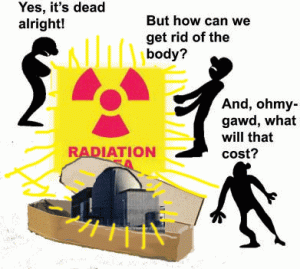 Costs for scrapping 79 nuclear facilities estimated at 1.9 tril. yen https://mainichi.jp/english/articles/20181227/p2g/00m/0na/001000c Costs for scrapping 79 nuclear facilities estimated at 1.9 tril. yen https://mainichi.jp/english/articles/20181227/p2g/00m/0na/001000c
December 27, 2018 (Mainichi Japan) TOKYO (Kyodo) — The state-backed Japan Atomic Energy Agency said Wednesday it would need to spend about 1.9 trillion yen ($17.1 billion) to close 79 facilities over 70 years, in its first such estimate. The total costs could increase further, as the agency said the estimated figure, which would be shouldered by taxpayers, excludes expenses for maintenance and replacing aging equipment. The JAEA plans to close more than half of the 79 facilities over the next 10 years due in part to the increased costs to operate them under stricter safety rules introduced after the 2011 Fukushima nuclear crisis. The agency, which has led nuclear energy research in Japan with its predecessors since the 1950s, owns a total of 89 facilities. Of the estimated costs, the expense for closing the nation’s first spent-fuel reprocessing plant in the village of Tokai, Ibaraki Prefecture, northeast of Tokyo, accounts for the largest chunk of 770 billion yen. It will cost 150 billion yen to decommission the trouble-plagued Monju prototype fast-breeder nuclear reactor. As for nuclear waste, the agency said about 100 kiloliters of high-level radioactive waste and up to 114,000 kl of low-level radioactive waste were estimated to have been produced but it has yet to decide on disposal locations. The Japanese government aims to restart nuclear power plants after a nationwide halt following the nuclear crisis, despite persistent concern over the safety of atomic power generation. |
|
|
Donald Trump can launch nuclear weapons anytime: even Secretary of Defense Jim Mattis (now sacked) could not have stopped him.
 Trump can launch nuclear weapons whenever he wants, with or without Mattis Trump can launch nuclear weapons whenever he wants, with or without Mattis
Mattis’ departure seems to be provoking unease, especially considering how dangerous our nuclear-command arrangements are. The notion that Mattis, a former four-star Marine Corps general, could have blocked or defied a move by Trump to impulsively launch nuclear weapons may have seemed comforting, but it shouldn’t have been. The secretary of defense has no legal position in the nuclear chain of command, and any attempts by a secretary of defense to prevent the president from exercising the authority to use nuclear weapons would be undemocratic and illegal. With or without Mattis, the president has unchecked and complete authority to launch nuclear weapons based on his sole discretion. The reaction to Mattis’ resignation, however, could open the door for the new Congress to create long-overdue legal barriers preventing the president from initiating a nuclear strike. Such a step could be implemented without any negative impact on U.S. security or that of our allies. Every day, the U.S. nuclear early warning system is triggered by some event or another, mostly civilian and military rocket launches by one or more of a dozen countries with ballistic missiles. When such launches appear to threaten North America, the head of U.S. Strategic Command is alerted, and sometimes these alerts warrant the urgent notification of the president. That alert comes by way of a direct call from the Strategic Command or via the White House Situation Room, the emergency-operations bunker beneath the East Wing, or the national security adviser. Partly a remnant of the Cold War, this system remains in place today to ensure the president can be notified quickly of any direct threat to the United States’ nuclear arsenal and the facilities that control it. That way, he can launch nuclear missiles before they are destroyed or the U.S. government is incapacitated by incoming weapons. n normal times, this system is precarious, and it can pressure even experienced leaders to consider nuclear weapons in a crisis sooner than warranted. Alerts stemming from ambiguous ballistic nuclear missile threats occurred multiple times during the administrations of George W. Bush and Barack Obama, and some alerts went directly to those presidents. Yet, this system seems especially ill-suited to a president who has demonstrated time and again that he can be provoked into taking rash action, and who, as a candidate, openly questioned why the United States could not use the nuclear weapons it possesses. This is a dangerous set of instincts for a commander in chief with sole and unchecked authority over almost 4,000 nuclear weapons, nearly 1,000 of which could be fired within a few minutes. For over a year, Mattis has been trying to reassure congressional leaders that he could help check some of Trump’s impulses, in part by intervening in the nuclear chain of command. In a break with normal procedures, Mattis reportedly told the commander of the Strategic Command to keep him directly informed of any event that might lead to a nuclear alert being sent to the president. He even told the Strategic Command “not to put on a pot of coffee without letting him know.” Congressional leaders interpreted this to mean that Mattis would either deal with a possible threat before it reached Trump or ensure he was present to advise Trump when such an alert arrived. This assurance may have helped ease concerns about our nuclear weapons for some members of Congress, but only if they were unfamiliar with how the command and control structure truly works. Personal relationships and back channels are no way to manage a nuclear arsenal. Even informed observers are surprised to learn the president can order the use of nuclear weapons without the input – or consent – of the secretaries of Defense or State, the chairman of the Joint Chiefs of Staff or the vice president. They only have a role in the presidential launch protocol if the president has given prior approval for them to be notified and solicits their advice. Otherwise, none of these people would need to be involved or informed that the president has decided to use a nuclear weapon. Under standard procedure, an attempt would be made to contact key national security officials, but in some real-world and exercise scenarios, it has proven impossible to tie them into a quickly convened emergency teleconference. Should he wish, the president could exclude all of them, and even bypass the primary designated adviser – the four-star general in charge of U.S. strategic forces – by ordering a low-ranking on-duty emergency operations officer at the Pentagon or elsewhere to transmit a launch order directly to the executing commanders of strategic U.S. submarines, silo-based missiles and bombers. Trump could have learned all this in a briefing about nuclear weapons shortly after he took office, and his military aide, ever at his side, could explain and assist in issuing a direct order to a lower-level officer at any time. Even if Mattis had been with Trump at a time of nuclear crisis, his resignation letter drives home the fact that Trump might very well have simply ignored his counsel. Trump, as he is proving in stark terms, listens only to himself. And any attempt by another person to physically block the president from issuing a launch order would probably result in his or her removal by the Secret Service. It is delusional and fundamentally undemocratic to think that our strongest check on a president bent on initiating nuclear war without justifiable cause might be a defense secretary trying to keep the president from communicating his launch authority using the so-called Gold Codes. When the United States faced the prospect of sudden nuclear attack from the Soviet Union, this system helped reinforce deterrence based on a balance of nuclear terror. But since the demise of the U.S.S.R., and even with a more aggressive Russia, the whole arrangement raises questions about its necessity, risks and consistency with democratic values. It is well past time for the system to be reformed to ensure that it hews to our Constitution and mitigates as much as possible the very real risks associated with a renewed arms competition with Russia. One key issue is whether Trump – or any president – should have the legal ability to independently initiate the use of nuclear weapons. It seems reasonable that the president needs to be able to quickly order a nuclear response if an adversary employs nuclear weapons first against us, and that he would not have time to consult with Congress or the Cabinet if nuclear missiles were headed here. (The flight time of ballistic missiles over intercontinental distances is 30 minutes or less, and the president would have only about five to seven minutes to decide whether and how to respond.) |
|
|
Nuclear power is losing its glow in China
 Why Is China Losing Interest In Nuclear Power? Oil Price,
The real change here regards discussions of the future. Pre-Fukushima, China’s power planners were considering adding 400 GWs of nuclear power by the year 2050. It appears plans of this magnitude are no longer under consideration.
Whatever the underlying cause, China has de-emphasized its massive nuclear new build strategy. We suspect the reason is a combination of slowing demand for electricity and deteriorating cost competitiveness of the nuclear plants compared to the alternatives.
After years of controversy, China’s massive Taishan NuclearPower Plant , goes online (all too close to Hong Kong)
Controversial nuclear reactor goes live in southern China
Reactor at Taishan Plant goes online, after five years of delays, debate and controversies about safety and other issues
The plant is in China’s southern Guangdong province, an economic dynamo whose annual gross domestic product is now on par with that of Russia and South Korea. The province has been intent on harnessing nuclear power to feed more electricity into its grid for its sprawling cities and manufacturing clusters.
Four nuclear plants along Guangdong’s coastline are already up and running and now a colossal new reactor at the Taishan Power Plant quietly went online last week. The plant has been plagued by bickering between technicians and Chinese officials as well as their French counterparts concerning safety and contingency measures, controversies that resulted in a five-year delay.
A joint venture by the state-owned China General Nuclear Power Corp (CGN) and Électricité de France, the Taishan plant is a mere 130 kilometers west of Hong Kong. It is home to the world’s first operational reactor of the novel third-generation European Pressurized Reactor (EPR) configuration, arguably the world’s largest electrical generator as measured by nameplate capacity……
Meanwhile, France’s Flamanville EPR project is still years behind its original commission target, the same as another plant in Finland.
Xinhua notes that the generator stator – the stationary part of a rotary system – at the Taishan reactor weighs almost 500 tonnes, and its double layer concrete dome is said to be strong enough to withstand a direct hit by a plane and can contain the fallout in a Chernobyl-like scenario, with improvements also made in light of the 2011 Fukushima incident.
CGN admitted that the Taishan reactor was “challenging to construct.” Environmentalists were also fuming at the elusive nature of the plant’s planning and project supervision, amid widespread skepticism about its safety and system redundancy.
Many opposed to the new EPR design demanded that the new reactor remain off the grid before every part could be checked by a third party, to which CGN and China’s National Energy Administration never acceded.
In 2015, France’s Nuclear Safety Authority admitted there were safety concerns about an EPR being built in Flamanville. The watchdog also warned that Taishan, which shared the same design and whose pressure vessels were procured from the same supplier, could also suffer from the same safety issues.
There were also reports alleging that the Taishan rector “did not receive the latest safety tests before installation,” as the French manufacturer said its tests detected faults that could lead to cracks in the reactor shell.
In December 2017, Hong Kong media blew the lid on a cover-up involving a cracked boiler found during test runs.
But CGN insisted that all design and quality issues had been ironed out throughout the years of delays and the pair of reactors in Taishan were indeed safer than the old units at the Daya Bay Plant built in Shenzhen in the late 1980s.
The Daya Bay project once triggered a massive outcry in Hong Kong when many rallied and petitioned against having a nuclear plant on the city’s doorstep. http://www.atimes.com/article/controversial-nuclear-reactor-goes-live-in-southern-china/
Japan’s nuclear export industry about to get the fatal blow
 Sun setting on Japan’s nuclear export sector http://www.atimes.com/article/sun-
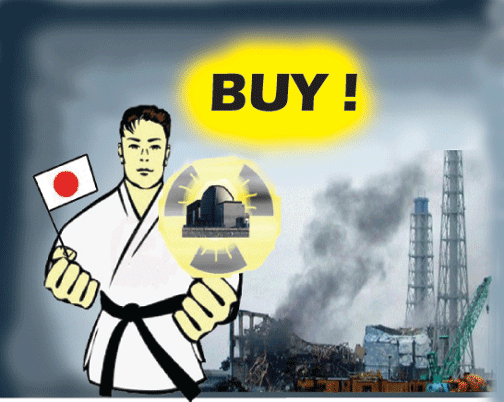 setting-on-japans-nuclear-export-sector/
Post-Fukushima cost overruns may kill a giant power project in Turkey, and there are few other deals to replace it
The Sinop plant project in Turkey was seen as Japan’s best chance for an industry – battered and bruised after the 2011 tsunami and triple meltdown at Fukushima – to put together a workable export strategy that did not break the bank of potential international customers.
Aside from Sinop, the Japanese industry has only one viable export project still upcoming: Hitachi’s bid to build two reactors on the island of Anglesey in Britain. And even that deal is looking shaky.
Mitsubishi Heavy Industries (MHI) has not pulled the plug yet on its stake in the four-reactor project on Turkey’s Black Sea coast, but a slew of domestic media reports and talk in Tokyo, suggests that, in the face of seemingly ever-rising construction costs to meet new safety standards that have been put in place since the 2011 Fukushima disaster, the company will bail.
Fukushima legacy
When the deal was signed with Ankara in 2013, the ownership profile was: 65% awarded to a consortium made up of MHI, Itochu, France’s Areva, and GDF Suez. The other 35% was covered by Turkey’s electric power utility, Elektrik Uretim.
However, in April, Itochu pulled out of the consortium, citing cost overruns. That left the consortium with 51%, and the remaining 49% owned by the Turkish utility.
Without Mitsubishi the viability of the project is in question, sources say, unless Turkey can find a new partner or is willing to take on the project without its largest foreign partner. The Russians, who are building a nuclear complex on Turkey’s southern Mediterranean coast, might be interested.
According to Kyodo, a thorough cost evaluation was to be completed by the end of this year. Itochu waited for the report to be released before bailing out of the deal. MHI is apparently waiting for the study to be completed before deciding its next move.
When the deal with Mitsubishi was signed in 2013, the estimated cost was $18 billion for four 1,100-megawatt nuclear power plants. But overall costs have soared, passing $42 billion in April – when Itochu withdrew, and is now put at about $44 billion.
Cost increases are nothing new in the nuclear power industry, but have been exacerbated in recent years by expensive adjustments phased in to meet more stringent safety concerns following the earthquake and tsunami that destroyed four units of the Fukushima Daiichi plant. The Sinop cost rises, however, also encompass other problems encountered in construction.
Fukushima, one of the most serious nuclear accidents in history, turned most of Japan against nuclear power. Before March 11, 2011, Japan had 54 nuclear plants. All were shut down after the accident and some are slowly returning to service having passed scrutiny by the regulator. Five are expected to restart within the next five years, and eight will likely be decommissioned. But prospects for the remaining plants are unclear.
Aware that no new nuclear plant may ever be built at home amid the anti-atomic public mood, Japan’s nuclear vendors have turned to overseas exports as the Fukushima accident does not appear to have destroyed the Japanese industry brand in other countries.
Endgame for nuclear exports?
If Mitsubishi does pull out of the huge project in Turkey it will be a blow to Prime Minister Shinzo Abe, who sees international exports of nuclear technology as an important way to boost the economy. On his many trips abroad, he often acts as a salesman for nuclear exports. For example, it was a topic of discussion with Turkish President Recep Erdogan on the sidelines of the G-20 meeting in Argentina.
Details of the conversation were not revealed, but it would be a good bet that they discussed the Sinop project with the threat of Mitsubishi hanging over them, and that Abe sought ways to keep the project viable.
Meanwhile, it is not just MHI that may have doubts about the sector. Japan’s nuclear export industry has suffered plenty of setbacks in the seven years since Fukushima. Questions about the future of the sector hang over all three main players in the sector.
Toshiba, one of Japan’s big-three nuclear constructors, recently pulled out of the nuclear power business overseas after incurring huge losses in the United States.
Toshiba has also suffered something of an administrative meltdown in its quest to win construction contracts in the US. In February it finally unloaded it money-losing American subsidiary, Westinghouse, for $1 billion less than it paid to acquire the company 10 years ago.
If the export program is to remain viable, it may be in Wales, where the British government is seeking to build a two-reactor nuclear power plant on the island of Anglesey. Among those bidding for the project is Japan’s third nuclear constructor, Hitachi, through a subsidiary called Horizon Nuclear.
In the nuclear world, there are constructors – like MHI, Toshiba and Hitachi – and operators, who run the plant after it is completed, and they are not always the same. Japan learned from Korea’s successful bid to build six nuclear plants in the United Arab Emirates that offering to build and also run them – a one-stop service – is key to making sales.
Hitachi is teaming up with the Japan Atomic Power Company, which operates two plants in Japan (although both are currently shut down pending the review by regulators). The plan is to present the British with a package deal.
Now, there are worries that Hitachi might pull out of the British project. Chairman Hiroaka Nakanishi was quoted in the Times of London saying his company was “facing an extreme situation,” and that a final decision on whether to stay with the project or leave it will be made next year.
If Mitsubishi does, as is widely expected, pull out of the huge project in Turkey, the only egg left in Japan’s overseas nuclear export basket will be Wales.
USA Congress Democrats and Republicans want strict controls on any nuclear deal with Saudi Arabia

Lawmakers Want a Greater Say as U.S. Seeks a Saudi Nuclear Deal, Members of Congress from both parties demand that an agreement to sell Riyadh civilian nuclear technology be based on stringent controls, WSJ . By Michael R. Gordon, Dec. 16, 2018
The Trump administration’s push to sell civilian nuclear technology to Saudi Arabia is emerging as the next battleground in the struggle between the White House and Congress over U.S. policy toward Riyadh following the killing of journalist Jamal Khashoggi.
The debate over Riyadh’s nuclear ambitions intensified last week after Energy Secretary Rick Perry brushed aside congressional appeals that nuclear talks be suspended because of Mr. Khashoggi’s killing and traveled to Saudi Arabia, where he accentuated the role American companies could play in helping the country establish a nuclear energy program.
…….But the CIA assessment that Saudi Crown Prince Mohammed bin Salman likely ordered Mr. Khashoggi’s killing has fueled concerns in Congress that the Saudi leader is too ruthless to be entrusted with nuclear technology. Saudi Arabia has repeatedly said the crown prince had no knowledge of the operation.
Lawmakers of both parties are demanding a deal be based on the most stringent nonproliferation controls. And some are now pushing legislation that would give Congress more of a say by requiring that a nuclear accord with Saudi Arabia be approved by the Senate and the House of Representatives.
“Before Khashoggi, I would say our chances were quite modest,” said Rep. Brad Sherman, a California Democrat, referring to prospects of House legislation he is drafting. “Now I would have to say our chances are better than 50-50.”
An identical measure is being prepared in the Senate by Sens. Ed Markey (D., Mass.) and Marco Rubio (R., Fla.), though the prospects for winning approval are likely to be more challenging.
The prospective nuclear deal comes amid a broader debate over Saudi policy, including a Senate vote last week to halt U.S. support for the Saudi-led coalition that is fighting in Yemen.
Even since the Trump administration signaled its interest in a nuclear agreement with Saudi Arabia last year, there has been debate about proliferation controls that should be imposed under an accord authorizing the transfer of U.S. nuclear technology, known as a 123 agreement.
……..Nuclear experts have also said that it would be important for Saudi Arabia to agree to the “Additional Protocol,” a formal arrangement with the International Atomic Energy Agency that provides for far-reaching inspections. The Saudis have been resisting that step, former officials who have been tracking the talks say. A spokeswoman for the Saudi embassy didn’t respond to a request for comment..
……..Under current law, a nuclear cooperation agreement with Saudi Arabia would go forward unless congressional opponents backed a joint resolution against it. That means that two-thirds of the lawmakers would need to oppose the accord so Congress could overcome a potential veto.
Mr. Sherman’s new bill aims to put nuclear accord skeptics in a more favorable position by requiring the administration to win approval from both the Senate and the House. That means a simple majority in one legislative chamber would be enough to block the agreement…….https://www.wsj.com/articles/lawmakers-want-a-greater-say-as-u-s-seeks-a-saudi-nuclear-deal-11544990606
Hitachi calling on Britain to further subsidise new nuclear reactors for Wales

 Hitachi to ask UK for further funding as nuclear project stalls https://asia.nikkei.com/Business/Companies/Hitachi-to-ask-UK-for-further-funding-as-nuclear-project-stalls
Company struggles to find other Japanese parties willing to invest TAKAFUMI HOTTA and SHINICHIRO IBUSUKI, Nikkei staff writers, DECEMBER 18, 2018
TOKYO — Hitachi will ask the British government for additional support for a nuclear power project in Wales as it struggles to recruit other Japanese investors amid international headwinds for atomic energy.
The company will consider scrapping the project, worth more than 3 trillion yen ($26.6 billion), should negotiations with London fail to reach a conclusion by January.
Aborting Japan’s last active proposal to build an overseas nuclear power plant would deal a blow to the government’s plan to expand exports of energy-related infrastructure, as similar projects face setbacks around the world.
“It is a fact that it is facing a difficult situation,” Hitachi Chairman Hiroaki Nakanishi said at a news conference Monday. “I told the British government that we are already reaching the limit.”
Nakanishi was speaking in his capacity as chairman of the Japan Business Federation, the nation’s top business lobby, better known as Keidanren. The news conference was held after reports emerged that Hitachi is considering scrapping the project altogether due to the difficulty of securing funding from Japanese companies.
With aid from the British government, Hitachi’s nuclear power segment intends to build two reactors on the Welsh island of Anglesey through British subsidiary Horizon Nuclear Power. It was scheduled to make a decision on the project’s economic feasibility sometime in 2019 but will probably push that decision forward by more than six months as the business environment worsens.
Nuclear power is losing its competitiveness as the price of renewable energy falls. The U.K. government also plans to buy electricity from the Wales plant for lower prices than those charged by other nuclear power facilities.
The Japanese government has promoted overseas nuclear power plant construction as a pillar of its strategy to boost infrastructure exports. Since the 2011 Fukushima disaster, no new reactors have been approved inside Japan. To maintain nuclear expertise and talent, Japan’s public and private sectors have teamed up to sell the technology abroad.
But ground has not broken on any project to date. A Japanese public-private consortium led by Mitsubishi Heavy Industries is planning to scrap a nuclear power plant in Turkey, for instance. Should the nuclear industry lose its legs, it could affect the restating and decommissioning of existing plants.
Hitachi has said it will move forward with the project if it can limit its exposure by reducing its 100% stake in Horizon Nuclear to around 30%. The U.K. has pledged more than 2 trillion yen in loans for the project, with the remaining cost of about 900 billion yen to be split among investments from Hitachi, the British government and business as well as the Japanese government and businesses.
Lining up Japanese investors, however, has proved to be a challenge. Tokyo Electric Power Co. Holdings, also known as Tepco, is reluctant to provide funding. Chubu Electric Power and other Japanese companies probably will follow its lead. Without other investors on the horizon, Hitachi is asking the British to share more of the burden.
Aside from Tepco and Chubu Electric, Hitachi also solicited investments from Japan Atomic Power, the Japan Bank for International Cooperation, the Development Bank of Japan and other parties. But the industrial conglomerate is having trouble gathering the necessary 300 billion yen.
The British government is no position to acquiesce to these demands. Having already pledged around $18 billion in loans, it risks backlash from the public by providing further financial support. Prime Minister Theresa May can ill afford another fight as her government risks collapse over negotiations to leave the European Union.
At a separate news conference held by Hitachi, Toshiaki Higashihara, the company’s president and CEO, did not attempt to downplay the situation. “Hitachi is a private company,” he said, “and there is a limit to how much risk it can take. If the project is not economically rational, it is possible that the project will be halted.”
Higashihara added that the final investment decision will be made by the end of 2019.
Hitachi Executive Vice President and Executive Officer Toshikazu Nishino also spoke, saying the company “has not given up yet,” though it recognizes “the negotiations are not easy.”
Bulgaria’s planned nuclear power station unlikely to ever be built
The Plan to Build a Nuclear Future From a Communist Relic, In the poorest corner of the European Union, political leaders are looking for a savior with 10 billion euros to spare. Bloomberg By James M Gomez, Elizabeth Konstantinova, and Slav Okov, December 14, 2018,
On the edge of a small Bulgarian town on the southern bank of the Danube River lies a relic from communism with eerie echoes of one of the Soviet era’s most infamous places.
Empty apartment buildings squat on the snow like forgotten boxes. Windows are broken, facades are crumbling and weeds flourish where gardens were meant to blossom. It looks like the ghost town at the abandoned Chernobyl nuclear site 1,200 kilometers (750 miles) north.
Except the crucial difference is that the one at Belene in Bulgaria was never occupied, save for the occasional squatter. The buildings were erected in the 1980s by the government to house workers at a planned facility. But the project was scrapped, revived and scrapped again during the eastern bloc’s transition from communism to capitalism.
Now, in the heart of the European Union’s poorest corner, Bulgaria plans to get the nuclear plant off the ground for real. Facing a dilemma that’s familiar across the continent, the government says the nation can’t keep up with demand for electricity any other way.
It will solicit bids from investors early next year to build a 2,000 megawatt plant at a capped cost of 10 billion euros ($11.4 billion). The land, empty apartment blocks, already prepped foundations and two unused Russian-made reactors will be thrown in as incentives.
Like with nuclear projects everywhere, there’s opposition and—given Bulgaria’s track record—plenty of skepticism as the government makes its case with promises that the effort won’t break state coffers or saddle taxpayers with the bill.
It’s a hard sell. Governments, builders and investors across Europe are shying away from the high cost of nuclear construction and turning toward renewable energy sources such as solar and wind. The consensus of local residents, industry analysts, economists and even some lawmakers is that it won’t work. And if it does, it will be for the benefit of Russia trying to wield influence in Bulgaria.
“It’s a complete mess,” said Krassen Stanchev, head of the KC2 consultancy in Sofia, an associate professor at the Sofia University and a long-time critic of the process. “This project will never fly.”
The Center for the Study of Democracy based in the Bulgarian capital reckons there’s no need for new capacity for almost another three decades and the plant would generate losses of 4.5 billion euros by 2050.
“The main reason not to build this plant is that it will be extremely costly and it can’t offer competitive prices,” said Martin Vladimirov, an energy analyst at the center. “At some point it will turn into a stranded asset, it will turn into a zombie plant without any real role in the electricity system.”
……..Behind a kilometers-long barbed wire fence outside Belene, the proposed plant site boasts a handful of buildings and careworn warehouses. Inside them are grey wooden crates stuffed with equipment meant to secure the reactors to the foundations and connect them to the system. There is also a water treatment facility ready to go online, a spur of railway track and a concrete plant ready to pour.

The only sign of the foundations is a flat, sunken section of ground larger than a football field and surrounded by 15-story cranes that haven’t been used since the 1990s.
The reactors, bought from Rosatom in the last attempt to get the project going, are each rated at 1,000 megawatts—about the same output as Chernobyl reactors. They sit in a field boxed up against the elements.
Though the Bulgarian government is sticking to its cost estimate, most analysts say cost overruns are typical in the industry. Because of that and the strict conditions that free Bulgaria from any financial responsibility, the number of prospective investors may be limited to Russian and Asian companies. China National Nuclear Corp. and Korea Hydro & Nuclear Power Co. have both expressed interest.
“The Bulgarian government doesn’t want to provide those price guarantees and unfortunately you need that to underpin the nuclear development,” said Elchin Mammadov, an energy analyst for Bloomberg Intelligence, who says he is bearish on new projects. “It’s too risky and too expensive for a private company to fund it.”………………… https://www.bloomberg.com/news/features/2018-12-14/the-plan-to-build-a-nuclear-future-from-a-communist-relic
Global nuclear industry’s confidence is wobbling, as China loses enthusiasm for nuclear power
 China’s losing its taste for nuclear power. MIT Technology Review, Once nuclear’s strongest booster, China is growing wary about its cost and safety. by Peter Fairley,December 12, 2018
Most beautiful wedding photos taken at a nuclear power plant” might just be the strangest competition ever. But by inviting couples to celebrate their nuptials at the Daya Bay plant in Shenzhen and post the pictures online, China General Nuclear Power (CGN), the country’s largest nuclear power operator, got lots of favorable publicity.
A year later, the honeymoon is over.
For years, as other countries have shied away from nuclear power, China has been its strongest advocate. Of the four reactors that started up worldwide in 2017, three were in China and the fourth was built by Beijing-based China National Nuclear Corp. (CNNC) in Pakistan. China’s domestic nuclear generation capacity grew by 24% in the first 10 months of 2018.
The country has the capacity to build 10 to 12 nuclear reactors a year. But though reactors begun several years ago are still coming online, the industry has not broken ground on a new plant in China since late 2016, according to a recent World Nuclear Industry Status Report.
Officially China still sees nuclear power as a must-have. But unofficially, the technology is on a death watch. Experts, including some with links to the government, see China’s nuclear sector succumbing to the same problems affecting the West: the technology is too expensive, and the public doesn’t want it.
The 2011 meltdown at Japan’s Fukushima Daiichi plant shocked Chinese officials and made a strong impression on many Chinese citizens. A government survey in August 2017 found that only 40% of the public supported nuclear power development.
The bigger problem is financial. Reactors built with extra safety features and more robust cooling systems to avoid a Fukushima-like disaster are expensive, while the costs of wind and solar power continue to plummet: they are now 20% cheaper than electricity from new nuclear plants in China, according to Bloomberg New Energy Finance. Moreover, high construction costs make nuclear a risky investment.
And gone are the days when nuclear power was desperately needed to meet China’s soaring demand for electricity. In the early 2000s, power consumption was growing at more than 10% annually as the economy boomed and manufacturing, a heavy user of electricity, expanded rapidly. Over the past few years, as growth has slowed and the economy has diversified, power demand has been growing, on average, at less than 4%.
China’s disenchantment with nuclear power corresponds with an overall decline in nuclear generation elsewhere in the world. Utilities are retiring existing plants and have stopped building new ones. If China, too, gives up on nuclear, it could sound the death knell………
Within days of Fukushima, nuclear reactor construction in China was frozen. When building resumed months later, after a wave of inspections, Beijing insisted that future nuclear power projects adopt more advanced designs with extra safety features.
The damage to public confidence, however, had already been done. In 2013 over a thousand people assembled in Jiangmen, east of Hong Kong, to decry a planned uranium fuel plant. Within days the state-run project was scrapped. In 2016 local officials suspended preliminary work on a site in Lianyungang, in northeastern Jiangsu province, after an uproar caused by revelations that it might host a recycling plant for spent nuclear fuel. In the wake of that protest, China’s State Council amended its draft regulations on nuclear power management, requiring developers to hold public hearings before siting projects…………
Dwindling options
The government has lately said little about nuclear policy. Its official target, last updated in 2016, calls for 58 gigawatts of nuclear generating capacity to be installed by 2020 and for another 30 GW to be under construction. All experts agree China won’t reach its 2020 goal until 2022 or later, and pre-Fukushima projections of 400 GW or more by midcentury now look fanciful. Han says he is betting that after the country builds the 88 GW in its 2020 plan, it will move on to other energy sources. …….
If the Hualong One proves too expensive, China’s lingering nuclear hopes will be pinned to its advanced-reactor program—an effort to develop a new generation of technologies that include high-temperature gas-cooled reactors, designs cooled with sodium metal or salt, and smaller versions of pressurized-water reactors. These various designs are meant to be cheaper to build and operate—and much safer—than conventional reactors.
But so far there is little evidence that any of them will solve nuclear’s problems. A sodium-cooled reactor completed near Beijing in 2011 has had familiar technical glitches such as problems in its coolant systems. And the rising cost of a pair of high-temperature gas-cooled reactors nearing completion at Shandong Province’s Shidao Bay ended plans for a further 18 such reactors at the site.
There’s always the possibility of a breakthrough that would make nuclear safe and cheap enough to compete with renewables and coal. But even China’s nuclear giants are hedging their bets. Both CGN and the state-owned firm funding China’s AP1000 investments rank among the world’s top 10 renewable-power operators……..
Maine watchdogs keep close eye on Trump’s bid to change nuclear waste storage rules
|
https://bangordailynews.com/2018/12/12/news/midcoast/maine-watchdogs-keep-close-eye-on-trumps-bid-to-change-nuclear-waste-storage-rules/ • December 12 2018, A new proposal by President Donald Trump’s administration to reclassify some high-level nuclear waste to reduce cleanup costs will not affect the 550 metric tons of spent nuclear fuel stored in more than 60 airtight steel canisters near the former Maine Yankee nuclear reactor in Wiscasset. The new proposal focuses on waste generated by nuclear weapons, not power plants. But Mainers tasked with advocating for safe handling of atomic waste voiced concern that it could foretell changes that would affect the Maine Yankee waste.
“Safety costs money; environmental protection costs money,” said Edgecomb resident Ray Shadis, technical adviser to the New England Coalition on Nuclear Pollution in Brattleboro, Vermont, and founder of the group Maine’s Friends of the Coast that eventually got Maine Yankee shut down. “I think that’s the next shoe. This initiative at the weapons’ facilities is very likely the first step.” The U.S. Department of Energy has proposed reclassifying some high-level radioactive waste in various U.S. locations to low-level, allowing the department to leave the waste buried in the ground and save $40 billion in cleanup costs, the Associated Press reported Tuesday. Per the Atomic Energy Act of 1954 and the Nuclear Waste Policy of 1982, high-level radioactive waste is currently defined as waste resulting from processing irradiated nuclear fuel that is highly radioactive. Shadis said the proposal would not affect waste at the former Maine Yankee plant, which closed in 1996. Trump’s current proposal would only affect high-level radioactive waste generated by nuclear weapons production — currently stored in South Carolina, Idaho, Washington and New York — not waste generated by civilian nuclear production. “The terms ‘highly radioactive’ and ‘sufficient concentrations’ are not defined in the [Atomic Energy Act] or the [Nuclear Waste Policy Act],” the proposal states. It goes on to argue that “Congress left it to [Department of Energy] to determine when these standards are met. Given Congress’ intent that not all reprocessing waste is [high-level waste], it is appropriate for DOE to use its expertise to interpret the definition of [high-level waste], consistent with proper statutory construction, to distinguish waste that is non-HLW from waste that is HLW.” According to Shadis, industry officials and regulators have insisted since the beginning of the nuclear age that civilian nuclear production and weapons production for defense have nothing to do with each other. They are not integrated in any way and are handled separately. In fact, waste generated by civilian nuclear reactors is regulated by the U.S. Nuclear Regulatory Commission. Eric Howes, spokesman for Maine Yankee, said Tuesday he is not aware of any proposals to reclassify waste stored at Maine Yankee. Nevertheless, Shadis said, “I will say that we could simply wait for the other shoe to drop, because the Trump administration has rushed to the rescue of commercial power plants, which are shutting down all over the country because they are no longer competitive … it’s one way of fixing the game. One way of adjusting the cost of nuclear is to be more lenient when it comes to environmental regulations, including regulations regarding nuclear waste.” “That’s completely outrageous,” Don Hudson, chairman of the Maine Yankee Community Advisory Panel, said of the proposal. “They couldn’t have done that with a straight face. But it doesn’t affect Maine Yankee’s waste.” A federal judge has already awarded Maine Yankee $24.6 million in a decision based on the federal government’s failure to remove and dispose of the spent nuclear fuel. But Hudson said again on Tuesday there is no viable solution for the waste in Wiscasset, although “there are a couple of potential projects that might get built sometime in the next decade for above-ground storage near Carlsbad, New Mexico, and west Texas.” Previous administrations have said “stranded” nuclear waste — hazardous materials stored where there is no operating nuclear plant such as Maine Yankee, Yankee Rowe in Massachusetts and several others — would be the first to be removed, according to Hudson. But he said he isn’t holding his breath. “The impasse on the nuclear waste issue continues,” Howes said. “Congress to date has not provided any funding in the fiscal year 2019 budget for consolidated interim storage or the Yucca Mountain license application process. Maine Yankee and many others are urging Congress to provide fiscal year 2019 funding for nuclear waste management during this lame duck session of Congress.” “I hate to sound cynical, but I’m not going to believe it’s going to happen until I actually hear there’s a bulldozer on the ground,” Hudson said. “It’s really dangerous stuff, and it needs to be taken care of … depending on who you ask, it’s going to be multi tens of thousands of years before you could assign just casual care of this waste.” |
|
UK’s “nuclear revival”?Japanese company Hitachi may walk away from Wylfa project
 Times 11th Dec 2018 , Doubts over Britain’s planned nuclear revival increased yesterday amid
fears that the Japanese company developing a new plant on Anglesey may be
preparing to scrap the project. Shares in Hitachi rose by as much as 2.9
per cent at one point after Japanese media reported that it was considering
abandoning work on the proposed Wylfa plant because of rising costs.
at which the fate of Horizon, the subsidiary developing the £15
billion-plus project, will be discussed.
the British government over financial support for Wylfa and is understood
to want a deal by the middle of next year or else could walk away. TV
Asahi, the Japanese broadcaster, reported that a decision was likely to be
taken by the end of the business year in March.
https://www.thetimes.co.uk/article/b6c04dec-fcbc-11e8-9a88-fa81ced0c139
Washingtonhelping nuclear workers to get compensation State will defend its law
State will fight feds over Hanford worker compensation, Q13 FOX, , DECEMBER 11, 2018, BY ASSOCIATED PRESS SPOKANE, Wash. (AP) — Officials for the state of Washington said Tuesday they will defend a new law that helps employees of a former nuclear weapons production site win worker compensation claims, after the federal government filed a lawsuit seeking to overturn the law.
Democratic Gov. Jay Inslee criticized the lawsuit as outrageous and “depraved.”
“The people who fought communism shouldn’t have to fight their federal government to get the health care they deserve,” said Inslee, who is weighing a run for the White House in 2020.
The U.S. Department of Justice filed the lawsuit on Monday in federal court for the Eastern District of Washington.
The Washington Legislature last spring passed a law that says some cancers and other illnesses among Hanford Nuclear Reservation workers are assumed to have been caused by chemical or radiological exposures at work, unless that presumption can be rebutted by clear and convincing evidence.
…….The legislation signed into law in March by Inslee was propelled through the Legislature by the concerns of sick Hanford workers frustrated by state denials of their compensation claims…..
Ferguson said he presumed the federal government was worried the new Washington law might spread to other states where federal employees were involved in dangerous work. He predicted the issue would likely be resolved at trial.
“Before this, workers had to prove that whatever illness they had was not caused by something else in their lives,” Ferguson said.
Inslee called it another attempt by the Trump administration to take health care away from people in the state.
“They want to tell workers at Hanford to go hang,” said Inslee, who used to represent the Hanford site in Congress.
Lynne Dodson of the Washington State Labor Council said the federal government should be working to improve worker safety, rather than pursuing this lawsuit.
“Donald Trump and (Energy Secretary) Rick Perry would kick these workers while they are down,” Dodson said. https://q13fox.com/2018/12/11/state-will-fight-feds-over-hanford-worker-compensation/
-
Archives
- October 2026 (91)
- September 2026 (339)
- August 2026 (330)
- July 2026 (355)
- June 2026 (287)
- May 2026 (306)
- April 2026 (356)
- March 2026 (251)
- February 2026 (267)
- January 2026 (308)
- December 2025 (358)
- November 2025 (359)
-
Categories
- 1
- 1 NUCLEAR ISSUES
- business and costs
- climate change
- culture and arts
- ENERGY
- environment
- health
- history
- indigenous issues
- Legal
- marketing of nuclear
- media
- opposition to nuclear
- PERSONAL STORIES
- politics
- politics international
- Religion and ethics
- safety
- secrets,lies and civil liberties
- spinbuster
- technology
- Uranium
- wastes
- weapons and war
- Women
- 2 WORLD
- ACTION
- AFRICA
- Atrocities
- AUSTRALIA
- Christina's notes
- Christina's themes
- culture and arts
- Events
- Fuk 2022
- Fuk 2023
- Fukushima 2017
- Fukushima 2018
- fukushima 2019
- Fukushima 2020
- Fukushima 2021
- general
- global warming
- Humour (God we need it)
- Nuclear
- RARE EARTHS
- Reference
- resources – print
- Resources -audiovicual
- Weekly Newsletter
- World
- World Nuclear
- YouTube
-
RSS
Entries RSS
Comments RSS

