 The Energy 202: Senate Democrats warn EPA may be ‘afoul’ of law by prepping Wheeler for confirmation during shutdown, The Hour, Dino Grandoni, The Washington Post, January 11, 2019 A group of Senate Democrats says the Environmental Protection Agency may be violating spending laws by preparing the agency’s acting chief, Andrew Wheeler, for his confirmation hearing during a partial government shutdown.
Four members of the Senate Environment and Public Works Committee – Thomas Carper of Delaware; Sheldon Whitehouse of Rhode Island; and Benjamin Cardin and Chris Van Hollen, both of Maryland – sent a letter to the agency questioning whether it is improperly using resources to help Wheeler get ready for his confirmation hearing before them next Wednesday.
The move underscores the extent to which Senate Democrats are ready to fight President Donald Trump’s second pick to run the EPA after the former chief, Scott Pruitt, and now Wheeler have sought the reversal of many environmental regulations implemented under President Obama.
In response to the letter, the EPA told The Washington Post it is well within its rights under Justice Department guidelines to work toward getting the agency a Senate-confirmed leader.
The EPA is one of the agencies that isn’t receiving funding as the partial government shutdown drags into its 21st day over the standoff surrounding President Trump’s border wall. Only about 800 of the EPA’s 14,000 employees have been deemed essential to work through the shutdown. The vast majority of those remaining at work are “necessary to protect life and property.”
Only a handful of other employees – six top-level political appointees and a dozen others “necessary to the discharge of the President’s constitutional duties and powers” – are still allowed to work during a shutdown, according to the agency’s Dec. 31 contingency plan.
But according to the Democratic senators, five EPA employees have been involved in coordinating meetings with senators, who will have to approve Wheeler to serve as the agency’s permanent chief after President Trump this week formally tapped him for the position.
An EPA notary also worked to certify an ethics form for Wheeler, who worked for years as a lobbyist.
“It is difficult to understand how preparing you for next week’s confirmation hearing credibly falls within any of the categories listed in EPA’s Contingency Plan, particularly the category of employee that is ‘necessary to protect life and property,’ ” the senators wrote in their letter to Wheeler, sent Thursday.
“Using EPA resources in this manner may also run afoul of the Antideficiency Act,” they added, referring to the law requiring a federal agency’s expenditures not exceed the amount appropriated by Congress.
……… The EPA has been without a Senate-confirmed chief since the White House forced Pruitt to resign in July amid investigations into his ethical and managerial decisions.
While happy to see Pruitt gone, many environmentalists are fiercely oppose to Wheeler’s nomination after he spent years representing coal mining and nuclear energy firms in Washington.
They have long been critical of the EPA under both Pruitt and Wheeler for pursuing the rollback of Obama-era rules. During the shutdown, however, much of that work rewriting regulations has been put on pause.
But activists still take issue with Trump and Senate Republicans working to advance Wheeler’s nomination while other EPA employees are furloughed, such as those working to inspect factories for pollution or prepare cleanup plans for toxic waste sites.
“It’s a shocking waste of precious resources to spend any staff time preparing Andrew Wheeler’s nomination,” Collin O’Mara, president and chief executive of the National Wildlife Federation, said while calling for a delay in the hearing. https://www.thehour.com/news/article/The-Energy-202-Senate-Democrats-warn-EPA-may-be-13526124.php
January 12, 2019
Posted by Christina Macpherson |
politics, USA |
Leave a comment
TASC 9th Jan 2019 , TASC’s initial opinion of the EDF 3rd stage consultation is that it is
‘vague to the point of being misleading.’ Pete Wilkinson, the group’s
chairman, said today, ‘This is the last chance before the Development
Consent Order for people of east Suffolk to submit their views about how
the proposed EDF development will affect their lives.
‘The glossy consultation brochure states baldly that, ‘An Environmental Impact
Assessment (EIA) process is on-going and is being used to identify any
likely significant effects arising as a result of Sizewell C’ (emphasis
added). This renders the document premature and deliberately vague to the
point of being misleading.
How can people therefore judge whether they feel
the impacts are acceptable or not when the developer itself does not know
to what degree and in which areas the environment will be degraded?
Consultees are being asked, in effect, how they want the deck chairs
arranged on the Titanic. TASC believes we should not embark on the Titanic
at all and we encourage all those who agree with us to write to EDF, Dr
Coffey and Greg Clark, the government minister responsible for this
unnecessary monstrosity on our precious coast, to tell them so.’ TASC’s
opinion is that very little of significance has changed since the 2nd
consultation.
The “Road-Led” vs “Rail-Led” strategies appear to be
no more than a red herring to distract from the overriding fact that
Sizewell C will have a devastating and unacceptable impact on the Suffolk
coastal community. This is a rural area lacking in the type of
infrastructure needed to construct such a massive industrial complex. It is
this lack of major roads and railway lines that has made this area a mecca
for walkers, cyclists, bird watchers and those that just enjoy the peace
and tranquility of a beautiful landscape. There is no doubt that the
monstrous folly of Sizewell C will put all this, and the vibrant and
sustainable tourist industry that has developed around it, at risk.
http://tasizewellc.org.uk/index.php/news/242-sizewell-opposition-group-condemns-consultation-as-deliberately-vague
January 12, 2019
Posted by Christina Macpherson |
politics, UK |
Leave a comment
Kim Jong Un’s New Year’s Speech: On the Domestic Front, 38 North, BY: GLYN FORD, JANUARY 9, 2019 “……
-
The speech was framed within the successes of last year. The 2013 Line of promoting two fronts—economy and a nuclear deterrent—simultaneously had finally been delivered. The country lives under the protective umbrella of its nuclear deterrent and can turn its focus to the “higher goal” of economic construction.
Kim acknowledged that challenges to this domestic agenda certainly exist, noting especially the misallocation of labor, lack of expertise and poor productivity. In his speech, he instructed a reallocation of labor and resources, both for the military and the Party, to start to address these barriers to success. He also indicated that contingency plans were being explored in case a second summit with Trump fails to set US-DPRK relations back on track.
………Focus on Energy Generation
The country’s principal economic bottleneck is the desperate need for a massive increase in electricity production. A first step is the renovation and modernization of the supply industry. By singling out the Pukchang Thermal Power Complex for praise all the others inevitably lie in its shadow. Yet the most aggravating problem is fuel shortages. Under the current sanctions regime, the short-term solution—and by no means good news for the climate-change lobby—to the electricity shortage is massive increases in productivity in the coal sector. ………..
While hydroelectric plants merit a passing mention, in reality, the North is close to maximizing the use of the water resources available with both floods and droughts sharply reducing output. In the longer term, Kim argued that the country needs to “create a capacity for generating tidal, wind and atomic power under a far-reaching plan.” The last underlines Pyongyang’s perception that denuclearization of the Korean Peninsula does not preclude ambitions to be a civil nuclear power. The ongoing construction of their indigenous Experimental Light Water Reactor (ELWR) at North Korea’s Yongbyon Nuclear Scientific Research Center suggests that light water reactors will form the backbone of the industry, harking back perhaps to the Korean Peninsula Energy Development Organization (KEDO) from the 1990s. ………..
There is no question the Party is now on top as well as on tap with constant references to its primacy. Kim emphasized in his speech that the KPA is to “defend the Party and revolution and the security of the country and the people and continuously perform miraculous feats at all sites of socialist construction.” Echoing that sentiment, the People’s Internal Security Forces are there to protect Party, system and people, in that order.
Delivering peace and prosperity to the Korean Peninsula is the stated goal for both Pyongyang and Seoul. Kim underscored this mandate with:
“When north and south join hands firmly and rely on the united strength of the fellow countrymen, no external sanctions and pressure, challenges and trials will be able to hinder us….We will never tolerate the interference and intervention of outside forces who stand in the way of national reconciliation, unity and reunification with the design to subordinate inter-Korean relations to their tastes and interests.”
The “dog that didn’t bark” is the “end-of-war” declaration. Last summer, Pyongyang complained long and hard that Washington had not delivered on its promise to sign a political declaration ending the Korean War. In Kim’s New Year’s speech, this declaration failed to get even a mention. Pyongyang seems to have moved on, from Washington at least. Kim stated, “it is also needed to actively promote multi-party negotiations for replacing the current ceasefire on the Korean peninsula with a peace mechanism in close contact with the signatories to the armistice agreement so as to lay a lasting and substantial peace-keeping foundation.” The concept of a bilateral US-DPRK declaration signed by Seoul and Beijing has now become a multilateral proposition and negotiation. Which parties would be involved is unclear, but this may have been one of many topics discussed between Kim and Chinese President Xi Jinping during Kim’s birthday visit to Beijing
……….Until now Pyongyang has rigidly adhered publicly to parallel bilateral negotiations, one with Washington looking for a peace settlement accompanied by sanctions relief and a second with Seoul on economic cooperation. Now with the potential for the first set of negotiations to go multilateral, the second set may follow suit, increasing pressure on Moon to put clear blue water between Seoul and Washington with respect to “maximum pressure.”https://www.38north.org/2019/01/gford010919/
January 12, 2019
Posted by Christina Macpherson |
North Korea, politics, politics international |
Leave a comment
More Than 600 Environmental Groups Just Backed Ocasio-Cortez’s Green New Deal,Gizmodo, Brian Kahn , 11 Jan 19, Pressure continues to mount on Congress to get its act together on climate change. The latest salvo came on Thursday, as 626 groups delivered a letter to every member of Congress laying out their support for a Green New Deal and their demands.
January 12, 2019
Posted by Christina Macpherson |
ENERGY, politics, USA |
Leave a comment
Trump administration wants to reclassify leaking nuclear waste to avoid cleaning it up, say officials
‘This is unacceptable, and we will not stand by while this administration plans to abandon its responsibility to clean up their mess’, Independent UK, 10 Jan 19, Josh Gabbatiss, Science Correspondent
January 10, 2019
Posted by Christina Macpherson |
politics, USA, wastes |
8 Comments

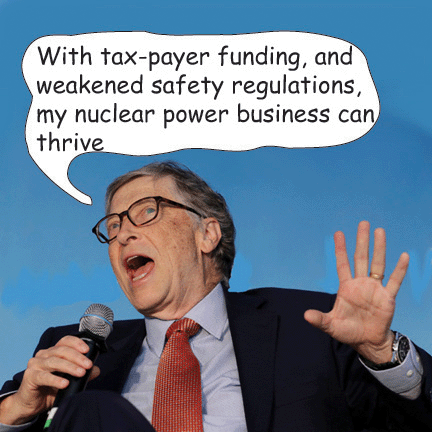
TRUMP ADMINISTRATION WANTS BILL GATES TO DITCH CHINA AND BUILD HIS NUCLEAR PROJECT IN THE US, Daily Caller, Jason Hopkins | Energy Investigator 01/08/2019 | Members of the Trump administration are actively working to convince Bill Gates to relocate his now-scrapped nuclear reactor project in China over to the U.S.
“We hope we can work with them and bring them back,” said Deputy Energy Secretary Dan Brouillette in an exchange with reporters Monday. Brouillette revealed the Energy Department has held “several conversations” with Gates, adding that he was optimistic the U.S. government could streamline the permitting process and entice the billionaire to bring his project stateside…….
“Unfortunately, America is no longer the global leader on nuclear energy that it was 50 years ago. To regain this position, it will need to commit new funding, update regulations, and show investors that it’s serious,” Gates wrote in a year-end blog post, first revealing his botched nuclear plans. ……
In the waning days of December, Congress passed the The Nuclear Energy Innovation and Modernization Act by wide margins in both chambers. The legislation aims to streamline the regulatory process for commercial nuclear plants, with an end game of making the development and commercialization of nuclear technology more affordable.
If signed by President Donald Trump, the bill could make nuclear projects, like the one Gates is spearheading, easier to accomplish. https://dailycaller.com/2019/01/08/bill-gates-nuclear-project/
January 10, 2019
Posted by Christina Macpherson |
politics, USA |
1 Comment
Feds say some Hanford radioactive waste is not so dangerous. Oregon disagrees, Tri City Herald, BY ANNETTE CARY, JANUARY 07, 2019 RICHLAND, WA
A Department of Energy proposal that could change what is done with some high level radioactive waste at Hanford has Oregon urging its residents to take a stand.
“Waste that is no longer considered high level would be disposed in shallow burial at Hanford,” said Oregon in a news release Monday.
The state’s position is at odds with Tri-City area groups, which say the DOE proposal could save billions of dollars in environmental cleanup money across the nation, making more money available for some of the most pressing environmental cleanup at the Hanford nuclear reservation.
Now radioactive waste at Hanford and other DOE nuclear cleanup sites across the nation is defined as high level waste based on its origin.
Waste associated with chemically processing irradiated uranium fuel to remove plutonium for the nation’s nuclear weapons program is currently classified as high level waste.
It is required to be disposed of in a deep geological repository, such as the one that has been proposed at Yucca Mountain, Nev.
DOE wants to reinterpret the definition to look at the waste’s characteristics and risks, as other countries typically do, rather than its origin.
Oregon proposed that be done nearly 30 years ago.
But it is concerned that DOE’s current proposal would give DOE unilateral discretion to determine how to classify and dispose of waste that for decades has been managed as high level waste.
Independent regulatory oversight by states and the Nuclear Regulatory Commission would be gone, as well as the criteria for defining waste that has been approved by Congress, according to Oregon’s comments submitted to DOE.
DOE published the proposal in the Federal Register and set an extended deadline for comments on it to be received by Wednesday……….
DOE has declined to say what waste could be affected by its proposal to change its interpretation of what is high level waste.
But the state of Oregon says it could could allow more of the long-lived and highly radioactive constituents in the tank waste to remain in the treated waste expected to be disposed of at Hanford.
It also could allow more waste to remain in Hanford’s tanks as they are closed, likely through a process of filling them with grout and leaving them in the ground, according to Oregon. DOE is unable to get all of the waste out of the enclosed tanks as it empties them, but its goal is to remove 99 percent of the waste.
Soil contaminated by leaks and spills of Hanford tank waste and discharges of contaminated liquid into the ground also could be affected. The change to the definition could make it easier for DOE to leave the radioactive contamination in the soil, Oregon said.
“DOE projects confidence that it understands one of the most complicated radiochemical mixtures created by our civilization, and that this waste can be managed for thousands of years in shallow environments,” Oregon said in its comments.
“DOE’s proposed interpretation could lead to long-term risk decisions with insufficient precaution and technical rigor,” it said.
DOE faces a conflict between its responsibility to ensure long-term safety from radiation and its interest in reducing the cost of environmental cleanup in the nation’s nuclear weapons complex, Oregon said.
But the state believes that safety should always prevail over cost savings, it said.
TRIDEC, Hanford Communities and Oregon find some common ground in concerns over the way that DOE is proposing to change how it interprets the definition of high level waste……..
Washington state also is expected to weigh in against the proposed change before the comment period ends Wednesday, but had not finished its comments by Monday.
Comments from organizations and individuals may be emailed to HLWnotice.em.doe.gov. https://www.tri-cityherald.com/news/local/hanford/article224033150.html
January 10, 2019
Posted by Christina Macpherson |
politics, USA, wastes |
Leave a comment
East Anglian Daily Times 7th Jan 2019 ,Campaigners have been left furious over the latest plans for a new nuclear power plant on the Suffolk coast – and say EDF Energy is still not
listening to residents’ concerns. The construction of the Sizewell C
twin-reactor is expected to cause widespread disruption with concern over
hundreds of trucks using unsuitable roads, the impact on the local economy
and worries over the effect on RSPB Minsmere. A main concern is the use of
land near Eastbridge for a campus for 2,400 workers which campaigners say
are “substantially unchanged” from early designs. Alison Downes,
co-chairman of Theberton and Eastbridge Action Group on Sizewell (TEAGS),
was furious at the lack of consideration being taken of the villages as EDF
clamours to start construction.
https://www.eadt.co.uk/news/edf-energy-sizewell-plan-slated-by-theberton-middleton-eastbridge-activists-1-5840910
January 10, 2019
Posted by Christina Macpherson |
politics, UK |
Leave a comment

 FT 7th Jan 2019
 The Huawei affair has revived the unresolved question of whether the non-Chinese world can trust Chinese companies as the country becomes an industrial superpower. The US has cited Huawei’s alleged breaches of Iranian sanctions to request the extradition of Meng Wanzhou, the company’s chief financial officer, from Canada, but it is clear that the real concern is about the ability of Huawei’s advanced technology to gather information.
The US, Australia and New Zealand have already banned Huawei from future G5mobile projects. The UK will soon have to face up to an additional aspect of the issue as a key decision approaches on Chinese plans to build a series of civil nuclear reactors in Britain, starting with Bradwell B on the site of a former air base in Essex.
But what happens next is not simply a matter for the US and the UK. China itself must decide what place in the world it wants. For the UK, the test of whether to follow the American line
will focus not just on Huawei but also on the proposed development of Bradwell B. The plant is intended to be a joint project between the Chinese nuclear company CGN and France’s EDF, with CGN set to own 66.5 per cent of the venture and use its HPR 1000 nuclear reactor. CGN is, on its own estimation, the world’s third largest nuclear power company but its operations have so far been concentrated in China and Bradwell would be a flagship project for its international ambitions.
The HPR Hualong design is going through the assessment process required by the UK nuclear regulator,but there is no reason to suppose it will fail on technical grounds. For the moment, CGN’s plans to build Bradwell B are going ahead but warning signs are appearing. The company was not encouraged to take up the option of developing the planned nuclear project at Moorside in Cumbria that was abandoned by Toshiba in November.
January 8, 2019
Posted by Christina Macpherson |
politics, UK |
Leave a comment

Times 5th Jan 2019 A million tonnes of nuclear waste could be buried under the Lake District after the government removed the right of county councils to veto plans for a vast underground dump.
The £19 billion “geological disposal facility” will have an underground area of up to 20 square kilometres, with radioactive waste stored in vaults at depths of between 200m and 1km.
Copeland borough council in Cumbria — the home of Sellafield, where most of Britain’s nuclear waste is stored — had wanted to be considered for the dump because it would create thousands of highly paid jobs and require local investment. But in 2013 Cumbria county council vetoed the idea.
Now the Department for Business, Energy and Industrial Strategy has published a plan for “the long-term management of higher activity radioactive waste” that prevents any one council in areas with two tiers of local government from pulling out of discussions on hosting the dump. Both councils can choose to withdraw but “no single principal local authority
will be able to unilaterally invoke the right”.
https://www.thetimes.co.uk/article/radioactive-waste-could-be-buried-under-lake-district-rqxpm9pjw
January 7, 2019
Posted by Christina Macpherson |
politics, UK, wastes |
Leave a comment
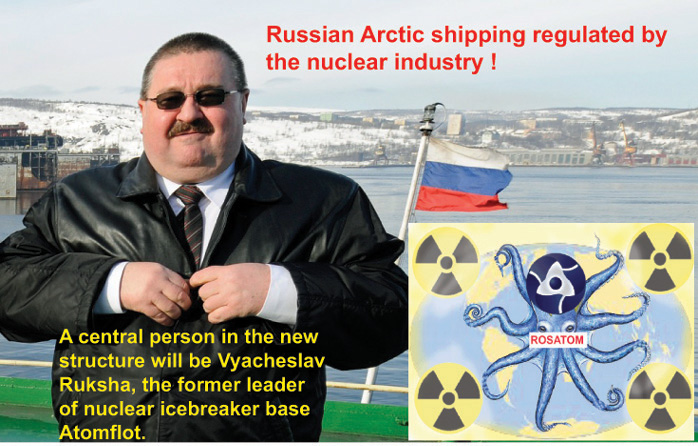
It’s a law – Russian Arctic shipping to be regulated by Rosatom https://thebarentsobserver.com/en/arctic/2019/01/its-law-russian-arctic-shipping-be-regulated-rosatom
President Putin signs the bill that makes the country’s state nuclear power company top regulator of the Northern Sea Route.By Atle Staalesen, January 02, 2019
Rosatom has officially been granted the leading role in the development of the vast Russian Arctic. The company that employs more than 250,000 people and engages in a multitude of activities related to nuclear power development and production is now formally Russia’s management authority for the Northern Sea Route.
The law was adopted by the State Duma on the 11th December and on the 28th signed by Vladimir Putin.
The new legislation comes as Russian Arctic shipping is on rapid increase. In 2018, about 18 million tons of goods was transported on the sea route, an increase of almost 70 percent from 2017. And more is to come. According to Vladimir Putin so-called May Decrees, the top national priorities, shipping on the Northern Sea Route is to reach 80 million tons already by year 2024.
Rosatom’s new powers in the Arctic include development and operational responsibilities for shipping, as well as infrastructure and sea ports along the northern Russian coast.
The responsibilities of the Northern Sea Route Administration, that until now has operated under the Ministry of Transport, will now be transferred to Rosatom.
It was Putin himself who in early 2017 made clear that a coordinating government agency for the Northern Sea Route was needed. A battle between Rosatom and the Ministry of Transport followed. In December 2017, it became clear that the nuclear power company had won that fight.
A central person in the new structure will be Vyacheslav Ruksha, the former leader of nuclear icebreaker base Atomflot.
The nuclear power company has since 2008 operated the fleet of nuclear-power icebreakers. Currently, five icebreakers are based in Atomflot, Murmansk, and several more ships are under construction, including four powerful LK-60 vessels.
Rosatom is also in the planning process of the «Lider», the 120 MW capacity super-powerful ship that can break through two meter thick ice at an unprecedented 10-12 knot speed.
January 5, 2019
Posted by Christina Macpherson |
politics, Russia, safety, secrets,lies and civil liberties |
10 Comments

 ‘The existential threat of our time’: Pelosi elevates climate change on Day One, Politico, By ANTHONY ADRAGNA and ZACK COLMAN , 01/03/2019
Democrats put climate change back on the forefront of their governing agenda Thursday, portraying the issue as an “existential threat” even as the caucus remains split over how forcefully to respond.
Speaker Nancy Pelosi brought up the issue in her opening address while touting a new select panel to come up with ideas on how to solve it, and the Energy and Commerce Committee announced that climate change would be the subject of its very first hearing this year……..
Progressives, led in part by Rep. Alexandria Ocasio-Cortez (D-N.Y.), are tugging the caucus into a more urgent posture that they say best reflects what scientists have called for to avert climate change. The Intergovernmental Panel on Climate Change warned last year that the world has 12 years to put policies in place to avoid irreversible, catastrophic effects of climate change. ……..https://www.politico.com/story/2019/01/03/nancy-pelosi-climate-change-congress-1059148
January 5, 2019
Posted by Christina Macpherson |
climate change, politics, USA |
Leave a comment

Bill Gates shelves nuclear reactor in China, citing U.S. policy, Axios, Amy Harder, Dec 30
TerraPower, a nuclear-energy company founded by Bill Gates, is unlikely to follow through on building a demonstration reactor in China, due largely to the Trump administration’s crackdown on the country.
Why it matters: This is a blow to America’s attempts to commercialize advanced, smaller scale nuclear technology and, separately, further evidence of soured relations between the U.S. and China under President Trump.
Driving the news: In a year-end blog post covering various topics published Saturday night, Gates said of TerraPower: “We had hoped to build a pilot project in China, but recent policy changes here in the U.S. have made that unlikely.”
Details: The Trump administration, led by the Energy Department, announced in October that it was implementing measures to “prevent China’s illegal diversion of U.S. civil nuclear technology for military or other unauthorized purposes.”
- Those measures have made it nearly impossible for TerraPower’s project to go forward, according to multiple people familiar with the development.
- TerraPower had pursued plans to build a pilot reactor in China because that country has two things America doesn’t — growing electricity demand and a long-term strategic energy plan — a top TerraPower executive told me last year.
- Morning Consult and, separately, an analyst for the think tank International Institute for Strategic Studies, covered the impacts of the October policy change shortly after it occurred, with brief mentions of the likely negative impact on TerraPower………
What’s next: “We may be able to build it [the reactor] in the United States if the funding and regulatory changes that I mentioned earlier happen,” Gates said in his post, although he didn’t specify which funding or regulations.
Meanwhile, the Energy Department just announced it plans to buy some of the power from new advanced reactors being pursued by NuScale, another advanced nuclear company, for here in the United States. https://www.axios.com/bill-gates-nuclear-reactor-china-terrapower-be4c792c-6f76-4723-bf63-d8f9fb527dc1.html
January 1, 2019
Posted by Christina Macpherson |
business and costs, China, politics, USA |
2 Comments
Putinism is 21st century fascism with nuclear weapons, Yakovenko says https://www.stopfake.org/en/putinism-is-21st-century-fascism-with-nuclear-weapons-yakovenko-says/ This article represents personal opinions of the author. Stopfake editors may not share this opinion. By Paul Goble, Window on Eurasia, 30 Dec 18
Putin’s Russia manifests in one way or another all of the 14 signs of “eternal fascism” Umberto Eco has outlined, “from the cult of tradition, the rejection of modernism, and reliance on historical traumas to the ideas of international and domestic conspiracy, and a cult of death,” according to Igor Yakovenko.
But it is distinctive from 20th century models of fascist regimes in “about 20 ways,” the Russian commentator said in a December 26 talk to the Parnas Political University in Moscow, of which seven are the most important (kasparov.ru/material.php?id=5C27592F3D167). They include the following:
- The absence of ideology and as a result the absence of propaganda. “The Putin media are not only not journalism but also not propaganda … They are weapons of an information war. They do not disseminate information and ideas: their product is feelings and emotions, including hatred, anger, and aversion to the West, Ukraine and the opposition. And love for Putin.”
- It is parasitic on the West. Putinism relies on economic and technological resources created by the West. That makes it very different from the USSR or Nazi Germany, “Parasitic fascism” does not have plans for “the seizure of the planet.” Were it to do so, Yakovenko argues, it would immediately “die” as a system.
- It uses ‘spider’ wars which seek to exhaust opponents by spider-like attacks on its neighbors and the destruction of its opponents from the inside. All of Putin’s wars “bear a ‘spider’ character.” That is, they seek to kill the organism they are attacking and then consume it once it is dead.
- Lies are the foundation of the regime and information forces are the most important weapons it has. In the fascist regimes of the 20th centuries, military force was predominant and propaganda played a supportive role. In Putin’s regime, the reverse is true.
- Putin’s fascism bears “a fake character.” It professes to be anti-Western but its “children and money are in the West;” and it claims to be a democracy but in fact is the most brutal of dictatorships. The Stalinist and Hitlerite elites also lived “not in complete correspondence with their ideologies, but the Putin elite lives by rules which directly oppose those it declares as the norms for the population.” It is thus, to use Yekaterina Schulmann’s, term, “’a reverse cargo cult.’”
- Putinism in contrast to 20th century fascism seeks the unlimited enrichment of its elites, either via corruption or economic machinations.
- Putinism is fascism with nuclear weapons, which makes it more dangerous because it is in a position, however weak otherwise, to inflict unacceptable damage on its opponents.
According to Yakovenko, the Putin regime will inevitably lose because it is fascist “and fascism always loses.” Putin himself has accelerated this process by destroying the previous social contract with the population, by breaking the agreement with the elite for wealth in return for loyalty, and by destroying cooperation with the West via aggression.
Four categories of people oppose the Putin regime: the politically active emigres, the supporters of street protests, the supporters of elections, and those who cooperate up to a point with the regime but ultimately oppose it like Kudrin. Unfortunately, for success, they need to cooperate but each of them dislikes the others more than it dislikes the Putin regime.
That makes the direct cooperation of the four “impossible,” Yakovenko says. But success may come if they appreciate the need for all four, and each acts so as to not interfere with the others even if it can’t cooperate with them. That is a real possibility if all understand what they are up against, the commentator concludes.
December 31, 2018
Posted by Christina Macpherson |
politics, Russia |
Leave a comment
 Nuclear Winter Is Coming: Nuclear ‘War’ To Hit Washington In 2019, Investor’s Business Daily , GILLIAN RICH, 12/18/2018
Nuclear weapons are about to explode as an issue on Capitol Hill, because partisan warfare is threatening to consume debates over nuclear procurement and policy in 2019.
Two events are converging that will blow up an already tenuous give-and-take deal between Republicans and Democrats. The first is the Trump administration’s threat to leave the Intermediate-range Nuclear Forces Treaty early next year if Russia doesn’t come into compliance. The second is the Democratic takeover of the House of Representatives next month.
There has been a “fragile bipartisan consensus” on nuclear weapons, according to Frank Rose, a senior fellow for security and strategy at the Brookings Institution.
During the Obama administration, a deal was brokered under which Republicans supported the New START treaty to reduce nuclear weapons while Democrats backed the modernization of the U.S.’ nuclear arsenal, he said.
All-out partisan warfare on the issue would come at a bad time for the Pentagon. In 2017, the Congressional Budget Office put the price tag of sustaining and modernizing the full nuclear triad of land-, air- and sea-based weapons at $1.2 trillion in constant dollars through 2046.
But, like other things that happened under Obama, the Republican-Democratic deal on nuclear weapons is starting to unravel under Trump.
Nuclear Weapons Treaties
In early December, the Trump administration gave Russia 60 days to come into compliance with the INF treaty or the U.S. will leave.
Trump’s threat raises questions about whether he will renew the New START treaty, which expires in 2021. Without the arms-control treaties, Democrats could block the funding of nuclear weapons in the 2020 budget with their new majority in the House.
“They can’t build a consensus to do something new or different — the Senate or president might not go along — but they can stop things from happening,” Tom Collina, director of policy at the Ploughshares Fund, which is focused on reducing nuclear weapons. “The power of ‘no’ is a significant force.”……….
Nuclear Weapons That May Go Boom Or Bust
To modernize the air-based leg of the nuclear weapons triad, the Air Force awarded the B-21 contract to Northrop Grumman (NOC) in 2015 to replace Cold War-era Boeing (BA) B-52s. The eventual procurement price tag is estimated at $80 billion.
Cancian believes that this new stealth bomber will survive upcoming procurement battles because of its ability to deliver conventional munitions as well.
New Columbia-class ballistic missile submarines will modernize the sea-based leg of the nuclear triad and replace Ohio-class “boomers.” General Dynamics’ (GD) Electric Boat is building them with total acquisition costs expected to hit $128 billion.
Cancian also believes that the Columbia-class submarine program will continue, saying ballistic subs are most likely to survive a nuclear attack because they are hidden underwater.
Then there are two missile programs without contract awards yet that have been more controversial. Lockheed and Raytheon (RTN) are competing for the Long-Range Standoff weapon (LRSO), a nuclear cruise missile to be launched from strategic bombers.
Northrop and Boeing are competing to build the Ground-Based Strategic Deterrent (GBSD) program to replace Boeing’s aging land-based Minuteman III intercontinental ballistic missile system.
Former Defense Secretary William Perry and retired Gen. James Cartwright, former vice chair of the Joint Chiefs, argued last year that ICBMs and nuclear cruise missiles carry greater risks of accidentally setting off a nuclear war because they can’t be recalled once launched.
Canceling them would also save billions of dollars that could be used for other pressing national security needs, they said. ………
High Anxiety Over Low-Yield Nuclear Weapons
The U.S. already has about 500 low-yield airdropped nuclear weapons in its arsenal. And Smith is extremely critical of the low-yield warheads for Lockheed’s Trident D5 submarine-launched ballistic missile.
“It makes no sense for us to build low-yield nuclear weapons,” Smith said at a Ploughshares conference in November. “It brings us no advantage and it is dangerously escalating. It just begins a new nuclear arms race with people just building nuclear weapons all across the board in a way that I think places us at greater danger.”……….
Pentagon Budget Uncertainty
Amid the policy and procurement debates, another source of uncertainty on defense spending is coming from Trump himself.
He blasted the current $716 billion Pentagon budget, tweeting earlier this month that it was “crazy.” But days later he reportedly said he wanted to give the Pentagon $750 billion, above the $733 billion the DOD requested…….https://www.investors.com/news/nuclear-weapons-upgrades-nuclear-treaties-inf-new-start/
December 29, 2018
Posted by Christina Macpherson |
politics, USA, weapons and war |
Leave a comment