The miniseries follows the power plant workers, first responders, Soviet Union officials, scientists, soldiers and the locals of Pripyat, Ukraine (formerly the Soviet Union) in the wake of the Chernobyl nuclear reactor exploding.
As with most historical dramas, the show has been critiqued for taking liberties with the truth in service of the story. And these departures are somewhat ironic for a show whose tagline is “the cost of lies”.
But the function of historical dramas isn’t pinpoint accuracy: the best ones work as allegories.
And as an allegory for our times, Chernobyl could not be more fitting.
Moscow has a long history of ‘fake news’
The lies start early on. While most of the town sleeps through the nuclear explosion, in the control room of the power plant, denial is in full swing.
The assistant chief engineer, Anatoly Dyatlov (Paul Ritter), tells his men to pump water to the core, insistent the problem can be fixed.
An engineer tells Dyatlov: “there is no core”.
Dyatlov insists the core is intact. From the earliest moments, the truth is in flux.
The radiation leak has already begun to kill these workers; we’re in the company of the living dead.
But despite the horror of watching these men slowly die, as if a needle is untethering the fabric of their DNA, it’s the words of a Soviet Union official (Donald Sumpter) that shock the most.
“When the people ask questions that are not in their own best interests,” he tells his men, “they should simply be told to keep their minds on their labour and leave matters of the state to the state.”
The next step is to seal the city and cut the phone lines to prevent the spread of misinformation.
The speech is met with applause.
Over the course of the series it becomes clear the Chernobyl disaster was caused by the cost-cutting measures of the Soviet Union, but the state was structured perfectly to work their way out of the problem and contain the truth.
Miners and soldiers are conscripted to clean-up the mess, despite the risk to their health. Scientists are told to do their job and not ask any questions.
All the while, Soviet officials work to compartmentalise the tragedy to hide the horrors of a nuclear meltdown.
For scientists Valery Legasov (Jared Harris) and Ulana Khomyuk (Emily Watson) to understand what caused the meltdown they must be critical of the Soviet Union.
The most intense moments are the conversations where characters weigh up the risk of telling the truth.
The war on the truth continues
Decades later, Moscow continues to tightly control the flow of information both at home and abroad — its “troll farms” set up to spread misinformation and propaganda are just the latest iterations.
But Australia is not immune to attempts by government to conceal and manipulate the truth.
Chernobyl focuses on what happens when government policy is put before human lives.
The scientists investigating Chernobyl repeatedly attempted to sound the alarm, warning Soviet Union officials that the problem was bigger than one reactor as poison spread across Eastern Europe (one study predicts by 2065 the disaster could cause 16,000 cases of thyroid cancer and 25,000 cases of other cancers).
Today, scientists are trying to warn us of an existential threat to our health and safety: climate change. Once again, government drags its feet.
If we take anything from Chernobyl, it should be this: put science before politics.
In 2019, we may have grasped the extreme dangers of radiation, but the war on the truth is ongoing — it’s eternal.
As we face another environmental catastrophe, the question will be: what is the cost of lies?
World Nuclear News 13th June 2019 Nuclear power reactors in Japan that have resumed operation could be forced
to temporarily shut down again if back-up safety measures are not in place
by specified deadlines under new rules approved by the country’s Nuclear
Regulation Authority (NRA). Operators of restarted units have already said
they expect delays in the completion of such facilities.
Adrian C Hedden, Carlsbad Current-Argus June 14, 2019The U.S. Department of Energy moved forward with its plans to adjust how it classifies high-level nuclear waste, potentially bringing more waste streams to the Waste Isolation Pilot Plant in southeast New Mexico.
The DOE published a notice in the Federal Register on June 10, updating a request for comment made in October 2018 to address comments received and adjustments to the initial proposal.
No plans to propose any changes to current policies or legal requirements regarding high-level waste (HLW) were made, but the Department but will address how its interpretation of HLW will apply to existing waste streams and whether or not they be managed as HLW.
The interpretations of HLW was revised in the notice following 5,555 comments received, which the Department broke down to about 360 distinct comments, read the notice.
Comments came from stakeholders, members of the public, Native American tribes and lawmakers, along with the federal Nuclear Regulatory Commission.
Previously, any nuclear waste generated directly from the reprocessing of spent nuclear fuel, including any liquids or solid material was classified as HLW, records show. But the DOE amended that definition to specify that waste can be determined as non-HLW if it does not exceed radioactivity levels for Class-C low-level radioactive waste, or required disposal in a deep geological repository.
Re-interpreting the definition could reduce the length of time nuclear waste is held onsite at DOE facilities, read a news release from the Department’s Office of Environmental Management, potentially increasing safety for workers and the public. It could also allow for the removal of reprocessing waste from generator sites where it’s been held for decades, the release read, by allowing the waste to go disposal sites, such as WIPP, designed for non-HLW.
The proposal would also align the U.S. with international guidelines that call of management and disposal to be based on the actual radiological risk, and shorten mission completion schedules – saving taxpayer dollars, read the release.
TRU waste is typically clothing items such as gloves or vests that are used during nuclear activities at various laboratories, but if other waste streams could be downgraded from HLW to TRU waste they could be sent to WIPP.
There is no permanent repository for HLW, as the facility proposed in Yucca Mountain, Nevada was blocked by state lawmakers and the federal government cut its funding.
The proposal did not mention WIPP specifically.
But John Heaton, chair of the Eddy-Lea Energy Alliance said the change could increase the time frame for WIPP’s mission, keeping the facility open longer and accepting more kinds of waste.
He said the proposal would ultimately classify nuclear waste based on its level of radioactivity, not its origin.
“A lot of would pass the waste acceptance criteria at WIPP,” Heaton said. “It would extend the life of WIPP for sure. They’re spending billions of dollars on this stuff a year. The only risk reduction that’s happening is in what’s coming to WIPP.”
The DOE also published a notice on June 10 of its intent to develop and environmental assessment of plans to dispose of about 10,000 gallons of waste water from the Savannah River Site’s Defense Waste Processing Facility (DWPF) in South Carolina.
That waste would be disposed of at a commercial low-level radioactive waste (LLW) disposal facility outside of South Carolina.
“The DWPF recycle wastewater would be treated, characterized, and if the performance objectives and waste acceptance criteria of a specific disposal facility are met, DOE could consider whether to dispose of the waste as LLW under the Department’s high-level radioactive waste (HLW) interpretation published elsewhere in this issue of the Federal Register,” read the notice.
But Don Hancock, director of the Nuclear Waste Program at the Southwest Research and Information Center said the DOE has no right to rewrite federal law and regulations passed by Congress.
He said reclassifying the waste as less dangerous was intended to move it from the generator sites, but if it is truly less dangerous, Hancock said, it could be left where it is.
“What it seems like they’re proposing is illegal,” Hancock said. “They say they get to rewrite the law, not Congress. They’re a lot of opposition to this nationally.”
Bipartisan Virginia pair to be lead sponsors of NELA BY JACQUELINE TOTH, June 11, 2019
A bipartisan House version of key Senate nuclear legislation could be introduced by a Democratic representative, alongside at least one co-sponsor, as soon as next week.
Freshman Rep. Elaine Luria (D-Va.) will introduce the Nuclear Energy Leadership Act, according to multiple people familiar with the bill’s pending introduction.
Rep. Denver Riggleman (R-Va.), also a freshman, will be the lead Republican co-sponsor on the House version, his spokesman confirmed by email.
One person with knowledge of the matter said the House version could include additional co-sponsors.
The Senate version of the bill calls on the Energy Department to create a 10-year strategic plan for nuclear energy and to demonstrate at least two advanced reactor projects by the end of 2025, as well as two to five additional advanced reactor designs by the end of 2035.
We had been told not to expect any really large, substantive changes” from the Senate version, and that while there could be some minor tweaks, “substantial portions would be identical,” said the person with knowledge of the matter. The person also expects that provisions in the bill would be referred not solely to the House Energy and Commerce Committee but also to others, including House Science, Space and Technology — a dispersion that could require further effort ahead of passage.
Luria, a U.S. Naval Academy graduate who served 20 years in the Navy, worked as a nuclear engineer and surface warfare officer in combatant ships and subsequently started a small business. Her district includes Virginia Beach and Naval Station Norfolk.
“As an engineer who operated nuclear reactors on aircraft carriers, I know that ensuring a thriving civilian nuclear industry is vital not only for our economy, but for our national security,” Luria said through a spokesman via email. “Nuclear energy must be part of any solution to transitioning to a clean energy future because nuclear power provides over 55% of our carbon-free energy. That’s why I’m proud to introduce this critical bill.”
“This bill will help position the United States as a global energy leader in a responsible and bipartisan way and break down barriers to the development necessary to achieve that goal,” Riggleman said through a spokesman by email.
NELA is popular across much of the U.S. nuclear community, which would like to see clear-cut goals enshrined in law for the federal government to help commercialize new nuclear technology.
“Republicans and Democrats recognize that nuclear energy is a critical national asset to provide clean, reliable and affordable electricity to Americans,” Nuclear Energy Institute President and Chief Executive Maria Korsnick told the Senate Energy and Natural Resources Committee at an April 30 hearing on the measure. Committee Chairman Lisa Murkowski (R-Alaska) re-introduced the Senate bill in March, and the bill now has nine Republican and eight Democratic co-sponsors in the chamber.
Advocates of the current Senate version of the bill say it would help bring about the next generation of nuclear reactors, not only through demonstrations but also by creating a potential customer in the federal government. NELA would extend the allowable length of federal power purchase agreements and attempt to secure an initial supply of high-assay low-enriched uranium — blends of uranium with higher concentrations of fissionable uranium, which multiple new nuclear designs will require to operate.
Passage of NELA would build on several legislative victories for the nuclear energy community since the start of last year, including the extension and expansion of a production tax credit for nuclear energy and enactment of two other nuclearbills.
An industry person familiar with the matter said that a markup of the Senate measure is projected for late June.
US President Donald Trump recently took another step toward bringing Saudi Arabia into the nuclear club. While Israeli-Saudi ties have warmed in recent years, helping the desert kingdom go nuclear – with its ongoing support for the most extreme Islamic radicals in the world – can hardly be good for the Jewish state.
Secret negotiations with the US Energy Department over many months have led Washington to “transfer highly sensitive US nuclear technology, a potential violation of federal law,” to Saudi Arabia, according to House Oversight Committee sources cited by The Washington Post.
Sen. Tim Kaine (D-Virginia) revealed last week that at least two transfers were approved since the assassination of Washington Post journalist Jamal Khashoggi.
The Saudis say they want to begin building their own nuclear power plants with their own enriched uranium, even though it could be purchased elsewhere more cheaply. That raises suspicions that their real goal isn’t producing electricity. By enriching their own uranium, they could begin diverting it to highly enriched weapons grade, especially if they bar international inspectors, as they’ve insisted.
Given its record of obeisance to Saudi demands for top technology and weapons, it is unlikely the Trump administration would object, but instead continue helping to conceal the kingdom’s plans. Crown Prince Muhammad bin Salman, the de facto ruler, has said that the kingdom would build nuclear weapons if the Iranians did. He may have taken encouragement from a speech in the UAE last month by Trump’s national security adviser, John Bolton.
The Iranians are threatening to leave the nuclear pact with the major powers – the Joint Comprehensive Plan of Action (JCPOA) – in the wake of the Trump administration’s unilateral exit last year and imposition of sanctions to tighten the economic screws on Tehran.
There’s “no reason” for Iran to walk away from JCPOA, “unless it is to reduce the breakout time to nuclear weapons,” said Bolton, a decades-long advocate of regime change in Iran. Bolton offered no evidence to back his claim.
That should give MBS the rationale he seeks to develop his version of the bomb.
When he turns to Trump for help, he will remind the president that if America won’t sell it to him, there are others who will. Trump is a sucker for that pitch.
North Korea would be a good place to go shopping, since they tried helping Syria build nukes until the Israeli Air Force stopped the plan, something it had done earlier in Iraq. Then there’s Pakistan, which is believed to have built its own nuclear weapons stockpile with Saudi financial help.
THERE MIGHT BE some resistance on Capitol Hill, where Saudi support is low and sinking, but Trump has shown himself more responsive to the wishes of the Saudis than the US Congress.
Republicans like Sen. Lindsey Graham of South Carolina may moan and groan and make threatening sounds toward Riyadh, but he and majority leader Mitch McConnell are Trump’s poodles, and will make sure the president gets what he wants.
All US administrations – Republican and Democratic – have indulged the Saudi appetite for top technology and weapons. They’ve been driven by pressure from industry and its friends in the Pentagon to sell, sell, sell – and an inexplicable attitude that we need the Saudis far more than they need us. Trump has just raised this to a new level.
Trump’s latest selling spree includes 120,000 conversion kits to produce smart bombs. It is part of an $8.1 billion package that Trump labeled “emergency” to bypass Congressional review.
Most alarming is the Trump administration’s approval for the transfer of highly sensitive weapons technology and equipment to Saudi Arabia so the kingdom can produce electronic guidance systems for Paveway precision-guided bombs, according to congressional sources cited by The New York Times.
The administration assured Congress that it is confident in the Saudi ability to protect the technology, that the need is urgent and that it won’t alter the balance of power in the region – which is exactly what it is intended to do.
Look for Trump to justify massive sales to the Saudis and the UAE as also helping protect Israel from Iran. Historically, all administrations have justified arms sales around the Middle East as harmless to Israel’s qualitative military edge. But they aren’t. Especially when the US is selling the Arabs the same planes, missiles and technology it sells Israel. Trump values his oil-rich customer so much that he has rejected the findings of his own CIA that the crown prince was complicit in Khashoggi’s murder.
Saudi Arabia is the Pentagon’s favorite cash cow. Arms sales are a lucrative business for the US Defense Department, which charges commissions and other fees, and gets economies of scale for its own purchases while selling off old inventory to help pay for replacements. Military attachés around the world are top salesmen for defense contractors as they lay the groundwork for post-uniform careers. Then there are the former – and possibly future – defense industry executives at the highest levels of the Pentagon, starting with the Secretary of Defense.
Sen. Chris Murphy (D-Connecticut) said the administration “has effectively given a blank check to the Saudis – turning a blind eye to the brutal murder of Jamal Khashoggi and allowing their ballistic missile program to expand.”
The United States is not allowed to sell ballistic missiles, so the Saudis have turned to China. CNN reported last week that American intelligence believes Beijing is helping enhance the kingdom’s strategic missile program. In the 1980s, it secretly bought Chinese DF-3 missiles and based them within range of Israel. It bought more advanced missiles in 2007 with the approval of then-president George W. Bush. Unconfirmed published reports suggest they also bought other missiles from Pakistan, which produces a version of the North Korean Nodong missile.
If the Saudis decide to pursue nuclear weapons, they can turn to Trump’s dear friend Kim Jong Un, whose cash-strapped regime has developed its own and the missiles to deliver them.
With Trump looking for business that will create jobs he can claim credit for – and with John Bolton rattling sabers and B-52s, and calling for regime change in Iran – can Saudi Arabia be knocking on an open door to the nuclear club?
DOE’s Perry: Coal, Nuclear Must Be Saved, Power, 06/12/2019 | Darrell Proctor Energy Secretary Rick Perry said coal and nuclear power must be part of the nation’s “all of the above” energy strategy, but the Department of Energy (DOE) does not have the “regulatory or statutory ability” to establish economic incentives for struggling U.S. coal and nuclear plants.Perry, who addressed the Edison Electric Institute’s (EEI’s) annual convention in Philadelphia on June 11, said the Federal Energy Regulatory Commission (FERC) would take the lead on creating incentives for any energy resource. Perry spoke with media after his address to convention delegates…….
Federal Bailout Still an Option
Perry’s comments Tuesday came after the White House Council of Economic Advisors in March released a report to the president calling for a strategic electricity reserve that could provide support to financially struggling power plants. Perry earlier that month reiterated his position that a federal bailout of coal and nuclear plants was still an option, though he said state incentives might be a better path forward.
“Each state has their own economic right to either put tax credits, tax breaks [or] incentives in place,” Perry said in response to a question about House Bill 6 in Ohio, which would provide $190 million in subsidies for nuclear power each year through 2026 …..
Perry also said he supports a nuclear bailout bill in Pennsylvania. He said the measure would bring “thoughtful, competitive programs where states don’t have to rely upon the federal government to support a particular industry sector.”… https://www.powermag.com/does-perry-coal-nuclear-must-be-saved/
Akron’s bankrupt FirstEnergy (FE) owns the Perry nuke, east of Cleveland, which in 1986 became the first US reactor damaged by an earthquake. Critical pipes and concrete were cracked, as were nearby roads and bridges. A top-level state study showed soon thereafter that evacuation amidst a major accident would be impossible.
FE’s uninsured Davis-Besse nuke, near Toledo, is a 42-year-old Three Mile Island clone. In 2002, boric acid ate through its head, threatening a Chernobyl-scale accident irradiating Toledo, Cleveland, and the Great Lakes. At FE’s request, the Nuclear Regulatory Commission has exempted Davis-Besse from vital regulations for flooding, fire protection, earthquake vulnerability, and security. Its radiation shield building is literally crumbling.
In 2003, when nearby power lines sagged onto tree limbs, FirstEnergy blacked out some 50 million people throughout the northeast and well into Canada.
By then, FE had scammed Ohio for some $9 billion in “stranded cost” bailouts. The utility said “open market competition” would lower rates … after it pocketed the public’s money.
Now FE says its subsidized nukes can’t compete with gas and wind power. It wants $190 million/year or more from all Ohio ratepayers, even though most get zero nuke electricity.
FE first said the money was for “clean air” and “zero emission reactors.” But all nukes emit heat, chemicals, radiation, Carbon 14, and more. Their cooling towers kill birds, their waste hot water kills marine life, their cores (at about 300 degrees Centigrade) heat the planet.
The bailout bill, called HB6, attacks renewable and efficiency programs that have saved Ohio ratepayers billions of dollars and created thousands of jobs. A single sentence in the Ohio Code is blocking some $4 billion in turbine development.
The breezy “North Coast” region along Lake Erie is crisscrossed with transmission lines and good sites near urban consumers. Farmers throughout the flat, fertile agricultural land desperately want the income turbine leases could provide. The new projects would create thousands of construction and maintenance jobs. They would feed Ohio’s manufacturing base, which produces a wide range of wind and solar components. By lowering electric rates, they would restore a competitive position long lost to high electric rates. Indiana, Michigan, New York, and Pennsylvania all have at least double Ohio’s installed wind capacity. Texas has twenty times more. By 2022, Germany will be totally nuke-free.
Ohio has just been shaken by findings that significant radiation has leaked from a dead uranium plant in southern Ohio, contaminating schools and terrifying local residents.
Like that old “stranded cost” scam, FE’s new bailouts would suck desperately needed capital from Ohio’s faltering industrial base. The reactors are obsolete. The workforce is aging. The nukes will shut anyway … if they don’t blow up first.
FE is really protecting its huge executive salaries. In 2018, it spent $3 million on “lobbying.” Its top seven officers, who bankrupted the company, were collectively paid more than $20,000,000, more than 10% of the proposed bailout:
The bill now moves to the Senate and its gerrymandered GOP majority. Ohio’s corporate-owned governor has assured FE he’ll approve their bailout.
Ohio consumers may then join lawsuits against similar bailouts in New York, New Jersey, and elsewhere. A referendum, which they might well win, is also possible.
Meanwhile, millionaire utility execs everywhere will see if the Buckeye State can be suckered again into bailing out two obsolete, cash-sucking nukes on the brink of catastrophic collapse.
Fight over Ottawa River nuclear waste dump getting political, but Liberals downriver standing behind the project—or staying quiet, The HillTimes, By PETER MAZEREEUW, BEATRICE PAEZJUN. 10, 2019 Aplan to bury low-level nuclear waste at a site near the Ottawa River is raising opposition from municipalities and environmentalists. The company behind the project, Canadian Nuclear Laboratories, says it’s safe. The Near Surface Disposal Facility proposal is in year three of an environmental assessment handled by a regulator the Liberal government is on the verge of stripping of that responsibility.
A proposed dump for low-level nuclear waste near the Ottawa River has stirred up opposition from community groups, environmentalists, and municipalities worried the waste could leach into the river that flows past about 50 federal ridings, including Ottawa Centre, the home of Parliament Hill and Canada’s environment minister, Catherine McKenna.
Members of Parliament from riverside ridings closest to the site of the proposed dump at thesprawling nuclear laboratories at Chalk River, Ont., are largely staying out of the fray. That includes Ms. McKenna, who has the final say over an environmental assessment for the project that is being conducted through a Harper-era assessment process, which she and an independent review panel have discredited………
Several Liberal MPs from ridings just downstream of the site declined to comment on or be interviewed about the proposed project, as did Natural Resource Minister Amarjeet Sohi (Edmonton Mill Woods, Alta.), , while two others organized or held information sessions on the subject for their constituents.
Ms. McKenna told The Hill Times during a press conference that she “heard” concerns from her constituents about the project, but didn’t say whether she shared them. Her office did not respond to numerous interview requests on the subject.
The Ottawa Riverkeeper environmental group and the NDP candidate in Ottawa Centre, Emilie Taman, are among those who say they will raise the issue during the upcoming election campaign. Municipal politicians in Montreal and Gatineau have already expressed their opposition. CNL staff, meanwhile, are trying to spread the word about the safety and safeguards planned to keep the proposed dump, which is located less than one kilometre from the Ottawa River, from harming the environment, or people around and downstream from Chalk River.
No ‘public trust’ in assessment system
The Near Surface Disposal Facility to hold the low-level nuclear waste is being proposed by Canadian Nuclear Laboratories (CNL). It is part of a complicated arrangement of private and public organizations created under the previous Conservative federal government, which privatized the operation of the Chalk River nuclear facilities that had been run by Atomic Energy of Canada Ltd. (AECL), a Crown corporation, in 2013.
Under the new model, the part of AECL that ran the labs was shrunk down to a shell of its former self, with most of its employees transferred to CNL. The government pays CNL to run the Chalk River facilities, and AECL—and by extension, the federal government—keeps both the assets and liabilities tied to the site.
CNL is owned by a consortium of companies that mounted a bid for the right to run Chalk River. It includes Quebec’s SNC-Lavalin and U.S. engineering firms Fluor and Jacobs, which call themselves the Canadian National Energy Alliance.
The Near Surface Disposal Facility, commonly abbreviated as NSDF, is three years into an environmental impact assessment overseen by the Canadian Nuclear Safety Commission, a regulator for the nuclear industry.
It started the assessment in 2016, months after Ms. McKenna was given a mandate letter from Prime Minister Justin Trudeau (Papineau, Que.) that tasked her with reviewing the process immediately “to regain public trust and help get resources to market.”
Ms. McKenna struck an expert review panel that same year, which spent seven months surveying environmental groups, project proponents, academics, government officials, and other stakeholders about the environmental assessment process established by the previous Conservative government in 2012. Some said that CNSC should continue to be responsible for conducting assessments, given the technical expertise of its staff, but others said it was too close to industry, creating an “erosion of public trust” in the process and its outcomes. The panel recommended that CNSC be stripped of its role conducting assessments on nuclear projects.
Ms. McKenna tabled a bill in Parliament, C-69, which did just that. An omnibus bill that has been subject to criticism by Conservative politicians, industry, and some environmentalists, C-69 would put the power over assessments into the hands of the Canadian Environmental Assessment Agency, which it would rename to the Impact Assessment Agency of Canada. CNSC officials would still play a role, occupying some of the seats on review panels struck to guide assessments of nuclear projects. The Senate sent Bill C-69 back to the House last week with nearly 200 amendments, including those that would put more power over reviews back into the hands of CNSC officials.
In the meantime, however, the NSDF nuclear dump proposal is being evaluated under the old assessment system. Isabelle Roy, a spokesperson for CNSC, said in an email statement that the projects currently being examined “would not be subject to Bill C-69 if it passes,” and that the decision will ultimately be made by its independent commission. Ms. Roy said CNSC is awaiting CNL’s response to public comments regarding concerns about the project. ………
More transparency needed on what CNL considers low-level waste, experts say
In the face of public concerns that one per cent of the waste in the engineered mound would be intermediate-level waste, Ms. Vickerd said, CNL has since tweaked its proposal, limiting it to low-level waste.
According to the International Atomic Energy Agency (IAEA), a near-surface disposal facility doesn’t have the capacity to safely contain and isolate intermediate-level waste, which, by its definition, has long-lived radionuclides. Such waste, it says, has to be buried underground, by up to a few hundred metres.
Michael Stephens is a former AECL employee whose career in the nuclear industry spanned 25 years, including 16 years at the Chalk River labs, where he helped oversee the decommissioning of nuclear waste. He is one among several retired AECL employees who have decried the project as environmentally unsound.
Mr. Stephens said his main contention with NSDF is the criteria CNL is using to determine what the mound can hold. “What bothered me from the outset was originally the proposal [called] for intermediate-level waste [to be dumped],” he said. “That, by definition, is a non-starter.”
Gordon Edwards, president of the Canadian Coalition for Nuclear Responsibility, a non-profit organization that aims to educate the public on nuclear-energy issues, said the lab seems to be trying to push the limits of what it can reasonably get away with. “If you put forward an outrageous, totally unacceptable proposal, you can trim it and see how far you can go,” Mr. Edwards said. “CNL [was urged by the Harper government] to act quickly, to find a timely remediation to reduce Canada’s nuclear liability, in a … cost-effective manner. That’s code for relatively quickly, cheaply.”
Mr. Edwards has worked as a nuclear consultant; in 2017, he was hired by the federal auditor general’s office to consult for its performance audit of CNSC.
He said scrapping the idea of adding intermediate-level waste only goes “a little way” to addressing the larger issue. “What we’re talking about is a mound of literally hundreds of radioactive materials. All have different chemistries, and have different pathways to the environment, to the food chain,” he said………
Another concern for him is the plan to transport and dump the waste of other decommissioned plants, including from Whiteshell Laboratories in Pinawa, Man. “How do they know what’s in those containers? As far as we know, if they get the go-ahead to drive those containers right into where the mound will be, they’ll simply put them there, bury them … without having properly identified what’s in there,” he said.
Mr. Stephens echoed Mr. Edwards’ concerns about what, he said, could conceivably wind up in the dump. CNL, he argued, hasn’t been transparent about whether, for example, it would dump packaged solid waste, which could have varying degrees of toxicity, or building rubble that’s just been slightly contaminated…………
House defense bill sets stage for contentious nuclear debate, The Hill BY REBECCA KHEEL – 06/10/19The House version of the annual defense policy would require an independent study on the United States adopting a “no first use” policy on nuclear weapons.Nuclear issues are shaping up to be among the most contentious issues as Congress debates this year’s National Defense Authorization Act (NDAA), with Republicans already coming out strongly against what’s in the bill.
The bill, a summary of which was released Monday morning, does not go as far as Chairman Adam Smith (D-Wash.) has opined about in the past. But it does seek to “start that debate” about the appropriate size and cost of the nuclear arsenal, staffers told reporters ahead of the bill’s release.
“The chairman feels strongly that the nuclear arsenal is too large, that we spend too much money on legacy weapons systems when we have emerging requirements like cyber, like [artificial intelligence], like space, which aren’t getting the kind of focus that’s required, and he wants to reevaluate where we’re spending money, if we’re going to have another money to spend on these emerging things that are coming out,” a staffer said.
Smith, who has long lambasted the price tag for nuclear modernization, pledged to make the issue a priority when he took control of the gavel after Democrats won back the House.
In hearings and speeches, he has questioned the need for the nuclear triad, said he wants to “kill” the low-yield warhead and blasted Trump for casting aside nuclear treaties.
n late January, Smith also reintroduced his No First Use Act that would make it U.S. policy not to use nuclear weapons first. Right now, U.S. policy leaves open the possibility of being the first to use a nuclear weapon in a conflict.
Rather than incorporating that bill, the NDAA requires the independent study on the implications of adopting such a policy.
Staffers also stressed the bill would not eliminate a leg of the triad, which refers to the three methods of delivering nuclear warheads. ……..
THE ASSOCIATED PRESS, June 10, 2019 Japan is calling for further efforts to cut its carbon emissions by promoting renewable energy while also pushing nuclear power despite its 2011 Fukushima nuclear plant disaster.
An energy policy paper, adopted by the Cabinet on Friday, said Japan faces the urgent task of reducing carbon emissions by utilities that rely heavily on fossil fuel plants to make up for shortages of cleaner nuclear energy. The call comes as nuclear reactors around Japan are slowly being restarted–despite lingering anti-nuclear sentiment since the Fukushima crisis–after being shut down to meet tougher safety standards.
Japan wants renewable energy’s share in 2030 to grow to 22-24 percent of the country’s power supply from 16 percent, while pushing nuclear energy to 20-22 percent from just 3 percent in 2017. The report said the cost of renewables also needs to be reduced.
Japanese utilities rely more heavily on fossil fuel plants than those in the United States and Europe, the paper said. Coal and natural gas accounted for 74 percent of Japan’s energy supply.
Nuclear energy made up about one-third of Japan’s energy supply before 2011, when a massive earthquake and tsunami destroyed the Fukushima No. 1 nuclear power plant’s cooling systems, sending three of its reactors into meltdowns.
Despite the government’s renewed ambitions for nuclear power, reactor restarts are proceeding slowly as nuclear regulators spend more time on inspections under the stricter post-Fukushima standards, while utility companies have opted to scrap aged reactors instead of investing in additional safety measures.
Nearly half of the 54 reactors in Japan have been designated for decommissioning, and only nine have resumed operation since the accident.
The slow reactor restarts have added to Japan’s large plutonium stockpile from spent fuel. Japan has resorted to reducing the 47-ton stockpile by burning plutonium in conventional reactors after the country’s fuel recycling program stalled. The plutonium is currently enough to produce about 6,000 atomic bombs.
But the amount is not decreasing, and experts are now calling for more drastic steps to reduce the stockpile amid criticism that it makes Tokyo’s calls for nuclear non-proliferation less credible.
About 37 tons of spent Japanese fuel is being stored in France and Britain where it has been reprocessed since Japan lacks the capability to do it at home.
Japan’s main reprocessing plant at Rokkasho, where plutonium and spent fuel are stored but reprocessing has not started, says the 10 tons stored in Japan is under close monitoring by the International Atomic Energy Agency and there is no risk of proliferation.
In a recommendation to the government this week, the Sasakawa Peace Foundation, a Japanese policy research group, said Japan should drastically reduce the stockpile to the amount just enough for 2-3 years and keep it under IAEA oversight to ensure the international community of Tokyo’s commitment to peaceful atomic use.
The recommendation by a foundation panel goes far beyond government guidelines last year that put the cap at 47 tons, with a pledge to eventually reduce it at an unspecified rate.
New Mexico governor says no to high-level nuclear waste,By SUSAN MONTOYA BRYAN, June 8, 2019, ALBUQUERQUE, N.M. (AP) — New Mexico’s governor said Friday she’s opposed to plans by a New Jersey-based company to build a multibillion-dollar facility in her state to temporarily store spent nuclear fuel from commercial reactors around the U.S.
In a letter to U.S. Energy Secretary Rick Perry, Gov. Michelle Lujan Grisham said the interim storage of high-level radioactive waste poses significant and unacceptable risks to residents, the environment and the region’s economy.
She cited the ongoing oil boom in the Permian Basin, which spans parts of southeastern New Mexico and West Texas, as well as million-dollar agricultural interests that help drive the state’s economy.
Any disruption of agricultural or oil and gas activities as a result of a perceived or actual incident would be catastrophic, she said, adding that such a project could discourage future investment in the area.
“Establishing an interim storage facility in this region would be economic malpractice,” she wrote…………
Lujan Grisham’s stance marks a shift from the previous administration, which had indicated its support for such a project.
During her last year in Congress, Lujan Grisham, a Democrat, opposed changes to the Nuclear Waste Policy Act and the possible development of a temporary storage facility in New Mexico. She was concerned that loopholes could be created and result in the waste being permanently stranded in New Mexico.
The Permian Basin Petroleum Association, the New Mexico Farm and Livestock Bureau and the New Mexico Cattle Growers’ Association all have sent letters of concern to the governor.
Several environmental groups also have protested the idea of an interim storage site for spent nuclear fuel. The groups raised their concerns during a hearing before federal regulators earlier this year.
Opponents question the project’s legality, the safety of transporting high-level waste from sites scattered across the country and the potential for contamination if something were to go wrong.
The governor’s letter came as the Nuclear Regulatory Commission considers whether to issue a 40-year license for the facility proposed by Holtec. ……..
Municipalities elsewhere in New Mexico and Texas have passed resolutions expressing concerns about an interim storage proposal in the region.
Reams of documents have already been submitted to the regulatory commission, and the overall permitting process is expected to be lengthy.
A Texas-based company also has applied for a license to expand its existing hazardous waste facility in Andrews County, Texas, to include an area where spent fuel could be temporarily stored. https://www.apnews.com/25e295f2157343b7b644c82936aee01d
Pompeo downplays climate change, suggests ‘people move to different places’
FOX 8 , JUNE 9, 2019, BY CNN WIRESecretary of State Mike Pompeo downplayed climate change as a longstanding trend, suggesting modern societies could adapt to a changing environment, possibly with people moving to different places.
“The climate’s been changing a long time. There’s always changes that take place,” Pompeo said during an interview with the Washington Times published Friday, when asked whether he thought climate change was man-made and how best to address it. He did not mention anything about man-made pollution in his remarks…..
The comments aren’t Pomepo’s first foray into controversial climate assessments.
Business Green 7th June 2019 Theresa May will ignore cost warnings and bring in net zero emissions goal before her successor takes over in Downing Street, reports suggest. The Prime Minister will set in law a target for the UK to reach net zero
greenhouse gas emissions by 2050 before she leaves office, although she is
unlikely to bring forward any new policy or detailed action plan for
achieving the goal, according to reports.
As recommended by the Committee
on Climate Change (CCC) in its landmark report last month, Theresa May is
set to announce a net zero goal for 2050 and could do so as soon as next
week, in a move the government expects to garner broad parliamentary
support, reports The Independent.
Halting Holtec – A Challenge for Nuclear Safety Advocates, CounterPunch, byJAMES HEDDLE 7 June 19″ ………Ruling Gives Go Ahead to Holtec New Mexico Project
On May 7, the Atomic Safety Licensing Board (ASLB) of the Nuclear Regulatory Commission (NRC) gave the go-ahead to the NRC’s consideration of a pending license application from Holtec International/Eddy-Lea [Counties] Energy Alliance to store 173,600 metric tons of highly radioactive irradiated nuclear fuel in southeastern New Mexico.
The 142-page ASLB decision denied all 50 contentions contained in petitions from nearly a dozen organizations opposing the project and requesting a full public evidentiary hearing on its potential impacts.
Petitioners included Beyond Nuclear, Sierra Club, Don’t Waste Michigan, Alliance for Environmental Strategies; Citizens for Alternatives to Chemical Contamination (MI), Citizens’ Environmental Coalition (NY), San Luis Obispo Mother’s for Peace (CA), Nuclear Energy Information Service (IL), Public Citizen (TX), Nuclear Issues Study Group (NM).
In an unusual alliance with environmental groups, extractive industry groups the Texas-based Fasken Land and Minerals Ltd. and Georgia-based NAC International Inc. also filed petitions for a hearing, contending that the nuclear waste storage project threatens lucrative fracking operations in the booming Permian Basin. The project is also widely opposed by Native American Tribes – already victimized by atom bomb testing and uranium mining – as well as ranchers and growers who fear water contamination and the boycotting of their products by suspicious consumers.
The region in which the proposed dump will be located is already known as Nuclear Alley, being home to the failed Waste Isolation Pilot Project(WIPP), the Urenco Nuclear Reprocessing Plant and the Waste Control Specialists (WCS) low-level waste site just across the border in Texas, which is also applying for a high-level waste storage license.
Opponents cite the likelihood that the Holtec/Eddy-Lea project – a below-grade ISFSI similar to the one at San Onofre – could and would be eventually expanded to accommodate spent fuel from aged reactors across the country as they are decommissioned in coming years, thus making the establishment of a permanent federal deep geological repository less urgent, and making New Mexico the de facto national dump.
They point out that over 200 million U.S. Citizens living along transportation routes would be placed in peril by the thousands of resulting shipments of highly radioactive waste being shipped cross country on the nation’s rickety rails, roads and bridges through major population areas.
According to Michael J. Keegan, an Intervenor with Don’t Waste Michigan, “The license application to construct and operate a ‘consolidated interim storage facility’ for spent nuclear fuel in New Mexico is a blatant violation of the Nuclear Waste Policy Act (NWPA 1982, Amended 1987). The entire application is contingent on the Department of Energy taking title to the spent nuclear fuel, this is forbidden by current law, unless it is a Permanent Repository. Concealed from the Public is the true intent of Holtec International to store high level nuclear waste for 300 years. This proposal is [for a] permanent high level nuclear waste dump and is again, a blatant violation of NWPA,” Keegan points out.
Holtec counsel Jay Silberg reportedly said during a January hearing that the plan would still be viable if utilities retain title to the waste in the case that the Nuclear Waste Policy Act is not altered – as is now being attempted in Congress = or that a permanent repository at Yucca Mountain or elsewhere is not constructed.
“No less than Rick Perry, Secretary of the U.S. Department of Energy, admitted a few weeks ago to a congressional committee that there is a distinct possibility that ‘interim storage’ sites like Holtec could become permanent, de facto spent nuclear fuel repositories for hundreds of years or even forever,” says Don’t Waste Michigan attorney Terry J. Lodge. “Holtec would have none of the safeguards and protections that were considered during the Yucca Mountain proceeding. If Holtec is allowed to build, there is a grave possibility that New Mexico will become the loser for all ages,” Lodge adds.
Mindy Goldstein, a lawyer for Beyond Nuclear comments, “Holtec, Beyond Nuclear, and the NRC all agree that a fundamental provision in the Holtec application violates the Nuclear Waste Policy Act. Today, the Licensing Board decided that the violation did not matter. But, the Board cannot ignore the mandates of federal law.”
Goldstein adds that this is the second time the NRC has issued a decision overruling Beyond Nuclear’s objection to NRC consideration of the unlawful application, and that the group will continue to pursue a federal court appeal it filed on December 27, 2018.
Donna Gilmore comments, “This is another example of the NRC not protecting our safety. The proposed Holtec New Mexico system is the same Holtec system used at San Onofre. The NRC knows every canister downloaded into the Holtec storage holes is damaged the entire length of the canister due to the poorly engineered downloading system that lacks precision downloading. In spite of this gouging of thin canister walls (only 5/8″ thick), the NRC refuses to cite Holtec with a Notice of Violation.”
Gilmore concludes, “The NRC told the ASLB they have no problem with Holtec returning leaking canisters back to sender, yet neither the proposed New Mexico Holtec site nor the San Onofre site have a plan to deal with leaking canisters, let alone prevent radioactive leaks or hydrogen gas explosions. We cannot trust the NRC to protect our safety. It will be up to each state to stop this madness.”
The opposition groups have vowed to appeal. San Luis Obispo Mothers for Peace said in a statement, “These Mobile Chernobyls are fast tracked to take to the rail, roads, and waterways. Disregard for the current NWPA law by proceeding as if it does not exist is not acceptable. This railroad of a ruling by the Atomic Safety and Licensing Board Panel will be appealed to the NRC Commission as prescribed by the Administrative Procedures Act (APA). Once these remedies have been exhausted appeal to federal courts is then in order.”
San Luis Obispo Mothers for Peace Spokesperson Molly Johnson stateed, “The NRC again demonstrates that it has been fully captured by the industry it is charged to regulate. The NRC process is shamelessly designed to prevent the public from participating in decision-making.”
Kevin Kamps, radioactive waste specialist for Beyond Nuclear, speaks for many when he says, “On behalf of our members and supporters in New Mexico, and across the country along the road, rail, and waterway routes in most states, that would be used to haul the high risk, high-level radioactive waste out West, we will appeal today’s bad ruling.” https://www.counterpunch.org/2019/06/07/halting-holtec-a-challenge-for-nuclear-safety-advocates/
US to label nuclear waste as less dangerous to quicken cleanup, Guardian, 6 June 19,
Energy department says labeling some waste as low-level at sites in Washington state, Idaho and South Carolina will save $40bn, The US government plans to reclassify some of the nation’s most dangerous radioactive waste to lower its threat level, outraging critics who say the move would make it cheaper and easier to walk away from cleaning up nuclear weapons production sites in Washington state, Idaho and South Carolina.The Department of Energy said on Wednesday that labeling some high-level waste as low level will save $40bn in cleanup costs across the nation’s entire nuclear weapons complex. The material that has languished for decades in the three states would be taken to low-level disposal facilities in Utah or Texas, the agency said………
Critics said it was a way for federal officials to walk away from their obligation to properly clean up a massive quantity of radioactive waste left from nuclear weapons production dating to the second world war and the cold war.
The waste is housed at the Savannah River Plant in South Carolina, the Idaho National Laboratory and Hanford Nuclear Reservation in Washington state – the most contaminated nuclear site in the country.
Washington’s Governor Jay Inslee, a Democratic presidential candidate, and the state attorney general, Bob Ferguson, said the Trump administration was showing disdain and disregard for state authority.
“Washington will not be sidelined in our efforts to clean up Hanford and protect the Columbia River and the health and safety of our state and our people,” they said in a joint statement.
The new rules would allow the energy department to eventually abandon storage tanks containing more than 100m gallons (378m liters) of radioactive waste in the three states, according to the Natural Resources Defense Council.
The change means that some of the “most toxic and radioactive waste in the world” would not have to be buried deep underground, the environmental group said.
“Pretending this waste is not dangerous is irresponsible and outrageous,” the group’s attorney Geoff Fettus said.
Tom Clements of Savannah River Site Watch, a watchdog group for the South Carolina nuclear production site, called the reclassification of waste “a cost-cutting measure designed to get thousands of high-level waste containers dumped off site”. He said moving the waste to Utah or Texas is a bad idea involving “shallow burial”.
The old definition of high-level waste was based on how the materials were produced, while the new definition will be based on their radioactive characteristics – the standard used in most countries, the energy department said……..
The nuclear site 200 miles (322km) south-east of Seattle contains about 60% of the nation’s most dangerous radioactive waste that’s stored in 177 ageing underground tanks, some of which have leaked.
Cleanup at Hanford has been under way since the 1980s, at a cost of more than $2bn a year.

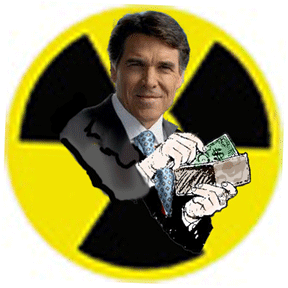

 huge proposed bailout of two Chernobyl-in-progress Ohio nukes (plus two old coal burners) would put $20 million directly into the pockets of seven utility executives. Their bankrupt company last year spent $3 million “lobbying” the legislature.








