Japan’s govt urges Fukushima evacuees to return – in drive to promote 2020 Olympics
Expert says 2020 Tokyo Olympics unsafe due to Fukushima | 60 Minutes
Fukushima: Despite health threats, the Japanese government urges residents to return https://www.express.co.uk/news/world/1161500/fukushima-japanese-government-encourages-residents-returnFAMILIES who fled nuclear meltdown in Fukushima are being urged to return to their homes ahead of the Tokyo Olympics., By DAVID PILDITCH, Aug 4, 2019 Alarming levels of radiation up to 20 times higher than official safety targets have been recorded in areas where locals are being encouraged to go back. We found ghost towns eight years after three reactors went into meltdown at Daiichi power plant 140 miles north east of Tokyo in March 2011. Tokyo 2020 is being hailed as the “Reconstruction Olympics” signalling new hope following the earthquake and tsunami that triggered the disaster and left more than 18,000 people dead.
But parents believe their children are in danger, saying officials are downplaying the dangers and safety is compromised in a cynical attempt to convince the world the crisis is over.
Families have accused the government of speeding up their return to showcase safety standards ahead of the Olympics.
We found once-vibrant communities now post apocalyptic wastelands like something from a Hollywood movie after the worst nuclear accident since Chernobyl.
Schools, shopping malls, supermarkets, libraries and petrol stations lie decaying along with thousands of homes. Many are set behind guarded barricades in exclusion areas known officially as “difficult to return to zones”.
Others lie in areas which the government says are safe to live in but whose few residents – wild boar and monkeys – demonstrate signs of mutation. Along roadsides sit giant black bags containing contaminated soil.
In Tomioka, five miles from the power plant, a school sports hall is scattered with footballs left when children fled.
It’s in stark contrast to arenas being built for the £20billion Games. Fukushima is hosting the first event, a softball match on July 22, two days before the opening ceremony.
The Japanese leg of the torch relay starts on March 26 at a soccer training centre 12 miles south of the crippled plant. The J Village, a base for emergency workers, only fully reopened last month.
In Okuma our Geiger counter sounded furiously, recording four microsieverts an hour. The government safety target is 0.23 microsieverts per hour.
It came days after evacuation orders were lifted for parts of the town which had 10,000 residents. The centre remains a no-go zone and just 367 former residents have registered to go back.
Ayako Oga, 46, who suffered a miscarriage, says: “The Olympics are putting lives in danger. The government is forcing people to leave the public homes they have been in. They are putting a heavy burden on people still suffering mentally and financially.”
In Namie, which had 21,000 residents, evacuation orders were lifted in 2017. It is said 800 people returned but we found desolation, only traffic lights working.
The Wild Boar bar last served a drink on disaster day. Owner Sumio Konno, in a group legal action against the government, says his son, who was five, still suffers nosebleeds. “He is sick all the time,” he says. “Every month he needs to go to the doctor.”
Ryohei Kataoka, of the Citizens Nuclear Information Centre, says: “The government’s insistence in lifting evacuation orders where heightened radiation-related health risks undeniably exist, is a campaign to show that Fukushima is ‘back to normal’ and to try to make Japan and the world forget the accident ever happened.”
Senator Elizabeth Warren causes a stir with her proposal for a “no first use” policy on nuclear weapons
 Warren’s pledge to avoid first nuclear strike sparks intense pushback, The Hill
Republicans slammed the proposal as sending a dangerous signal to both allies and enemies about a lack of U.S. resolve — previewing a potential attack line from President Trump should the two face off in the general election.
The United States has long reserved the right to be the first country to launch a nuclear weapon in a conflict.
Former President Obama reportedly thought of declaring a no first use policy toward the end of his tenure, but was talked out of it by advisors who argued it would worry allies and embolden adversaries.
Arms control advocates hold that declaring a no first use policy would improve U.S. national security by lowering the risk for miscalculation.
Warren made no first use a key part of her foreign policy early on in her run.
The speech was delivered before she officially jumped in the race but was considered an early sign she was running.
In January, she introduced the Senate version of a bill to make no first use official U.S. policy. The bill has six co-sponsors, including follow presidential contenders Sens. Bernie Sanders (I-Vt.) and Kirsten Gillibrand
House Armed Services Committee Chairman Adam Smith (D-Wash.), a longtime no first use advocate, also introduced the bill in the lower chamber. The House version has 35 co-sponsors, including presidential candidates Reps. Tulsi Gabbard (D-Hawaii) and Tim Ryan (D-Ohio.).
Only Warren, though, was asked to defend the policy at this week’s Democratic debates.
“We don’t expand trust around the world by saying, ‘You know, we might be the first ones to use a nuclear weapon,’” Warren said Tuesday night from the stage in Detroit.
“That puts the entire world at risk and puts us at risk, right in the middle of this,” she said.
She also noted that Trump’s policies, including pulling out of a nuclear deal with Iran, had gotten the world “closer and closer to nuclear warfare.”
n response to criticism of the policy, Warren’s campaign sent The Hill seven tweets and articles from nonproliferation advocates in support of Warren. The support included former Defense Secretary William Perry, who tweeted that “our nuclear arsenal is intended to deter a nuclear attack, not to initiate a nuclear war.”
Iran can follow the Israeli nuclear example, or the Egyptian one
|
Iran has two nuclear options, The Islamic republic can go either the Israeli way or the Egyptian way. Aljazeera, 4 Aug 19,
” ………. The Israeli option Iran could choose to follow Israel’s example and develop nuclear weapons in defiance of international agreements on denuclearisation. It could withdraw from the Nuclear Non-Proliferation Treaty and build with haste a nuclear arsenal to match Israel’s. The Iranians have the knowledge, the technology, and the raw materials. Whatever they do not have, they can adopt the Israeli approach to acquire it illicitly……… The Egyptian option The second option, the one that a peaceful and sane world would prefer and propose, is the Egyptian one. Iran should follow in the footsteps of Egypt and mobilise other countries in the region to launch a global quest for a nuclear-free Middle East. Back in 2015, Egypt proposed that then UN Secretary General Ban Ki-moon convene a regional conference to explore the possibility of imposing a ban on weapons of mass destruction (WMD) in the Middle East……… Today the world is becoming increasingly insecure, as global powers – including the US, Russia and China – disregard international agreements and choose proliferation of WMDs over peace and cooperation. Iran and other regional powers can be part of the solution by leading the way in calling for a nuclear-free world. https://www.aljazeera.com/indepth/opinion/iran-nuclear-options-190729112714738.html |
|
Bernie Sanders supports Elizabeth Warren’s ‘no first use’ nuclear policy
Sanders backs Warren after Liz Cheney attacks ‘no first use’ nuclear policy https://www.theguardian.com/us-news/2019/aug/03/bernie-sanders-elizabeth-warren-liz-cheney-nuclear-no-first-use
Sanders rejects ‘national security advice from a Cheney’
Congresswoman is daughter of Iraq war architect Dick Cheney Lois Beckett@loisbeckett 4 Aug 2019 Bernie Sanders has defended his rival for the Democratic presidential 2020 nomination, Elizabeth Warren, after her policy against pre-emptive use of America’s nuclear weapons was attacked by the daughter of one of the architects of the Iraq war.
Warren reiterated her support for a “no first use” policy on nuclear weapons during the second round of Democratic presidential debates this week.
“It makes the world safer,” the Massachusetts senator said during the debate. “The United States is not going to use nuclear weapons pre-emptively, and we need to say so to the entire world.”
Liz Cheney, a Republican congresswoman from Wyoming, attacked Warren’s policy on Twitter, asking “which American cities and how many American citizens are you willing to sacrifice with your policy of forcing the US to absorb a nuclear attack before we can strike back?”
Cheney is the daughter of former vice-president Dick Cheney, a key advocate of the 2003 invasion of Iraq by the United States and its allies.
The Bush administration’s primary justification for the pre-emptive war, that Saddam Hussein had weapons of mass destruction and that his regime presented an escalating threat, was discredited after the invasion.
The war in Iraq, now in its 16th year, has resulted in an estimated 200,000 documented civilian deaths from violence, according to Iraq Body Count, although estimates vary widely, particularly estimates that factor in hundreds of thousands of additional war-related civilian deaths. More than 4,000 members of the US military have been killed.
“Taking national security advice from a Cheney has already caused irreparable damage to our country,” Sanders wrote on Friday, in response to Cheney’s attack on Warren.
The Democratic congresswoman Alexandria Ocasio-Cortez, who was 13 years old when the Iraq war began in 2003, also responded to Cheney’s attack on Warren, criticizing Cheney for offering hawkish foreign policy advice “as if an entire generation hasn’t lived through the Cheneys sending us into war since we were kids”.
Elizabeth Warren proposed “no first use” policy on nuclear weapons
Warren, Bullock spar over ‘no first use’ nuclear  policy, The Hill
In defending the proposed policy, Warren argued for diplomatic and economic solutions to conflict, saying “we should not be asking our military to take on jobs that do not have a military solution.”
But Bullock opposed that proposal, saying, “I don’t want to turn around and say, ‘Well, Detroit has to be gone before we would ever use that.’”
Warren is the lead sponsor of the Senate version of a bill that would make it U.S. policy not to use nuclear weapons first.
It has long been the policy of the United States that the country reserves the right to launch a preemptive nuclear strike.
Backers of a no first use policy argue it would improve U.S. national security by reducing the risk of miscalculation while still allowing the United States to launch a nuclear strike in response to an attack.
During the debate, Warren argued such a policy would “make the world safer.”
“The United States is not going to use nuclear weapons preemptively, and we need to say so to the entire world,” she said. “It reduces the likelihood that someone miscalculates, someone misunderstands.”
Bullock argued he wouldn’t want to take the option off the table, but that there should be negotiations to eliminate nuclear weapons……https://thehill.com/policy/defense/455472-warren-bullock-spar-over-no-first-use-nuclear-policy
40 Ways Ohio Now Proposes Nuclear Suicide
By Harvey Wasserman, 1 August 19
A bought, gerrymandered Ohio Legislature has just handed a much-hated $150 million/year public bailout to two dinosaur nuke reactors primed to explode.It also bails out two filthy 50-year-old coal burners and guts programs for increased efficiency.But a possible repeal referendum could reverse all that—-and have a serious impact on the Trumpsters who pushed it—-in the 2020 election.Here are some basics:X The 42-year-old Davis-Besse reactor near Toledo and 33-year-old Perry, east of Cleveland, are both dangerously crumbling.X Neither can compete with wind, solar, gas or increased efficiency.X Both would shut immediately in a free market environment.X Like all nuke reactors, both emit substantial quantities of heat, radiation and carbon.X Both threaten the entire north coast and Great Lakes region with a radioactive apocalypse.X Neither can get private disaster insurance.X Their owner, FirstEnergy (FE) of Akron, is bankrupt.X The utility stands to gain some $150,000,000/year at the expense of ALL Ohio electric consumers, not just those in its territory. .X FE’s top seven execs are paid roughly $25,000,000/year; CEO Chuck Jones gets $9,500,000.X In 2003 FE blacked out 50,000,000 people.X Davis-Besse’s infamous 2002 “hole-in-the-head” came when boric acid ate nearly all the way through the reactor pressure vessel.X In 1986 (as the Challenger blew up) Perry became the first US reactor to be damaged by an earthquake; a 4.0 shock recently hit less than 25 miles away.X A state-mandated 1986-7 study showed northern Ohio cannot be evacuated from a melt-down…and certainly not amidst an earthquake.X Ohio’s North Coast is flat, blown by constant lake-based winds, criss-crossed with transmission lines and good turbine sites near the cities to be served.X Local farmers are desperate for the income the turbines would provide.X Some $4.2 billion in private capital is poised to pour into the region for wind farms creating thousands of jobs and lowering electric rates.X Turbines in Lake Erie, plus land-based wind and solar farms, enhanced by batteries and efficiency, can provide all Ohio’s electricity far cheaper than from nukes and/or fossil fuels, creating far more jobs.X But in 2014, with zero basis in health or environmental protection, FE’s bought legislators put in the Ohio Code a setback clause that has killed wind development in the state.X Ohio now has far less installed wind capacity than neighboring Indiana, Michigan, New York or Pennsylvania, which have comparable wind resources but no such set-back clause.X Ohio is a national leader in manufacturing wind turbine components, virtually none of which are deployed in Ohio.X Perry & DB have been repeatedly bailed out dating back at least to 1999, when FE scammed a $9 billion “stranded cost” give-away.X It was called a “stranded cost” bailout because FE complained even then the reactors could not compete in an open market.X This latest bailout was directly pushed by Trump, at least one of whose co-conspirators personally lobbied key legislators for it.X Ohio is roughly 50/50 Republican/Democrat, but the GOP has heavily gerrymandered majorities in both houses of the Legislature.X In 2018 FE targeted a dozen GOP legislative primaries, buying at least 11 bailout votes.X This latest bailout bill could not have passed without votes from key corporate Democrats.X A strong statewide grassroots movement arose to oppose the bailout.X An overwhelming majority of testifiers before the Legislature were opposed.X A strong majority of the state’s newspapers was also opposed.X All were ignored by Democrats and Republicans alike.X Efforts are now underway to put a referendum on the fall 2020 ballot.X If filed within 90 days, the bailout will be put on hold until the vote.X Polls show a strong majority of Ohioans oppose the bailout.X If the bailout is on the 2020 ballot, it could encourage a strong opposition turnout that could hurt Trump and help tip the election in a key swing state.X But Trump, FE and the nuke industry will spend unlimited millions to defeat it.X It’s been widely known since at least 2004 that Ohio’s registration rolls and voting procedures are heavily rigged to favor the GOP and its corporate owners.X The longer Perry and Davis-Besse operate the higher the odds they’ll obliterate Toledo, Cleveland and the entire Great Lakes region.X Neither has private disaster insurance.X FE can’t handle its radioactive wastes, evacuate the region when disaster strikes or credibly maintain the reactors in their current (deteriorating) state.Should the referendum get on the ballot, it could help take down Trump and save the region from an apocalyptic catastrophe, as well as economic ruin. Should it fail, the odds on a major nuclear catastrophe along the shores of Lake Erie are too high to contemplate.The stakes could not be higher.—————Harvey Wasserman is co-author of KILLING OUR OWN: THE DISASTER OF AMERICA’S EXPERIENCE WITH ATOMIC RADIATION (free on line) and SOLARTOPIA! OUR GREEN-POWERED EARTH at www.solartopia.org.

U.S. bipartisan lawmakers aim to restrict nuclear deals with Saudi Arabia
U.S. Senate Targets Saudi Nuclear Technology https://foreignpolicy.com/2019/07/30/us-senate-targets-saudi-nuclear-technology-senate-van-hollen-lindsey-graham/
The bipartisan bill follows the revelation that a longtime Trump advisor was pushing for lucrative nuclear deals with Riyadh.
BY ROBBIE GRAMER JULY 30, 2019 A bipartisan group of lawmakers is introducing new legislation aimed at restricting the transfer of nuclear technology to Saudi Arabia, the latest sign of growing congressional backlash to the Trump administration’s close relationship with the wealthy Gulf nation.The bill, put forward by Democratic Sen. Chris Van Hollen and Republican Sen. Lindsey Graham, would bar the U.S. Export-Import Bank from financing the transfer of nuclear technology and equipment to Saudi Arabia, absent nuclear cooperation agreements, and adopting restrictive international standards to safeguard against nuclear proliferation. The Export-Import Bank plays a key role in funding the export of U.S. nuclear energy equipment and technology abroad.
“We should never allow nuclear material to fall into the wrong hands, and certainly the [Saudi] crown prince and this regime have demonstrated they can’t be trusted,” said Van Hollen in a phone interview.
The legislation comes on the heels of a bombshell new report from a House oversight committee that alleges a longtime associate of U.S. President Donald Trump, the wealthy businessman Thomas Barrack, was using his relationships in the White House to advance lucrative business deals on nuclear power in Saudi Arabia and stood to profit from the efforts.
The report, released by Democrats on the House Oversight Committee on Monday, “exposes how corporate and foreign interests are using their unique access to advocate for the transfer of U.S. nuclear technology to Saudi Arabia,” Rep. Elijah Cummings, the Democratic chairman of the committee, said in a statement.
Van Hollen and Graham’s bill, according to a draft obtained by Foreign Policy, would bar the Export-Import Bank from funding such transfers to Saudi Arabia unless Riyadh renounces uranium enrichment and reprocessing, establishes a nuclear cooperation agreement in line with the Atomic Energy Act that regulates civilian nuclear energy, and adopts additional safeguard protocols in line with the International Atomic Energy Agency. Republican Sen. Jerry Moran and Democratic Sen. Jeff Merkley are also co-sponsoring the bill.
The legislation would also require the bank to report to Congress details of any agreement on nuclear transfers to Saudi Arabia. One such proposal is already underway. The Export-Import Bank in 2018 received an application to finance U.S. exports for a proposed nuclear power plant in Saudi Arabia, according to an email sent by a senior Export-Import Bank official to Senate staff, obtained by Foreign Policy. “The application is in the early stages of review,” the official wrote in the email.
While Saudi Arabia has plans to develop an extensive nuclear power program, its government thus far “has demonstrated little willingness to accept strong non-proliferation measures” the draft legislation reads.
Critics of the Trump administration say it is not requiring Saudi Arabia to use the so-called “gold standard” in a nuclear cooperation agreement, which requires a foreign country to commit to not using transferred nuclear technology to make nuclear weapons.
Van Hollen said the Trump administration has not been transparent with Congress on its push to transfer nuclear technologies to Saudi Arabia. “This administration’s been secretly moving ahead to try to transfer nuclear technology to the Saudis without appropriate oversight and without appropriate conditions,” he said. When Congress asks for more information, “they’ve been totally opaque, they’ve been dragging their feet, they’ve not been providing information,” he said.
The Trump administration has locked horns with Congress for months over the United States’ relationship with Saudi Arabia in the wake of Riyadh’s role in the deadly conflict in Yemen and Saudi officials’ roles in the murder of the Washington Post journalist Jamal Khashoggi last year.
Japan to scrap remaining nuclear reactors in Fukushima
Japan to scrap remaining nuclear reactors in Fukushima, Aljazeera, 1 Aug 19
Tepco to decommission four more reactors in the Fukushima prefecture, eight years after Japan’s worst nuclear disaster. Tokyo Electric Power Company has announced plans to decommission its Fukushima Daini nuclear plant, located a few kilometres south of the Fukushima Daiichi plant where three reactors melted down after an earthquake and tsunami in 2011.
The decision by Tepco’s board on Wednesday means all 10 nuclear reactors in the northeastern Fukushima prefecture will be decommissioned.
The prefectural government had previously urged the operator to dismantle the Daini plant, saying its existence has hampered reconstruction efforts, according to Kyodo news agency.
The Daini plant, which started its commercial operation in 1982, only narrowly avoided a major accident at the time of the disaster at the Daiichi. …….In April, Japan partially lifted an evacuation order in one of the two hometowns, Okuma, for the first time since the disaster, but many former residents are still reluctant to return.
The other hometown, Futaba, remains off-limits, as are several other towns nearby.
Tepco said it will take more than four decades to dismantle the four reactors at the Daini plant. The estimated cost for dismantling and decontamination will be 280 billion yen ($2.6bn).
Company president Tomoaki Kobayakawa visited Fukushima Governor Masao Uchibori and told him about the decision and the governor asked Kobayakawa to “make safe and steady progress” on the decommissioning.
The utility plans to build an on-site facility to store spent nuclear fuel from the plant, though it has yet to pick a final disposal site for the fuel, Japanese daily The Mainichi reported.
The decommissioning means Japan is left with 33 reactors to generate electricity nationwide, compared with 54 before the disaster.
Of the 33 units, seven reactors are in operation amid lingering concerns about nuclear energy………. https://www.aljazeera.com/news/2019/07/japan-shut-remaining-nuclear-reactors-fukushima-190731134314037.html
Concern in Suffolk over the socio-economic and environmental effects of massive Sizewell nuclear project
East Anglian Daily Times 30th July 2019 County council chiefs are to write again to Government to voice their concern over the number of massive energy projects planned for a small area of east Suffolk. The decision follows a high-level meeting with community
leaders from across the area over their ongoing worries over the proposals
for Sizewell C.
Officials said the group of 86 representatives from 28 town
and parish councils remained unconvinced over EDF Energy’s plans for the
new twin reactor nuclear power station, particularly whether it will
provide a long lasting legacy for the socio-economic benefit of the area,
and its impact on wildlife and flood risk.
The meeting to discuss the Stage
4 consultation was held by members of Sizewell C Joint Local Authorities
Group (JLAG). JLAG chairman Richard Smith said: “These local leaders are
all very well informed and knowledgeable surrounding EDF Energy’s proposals
having been through 3 stages of consultation so far. As expected, there was
a lot of strong feeling within the room and it was important for us to hear
the concerns of the community as we consider a joint response to the Stage
4 consultation from Suffolk County Council and East Suffolk Council.
https://www.eadt.co.uk/news/jlag-sizewell-c-worries-outlined-1-6189261
Australian Senate reaffirms Australia’s law banning nuclear power
 This motion was moved by Senator Hanson-Young and passed by the Senate, 29 July 19

Boris Johnson’s secret instructions on nuclear action
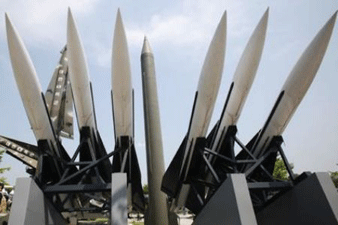
 EXPLAINER: The Letters of Last Resort – Boris Johnson’s secret instructions on nuclear action, There are, at most, nine countries on earth with nuclear weapons. Joe, 28 July 19
Before today, two of those arsenals were in the hands of Donald Trump and Kim Jong-un. As of today, they have been joined by Boris Johnson.
Among the very first things that will happen as Johnson begins is premiership, is a briefing from the Chief of the Defence Staff, who will tell him exactly the kind of devastation and death a nuclear Trident missile would cause. Johnson will then be tasked with composing the “letters of last resort.”
The letters of last resort are an almost mythical device, the kind of thing that would make more sense in a Tom Clancy novel than they do in real life. But they are real, and they are terrifying.
They are four letters, each one issued to the commanding officers of each of the United Kingdom’s four nuclear-capable ballistic missile submarines. They are only to be opened under one specific circumstance: the destruction of the government of Britain through a major, likely nuclear, bombing campaign.
The letters are only to be opened under the assumption that the Prime Minister and any designated deputies are dead, and that it is up to the UK’s military submarines to respond.
Typically, the UK has one of these submarines patrolling at any given time, armed with 40 of its 120 operational nuclear warheads. The other three subs are based in Faslane naval base in Scotland.
And right now, those letters are being written by Boris Johnson. Cool.
Four possible directives are known:
- That the UK should retaliate.
- That the UK should not retaliate, and should retreat to a commonwealth nation.
- That the commanding officer should use their own judgment.
- Place the submarines under the command of an allied country, such as the United States.
It is very possible, however, that a PM will be much more specific than this.
When quizzed on the matter of their own letters by the BBC, former Prime Ministers John Major, Tony Blair and Gordon Brown all revealed that they had included a caveat that under no circumstances should civilians be targeted with nuclear weapons.
Nobody will ever know for sure though, since the letters are burned in their unopened state as soon as an outgoing premiership comes to a close……… https://www.joe.ie/life-style/boris-letters-of-last-resort-676243
Tax-payers still on the hook for UK’s planned ‘nuclear renaissance’
Despite Hinkley, the new plan for nuclear is hardly better than the old one https://www.theguardian.com/business/2019/jul/27/despite-hinkley-new-plan-nuclear-hardly-better-than-old-one
EDF Energy’s deal to build Hinkley Point C, Britain’s first new nuclear power plant in a generation, has been dubbed the world’s most expensive power plant of all time, a “white elephant” in a changing energy landscape, and a risky and expensive gamble with taxpayers’ money.
There was little chance that a deal so politically unpalatable could be repeated for EDF’s follow-on project at Sizewell B. Instead, officials returned to the drawing board to re-engineer a multibillion-pound funding framework that could help lower the eye-watering costs of constructing a nuclear reactor.
The £20bn Hinkley Point C project will cost energy bill payers £92.50 for every megawatt-hour of electricity it produces for 35 years. It is a price well above both the UK’s wholesale energy price of around £55 a megawatt-hour, and the new breed of offshore wind farms.
The new funding model promises to cut the cost of building a new nuclear plant by a fifth – but this, too, comes at a cost. The government’s plans to make nuclear affordable means Britons will twice shoulder the risk of building new nuclear reactors.
First, by paying upfront for the reactors through energy bills to help fund their construction. Second, by taking on the cost of any overruns or construction delays through a taxpayer guarantee. The public purse would also compensate nuclear investors if the project were scrapped.
It is the same model used to fund London’s £4.2bn super-sewer project, the Thames Tideway tunnel, which has drawn criticism for raising water bills while investors reap financial rewards.
By shifting the risk from private investors to taxpayers, nuclear developers will be able to borrow money at cheaper rates, which will lead to lower bills for consumers.
On paper, the proposal is a better deal than Hinkley, but it’s far from perfect.
The National Infrastructure Commission has taken a dim view of the model. “This makes projects appear cheaper as consumers are effectively financing the projects at zero interest. At least some of the risk associated with construction costs also sit with consumers, a further hidden cost, since consumers are not paid to hold these risks in the way investors would be,” it said.
In addition, the sums hold true only if the project remains on schedule and on budget for the decade it takes to construct a nuclear plant. There are worryingly few examples where this has been the case; EDF Energy’s forerunner to the Hinkley project, at Flamanville in Normandy, is expected to cost four times original estimates. It was expected to begin generating electricity in 2012, but is now expected to start up in 2022.
he French energy giant has said the lessons learned from Flamanville mean Hinkley Point will avoid a similar fate. Sizewell will be at an even greater advantage because it will use the same UK workers once Hinkley is complete.
Why take the risk at all, though?
“If ministers want affordable and clean energy, the fastest, safest and cheapest way to do that is to boost renewables like wind and solar,” said Doug Parr, chief scientist at Greenpeace.
There have been major advances in flexible renewable energy technologies in recent years, but ministers retain an appetite for the “firm” low-carbon electricity generated by nuclear reactors despite the financial hurdles to building them.
The UK’s energy landscape is littered with stalled nuclear plant projects which have so far failed to make a financial case. Already half the projects proposed three years ago have foundered.
But the government’s commitment to a new atomic era is still the most reliable element of its nuclear programme to date.
Nuclear power losing its appeal in Eastern Europe
Eastern Europe’s Love Affair With Nuclear Is Hitting the Rocks
Countries in the former Soviet bloc are desperately trying to upgrade facilities but are squeezed by time and money. Bloomberg, By James M Gomez and Zoltan Simon, July 28, 2019 Zoltan Gorog is ready for the Russian invasion. The real estate agent in the Hungarian town of Paks has added Cyrillic to the blue and white sign hanging above his offices. He’s set up empty desks for when he needs to expand to cope with the surge in business.
Rather than a flood of people, though, there’s barely a trickle. Five years after Hungary’s government signed an agreement with nuclear energy company Rosatom Corp. to build two new reactors at the aging plant near the town, there’s still no start date for the bulk of the work….. (subscribers only) https://www.bloomberg.com/news/articles/2019-07-28/eastern-europe-s-love-affair-with-nuclear-is-hitting-the-rocks
Boris Johnson enthusiastic for a new ‘nuclear renaissance’ in UK
 UK’s new premier promises boost for nuclear power, WNN. 26 July 2019 Boris Johnson expressed his “passionate” support for nuclear power when he addressed the House of Commons for the first time as UK prime minister yesterday. Seven of the country’s eight existing nuclear plants are set to be retired by 2030, while new-build projects have faced financial uncertainty over the last two year………On 22 July, the day that Johnson was elected leader of the Conservative Party and two days before he officially replaced Theresa May as prime minister, the government launched a consultation into funding large-scale nuclear power plants and a proposed GBP18 million (USD22 million) investment into small modular reactors.
Greg Clark, secretary of state for the Department for Business, Energy and Industrial Strategy (BEIS) – who Johnson replaced this week with Andrea Leadsom – announced in June 2018 that the government would review the viability of a Regulated Asset Base (RAB) model for new nuclear projects. The consultation states that, as the cost of renewable technologies continues to fall, they are likely to provide the majority of the country’s low-carbon generating capacity in 2050. It adds however there will still be a crucial role for low-carbon ‘firm’ – always available – power in 2050.
The RAB model would not apply to Hinkley Point C (HPC), which is currently under construction by EDF Energy in Somerset, England, but would apply to future plants. As many as five more new-build projects had been planned – by EDF Energy together with China General Nuclear (CGN); NuGeneration (NuGen); and Horizon Nuclear Power……… http://world-nuclear-news.org/Articles/UKs-new-premier-promises-boost-for-nuclear-power
Boris Johnson government could reach net zero, without nuclear power
Utility Week 26th July 2019 , Boris may not need the nuclear option to reach net zero. The proposal to use the regulated asset base model to fund new nuclear projects this week
was given a mixed reaction. SSE chief executive Alistair Phillips-Davies
writes exclusively for Utility Week about why he believes the government
should now be showing the same level of support for renewable electricity
if it is serious about reaching net-zero emissions by 2050.
https://utilityweek.co.uk/boris-may-not-need-nuclear-option-reach-net-zero/
1 This Month





PLEASE OPPOSE HR 8255 AND S.3639 – bills would accelerate satellite deployment, with no environmental review or safeguards – https://ncstd5li.quorum.us/campaign/169331/
To see nuclear-related stories in greater depth and intensity – go to https://nuclearinformation.wordpress.com
-
Archives
- October 2026 (81)
- September 2026 (339)
- August 2026 (330)
- July 2026 (355)
- June 2026 (287)
- May 2026 (306)
- April 2026 (356)
- March 2026 (251)
- February 2026 (267)
- January 2026 (308)
- December 2025 (358)
- November 2025 (359)
-
Categories
- 1
- 1 NUCLEAR ISSUES
- business and costs
- climate change
- culture and arts
- ENERGY
- environment
- health
- history
- indigenous issues
- Legal
- marketing of nuclear
- media
- opposition to nuclear
- PERSONAL STORIES
- politics
- politics international
- Religion and ethics
- safety
- secrets,lies and civil liberties
- spinbuster
- technology
- Uranium
- wastes
- weapons and war
- Women
- 2 WORLD
- ACTION
- AFRICA
- Atrocities
- AUSTRALIA
- Christina's notes
- Christina's themes
- culture and arts
- Events
- Fuk 2022
- Fuk 2023
- Fukushima 2017
- Fukushima 2018
- fukushima 2019
- Fukushima 2020
- Fukushima 2021
- general
- global warming
- Humour (God we need it)
- Nuclear
- RARE EARTHS
- Reference
- resources – print
- Resources -audiovicual
- Weekly Newsletter
- World
- World Nuclear
- YouTube
-
RSS
Entries RSS
Comments RSS

