|
Inside the US military’s $223 million ‘doomsday plane,’ capable of surviving a nuclear blast, Business Insider ABBY NARISHKIN, STEVE CAMERON,16 Sept 19,
- If there ever were a nuclear war and all US military ground communication was destroyed, the US Air Force keeps a E-4B “Nightwatch,” nicknamed the “doomsday plane,” on alert 24/7.
- The $US223 million militarised Boeing 747 is designed to survive a nuclear blast and would become the command and control centre for the US military’s most senior officials, including the US President, Secretary of Defence and the Joint Chiefs of Staff.
- Originally designed in 1973, the E-4 series planes were thought to be the best way a president during the Cold War might survive a nuclear explosion.
|
|
September 17, 2019
Posted by Christina Macpherson |
politics, USA, weapons and war |
Leave a comment
Koizumi hopes son will push for abandonment of nuclear power http://www.asahi.com/ajw/articles/AJ201909160016.html, THE ASAHI SHIMBUN, September 16, 2019 HITACHI, Ibaraki Prefecture–Former Prime Minister Junichiro Koizumi said he hopes his son in his new position in the Cabinet will wean Japan from nuclear power and expand the use of natural energy.In a speech here on Sept. 15, Koizumi said he was happy that his son, Shinjiro, 38, was appointed environment minister, his first Cabinet post, last week.
“He has studied things more than I did,” Koizumi said. “The environment is the most pressing issue. I want him to abandon nuclear power and turn Japan into a nation that can develop on natural energy.”
Koizumi also reiterated that he made a mistake when he promoted nuclear power when he was prime minister from 2001 to 2006.
Pro-nuclear advocates had said that nuclear power was safe, low-cost and clean, but Koizumi said the accident at the Fukushima No. 1 nuclear power plant in 2011 “proved all three ‘virtues’ false.”
He said Japan has abundant natural energy and should seek a path that does not rely on nuclear power.
September 17, 2019
Posted by Christina Macpherson |
Japan, politics |
Leave a comment
|
Many obstacles in Turkey’s path to nuclear weapons – Yakış, Ahval 16 Sept 19,
Several hurdles stand in the way of Turkish President Recep Tayyip Erdoğan achieving his vision of acquiring nuclear weapons, former Foreign Minister Yaşar Yakış wrote in an article for the Arab News website.
Addressing businessmen earlier this month, Erdoğan said it was unacceptable for other countries to have nuclear weapons while Turkey had none, spurring observers to consider the possibility. …….
Turkey is a signatory to the nuclear Non-Proliferation Treaty, which means it has sworn not to pursue nuclear weapons. Turkey has also committed to the Nuclear Test Ban Treaty of 1996, the Missile Technology Control Regime that bars the proliferation of chemical, biological and nuclear-tipped ballistic missiles, and the Hague Code of Conduct against ballistic missile proliferation of 2002, Yakış said.
“If Turkey is determined to acquire nuclear warheads, it would first have to withdraw from all these international instruments. If it acquires nuclear warheads without withdrawing from them, it will face sanctions,” said Yakış .
Meanwhile, Turkey’s withdrawal from these international treaties would not entitle it to acquire nuclear warheads; it would still need to find a nuclear state willing to cooperate, according to Yakış.
Additionally, Turkey has no missile capable of delivering a nuclear payload, so would either have to develop its own or find a country willing to supply one, he added.
“It is still unclear whether the establishment in Turkey will follow Erdoğan’s abrupt move,” said Yakış. “But, in the long term, Erdoğan’s idea may gain traction with the public.” https://ahvalnews.com/nuclear-treaty/many-obstacles-turkeys-path-nuclear-weapons-yakis
|
|
September 17, 2019
Posted by Christina Macpherson |
politics, Turkey, weapons and war |
Leave a comment
China’s gambling on a nuclear future, but is it destined to lose? By James Griffiths, CNN September 14, 2019 Hong Kong (CNN Business)Panicked shoppers thronged supermarket aisles, grabbing bags of salt by the armful. They queued six deep outside wholesalers. Most went home with only one or two bags; the lucky ones managed to snag a five-year supply before stocks ran out.
This was China in the days after Japan’s
Fukushima nuclear disaster, when people in cities up and down the country’s highly populated east coast
bought huge quantities of iodized salt in the misguided belief it would protect them from radiation.
The 2011 disaster — the worst nuclear accident in 25 years — threw a major wrench into
China’s ambitious nuclear plans. It sent authorities scrambling to reassure people that they were not at risk of a similar catastrophe and sparked an immediate moratorium on new power plants.
That ban was lifted this year. Now, China is gradually ramping up construction again.
With around a dozen nuclear power plants
in the works, China will overtake France as the number two producer of atomic energy worldwide within two years. If it continues with its aggressive plan, it will surpass the United States to become number one by 2030.
China is the
world’s largest consumer of energy, thanks mainly to industrial activity. This is only going to increase, with households expected to use nearly twice as much energy by 2040,
according to the International Energy Agency. At present, some 60% of that energy consumption is powered by coal. But China is spending heavily on natural gas and nuclear power, as well as renewables — the country accounted for almost
half of all investments in the latter globally in 2017.
Beijing’s outward enthusiasm for nuclear energy masks a multitude of challenges facing China’s atomic plans.
Surveys and protests against proposed nuclear plants suggest ordinary Chinese are a lot less enthusiastic about nuclear power than their leaders are. The potential ramifications of a nuclear disaster in the world’s most populated country are stark, to say nothing of economic or environmental fallout. And while China’s nuclear industry has a
strong safety record — and domestic regulations have tightened since Fukushima — some fear corruption and supply line issues could undercut these efforts.
Nuclear is also not the attractive clean energy solution it once was. In the years following the Fukushima disaster, renewable energy such as solar and wind have plummeted in price thanks in part to heavy Chinese investment, while new safety standards have driven up the cost of nuclear power.
“For a long time, China was basically subsidizing the (nuclear) industry, and now they’re trying to put it on a market footing,” said Miles Pomper, a Washington-based expert in nuclear energy at the James Martin Center for Nonproliferation Studies.
“When you do that, oftentimes it doesn’t meet the market test, especially competing with wind and other kinds of power.”
China’s National Energy Administration and Atomic Energy Authority did not respond to requests for comment for this report.
Nuclear panic
The Fukushima disaster was a shocking wake-up call to all countries with coastal nuclear plants. It raised concerns that other plants could be vulnerable to tsunamis and other extreme weather…….
The disaster
broke Japan’s longstanding commitment to nuclear power and prompted a four-year moratorium on the country’s atomic energy production.
The sudden aversion to nuclear energy reached China, where the State Council immediately suspended approval of nuclear power projects and ordered a comprehensive safety inspection of all existing facilities. New regulations were passed, including the 2020 Vision for Nuclear Safety and Radioactive Pollution Prevention, which set safety standards and inspection goals, as well as a Nuclear Safety Act that went into effect last year.
In particular, according to a report by the International Atomic Energy Agency (IAEA), new power supplies and water pumps were issued to all Chinese nuclear plants to protect against the flooding and power loss suffered at Fukushima. New emergency response protocols were introduced, including the need for emergency response drills.
The effect of the disaster on China’s domestic nuclear industry has been profound. Some semi-official projections that China might have more than 400 nuclear plants by 2050 “have been cut in half,” according to Mark Hibbs, an analyst with the Carnegie Endowment and co-author of “
Why Fukushima Was Preventable.”
The failure of Japan, “one of the world’s most technologically equipped and experienced” countries as regards nuclear power, raised serious questions as to whether China too was vulnerable to a serious accident, Hibbs wrote in a report on the country’s nuclear industry last year.
Safety fears
Despite China’s efforts to alleviate public concern after Fukushima with a moratorium and new safety checks, support for nuclear energy remains tepid at best and outright hostile at worst.
A government-supported survey in August 2017
found that “only 40% of the public supports the development of nuclear power in China,”
according to the Chinese Academy of Engineering. The Fukushima accident “has had the consequence that the public has become more sensitive to the possible development of nuclear energy projects, and is opposing such projects, especially near their homes.”
Plans to build a nuclear waste processing plant in the eastern province of Jiangsu resulted in violent protests from locals and the project eventually
being scrapped in August 2016, according to Chinese media. ……….
“So far, knock on wood, there hasn’t been any significant, major accident (in China),” said Pomper, the nuclear expert. “But there’s certainly a lot of skepticism and concern there, given China’s performance in other sectors in terms of safety.”
China’s industrial safety record has improved substantially in recent years, but “accident rates, death tolls and the incidence of occupational disease are all still comparatively high,” said
China Labor Bulletin, a workers’ rights organization. There were 134 work-related accidents each day on average in 2018, according to official figures.
In his report, Hibbs noted that “China faces numerous challenges from its historically weak industrial safety culture and the strain on regulatory capacity that has been exacerbated by nuclear growth.”
“Barring measures to effectively generalize safety culture, more nuclear power reactors in China means greater risk,” he said.
Legacy of disaster
Nuclear is, perhaps, the only industry where accidents in one plant or one country have a major knock-on effect worldwide……It is the long shadow of nuclear disasters that makes the risks too great to bear for many. Parts of the Chernobyl exclusion zone will remain contaminated for
at least 300 years, and it will
take decades before the Fukushima plant is fully decommissioned, with tens of thousands of residents
still displaced. Some
areas around the site may never be totally safe .
Following the Fukushima disaster, an initial exclusion zone extending 20 kilometers (12.4 miles) around the stricken plant
was established, which was later extended to 30 km (18.6 miles), though some experts said at least 80 km (50 miles) should have been considered.
In the densely populated parts of eastern and southern China where many of the country’s nuclear reactors are located, such an exclusion zone could impact huge numbers of people.
A 20 km exclusion zone around the Daya Bay nuclear plant in southern China, for example, would include much of the nearby areas of
Pingshan and
Huiyang, affecting around 1 million people. Any larger exclusion zone could effect the nearby metropolises of Shenzhen and Hong Kong, which between them are home to almost 20 million people.
“You’re also dealing with prevailing winds,” said Pomper. “Does this blow off into the rest of China, or Korea or Japan?”‘…..
in the years after Fukushima, as the nuclear industry saw its projects stalled and stringent new safety regulations introduced, renewables have continued to leap ahead, becoming cheaper and more reliable. In the United States, renewable energy, led by solar and wind, is projected to be the fastest-growing source of electricity generation
for at least the next two years.
Meanwhile, new regulations and more frequent safety inspections are driving up already the high costs of building new nuclear plants.
“A complaint of the (nuclear) industry is that regulation is costing them all this money and that’s why they’re not competitive,” Pomper said. “But some of it is just basic economics: Nuclear plants are very expensive to build … and it takes a huge (amount of) time to build them.”
He added that while “regulations don’t help, a lot of them are necessary, and (nuclear plants) were not very competitive beforehand.”
Nuclear energy remains a key part of China’s
current five-year plan. Whether it is still a priority when that economic blueprint expires next year remains to be seen.
Beijing may decide that far from being a climate panacea, the economics of nuclear energy — along with the risks — no longer make sense in a world that is leaning toward cheaper, more reliable renewable energy.
https://edition.cnn.com/2019/09/13/business/china-nuclear-climate-intl-hnk/index.html
September 16, 2019
Posted by Christina Macpherson |
China, politics |
Leave a comment
[in 1992] Baverstock and his colleagues published a letter on their findings in the scientific journal Nature, in which they concluded, “the consequences to the human thyroid, especially in fetuses and young children, of the carcinogenic effects of radioactive fallout is much greater than previously thought.”
Now, after more than 30 years, U.N.-sponsored researchers have backed away from the 1992 UNSCEAR study by concluding that “studies of clean-up workers/liquidators suggest dose-related increases of thyroid cancer and hematological malignancies in adults,” as well as “increases in cardiovascular and cerebrovascular disease. If confirmed, these would have significant public health and radiation protection implications.”
The United States’ involvement with the Chernobyl aftermath was shaped largely, and shamefully, by the desire to avoid potential legal liabilities associated with the 166 U.S. open-air nuclear weapons tests in Nevada and the Marshall Islands. At the time of the Chernobyl accident, compensation radiation claims for injuries and deaths from bomb testing were looked upon by the nuclear weapons program as a dagger aimed at the heart of U.S. national security.
|
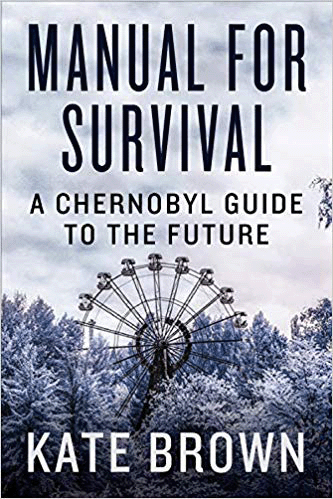
Much has been written about the strengths and flaws of Chernobyl—the HBO miniseries nominated for 19 Emmys that chronicles the catastrophe at the eponymous Russian nuclear power plant in 1986. In the mind of this reviewer, it’s a riveting if sobering television gem, and highly recommended. And to this newly enlivened debate over nuclear power we can now add Kate Brown’s book, Manual for Survival: A Chernobyl Guide to the Future, a tour de force about the radiological aftermath of the Chernobyl disaster. A science historian at the Massachusetts Institute of Technology, Brown peels away the layers of long-held mythologies—that in the end, the accident only killed 54 people, and that “radiation phobia” among the people who sustained heavy radioactive fallout was a bigger problem than any of the other health outcomes.
Brown, who is conversant in Russian, devoted years to extensive archival research (much of which was scattered and hidden from official attempts at confiscation). She conducted interviews with villagers, military officials, factory workers, medical doctors, Soviet nuclear experts, emergency responders, KGB operatives (who assumed control over much of the data from the accident), and international nuclear safety and radiation health experts. The result is a rich and deeply disturbing picture of the environmental perils of extensive and lasting nuclear contamination.
She digs prodigiously, much to the disfavor of defenders of nuclear power, into the widespread practice of secrecy and deception regarding the radiological harm from elevated, long-term, chronic exposures. Continue reading →
|
September 14, 2019
Posted by Christina Macpherson |
investigative journalism, politics, secrets,lies and civil liberties, Ukraine, USA |
Leave a comment
New Japanese environment minister touts end of nuclear power https://www.pv-magazine.com/2019/09/12/new-japanese-environment-minister-touts-end-of-nuclear-power/?fbclid=IwAR0wa5N2qxBhKPMOibQzKmgxNxwLF_0wOxorChWnD2uYe7w1OfH8K2aE-nI
After Fukushima, Japan’s nuclear power fleet went offline with plans to restart only when safety concerns could be addressed. On his first day at the office, the new environment minister has said he has no intention of ever restarting the reactors. The move could put Shinjiro Koizumi at loggerheads with PM Shinzo Abe, a vocal proponent of nuclear.
SEPTEMBER 12, 2019 MARIAN WILLUHN On his final day in office, Japanese environment minister Yoshiaki Harada stunned environmentalists by announcing more than a million tons of contaminated water from the Fukushima-Daiichi nuclear power station will have to be dumped in the Pacific.
A day later Japan inaugurated a new environment minister who, at his very first press conference, flew in the face of prime minister Shinzo Abe’s plans to restart the nation’s nuclear power plants.
Shinjiro Koizumi took office yesterday and within hours revealed his intentions regarding the nuclear fleet, which comes under his ministerial purview.
“I would like to study how we will scrap them, not how to retain them,” said Koizumi of the reactors. “We will be doomed if we allow another nuclear accident to occur.”
Disaster
After an earthquake and subsequent tsunami battered the Fukushima-Daiichi nuclear power station in early 2011 – causing a triple meltdown at the plant – Japan shuttered its 54 reactors. Plans have been in place to restart most of them, encouraged by Prime Minister Abe. The PM says the country’s reliance on 30% of its energy from nuclear ensures it can hit its carbon emission reduction targets. Any permanent closure of nuclear assets could mean a big push on solar and other renewables.
Many Japanese heavily oppose nuclear. Tuesday’s announcement wastewater may be dumped into the ocean immediately had fisheries voicing protest, for example. The decision to dump the waste is not final and will be reviewed by a panel of experts appointed by the government.
At 38, Koizumi is Japan’s youngest post-war minister and has been dubbed “a rising star” by Japanese media. He is the son of former PM Junichiro Koizumi and does not appear content to remain in the old man’s shadow, with political analysts predicting the new environment minister is on the path to becoming PM himself.
September 14, 2019
Posted by Christina Macpherson |
Japan, politics |
Leave a comment
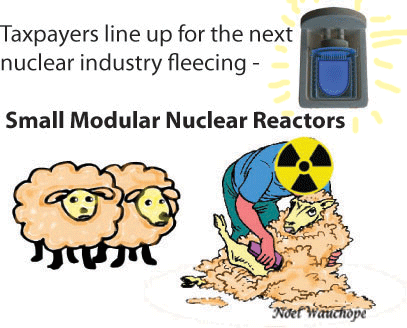
Nuclear Energy Insider 11th Sept 2019 Rolls-Royce group wins funding as UK SMR race gathers pace. The UK SMR Consortium has received financial backing from the UK government to advance
its small modular reactor programme, as part of the Industrial Strategy
Challenge Fund.
The consortium, led by Rolls-Royce, comprises Assystem, SNC
Lavalin/Atkins, Wood, Arup, Laing O’Rourke, BAM Nuttall, Siemens,
National Nuclear Laboratory, and Nuclear AMRC. “The £18 million [US$22.3
million] government funding for phase 1 of the programme (from the ISCF
Wave 3 bid we were recommended from by government) is being matched by
industry funding in the consortium,” Ben Todd, Rolls-Royce Communications
Business Manager – Nuclear, told Nuclear Energy Insider.
“It’s a really big boost to the project, however we have a conservative outlook and
realise there remains a significant amount of work still to do and many
hurdles to overcome. Phase 2 will be a further circa £500 million [US$618
million] total (matched from government, industry and possibly equity
providers) to take through to the completion of the GDA process.”
https://analysis.nuclearenergyinsider.com/rolls-royce-group-wins-funding-uk-smr-race-gathers-pace
September 14, 2019
Posted by Christina Macpherson |
politics, UK |
Leave a comment
U.S. Department of Energy Awards $15.2 Million for Advanced Nuclear Technology, WASHINGTON, D.C. SEPTEMBER 10, 2019 – The U.S. Department of Energy (DOE) today announced funding selectees for multiple domestic advanced nuclear technology projects. Three projects in three states will receive varying amounts for a total of approximately $15 million in funding. The projects are cost-shared and will allow industry-led teams, including participants from federal agencies, public and private laboratories, institutions of higher education, and other domestic entities, to advance the state of U.S. commercial nuclear capability.
The awards are through the Office of Nuclear Energy’s (NE) funding opportunity announcement (FOA) U.S. Industry Opportunities for Advanced Nuclear Technology Development. This is the sixth round of funding through this FOA…….
U.S. Secretary of Energy Rick Perry. “The Trump Administration is committed to reviving and revitalizing the U.S. nuclear industry.” ……https://www.energy.gov/ne/articles/us-department-energy-awards-152-million-advanced-nuclear-technology-0
September 14, 2019
Posted by Christina Macpherson |
politics, USA |
Leave a comment
France’s nuclear love affair shows signs of souring, https://finance-commerce.com/2019/09/frances-nuclear-love-affair-shows-signs-of-souring/ By: Bloomberg News September 11, 2019
Electricite de France SA’s announcement that some of its nuclear reactors at home may contain substandard components is the latest setback in the country’s 40-year love affair with atomic energy.
France launched its nuclear program in the 1970s to reduce its dependence on fossil fuels as unprofitable coal mines progressively closed and Western economies were roiled by two consecutive oil shocks. EDF commissioned 58 reactors between 1978 and 2002, which has seen the country get more of its power from nuclear than any other nation. It also means it’s got an aging energy infrastructure, with its oldest plants embarking on large modernization programs to extend their lifecycle.
“The French nuclear fleet is now aging, meaning that some plants will have to be halted in the next 15 years,” said Marc-Antoine Eyl-Mazzega, director of the Center for Energy at the Institut Francais des Relations Internationales. “Some say that nuclear energy is very risky. Renewable energies come with tens of thousands of jobs, but France has been lagging behind.”
After commissioning its 58th reactor in 2002, EDF started building a new type of atomic plant in 2007. Its flagship Flamanville project in Western France was initially due be completed in 2012, though it’s been beset by construction problems.
EDF has also faced setbacks at its existing fleet of French reactors. In 2016, its main supplier Framatome disclosed anomalies in manufacturing records for large equipment, leading to prolonged halts at almost a third of the utility’s reactors. Tuesday’s announcement’s by EDF that some of its reactors may contain substandard components made by Framatome, now 75.5%-owned by EDF, is reigniting fears of prolonged shutdowns.
Given France gets three quarters of its energy generation from nuclear energy, the financial impact of disruption could be severe.
“There should be a significant uplift in French and Central European power prices based on likely future French nuclear outages, which could potentially mean EDF having to buy French generation output that it is short at a premium price,” Barclays Bank analysts Peter Crampton and Dominic Nash wrote in a note.
The stakes are high for the French nuclear industry, which employs about 220,000 people. President Emmanuel Macron has pledged to reduce nuclear output to 50% of France’s power mix in 2035 by shutting down 14 aging reactors to make room for renewables.
Even as the price of electricity stemming from wind and solar has sunk below that of new nuclear builds, the French president has asked EDF to prove by mid-2021 that it can build more competitively-priced nuclear plants, to provide large volumes of carbon-free power as a 100% renewable electricity system seems likely to remain out of reach for at least several decades.
It comes as state-controlled EDF struggles to fund the billions of euros needed each year to maintain its nuclear plants and build new ones within existing cash flows. It’s considering spinning off a minority stake in an entity that would include its power-distribution, renewables and energy-services businesses to raise funds.
September 12, 2019
Posted by Christina Macpherson |
France, politics |
Leave a comment
Japan should scrap nuclear reactors after Fukushima, says new environment minister, https://www.theguardian.com/world/2019/sep/12/japan-should-scrap-nuclear-reactors-after-fukushima-says-new-environment-minister
Shinjiro Koizumi says: ‘We will be doomed if we allow another accident to occur’, Justin McCurry in Tokyo
Thu 12 Sep 2019 Japan’s new environment minister has called for the country’s nuclear reactors to be scrapped to prevent a repeat of the Fukushima nuclear disaster.
Shinjiro Koizumi’s comments, made hours after he became Japan’s third-youngest cabinet minister since the war, could set him on a collision course with Japan’s pro-nuclear prime minister, Shinzo Abe.
“I would like to study how we will scrap them, not how to retain them,” Koizumi, 38, said. “We will be doomed if we allow another nuclear accident to occur.”
Japan’s government wants nuclear power to comprise 20% to 22% of the overall energy mix by 2030, drawing criticism from campaigners who say nuclear plants will always pose a danger given the country’s vulnerability to large earthquakes and tsunamis.
Abe, however, has called for reactors to be restarted, arguing that nuclear energy will help Japan achieve its carbon dioxide emissions targets and reduce its dependence on imported gas and oil.
All of Japans 54 reactors were shut down after a giant tsunami caused a triple meltdown at the Fukushima Daiichi nuclear power plant in March 2011.
Nuclear power accounted for about 30% of Japan’s energy production before the disaster. Today, just nine reactors are back in operation, having passed stringent safety checks introduced after the Fukushima meltdown.
But the government is unlikely to meet its target of 30 reactor restarts by 2030 amid strong local opposition and legal challenges.
Although he faces potential opposition from inside the cabinet, Koizumi should at least receive the backing of his father, Junichiro Koizumi, a former prime minister who has emerged as a vocal opponent of nuclear power.
While Japan debates the future of nuclear energy, the younger Koizumi, who has been tipped as a future prime minister, is now at the centre of a controversy over the future of more than a million tonnes of contaminated water stored at Fukushima Daiichi.
On Tuesday, his predecessor as environment minister said the plant’s operator, Tokyo Electric Power, had no choice but to dilute the water and release it into the Pacific ocean rather than store it indefinitely.
The prospect of dumping the water into the sea has angered local fishermen and drawn protests from neighbouring South Korea.15.23 AESTLast modified on Thu 12 Sep 2019 15.59
September 12, 2019
Posted by Christina Macpherson |
Japan, politics |
Leave a comment
 How can we pay for new nuclear power stations? https://www.ft.com/content/4b81682e-cf19-11e9-99a4-b5ded7a7fe3f, Funding methods that work in the water industry cannot be applied to the sector, NICK BUTLER 9 Sept 19,
We are coming to a crucial moment of decision on the future of nuclear power in the UK, with implications for the industry across Europe and beyond. The basic issue is whether nuclear power can be provided at a cost that does not damage industrial competitiveness or impose an unacceptable burden on consumers. Without a positive answer to that question, nuclear will not be able to play a role in the transition to a lower-carbon economy.
Despite a long standing commitment to build 16GW of new nuclear capacity, only one new plant is under construction — Hinkley Point C in Somerset — which will, when eventually brought on stream, impose a long-term burden on UK consumers. The price agreed in 2013 — £92.50 per MW hour — looked extremely expensive then, but the real burden will come from the agreed index-linking of the price for 35 years. That already gives a price of over £100, a number way above those for competing sources of power such as wind, solar and natural gas.
The latest attempt to reduce this headline price slipped out in a consultation paper from the department for business, energy and industrial strategy in the dying hours of former UK prime minister Theresa May’s administration. The suggestion is that future nuclear power projects should be funded through the “regulated asset base” system. Put simply, the Rab would fund new projects from the moment construction begins through a levy on consumers. This would reduce the borrowing costs for the companies building the projects and thus in turn bring down the level of future bills. £92.50 might come down to £80.
This method of funding is a serious option for long-term projects with high upfront capital costs and has been used effectively in the water industry and elsewhere. As a mechanism for funding new nuclear, however, it is far from convincing. Water projects, such as reservoirs and pipeline systems, require large-scale capital investment. But the technology is proven and the construction risks are low. In new nuclear, however, the construction risks are high and to place them on the shoulders of consumers is unfair.
Of course, the dream of any company is to pass the burden of risk in any project to someone else while collecting a guaranteed stream of income once the project is up and running. In this case, however, the unfairness of such an outcome makes the model unsustainable. Consumers cannot be encouraged by the example of one of the few new nuclear stations being built in Europe — Flamanville on the northern coast of France.
Please use the sharing tools found via the share button at the top or side of articles. Copying articles to share with others is a breach of FT.com T&Cs and Copyright Policy. Email licensing@ft.com to buy additional rights. Subscribers may share up to 10 or 20 articles per month using the gift article service. More information can be found here.
https://www.ft.com/content/4b81682e-cf19-11e9-99a4-b5ded7a7fe3f
Flamanville began construction in 2007 and was due to come on stream in 2012. When I was working in government a decade ago, I was told that Flamanville would set the example for all new nuclear stations to be built in the UK. Today, Flamanville is still under construction. Earlier this year further faults were found by the French regulator and the commissioning of the station has been put back. The operator EDF has so far been unable to name the date when it will come on stream but has talked of a further delay of perhaps another three years. The cost of the plant was originally set at €3.3bn. Now the estimate is €10.9bn.
Under the Rab funding system, consumers would have been paying a surcharge on their bills since 2007 with nothing to show for it. They would have no leverage over the company building the plant and no scope for compensation. They would also of course have to pay in addition the cost of buying the power they need from someone else. Such an allocation of risk is unfair and unacceptable, and it is hard to think that ministers in a UK government, highly attuned to public opinion when it comes to energy prices, will impose such a system.
What are the implications of this? If the private sector will not fund new nuclear, and if no fair system of allocating costs and risks can be found, the 16GW of capacity required under current energy policies will not be built. That will be true not just in the UK but across most of Europe and perhaps even France, a country committed to nuclear power in the past and where a decision on new nuclear facilities is due to be taken in the early 2020s. Over time, nuclear power will become a source of power only in countries, such as China, where the state can provide full funding for new developments, as well as subsidies to conceal the costs to business and other consumers.
Nuclear’s future in Europe, Japan and the US is limited by these unanswered challenges. Of course there are alternatives. Wind and solar are becoming cheaper, and there is huge scope for energy efficiency. But until large grid-level storage capacity is available, economically viable renewables will always need some back-up — which means gas or, in many countries, coal. If Rab pricing systems are not the answer, is there another way through this dilemma? Next week, I will look at one possible option. The writer is an energy commentator for the FT and chair of The Policy Institute at King’s College London
September 10, 2019
Posted by Christina Macpherson |
business and costs, politics, UK |
Leave a comment
Try, Try Again: Trump Mulling Taxpayer Bailout of Nuclear Industry https://www.ewg.org/energy/release/22837/try-try-again-trump-mulling-taxpayer-bailout-nuclear-industry10 Sept 19 WASHINGTON – Although previous schemes to bail out the dying nuclear industry fizzled, the Trump administration is at it again.
Bloomberg reports that the administration is considering using an obscure Cold War-era law to directly purchase U.S.-mined uranium to restock nuclear power plants.In an Aug. 18 letter from the Nuclear Energy Institute to White House national security advisor John Bolton and economic advisor Larry Kudlow, the industry trade group called on the administration to use “direct payments to either a U.S. utility or domestic uranium producer for sale of U.S.-origin uranium to a utility.”
The purchases would be authorized under the Defense Production Act, enacted during the Korean War to ensure that U.S. industries have the resources necessary for national defense. The act allows the president to allocate uranium and other materials needed to power and arm submarines, aircraft carriers and warheads.
But experts say there is no military justification for the scheme.
“Frankly, we have already taken care of our naval fuel needs for the next 60 years. We are awash in enriched uranium for weapons,” Sharon Squassoni, a professor on nuclear policy at George Washington University, told Reuters.
In July, the president dismissed a Commerce Department proposal, strongly backed by the uranium and nuclear industries, to slap tariffs on uranium imported to the U.S. Instead, President Trump created a working group including Bolton, Kudlow and six cabinet secretaries to come up with other options for propping up the nuclear power industry.
The industry is struggling because of aging plants and high operating costs, which make it hard to compete against much cheaper renewable energy sources and natural gas.
This is not the first time the Trump administration has toyed with ideas to use taxpayer money to prop up the nuclear power industry artificially. Energy Secretary Rick Perry twice pursued plans to bail out both the nuclear and coal industries by requiring regional electricity suppliers to buy above-market-rate power from coal and nuclear plants, even when cheaper sources are available.
Perry’s proposals were shot down by the Federal Energy Regulatory Commission and top White House national security officials. In June, Perry admitted there is no federal authority for his scheme, so operators of struggling nuclear plants have turned to getting bailouts from state governments.
“The Trump administration is once again looking to prop up the dying and dangerous nuclear energy industry and squandering taxpayer dollars to do it,” said EWG President Ken Cook. “Nuclear power is a relic of the last century, too risky, too expensive and completely rejected by Wall Street investors. Instead of backing another energy loser, the administration should push to make America’s wind and solar power great again, by helping U.S. makers of turbines and solar panels recover from years of standing by while foreign competitors dominate.”
Data from the Energy Information Administration shows that since 2009, solar power capacity has grown by more than a factor of 89, and wind power capacity has increased sixfold. But production of solar panels and wind turbines is dominated by companies from China and Europe.
Reuters reported that the White House working group is expected to make its recommendations for bailing out domestic uranium mining and the nuclear power industry by Oct. 10.
Much of the U.S.’ uranium deposits are in the desert Southwest, including along the rim of the Grand Canyon. In 2012, then-Interior Secretary Ken Salazar placed a 20-year moratorium on uranium mining on more than 1 million acres of land along the canyon rim.
But in November 2017, the Trump administration announced plans to reconsider the mining ban near the Grand Canyon. And in March 2018, the uranium mining lobby petitioned the Supreme Court to lift the Obama-era ban.
###
The Environmental Working Group is a nonprofit, non-partisan organization that empowers people to live healthier lives in a healthier environment. Through research, advocacy and unique education tools, EWG drives consumer choice and civic action.
September 10, 2019
Posted by Christina Macpherson |
politics, Uranium |
Leave a comment

Energy Voice 3rd Sept 2019 Sizewell C and Bradwell B are not yet wholly done deals though groundwork
is under way with contracts issued and limited employment generated. At the end of July, for example, Atkins was awarded a £5m contract for preparatory works at Sizewell C for EDF. It is the first programme of construction work to start at the proposed nuclear power station, which will be located next to the existing Sizewell B plant on the Suffolk coast.
The situation at Bradwell in Essex is more complex, with the original power station now being decommissioned and China Electric pushing hard to get the green light for the new B station. In January, the new boss at Bradwell B peddled the claim that the nuclear plant “will bring significant benefits” to the community. Alan Raymant, a local lad, claimed: “The need for the reliable, low-carbon energy that nuclear provides continues to grow strongly. “Bradwell B will be a major part of Britain’s energy future, powering the national, regional and local economy for many years to
come.”
The project is being headed by China General Nuclear Power Group and EDF. UK technology content will be very limited. Same for Sizewell C. Neither project is slam-dunk. The case for their cancellation is very strong, not least that competitive civil nuclear is a total lie.
There is no such thing as economic or environmentally responsible nuclear. It is hugely expensive and most certainly not low carbon. Until now, all nuclear plant– more than 650 reactors – around the world has ridden on the back
of defence programmes and been subsidised.
And no one anywhere has solved the nuclear waste legacy, which is a trans-generational challenge and absolutely cancels out any of the contrived profit.
Moreover, early, high-capacity nuclear energy countries such as the UK, Canada and France have still not dismantled any of their reactors. These stations spend more time as industrial sarcophagi than they do generating electricity and
profits.
According to a fresh study published in July by Deutsche Welle of Germany, the challenges of the long-term storage of nuclear waste have been basically ignored, to the extent that today there are no long-term storage facilities for highly radioactive waste in operation.
In countries such as Germany, the UK and the US, the search for a suitable location has gone on for decades with governments all too ready to bribe communities to accept nuclear waste dumps on their doorstep, fortunately unsuccessfully.
Oh, and one more thing that no one talks about here. Civil nuclear is virtually uninsurable. So what if there is an accident? The answer is simple. According to Deutsche Welle: “Society will be asked to bear a very large proportion of these costs. The fact that nuclear power plant operators are not insured against the risk of accidents makes this abundantly clear. Worldwide, there are no financial service organisations that offer insurance to them.”
https://www.energyvoice.com/opinion/206775/nuclear-secrets-and-lies/
September 5, 2019
Posted by Christina Macpherson |
business and costs, politics, UK |
Leave a comment
|
 A Fight Over Subsidies for 2 Ohio Nuclear Plants Draws Claim That China Is ‘Invading’ the Electric Grid, TIME BY WILL WADE / BLOOMBERG –– 30 Aug 19, The voice on the television ad sounds ominous. “The Chinese government is quietly invading our American electric grid,” it says. “Now they’re coming for our energy jobs.” A Fight Over Subsidies for 2 Ohio Nuclear Plants Draws Claim That China Is ‘Invading’ the Electric Grid, TIME BY WILL WADE / BLOOMBERG –– 30 Aug 19, The voice on the television ad sounds ominous. “The Chinese government is quietly invading our American electric grid,” it says. “Now they’re coming for our energy jobs.”
As the narrator speaks, images of marching soldiers and President Xi Jinping flash across the screen. It ends with a warning: “Don’t sign the petition allowing China to control Ohio’s power.”
The commercial, which has the air of a political-attack ad, is the latest and most bizarre salvo in a bitter fight over a new Ohio law subsidizing two struggling nuclear power plants owned by bankrupt FirstEnergy Solutions Corp.
The voice on the television ad sounds ominous. “The Chinese government is quietly invading our American electric grid,” it says. “Now they’re coming for our energy jobs.”
As the narrator speaks, images of marching soldiers and President Xi Jinping flash across the screen. It ends with a warning: “Don’t sign the petition allowing China to control Ohio’s power.”
The commercial, which has the air of a political-attack ad, is the latest and most bizarre salvo in a bitter fight over a new Ohio law subsidizing two struggling nuclear power plants owned by bankrupt FirstEnergy Solutions Corp.
The law, enacted last month, carves out $150 million annually for FirstEnergy Solutions’s Davis-Besse and Perry plants, which the company had said it would close without aid. Ohio will fund it by cutting support for wind and solar. The move is unprecedented. While New York, New Jersey and Illinois all subsidize nuclear power as part of their clean-energy strategies, Ohio is the first to do so by directly yanking support from renewables.
Now environmentalists and others are gathering signatures in support of a referendum to repeal it. But the group behind the television ad, Ohioans for Energy Security, says they’re circulating the petition on behalf of China. ……
The group is funded by “dark money,” said Gene Pierce, a spokesman for the organization gathering signatures to repeal the law, Ohioans Against Corporate Bailouts. The notion that the financing of gas plants is tantamount to taking over the power grid is far-fetched, he said. …https://time.com/5665336/ohio-nuclear-plant-chin
|
|
August 31, 2019
Posted by Christina Macpherson |
politics, USA |
Leave a comment
Attacks on the Sanders’ climate plan appear to have less to do with the ongoing viability of nuclear power as a legitimate climate solution and more to do with an ongoing effort to convince the public to subsidize another unsuccessful sector of the energy industry.
|
Bernie Sanders’ Plan to Phase out Nuclear Power Draws Attacks — Here’s Why They’re Wrong https://www.desmogblog.com/2019/08/30/bernie-sanders-climate-plan-nuclear-phase-out-attacks, By Justin Mikulka • Friday, August 30, 2019 Senator and Democratic presidential hopeful Bernie Sanders has released an ambitious climate proposal, one which champions of the status quo were quick to criticize. One line of attack, coming from many different sources, focuses on Sanders’ plan to phase out nuclear power, but the arguments, and who is behind them, deserve a closer look.Sanders’ proposal refers to nuclear power as one of several “false solutions” to the climate crisis:
“To get to our goal of 100 percent sustainable energy, we will not rely on any false solutions like nuclear, geoengineering, carbon capture and sequestration, or trash incinerators.”
The Washington Post editorial board quickly blasted Sanders’ plan to eliminate nuclear power: “Mr. Sanders also promises to make his plan unnecessarily expensive by ruling out a long-established source of carbon-free electricity: nuclear power.”
The New York Times quoted Joshua Freed, vice president for clean energy at Third Way, a think tank that describes itself as promoting “modern center-left ideas.”
“The Sanders plan appears to be big, but it’s not serious,” Freed said. “We need to have every option on the table.” Freed’s biography on the Third Way website makes clear that “advanced nuclear” is a top priority for the organization.
In an op-ed at Forbes attacking Sanders’ plan, Ellen R. Wald, an energy historian and senior fellow at The Atlantic Council, went so far as to say that the outcome of the plan would be that “we would live in darkness” and “many of us would starve.”
Former Top Regulator Says ‘Nuclear is Dying’
However, if you ask a former top nuclear regulator about the future of nuclear power, the prospects are much dimmer. Gregory Jaczko was the chairman of the U.S. Nuclear Regulatory Commission from 2009 to 2012 and is the author of the book Confessions of a Rogue Nuclear Regulator. In an op-ed for the Washington Post in May, Jaczko asserted that “[n]uclear is dying” and argued that nuclear power is not a solution to the climate crisis.
He spells out multiple reasons not to pursue nuclear power, with the obvious safety risks topping his concerns. And rightly so. Jaczko served on the Nuclear Regulatory Commission during the 2011 Fukushima nuclear disaster in Japan.
In addition to nuclear’s well-publicized safety risks, Jaczko also highlighted a less well-known one. He said that the nuclear industry wields such influence over regulatory agencies — something he saw firsthand — that safety is being sacrificed for profit.
Another downside is that building nuclear power plants is an incredibly expensive undertaking. Recent attempts to revive nuclear energy in the U.S. have been financial disasters, with $9 billion spent on one failed project in South Carolina alone.
Jaczko cites the low cost and low risk of renewables as another factor that makes nuclear obsolete. “I’ve now made alternative energy development my new career, leaving nuclear power behind. The current and potential costs — in lives and dollars — are just too high,” wrote Jaczko, who has founded the company Wind Future LLC.
Last year, William Von Hoene, senior vice president at Exelon, which operates nuclear plants, predicted that there would be no new nuclear power plants built in America for the same reason. “They are too expensive to construct, relative to the world in which we now live,” said Hoene.
Bailing Out Another Failing Industry
Like the coal industry, the U.S. nuclear industry has been on the decline, but in this case, the drop is primarily due to aging nuclear plants closing and not being replaced. Still, this trend doesn’t mean U.S. taxpayers won’t pay the price as both industries continue to lobby hard for bailouts.
n Ohio, nuclear industry lobbyists recently secured a $1.1 billion bailout of two economically failing nuclear power plants (and struggling coal plants) while incentives for renewables were cut. Not all Ohio citizens were happy with this handout, and one group is currently collecting signatures to put the bailout before voters in a referendum next year.
A similar bailout of the nuclear industry was proposed in Pennsylvania.
“I don’t see nuclear as a solution to climate change,” Jaczko told The Intercept. “It’s too expensive, and would take too long if it could even be deployed. There are cheaper, better alternatives. And even better alternatives that are getting cheaper, faster.”
The International Energy Agency (IEA) released a report in May urging the use of more nuclear power but also admitted that this move would require the government picking up the tab. As Oilprice.com reported at the time, the “IEA pleaded with governments to rescue the industry” while admitting that without government intervention the prospect of new nuclear power projects in the U.S. and Europe was “inconceivable.”
Industry Not Giving Up
As evidenced by the nuclear bailouts, there is still money to be made in the utility business, and while the chances of building new nuclear power plants in the U.S. are remote, the industry is pushing back hard against Bernie Sanders’ plan.
Nuclear industry executives are perhaps inspired by the executives of failed coal, oil, and gas firms who get rich while bankrupting their companies.
Industry-backed think tanks and academic groups echo their funders’ talking points and continue to champion nuclear power as a climate solution.
The Manhattan Institute — known for its climate denial and oil and gas industry funding — claims that no one can be taken seriously on climate issues unless they embrace nuclear power.
And this think tank isn’t alone. According to the right-leaning Washington Examiner, Dr. Noah Kaufman, a research scholar at Columbia University’s Center on Global Energy Policy (CGEP), also disagreed with Sanders’ approach to nuclear power.
“I see ruling out any valuable low-carbon technologies and policies as fighting the [climate] battle with one arm tied behind our backs,” said Kaufman.
However, CGEP itself is known for supporting climate-killing policies, such as its successful effort to help lift the crude oil export ban. Additionally, last year CGEP hired former Trump energy advisor and fossil fuel defender George “David” Banks as an expert on “international climate policy.”
Attacks on the Sanders’ climate plan appear to have less to do with the ongoing viability of nuclear power as a legitimate climate solution and more to do with an ongoing effort to convince the public to subsidize another unsuccessful sector of the energy industry.
|
|
August 31, 2019
Posted by Christina Macpherson |
election USA 2020, politics |
Leave a comment