Survey finds that U.S. Democrats and Republicans both want to phase out land-based nuclear missiles
|
Democrats And Republicans Agree: Phase Out Land-Based Nuclear Missiles https://www.forbes.com/sites/matthewkorda/2020/08/12/democrats-and-republicans-agree-phase-out-land-based-nuclear-missiles/#74441be7109d Matt Korda I write about the nexus between nuclear weapons, climate change, and injustice. Although Democrats and Republicans increasingly seem worlds apart, when it comes to nuclear weapons issues, they’re actually much closer than one might think.
According to a new report by the Program for Public Consultation at the University of Maryland, 61 percent of Americans–including both Democratic and Republican majorities–are in favor of phasing out the United States’ aging fleet of 400 intercontinental ballistic missiles. This finding is highly noteworthy, as it runs in direct contrast to the Pentagon’s current plan of spending approximately $100 billion to buy a brand-new generation of ICBMs by 2030. The survey, entitled “Common Ground of the American People,” is a compilation of studies conducted over the past five years, collecting data from nearly 86,000 individuals throughout the polling process. It specifically aimed to place the respondents into the shoes of a policymaker: respondents were first given an issue briefing, and were then asked to evaluate arguments for and against various policy proposals, before finally offering their recommendations.
The survey’s unique methodology is highly illuminating, because it allows readers of the report to see which arguments were deemed to be most or least convincing, and by whom. For example, Republicans preferred a proposal to phase out ICBMs while maintaining the same number of deployed warheads, while Democrats preferred a proposal to phase out ICBMs and reduce the arsenal to a lower number of deployed warheads.
The main takeaway though, is that–regardless of how the ICBM phase-out takes place–69 percent of Democrats and 53 percent of Republicans agree that the land-based leg of the nuclear triad should be eliminated entirely.
It makes sense that both Democrats and Republicans would agree on phasing out ICBMs: they are outdated, destabilizing, and very expensive. Intercontinental ballistic missiles are largely relics of the Cold War, when the United States and the Soviet Union alike feared a “bolt-from-the-blue” nuclear attack. At the time, it was believed that both countries having large land-based nuclear arsenals would prevent each other from launching a massive surprise attack. However, in today’s multipolar nuclear environment, the likelihood of such an attack is extremely slim, and so ICBMs no longer hold much strategic value. Given the abundance of more flexible options in the U.S. arsenal, U.S. Strategic Command would certainly turn to nuclear bombers or submarines–not ICBMs–in the event of a low-level nuclear crisis.
Additionally, the inherent vulnerability of the ICBM fleet actually creates a psychological pressure to launch them during a nuclear crisis, before an adversary’s missiles can wipe them out. This is why siloed ICBMs–like those deployed across the United States––are commonly referred to as “use ‘em or lose ‘em” weapons. In the event of a false alarm, accident, or miscalculation, this pressure to “use ‘em” could inadvertently trigger a nuclear war. No other nuclear weapon in the US nuclear arsenal comes with this kind of destabilizing psychological pressure. ……
Perhaps knowing this, the Pentagon argues that ICBMs are necessary as a “hedge” in case technological advances suddenly render the United States’ nuclear-armed submarines vulnerable. However, the 2018 Nuclear Posture Review admits that “When on patrol, [ballistic missile submarines (SSBNs)] are, at present, virtually undetectable, and there are no known, near-term credible threats to the survivability of the SSBN force.” This condition is likely to continue as US submarines get even quieter, thus making these fears seem relatively exaggerated. On top of this, replacing the ICBMs with brand-new missiles would be extremely expensive. The latest estimate for the Ground-Based Strategic Deterrent, as the replacement program is called, totals approximately $100 billion. In reality, these costs are expected to rise, given that the contract will be sole-sourced to Northrop Grumman NOC -0.7% after Boeing BA -2.6% pulled out of the competition last year. The chairman of the House Armed Services Committee has called this development “very troubling,” and the sole-source contract has since triggered a Federal Trade Commission investigation into Boeing’s allegations that Northrop Grumman was engaging in anti-competitive behavior.
Given these underlying programmatic and strategic concerns––in addition to the new survey demonstrating that both Democrats and Republicans want to phase out ICBMs entirely––why is this $100 billion project still moving forward? In the midst of an election, a recession, and a devastating pandemic, it seems like common sense to delay the program at the very least.
However, a robust lobbying effort by weapons contractors has impeded public scrutiny of the program. Northrop Grumman––the only bidder for the ICBM replacement contract––spent more than $162 million on lobbying between 2008 and 2018, with the bulk of the contributions going to members of the “ICBM Caucus”––a coalition of Senators from states where ICBMs are deployed. In 2018, this lobbying effort helped kill an amendment to the National Defense Authorization Act which called for a feasibility study on extending the life of the current ICBM force, rather than rebuilding it from scratch. This has had the effect of suppressing public debate over the future of the ICBMs; without studies like this one, the public is being asked to blindly swallow the pro-ICBM claims of those that would materially benefit from their replacement.
The University of Maryland’s report offers a new tool to push back against the “business” of nuclear policy. The survey suggests that corporate lobbying and “special interests” are alienating the public from their elected representatives, and dividing the two political parties even further. Therefore, treating its respondents as neutral “policymakers” clearly demonstrates that without the presence of moneyed interests, Democrats and Republicans agree on much more than one might think. And in this particular instance it is clear: majorities from both parties want to phase out intercontinental ballistic missiles.
|
|
North Dakota shows how to deter any plan for nuclear waste dumping

The Legislature passed a bill into law in 2019 that prohibits the disposal of high-level radioactive waste in North Dakota. For the rules to even take effect, “the first thing you have to do is get that law overturned or thrown out,” State Geologist Ed Murphy said.
Regulators prep for an industry few want: nuclear waste disposal, Bismarck Tribune, 10 Aug, 20
The state Industrial Commission approved the regulations in late July, as well as new rules surrounding deep geothermal wells, another industry that does not exist in North Dakota but could emerge one day.
The waste disposal rules spell out all the steps an entity would have to go through if it were to propose storing “high-level radioactive waste” in North Dakota. Such waste is highly radioactive material generated from the reprocessing of spent nuclear fuel, for example, and it requires permanent isolation……
The Legislature passed a bill into law in 2019 that prohibits the disposal of high-level radioactive waste in North Dakota. For the rules to even take effect, “the first thing you have to do is get that law overturned or thrown out,” State Geologist Ed Murphy said.
“We were writing rules for a program that, by law, is prohibited,” he said.
Roers said the thinking behind establishing the rules in light of the ban is that if the federal government were ever to try to trump North Dakota’s prohibition, it might still agree to follow the regulations established by the state.
If the entity wanted to move forward with a project, it would then need a “facility permit,” which would prompt a similar vetting process. Officials would have up to a year to decide whether to issue a permit.
Before granting a permit, the operator would need to deposit at least $100 million in a new state fund.
“The half-lives of some of the radioactive waste will be dangerous much longer than any sign, monument, or avoidance structures would remain unless they are maintained in perpetuity,” the regulations state. “This money is to be used to ensure the passive institutional controls are maintained for thousands of years.”
If a facility were to make it through the permitting process, it would have to pay an annual operating fee of at least $1 million to the state. It also would need to provide monthly reports on activities at the site and comply with reclamation rules when the site is no longer in use.
Documents regarding the location and depth of the site, as well as details about the half-life of the radioactive waste buried there, must be stored in local, state and national archives — an effort to ensure they last in perpetuity in case the information is needed hundreds or thousands of years down the road, Murphy said.
While counties cannot outright impose a ban on the disposal of the materials, any project would need to adhere to local zoning regulations as to the size, scope and location of the site.
Murphy said the state examined the regulations of 13 other states in developing its rules…………..
The new rules for high-level radioactive waste and deep geothermal energy have one final hurdle to clear before they become official — they will go to a legislative Administrative Rules Committee for approval. ….. https://bismarcktribune.com/news/state-and-regional/regulators-prep-for-an-industry-few-want-nuclear-waste-disposal/article_5afd3c76-9ac1-556f-be69-50f6c9811642.html
UK Chancellor evasive on the involvement of China in building Bradwell nuclear plant
|
LBC 7th Aug 2020 The Chancellor refuses to rule out a U-turn on the involvement of China in
the building of the Bradwell nuclear power station in Essex. Tom Swarbrick asked Chancellor Rishi Sunak if the Government would still allow a Chinese state-owned nuclear power company to build a nuclear power plant at Bradwell, in Essex. Rishi Sunak said the Government’s position hasn’t changed adding “decisions haven’t been made” for the project. The
Chancellor said the Business Secretary would be the lead minister on this issue and he thought a paper would be published on it in Autumn. When LBC host Tom asked if the Chancellor thought Chinese president Xi Jinping was a “reliable partner,” Mr Sunak said he thought the UK should have an “eyes wide open relationship with China.” He added the country was “obviously
important to us in many ways” for supply of goods and as a trading partner. But, the senior Minister said, “we should be eyes wide open where we have different values and interests and we should be robust in standing up for those things.” The Chancellor cited Huawei as an example of the Government taking “quite strong, and significant action over time.”https://www.lbc.co.uk/radio/presenters/tom-swarbrick/chancellor-says-uk-needs-eyes-wide-open-relationship-with-china/ |
|
|
Nuclear crime seems to have actually still been worth it for South Carolina fraudsters
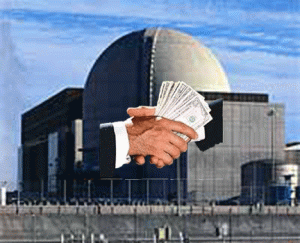 Executive admits fraud in fleecing ratepayers and shareholders https://wordpress.com/read/feeds/72759838/posts/2851460855 By Linda Pentz Gunter

“It looks like crime might well pay after all.”
That was the weary and only slightly tongue-in-cheek conclusion drawn by longtime anti-nuclear campaigner, Tom Clements recently, after a former South Carolina nuclear utility executive pled guilty to fraud in federal court.
Clements is the director of Savannah River Site Watch, but his activism has, for decades, extended well beyond the perimeter of that vast nuclear site.
For years, Clements and others have followed — and attempted to stand in the way of — the forced march of South Carolina ratepayers toward nuclear fiasco. When it finally unraveled in late July, there was only cautious cause for celebration.
On July 23, Stephen Byrne, the former COO of SCANA, the South Carolina utility originally in charge of the construction of two new nuclear reactors in the state, pled guilty in a massive nuclear conspiracy that defrauded ratepayers, deceived regulators and misled shareholders.
Byrne is charged with lying about progress on two Westinghouse AP 1000 reactors under construction — and since abandoned — at the V.C. Summer site, where costs ballooned to more than $9 billion.
The lies — or “intentional misrepresentations” as court documents described them — were necessary to make the case that the two new reactors would be finished on time, thereby qualifying the company for $1.4 billion in future federal tax credits.
But when Clements did the math, Byrne still came out ahead. “One of the court filings says Byrne earned $6.3 million from 2015-2017,” Clements said. “The project originally started with a filing with the SC Public Service Commission in 2008 and ended in July 2017. His plea agreement says he will pay a $1 million fine, though the judge could make it higher.”
So yes, crime still pays.
And so did South Carolina ratepayers. They were bilked of at least $2 billion until the project faltered and finally collapsed. A class action law suit and decisions by judges will see millions returned to ratepayers.
Ironically, the Nuclear Energy Institute, the industry’s lobbying group, gave Byrne the opportunity to explain exactly how ratepayers could be fleeced in advance to save money. In this 2012 NEI video, Byrne describes how Construction Work in Progress (CWIP) would allow the utility to collect funds from ratepayers in advance rather than waiting for construction completion — which has now, of course, not happened, even though customers paid for two new reactors that failed to materialize.
Byrne, who began cooperating with investigators about two years into the now three year-long investigation, could face jail time and a fine, but will likely testify against his co-conspirators to reduce his punishment.
For the time being, the judge has let him go home without even requiring he post the $25,000 bond. Sentencing could be years down the road. Clements believes Byrne “should face prison time” and that he “must fully reveal the criminal role of others in the conspiracy that has been so disastrous for ratepayers.”
Two other top SCANA executives could also be in the FBI’s crosshairs by now — former CEO Kevin Marsh and former chief financial officer Jimmy Addison.
Early warning signals of trouble to come sounded in February 2020, when Byrne and Marsh were charged with civil fraud by the Securities and Exchange Commission (SEC). The agency said the pair “lied and deceived shareholders, regulators, and the public regarding the construction of two new nuclear units at the V.C. Summer site, which the company abandoned amid massive cost overruns in July 2017,” according to reporting in Energy and Policy.
The thoroughly duped — or possibly hopelessly biased — S.C. Public Service Commission, had earlier “allowed SCE&G to raise its electric rates nine times to finance the doomed V.C. Summer Nuclear Station project,” reported the Charlotte Observer.
But by January 2019, the PSC had changed its mind, saying that “SCE&G intentionally misled the commission about a failing nuclear reactor construction project to win electric rate hikes.”
Clements joined other protesters outside the Columbia, SC courthouse where Byrne pled guilty to his offenses. “As he scurried into the federal courthouse, Byrne refused to tell us if he would apologize for his crime against ratepayers,” Clements said.
He, along with other South Carolina activists, and with support of Friends of the Earth, had consistently opposed the state law (CWIP, described in the NEI video), that had allowed the utility to fleece ratepayers in advance of completion of the reactors. The groups had also contested approval of the two-reactor project before the SC PSC since 2008.
As Clements watched Byrne enter the courthouse, finally forced to face up to his crimes, he basked, for a brief moment, in the glow of the celebratory light at the end of the tunnel.
“I’m glad there is going to be a little bit of justice,” Clements told the Post and Courier. And in an email, he wrote: “Nukes bring fraud, graft and corruption wherever they go. The next charges here will be more serious, I think.”
The Post and Courier described the nuclear debacle as “one of the worst economic calamities in South Carolina history”.
But while there may eventually be a day of reckoning — and sentencing — until then, South Carolina ratepayers could keep right on paying.
That is because, when SCANA went bankrupt over the Summer debacle, Dominion Energy took over. Dominion, says Clements, “will file a rate-hike request next month and the cost to ratepayers for the nuclear construction debacle will go up.”
Nuclear blackmail in Illinois — Beyond Nuclear International

Ratepayers robbed of renewables as well as cash
Nuclear blackmail in Illinois https://wordpress.com/read/feeds/72759838/posts/2851460456
Exelon stranglehold on energy legislation runs long and deep
By David Kraft, 9 Aug 20
The recent Illinois lobbying corruption scandal involving Exelon Corporation, its subsidiary Commonwealth Edison and Democratic House Speaker, Michael Madigan, demonstrates the extent to which nuclear “power” is about more than electrons.
The FBI arrests of the Ohio House Speaker and five others in a $60 million bribery/corruption scheme; the $10 billion Exelon nuclear bailout in New York; the questionable circumstances surrounding Exelon’s 2016 PepCo merger; and the South Carolina $9 billion SCANA fraud case, suggest that this may be a national pandemic.
All of this was summarized nicely in a recent New York Times opinion column, “When Utility Money Talks,” (8/2/20).
However, the situation in Illinois with Exelon, and its subsidiary ComEd, has been longstanding and particularly egregious.
For decades, Exelon’s stranglehold on Illinois energy legislation, in cooperation with the currently investigated Mr. Madigan, has stuck Illinois with more reactors (14) and high-level radioactive waste (>11,000 tons) than any other state. It has also severely stifled expansion of renewable energy and energy efficiency, and hampered the Illinois energy transformation to renewables needed to deal with the worsening climate crisis.
For decades, the Illinois environmental community has seen renewables expansion thwarted because no significant renewable energy buildout could occur without concessions to either Exelon or ComEd, and without Speaker Madigan’s approval. The most recent instance was the 2016 $2.35 billion bailout of three uncompetitive Exelon reactors.
This “nuclear blackmail” politics has forced environmentalists wanting to see new legislation pass that would expand renewables, into a reluctant and grudging alliance with Exelon, but on Exelon’s terms, with capacity market “reform” rewarding both renewables and ten of the company’s operating reactors.
If passed in its presently proposed form, this new legislation would provide yet another nuclear bailout under the disguise of “market-based reform.”
To ratchet up the pressure to enact this nuclear prop-up even more, Exelon CEO Chris Crane, in Exelon’s 2Q quarterly earnings call with analysts, once again dangled the prospect of closing up to six reactors if this market-based-bailout is not granted in 2021.
Under the current ongoing FBI corruption investigation, this reluctant alliance of necessity has turned disastrous, given the political toxicity of any current association with either ComEd or Exelon.
It is just and reasonable that ComEd executives (and the so-called “bad apples” who “retired” already), should be penalized and prosecuted for their misdeeds, even if they are reportedly “cooperative.”
However, a $200 million “settlement” penalty for a $34 billion corporation, which for decades has gouged billions from Illinois ratepayers through admittedly corrupt illegal practices, is a slap on the wrist.
Further, the $200 million penalty agreement provides no restitution for the decades-long societal damage done via nuclear pay-for-play.
Illinois rate payers deserve restitution from these and any predatory, corrupt companies that would engage in such activities. This may require explicit legislation. How can one logically or ethically assert that ill-gotten gains (e.g., the 2016 $2.35 billion nuclear bailout) are still “good for the public” when bribery and corruption were used to get them?
Last Fall, a spokesperson for Illinois Gov. JB Pritzker stated, “The governor’s priority is to work with principled stakeholders on clean energy legislation that is above reproach.” Gov. Pritzker – your moment of truth has arrived.
We urge the governor and the legislature to begin the restitution process by repealing the $2.3 billion 2016 nuclear bailout. Further, and as others like Crain’s Joe Cahill have suggested, Crane must step down completely from all functions at Exelon.
The legislature should also enact explicit utility ethics legislation, with transparent oversight of utility contracting and philanthropic giving activities, to insure that this kind of corrupt behavior is not repeated.
And if Crane’s threat of imminent reactor closure is true, then community just-transitions legislation to protect those negatively impacted communities should be a priority of the legislature.
As NEIS has maintained — and advocated since 2014 — it’s the reactor communities (and equally adversely affected coal mining and power plant communities) that need state support and bailouts when plants are threatened with closure, not profitable private corporations like Exelon.
Finally, we support the FBI’s continued investigation into the activities of Speaker Madigan, his associates, and other legislators if necessary, to ferret out the remaining political corruption that has abetted this corporate larceny.
This is the only way to send a significant and lasting message that nuclear pay-for-play in Illinois is over.
David Kraft is the director of Nuclear Energy Information Service
Nuclear scandals in Ohio and Illinois raise serious issues about the role of government in the electricity sector.
  Twin nuclear scandals in Ohio and Illinois show why politicians shouldn’t be picking energy winners and losers: Josiah Neeley and Michael Haugh https://www.cleveland.com/opinion/2020/08/twin-nuclear-scandals-in-ohio-and-illinois-show-why-politicians-shouldnt-be-picking-energy-winners-and-losers-josiah-neeley-and-michael-haugh.html Aug 09, 2020 “……… two very similar political scandals involving the nuclear industry are playing out in Ohio and Illinois. In both cases, the operators of nuclear power plants are alleged to have bribed the state’s speaker of the house in exchange for enactment of favorable treatment and government bailouts. Twin nuclear scandals in Ohio and Illinois show why politicians shouldn’t be picking energy winners and losers: Josiah Neeley and Michael Haugh https://www.cleveland.com/opinion/2020/08/twin-nuclear-scandals-in-ohio-and-illinois-show-why-politicians-shouldnt-be-picking-energy-winners-and-losers-josiah-neeley-and-michael-haugh.html Aug 09, 2020 “……… two very similar political scandals involving the nuclear industry are playing out in Ohio and Illinois. In both cases, the operators of nuclear power plants are alleged to have bribed the state’s speaker of the house in exchange for enactment of favorable treatment and government bailouts.
These twin scandals raise serious issues about the role of government in the electricity sector.
Take Illinois first. On July 17, electric utility Commonwealth Edison (ComEd) admitted in court documents that it had directed jobs and contracts to associates of Illinois speaker Michael Madigan in exchange for favorable treatment by the legislature, such as approval of rate increases. ComEd is paying a $200 million fine to avoid prosecution. Madigan has denied the charges.
The situation in Ohio is even wilder. The 82-page criminal complaint for federal racketeering, money laundering and bribery alleges that the speaker of the Ohio House essentially set up a “dark money” account into which eventually was poured over $61 million by a power company and others that stood to benefit from legislation. The money was used partly to finance primary candidates over an election cycle to secure the vote for the top leadership position in the Ohio House of Representatives. Perhaps even more disgusting, the bulk of it, $38 million, was allegedly used for ads to defeat a referendum attempt and to harass and buy off signature gathers who were trying to keep the legislation from going into effect via a vote of the people.
The major alleged funder of this effort was FirstEnergy Corp., identified as Company A Corp. in the complaint, then-owner through a subsidiary of the only two nuclear plants in Ohio. In return, the speaker allegedly delivered a $1 billion bailout of FirstEnergy’s failing nuclear plants in House Bill 6 and set up his own little fiefdom of representatives.
Corruption is as old as human history. But it’s worth considering whether there is something about the way that power plants are operated and regulated that makes scandals like those in Ohio and Illinois more likely. In Ohio, a person identified as Company A Corp.‘s CEO provided an answer in comments detailed in the complaint about a provision added to HB 6 in the Ohio Senate to “decouple” the company’s revenue from the amount of energy sales. Under this provision, if the utility made less money in a year than it had in 2018, it could add a surcharge to customers’ bills to make up the difference. As the CEO bragged to investors, the provision would help make them “somewhat recession-proof.” Revenue guarantees may be a great deal for electric providers, but they aren’t necessarily for consumers. Nevertheless, they are actually the norm throughout much of the United States. This is because electric providers were once all government-sanctioned monopolies, the rates of which were set to cover their costs plus a set percentage of profit. In recent decades, some states have moved away from this model, introducing more competition into the system, but there are still too many avenues open for government intervention. One of the main arguments used in favor of HB 6 was that the state had already intervened to support alternative energy, and so it was only fair to bail out nuclear plants, too.
Ultimately, there are two ways for a business to make money. One is through the market. The other is through politics. The more space we give to the latter, the more likely we are to see corruption. And the one who will definitely pay for this corruption is the customer. Josiah Neeley is a resident senior fellow in energy with the R Street Institute. Michael Haugh is a senior fellow with the R Street Institute. The libertarian-leaning institute favors free-market solutions.
|
|
Trump administration keen for nuclear power, – so is Joe Biden
 Trump Administration Pivots To Nuclear Energy, Finds Lever Against China, Russia, Forbes, Dipka Bhambhani, 9 Aug 20, Trump Administration Pivots To Nuclear Energy, Finds Lever Against China, Russia, Forbes, Dipka Bhambhani, 9 Aug 20, Expanding U.S. commercial nuclear power abroad could become the Trump administration’s strongest lever against Chinese hegemony and Russian expansion in the global market. The U.S. Department of Energy, which is leading the national initiative, is on an aggressive timeline—five to seven years—to bring new advanced nuclear reactors for electric power to the international market. A senior Energy Department official told Forbes it’s a matter of national security……. a year ago, President Trump asked his Energy Secretary, Dan Brouillette, to assemble a nuclear energy working group to find ways to expand the U.S. nuclear energy industry in an effort to compete globally. ……
This May, DOE released Restoring America’s Competitive Nuclear Energy Advantage, a blueprint to transform a U.S. nuclear industry notorious for massive facilities, long construction timelines, cost overruns and a sour public opinion.
Baranwal has launched the $230 million Advanced Reactor Demonstration Program (ARDP) currently calling on the U.S. private sector to apply to demonstrate they can construct smaller, more efficient, more affordable advanced reactors that can be commercially available within five to seven years. Applications are due August 12.
…..the issue is bipartisan, giving it breath to continue regardless of who wins in the presidential election in November.
For about a dozen years, the U.S. government poured money into nuclear energy research and development (R&D) at DOE’s national laboratories. Now, the U.S. government will use those existing platforms, resources, materials and expertise to help commercialize private sector innovation and bring new nuclear reactors to the world market. ……. Government Financing for Nuclear is Lining Up DOE’s blueprint tacitly instructed the U.S. Development Finance Corporation (DFC), formerly the Overseas Private Investment Corporation, to remove legacy policies that prevented it from investing in nuclear power projects overseas. A few weeks ago, DFC did just that. It said it would “prioritize support of advanced nuclear technology in emerging and frontier markets that adheres to the highest safety standards.” DOE also cited a role for the U.S. Export-Import Bank (EXIM Bank). Last November, Republican and Democratic lawmakers agreed to President Trump’s request to reauthorize the country’s export credit agency. EXIM Bank is chartered to finance and facilitate the sale of U.S.-made products for export. Forbes reported extensively on the long-term value of the reauthorization, proving useful for global nuclear energy. …… Chinese officials told Forbes the country would be willing to sign new 123 agreements with the U.S. and welcomes continued cooperation, not an adversarial relationship. China and the U.S. established a 123 agreement about two decades ago led by the DOE’s assistant secretary of international affairs in the Clinton administration, Robert Gee, now president of Gee Strategies Group in Washington. Zheng Dongdong, director of China’s Department of Energy Research, said, “Nuclear energy expansion is a global issue that should be considered with global perspective.” Zheng is also China’s assistant secretary-general of the Energy Investment Professional Committee under the Investment Association of China, an administrative arm of China’s Ministry of Civil Affairs, which promotes global investment in China. Zheng said the energy relationship with the U.S. has not always been strained. In 2007, China, the United States, France, Japan, and Russia jointly established the Global Nuclear Energy Partnership, a multilateral effort to share R&D of advanced nuclear energy technologies, adopt safe, reliable global nuclear energy power systems and promote nonproliferation. “This is a good platform and a very effective means to strengthen global nuclear energy cooperation,” Zheng said…… https://www.forbes.com/sites/dipkabhambhani/2020/08/07/trump-administration-pivots-to-nuclear-energy-finds-lever-against-china-russia/#70baa6f547b1 |
|

Conservative politicians in UK gathering opposition to China’s involvement in nuclear projects
|
China tensions raise doubts over UK nuclear projects
After Huawei’s ban, rebel Tory MPs turn their sights on CGN and its plans to build a new plant Ft.com
Jonathan Ford and Jim Pickard in London and Nathalie Thomas in Edinburgh AUGUST 6 2020 Flushed with their success at changing UK government policy towards Huawei, rebel Conservative MPs are now turning their attention to a proposed Chinese project to build a nuclear power station at Bradwell-on-Sea in the south-east of England.
In their sights is an agreement forged by the government of David Cameron, that would allow the Chinese nuclear group CGN to build its own nuclear plant in return for backing two giant French-led nuclear projects in Britain. The first of those French projects — a plant at Hinkley Point in the south west of England that could cost £22.5bn — is well under way and CGN has already pumped billions into the scheme.
“There are an awful lot of Tory MPs who will use their summer break to get their heads around the CGN situation,” said one person close to the rebel MPs. “Bradwell will be the focus of attention.” Just as with the decision to remove telecoms company Huawei from Britain’s 5G mobile phone networks by 2027, they are being encouraged by a US administration vocal in its opposition to China’s involvement in Britain’s nuclear programme.
In 2018, the US assistant secretary for international security and non-proliferation, Christopher Ashley Ford, warned the UK against partnering with the company, saying Washington had evidence it was taking civilian technology and converting it to military uses. CGN declined to comment.
At a private meeting with MPs last month, the subject of CGN’s activities was raised by US secretary of state Mike Pompeo, according to one person in the room. The senior Tory MP, Iain Duncan Smith has called for a review of nuclear contracts on the grounds that China is not a “trusted vendor”, and has likened Britain’s commercial dealings with Beijing to 1930s appeasement.
The closer scrutiny of China’s role in Britain’s nuclear programme comes at a crucial moment. The UK’s Committee on Climate Change has said that the country might need 38 per cent of its power from non-weather-dependent sources to help achieve “net zero” carbon emissions by 2050. Supporters of nuclear say it is the only proven technology capable of delivering that target. Yet despite this, plans to build a fleet of new reactors using private sector funding have stalled. ……..
Some MPs believe that Britain no longer needs CGN’s money because Boris Johnson’s government may be willing to contemplate public subsidies. The government last year launched a consultation on an alternative funding model, Regulated Asset Base (RAB), which is used for other infrastructure such as the Thames Tideway “super sewer” and would see consumers pay for nuclear plants upfront via their energy bills. Some experts have also floated the idea of the state taking direct stakes in schemes. …….
So far CGN has invested £3.8bn in the UK, the majority in Hinkley. CGN is funding a third of the construction costs for Hinkley and 20 per cent of the development costs of Sizewell C in Suffolk. ………
Ministers are yet to deliver their verdict on the RAB funding model and have continuously delayed a white paper on energy, originally expected last year, and which nuclear industry executives hope will emerge in October.
Last week the managing director of Hinkley Point C, Stuart Crooks, said the UK government “needs to decide if it wants nuclear or not.” ……..
environment groups such as Greenpeace insist there are far cheaper, greener ways of meeting the future country’s energy needs, such as offshore wind power. …… https://www.ft.com/content/9d0d3a75-d3f4-4cab-9176-be582140987c
|
|
Nuclear testing: ‘Why do we need to start a new arms race?’
|
Nuclear testing: ‘Why do we need to start a new arms race?’
Provision in National Defense Authorization Act to ban testing, Big Country, by: Alexandra Limon Aug 7, 2020 WASHINGTON (Nexstar) — The United States has not conducted live nuclear weapons tests for 28 years. But reports indicate the Trump Administration has discussed re-starting the nuclear testing program.
That has Democrats from the areas impacted by past testing — in Nevada and Utah — pushing a provision in this year’s National Defense Authorization Act to ban new nuclear tests. “It would prevent this administration or any in the future from using funds to restart nuclear weapons testing,” said Nevada Rep Dina Titus, who introduced the bill with support from Utah’s Ben McAdams. “Thousands and thousands of Utahns have developed cancer and died from those tests. And I think it’s important that we don’t see that testing resume,” he said. The ban on live nuclear testing was included in the House version of the NDAA, but it’s unclear if it will make it into the final version. “We can test our stockpile without doing tests with yield and our scientists have been doing it for over 20 years,” Titus said. “Why do we need to start a new arms race?”……. The National Defense Authorization Act likely won’t be finalized until after the November election. https://www.bigcountryhomepage.com/news/politics/nuclear-testing-why-do-we-need-to-start-a-new-arms-race/ |
|
NuScam’s (sort of) small nuclear reactors rejected by Utah Taxpayers Association

Critics of planned nuclear power project urge Utah cities to pull out before it’s too late, Utah Taxpayers Association warns it believes proposal is too costly, not transparent DeseretNews, By Amy Joi O’Donoghue@Amyjoi16 Aug 4, 2020 SALT LAKE CITY — The Utah Taxpayers Association and a former member of the U.S. Nuclear Regulatory Commission are urging cities that have signed on to a planned nuclear power plant in Idaho to get out while they can before costs become too great.
NuScale’s Small Modular Reactor is planned for construction at the Idaho National Laboratory near Idaho Falls and would provide 720 megawatts of power, or enough energy for 720,000 homes.
The Carbon Free Power Project is promoted as the next generation design for nuclear power, featuring 12 distinct modules, with the first scheduled to come online in 2029 with the 11 others following the next year.
The project is a collaborative effort involving the U.S. Department of Energy, NuScale and the Utah Associated Municipal Power Systems, a political subdivision of the state of Utah. ……
there are several off-ramps in those phases for cities to exit, one of which is coming up Sept. 14. That deadline prompted the taxpayers association to urge cities to get out now before they get trapped into paying millions for a technology it says is unproven.
“Small modular reactor power is just not cost competitive,” said Rusty Cannon, vice president of the taxpayer group, adding participating cities and districts should hold a public vote to withdraw from the project……..
Peter Bradford, a former member of the U.S. Nuclear Regulatory Commission, said enthusiasm over new developments in nuclear technology that turned out to be flawed have cost ratepayers and taxpayers in multiple states billions of dollars.
He said that of 31 projects pending before the commission in 2009, only two remain — with the rest canceled or indefinitely postponed.
“The stranded costs of nuclear plants paid off by customers in the 1990s exceeded $50 billion nationwide,” he said. “Each period of abject failure is followed by an array of new proposals.”…….
The project is backed heavily by the U.S. Department of Energy, which gave NuScale a competitive award of $226 million in 2013 to develop the technology. Two years later, the federal agency gave NuScale $16.7 million for licensing preparation……..
Cannon and Bradford also criticized the municipal power association for not being transparent enough because its briefing meetings are exempt from the Utah open meetings law and are closed……… https://www.deseret.com/utah/2020/8/4/21354171/critics-nuclear-power-project-urge-utah-cities-pull-out-nuscale-small-modular-reactor-idaho
Utah Taxpayers – NuScam nuclear power project costly and public kept in the dark
 New Information Disclosed in Meeting Closed to Public Points to Major Budget Commitments, Delay Risks in UAMPS Power Project https://utahtaxpayers.org/new-information-disclosed-in-meeting-closed-to-public-points-to-major-budget-commitments-delay-risks-in-uamps-nuclear-power-project/
by Tax Watchdog | Aug 4, 2020 “We Need Public Hearings and We Need Public Votes”: UTA Calls for Full Transparency and Accountability Ahead of September 14th Deadline; Parallels Seen to Ohio, Illinois and South Carolina Nuclear Controversies Where Public Was Kept in the Dark.
SALT LAKE CITY – August 4, 2020 – Utah Associated Municipal Power Systems (UAMPS) and NuScale Power held an “online town hall meeting” on July 21st, but there was just one problem: due to a quirk in Utah’s open meeting laws, the town was not invited. Not only did UAMPS/NuScale fail to be transparent in terms of the meeting about their controversial small modular nuclear reactor plans, but they also failed to disclose new and troubling information that emerged during the behind-closed-doors virtual session, according to the nonprofit Utah Taxpayers Association (UTA). UTA and Peter Bradford, a former U.S. Nuclear Regulatory Commission (NRC) member, warned that potentially higher costs, project delays, and other risks could be costly for UAMPS members and ratepayers.
A total of 34 municipalities in Utah, Idaho, New Mexico and California (see full list below) are participating in the UAMPS small modular nuclear project. Ratepayers will be locked into more than $100 million in commitments by a September 14th deadline and billions of dollars of risks later on if UAMPS members do not opt out of the project. The need for openness is particularly important while the nuclear industry is currently facing major credibility problems with scandals in Ohio, Illinois, and South Carolina.
On July 21st, UAMPS and NuScale held a so-called “online town hall meeting,” which was not made open to the media under a special Utah exemption for UAMPS for open meeting requirements. A video copy of the UAMPS/NuScale event was acquired after the fact. (The timecodes shown below refer to various points in the video.)
Rusty Cannon, Vice President, Utah Taxpayers Association, said: “The UAMPS project will lock in 27 municipalities in Utah and several in surrounding states for a share of billions of dollars in costs and unclear risk in the pursuit of a cluster of small modular reactors (SMRs) touted by Oregon-based NuScale Power, which repeatedly has delayed timelines and increased costs associated with its SMRs.”
Cannon added: “This risky project with massive cost escalations is being conducted largely out of the public eye. Most recently the public was barred from a late July online ‘town hall meeting,’ the content of which has since come to light and which raises serious concerns about what has not been disclosed to the general public. The Utah Taxpayers Association urges elected officials involved with UAMPS to disclose all relevant information to the public so decisions can be made in the open and city officials can be held accountable. We are urging city councils in Utah that are subscribed to the project to vote in a public meeting before the September deadline to withdraw from the project.”
Also speaking at today’s news event was Peter Bradford, a former member of the U.S. Nuclear Regulatory Commission who served as chair of both the New York Public Service Commission and the Maine Public Utilities Commission. He has been an expert witness in many cases involving nuclear power economics, and he has taught Nuclear Power and Public Policy at the Vermont Law School as well as Energy Policy and Environmental Protection at the Yale School of the Environment.
Peter Bradford said: “There is the very real possibility of large rate increases to the customers in these communities due to inadequate safeguards in this project. It is difficult to understand the case for taking on this risk given the certainty of cheaper clean energy alternatives as clearly shown by recent purchases of firm combinations of renewables, energy efficiency plus storage elsewhere in the West. The cost of lack of transparency plus unwise and secretive deals has resulted in the nuclear energy industry becomingembroiled in multiple debacles. UAMPS members and ratepayers should take heed and avoid making the same mistakes.”
Just what is UAMPS and NuScale failing to disclose to the public?
- RAPIDLY ESCALATING CONSTRUCTION COSTS. NuScale’s website currently explains to the public: “The estimated construction cost for the first NuScale 684 MWe (net) plant is about $3 billion.” However, during the July 2020 “town hall,” UAMPS contractor Bob Squires (MPR Associates) calls the project a “roughly $5 billion nuclear power plant development project with first of a kind technology.” (3:47:24) Even worse: NuScale’s 2020 Amended Budget & Plan of Finance projects a total cost of approximately $6.1 billion.
- MAJOR MISSED DEADLINES. In 2008, NuScale explained: “With timely application for a combined construction and operating license (COL), a NuScale plant could be producing electricity by 2015-16.” In 2019, UAMPS publicly announced that the NuScale nuclear power plant would begin construction in 2023, “with the first 60 MW module becoming operational in 2026 [and] [o]ther modules would come on-line soon thereafter.” However, during the non-public July “town hall,” Glenn Neises, nuclear director, Burns & McDonnell, announced for the first time that completion is now projected for June 2030, and the first module is not expected to become operational until June 2029. (3:22:25) And things could get even worse. Warning of possible new delays, Neises said: “I’d also like to stress that this is the current schedule and expect it to change as we see changes in funding, engineering moves forward, and as licensing advances.” (3:22:25)
-
- LOW-BALLED ENERGY PRICE. Doug Hunter, UAMPS CEO, said an undisclosed Economic Competitiveness Test (ECT) determined the UAMPS project power that could be generated would cost $55/MWh in 2018 dollars. (24:30) The UAMPS/NuScale estimate contrasts sharply with other independent utility projections (PacifiCorp’s estimate of $95/MWh and Idaho Power’s estimate of $125/MWh). Doug Hunter confirms this in answering a question as to why large investor-owned utilities are not pursuing this project: “Right now they’re still relying on existing capacity, most of them, to fill in energy with renewables because that happens to be the lowest IRP.” (2:28:20)
- DEPENDENCE ON UNPREDICTABLE FEDERAL SUBSIDIES. Mason Baker, UAMPS chief legal officer, admitted during the “town hall” that project organizers are now banking on a “massive increase” in the federal government’s contribution to UAMPS, a jump from $60 million to $1.4 billion. (48:30) UAMPS now acknowledges taxpayer subsidies are necessary to achieve the $55 per MW/h price point. (53:50) In effect, U.S. taxpayers are being asked to subsidize roughly 25 percent of the UAMPS SMR project to artificially hold down energy costs. However, taxpayer subsidies of this sort are both objectionable on their merits, entirely unpredictable as to passage, and subject to being withdrawn at any time.
- The Utah Taxpayers Association also noted that no town or city of more than 100,000 has opted into the UAMPS SMR project, which has not been successful in securing investments in it by investor-owned utilities. It is not apparent that any UAMPS member so far opting into the SMR project has been able to afford to do its own independent financial evaluation of the project, and, instead, may be over relying on assurances from the promoter, NuScale. Committing a municipal government to a long-term contract of this magnitude could result in massive sunk costs and higher rates and taxes on citizens.
- The following are the UAMPS members currently subscribed to the SMR project: Utah (Beaver City, Blanding, Bountiful, Brigham City, Enterprise, Ephraim City, Fairview City, Fillmore City, Heber City Light & Power, Holden Town, Hurricane City, Hyrum City, Kanosh Town, Kaysville City, Lehi, Logan City, Monroe City, Morgan City, Mt. Pleasant City, Murray City, Oak City, Paragonah Town, Parowan, Payson City, Santa Clara City, South Utah Valley Electric Service District, Spring City, Washington City, and Weber Basin Conservancy District); Idaho (Idaho Falls Power and Salmon River Electric Cooperative, Inc.); California (Lassen Municipal Utility District and Plumas-Sierra Rural Electric Cooperative); and New Mexico (Los Alamos County). The total size of the subscriptions is 160.4 megawatts, with 133.4 megawatts going to the state of Utah.
The Utah Taxpayers Association is a non-profit 501(c)(4) organization that works to limit state and local taxes, making Utah an attractive place to live and do business. www.utahtaxpayers.org
Important note: The Utah Taxpayers Association has no position on nuclear energy. The Association’s interest in this matter is limited to the extent to which public business of interest to ratepayers/taxpayers is conducted in an open and transparent manner in order to ensure maximum accountability to the public.
Flamanville -the costly bloated shoddy leaky white elephant in France’s nuclear room
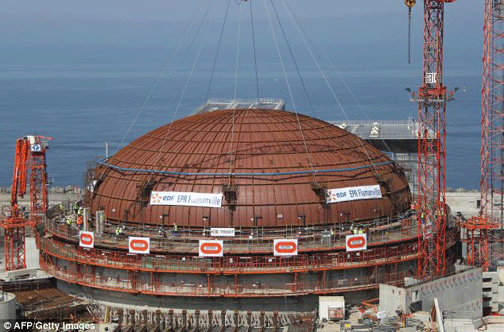
France’s Revolutionary Nuclear Reactor Is a Leaky, Expensive Mess
With a bloated budget, endless delays, and shoddy construction, EPR looks like a big mistake. BY CAROLINE DELBERT, AUG 3, 2020
- A revolutionary French reactor design is 10 years overdue and nearly four times over budget.
- Taking big technology swings requires risk, but this huge miscalculation looks bad.
- The reactor uses less uranium and aims to replace a decommissioned reactor at an existing plant.
France’s new energy minister has called a major French nuclear project “a mess” in public interviews. The European pressurized reactor (EPR) that was commissioned for the Flamanville nuclear power plant, where it joins two existing pressurized water reactors, has been delayed and plagued by problems. The latest extension takes the project timeline from 13 years to 17 at least.
The goal with the EPR design was to continue to kit out the world’s highest-output nuclear plants, with individual reactors that were more powerful and safer. The EPR uses less uranium because its chemical design is more efficient. And it’s not any kind of major technological leap; instead, it’s an iteration on a previous design that’s just a little bit better.
The engineers are so eager to keep iterating that they already have an EPR 2 design in the works. This sounds pretty straightforward … right?
That puts Flamanville 10 years past its original due date. One of the more alarming causes for delay is a break in the “main secondary system penetration welds,” which has contributed to a budget that’s bloated from a planned $3.9 billion to $14.6 billion.
Barbara Pompili was just appointed France’s minister of ecological transition, which is the department that includes energy as well as environmental issues like biodiversity. Pompili is publicly and avowedly anti-nuclear, even for civilian energy. With a new spotlight on her office, she told a French radio station, “We have made a commitment to reduce the share of nuclear power to 50 [percent] by 2035.”
Pompili said the critiques of Flamanville’s overdue EPR reflect broad industry consensus from different reports, not her own anti-nuclear views.
Ballooning by $billions – UK’s costs for its nuclear weapons
 The Ferret 2nd Aug 2020 The cost of UK programmes to replace Trident and nuclear submarines on the
Clyde increased by over £1 billion in a year, according to data released
by the Ministry of Defence (MoD).
The construction of new reactor cores,
replacement submarines and major new facilities at the Faslane and Coulport
bases in Argyll are also facing prolonged delays, with growing doubts over
whether some projects can be successfully delivered.
Most of the delays are
unrelated to the coronavirus pandemic. Four major nuclear projects have
been officially rated as “amber” or worse, meaning that they have
“significant issues”. Two have been “rebaselined” by the MoD,
meaning that costs have risen significantly and timescales lengthened.
https://theferret.scot/trident-nuclear-submarine-costs-1bn-delays/
The continuing and ever more expensive saga of Britain’s Hinkley Point C nuclear project

Times 3rd Aug 2020, The first thing you notice as you approach Hinkley Point C is the sea of
cranes. There are dozens of them, jutting into the Somerset sky from the
site where EDF, of France, and CGN, the Chinese state nuclear group, are
building Britain’s first new nuclear plant in a generation. One stands
out: a 250 metre-tall yellow beast known as “Big Carl”. It is the
world’s largest crane and is central to the companies’ battle to
deliver the project successfully.
£18 billion, the plant was slated to generate its first power before the
end of 2025. Four years on, the budget has risen to between £21.5 billion
and £22.5 billion and EDF says that there is a risk that first power may
be delayed until 2027, adding £700 million in costs; thanks to disruption
from Covid-19, that risk is now “high”.
another big risk, with EDF warning last week that productivity at the site
and in supply chain factories were still being affected. The company said
that it had done what it could to minimise delays, from bringing in extra
buses to transport workers to sending contractors to France to bring back
parts from a factory laid low by the pandemic. EDF believes that it can
catch up on Covid-19 delays by the end of next year, so long as operations
and its supply chain are back to normal by the end of 2020. How confident
was Mr Crooks that the plant would start up in 2025 as planned?
“There’s a long way to go yet. It is a big, complex project.”
https://www.thetimes.co.uk/article/no-let-up-in-heavy-lifting-at-hinkley-point-plant-3s02wmscp
Chinese minority owner of Hinkley nuclear project appoints CEO from China’s military area
New head of Chinese investor in Hinkley nuclear plant brings military links
China General Nuclear’s role in the Hinkley Point C nuclear power station has come under scrutiny recently
Telegraph ByEd Clowes1 August 2020 China General Nuclear, the
minority owner of the Hinkley Point C power station, has appointed a chairman with close ties to the Chinese Communist Party and the country’s military nuclear programme.
leader of the state-owned conglomerate last week, speaking on the virtues
of Communism and the value of a strong nuclear industry. He previously
served as deputy general manager at China National Nuclear Corporation, the
organisation responsible for developing the country’s nuclear weapons.
and called on his colleagues to build a company that was more infused with
Communist ideals.
strategy held at its own university, which is designated as an official
Communist Party school. Mr Changli spoke of “in-depth implementation of
general secretary Xi Jinping’s important expositions on high-quality
development”, and said: “We must be good commanders and good
combatants.” CGN owns a 33.5pc stake in the £22.5bn Hinkley Point C
project in Somerset where it has partnered with EDF, the French energy
giant.
Westminster and stoke speculation that the civil nuclear company will be
merged with CNNC.https://www.telegraph.co.uk/business/2020/08/01/new-head-chinese-investor-hinkley-nuclear-plant-brings-military/
1 This Month





PLEASE OPPOSE HR 8255 AND S.3639 – bills would accelerate satellite deployment, with no environmental review or safeguards – https://ncstd5li.quorum.us/campaign/169331/
To see nuclear-related stories in greater depth and intensity – go to https://nuclearinformation.wordpress.com
-
Archives
- October 2026 (49)
- September 2026 (339)
- August 2026 (330)
- July 2026 (355)
- June 2026 (287)
- May 2026 (306)
- April 2026 (356)
- March 2026 (251)
- February 2026 (267)
- January 2026 (308)
- December 2025 (358)
- November 2025 (359)
-
Categories
- 1
- 1 NUCLEAR ISSUES
- business and costs
- climate change
- culture and arts
- ENERGY
- environment
- health
- history
- indigenous issues
- Legal
- marketing of nuclear
- media
- opposition to nuclear
- PERSONAL STORIES
- politics
- politics international
- Religion and ethics
- safety
- secrets,lies and civil liberties
- spinbuster
- technology
- Uranium
- wastes
- weapons and war
- Women
- 2 WORLD
- ACTION
- AFRICA
- Atrocities
- AUSTRALIA
- Christina's notes
- Christina's themes
- culture and arts
- Events
- Fuk 2022
- Fuk 2023
- Fukushima 2017
- Fukushima 2018
- fukushima 2019
- Fukushima 2020
- Fukushima 2021
- general
- global warming
- Humour (God we need it)
- Nuclear
- RARE EARTHS
- Reference
- resources – print
- Resources -audiovicual
- Weekly Newsletter
- World
- World Nuclear
- YouTube
-
RSS
Entries RSS
Comments RSS

