UKRAINIAN NEOFASCISM – War Time Developments: Part 1 ‘Azov’ and Part 2 ‘Right Sector’
by Gordonhahn, September 5, 2025
Neo-fascism and ultranationalism may not have been the most powerful element in Ukraine or even among Ukrainian nationalists before the NATO-Russia Ukrainian War, but they are almost certainly so now, and they are becoming increasingly powerful military-politically, culturally, and ideologically.
Ukraine’s neofascists have never been satisfied with the Maidan revolt, despite their pivotal role in overthrowing the previous oligarch-dominated order, which the Maidan revolt only replaced in part. They have always looked tot he future and completion of the ‚nationalist revolution‘, as they call it. A few years ago, Dmitro Yarosh, founder and then leader or “coordinator’ of Ukraine’s neofascist Right Sector (RS) and later advisor to now fired Ukrainian Armed Forces Commander, Gen. Valerii Zaluzhnyi, who is now Kiev’s ambassador to the UK, promised there would be a ‘second phase of the nationalist revolution’ of which the February 2014 Maidan revolt was supposedly but the first.
The second phase is to sweep away the liberal and oligarchic remnants of the pre-Maidan democratic order brought into the Maidan regime, in Yarosh’s view. Yarosh recently repeated his call for the completion of the neofascist revolution on his Facebook page: “As it turned out, during the Dignity Revolution and the Russian-Ukrainian War, Ukrainian nationalists became the main factor in the Ukrainian national-liberation struggle in the 21st century… I am a Ukrainian Nationalist – sounds proud both in Ukraine and across the world. The next power after the War for Independence should be nationalist. Otherwise, we will once again be led down an unbreakable cycle of national humiliation, corruption, degeneracy, moral degradation, economic decline, inferiority and defeat… Therefore, after the War for Independence, the wise, courageous and noble should rule in Ukraine. Glory to the Nation!”
Similar views are held by Ukraine’s many other ultra-nationalist and neo-fascist groups and their leaders, and they have been waiting for the moment to complete their revolution. The catastrophe of the war, its outcome, and consequences are bringing their dream ever closer to reality. These factors alone could assist the neo-fascist’s rise to power, even if only temporarily.
There once was a time when the West acknowledged Ukraine’s neofascist threat to republican rule, even as it helped armed, trained, and equipeed the neofascists‘ cocoons, the siloviki –, i.e. the Ukrainian military, SBU, and HRU. The de facto NATO think tank, the Atlantic Council, at the time noted:
Since the beginning of 2018, C14 and other far-right groups such as the Azov-affiliated National Militia, Right Sector, Karpatska Sich, and others have attacked Roma groups several times, as well as anti-fascist demonstrations, city councilmeetings, an event hosted by Amnesty International, art exhibitions, LGBT events, and environmental activists. On March 8, violent groups launched attacks against International Women’s Day marchers in cities across Ukraine. In only a few of these cases did police do anything to prevent the attacks, and in some they even arrested peaceful demonstrators rather than the actual perpetrators.
“International human rights groups have sounded the alarm. After the March 8 attacks, Amnesty International warned that “Ukraine is sinking into a chaos of uncontrolled violence posed by radical groups and their total impunity. Practically no one in the country can feel safe under these conditions.”[1]
Below I look at the political and cultural role neofascist groups have been playing in Ukraine, particularly since the beginning of the NATO-Russia Ukrainian War. In this Part 1, I begin with the most powerful and influential neofascist structure, Azov. No other neofascist or other fporm of Ukrainian group has seen its power and influence in the state and society be so enhanced over the last decade and certainly since the beginning of the beginning oft he NATO-Russia Ukrsainian War. Indeed, Azov’s leader, Andriy Biletskiy could very well be Ukraine’s next president and become so in the not too distant future.
Part 1: Azov
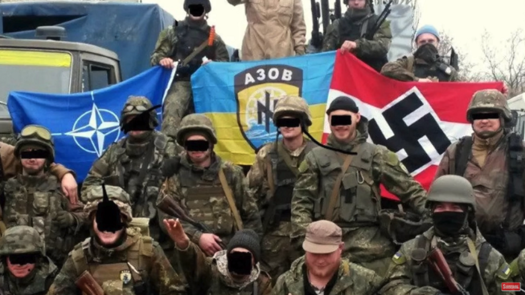
The Azov Battalion emerged from the Nazi-inspired Social-National Assembly (SNA) founded by Andriy Biletskiy, now commander of the Ukrainian army’s 3rd Separate Assault Battalion ‘Azov’. Azov’s rise along with its politics and ideology have much in common with Adolph Hitler’s Waffen SS.[2] Prior to running the SNA, Biletskiy led the equally ultra-nationalist ‘Patriots of Ukraine,’ the military wing of the Ukrainian National Army, self-procliamed successor to the Nazi-allied outfir of the same name during World War II. The ‘Patriots were infamous their beatings of immigrants. In a 2010 interview Biletskiy described his organization as nationalist “storm troopers.[3][4] A year later Biletskiy was in prison, after his organization—already renamed the SNA—had been involved in a series of shootouts and mass brawls.
The SNA’s, Azov’s, and Biletskiy’s ideology is an extremist brand of Ukrainian neofascism melded with international white supremacism. The SNA program emphasizes the concept of “nationocracy,” which was later incorporated into the RS program and propaganda courses. The SNA in power would ban all political parties, organizations, associations and ideological groups, so the ethnic Ukrainian elite holds full power: “Political power is wholly owned by the Ukrainian nation through its most talented, idealistic and altruistic national representatives who are able to ensure proper development of the nation and its competitiveness.” “Supreme power (executive, legislative and judicial) of the Ukrainian state will be in the hands of the head of state, who is personally responsible to the nation’s own blood and property.” Capitalism is to be “dismantled” and democracy is to be “eliminated.” All actions that fail “to comply with obligations to the nation and the state will entail the restriction of civil rights or deprivation of citizenship … The ultimate goal of Ukrainian foreign policy is world domination.”[5]
In 2007, Azov’s ideology is reflected in its leaders statements. Top leader, commander Biletskiy, castigated a government decision to introduce fines for racist remarks, noting: “So why the ‘Negro-love’ on a legislative level? They want to break everyone who has risen to defend themselves, their family, their right to be masters of their own land! They want to destroy the Nation’s biological resistance to everything alien and do to us what happened to Old Europe, where the immigrant hordes are a nightmare for the French, Germans and Belgians, where cities are ‘blackening’ fast and crime and the drug trade are invading even the remotest corners.”[6] Biletskiy has also said: “The historic mission of our nation in this critical moment is to lead the White Races of the world in a final crusade for their survival. A crusade against the Semite-led Untermenschen.”[7] In 2017, Biletskiy gathered his men in order to express Azov’s support for former Bosnian Serb military officer and convicted war criminal, Ratko Mladić, running directly counter to Western policy. Mladic was held responsible by a Western-sponsored war tribunal at the Hague for war crimes during the Yugoslav civil wars in the 1990s, including the Srebrenica massacre. Biletsky declared Mladić a “patriot of Serbia” and refers to the Iinternational Criminal Tribunal for Yugoslavia in the Hague as a “Zionist tribunal.”[8] More recently, in May 2025 Biletskiy claimed that Hungary, Poland, and Romania are waiting for Ukraine’s collapse so they can annex their former territories that became part of Ukraine under Sdtalin in the wake of the USSR’s victory over fascism: “They are not preparing for war. They are preparing to take their own scraps in the event of a global defeat of Ukraine,” he asserted.[9]`
On the basis of Azov, Biletskiy founded the National Corps with an affiliated paramilitary organization ‘National Teams.’ One of the points of Biletskiy’s foreign policy vision and of National Corps’ program is the creation of a union of countries called the ‘Intermarium’, which would include, among others, Ukraine and Poland – an idea also propagated by many Western apologists and supporters of Ukrainian neofascism. However, Poles, as victims of the OUN’s and UPA’s massacres 80 years ago in Volyn and elsewhere, do not shy away from noting Azov’s neofascism. They point out that Azov members eagerly use Nazi symbols, including the „Dirlewanger“ of the 36th SS Grenadier Division, which massacred Poles in Warsaw’s Wola during the Warsaw Uprising.[10] And, as noted above, Biletskiy recently accused Poland, along with Hungary and Rumania, with having designs on Ukrainian territory……………………………………………………………………………………….
The NATO-Russia Ukrainian War is strengthening Azov’s hand in Ukraine’s army, politics, and culture. In the course of the war, the Azov Battalion was incoroprated into the army, becoming the Ukrainian army’s 3rd Separate Assault Brigade, while retaining a brigade in the National Guard (the 12th National Guard Brigade), into which it was originally incorporated. Azov also has another military unit, known as ‚Kraken‘, under the control of Ukrainian Military Intelligence (GRU) and its director, the CIA-trained Kyrylo Budanov. Kraken has been involved in a series of war crimes, including the execution of captured Russian soldiers. This year,the 3rd Assault Brigade ‚Azov‘ was upgraded further to become the Third Army Corps ‚Azov‘.[18]Thousands of new soldiers will be integrated into Azov, and a special training school for sergeants established for it will inevitably indoctrinate recruits with ultra-nationalist ideology. Azov 3rd Assaualt Corps‘ founding ceremony, replete neo-Nazi pagan-like symbolism, was held near Kyiv and attended by Biletskiy and his fellow commanders. Participants offered “The Prayer for Ukraine,” a hymn borrowed from the neofascist, antisemitic OUN, whiuch enthusiastically collaborated with the Hitler’s Nazis in the Holocaust and ethnic cleansing of Poles during World War II.[19] The new commander of Azov’s 3rd Assault Brigade, Yaroslav Levenets, appointed in April-May, recently met Zelensky in an awards ceremony. He allegedly helped to organize the 2017 killing of Denis Voronenkov, a former member of the Russian parliament. As of December 2021, Levenets was still wanted in Ukraine.[20] Aside from the army’s and therefore Azov’s growing role in Ukrainian society as a result of the war, Azov maintains a youth organization called ‘Centuriya’, which networks Azov across Ukrainian society in schools, children’s camps, and sports clubs.
According to Havryshko, Azov benefits from „enormous media presence“ and university support in Ukraine and uses „celebrity journalists and media experts to create a glamorous image of their units.“[21] Indeed, Biletskiy, other leaders and members appear frequently on mainstream television and other media. Ukrainian and foreign media propagate Azov’s units as „true patriots“ and “elite brigades,” respectively, whereas in the West before the war there was significant reporting on Azov‘s and other Ukrainian groups‘ neofascist political orientation and ideology. …………………
With this media and academic network, Azov is able to insinuate neofascism into every knook and cranny of Ukrainian society. For example, it has been at the forefront of a campaign to slander and threaten the life of a leading scholar of historical and contemporary Ukrainian neofascism, Professor Marta Havryshko of Clark University in Massachusetts, running her out oft he country. As a result of the campaign Havryshko was fired from her position in the Kripyakevich Institute for Ukrainian Studies for her research on various aspects of this subject inculding the violence committed by the WW II-era Ukrainian fascist organizations OUN and UPA allied with Nazi Germany, contemporary Ukrainian glorification of Ukraine‘s Waffen-SS division “Galicia”, and her rejection of ultra-nationalist driven history policies. ………………………………………………………………………………………………………………………………………………………….. https://gordonhahn.com/2025/09/05/ukrainian-neofascism-war-time-developments-part-1-azov-and-part-2-right-sector/
Trump Is Renaming the Defense Department the Department of War

President Trump will sign an executive order on Friday renaming the Department of Defense the Department of War, the White House said, fulfilling his pledge to realign the military’s mission by restoring the name the agency held until shortly after World War II……………… (Subscribers only) https://www.nytimes.com/2025/09/04/us/politics/trump-department-of-war-defense.html?campaign_id=190&emc=edit_ufn_20250904&instance_id=161936&nl=from-the-times®i_id=60047519&segment_id=205306&user_id=432fc0d0ad6543e820e2dfcd39f76c35
Golden Dome is already a turning point for American space policy.
As the space community awaits the upcoming deadline for a Golden Dome architecture, perhaps the biggest story on Golden Dome is how the program is resonating through the industry.
Last month, a new report by the Aerospace Corporation’s Center for Space Policy and Strategy identified Golden Dome (and its prominence within the Trump administration’s fiscal year 2026 defense budget request) as a significant turning point for American space policy, Pentagon spending priorities and the role of the Space Force.
The report said that “the introduction of Golden Dome is arguably the most important development affecting the defense space budget since the inception of the Space Force.”
As SpaceNews’ Sandra Erwin wrote:
For the relatively young Space Force, established in 2019, Golden Dome represents a significant expansion of resources and responsibilities. Sam Wilson, budget analyst at the Center for Space Policy & Strategy and author of the report, views the initiative as creating “a major opportunity for the Space Force as it brings extra resources for some of Space Force’s priorities such as missile warning satellites that the service already was planning to develop.”
“This is an opportunity to get those funded at higher levels,” Wilson told SpaceNews.
The article describes how Golden Dome’s prominence – and the level of attention paid to it – is elevating space issues within broader defense planning. It’s also a program that could benefit new and old space firms alike while calling broader public attention to the military’s role in and influence over space.
Investors feel the same. A note from Capital Alpha Partners this week highlighted that “Golden Dome gave something new for U.S. contractors to talk about and position for,” but so far details are scarce. At last month’s industry summit in Huntsville, Alabama, defense firms got little more than high-level overviews.
“Even if it’s classified, clarity on the architecture may provide something more meaningful for companies to discuss in the October-November earnings season,” the Capital Alpha note read….(Read more at link –
https://spacenews.bluelena.io/index.php?action=social&chash=980ecd059122ce2e50136bda65c25e07.830&s=d7cea81a8b3dc478fa14dbee41fab337)
Secret antisemitism research. Australia’s Envoy Jillian Segal hides evidence?
by Emma Thomas | Aug 31, 2025 https://michaelwest.com.au/secret-antisemitism-research-envoy-jillian-segal-hides-evidence/
Jillian Segal, the government-appointed Special Envoy for Antisemitism, has refused to answer questions from the NSW parliament about her plan. Emma Thomas reports.
The Special Envoy’s Plan to Combat Antisemitism has been heavily critiqued since it was released last month. The plan proposes a suite of interventions across government and civil society, including allowing the Special Envoy to weigh in on immigration issues and to ‘monitor’ public media.
Among the plan’s more controversial (and impractical) recommendations is a proposal to withhold government funding from universities and arts bodies that fail to meet the Special Envoy’s criteria.
Since the plan’s release on 10 July, critics have denounced it as “authoritarian”, “insulting”, designed to “enforce ideological conformity” while risking “deepening community divisions.” The plan is marred by a “biased argument”, “weak evidence”, and silence on Gaza and is “simultaneously too thin [on facts…] and overblown in its recommendations”, commentators say. It has been labelled “one of the worst public policy documents produced in recent years”.by Emma Thomas | Aug 31, 2025 |
The plan’s architect, Jillian Segal, has meanwhile retreated from public view. This follows her seemingly ill-prepared appearance on ABC on 10 July (coinciding with the release of the plan) and a 12 July report detailing her family trust’s $50,000 donation to the right-wing lobby group Advance, which is known for promoting racism and campaigning against an Indigenous Voice to Parliament.
Last week, however, the Special Envoy responded to a series of questions about her plan posed by the parliamentary committee inquiring into antisemitism in NSW.
Evidence-free policy proposals
The plan’s lack of sources, statistics or citations – that is, any evidence that might support its claims and underpin its proposed policies – has been widely noted and critiqued.
Yet, in her response to the NSW parliamentary inquiry, Segal claimed that there is a “wide base of research” behind her plan, which includes “commissioned surveys, consultations with community organisations, and international comparisons.” The plan, she insists, “is a policy framework grounded in both evidence and expert practice.”
She has, however, refused to provide evidence or publicly release any research supposedly conducted by her taxpayer-funded office, citing “security and privacy reasons.”
When asked specifically about what data or evidence supports her claim of systemic antisemitism in Australia’s public sector, Segal simply reasserted the claim that “There is clear evidence of antisemitic discrimination in parts of the public sector.” Although she provides none, she suggests the committee “review publicly available data.” Again, no such data was provided.
When asked for evidence of “foreign funding” supporting “clusters of antisemitism” in Australian universities, Segal pointed only to “credible concerns” that this “could” be happening. Pressed for specific examples of universities failing to act against antisemitism or of media outlets presenting “false or distorted narratives”, she again provided none. Instead, she described that plan as “proactive” and “precautionary”.
Neither in her plan nor in her responses to the NSW inquiry does Segal cite a single study, piece of evidence or expert assessment, from either the national or international context, that might support the efficacy of her plan to combat antisemitism. It’s possible that there are none.
No evidence for IHRA’s effectiveness
Segal’s plan hinges on Australia’s widespread adoption and application of the International Holocaust Remembrance Alliance (IHRA) working definition of antisemitism – “including its illustrative examples”.
The 11 illustrative examples are highly contested because seven of them relate to criticism of the State of Israel, whose prime minister is currently wanted by the International Criminal Court for war crimes and crimes against humanity.
The examples are so contentious that IHRA’s decision-making body, the Plenary, itself has not endorsed them as part of the definition. IHRA itself describes the examples only as “illustrations” that may guide the organisation’s own work. Segal’s suggestion that the definition, along with the examples, be “required” across all levels of government, public institutions and regulatory bodies
“goes well beyond IHRA’s own framework”.
First published in 2005 by the European Union agency, the European Monitoring Centre on Racism and Xenophobia, the definition was intended for use in data collection, not policymaking. In 2013, the definition was abandoned. It was repackaged as the “IHRA’s non-legally binding working definition of antisemitism” in 2016.
In the nine years since the definition’s adoption by IHRA, no evidence has been provided that it is effective in combating antisemitism – not in Segal’s plan, nor in external studies,
There is, however, a wealth of academic and legal critique showing that the definition fosters self-censorship and penalises speech on Israel’s violations of international law and advocacy for Palestinian rights. The definition’s efficacy – like that of Segal’s proposed plan – lies in the “proactive” and “precautionary” implementation. And as historian Avi Shlaim states, it
“has little to do with antisemitism.”
Emma ThomasDr Emma Thomas is a researcher and writer based in the Greater Sydney area. As a historian, she has spent the last fifteen years studying and teaching at universities in Australia and the United States. One of the first things she teaches all her students is that opinions and evidence-based arguments are not the same thing.
China’s SCO Summit Highlights West’s Growing Ideological Isolation, + Zelensky’s Desperate Gambit

On the Ukrainian-political front, it’s obligatory to note that Trump’s two-week deadline has now expired. He had threatened some kind of consequences for Russia, and predictably there aren’t any, though he has now hinted that he has “learned something very interesting” about the war that he will reveal in the next few days—likely another made-up deflection to buy himself time.
Simplicius, Sep 03, 2025
Last week Zelensky made the curious decision to open up the borders to Ukraine’s 18-22 year old males. The decision was met with both approval and disgust in different quarters of the country:
“We say:” Those who are not in the army, you are 18-22, you can leave the country, no one is holding you, you are cool guys.” And we go back to the army, we say: “You are slaves. Listen to what you will do and when, how much you will fight in this army, ” said the deputy of the Kiev City Council, an officer of the Armed Forces of Ukraine Alexander Pogrebissky in an interview with a Ukrainian TV channel.
The bigger question is why did Zelensky “liberate” such a vital age group at a time when manpower is at critical lows on the front? Astute observers have noted it wasn’t simple coincidence that the decision came mere weeks after the NABU investigations and decision reversal. More importantly, it came weeks after Ukraine’s youth took to the streets in protest against Zelensky, in what appeared at times to be a new Maidan in the making.
The natural conclusion, then, is that Zelensky was forced to loosen the check valve on society, letting off some pressure from himself and allowing the most dissenting and anti-war 18-22 year-olds to flee the country so that they’re not able to form up a rebellious vanguard to create a political headache for Zelensky.
Even Le Monde leaned toward this natural angle:
The timing of the new regulation is not insignificant. It comes just over a month after the Ukrainian government tried to strip two anti-corruption agencies of their independence, on July 22. Thousands of young people protested in several Ukrainian cities for days, until the presidency backtracked and passed a law restoring the agencies’ autonomy.
The fact that Zelensky himself raised the issue of allowing 18- to 22-year-olds to leave the country, on August 12 during a youth forum, was a strong political signal. “I think the president was trying to make amends with the younger generation by granting them some benefits,” said Sovsun. MP Bohdan Yaremenko, a member of Zelensky’s party, shares this view: “There will probably be more similar actions in the future to reach out to young people.”
It’s interesting that the 18-22 cohort was chosen, whereas 23-24 year olds are still prohibited from leaving given that they’re on the cusp of the critical age of 25 to which mobilization was lowered.
Across Ukraine, there are growing signs of the lack of young males. This photo [on original] was posted by a professor at a Kiev university, reportedly showing a class overflowing with young females:
NO BOYS – NO MEN:
Andrey Dlyhach, a lecturer at the Faculty of Economics of Taras Shevchenko National University of Kyiv, published a photo of the first-year students, showing that the overwhelming majority of the students are girls.
“You wanted to say something else with this photo, but what I see there are the consequences of 3 years of closed borders for men aged 18+,” comments economist Gleb Vyshlinsky on the photo.
Other people reportedly chimed in in the comments, posting photos of similar gender disparities in their own schools across Ukraine.
There are other possible deductions to make about Zelensky’s sly decision. We can hypothesize on the following:
- Zelensky sees the negotiations and peace track as being definitive such that he does not expect the war to last and does not see the need for the eventual tapping of the 18-22 cohort.
- The political danger to Zelensky was so great—more so than even we know of—that he needed a boost to his image in order to restore some semblance of control. This also has to do with the quiet initiations of Zaluzhny’s political campaign—this could be Zelensky’s attempt to win back favor with society to increase his poll numbers and fortify himself against potential challengers.
- Ukraine’s ‘recruitment problems’ are not as bad as we were led to believe, and its authorities are confident they can sustain military manpower regeneration even without the 18-22 cohort.
More than likely, Zelensky weighed the options and viewed the tradeoff as favorable. Crunching the numbers, his team likely concluded it was worth the long term risk to manpower in order to secure the short term political viability of Zelensky’s rule.
On the Ukrainian-political front, it’s obligatory to note that Trump’s two-week deadline has now expired. He had threatened some kind of consequences for Russia, and predictably there aren’t any, though he has now hinted that he has “learned something very interesting” about the war that he will reveal in the next few days—likely another made-up deflection to buy himself time.
Trump “seems to have run out of ideas regarding the advancement of the peace process” in Ukraine, as his latest two-week deadline has expired, and the meeting between Putin and Zelensky that he wanted has not taken place, writes The Times newspaper.
In reality, Putin is presently hitting his stride as celebrated guest in Beijing where the Global South power-players are convening to showcase just how little the wretched ‘Western world’ matters anymore:
In the grand ebb and flow of the Ukrainian negotiations cycle, we’re in a kind of waning phase, with no real initiatives or urgency at the moment as all involved parties have essentially gotten fatigued from the same old copy-pasted carousel of banality and deadend options……………………………………………………………………………
two clashing systems of ideologies: one that elevates war and domination—what Xi called hegemonism in his earlier SCO speech—to the status of national religion, while the other seeks to unite the world in mutual development, and most importantly, shared respect……………………….. https://simplicius76.substack.com/p/chinas-sco-summit-highlights-wests?utm_source=post-email-title&publication_id=1351274&post_id=172310012&utm_campaign=email-post-title&isFreemail=true&r=rq5yc&triedRedirect=true&utm_medium=email
The final furlong: EDF announces further lifetime extension for aging AGR reactors

Britain’s aging Advanced Gas Cooled reactors may, like exhausted
racehorses, be on their last legs, but operator EDF Energy is clearly
intent on keeping them running for as long as possible.
The company
announced yesterday a twelve month extension in operations at their Heysham
1 and Hartlepool AGR plants until March 2028, citing the retention of jobs
and a desire to contribute to the UK achieving net zero and energy security
– but the NFLAs suspect a more pressing motivation.
In a comment to
industry media, NFLA Secretary Richard Outram said: ‘The EDF announcement
is unsurprising. Although company bosses may crow a lot about the
preservation of local jobs, the NFLAs suspect this is about the
preservation of EDF’s bottom line. ‘Given the parlous state of the
French parent company’s finances, the intermittent output of the domestic
fleet, and the vast overspend on Hinkley Point C, EDF have a clear
incentive to keep open for as long as possible any nuclear plant in their
portfolio which operates and generates profits.’
Dr Ian Fairlie, an
independent consultant on radioactivity in the environment and a former
advisor to the UK Government and European Parliament, is also sceptical as
to EDF’s motives: “The real reason why French parent company
Électricité de France wants to prolong the lives of their obsolete,
past-it, reactors is financial.
NFLA 3rd Sept 2025, https://www.nuclearpolicy.info/news/the-final-furlong-edf-announces-further-lifetime-extension-for-aging-agr-reactors/
U.S. Government Is Taking Historic Steps To Restart Nuclear Plants
The Nuclear Regulatory Commission is considering allowing a Michigan
nuclear plant to restart after approving in July its first such plant
resumption with Palisades Nuclear Plant to increase U.S. energy output for
data centers. The NRC held a series of public meetings from July 31 through
August 6 to gather feedback about enabling a restart of a former Three Mile
Island Unit 1 that permanently stopped operating after 40 years in
September 2019.
Forbes 28th Aug 2025, https://www.forbes.com/sites/noelfletcher/2025/08/28/us-government-is-taking-historic-steps-to-restart-nuclear-plants/
East Lothian Council calls for a study into new nuclear at Torness
EAST Lothian Council will ask the UK Government to carry out a study into
the possibility of creating a new nuclear power station at Torness. The
Council will ask the UK Government to fund the study. The Tories and Labour
supported the motion; SNP and Greens opposed it.
Musselburgh Courier 28th Aug 2025, https://www.pressreader.com/uk/musselburgh-courier-SAXC/20250828/281548002004589
Why won’t 519 other congresspersons join Rep. Marjorie Taylor Green and 13 other congresspersons in condemning US enabled Israeli genocide in Gaza?
Walt Zlotow, West Suburban Peace Coalition, Glen Ellyn IL, 29 Aug 25.
Only 14 of Congress’s 533 members (2 vacancies) are correctly calling Israel’s genocide in Gaza… genocide and calling for end to all US weapons fueling that genocide.
The most impassioned and articulate in condemning the most grotesque US foreign policy in its 250 years is Georgia Republican Marjorie Taylor Green. She doesn’t hold back while the 519 congresspersons who dare not jeopardize their standing with the Israel Lobby cower in the background. “I don’t know about you, but I don’t want to pay for genocide in a foreign country against a foreign people for a foreign war that I had nothing to do with. And I will not be silent about it.”
Greene is an outlier in the Israeli genocide loving Republican Party. All 272 other Republicans in the House and Senate want nothing to do with Greene’s principled stance.
Democrats are just a tad better. The other 13 congresspersons condemning Israel’s genocide and calling or end to all US weapons fueling it are Democrats. But that is only 5% of 260 Democrats in Congress, a sorrowful indictment of the so called progressive party. Supporting genocide is not progressive. It is ghastly.
My peace organization West Suburban Peace Coalition in Glen Ellyn IL in the IL 6th District, reached out to our Congressman Sean Casten in January, 2024 and this month on Zoom regarding the genocide. He refuses to join the morally centered congresspersons calling the genocide what it is and demanding end to all genocide weapons to Israel. He continues to claim he’s “doing everything he can to end the suffering of the Palestinian people.” Nonsense, he doing nothing except engaging in ‘happy talk’ designed to lull his constituents into believing he cares about a people being wiped out of their homeland with his tacit cooperation.
My appeal to Congressman Casten including this appropriate warning. “Congressman Casten, please do not let ignoring the genocide you surely know is happening remain a stain on your congressional resume for one more day during your congressional career.”
Sadly, my Congressman Sean Casten remains in league with the other 518 congresspersons who refuse to stand up against the Israeli genocide their government, of which they are members of and are complicit with, is supporting.
Is the UK’s giant new nuclear power station “unbuildable”?

The design of the UK’s latest nuclear power station is “terrifying”,
“phenomenally complex” and “almost unbuildable”, according to Henri
Proglio, a former head of EDF, the French state-owned utility behind the
project.
One month after the final green light for Sizewell C, 1,700
workers are on site in Suffolk, on the UK’s east coast, preparing the
sandy marshland for two enormous reactors that will eventually generate
enough electricity for 6mn homes. The plant will be a replica of the
European Pressurised Reactor (EPR) design that is running four to six years
late and 2.5 times over budget at Hinkley Point C in Somerset, which has
had problems wherever it has been built, in France, Finland and China.
But unlike at Hinkley, where EDF was responsible for spiralling costs and took
a hit of nearly €13bn after running late and over budget, the UK
government and bill payers are on the hook for Sizewell. The state will
provide £36.5bn of debt to fund the estimated £38bn price tag and be
responsible if costs go beyond £47bn
“Being able to build an EPR in the
timeframe, with the planned costs? I don’t think so,” Proglio, a critic
of the design, told the Financial Times. “The EPR is a machine that is
phenomenally complex to build, with more rebar than concrete, it is
terrifying . . . it’s almost unbuildable. As long as the design has
not changed, the difficulty of building will not have changed either.”
FT 27th Aug 2025,
https://www.ft.com/content/ee89bce2-a3e9-48ed-82eb-85916eb24777
Peace in Ukraine spells disaster for mainstream political parties in Europe.

we are living in an era of high debts and constant pressure for cuts, while carrying on funnelling billions into Zelensky’s life ending gravy train. It’s quite remarkable.
In discussion with Jamarl Thomas
Ian Proud, Aug 27, 2025 https://thepeacemonger.substack.com/p/peace-in-ukraine-spells-disaster?utm_source=post-email-title&publication_id=3221990&post_id=172084456&utm_campaign=email-post-title&isFreemail=true&r=1ise1&triedRedirect=true&utm_medium=email
I enjoyed talking today for the first time to Jamarl Thomas, an American commentator, currently living in Indonesia (a country I have a soft spot for from my time as Head of the Indonesia and East Timor Section at the start of my Foreign Office career). The conversation covers the first 45 minutes of the video.
We covered the normal topic – Ukraine. I set out my view that peace in Ukraine spells disaster for mainstream political parties in Europe, because they would have to admit a massive foreign policy blunder in the face of a rising tide of nationalism, including in the UK, Germany and France.
Of course, cutting their losses now and pushing Zelensky to sue for peace would increase their chances to repairing the damage before the next rounds of elections. Instead, they are pushing increasingly unsustainable policies, including massive welfare upheaval in Germany at a time when that country wants to boost defence spending by 100bn Euros per year by 2029! Britain, apparently, is edging closer to an IMF bailout – I personally think that story is overblown by the right wing media in the UK. However, we are living in an era of high debts and constant pressure for cuts, while carrying on funnelling billions into Zelensky’s life ending gravy train. It’s quite remarkable.
Partly, this is a bi-product of the erosion of democracy in Europe, characterised best by the ever centralising tendencies of the European Institutions.
Keir Starmer may wonder why his seemingly unassailable lead has been gobbled up by Reform (who, by the way, I’d personally never vote for). Rather than worry about English people putting up English flags, he might wonder whether, in fact, British voters want him to put British interests first.
Seems obvious, right? Clearly not, though..
I hope you find the discussion interesting. Also note I am setting up a new area in my study for podcast interviews which is a bit more personal.
The red plate over my shoulder is my Diplomatic number plate from Moscow.
Indonesia Bets On Thorcon’s Molten Salt Reactor, But History Suggests Trouble Ahead.
Indonesia has none of the ingredients that historically led to nuclear success. It has no prior nuclear fleet, no experience operating reactors, no large-scale nuclear workforce, no plans to build nuclear weapons and no tradition of standardized reactor builds.
Michael Barnard, Clean Technica, 27 Aug 25
Indonesia has taken a bold and likely problematic step with the announcement of its first, early stage regulatory approval for a nuclear power project. Thorcon International, a Singapore-based developer of molten salt reactors, has received permission from Indonesia’s regulator to evaluate a site for a demonstration plant on Kelasa Island. For a country of more than 270 million people with electricity demand that is still growing rapidly, this might appear to be a turning point. Yet if one examines history, technology, and the context in which this project is being launched, the chances of it succeeding look vanishingly small.
Indonesia is the world’s largest archipelago, stretching across more than 17,000 islands, with only about 6,000 of them inhabited. This geography creates enormous challenges for the national grid, which is fragmented into multiple regional systems rather than a single interconnected backbone. Java and Sumatra host most of the country’s transmission infrastructure, while many outlying islands depend on small isolated grids. Remote communities often rely on diesel generators for electricity, which are expensive to operate and create significant local pollution…………………………………………………………….
the government has announced a target of 10 GW of nuclear capacity by 2040, marking its first commitment to nuclear power.
If delivered, these additions would lift renewables to roughly 35% of the national mix while also introducing nuclear into the system for the first time. Looking further ahead, Indonesia targets 75 GW of new renewable capacity by 2035, supported by more than 10 GW of storage, reflecting the scale of investment needed to diversify away from coal and meet climate commitments.
Nuclear power has only succeeded when certain conditions were in place. In the mid-twentieth century, large economies aligned nuclear energy programs with nuclear weapons programs. They standardized on one design, built dozens of gigawatt-scale plants in sequence, trained workforces through government-led programs, and maintained focus for decades. Those programs were not efficient by today’s standards, but they were coherent and well-resourced.
Countries that did not follow that formula, such as Canada’s stop-start approach with CANDUs or the the last couple of decades of western nuclear reactor builds, ended up with mixed results and rising costs. Even China, which has mastered megaproject delivery, is struggling with nuclear because it has spread effort across too many designs and has not locked into the necessary standardization. While nuclear advocates in the west point to China’s build out as impressive, it is years behind on targets and falling further behind. It only achieved its 2020 target in 2024, is still well under its 2% of grid capacity target for 2025 and its scheduled construction through 2030 will leave it tens of GW off that target.
Indonesia has none of the ingredients that historically led to nuclear success. It has no prior nuclear fleet, no experience operating reactors, no large-scale nuclear workforce, no plans to build nuclear weapons and no tradition of standardized reactor builds. It’s not building dozens of standard and proven GW-scale reactors, but only 10 GW in total, starting with a 500 MW unproven design, and not necessarily repeating that one solution multiple times. So far they appear to have little political opposition to nuclear, but that doesn’t mean the bipartisan support required for a two to four decade strategic national construction program. The country is signatory to the nuclear Non-Proliferation Treaty and has eliminated highly enriched uranium that might be transferable to nuclear weapons from the countyr, so there is military strategic alignment and discipline to call upon.
The choice of a molten salt reactor adds another layer of difficulty. Molten salt designs were first tested at Oak Ridge in the 1960s. They worked in the lab but ran into issues with corrosion, material embrittlement, plugging of salt lines, and complex chemistry that had to be actively managed. They never scaled beyond a few megawatts of thermal output. In recent years, startups from North America to Scandinavia have revived the concept, promising walk-away safety and lower costs. Yet not a single one has delivered a commercial plant. Thorcon itself has never built or operated a reactor, anywhere. It is proposing to build large sealed modules in shipyards and tow them to Indonesia, an approach that exists only on paper.

……………………………..Germany tried thorium in its pebble-bed reactor, and India built an entire nuclear strategy around its domestic thorium reserves, planning a three-stage cycle that would eventually rely on advanced heavy water reactors fueled with uranium-233 bred from thorium. Yet in every case, thorium stopped short of commercial deployment. The complexity of fuel handling, the need for an initial fissile inventory of uranium or plutonium, and the sheer momentum of the uranium-fueled reactor fleet kept thorium in the category of “promising but not delivered.”
Thorcon’s original vision was built on thorium’s promise. Its very name, short for “Thorium Concept,” signaled an intention to commercialize molten salt reactors running on a thorium cycle. Early designs envisioned dissolving thorium in molten fluoride salt, breeding uranium-233 in situ, and demonstrating the fuel’s long-touted advantages. But as the company moved from concept to trying to build an actual plant in Indonesia, pragmatism set in. For a first-of-a-kind power reactor, relying on thorium would mean untested chemistry, uncertain licensing pathways, and even greater risk.
Indonesia’s proposed demonstration plant is therefore designed to run on conventional low-enriched uranium fuel dissolved in molten salt, not thorium. Thorium remains a potential long-term option in the design, but the Indonesian reactor will take the easier, more familiar path to get the project off the ground. In other words, while Thorcon began as a bet on thorium, its first potential real-world deployment has been scaled back to uranium, underscoring how thorium continues to hover at the edge of nuclear power rather than forming its core.
Bent Flyvbjerg’s work on megaprojects should be a warning. He has shown repeatedly that nine out of ten large projects go over budget and over schedule, and nuclear projects are consistently among the very worst. The average nuclear build is more than 100% over budget and about a decade late. Add in the fact that this is a first-of-a-kind reactor by a company with no track record, in a country with no nuclear infrastructure, and the probability of delivering on time, on budget, and at promised cost of electricity falls close to zero. Even if the project is eventually completed, it will almost certainly take much longer and cost much more than advertised, and the benefits to Indonesia will not match the rhetoric.
The alternative paths are clearer and less risky. Indonesia sits on some of the world’s richest geothermal resources and has significant hydro potential. Solar costs continue to fall and the archipelago has ample land and rooftops for deployment. With investment in storage, interconnections, and grid modernization, these resources could supply reliable and cheap electricity without the risks of nuclear. International partnerships like the Just Energy Transition Partnership are already funneling billions into renewables and grid upgrades. Building out this system is not trivial, but it does not carry the weight of unproven technologies, uncertain regulation, and the specter of megaproject failure that Thorcon does.
……………………..A better bet would be to double down on renewables, expand storage, and build the transmission backbone to connect islands and balance supply. That path has its own challenges but rests on proven technologies already delivering results worldwide. Indonesia has made a bold gesture toward nuclear. The sober assessment is that it will not pay off. https://cleantechnica.com/2025/08/26/indonesia-bets-on-thorcons-molten-salt-reactor-but-history-suggests-trouble-ahead/
How France’s nuclear dream became a financial nightmare
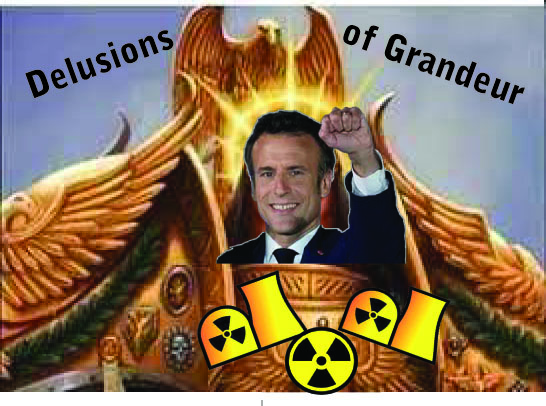
Decades of neglect, spiralling costs and political denial have turned France’s once-vaunted nuclear program into a cautionary tale, writes Jean-Luc Porquet (translated by Dr Evan Jones).
By Jean-Luc Porquet | 22 August 2025, https://independentaustralia.net/politics/politics-display/how-frances-nuclear-dream-became-a-financial-nightmare,20076
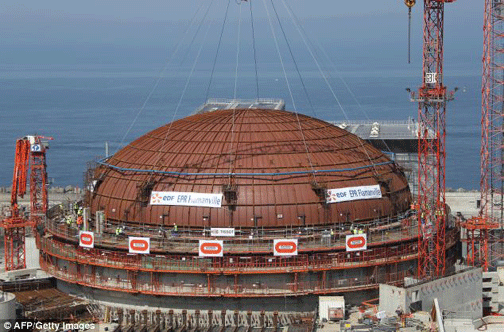
Translator’s note: The French nuclear power sector is in deep trouble technically and financially. Formally a cheap source of power, embedded costs have not been counted. There has been a dramatic loss of skills over the decades, inhibiting effective maintenance of existing plants and turning the construction of France’s then most powerful reactor at Flamanville on the Normandy coast into a nightmare.
Technological and resource challenges have escalated, including water availability in the face of climate change. The plan to bury accumulated highly radioactive waste at Bure, 250 kilometres east of Paris, remains at an impasse. And the political class lives in denial.
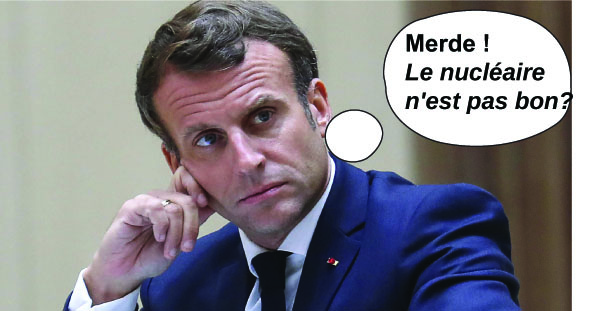
Meanwhile, sections of the Coalition parties cling to nuclear power as Australia’s post-coal salvation. Australia has uranium. However, regarding nuclear power prospects, there is no history, no capacities, no acceptable locations, no acceptable burial sites and no water. In short, local nuclear power adherents have no brains.
EVERYTHING WAS SUPPOSED to work to plan.
The 58 French nuclear reactors built at an accelerated pace between 1977 and 1996 were due to tranquilly finish their life after 30 years of good and faithful service. And the new super-powerful EPRs [European Pressurised Reactors], designed and built by Éléctricité de France, were to effect a seamless transition.
It was estimated that, by 2012, the first French EPR would be put into operation at Flamanville.
Kapow! Not only has its cost, initially fixed at €3.3 billion [AU$5.9 billion], multiplied by six (!), but its construction site has proved a nightmare. The EPR was connected to the grid only in 2024. And it has hardly run since (it is currently in shutdown).
An emergency patch-up job has been necessary on the aged French nuclear park so that its tired reactors can hang on for another 20 years. Total cost of this major overhaul now in progress: €100 billion [AU$180 billion].
At the moment when the urgent necessity to find €40 billion [AU$72 billion] in economies for the 2026 budget obsesses the Bayrou Government [under pressure from Brussels], Reporterre publishes on YouTube a remarkable documentary by journalist Laure Noualhat, titled Nucléaire – Comment il va ruiner la France. (See also Noulhat’s book, Le nucléaire va ruiner la France, Seuil-Reporterre, 224p.) It is noted there that, in the fairytale world that is nuclear energy, billions waltz out by the dozens. The golden rule is: “Whatever it costs!”
Other inescapable costs to come? To prolong the life of the plant at The Hague, where nuclear fuel is processed and which is at the end of its life — rough estimate: €34 billion [AU$61 billion]. To continue to dig deep at Bure, where the most dangerous nuclear waste will be buried 500 metres below ground — estimated cost: €35 billion [AU$63 billion]. To dismantle the 58 reactors, which, even patched up, will finish by being at the end of their life in ten or 20 years — cost: €50 billion. Total: €219 billion [AU$395.8 billion] to find. This is not all.
The EDF has sold an EPR to Finland for €3 billion [AU$5.4 billion] and two others to the United Kingdom for €22 billion [AU$39.7 billion]. And has promised to take care of any additional costs. Such comes in at €12 billion [AU$21.6 billion] for the former, €56 billion [AU$101 billion] for the latter. Do the maths.
Thomas Piquemal, the EDF’s chief financial officer at the time, went into meltdown. And resigned [in March 2016]. And this is not all.
In 2022, President Macron announced that, at his demand, the EDF will launch six “new generation” EPRs [initially, then eight more to 2050]. Hand on heart, it will happen (in fact, one knows nothing about them). Estimated total price: €100 billion [AU$180.7 billion] (more or less). A former EDF Director, Philippe Huet, interviewed by Laure Noualhat, called this a “crazy gamble”.
If ever this delusional program (transparently dismissed by the Cour des comptes [equivalent to the National Audit Office] as inadvisable) sees the day, who will pay for it? Not the EDF, already indebted to the tune of €55 billion [AU$99 billion]. Nor any private investor (not mad!). Guess… https://www.youtube.com/watch?v=rjfHyhkpef8
Jean-Luc Porquet has been a journalist at Le Canard enchaîné since 1994, where this article appeared on 9 July. He writes a column on ecology and technocratic society, as well as theatre reviews. He has written a dozen books, the latest of which, Le grand procès des animaux, is a satirical fictional account of the sixth extinction in progress.
Iran willing to reduce uranium enrichment to avoid British sanctions.

Reformist government is pushing hardline security figures to curtail nuclear programme.
Telegraph 24th Aug 2025
Iran is prepared to significantly reduce its uranium enrichment to prevent Britain reimposing United Nations sanctions, The Telegraph has been told.
Iranian officials said Tehran was willing to soften its hardline stance to avoid further military strikes from Israel and the United States.
Ali Larijani, the newly appointed secretary of Iran’s supreme national security council, is leading efforts to convince the clerical regime to lower uranium enrichment to 20 per cent purity, down from 60 per cent.
The current enrichment level is approaching the roughly 90 per cent purity required for nuclear weapons development, raising international concerns about Iran’s nuclear ambitions…………………………………………………………………………………………https://www.telegraph.co.uk/world-news/2025/08/24/iran-willing-reduce-uranium-enrichment-uk-sanctions/
Taiwan nuclear plant re-opening vote fails as approval threshold missed

By Ben Blanchard, August 23, 2025
TAIPEI, Aug 23 (Reuters) – A referendum to push for the re-opening of Taiwan’s last nuclear plant failed on Saturday to reach the legal threshold to be valid, though the president said the island could return to the technology in the future if safety standards improve.
The plebiscite, backed by the opposition, asked whether the Maanshan power plant should be re-opened if it was “confirmed” there were no safety issues. The plant was closed in May as the government shifts to renewables and liquefied natural gas.
The small Taiwan People’s Party (TPP) proposed the referendum earlier this year, and with the backing of the much larger Kuomintang (KMT) passed the legislation for the vote, saying Taiwan needs reliable power supplies and not to be so reliant on imports.
Around 4.3 million people voted in favour of the plant’s re-opening in the referendum, a clear majority over the 1.5 million who voted against, figures from the Central Election Commission showed.
But the motion needed the backing of one quarter of all registered electors – around 5 million people – to get through under electoral law, meaning the plant on Taiwan’s southern tip will not re-open.
Taiwan’s government says there are major safety concerns around generating nuclear power in earthquake-prone Taiwan and handling nuclear waste………………………..https://www.reuters.com/business/energy/taiwan-nuclear-plant-re-opening-vote-fails-approval-threshold-missed-2025-08-23/
1 This Month

of the week – Shut Down Drone Warfare!


Tell the Ukrainian Government to Drop Prosecution of Peace Activist Yurii Sheliazhenko

Petition to revoke the licensing of the Near Surface Nuclear Disposal Facility (NSDF) at Chalk River. https://www.ourcommons.ca/petitions/en/Petition/Details?Petition=e-7247
To see nuclear-related stories in greater depth and intensity – go to https://nuclearinformation.wordpress.com
-
Archives
- April 2026 (7)
- March 2026 (251)
- February 2026 (268)
- January 2026 (308)
- December 2025 (358)
- November 2025 (359)
- October 2025 (376)
- September 2025 (257)
- August 2025 (319)
- July 2025 (230)
- June 2025 (348)
- May 2025 (261)
-
Categories
- 1
- 1 NUCLEAR ISSUES
- business and costs
- climate change
- culture and arts
- ENERGY
- environment
- health
- history
- indigenous issues
- Legal
- marketing of nuclear
- media
- opposition to nuclear
- PERSONAL STORIES
- politics
- politics international
- Religion and ethics
- safety
- secrets,lies and civil liberties
- spinbuster
- technology
- Uranium
- wastes
- weapons and war
- Women
- 2 WORLD
- ACTION
- AFRICA
- Atrocities
- AUSTRALIA
- Christina's notes
- Christina's themes
- culture and arts
- Events
- Fuk 2022
- Fuk 2023
- Fukushima 2017
- Fukushima 2018
- fukushima 2019
- Fukushima 2020
- Fukushima 2021
- general
- global warming
- Humour (God we need it)
- Nuclear
- RARE EARTHS
- Reference
- resources – print
- Resources -audiovicual
- Weekly Newsletter
- World
- World Nuclear
- YouTube
-
RSS
Entries RSS
Comments RSS
 nuclear-news