Texas Legislature passes Bill to prevent import and storage of high level nuclear waste
A bill passed by the Texas Legislature could ban the storage of high-level
nuclear waste in the state and could prove a path to similar efforts in
neighboring New Mexico. House Bill 7 was passed by the Texas House of
Representatives on an 119-3 vote Sept. 2 and unanimously by the Texas
Senate. The bill was sent to Gov. Greg Abbott for a signature and which
would create a new state law. If enacted, the bill would expressly prohibit
the state from issuing permits to construct or operate a facility to store
nuclear waste within the state, with the exception of existing nuclear
facilities like power plants that store the waste on-site.
Carlsbad Current Argus 9th Sept 2021
USA Bill to protect journalists – EXCEPT FOR JULIAN ASSANGE

press freedom advocates, while supportive of the press freedom bill, said that the legislation would yield the biggest impact if the U.S. followed its own policies.
“Anytime we, or the U.S. government, or members of Congress are talking about press freedom internationally, it’s, in my mind, a good thing,” said Trevor Timm, co-founder and executive director of the Freedom of the Press Foundation. “But for any of that advocacy to be remotely effective, it’s important for the U.S. to walk the walk and not just talk the talk.”
PRESS FREEDOM BILL WOULD PROTECT JOURNALISTS FACING PERSECUTION — BUT NOT JULIAN ASSANGE https://theintercept.com/2021/09/08/julian-assange-international-press-freedom-act/ 8 Sept21,
Senators say they want to protect foreign journalists from government aggression. But what happens when the U.S. is the aggressor? Rose Adams
September 8 2021, EARLIER THIS YEAR, just days before World Press Freedom Day, Sens. Tim Kaine, D-Va., and Lindsey Graham, R-S.C., joined forces to introduce the International Press Freedom Act of 2021, a bipartisan bill to protect at-risk journalists working in highly censored countries. The legislation is predicated on the idea that the United States is a uniquely safe place for journalists — but that notion doesn’t always hold up under scrutiny.
Introduced on April 29, the International Press Freedom Act is one of at least three press freedom bills that Congress has considered since Saudi authorities killed journalist Jamal Khashoggi in October 2018. But while other bills have proposed piecemeal protections — such as sanctions on restrictive governments or a government office for threatened journalists — Kaine and Graham’s bill takes a more comprehensive approach. In addition to directing State Department funds toward investigating and prosecuting crimes against journalists abroad, the law would create a new visa category for threatened reporters and open a State Department office with a $30 million annual fund to help journalists report safely or relocate.
Press advocacy groups such as the Committee to Protect Journalists have praised Kaine and Graham’s bill, claiming that the legislation would “bolster U.S. foreign diplomacy on global press freedom.” In a statement, Kaine emphasized the U.S.’s responsibility to spread its free speech ethos.
“Enshrined in both our Constitution and the Universal Declaration of Human Rights, press freedom is a core American value that we must constantly promote around the globe,” he said in a press release. “With this bill, our country will let journalists know that we will protect their right to report and offer safe harbor when they are threatened.”
But that safe harbor doesn’t seem to apply to foreign journalists the U.S. government itself has threatened. For years, the Justice Department has worked to extradite and prosecute WikiLeaks founder Julian Assange for publishing Army war logs provided by Chelsea Manning in 2010, and increased the pressure following his 2016 publication leaked Democratic Party emails that the Justice Department said were hacked by Russia. And though the government’s extradition efforts are inching closer to fruition amid several U.S. appeals, Kaine and Graham have remained silent.
Continue readingJapan’s Liberal Democratic Party hopes that presidential contender Taro Kono will drop his anti nuclear stance.

LDP leadership race hopeful Taro Kono modifies stance on nuclear energy Japan Times 8 Sept 21, Liberal Democratic Party leadership race hopeful Taro Kono indicated his readiness on Wednesday to accept the restart of idled nuclear power plants for the time being, in order for Japan to realize its goal of achieving carbon neutrality by 2050.
“It’s necessary to some extent to restart nuclear plants that are confirmed to be safe, as we aim for carbon neutrality,” Kono, currently regulatory reform minister, told reporters.
Kono, known as an advocate for a shift away from nuclear energy, is eager to run in the ruling party’s leadership election on Sept. 29 to select a successor to outgoing LDP President and Prime Minister Yoshihide .
However, there are concerns among some LDP members over his position on the issue. Kono apparently modified his stance to win broader support ahead of the party election.
“Basically, our priority is to increase the use of renewable energy sources, but it would be possible to use nuclear plants whose safety is confirmed for now if there are power supply shortages,” Kono said.
“Nuclear plants will disappear eventually, but I’m not saying that they should be scrapped immediately, like tomorrow or next year,” he added.
With Kono also in charge of COVID-19 vaccine rollout, some people are questioning whether it would be possible for him to continue in the role while campaigning for the LDP presidency.
“I don’t think (my election campaign) would affect my duties,” Kono said….. https://www.japantimes.co.jp/news/2021/09/08/national/politics-diplomacy/kono-nuclear/
Exelon Corp hanging on in hope that Illinois government will bail out 2 nuclear power stations

Illinois House inches closer to saving two nuclear plants, By Timothy Gardner WASHINGTON, Sept 7 (Reuters) – The Illinois House plans to consider an energy bill on Thursday, the House speaker said, that could prevent two Exelon Corp nuclear power plants from shutting in coming days and months.
The Illinois Senate on Sept. 1 passed a bill that contains more than $600 million in carbon mitigation credits for nuclear plants, which generate virtually emissions-free electricity. [as long as you don’t count the full dirty nuclear fuel chain]
………. U.S. nuclear plants have been struggling to compete with wind and solar farms and plants that burn low-cost natural gas. Exelon (EXC.O) has said it will close its Byron nuclear plant on Sept. 13 and its Dresden plant in November if a state or federal program does not come to the rescue.
Preventing nuclear plants from closing has been a priority for the administration of President Joe Biden, which has supported tax incentives for nuclear in federal infrastructure legislation and sees the plants as important to its goal of decarbonizing the power grid by 2035.
Exelon has said the federal incentives alone could not come fast enough to save the plants. The company said it has authorized uranium fuel shipments to Byron for use if the legislation passes. But Exelon said the fuel will be shipped to another plant if no action is taken and Byron will permanently shut. https://www.reuters.com/world/us/illinois-house-inches-closer-saving-two-nuclear-plants-2021-09-07/
Walking the nuclear dog – a South African tale

Walking the nuclear dog – a South African tale, ESI Africa, By Chris Yelland, managing director, EE Business Intelligence, 6 Sept 21
Apparently, in government, there is an activity known as “walking the dog” – a strategy intended to keep self-serving politicians, officials and stakeholders quiet, and to calm them down when they are getting agitated and fidgety for some of the action.
Of course, there is some excitement at the prospect of sniffing out the territory on a brisk walk, with the anticipation that something big is on the cards. But this is inevitably short-lived, and things soon revert back to the normal and more leisurely state of inaction. Mission accomplished.
There are some examples of this in the coal and nuclear energy sectors of South Africa. The media and the public need to be careful not to be bamboozled by the noxious smoke and mirrors, sometimes radioactive, that emanate from these quarters in their excitement.
2,500MW of new nuclear power?
However, in the days following the board meeting, Nersa seemed to be acting very coy – firstly about clarifying exactly what it was that the board had concurred with, and secondly, whether this was even a concurrence by Nersa after all, as opposed to a conditional concurrence that was still subject to a number of suspensive conditions.
Of course, the independent Regulator was treading a very delicate line – to at least give the appearance that the noisy nuclear sector had got its way, while covering all political bases and legal angles, protecting its fragile reputation, and taking care not to become the scapegoat for scuppering the nuclear ambitions of a fractious Minister.
However, on 3 September 2021, Nersa finally succumbed to the growing pressure to release full details of its actual decision on 26 August 2021, with the reasons for the decision (RFD) to follow in due course. In so doing, the tricky game that Nersa was having to play became clearer.
Following a meeting by the board of the National Energy Regulator of South Africa (Nersa) on 26 August 2021, there were breathless public statements to the media by officials at the Department of Mineral Resources and Energy (DMRE) regarding a decision by the Regulator in respect of 2,500MW of new nuclear power in South Africa.
The Regulator was said to have “concurred” with a so-called Section 34 ministerial nuclear determination in terms of the Electricity Regulation Act (ERA). Some in the media fell for this hook, line and sinker. The nuclear energy sector was ecstatic, asserting that the procurement of 2,500MW of new nuclear power in South Africa would now commence.
Suspensive conditions?
Contrary to the public statements and media interviews by DMRE officials, written details of the board decision reveal that Nersa has in fact not yet concurred with the Section 34 determination per se, but that such concurrence is still subject to a number of suspensive conditions which have not yet been met.
The precise wording of Nersa’s decision of 26 August 2021 in respect of the suspensive conditions, indicate that the Energy Regulator has decided:
To concur with the commencement of the process to procure the new nuclear energy generation capacity of 2,500MW as per Decision 8 of the Integrated Resource Plan for Electricity 2019 – 2030 … subject to the following suspensive conditions:
Satisfaction of Decision 8 of IRP 2019 – 2030, which requires that the nuclear build programme must be at an affordable pace and modular scale that the country can afford because it is no regret option in the long term;
- Recognition and taking into account technological developments in the nuclear space; and
- To further establish rationality behind the 2,500MW capacity of nuclear. A demand analysis aimed at matching the envisaged load profile post 2030, with the generation profile that would be needed to match that load profile, is required. This will assist to determine the capacity and the scale at which the country would need to procure nuclear.
It is thus clear that Nersa is only concurring with Decision 8 of the current Integrated Resource Plan for Electricity, IRP 2019 – 2030, to “commence preparations for a nuclear build programme to the extent of 2,500MW”, with this itself being subject to the suspensive conditions listed.
The Regulator is not concurring with the commencement of a request for proposals (RFP) for new nuclear power in South Africa, nor is Nersa giving the green light to any new nuclear construction programme.
Not so fast please!
It goes without saying that any public procurement must still comply with the requirements of the Public Finance Management Act (PFMA) and the Constitution. As such, National Treasury remains a gatekeeper through the requirement for a positive outcome to a detailed cost-benefit analysis, and the requirement for National Treasury to establish the affordability of any such procurement.
It is still far from resolved as to the technology to be used for a nuclear new-build programme in South Africa. Would these be giant pressurised water reactors (PWRs) such as the Rosatom VVER 1200 units? Or small modular nuclear reactors (SMRs) that still have to be developed, piloted, commercialised, licenced and proven elsewhere in the world?
The suspensive conditions even indicate that the very rationality of a 2,500MW nuclear new-build programme still needs to be established through long-term demand forecasting for the period post-2030 in order to determine the mix of the generation capacity required to meet that demand.
Finally, as no new nuclear power is provided for in the current IRP in the years to 2030, it is clear that any new nuclear procurement can only commence, at the earliest, after an updated IRP has been considered by government’s “social partners”, approved by the Cabinet, and promulgated.
1,500MW of new, clean, coal-fired power?
A further example of “walking the dog” may be found in ongoing suggestions by the Minister and his officials at the DMRE that “clean coal” technologies can be deployed……………….
The 9,600MW nuclear fleet?
Yet another case of “walking the dog” was detailed in an article in Daily Maverick on 26 August 2021. In the article, former Deputy Finance Minister Mcebisi Jonas reveals that there was a general understanding in government that the 9600 MW nuclear deal with Russia, being pushed in 2017 by then-President Jacob Zuma and Energy Minister David Mahlobo, would be terrible for South Africa.
| According to Jonas, President Ramaphosa’s instruction was to “walk it” as long as possible. “He [Ramaphosa] said that by the time we have to make a decision, Zuma will be gone. He told us to find everything in the book to delay”.Does a question arise as to whether the upsides of dog walking really outweigh the downsides? It is hard to give a clear answer to this question, but it would seem that our President clearly prefers walking the dog to dealing firmly with self-serving elements within the party circle.However, a poorly-founded but nagging question keeps popping up as to what Vice-President DD Mabuza was really up to during his extended five-week leave of absence in Russia in July 2021?Putin would likely be a big, vicious dog, ready for a fight, and not easily controlled on the walk – actually more of a bear than a dog. And I would hate to be walking a grumpy bear. https://www.esi-africa.com/industry-sectors/generation/op-ed-walking-the-nuclear-dog-a-south-african-tale/ |
Downwinders Look to Renew and Expand Radiation Exposure Compensation Act
Downwinders Look to Renew and Expand Radiation Exposure Compensation Act, Sierra Nevada Ally, By Brian Bahouth -September 4, 2021
Audio: a conversation with downwinder Mary Dickson Between 1951 and 1992, U.S. scientists and engineers conducted 928 nuclear blasts at the Nevada Test Site (NTS), a roughly 1,400 square-mile federal reservation located 65 miles north of Las Vegas. Eight hundred and twenty eight were underground tests and 100 atmospheric tests in which the atomic weapons were exploded at or above ground level, which releases highly radioactive material high into the atmosphere.
In total, at various locations around the globe, the Atomic Energy Commission and later the Department of Energy, conducted 1,054 atomic weapons tests.
Fallout from these many bombs circled the planet. If a person is in close proximity to a nuclear blast, the symptoms of acute radiation sickness are obvious, but outside the blast area, human senses do not apprehend radioactivity that can lodge in the fat of milk or meat and can linger for decades in the environment.
The health effects of nuclear testing on those directly downwind of the events in eastern Nevada, Utah and Arizona became evident with cancer clusters and and other related illnesses. Many ranchers lost livestock.
After years of lawsuits and wrangling, the Radiation Exposure Compensation Act (RECA) became law in 1990 and provides one-time benefit payments to “persons who may have developed cancer or other specified diseases after being exposed to radiation from atomic weapons testing or uranium mining, milling, or transporting.”
The U.S. Department of Justice administers RECA and has distributed over $2.4 billion in benefits to more than 37,000 claimants since its inception in 1990, but the RECA program is scheduled to sunset in 2022.
Geographically, RECA covers people living in a total of 22 counties with some in eastern Nevada, Utah, and Arizona. But research shows that parts of Idaho and Montana saw radioactivity impacts on par with Nevada, Utah and Arizona. Many places in North America realized toxic levels of radiation. Fallout from the tests travelled around the globe.
U.S. Senator from Idaho, Mike Crapo has been a long-time advocate for downwinders. In a recent newsletter to constituents, he said he’s working on bi-partisan legislation that would renew and expand the dimensions of RECA to include many more states.
Work is in progress with stakeholders to determine the best path forward to reintroduce the Radiation Exposure Compensation Act Amendments, which expands coverage of the Radiation Exposure Compensation Act (RECA) to include victims in Idaho among states impacted by exposure to fallout from nuclear weapons testing.”………….
“The more I started researching and the more I started following that story, the more I thought, ‘my government did this to me,’” Mary Dickson said. “I’m a casualty of the Cold War.
“My sister, at the time, was ill with an autoimmune disease, and she and I started making a list of all the people in our childhood neighborhood who had cancer or tumors. It didn’t take long before, in a four or five block area, we had about 54 people on that list …
“And we just thought, ‘OK, yeah, something happened to us. Something happened to us, something happened …”……… https://www.sierranevadaally.org/2021/09/04/downwinders-look-to-renew-and-expand-radiation-exposure-compensation-act/
UK government scared that Scotland’s Nicola Sturgeon will use COP25 to further SCotland’s independence
No 10 has been plotting how to cut Nicola Sturgeon out of Cop26 to prevent
the first minister stealing the limelight, The Independent can reveal.
Advisers at No 10 and the Cabinet Office have been trying to work out how
to prevent this autumn’s landmark Glasgow summit from becoming an
“advert” for Scottish independence.
Independent 4th Sept 2021
https://www.independent.co.uk/news/uk/politics/cop26-scotland-independence-indyref2-b1902613.html
Illinois nuclear subsidy law – too late for Exelon’s Byron and Dresden nuclear plants
Time running out for Exelon’s Byron and Dresden nuclear plants as Illinois Senate passes major energy bill, Utiliy Dive, Sept. 2, 2021 By Scott Van Voorhis ”’………
- Senate Bill 18 provides hundreds of millions in subsidies to keep the state’s nuclear power sector open, with Exelon preparing to shut down its Byron nuclear plant Sept. 13.
- But the legislation, which still needs to pass the House, faces 11th hour hurdles: Gov. J.B. Pritzker, D, is raising objections to a key part of the plan dealing with the large Prairie State coal-fired plant.
……….The Illinois Senate’s clean energy package provides more than $600 million in subsidies for renewable power-related initiatives, and nearly $700 million over five years for the state’s struggling nuclear power sector.
However, Illinois’ governor has raised objections to a key piece of the deal, which would require the municipally-owned Prairie State coal-fired plant, the largest carbon emitting power plant in Illinois and one of the largest in the nation, to shut down by 2045
ssed before Exelon moves ahead with its closure plans.
….. The governor’s objections raise the prospect of legislative negotiations going down to the wire, with roughly 10 days, or even less, for a final bill to get pa…….. Exelon, which owns six nuclear plants in the state, has said it plans to close its Byron plant on Sept. 13 unless the bill passes.
But the real deadline is even tighter than that, with the legislation needing to clear before Sept. 13 in order to keep the plant open, Exelon noted in a statement.
….. The governor’s objections raise the prospect of legislative negotiations going down to the wire, with roughly 10 days, or even less, for a final bill to get pa…….. Exelon, which owns six nuclear plants in the state, has said it plans to close its Byron plant on Sept. 13 unless the bill passes.
But the real deadline is even tighter than that, with the legislation needing to clear before Sept. 13 in order to keep the plant open, Exelon noted in a statement.
……. “To be clear, Byron will run out of fuel and will permanently shut down on September 13 unless legislation is enacted,” the spokesperson stated. “We have been clear that we cannot refuel Byron on September 13 or Dresden in November absent policy changes.” ……………….. https://www.utilitydive.com/news/time-running-out-for-exelons-byron-and-dresden-nuclear-plants-as-illinois/605981/
Advanced nuclear reactors need the government to create a market – nuclear loves socialism

……….………. Advanced reactors are in a position where they need a HALEU supply for commercialization of their technology to be possible, but there needs to be commercial market with demand for the fuel in place for the HALEU supply to get off the ground, according to nuclear engineer Matthew Corradini, a professor emeritus at the University of Wisconsin. “It’s a chicken and egg situation,” he said
One solution proposed by NEI is for the federal government to create the market ………….
Nuclear reactors of the future have a fuel problem, Utility Dive
Higher levels of uranium enrichment can unlock value from smaller and simpler reactors, but they come with new hurdles that the nuclear industry says only the federal government can address. Aug. 30, 2021 By Matthew Bandyk

President Joe Biden entered office being hailed by nuclear power advocates as perhaps the most pro-nuclear-energy president ever. He followed up his campaign trail discussions of nuclear energy as a necessary source of carbon-free emissions with a budget that proposed a record-setting $1.85 billion for the U.S. Department of Energy’s Office of Nuclear Energy
But many in the nuclear industry are concerned that the budget does not sufficiently address a problem that could prevent nuclear reactors of the future from being able to function. The impasse would stand even if technological advancements to make nuclear energy technology cheaper and easier to operate are realized. Some of the most prominent of these next-generation reactor designs can only run on a fuel for which there is no commercial supply chain currently — and building that supply chain could take years and lots of political will, according to reactor developers and nuclear fuel supply companies alike.

The nuclear industry, beset by massive cost overruns in the construction of current-generation reactors, has placed its hopes for new nuclear capacity in “advanced” or “next-generation” reactor designs, a broad category that includes everything from smaller versions of conventional light-water reactors to designs that eschew water entirely in favor of other cooling substances in the nuclear core like helium or salt. These reactors have the potential to help achieve decarbonization goals [an unlikely claim, and certainly not in time for the urgent climate need] by replacing fossil fuel plants, powering the production of clean hydrogen and firming renewable energy, among other possibilities. Several companies are developing designs and targeting deployment of their first commercial demonstration projects over the next decade.
Both the Biden and Trump administrations have supported research and development efforts toward advanced reactors, and Congress has passed legislation intended to streamline the regulatory path ahead. But the Nuclear Energy Institute (NEI), the primary trade association for the nuclear industry, argues that if advanced reactors are to succeed, the federal government needs to do much more to create a domestic market for this fuel. “The commercialization of many advanced nuclear technologies is in jeopardy,” NEI President and CEO Maria Korsnick said in a 2020 letter to then-U.S. Energy Secretary Dan Brouillette.
The biggest policy change advocated by NEI is for the federal government to sign a contract with a nuclear fuel supplier to essentially create a new market.
Both the Biden and Trump administrations have supported research and development efforts toward advanced reactors, and Congress has passed legislation intended to streamline the regulatory path ahead. But the Nuclear Energy Institute (NEI), the primary trade association for the nuclear industry, argues that if advanced reactors are to succeed, the federal government needs to do much more to create a domestic market for this fuel. “The commercialization of many advanced nuclear technologies is in jeopardy,” NEI President and CEO Maria Korsnick said in a 2020 letter to then-U.S. Energy Secretary Dan Brouillette.
What is HALEU?
What most of the advanced reactor developers seeking Nuclear Regulatory Commission (NRC) approval have in common, however, is that they would not be fueled by the form of uranium used in most nuclear power plants operating around the world today. Rather, they would use a form that is more highly enriched — or, to be more specific, has been made into a more fissionable form by using technology such as centrifuges to alter the balance of protons and neutrons in the uranium……….

TerraPower, the Bill Gates-funded startup that is developing the Natrium sodium fast reactor with GE Hitachi Nuclear Energy, is also banking on HALEU. While, at 345-MW, the Natrium reactor is much larger than Oklo’s, TerraPower’s design also relies on the high uranium-235 content of HALEU to allow the reactor to run efficiently, particularly when ramping up or down to follow changes in load driven by renewable energy. TerraPower declined to comment for this story. The startup and Centrus have said they plan to work together to expand HALEU production after Centrus’s DOE contract ends in 2022.
……………….. Advanced reactors are in a position where they need a HALEU supply for commercialization of their technology to be possible, but there needs to be commercial market with demand for the fuel in place for the HALEU supply to get off the ground, according to nuclear engineer Matthew Corradini, a professor emeritus at the University of Wisconsin. “It’s a chicken and egg situation,” he said
One solution proposed by NEI is for the federal government to create the market …………. https://www.utilitydive.com/news/nuclear-reactors-of-the-future-have-a-fuel-problem/604707/
Illinois very soon to vote on a Bill for the state to prop up the nuclear industry
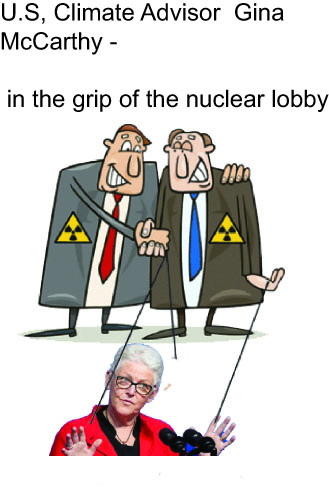
Gina McCarthy, President Joe Biden’s climate adviser, has said existing nuclear plants are “absolutely essential” to hit U.S. goals to decarbonize the electric grid by 2035 and the administration has supported federal incentives for the nuclear in
Illinois could vote Tuesday on bill that aims to save nuclear plants, By Timothy Gardner, Aug 31 (Reuters) – The Illinois legislature is edging closer to a vote as soon as Tuesday on a bill that aims to prevent two nuclear power plants from shutting, as the owner moves to close the first plant next month unless the state acts.
The legislature could vote in a special session on a compromise of a wide-ranging energy bill, introduced Monday, or a narrow version of it that would allow nuclear plants to earn carbon mitigation credits for generating virtually emissions-free power [not really emissions-free, considering the whole nuclear fuel chain]. Tuesday’s session is on legislative mapping, but could include the energy bill vote………..
Lawmakers were set to meet on Tuesday to consider a measure on the bill.
Exelon Corp (EXC.O) has said it will close the Byron nuclear plant in mid September and the Dresden plant in November if a state or federal program does not come to the rescue.
Gina McCarthy, President Joe Biden’s climate adviser, has said existing nuclear plants are “absolutely essential” to hit U.S. goals to decarbonize the electric grid by 2035 and the administration has supported federal incentives for the nuclear industry.
Illinois Senate passes bill to save nuclear plants
Illinois Senate passes bill to save nuclear plants, sends to House, By Timothy Gardner Sept 1 (Reuters) – The Illinois Senate passed a bill early on Wednesday that aims to prevent two nuclear power plants from shutting this autumn, sending the legislation to the House where it was uncertain if the chamber would bring the legislation to a vote.
The Senate voted 39-16 to pass a wide-ranging energy bill, with two senators voting “present.” The bill contains more than $600 million in carbon mitigation credits for nuclear plants which generate virtually emissions-free electricity. [that’s as long as you ignore the full nuclear fuel chain]
U.S. nuclear plants have been struggling to compete with wind and solar farms and plants that burn low-cost natural gas. Exelon Corp has said it will close its Byron nuclear plant in mid-September and its Dresden plant in November if a state or federal program does not come to the rescue.
It was uncertain whether the House would move fast enough to pass the legislation to prevent the shutting of the first plant, located in Byron, Illinois…….. https://www.reuters.com/article/usa-nuclearpower-illinois-idUSL1N2Q31QZ—
Two Billionaires Join Forces in Poland’s Nuclear Energy Push
Two Billionaires Join Forces in Poland’s Nuclear Energy Push, Bloomberg Wealth, By Maciej Martewicz. 31 August 2021, ”’….. Michal Solowow, who controls chemicals producer Synthos SA, and Zygmunt Solorz, the main owner of media and telecommunications giant Cyfrowy Polsat SA, plan to build four to six nuclear reactors, each with a capacity of 300 megawatts. ……. Synthos’ green energy unit, which has exclusive rights in the country for GE Hitachi Nuclear Energy’s small nuclear reactors, will provide the technology, the companies said in a statement, without specifying the project’s timeline or cost.
…….. The companies said that their private project isn’t competing with the state’s plan to build as much as 9 gigawatts of nuclear power using large reactors of more than 1 gigawatt capacity each. https://www.bloomberg.com/news/articles/2021-08-31/two-billionaires-join-forces-in-poland-s-nuclear-energy-push
As South Africa restarts nuclear plan, critics and advocates clash over its clean energy credentials
As SA restarts nuclear plan, critics and advocates clash over its clean energy credentials, Fin 24, Jan Cronje 30 August 21, As South Africa’s revived nuclear power plan moves forward, questions over the green credentials of atomic power have added another dimension to an already fraught debate between critics and proponents of nuclear energy.
The debate mirrors one taking place internationally about where, if at all, nuclear power should fit into the battle against climate change…… (Subscribers only) https://www.news24.com/fin24/economy/as-sa-restarts-nuclear-plan-critics-and-advocates-clash-over-its-clean-energy-credentials-20210830
European Leadership Network aims to build a new nuclear network
Building a new kind of nuclear network: The N Square example, European Leadership Network , Sara Z. Kutchesfahani |Director of the N Square DC Hub, Jenny Johnston |Editorial Director at N Square 29 Aug 21,
Networks are central to the ELN’s way of working. As part of a series of reflections on the ELN’s anniversary, we invited N Square to share their case study of building a diverse network to work creatively on nuclear policy.
In 2014, five of the world’s largest peace and security funders set out to address a glaring problem. The field of professionals working to control the threats from nuclear weapons has long been insular and fragmented. While the field is filled with brilliant and committed individuals dedicated to ending the nuclear threat, they almost universally do that work in organisational silos, disconnected from other fields and even from one another (see N Square’s 2019 “Greater Than” report for a deep dive into factors inhibiting collaboration and shared learning in the nuclear field and how we might overcome them). Working collaboratively, the funders launched N Square, a path-breaking initiative built on the idea that sparking new forms of cross-sector collaboration will accelerate the achievement of internationally agreed goals to reduce nuclear dangers.
In the years since, N Square has done wide-ranging work to bring new people, new ideas, and new resources into the nuclear field, seeking to light up the field with ingenuity and innovation. At the heart of this effort is the N Square Innovators Network (NSIN), a vibrant, intentional community of cross-sector experts who work together in novel ways to tackle nuclear challenges.
The NSIN represents an entirely novel kind of network in the nuclear space. It reaches outside the sector to build bridges with other fields as well as to enable those inside the field to work collaboratively across organizations and focus areas, empowering them to work in new ways and to access new ideas that will help them achieve national security goals. At the same time, the model enables non-nuclear experts to explore nuclear issues and discover how they might apply their skills to nuclear challenges. Given the siloed nature of the field, it can be challenging for newcomers to know how and where to offer their expertise unless they are given well-defined entry points—an impediment to cross-sector collaboration that the Innovators Network helps overcome.
The network we have today includes people from fields as diverse as marketing and communications, artificial intelligence, finance, filmmaking, social science, and big data. What unites them is the belief that by working together, bringing their own diverse experiences and expertise, we can bust open longstanding problems and explore them in ways that are more effective when we work collectively versus apart.
How the NSIN works
A key characteristic of our network is that it is iterative. Roughly 120 individuals have joined the network as NSIN fellows, but they did not all join at once. Rather, we continue to host “cohorts” of cross-sector fellows, with each cohort bringing a new mix of expertise, energy, and issue-area focus to the network. ………………….https://www.europeanleadershipnetwork.org/commentary/building-a-new-kind-of-nuclear-network-the-n-square-example/
Share
Nuclear power “just doesn’t make sense” for Ireland, a leading energy expert says.
Why nuclear power ”just doesn’t make sense” for Ireland, news talk, Stephen McNeice, 26 AUG 2021
Nuclear power “just doesn’t make sense” for Ireland, a leading energy expert says.
John Fitzgerald was speaking following recent fears that Ireland could face potential blackouts this winter.
Those concerns have eased now that two power generators are due to come back online in October and November, ahead of the high-demand winter season.
However, the situation has raised concerns about how the system will cope during periods when renewable sources such as wind turbines are unable to produce much power.
Those concerns have increased as more and more data centres are announced for Ireland – all of which require substantial and consistent supplies of electricity.
That has led to some questions about whether nuclear power – which, outside of safety concerns, is seen as a reliable source of energy by many countries – should be considered for Ireland.
Professor Fitzgerald – Research Affiliate at the ESRI and an Honorary Fellow of Trinity College Dublin – told The Pat Kenny Show it wouldn’t work for Ireland.
“Our generators come in what are called 400 megawatt lumps – nuclear comes in 1200 megawatt lumps.
“If you have a bloody massive nuclear generator in Ireland, you’ve got to have three gas stations puttering away and ready to go in case anything goes wrong. It just doesn’t make sense.”
rading electricity……
he suggested the current make-up of Ireland’s electricity grid does make sense.
He said: “The thing about nuclear is it’s always on, whereas with wind it’s intermittent.
“When you have a load of wind on the system, having a load of nuclear doesn’t fit – it makes more sense to put in more wires to France and Britain and trade the electricity.
For now, he said the concerns with wind energy are about what happens in periods – usually in January – when you have several weeks with low or no wind.
He explained: “You have to have alternatives so the lights don’t go off when the wind doesn’t blow.
“What the concerns were – although there are less now than they would have been two weeks ago – is there are two big gas generators which are broken.
“They’re an important part of the system, and if they didn’t come back on… then when the wind didn’t blow we’d be short of generation.”
However, he said EirGrid and its predecessors have ensured Ireland’s electricity supply has been one of the most reliable in the world.
He added: “We just need to keep them at it.” https://www.newstalk.com/news/why-nuclear-power-just-doesnt-make-sense-for-ireland-1243726
1 This Month
23-25 October – on Zoom – World BEYOND War’s annual global conferenc


Shut down the radiation-damaged Heysham nuclear reactors now
To see nuclear-related stories in greater depth and intensity – go to https://nuclearinformation.wordpress.com

Say No to NASA’s Reckless Nuclear Reactor on the Moon
Say No to NASA’s Reckless Nuclear Reactor on the Moon

-
Archives
- October 2026 (209)
- September 2026 (339)
- August 2026 (330)
- July 2026 (355)
- June 2026 (287)
- May 2026 (306)
- April 2026 (356)
- March 2026 (251)
- February 2026 (267)
- January 2026 (308)
- December 2025 (358)
- November 2025 (359)
-
Categories
- 1
- 1 NUCLEAR ISSUES
- business and costs
- climate change
- culture and arts
- ENERGY
- environment
- health
- history
- indigenous issues
- Legal
- marketing of nuclear
- media
- opposition to nuclear
- PERSONAL STORIES
- politics
- politics international
- Religion and ethics
- safety
- secrets,lies and civil liberties
- spinbuster
- technology
- Uranium
- wastes
- weapons and war
- Women
- 2 WORLD
- ACTION
- AFRICA
- Atrocities
- AUSTRALIA
- Christina's notes
- Christina's themes
- culture and arts
- Events
- Fuk 2022
- Fuk 2023
- Fukushima 2017
- Fukushima 2018
- fukushima 2019
- Fukushima 2020
- Fukushima 2021
- general
- global warming
- Humour (God we need it)
- Nuclear
- RARE EARTHS
- Reference
- resources – print
- Resources -audiovicual
- Weekly Newsletter
- World
- World Nuclear
- YouTube
-
RSS
Entries RSS
Comments RSS

