Nuclear industry ecstatic about costly UK’s nuclear policy, but in reality it is a low priority for the government

UK Net Zero Strategy puts nuclear as a low priority, Nuclear Engineering
22 October 2021 ”………………………………. Detail on plans for nuclear
The 368-page report itself does not include much about plans for nuclear. “The net zero economy will be underpinned by cheap clean electricity, made in Britain,” it says. “A clean, reliable power system is the foundation of a productive net zero economy as we electrify other sectors – so we will fully decarbonise our power system by 2035, subject to security of supply. Our power system will consist of abundant, cheap British renewables, cutting edge new nuclear power stations, and be underpinned by flexibility including storage, gas with CCS, hydrogen and ensure reliable power is always there at the flick of a switch….
By 2035 the UK will be powered entirely by clean electricity, subject to security of supply, the report notes. One of the key policies listed there is to: “Secure a final investment decision on a large-scale nuclear plant by the end of this Parliament, and launch a new £120 million Future Nuclear Enabling Fund, retaining options for future nuclear technologies, including Small Modular Reactors, with a number of potential sites including Wylfa in North Wales.”
The report says that, “in the past year, we have already taken important action on climate change, delivering on the commitments in the Prime Minister’s Ten Point Plan”. With respect to nuclear, it recalls that the government committed to delivering new and advanced nuclear power, including:
- Pursuing large-scale nuclear projects, subject to value for money;
- Legislating for a new financing model for nuclear projects;
- A £385 million Advanced Nuclear Fund to enable up to GBP215 million for Small Modular Reactors; and
- £170 million for a R&D programme on Advanced Modular Reactors.
…………….. The only detailed mention of nuclear is in the Power section (10 pages) of Chapter 3 on “Reducing Emissions across the Economy”. It constitutes just one of 14 listed key commitments, to “Secure a final investment decision on a large-scale nuclear plant by the end of this Parliament whilst taking measures to inform investment decisions during the next Parliament on further nuclear projects as we work towards our net zero target.”
There are 43 numbered paragraphs in the section. Nuclear is mentioned in paragraph 2 (subsection “Progress to date”) as follows:
“On delivering new and advanced nuclear power, we have committed to reaching a final investment decision on a large-scale nuclear plant this parliament, subject to value for money and approvals. We are in negotiations with the developer on Sizewell C project in Suffolk. We have since taken further steps.”
Nuclear is the subject of three small paragraphs in the sub-section “Policies and proposals”:
38. We also need to increase our nuclear capacity, which is why we said in the Energy White Paper that we will aim to bring at least one large-scale nuclear project to the point of final investment decision by the end of this Parliament, subject to clear value for money and all relevant approvals. In December 2020 we announced the start of formal negotiations on Sizewell C and those negotiations are ongoing. To facilitate a decision this Parliament, we plan to establish the Regulated Asset Base model to fund new nuclear projects at a low cost of capital, saving consumers money.
39. The government will also take measures to inform investment decisions during the next Parliament on further nuclear projects as we work towards our net zero target. This will include consideration of large-scale and advanced nuclear technologies, including Small Modular Reactors (SMRs) and potentially Advanced Modular Reactors (AMRs). As part of this, we are announcing a new £120 million Future Nuclear Enabling Fund to provide targeted support in relation to barriers to entry. Further details of how this fund will operate will be published in 2022 alongside details of a roadmap for deployment that takes into account value for money.
40. We are also providing funding for a SMR design through our £385m Advanced Nuclear Fund and are progressing plans for an Advanced Modular Reactor demonstrator in the early 2030s. Whether large- or small-scale projects, there remain a number of possible sites available for these options, including Wylfa in North Wales.
Industry reaction
The strategy was, nevertheless, enthusiastically received by the nuclear industry. Nuclear Industry Association Chief Executive Tom Greatrex said: “It is very welcome to see the government commit new money to the development of nuclear projects and set out its intention to bring Sizewell C to a Final Investment Decision. We need to invest quickly to clean up the grid by 2035 and ensure our energy security, so we look forward to seeing details of this new fund, money for SMR deployment and legislation for Regulated Asset Base financing coming forward soon.”
A US consortium led by Westinghouse and Bechtel immediately released a statement that was widely reported by the Welsh media. It noted: “We welcome the publication of the Government’s net zero strategy today and are pleased to see that nuclear power features prominently throughout the proposal as an intrinsic part of achieving the UK’s net-zero goals……………https://www.neimagazine.com/news/newsuk-net-zero-strategy-puts-nuclear-as-a-low-priority-9176564
Greenland to reinstate its ban on uranium mining
Within weeks, Greenland’s parliament, the Inatsisartut, is expected to
pass a bill reinstating a ban on uranium mining that was lifted in 2013
following pressure from mining companies. “The Greenlandic minister with
responsibility for minerals has publicly stated that a ban on uranium
mining will put an end to all future uranium mining, full stop,” Mariane
Paviasen, a Greenland MP and leading activist in the anti-uranium mining
movement, Urani? Naamik (Uranium? No), told Green Left.
Green Left 20th Oct 2021
https://www.greenleft.org.au/content/greenland-set-restore-uranium-mining-ban
UK govt teams up with Bill Gates – (coyly – no public mention of nuclear)
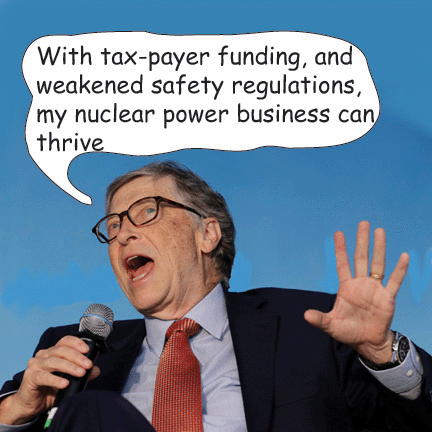
Government teams up with Bill Gates and top corporates to catalyse wave of
green [?] tech investment. Prime Minister announces £9.7bn of inward
infrastructure investment, as government launches new £400m public-private
clean tech innovation fund.
Prime Minister Boris Johnson this morning used
the Global Investment Summit as a curtain-raiser for the government’s
much-anticipated Net Zero Strategy, announcing almost £10bn of new foreign
investment in a wave of primarily low carbon infrastructure projects.
The government confirmed a new package of 18 deals worth £9.7bn, which are set
to ramp up investment in a host of clean infrastructure projects, including
offshore wind, hydrogen development, carbon capture and storage (CCS), and
green homes.
Meanwhile, Johnson shared a virtual stage with billionaire
philanthropist Bill Gates to announce the UK government has teamed up with
Gates’ Breakthrough Energy Catalyst clean tech venture to each invest
£200m in a new fund for supporting cutting edge clean tech projects. “The
world’s top investors have seen the massive potential in the UK for growth
and innovation in the industries of the future,” Johnson said. “The
fantastic £9.7bn of new investment we have secured today will power our
economic recovery, creating thousands of jobs and helping to level up
across the country.
Business Green 19th Oct 2021
Spain is turning rapidly away from coal and nuclear, going for renewable energy
Spain is expected to see a sharp decline in nuclear and coal power
capacity by 2030 in its turn towards renewable energy sources.
Power Technology 21st Oct 2021
https://www.power-technology.com/comment/spain-nuclear-power-phase-out/
Tamil Nadu leaders call for a nuclear-free zone, and stopping of development of Kudankulam project

—TAMIL NADU Declare T.N. a nuclear free zone, say leaders https://www.thehindu.com/news/national/tamil-nadu/declare-tn-a-nuclear-free-zone-say-leaders/article37100662.ece 20 Oct 21, They express concern over KKNPP
Leaders of political parties, led by VCK chief Thol. Thirumavalavan, on Wednesday sought to declare Tamil Nadu a “nuclear-free zone”.
At a press conference here, he said the unscientific disposal of radioactive waste from the nuclear reactor at Kudankulam was likely to increase the risk to public health. “Experts have said some of the reasons for the disaster in Chernobyl and Fukushima were similar to the existing conditions at Kudankulam,” he said.
Pointing to the issues in the disposal of radioactive waste from the Kudankulam reactor, Mr. Thirumavalavan said the Union Government had continued such activities which were dangerous to people. “The Union Government should suspend the operations pertaining to the third and fourth reactors. It should announce the location of the deep geological repository before conducting the public consultations on the development of the facility away from reactor.”
The government should not develop the fifth and sixth reactors too, he added.
The group of leaders called for a White Paper on the Kudankulam project and the withdrawal of cases against the residents who protested against the project.
The first reactor was stopped for maintenance from June 22 and resumed operations on September 2. After 35 days, it was stopped again. The frequent disruption of operations and snags had increased the risk of disaster, a release said.
UK government’s grand energy plan – focus is on saving the nuclear industry
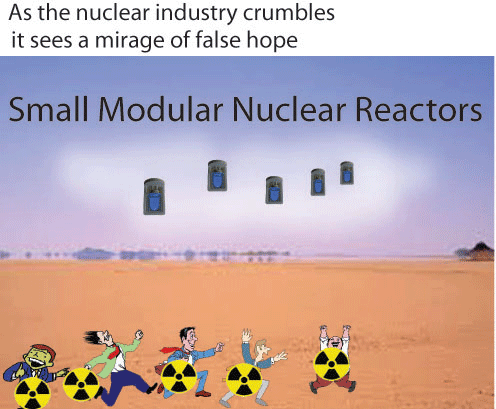
”Nuclear power is slow, dangerous and extortionately expensive. It will do nothing to address the current energy crisis, neither will it be effective to counter climate change”
Reviving nuclear power station projects such as Wylfa B on Anglesey and Trawsfynydd in Gwynedd is at the heart of the UK Government’s ambitions to attain net zero carbon emissions by 2035, government sources have said.
The UK Government is expected to reveal its new nuclear strategy in documents to be published next week, alongside a plan for how to pay for the new array of nuclear plants. US nuclear company Westinghouse is planning to revive plans for a nuclear power plant at Wylfa that was abandoned by Japan’s Hitachi in 2019, and the UK Government has indicated that it is keen to see the plan come to fruition.

Ministers are also expected to back smaller modular reactors which are being developed by a consortium led by Rolls-Royce. One of these is planned for installation in the now-decommissioned Trawsfynydd nuclear plant. Kwasi Kwarteng, the business secretary who has been under fire from industry this week due to
the rising cost of energy prices, is to unveil the overarching ‘Net Zero Strategy’ paper on Monday.
According to the Financial Times, the strategy will have a “heavy focus” on Britain’s languishing nuclear power
programme. Under the plans, an energy levy on consumers by the UK Government finance the cost of producing the power before the nuclear energy plants are built. Kwasi Kwarteng has set a target of 2035 to reach
‘net zero’ based on nuclear power, renewables and carbon capture and storage.
Anti-nuclear groups have already criticised the plans, saying that the emphasis should be placed on green renewable energy instead. Dylan Morgan of PAWB (People Against Wylfa B) said: “We have an immediate crisis now. Building huge reactors at a nuclear power station take at least 15 years. “Nuclear power is slow, dangerous and extortionately expensive. It will do nothing to address the current energy crisis, neither will it be effective to counter climate change”
Nation Cymru 16th Oct 2021
Many businesses urge UK government to incentivise the uptake of genuinely clean energy
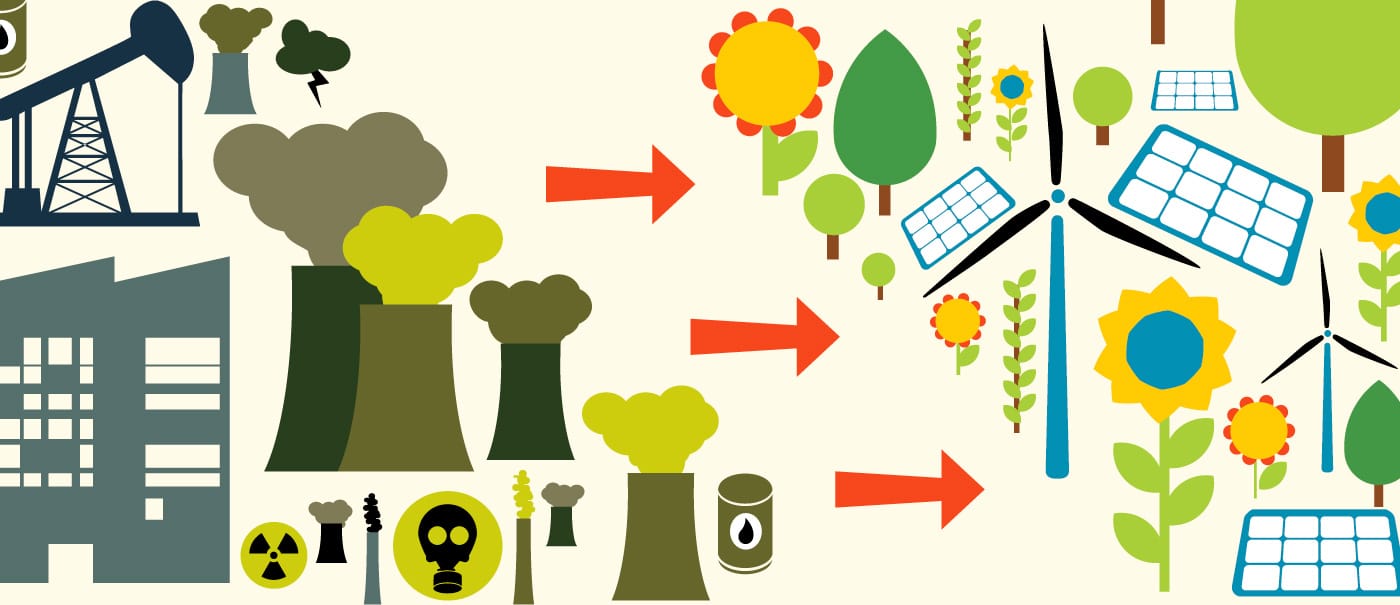
The government is facing yet more calls to slash VAT rates on domestic renewable energy and clean technology systems so as to incentivise the uptake of green solutions that can reduce household carbon emissions and
shield consumers from volatile gas prices.
In a letter to the government yesterday, nearly 30 companies and organisations from across the energy
sector argued steps needed to be taken to bring down the cost of a number of clean technologies, arguing that domestic zero carbon energy systems remained “unaffordable” for many households.
The coalition – which includes the Association for Renewable Energy and Clean Technology (REA), EDF, Nissan, and Ovo Energy – called on the government to slash VAT on a range of domestic energy saving materials, including energy storage systems, domestic EV chargers, heat pumps, and solar PV installations.
Business Green 15th Oct 2021
https://www.businessgreen.com/news/4038700/energy-players-vat-scrapped-green-home-solutions
UK to push for nuclear power: households to pay up long before the reactors are built
UK to put nuclear power at heart of net zero emissions strategy. British
ministers will put nuclear energy at the heart of Britain’s strategy to
reach net zero carbon emissions by 2050 in government documents due as
early as next week, along with new details on its funding model.
Kwasi Kwarteng, business secretary, is due to unveil the “Net Zero Strategy”,
as well as a “Heating and construction strategy” and an assessment of
the Treasury of the cost to reach the 2050 target. The main strategy will
be heavily focused on the long overdue and slow British nuclear program.
The country’s existing reactors are expected to be phased out by 2035,
with construction of a single large plant, Hinkley Point C, already
underway.
The creation of a “regulated asset base” (RAB) model will be
the key to the delivery of a future fleet of large nuclear power plants.
Under this program, households will be billed for the cost of the plant via an energy
tax long before it starts producing electricity, which could take a decade
or more from the time. where the final investment decision is made.
FT 16th Oct 2021
https://www.ft.com/content/e6426194-21e6-49c4-9520-97c337b350fd
Japan’s new pro nuclear push – and for small nuclear reactors
Japan’s Carbon Goal Is Based on Restarting 30 Nuclear Reactors, Bloomberg, By Isabel Reynolds 17 October 2021, Japan’s goal of reducing carbon emissions by 46% by 2030 is based on the assumption it will restart 30 of its nuclear reactors, a top ruling party executive said.
Akira Amari, secretary general of the Liberal Democratic Party, made the remarks Sunday in a televised debate broadcast by NHK ahead of the Oct. 31 general election.
Much of Japan’s nuclear capacity has been offline since the 2011 Fukushima disaster and Amari said only nine reactors are currently in service. Surveys generally show the electorate is against restarting the plants.
The LDP has also been promoting the idea of building small modular reactors, saying they are safer than Japan’s existing atomic plants……..https://www.bloomberg.com/news/articles/2021-10-17/amari-says-japan-s-carbon-goal-based-on-restarting-30-reactors
French President Macron now goes for small nuclear reactors – with vision of an exporting bonanza
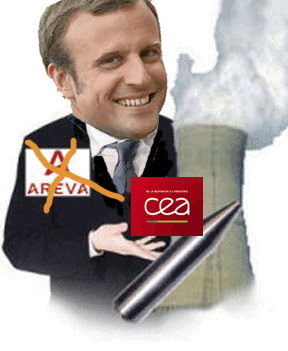
France unveils nuclear power overhaul – with an eye on China, French President Emmanuel Macron announced a shift to small modular nuclear reactors on Tuesday as he unveiled his €30 billion, five-year strategy to bolster France’s high-tech sectors, building on the country’s history as a pioneer of nuclear energy. France 24, 17 Oct 21,
Macron announced that the “number one priority” for his industrial strategy was for France to develop “innovative small-scale nuclear reactors” by 2030.
This marks a sea change in France’s approach to nuclear energy……………“The small modular reactors each generate less than 300 megawatts (MW) of energy; far less than most reactors currently in service, which tend to produce between 950 and 1300 MW, with some of them including the Flamanville plant [on the English Channel] capable of as much as 1600 MW,” said Giorgio Locatelli, an expert on the engineering of nuclear power stations at Milan Polytechnic.
……… In the grand sweep of the history of French nuclear power, the shift towards smaller reactors looks like a step back, Locatelli suggested, because France “started with small reactors in the 1960s before switching to larger ones to develop economies of scale”.However, this trend has now reached its limited, he continued. “Reactors like the one at Flamanville are not only very expensive, but also it’s a long and complex process to build them.” It takes billions to create such plants, and often it is difficult for governments to find investors willing to wait up to a decade before their returns start coming in.
Competition with China
Most countries lack the means to pull of these massive reactors, noted Nicolas Mazzucchi, an energy specialist at France’s Foundation for Strategic Research: “The financing models they require – not to mention the capacity to really mobilise a country’s savoir-faire in this domain – are increasingly rare, except in nations like Russia and China where energy companies have total state backing.”
Consequently, switching to small modular reactors is a strategic pivot to allow France to deal with competition from countries like China, which has increasingly big ambitions when it comes to nuclear power.
France’s change of approach could also allow it to win lucrative new markets. “By 2025, nearly a quarter of the world’s existing nuclear capacity will be exhausted because the reactors will have become too old,” Mazzucchi continued……………..
‘Lack of experience’………. The people in charge of reactors using cutting-edge technology “will have to justify their safety”, Herviou said. So far, the theoretical advantages of small modular reactors have not been confirmed in practice. Some 70 such reactors are currently in development throughout the world – and the vast majority of these projects are still in the early stages. “The main concern with this technology is the lack of a track record,” said Locatelli. What is more, he continued, nuclear power’s “chicken-and-egg problem is still there: Is it better to start building reactors first to win over buyers or is it best to find the investors first?” …………. https://www.france24.com/en/france/20211013-france-unveils-nuclear-power-overhaul-with-eye-on-china
Nuclear hawks under Kishida threaten Suga’s renewables push
THE ASAHI SHIMBUN, October 14, 2021 Pro-nuclear lawmakers now hold key positions under Prime Minister Fumio Kishida, sparking concern that he will stray from the prior administration’s focus on renewables to help achieve “net zero” greenhouse gas emissions by 2050.
New ministers in charge of Japan’s efforts to fight climate change and energy issues under the Kishida administration have vowed to stick with the net zero target………
The new Basic Energy Plan drafted by the Suga administration made no mention of such nuclear power-related projects despite pressure from pro-nuclear lawmakers within the LDP and the nuclear industry.
LDP lawmakers who support nuclear energy are unhappy about the Basic Energy Plan, which said Japan will “reduce its dependence on nuclear energy as much as possible.”
……………concerns have been raised over a possible return to reliance on more nuclear power following pro-nuclear lawmakers assuming key posts in the government and the ruling Liberal Democratic Party.
Koizumi, who as environment minister pushed for renewable energy, and Taro Kono, who served as minister in charge of administrative reform and is a staunch opponent of nuclear energy, were replaced when Kishida formed his Cabinet.
….. Despite his vow against new reactor projects, Hagiuda is a close ally of former Prime Minister Shinzo Abe, who serves as the most senior adviser to a group of lawmakers advocating construction of new reactors to replace aged units.
Akira Amari, the new secretary-general of the LDP, the second most powerful post after the party president, Kishida, is the most senior adviser to the group.
Sanae Takaichi, who proposed bolstering development of new technology to build a nuclear fusion reactor during the LDP
leadership race last month, landed the position of the party’s policy chief.
…Not surprisingly, the nuclear industry hailed the government and the new party lineup…….. https://www.asahi.com/ajw/articles/14460623
Senate Inquiry quizzes Australian Nuclear Science and Technology Organisation and Australian Radiation Protection and Nuclear Safety Agency on infrastructure needs for nuclear submarines.
Nuclear agencies say it’s too early to know what infrastructure is needed to support submarine program
Rex Patrick says it’s ‘beyond comprehension’ Australia could build a nuclear-powered fleet without a domestic industry to support it, Guardian, Tory Shepherd, Fri 15 Oct 2021
Nuclear agencies say it is too early to speculate what legislative and infrastructure changes need to be made to support a nuclear-submarine project.
A senate economics committee inquiry into naval shipbuilding has been running for two years, but a public hearing on Friday was the first since the federal government announced its intention to acquire at least eight nuclear-powered submarines.
Independent senator Rex Patrick called the Australian Radiation Protection and Nuclear Safety Agency and the Australian Nuclear Science and Technology Organisation to appear. The agencies were quizzed over what nuclear infrastructure and industry would be needed to support the project, and what laws would need to be changed – however, they took most of those questions on notice.
Ansto did confirm it was consulted in March about the plan to buy nuclear-powered submarines, about six months ahead of September’s surprise announcement.
“Initial conversations started in March and we had a number of consultations between then and the announcement,” chief executive officer Shaun Jenkinson said.
Arpansa chief executive officer Carl-Magnus Larsson said his agency was briefed on the plan at the end of June or beginning of July.
The prime minister, Scott Morrison, has said there are no plans to develop a civil nuclear industry to support building submarines. He and defence say the nuclear reactors – which will be procured from the United States or the United Kingdom as part of the Aukus agreement – will not need refuelling, and therefore a domestic industry is not necessary.
Ahead of the inquiry, Patrick said: “It’s just unimaginable, it’s beyond comprehension that someone could suggest we’d be operating a nuclear operator in a submarine in a hands-off manner.
“I also want to understand what safety regime they understand to be necessary for this to be carried out,” he added.
Labor senator Kim Carr said there would have to be “extensive onshore facilities” to train people in case there’s an emergency, or a malfunction.
“I’d be interested to know how this can be done without the development of the various sustainment industries.”
“We’d need to have intensive training of all personnel to understand the linkages between the reactor and all the other bits of the boat,” he said.
“You can’t just drop it in. It’s not like a battery in a mobile phone, everything’s connected to everything else.”……….https://www.theguardian.com/world/2021/oct/15/inquiry-to-question-whether-australia-needs-nuclear-industry-to-support-submarine-program
France – a new Bill calls for transparency on costs of nuclear power
A bill calls for more transparency on French nuclear power “There are not
enough figures, today we do not know how much it costs!”, Laments a member
of the Meuse. Émilie Cariou denounces the opacity in the sector.
France Inter 13th Oct 2021
Belgium’s Energy Minister calls for the government to speed up plan to shut down nuclear reactors
Another government crisis looms in Belgium — this time over nuclear
power. The government is set to decide next month whether to go ahead with
a plan to shut down all nuclear reactors by 2025 or prolong the lifespan of
the two newest reactors.
But the seven-party coalition is deeply divided on
the issue, with some warning the government could implode if the fight
escalates. It’s also a make-or-break moment for the Greens, who are in
charge of the energy file and in government for the first time since 2003.
Tinne Van der Straeten, the Green energy minister, is calling on the
government to move ahead with its plan to shut down Belgium’s remaining
reactors — a position that’s in line with the party’s anti-nuclear agenda
and that she has defended as consistent with the country’s long-term
climate goals. But her suggestion to build new gas-fired plants to replace
part of the nuclear capacity before relying fully on renewables isn’t going
down well with other parties, especially as natural gas prices soar across
Europe.
Politico 11th Oct 2021
https://www.politico.eu/article/belgium-nuclear-power-government-climate-greens/
Crypto currency and nuclear power – a worrying partnership

Why Crypto Mining Needs Nuclear Power, Yahoo Finance Florent Heidet, Milos Atz (both writers employed at USA’s Dept of Enegy Argonne National Laboratory) Thu, October 14, 2021
”………Cryptocurrencies are digital currencies secured by cryptography. Unlike physical money, like dollars, cryptocurrencies are not minted by national institutions. Instead, they are created through complex algorithms that take place over computer networks. While not all crypto currencies have a specific function, the most valuable ones, such as BTC and ETH, exist primarily to carry financial transactions embedded in the blockchain – the cryptographic transaction record.
……….. The incredible rise in cryptocurrency value, associated with the ease to contribute to the cryptocurrency mining process with common computer hardware, has resulted in an ever-larger number of miners joining cryptocurrency networks. Increasing the number of miners benefits the system by further decentralizing, and therefore securing, the cryptocurrency.
……… Total power consumption used by mining across the major cryptocurrencies is tens of gigawatts electrical, or GWe, based on current network size and average mining equipment power. That is about the same as the power demand of Sweden or Montana. New generations of computing hardware are more efficient and progressively reduce power consumption per hashrate, but the high profitability of mining attracts more participants, yielding a net increase of the overall power used by the network. In fact, as long as the combined costs of electricity and hardware remain lower than the value of the generated cryptocurrency, the networks and their power consumption will continue growing and will soon surpass that of most countries.
Although cryptocurrency mining requires huge amounts of energy, the process itself is not directly polluting. The natural resource requirement is limited to what is needed to manufacture computer hardware and to generate electricity for the mining operations. Cryptocurrency mining is a 24/7 process using constant power with minimal downtime. Additionally, larger mining operations can require in excess of 100 megawatts of power for facilities with the footprint of a medium-size factory. Mining operations need a highly reliable and dense power supply.
………. To guarantee a share of carbon-free electricity, cryptocurrency mining operations may seek agreements with local grid operators or electricity generators. Some larger cryptocurrency mining operations may choose to own and operate their own electricity generation facilities.
………….The power demands of the cryptocurrency mining industry create a unique opportunity for synergizing with nuclear power. Nuclear reactors harness energy from fissioning elements such as uranium
………… Engaging with the burgeoning cryptocurrency industry is advantageous for the nuclear industry,…….. the cryptocurrency industry specifically demands the unique benefits of nuclear power, making partnerships an ideal opportunity…….. Cryptocurrency network growth will only further propel energy cost increases.
…………. Partnerships between the crypto-mining and the nuclear industries have already started to blossom. Recent reporting has showcased agreements forged between cryptocurrency mining operations and both nuclear utilities and nuclear reactor vendors. Given the synergies between cryptocurrency energy demands and nuclear power, we hope that these industries continue to engage with each other to explore mutually beneficial opportunities for growth and collaboration.
1 This Month
23-25 October – on Zoom – World BEYOND War’s annual global conferenc


Shut down the radiation-damaged Heysham nuclear reactors now
To see nuclear-related stories in greater depth and intensity – go to https://nuclearinformation.wordpress.com

Say No to NASA’s Reckless Nuclear Reactor on the Moon
Say No to NASA’s Reckless Nuclear Reactor on the Moon

-
Archives
- October 2026 (209)
- September 2026 (339)
- August 2026 (330)
- July 2026 (355)
- June 2026 (287)
- May 2026 (306)
- April 2026 (356)
- March 2026 (251)
- February 2026 (267)
- January 2026 (308)
- December 2025 (358)
- November 2025 (359)
-
Categories
- 1
- 1 NUCLEAR ISSUES
- business and costs
- climate change
- culture and arts
- ENERGY
- environment
- health
- history
- indigenous issues
- Legal
- marketing of nuclear
- media
- opposition to nuclear
- PERSONAL STORIES
- politics
- politics international
- Religion and ethics
- safety
- secrets,lies and civil liberties
- spinbuster
- technology
- Uranium
- wastes
- weapons and war
- Women
- 2 WORLD
- ACTION
- AFRICA
- Atrocities
- AUSTRALIA
- Christina's notes
- Christina's themes
- culture and arts
- Events
- Fuk 2022
- Fuk 2023
- Fukushima 2017
- Fukushima 2018
- fukushima 2019
- Fukushima 2020
- Fukushima 2021
- general
- global warming
- Humour (God we need it)
- Nuclear
- RARE EARTHS
- Reference
- resources – print
- Resources -audiovicual
- Weekly Newsletter
- World
- World Nuclear
- YouTube
-
RSS
Entries RSS
Comments RSS

