President Macron backs nuclear energy, but France’s Greens want speedier end to nuclear power
The president 9 Macron) used the speech to state his support for nuclear energy, which accounts for about 70% of French electricity and has become a point of fierce debate in the run-up to next year’s election.
Green politicians want France to move fast to end its dependence on nuclear, highlighting the large amounts of radioactive waste it produces as well as safety issues.
Politicians on the right and far-right want more reactors. Macron said France would invest €1bn by 2030 in “disruptive innovation” to produce atomic power, which he said would focus on designing small nuclear reactors with improved waste management. He added that France should be able to produce 2m electric and hybrid cars by 2030 and build a low-CO2 aeroplane during the same timeframe.
Guardian 12th Oct 2021
https://www.theguardian.com/world/2021/oct/12/macron-30bn-plan-to-reindustrialise-france
The French are mainly for nuclear power, but not so keen on new nuclear stations
The French mainly for nuclear but against new power plants. According to
the Institute for Radiation Protection and Nuclear Safety, 53% of French
people consider that this energy has been a good thing for France, but they
are 45% to oppose the construction of new plants.
Le Monde 10th Oct 2021
Finland lobbied EU to declare nuclear power sustainable after unpublished cabinet decision.

Finland lobbied EU to declare nuclear power sustainable after unpublished cabinet decision supported by Greens, Uutiset, 9 Oct 21,
The EU Commission decides this autumn if nuclear power will be classified as sustainable.
Finland’s government has agreed to lobby the EU to declare nuclear power a sustainable energy source, but kept the decision secret.
If nuclear power gets the so-called ‘green label’, financing for nuclear projects will be easier to come by and the terms of any loans will be softer than for other energy projects…..
Finland’s decision was reached at a meeting of ministers on 9 July, but not announced publicly. Yle’s sources say that parliament’s Grand Committee, which sets the parameters of Finland’s EU policy, has not been informed of the change.
Yle requested the memo from the meeting, which was provided after publishing a report on the decision on Thursday.
Finance Minister Annika Saarikko (Cen) said that she did not see a reason to keep Finland’s view on nuclear power secret, and that the decision was reached in order to influence the EU decision-making process.
The EU has already granted solar and wind power projects the green ‘sustainable’ stamp of approval, but postponed decisions on gas and nuclear…..
Greens emphasise that there are still different views on nuclear within the party, but it has now adopted a ‘technology neutral’ stance on fighting climate change, according to Yle’s sources…..
On Thursday Iltalehti reported that Prime Minister Sanna Marin (SDP) raised the matter of nuclear policy with EU Commission President Ursula von der Leyen in Helsinki on Monday https://yle.fi/uutiset/osasto/news/finland_lobbied_eu_to_declare_nuclear_power_sustainable_after_unpublished_cabinet_decision_supported_by_greens/12135621
Morrison’s decision on AUKUS and nuclear submarines was made with no debate in the Australian Parliament

Our PM, Scott Morrison, struts the world stage, vilifies China (some of it deserved), but in the process is locking in Australia’s subservience to US foreign policy while guaranteeing increased US troop access and US spy stations on Australian territory for the future. Add to this the crippling cost of procurement of nuclear powered subs and the possible return of Donald Trump to ‘guide’ our nation into the future.
This sabre rattling at an external enemy will allow Morrison some catch up in the polls while the ALP is wedged. The huge crime here is to make a decision without debate in the Federal Parliament.
Times change, but some things regarding the nuclear industry and international political posturing remain the same.
Local anti-nuclear activists who chose to make a difference…https://www.echo.net.au/2021/10/local-anti-nuclear-activists-who-chose-to-make-a-difference/ By Ian Cohen October 7, 2021 Following the Nuclear Disarmament Party’s close loss with front man Peter Garrett in 1984, nuclear issues were at the forefront of people’s minds. We extended our influence far beyond our Shire. The pending arrival of nuclear armed warships sent the local region into overdrive. Benny Zable from Nimbin rolled out his ‘radioactive’ barrels for street theatre. Dean Jefferys based in Brunswick Heads came with his ultralight, Hoss (Ian Hoskens) of Main Arm with his megaphone voice and me with my surfboard.
September 1986 heralded the arrival of the largest assembly of international ships in Sydney Harbour’s history. Many were nuclear armed.
Our north coast contingent was vital to the success of the protest actions. Driven by a reckless, but heartfelt, desire to impact on the nuclear arms race and send a direct message to US President Ronald Reagan and USSR’s Yuri Andropov.
The mad concept of surfing the nose of a nuclear armed warship was mine, but Sydney Morning Herald photographer, Robert Pearce, from a media barge directly in front of myself and the warship, captured the image of a vulnerable surfer hanging onto the nose of a nuclear armed destroyer that went global.
Continue readingDespite pre-election promises, Biden administration is continuing Trump’s costly nuclear weapons modernisation.

In terms of nuclear policy, the Biden administration, for its part, seems set on continuing much of the strategic weapons modernization that was already underway during the Trump administration, despite the president-elect making calls for reducing spending on nuclear weapons, even stating that “the United States does not need new nuclear weapons.”…..……
despite pre-election rhetoric about pursuing a “sustainable nuclear budget,” the nuclear weapons plans of the current administration are more or less business as usual
Newly Declassified Data Shows Unexplained Increase In U.S. Nuclear Warhead Stockpile
There had been no increases in the stockpile for over 25 years before this data point was released.
BY THOMAS NEWDICK OCTOBER 7, 2021, The Drive, In the latest official public count, the U.S. military possesses a stockpile of 3,750 nuclear warheads, with approximately 2,000 more that have been retired and are awaiting disposal. Under the Trump administration, however, a small but unusual bump in stockpile size occurred between 2018 and 2019, according to these same figures. The unexplained increase in the total number of warheads in inventory is apparently only the second reported instance of its kind since the end of the Cold War.
The revelations are among newly declassified details of nuclear weapons numbers in a recently published fact sheet from the U.S. Department of State with the title Transparency in the U.S. Nuclear Weapons Stockpile. This is the first time such data has been released since September 2017, after which the Trump administration took the decision to classify the information.
The revelations are among newly declassified details of nuclear weapons numbers in a recently published fact sheet from the U.S. Department of State with the title Transparency in the U.S. Nuclear Weapons Stockpile. This is the first time such data has been released since September 2017, after which the Trump administration took the decision to classify the information.
While there is no information immediately available to explain that 20-warhead increase, FAS suggests that one possibility is the production of the controversial low-yield W76-2 nuclear warheads for the U.S. Navy’s Trident D5 submarine-launched ballistic missiles.
The-then presidential candidate Joe Biden warned before taking office that fielding the W76-2 was a “bad idea” and that the warhead’s existence makes the U.S. government “more inclined to use them” than in the past…………..
The timing of the latest nuclear warheads fact sheet coincides with a review of nuclear weapons policy and capabilities by the Biden administration. Declassifying the nuclear stockpile information is also likely geared toward next January’s Nuclear Non-Proliferation Treaty conference, in which nuclear powers who have signed the treaty — among the United States, Russia, the United Kingdom, France, and China — will address the issue of disarmament commitments………….
As The War Zone has examined in the past, New START places hard limits on the total number of strategic nuclear weapon delivery systems, as well as the warheads that they carry, that each country can possess. The arrangement is seen as being key to preventing a new nuclear arms race between the two powers and the Biden administration is apparently keen to negotiate new arms control deals with Russia, especially given the collapse of the Intermediate-Range Nuclear Forces Treaty, or INF, in 2019.
In terms of nuclear policy, the Biden administration, for its part, seems set on continuing much of the strategic weapons modernization that was already underway during the Trump administration, despite the president-elect making calls for reducing spending on nuclear weapons, even stating that “the United States does not need new nuclear weapons.”………..
despite pre-election rhetoric about pursuing a “sustainable nuclear budget,” the nuclear weapons plans of the current administration are more or less business as usual. The hopes of some analysts that the United States might even do away with the ICBM leg of its nuclear triad were swiftly dashed, the Biden administration quickly committing itself to the primacy of the nuclear triad itself — ICBMs, nuclear-capable Air Force bombers, and submarine-launched ballistic missiles. All of those areas are undergoing a process of modernization……… https://www.thedrive.com/the-war-zone/42666/newly-declassified-data-shows-unexplained-increase-in-u-s-nuclear-warhead-stockpile
Japanese Prime Minister Fumio Kishida praises Treaty on the Prohibition of Nuclear Weapons
ICAN 9 Oct 21, After receiving a letter from Hiroshima survivor and long-time ICAN activist Setsuko Thurlow and ICAN, the new Japanese Prime Minister Fumio Kishida said “I believe that the Treaty on the Prohibition of Nuclear Weapons is a very important treaty for a world without nuclear weapons.” This is definitely a good sign from a nuclear allied country that previously has dismissed our treaty.
Setsuko had already met with Mr Kishida in 2018, together with ICAN partner Peace Boat, to discuss Japan’s nuclear disarmament policy and we will use the opportunity of this new Prime Minister to strengthen our work to get Japan join the treaty.
Nuclear power for Australia? It’s not going to happen!

Nuclear enthusiasts and fellow travellers like me once said of solar it’s the greatest future source of power and always will be. Solar investors may aim that rhetorical dart at small modular reactors and, indeed, the nuclear sector as its energy share, for years stagnant, proceeds to go backwards.
In Australia nuclear attracts not the remotest investor interest. If nuclear were an option a merchant bank or superannuation fund might be manoeuvring to own the space. They might have formed a consortium with a miner and a construction company or two, with a brace of lobbyists at work. It’s not happening.
The contrast with the surge to renewables is stark………..
[ED. An interesting and important piece here re the failure of nuclear power in today’s Australian.
Important because Bob Carr used to be pro-nuke and has changed in response to evidence.
This is timely and a good reinforcement to federal Labor re their strong opposition to any domestic nuclear industry.]
Nobody’s really interested in the nuclear option
BOB CARR, OCTOBER 7, 2021,THE AUSTRALIAN
Australians may be open to nuclear power, as evidenced by Tuesday’s Newspoll. But nuclear is not open for them.
Globally the industry is moribund. “The dream that failed,” says The Economist magazine, concluding it needs government money for life support.
In 2010 one enthusiast predicted within 10 years fourth-generation reactors and small modular reactors would be commonplace, including in Australia. None exists, here or abroad.
More damning, the industry lacks a single example in a Western country of a new power plant being built remotely on time and budget. According to the World Nuclear Industry Status Report, 94 plants were to come on line across the last decade but 98 get decommissioned. Yet 48 of those to be built are to be in China. Remove them and that leaves 46 coming online and – stubborn fact – 98 being decommissioned in the rest of the world.
In 2019, for the first time, renewable sources, excluding hydro, generated more power than nuclear.
In Australia nuclear attracts not the remotest investor interest. If nuclear were an option a merchant bank or superannuation fund might be manoeuvring to own the space. They might have formed a consortium with a miner and a construction company or two, with a brace of lobbyists at work. It’s not happening.
The contrast with the surge to renewables is stark. Andrew Forrest and Mike Cannon-Brookes are prepared to put their own funds into a vast solar farm in the Northern Territory and Forrest to make a huge commitment to hydrogen. There is no single investor with a comparable zest for nuclear power, either high net worth individual or institution.
Ziggy Switkowski produced a report on nuclear power for John Howard in 2007. It was to be the foundation of Australian nuclear power, a decades-long dream. Even with a partiality for the industry Switkowski could only conclude nuclear power, at double the price of coal and gas, would require a price on carbon – and even additional government subsidy.
Three prime ministers – Tony Abbott, Malcolm Turnbull, Scott Morrison – have not reopened the debate. For his part, by becoming chair of Crown in August, Switkowski seems to demonstrate more confidence in gaming-based tourism than the commercial potential of the nuclear fuel cycle.
I argued a pro-nuclear case within the Labor Party and scorned what I saw as the left phobia against the nuclear option. Like British scientist James Lovelock I thought coal more destructive and nuclear the bridge to the era of renewables.
But it’s now clear nuclear is lumbering, subject to breakdowns and cripplingly expensive. New renewable sources such as wind and solar increased by 184 gigawatts last year while nuclear grew by only 2.4GW. The number of active reactors has barely changed since the 1980s.
France was the poster child. But no new reactor has been connected to its grid since 1999. It closed its pressurised water reactor in 1991 and followed by terminating two fast breeder reactors and a small heavy-water reactor.
Poor reliability plagues the fleet. On any day at least four plants are at zero output because of technical failures. The average per plant is a month per year at zero production. But investment in upgrades faces competition from renewables and tough new EU energy efficiency standards.
Not even Scandinavian efficiency can provide a happy pro-nuclear narrative. Finland became the first country in western Europe to order a new nuclear reactor since 1988 but it’s running 13 years late, plagued with management and quality control issues, bankruptcies and investor withdrawals.
Who could have the faintest confidence that Australia could throw up a nuclear reactor with more panache – exceeding with efficiency not only the Finns but the British with their delays and cost blowouts and the Americans with their construction disasters in Georgia and South Carolina?
Doing big complex projects is hardly an Australian competitive edge. Think of the 50 years opining about a second Sydney airport, or – killer fact – the fumbling with submarines.
Where is the shire council putting up its hand to host a nuclear power plant? Harder to find than a sponsor for a high-temperature toxic waste incinerator.
Nobody in the Hunter Valley has urged nuclear for the Liddell site, even on the footprint of this coal-fired power plant scheduled to close. And not even invoking the prospect of a small modular reactor that 10 years back was the vanguard of the nuclear renaissance. About to be planted across the Indonesian archipelago and the rest of Asia, we were promised. Today they exist only on the Rolls-Royce drawing boards they have adorned since the 1970s.
Nuclear enthusiasts and fellow travellers like me once said of solar it’s the greatest future source of power and always will be. Solar investors may aim that rhetorical dart at small modular reactors and, indeed, the nuclear sector as its energy share, for years stagnant, proceeds to go backwards.
Bob Carr is the longest-serving premier of NSW and a former Australian foreign minister.
The “No Militarization of Space Act” has been introduced in the U.S. Congress.
No Militarization of Space Act, CounterPunch BY KARL GROSSMAN, 6 Oct 21,
Finally, there’s some good news about the U.S. push to turn space into a war zone. The “No Militarization of Space Act” has been introduced in the U.S. Congress. It would abolish the new U.S. Space Force.
It is being sponsored by five members of the House of Representatives led by Representative Jared Huffman. In a statement announcing the September 22nd introduction of the measure, Huffman called the U.S. Space Force “costly and unnecessary.”
The arms and aerospace industries, which have a central role in U.S. space military activities, will no doubt be super-active in coming weeks working to stop movement of the legislation.
Representative Huffman, with a background as a consumer attorney specializing in public interest cases, was elected in 2012 to represent the 2nd Congressional District in California which covers the state’s North Coast up to the Oregon border. He resides in San Rafael.
In his statement announcing the introduction of the bill, Huffman said the “long-standing neutrality of space has fostered a competitive, non-militarized age of exploration every nation and generation has valued since the first days of space travel. But since its creation under the former Trump administration, the Space Force has threatened longstanding peace and flagrantly wasted billions of taxpayer dollars.” And, he continued: “It’s time we turn our attention back to where it belongs: addressing urgent domestic and international priorities like battling COVID-19, climate change, and growing economic inequality. Our mission must be to support the American people, not spend billions on the militarization of space.”
Co-sponsors of the “No Militarization of Space Act” are Representatives Mark Pocan of Wisconsin, chair of the Congressional Progressive Caucus; Maxine Waters of California; Rashida Tlaib of Michigan; and Jesus Garcia of Illinois. All are Democrats.
Alice Slater, a board member of the organization World BEYOND War, commented that Trump, “in his besotted hunkering for hegemonic glory,” established the Space Force as “a brand new branch of the already gargantuan military juggernaut….Sadly, the new U.S. President Biden has done nothing to ratchet down the warmongering. Fortunately, help is on the way with a group of five sane members of Congress.”
But not only has Joe Biden stuck with the U.S. Space Force, but most Democrats in both the House of Representatives and Senate voted for its creation as championed by Trump. All Republicans in Congress voted for it…………….https://www.counterpunch.org/2021/10/06/no-militarization-of-space-act/
Call the U.S. Defense Budget what it is – the War Budget

Stop Calling the Military Budget a ‘Defense’ Budget, https://www.commondreams.org/views/2021/10/05/stop-calling-military-budget-defense-budget To call the Pentagon’s massive and escalating budget a “defense” budget is nothing less than internalized corruption of language that undermines our capacities to think clearly and talk straight.
NORMAN SOLOMON, October 5, 2021 It’s bad enough that mainstream news outlets routinely call the Pentagon budget a “defense” budget. But the fact that progressives in Congress and even many antiwar activists also do the same is an indication of how deeply the mindsets of the nation’s warfare state are embedded in the political culture of the United States.
The misleading first name of the Defense Department doesn’t justify using “defense” as an adjective for its budget. On the contrary, the ubiquitous use of phrases like “defense budget” and “defense spending”—virtually always written with a lower-case “d”—reinforces the false notion that equates the USA’s humongous military operations with defense.
In the real world, the United States spends more money on its military than the next 10 countries all together. And most of those countries are military allies.
What about military bases in foreign countries? The U.S. currently has 750, while Russia has about two dozen and China has one. The author of the landmark book “Base Nation,” American University professor David Vine, just co-wrote a report that points out “the United States has at least three times as many overseas bases as all other countries combined.” Those U.S. bases abroad “cost taxpayers an estimated $55 billion annually.”
As this autumn began, Vine noted that President Biden is “perpetuating the United States’ endless wars” in nations including “Iraq, Syria, Somalia and Yemen” while escalating “war-like tensions with China with a military buildup with Australia and the UK.”
All this is being funded via a “defense” budget?
Calling George Orwell.
As Orwell wrote in a 1946 essay, political language “is designed to make lies sound truthful and murder respectable, and to give an appearance of solidity to pure wind.” In 2021, the hot air blowing at gale force through U.S. mass media is so continuous that we’re apt to scarcely give it a second thought. But the euphemisms would hardly mean anything to those in faraway countries for whom terrifying and lethal drone attacks and other components of U.S. air wars are about life and death rather than political language.
You might consider the Pentagon’s Aug. 29 killing of 10 Afghan civilians including seven children with a drone attack to be a case of “respectable” murder, or negligent homicide, or mere “collateral damage.” Likewise, you could look at numbers like 244,124—a credible low-end estimate of the number of civilians directly killed during the “war on terror” in Afghanistan, Pakistan and Iraq—and consider them to be mere data points or representing individuals whose lives are as precious as yours.
But at any rate, from the vantage point of the United States, it’s farfetched to claim that the billions of dollars expended for ongoing warfare in several countries are in a budget that can be legitimately called “defense.”
You might consider the Pentagon’s Aug. 29 killing of 10 Afghan civilians including seven children with a drone attack to be a case of “respectable” murder, or negligent homicide, or mere “collateral damage.” Likewise, you could look at numbers like 244,124—a credible low-end estimate of the number of civilians directly killed during the “war on terror” in Afghanistan, Pakistan and Iraq—and consider them to be mere data points or representing individuals whose lives are as precious as yours.
But at any rate, from the vantage point of the United States, it’s farfetched to claim that the billions of dollars expended for ongoing warfare in several countries are in a budget that can be legitimately called “defense.”
You might consider the Pentagon’s Aug. 29 killing of 10 Afghan civilians including seven children with a drone attack to be a case of “respectable” murder, or negligent homicide, or mere “collateral damage.” Likewise, you could look at numbers like 244,124—a credible low-end estimate of the number of civilians directly killed during the “war on terror” in Afghanistan, Pakistan and Iraq—and consider them to be mere data points or representing individuals whose lives are as precious as yours.
But at any rate, from the vantage point of the United States, it’s farfetched to claim that the billions of dollars expended for ongoing warfare in several countries are in a budget that can be legitimately called “defense.”
Until 1947, the official name of the U.S. government’s central military agency was the War Department. After a two-year interim brand (with the clunky name National Military Establishment), it was renamed the Department of Defense in 1949. As it happened, that was the same year when Orwell’s dystopian novel “1984” appeared, telling of an always-at-war totalitarian regime with doublespeak slogans that included “War Is Peace.”
Today, the Department of Defense remains an appropriately capitalized proper noun. But the department’s official name doesn’t make it true. To call its massive and escalating budget a “defense” budget is nothing less than internalized corruption of language that undermines our capacities to think clearly and talk straight. While such corroded language can’t be blamed for the existence of sloppy thinking and degraded discourse, it regularly facilitates sloppy thinking and degraded discourse.
Let’s blow away the linguistic fog. The Pentagon budget is not a “defense” budget.
Norman Solomon is co-founder and national coordinator of RootsAction.org. His books include “War Made Easy: How Presidents and Pundits Keep Spinning Us to Death“ (2006) and “Made Love, Got War: Close Encounters with America’s Warfare State” (2007).
2022 French Presidential candidates divided over nuclear energy
2022 French Presidential candidates divided over nuclear energy, Candidates on the left and right have spoken out about the future of energy in France, and whether nuclear energy should still be used. Connexion, By Joanna York, 6 Oct 21
Six months ahead of the French Presidential elections, and with energy prices rising steeply this month, the future of nuclear energy in France is becoming a key issue.
President Emmanuel Macron has previously spoken out in favour of using nuclear energy, saying during a 2019 European summit that use of nuclear power would help France transition towards carbon neutral energy sources.
In mid-October the president is expected to announce the creation of small-scale nuclear plants, or SMRs, which are said to be affordable, safer and to produce emission-free, carbon-free energy.
According to EDF, nuclear energy is the primary source of electricity production in France.
There are 56 nuclear reactors of varying sizes located throughout France, with those in l’Auvergne-Rhône-Alpes, Grand Est, Centre val-de-Loire and Normandie providing 80% of electricity produced by nuclear power.
Candidates on the right for increasing nuclear production
Candidates on the right have so far said they support expanding use of nuclear energy in France
Xavier Bertrand, current regional president of Hauts-de-France, told FranceInfo on October 4 he was in favour “of laws bringing nuclear energy back to producing 50% of energy” in order for France to remain an “independent” energy producer.
Diverse opinions from candidates on the left
In contrast, some candidates on the left have spoken out strongly against continued use of nuclear energy.
EELV (centre-left, green) candidates Yannick Jadot and Sandrine Rousseau have both said that they wish to see an end to the use of nuclear energy.
Paris Mayor and Parti Socialiste (centre-left) candidate Anne Hidalgo agrees. In her recently-released book she wrote: “we need to stop using nuclear energy as soon as the development of renewable energy allows it.”
However, Olivier Faure, also from the Parti Socialiste, told FranceInfo he “did not believe” in ending use of nuclear power in France by 2030, because “as long as we have not fully developed renewable energies, we have to continue using nuclear plants”.
As in previous presidential campaigns in 2012 and 2017, Mr Mélenchon has said that use of nuclear energy should be stopped before 2023, in favour of 100% renewable energies.
He has previously campaigned for abandoning nuclear plants, the burial of nuclear waste and the closure of France’s oldest nuclear power station Fessenheim, which happened in June 2020.
Parti Communiste (far left) candidate, Fabien Roussel, spoke out against the closure of the power station at the time.
In an interview with Le Point in May 2021 he said he was “in favour of maintaining use of nuclear power in France”. https://www.connexionfrance.com/French-news/2022-French
Rep. Burgess Owens and Rep. Chris Stewart sponsor a Bill to ensure compensation for health effects of nuclear bomb testing
Too many ‘downwinders’ are still suffering https://www.deseret.com/2021/10/4/22709221/utah-nuclear-testing-downwinders-congress-compensation-health-effects We are sponsoring a bill that would make sure the government’s responsibility to those who were harmed by nuclear testing does not get swept under the rug. By Burgess Owens and Chris Stewart Oct 4, 2021, ‘ Any objective study of American history brings us to the realization that there are many Americans who quietly made, and continue to make, great sacrifices for our national security. Many of these women and men willingly give of themselves to ensure that our country remains free.
Tragically, under the banner of national security the United States government exposed Americans to radioactive uranium ore and radioactive dust — subjecting them to lung cancer and other respiratory illnesses.
On July 16, we marked the 76th anniversary of the detonation of the first nuclear weapon — code-named Trinity — in the desert of New Mexico’s Tularosa Basin. Three weeks after the Trinity detonation, the United States exploded the Little Boy bomb over Hiroshima and, three days later, the Fat Man bomb over Nagasaki. Six days later, Japan surrendered. In the aftermath of World War II, a nuclear arms race began that reached its zenith with over 60,000 nuclear weapons worldwide in 1986.
Many lives were lost or severely altered by the nuclear weapons program. Thankfully, the world stockpile of nuclear weapons has steadily declined since 1986 and will, hopefully, continue to do so in the future. Yet, the effects of detonating over 1,100 nuclear weapons since the Trinity test in 1945 continue to mar the lives of Americans to this day.
Through atmospheric weapons tests, as well as mining, transporting and milling of uranium ore, many Americans have been slowly killed by radiation exposure. Thousands of Utahns were infected by radiation exposure simply by living “downwind” of the federal government’s nuclear weapons testing sites. Additional Utahn miners were affected as they worked the uranium necessary for these weapons. These “downwinders” and miners and their families friends, and communities often suffered excruciating illness, loss and devastation.
In response to this malfeasance, Congress rightly enacted (and later amended in 2000) the Radiation Exposure Compensation Act (RECA) in 1990. This legislation was a good first step in making recompense to those who mined and hauled uranium ore and those who processed the ore at a mill. The RECA legislation also addresses those exposed to radiation downwind from nuclear test sites.
It has been more than 20 years since any meaningful reform to RECA has been made for those whose lives have been taken or irreversibly altered by our foray into the arms race. Several classifications of workers such as core drillers and ground workers have been denied justice by being excluded completely from the process.
Some diseases that should have been compensable have been excluded. Numerous geographical locations exposed to downwind radiation have been left out. Uranium miners continued to mine after the United States stopped buying uranium for its nuclear weapons programs in 1971. These so-called post-1971 workers were excluded from accessing benefits since the original RECA legislation had an arbitrary cutoff date of Dec. 31, 1971 — even though the federal government continued to regulate uranium mines long after 1971. To make matters worse, RECA is scheduled to sunset in July 2022 — potentially leaving all classifications of exposure victims without redress.
We are honored to represent some of these “downwinders” and their family members and want them to know their suffering — and the sacrifices they made for our nation — are not forgotten.
That is why we are pleased to be the lead Republican members of the House of Representatives on the “RECA Amendments Act of 2021,” legislation that will reauthorize RECA for those still suffering the consequences of nuclear testing.
The tragic consequences of the nuclear arms race cannot be swept under the rug of history. We urge our colleagues in Congress to support the “RECA Amendments Act of 2021.” Our country must act now to address the injustices of those who have been forgotten by their own government.
Rep. Burgess Owens represents Utah’s 4th Congressional District. Rep. Chris Stewart represents Utah’s 2nd Congressional District.
UK government to generate a colossal public sector loss in building more nuclear power station at Sizewell C
Drunk on the latest fossil fuel energy crisis, the UK Government has handed
the British public a giant nuclear hangover that will leave the country
scrabbling for renewable energy solutions. Boris Johnson has promised 40 GW
of offshore wind by the end of the decade, which, when added to other
renewable energy sources, will generate over three-quarters of current
levels of UK electricity consumption.
But this growth could be threatened
by the nuked-up knee jerk reaction to the current natural gas price crisis
that will plunge the energy budget into a massive deficit and leave the
electricity system dangerously unbalanced. After fossil fuel prices subside
back towards their more usual levels, this will constitute a giant
hangover.
The last time we had an energy crisis, in 2008 and 2011 when oil
prices spiked, the UK ended up with what was regarded as a bad deal to pay
(in today’s money) over £110 per MWh for Hinkley C over 35 years. That
was the hangover after the last crisis. This time it is likely to be worse
as the Government recycles its own half-truths to generate a colossal
public sector loss in building more nuclear power plant at Sizewell C and,
then, it hopes, at Wylfa. These plans would, eventually, ensure that around
20 percent of UK electricity comes from nuclear power, but also ensure that
efforts to balance the much cheaper renewable energy will be poorly
developed at best, and ignored at worst.
100% Renewables 4th Oct 2021
https://100percentrenewableuk.org/how-the-governments-drunken-nuclear-binge-will-threaten-renewables
Surprise surprise. USA Justice Dept drops charges against Michael Flynn.

In surprise move, US Justice Department drops case against Michael Flynn, SMH, 8 May 20, Washington: The Justice Department says it is dropping the criminal case against President Donald Trump’s first national security adviser, Michael Flynn, abandoning a prosecution that became a rallying cry for the President and his supporters in attacking the FBI’s Trump-Russia investigation.
The move is a stunning reversal for one of the signature cases brought by special counsel Robert Mueller. It comes even though prosecutors for the past three years have maintained that Flynn lied to the FBI in a January 2017 interview about his conversations with the Russian ambassador.
Flynn himself admitted as much, pleading guilty before asking to withdraw the plea, and became a key cooperator for Mueller as the special counsel investigated ties between Russia and the 2016 Trump campaign.
In court documents being filed on Thursday, the Justice Department said it is dropping the case “after a considered review of all the facts and circumstances of this case, including newly discovered and disclosed information.” The documents were obtained by The Associated Press………
Flynn himself admitted as much, pleading guilty before asking to withdraw the plea, and became a key cooperator for Mueller as the special counsel investigated ties between Russia and the 2016 Trump campaign.
In court documents being filed on Thursday, the Justice Department said it is dropping the case “after a considered review of all the facts and circumstances of this case, including newly discovered and disclosed information.” The documents were obtained by The Associated Press………
Flynn pleaded guilty that December, among the first of the President’s aides to admit guilt in Mueller’s investigation. He acknowledged that he lied about his conversations with Kislyak, in which he encouraged Russia not to retaliate against the US for sanctions imposed by the Obama administration over election interference.
He provided such extensive cooperation that prosecutors said he was entitled to a sentence of probation instead of prison…… https://www.smh.com.au/world/north-america/in-surprise-move-us-justice-department-drops-case-against-michael-flynn-20200508-p54qzu.html
Boris Johnson promoting nuclear power as clean, green, renewable.

Boris Johnson will this week announce that all of Britain’s electricity will come from renewable sources by 2035 as he seeks to reduce the country’s dependence on gas and other fossil fuels, The Times has been
told. The prime minister will use his conference speech to commit his party to plans to hugely increase investment in renewable and nuclear energy as Britain faces a crisis caused by a surge in the cost of gas.
He is expected to argue that taking all electricity from green sources would be a significant step towards the government’s ambition to hit net zero emissions by 2050, and reduce exposure to fluctuations in gas prices. Thenew target will require significant growth not only in offshore wind generation but also in nuclear capacity to provide a “baseload” of electricity to cope with variable supply and demand. It will mean a minimum quadrupling of offshore wind from the present level over the coming decade.
Johnson is also expected to commit to the construction of at least two large-scale nuclear power plants. Britain’s seven existing nuclear plants provide about 17 per cent of the country’s electricity needs but this
will fall by almost half by 2024. Further plants are due to close between then and 2030. So far only one nuclear power station, at Hinkley Point in Somerset, is under construction. However, ministers are looking to give the go-ahead for up to two more plants, with a funding announcement for at least one being expected in this month’s comprehensive spending review,the conclusions of which are due to be given in the autumn budget on October 27.
Times 4th Oct 2021
https://www.thetimes.co.uk/article/all-britains-electricity-to-be-green-by-2035-ns76tl7vm
Why USA needs a fundamental reappraisal of nuclear weapons policy
Why we need a fundamental reappraisal of nuclear weapons policy, The Hill, BY WARD WILSON, OPIN— 10/03/21 The Deputy Assistant Secretary of Defense for nuclear and missile defense policy, a Biden appointee who apparently was intent on challenging status quo ideas, recently was forced out of the Nuclear Posture Review process in a “reorganization.” The move led some to conclude that new ideas and innovative thinking are being excluded, some to have even sharper reactions, and inspired Sen. Edward Markey (D-Mass.) to fire off a letter to the president asking eight pointed questions and expressing concern that the move “will result in a draft Nuclear Posture Review that reflects the Cold War era’s over-reliance on nuclear weapons.”
This move to force out a proponent of new ideas is disappointing because the need for a fundamental, realistic reappraisal of nuclear weapons policy is unmistakable — not because recent policies were obviously flawed, although they do seem to have failed to avert a second nuclear arms race. The problem goes back to the origins of nuclear weapons policy and the peculiar fact-free nature of the field………
if U.S. nuclear weapons policy is not based on fact, on what is it based? It is based on assumptions. The people who first made policy about nuclear weapons did the best they could using intuition, judgment and what little experience they had. The problem is that it is easy to get assumptions wrong. In the case of nuclear weapons, there is every reason to believe that at least some of the assumptions that underpin thinking about these weapons are mistaken.
It’s likely, for example, that early judgments were skewed by fear. Nuclear weapons policy was first formulated during the Cold War, a time of uniquely intense anxiety, paranoia and continual fear of nuclear war. This is a problem, because people don’t do their best thinking when they are afraid. Strong emotions almost certainly distorted early thinking about nuclear weapons.
Another likely source of error is what happened in Hiroshima, Japan. Over the past 15 years, the meaning of that one real experience has come under scrutiny. There are now credible reasons to doubt that the twin bombings of Hiroshima and Nagasaki played a significant role in Japan’s decision to surrender at the end of World War II. Some believe it is even possible they played no role at all……….https://thehill.com/opinion/national-security/574383-why-we-need-a-fundamental-reappraisal-of-nuclear-weapons-policy
1 This Month
26 April – Chernobyl: Inside the Meltdown airs on National Geographic on Sunday 26th April from 4pm

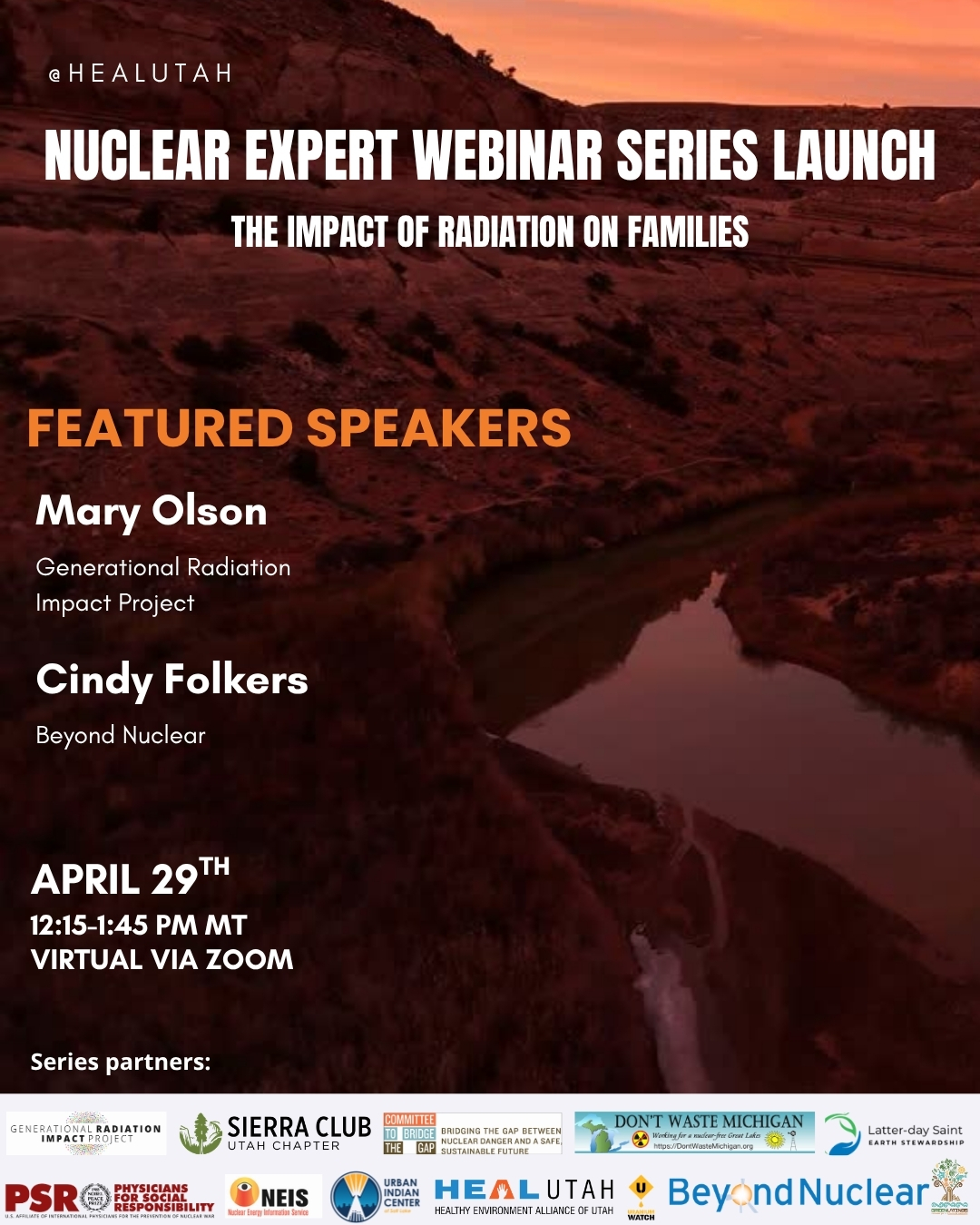
29 April – Nuclear Expert Webinar #1 – Radiation Impacts on Families with Mary Olson and Cindy Folkers
- 12:15 PM MT – 1:45 PM MT
- Location: Virtual – REGISTER TODAY

4 May -West Suburban Peace Coalition to discuss Iran war at May Educational Forum
Monday, May 4, 7:00 – 8:00 PM Central Standard Time
Title: : How Trump’s Narrative Tries to Shape the Reality of the War on Iran.
Contact Walt Zlotow, zlotow@hotmail.com 630 442 3045 for further information
14 May – online event From Bombs to Data Centres: the Face of Nuclear Colonialism

Pine Ridge Uranium is the real threat, not Tehran- Tell Burgum: Stop the Extraction.
Chernobyl: The Lost Tapes – A good documentary on Chernobyl on SBS available On Demand for the next 3 weeks– https://www.sbs.com.au/ondemand/tv-program/chernobyl-the-lost-tapes/2352741955560
To see nuclear-related stories in greater depth and intensity – go to https://nuclearinformation.wordpress.com
-
Archives
- April 2026 (346)
- March 2026 (251)
- February 2026 (268)
- January 2026 (308)
- December 2025 (358)
- November 2025 (359)
- October 2025 (376)
- September 2025 (257)
- August 2025 (319)
- July 2025 (230)
- June 2025 (348)
- May 2025 (261)
-
Categories
- 1
- 1 NUCLEAR ISSUES
- business and costs
- climate change
- culture and arts
- ENERGY
- environment
- health
- history
- indigenous issues
- Legal
- marketing of nuclear
- media
- opposition to nuclear
- PERSONAL STORIES
- politics
- politics international
- Religion and ethics
- safety
- secrets,lies and civil liberties
- spinbuster
- technology
- Uranium
- wastes
- weapons and war
- Women
- 2 WORLD
- ACTION
- AFRICA
- Atrocities
- AUSTRALIA
- Christina's notes
- Christina's themes
- culture and arts
- Events
- Fuk 2022
- Fuk 2023
- Fukushima 2017
- Fukushima 2018
- fukushima 2019
- Fukushima 2020
- Fukushima 2021
- general
- global warming
- Humour (God we need it)
- Nuclear
- RARE EARTHS
- Reference
- resources – print
- Resources -audiovicual
- Weekly Newsletter
- World
- World Nuclear
- YouTube
-
RSS
Entries RSS
Comments RSS
 nuclear-news