Germany rules out nuclear power as an option during the energy crisis.
German Leader Rules Out Nuclear Option to Fill Energy Gaps
German Chancellor Olaf Scholz says his government remains committed to phasing out nuclear power despite concerns about rising energy prices and possible future shortages due to Russia’s war in Ukraine.
By Associated Press, June 8, 2022, BERLIN (AP) — German Chancellor Olaf Scholz said Wednesday that his government remains committed to phasing out nuclear power despite concerns about rising energy prices and possible future shortages due to Russia’s war in Ukraine.
Germany shut down half of its six nuclear plants in December and the remaining three are due to cease production at the end of this year as part of the country’s long-running plan to phase out conventional power plants in favor of renewable energy……………….
“We also know that building new nuclear power plants makes little sense,” he said at a news conference with foreign correspondents in Berlin.
“If someone decides to do so now they would have to spend 12-18 billion euros on each nuclear power plants and it wouldn’t open until 2037 or 2038,” said Scholz. “And besides, the fuel rods are generally imported from Russia. As such one should think about what one does.”
“That’s why the government, all the governing parties unanimously, are counting on (…) the massive expansion of renewable energy,” he added…………..
“The goal of completing the phaseout of coal in Germany ideally by 2030, and the climate targets, remain in place,” Government spokeswoman Christiane Hoffmann said. https://www.usnews.com/news/business/articles/2022-06-08/germany-to-keep-more-coal-plants-on-hand-in-case-of-gas-cuts
UK government urged to end its obsession with nuclear power

THE UK Government has been urged to end its “obsession” with nuclear
power and focus on renewable energy. The SNP have said it is “abundantly
clear” nuclear will cost more and will send energy bills soaring even
further, while people in Scotland “can see clean energy being produced in
their own backyards”.
It comes as a written response to a parliamentary
question confirms further delays to the UK’s Hinkley Point C nuclear
power station, which reports suggest could cost the taxpayer up to £26
billion – opening four years later than scheduled. MP Alan Brown, the party’s Shadow Minister for Energy and Climate change, said the delays added “insult to injury” for consumers, after UK
Government Business Secretary Kwasi Kwarteng admitted recently the
construction of new nuclear plants would initially raise household energy
bills.
Based on the contract awarded by the Westminster government to
Hinkley Point C, the electricity that will be generated by that existing
nuclear station will be priced at £92.50 per megawatt hour, for a 35-year
contract, whereas the electricity being generated from offshore wind is
currently priced at £39.65 per megawatt hour on a 15-year concession. This
means Hinkley Point C alone could add up to £40 a year to consumer bills,
compared to wind power, which could reduce bills by £8 a year. Brown said:
“This latest admission shows the Westminster government’s obsession
with nuclear power will do absolutely nothing to help people cope with the
spiralling Tory-made cost of living crisis. “For months we’ve heard
endless lectures and bleatings from the Tories on their nuclear obsession,
yet every week we’re treated to new reports and estimates of the true
cost of prioritising a massive shift towards nuclear.
“The latest reports simply add insult to injury for the consumers whose energy bills have
skyrocketed in recent months and who were promised a great reprieve when
the UK shifts its reliance to nuclear.
The Scottish Greens have also branded the UK Government’s drive towards nuclear as nonsensical. The
party’s climate change spokesperson, Mark Ruskell, said: “Both the Tory
Government and Labour Party’s ideological obsession with nuclear power
doesn’t make sense either economically or environmentally. “Nuclear is
hugely expensive and leaves a toxic waste legacy for generations. Instead
of investing in toxic white elephants, investment should be focused in
Scotland’s massive renewable potential.”
Lynn Jamieson, chair of the Scottish Campaign for Nuclear Disarmament (CND), said she rejected the UK
Government’s claims nuclear was good for the planet, and insisted we
should be transitioning away from it. She said: “The UK Government’s
claims that nuclear is good for the environment ignores the harms of
uranium mining, the radioactive waste, the risks of cancers and
catastrophic accident – irrationally favouring nuclear industries over
cheaper, safer and more quickly available renewables.
The National 1st June 2022
A warning from France, about nuclear delusions of grandeur,
Nuclear: ” Industrialists are in denial, politicians know nothing about it “

France had the madness of grandeur in wanting to build more and more powerful reactors.
Gaspard d’Allens and Émilie Massemin (Reporterre) Reporterre 28th May 2022
Nuclear ” unacceptable “, ” industrial disaster ” of the EPR , France and its ” delusions of grandeur “… Pillar of the fight against the atom, the engineer Bernard Laponche warns of the dangers of this technology.
You are reading Bernard Laponche’s great interview. The first part is here .
Reporterre — How do you analyze the return to grace of the nuclear industry by Emmanuel Macron, with the construction of six EPR2s and the study of eight additional ones ?
Bernard Laponche — It’s communication ! This operation is part of the mythology that goes back to General de Gaulle, and that Emmanuel Macron has taken over, according to which civil and military nuclear power is the basis of France’s independence.
EDF ‘s nuclear fleet is going through its worst crisis since its birth. The stalemate of the Flamanville EPR site , the chain shutdowns of reactors due to problems of corrosion and cracks, the problems at the Orano reprocessing plants in La Hague and the manufacture of Mox [1] in Marcoule, EDF on the verge of bankruptcy … This is unheard of. Between 2010 and 2020, nearly a hundred incidents occurred throughout the park. Bernard Doroszczuk, president of the Nuclear Safety Authority ( ASN ), recognized this on April 7, 2021 during a hearing in the Senate : “ A nuclear accident is possible in France. »
In this situation, it seems very difficult to hold a triumphant speech on nuclear power. But the industrialists are in denial, the politicians who promote it know nothing about it. All are surfing on the argument of the fight against climate change to promote the sector.
Why nuclear won’t save the climate ?
Greenhouse gas emissions are far from negligible. Nuclear fissions in an operating reactor, the source of the energy produced, do not effectively emit CO₂ . But all nuclear activities in a plant in operation – 800 employees on average – or during shutdowns for maintenance work, yes. These activities also very often cause leaks of gases that are very active in global warming, such as refrigerants (1,000 times warmer than CO₂) and especially sulfur hexafluoride (23,500 times more warming). The extraction of uranium from the mines of Canada, Niger and Kazakhstan, the construction of nuclear plants and power stations, the manufacture of nuclear fuels, the transport and storage of radioactive materials and waste also emit considerable quantities of CO ₂ and other greenhouse gases. For example, the work for each fourth ten-year inspection of a 900 megawatt ( MW ) reactor — there are thirty-two of them — mobilizes 5,000 workers, between six months and a year.
………………………………….. Take the case of the Flamanville EPR : very high CO₂ emissions during construction — several thousand cubic meters of concrete, hundreds of tons of steel and thousands of workers since 2007 — and we do not know still not sure if it will start one day, or when.
Today, nuclear represents only 10 % of the world’s electricity production and only makes it possible to avoid 2.5 % of the world’s greenhouse gas emissions. For it to contribute significantly to the fight against climate change, its share in the global electricity mix would have to be multiplied by at least five. Which, given the duration of construction of a plant, is absolutely technically impossible, even in fifty years.
Finally, due to accelerating global warming, power stations on the banks of the river will increasingly be confronted with warming waters and the reduction of this resource, and those on the seashore with rising ocean waters, caused by melting ice.
But above all, the nuclear issue cannot be reduced to greenhouse gas emissions. Other factors must be taken into account when choosing the electricity mix: the risk of a serious or major accident , the radioactive waste which accumulates for thousands of years, the proliferation of nuclear weapons through the enrichment uranium and the production of plutonium, via the reprocessing of irradiated fuel. This technique is unacceptable for the threat it poses to humanity.
As you remember, the setbacks accumulate for the sector. Which do you think is the most serious ?
The management of radioactive waste is very problematic. In the other nuclear-powered countries, irradiated fuel is considered waste as soon as it leaves the reactors. France, on the other hand, reprocesses its irradiated fuel to produce plutonium, initially for the atomic bomb. Nearly 70 tons of this radioactive material are currently stored at La Hague. The plutonium produced is now used to manufacture Mox fuel. Used in about twenty 900 MW reactors , it is more radioactive and more dangerous than ordinary enriched uranium fuel and is not reprocessed once it is irradiated.
The La Hague plant is one of the most dangerous installations in the world. It stores in its pools, unprotected against external attacks, the equivalent of 100 reactor cores in irradiated fuel. And she is aging. Some evaporators are down, preventing the site from operating at full capacity. The risk of bottling the fuels to be reprocessed and saturation of the storage pools is increasing.

It is urgent to stop reprocessing. The Nuclear Safety Authority recently mentioned the difficulties that are accumulating in the management of irradiated fuels. But the sector is stubborn, and prefers to mitigate the risk of saturation by asking to build a new large storage pool .
Even if we stopped reprocessing, the question of waste would still arise. What do you think of the only seriously studied project in France to bury them 500 meters underground in Bure (Meuse) ?
………………….. There are many criticisms and questions about this project, in particular from the Environmental Authority , independent experts, environmental organizations and local populations: on the legacy to future generations of hazardous waste for hundreds of thousands of years, on the risks during the 150-year period of construction and operation, on the choice of clay, on the risks of fire, hydrogen production, water pollution, etc. Such experiences abroad of deep burial of chemical or nuclear waste have proven to be catastrophic: Stocamine in France , Asse in Germany , WIPP in the United States. In addition, the cost of Cigéo, not yet estimated [4] , would be considerable, not to mention the CO ₂ emissions of such a project………………………………..
The number of reactors currently shut down is historically high. How do you assess the state of the park ?
France had the madness of grandeur in wanting to build more and more powerful reactors.
After the French natural uranium graphite gas ( UNGG ) model was abandoned in 1969, France bought the American Westinghouse license for pressurized water reactors. Framatome [5] was tasked with implementing the 1974 Messmer plan and delivered the first 900 MW reactors under Westinghouse license. EDF has thus built 34 reactors in less than ten years, which is a performance.
Framatome then developed a 1,300 MW model , then achieved a further power jump of around 1,450 MW . This latest model presented design problems from the start. The Civaux and Chooz plants were delivered two years late.
The difficulties continued with the EPR , of 1,650 MW , a veritable industrial disaster. The Flamanville EPR began construction in 2007 and was due to start in 2012. It has accumulated failures: concrete of its platform, welds to be redone several times, refusal of control command, falsification of equipment certificates, delivery of a non-compliant tank… The cost of the EPR , initially established at 3 billion euros, is now estimated at 19 billion euros by the Court of Auditors . The two Taishan reactors in China, built faster and commissioned in 2018 and 2019, are shut downsince the discovery of radioactive leaks from damaged fuel sheaths – without the cause of this phenomenon being understood yet.
……….. Every time you increase the power of a reactor, you have to redesign everything. The calculations to be performed are extremely complex. But if these leaks turned out to be linked to a design problem, it would be catastrophic for EDF , because all the EPRs would be affected.
Finally, for several months, EDF has been faced with a problem of corrosion and cracks on the emergency cooling circuits connected to the primary circuit of several reactors in the fleet, primarily its most powerful reactors (1,450 megawatts) at Civaux and Chooz, but also those of 1,300 MW and probably those of 900 MW . The Civaux, Chooz and Penly reactors have been shut down for several months and will perhaps remain so for years, for inspections after cutting and examination of the parts concerned in the safety cooling circuits ( RIS ) and the cooling circuits at the stop ( RRA), for repair. All reactors must be checked by the end of 2023. The cause of these faults is still poorly explained [6] and would be multifactorial: quality of the steel of the parts, method of welding, layout of the circuits…
Currently, between a third and a half of EDF ‘s reactors are shut down due to these difficulties and almost daily incidents on such and such a reactor.
During the war in Ukraine, civilian nuclear power became a military target with the seizure of the Chernobyl and Zaporijia power plants. How do you view this new risk ?
In Ukraine, the Chernobyl power plant, located on the northern border with Belarus, was equipped with four Soviet RBMK reactors commissioned between 1974 and 1983. After the 1986 disaster on reactor 4, the other three were definitively stopped between 1991 and 2000. There now remains on the site the destroyed reactor containing the molten core protected by a sarcophagus, a new arch intended to confine the radioactivity, but not at all designed to withstand strikes ; three reactors to be dismantled ; as well as storage facilities for irradiated fuel and radioactive waste. Many workers remain on site. The entry of Russian tanks into the prohibited fenced area of 2,600 km 2produced significant resuspension of radioactive aerosols and air contamination. Russian soldiers who dug trenches were irradiated. On March 30, the Russian army began to evacuate the Chernobyl site.
( Zaporizhia)…………………………………..The reactors, even shut down, and the storage facilities for irradiated fuels, must be supplied with cooling water and therefore constantly supplied with electricity. They are therefore extremely fragile vis-à-vis any external aggression in a situation of armed conflict or terrorist attack. Even if the reactor itself is not targeted, any bombardment, missile or shell can lead to a loss of water, by the piercing of a pipe for example, or of electricity by loss of the network or lack of fuel for emergency diesels. With the key to a risk of serious accident as in Three Mile Island (United States), even major as in Fukushima and Chernobyl. This intrinsic fragility is a warning for all nuclear plants and power stations in the world.
Reporterre 28th May 2022 https://reporterre.net/Nucleaire-Les-industriels-sont-dans-le-deni-les-politiques-n-y-connaissent-rien
Julian Assange’s family says Australia’s election result brings renewed hope for WikiLeaks founder’s release
https://www.abc.net.au/news/2022-05-27/julian-assange-release-family-election-result-brings-hope/101100860, By Brendan Mounter and Adam Stephen, 27 May 22,
Key points:
- The family and supporters of Julian Assange are hopeful of securing his release following a change of government
- Prime Minister Anthony Albanese has previously expressed support for efforts to secure the WikiLeaks founder’s return to Australia
- Mr Assange has spent the past three years in the UK’s Belmarsh Prison
The family of Julian Assange is hopeful the election of a federal Labor government will pave the way for the WikiLeaks founder’s eventual release and a return to Australia.
It has been almost a decade since Mr Assange, who originally hails from Townsville in north Queensland, has been a free man.
For the past three years, he has been in high security detention at Belmarsh Prison in the United Kingdom, after seven years of asylum within London’s Ecuadorian embassy in a bid to avoid arrest.
United States authorities have sought Mr Assange’s extradition from the UK so he can stand trial on charges of espionage and computer misuse relating to hundreds of thousands of leaked cables from the wars in Iraq and Afghanistan.
His brother, film producer Gabriel Shipton, said Mr Assange had been persecuted for publishing the ugly truths of war.
“Julian is accused of what investigative journalists do all the time, which is sourcing and publishing materials from a source, Chelsea Manning,” Mr Shipton said.
“Those releases exposed war crimes in Iraq, undocumented civilian deaths in Iraq, corruption, government malfeasance … all sorts of things.”
American prosecutors allege Mr Assange unlawfully helped US Army intelligence analyst Chelsea Manning steal classified diplomatic cables and military files that WikiLeaks later published, putting lives at risk.
Family urges incoming government to act
Lawyers for Mr Assange fear he could face up to 175 years in jail if he is extradited to the US and convicted.
But the weekend’s election result has buoyed his supporters, with the hope that the new Labor government will intervene and help secure his release.
While in Opposition, newly elected Prime Minister Anthony Albanese is reported to have told a February 2021 caucus meeting that “enough was enough” and he “can’t see what’s served by keeping [Assange] incarcerated”.
Mr Albanese is also a signatory to the Bring Julian Assange Home Campaign petition.
Senior Labor MP Mark Dreyfus, who is expected to be appointed Attorney-General, has also expressed a need to “bring the matter to a close”.
Mr Shipton is calling on the new government to turn those words into action.
“That was the Labor position before the election so we’re very hopeful when there’s a new administration, a new government coming in there’s always a lot of hope that they will live up to their promises,” he said.
France’s Nuclear Industry Slides Into Crisis

https://globeecho.com/news/europe/germany/frances-nuclear-industry-slides-into-crisis/ By David Sadler May 26, 2022,
France is less dependent on Russian gas than Germany – thanks to the country’s 56 nuclear reactors. But because more than half of them are standing still and Russia is disappearing as a customer, France’s nuclear industry is under pressure.
French President Emmanuel Macron had promised a “renaissance of nuclear energy” in February. He wants to have six new pressurized water reactors built. More electricity, more independence, more innovation – Macron is going all-out on the nuclear power card to push France’s industry forward.
Corrosion stalls the plans

But these ambitious plans are currently experiencing a serious setback: 29 of the 56 reactors are shut down. There is a double problem: the state-owned company EDF’s kiln park is showing its age. Many reactors are shut down for routine maintenance. But now, of all things, twelve of the younger series also have to be taken off the grid.
The reason is a corrosion problem that nobody expected. “At the moment, the controls do not allow any statement to be made as to how large the cracks in the cooling tubes are. The reactors have to be shut down for this,” says Bernard Doroszczuk, rapporteur for the Nuclear Safety Authority.
Proportion of nuclear power unplanned at low point
Instead of around 70 percent, France’s nuclear power plants only supplied 37 percent of the electricity requirement in April – less than ever before! Europe’s largest nuclear power provider, Electricité de France, currently estimates the group’s shortfall in revenue for 2022 at 18.5 billion euros. It is already foreseeable that there will be power shortages in winter.
But a quick solution to the technical problems is not in sight. Because there is a lack of skilled workers. “Basically, EDF estimates that by 2026 there will be a six-fold increase in the need for specialist staff. Above all when it comes to the machinery: i.e. pumps, the pipe network, and there is a lack of welders – that’s what drives everyone,” says Jean-Luc Lachaume from the security agency. “And this calculation does not even include the announced construction of new reactors. Nor does it include the need that has now arisen as a result of these unforeseen corrosion problems.”
Instead of renaissance, first of all, renovation. Security auditor Doroszczuk therefore calls for a Marshall Plan. “Industry and the state have to get involved now,” he demands. “Otherwise the announced goals are not tenable. And that would be the worst thing for the credibility of the entire industrial program.”
Russia has been the most important customer so far
On top of all these problems there is now the war in Ukraine. To date, Russia has been the most important customer of the French nuclear industry. Mycle Schneider, editor of the World Nuclear Industry Status Report, sees the items in the order books dwindling. Internationally, Russia was “the decisive, most aggressive promoter” of the construction of new nuclear power plants. And now suddenly this bottleneck has arisen. “In Finland, a project for a Russian nuclear power plant has already been officially canceled – and turbines for this nuclear power plant were to be delivered from France,” says Schneider.
In fact, the French Ministry of Economic Affairs even planned to take a 20 percent stake in the domestic turbine manufacturer in Belfort for the Russian company Rosatom. But that plan could now be shelved. France believed that its nuclear strategy was on the upswing. But the plans have gone haywire.
Australia’s new Labor government urged to act to prevent Julian Assange extradition

https://www.thesaturdaypaper.com.au/news/politics/2022/05/28/labor-urged-act-prevent-julian-assange-extradition#mtr, 28 May 22, The legal case against Julian Assange is a game of luck and whim. Any day now, the British home secretary, Priti Patel, is expected to rubber stamp his extradition to the United States. What will happen to him there is uncertain.
The Westminster Magistrates’ Court formally approved his extradition on April 20 and Patel has until May 31 to announce whether it will happen. If convicted of espionage in the US, Assange could be sentenced to 175 years in prison. His legal team argue he would likely kill himself.
There is one glimmer of hope for the WikiLeaks founder, however, bound up in last weekend’s Australian election result. The victory of Anthony Albanese, a supporter of the journalist, has reignited calls to halt the extradition.
Albanese has said that while he didn’t sympathise with Assange for some of his actions, he could not see any purpose to keeping him in jail.“Assange’s appeal is like a game of extradition snakes and ladders. He managed to take his argument about US prison conditions all the way to the door of the Supreme Court, but they rejected it, so he slid back down to the magistrates’ court where he started.”
“The prime minister, Mr Albanese, has previously said ‘enough is enough’. [Then shadow] Attorney-General Mark Dreyfus issued a statement last year confirming that Labor wanted the matter ‘brought to an end’,” says lawyer and human rights activist Kellie Tranter, who is a former WikiLeaks Party senate candidate. “So it remains to be seen whether such statements will result in the new government requesting that the US drop the case.”
She was “cautiously optimistic” about the case of Assange, who faces 17 charges under the US Espionage Act relating to the publication of classified documents and information related to US war crimes.
“It is helpful that the Greens – who have been calling for the Australian government to take action in the Assange case for some time – may hold the balance of power in the senate,” Tranter added.
Earlier this week, Albanese travelled to Japan for a meeting of the Quad leaders – from India, Japan, the US and Australia – to deliver a message about Australia’s policy changes.
Supporters including Tranter had urged the Department of Foreign Affairs and Trade (DFAT) and the Department of the Prime Minister and Cabinet to include the whistleblower on the agenda, and not just as a sideline issue.
The meeting was the “ideal opportunity” for Albanese to speak with US President Joe Biden and British Prime Minister Boris Johnson to request that Assange be allowed to come home, said Greg Barns SC, an adviser to the Australian Assange campaign.
A spokesperson for the Department of the Prime Minister and Cabinet said they were unable to provide comment on Quad agenda items. Comment was being sought from DFAT.
Stella Assange, who married the WikiLeaks founder in Belmarsh prison this year and is the mother of their two children, told The Saturday Paper the case had become political. She insisted the government had a duty to protect its citizens.
“By failing to act, it’s not just negligent; it shows that whoever is in office that isn’t acting is not fit for office,” the human rights lawyer said. “This can end today if the Australian government decides to do something about it.”
Every human rights organisation in the world had said the extradition of the Townsville-born computer hacker, editor and publisher should be stopped, she said. The latest to speak out is the Council of Europe.
Earlier this month, then Foreign Affairs minister Marise Payne and her Labor shadow, Penny Wong, claimed Australia couldn’t intervene, as the matter was before the courts.
But former British Labour Party leader Jeremy Corbyn, speaking to The Saturday Paper, rubbished the claim. The MP pleaded to Australia to “speak up for your own”.
“Whilst in Britain there are – for good reason – constraints about raising [it] in parliament because it’s a sub judice matter, that does not apply in Australia,” Corbyn said.
“There is no legal case in Australia. So there’s nothing to stop every Australian politician speaking up with Julian Assange, and I think they should. Please do, because it will help the freedom for journalists everywhere.”
Barns said there was “plenty of political support” for Albanese to ensure the whistleblower does not face an effective death penalty in the US. He pointed out that the Bring Julian Assange Home Parliamentary Group had 30 members from every party before the election. This is expected to increase, Assange’s brother, Gabriel Shipton, said.
“Ultimately I don’t think Albo wants to become another Australian prime minister who is complicit in Julian’s persecution and more broadly the Western descent into barbarity that has been taking place ever since the Iraq invasion,” he said. “Whether he has the power to resist that is up to us.”
A spokesperson for DFAT said the government had “consistently raised the situation of Mr Assange with the United States and the United Kingdom”. The spokesperson said the government “conveyed our expectations that Mr Assange is entitled to due process, humane and fair treatment, access to proper medical and other care, and access to his legal team”. However, “The extradition case regarding Julian Assange is between the United States and the United Kingdom; Australia is not a party to this case.”
US–Australian relations are one of many matters that will test Albanese’s leadership. According to Tranter, freedom of information requests show “that consecutive governments have long held the view that the Assange case has strategic implications for the alliance”. She says this is why no Australian government had spoken out in support of his human rights or provided diplomatic assistance to him.
“Mr Albanese should take a stand consistent with his stated ethos of protecting the persecuted and not forsake any Australian citizen to personal abuse for political purposes,” Tranter said.
As he awaits his fate, Assange is incarcerated in London’s maximum security Belmarsh prison. He was taken there after seven years in the Ecuador embassy in London, where he sought asylum to prevent extradition to Sweden over now-abandoned sexual assault charges.
“Assange’s appeal is like a game of extradition snakes and ladders,” says Nick Vamos, the former head of extradition at Britain’s Crown Prosecution Service. “He managed to take his argument about US prison conditions all the way to the door of the Supreme Court, but they rejected it, so he slid back down to the magistrates’ court where he started.”
Assange “can’t climb that particular ladder again”, Vamos says. “But he can still appeal on the other grounds that he lost originally, so there are likely to be a few more ups and downs before this process is finally over.”
The partner and head of business crime at London firm Peters & Peters said the attempts to persuade Home Secretary Patel not to order the extradition would not be successful – “not in a million years”.
Vamos says that if there is another appeal in Britain it could take another six months to be heard. If it is denied, another avenue is the European Court of Human Rights, in Strasbourg, France, which could issue an order directing Britain not to extradite Assange until its case is heard.
Jennifer Robinson, part of Assange’s legal team, has confirmed this is a path being considered.
“This case is too important from a free speech point of view, but also from a humanitarian point of view,” she said.
“We know what the medical evidence is about Julian’s mental health, and that he will find a way to commit suicide if he’s extradited.”
In all, Vamos says, these appeals could take another two years. But once Assange’s extradition has been signed off, he says, US Marshals are free to fly to Britain to arrest Assange: “It will normally happen within a couple of weeks of Patel making the order.”
At an EU Free Assange rally in Brussels, on April 23, Assange’s wife wiped away tears as she spoke to the crowd. The event was aimed at targeting European leaders, with speeches by politicians from various countries. “In the end this will end up in Europe,” Stella Assange said. “Europe can free Julian. Europe must free Julian.”
She recalled that 15 years into his 27-year imprisonment, people thought Nelson Mandela would never be liberated. “But he was, because decent people in that case came out and they shouted for his freedom, even if they were the only person in the square to shout,” she said.
“The fact is, it takes a few decent people to show the way and what we stand for, because we create the reality around us.”
Activists were defending “not just decency and the memory” of all the tens of thousands of victims of the Iraq and Afghan war, caught up in the crimes that WikiLeaks exposed; they were also standing up for the right to a free future.
“What has been done to Julian is a crime,” Stella Assange said. “The law is being abused in order to keep him incarcerated, year after year, for doing the right thing … When will it end? Will it end?”
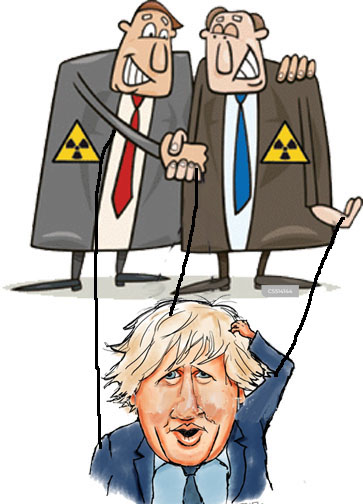
Boris Johnson promised ”1 nuclear reactor a year for 8 years” – one by 2040 if he’s lucky!
With the weather changing dramatically across the world, will politicians
finally take the climate crisis seriously? With a concerted effort, there
could still be time. But time is the critical thing. And on the campaign
trail in “red wall” seats before the May elections, the prime minister,
Boris Johnson, repeatedly promised building nuclear reactors “one a year
for eight years”.
Last week at the Conservative conference in Wales he
was at it again – this time promising one on Anglesey and another at
Trawsfynydd in Mid Wales.
Anyone who knows a little about nuclear reactors
(current designs 10 years late and £10bn over budget) or about the prime
minister’s other mega-projects – bridges across the Thames and Irish
Sea, and an airport in the Thames estuary – is confident that this
won’t happen.
A protest via my MP brought a measured response from Greg
Hands, the minister responsible for energy policy. He said provided
reactors were value for money and technically sound, the government’s
target for nuclear projects was to give one a final investment decision
this parliament, and two in the next – so maybe three building starts by
2030. On current trends that means one reactor possibly ready by 2040 and
two others much later. Far too late to heal the climate.
Guardian 27th May 2022
Finland: Fennovoima withdraws from its new nuclear reactor application.
FENNOVOIMA on Tuesday announced it has withdrawn its application for a
building permit for a nuclear power plant in Pyhäjoki, Ostrobothnia,
delivering what many believe was the final blow to the controversial
project. The Finnish energy company reported earlier this month that it has
terminated the supplier contract for the plant with Raos Project, a Finnish
subsidiary of Russia’s Rosatom.
Helsinki Times 26th May 2022
They’re Just Outright Telling Us That Peace In Ukraine Is Not An Option

Caitlin Johnstone, 25 May 22, US Senator Joe Manchin said at the World Economic Forum on Monday that he opposes any kind of peace agreement between Ukraine and Russia.
Manchin, who at the moment is one of the most powerful elected officials in Washington, added that only the complete forcible ejection of Russia from all of Ukraine is acceptable, that the war should ideally be used to remove Putin from power, and that he and the strategists he talks to see this war as an “opportunity”.
…………………………… Manchin’s comments fit in perfectly with what we know about the US-centralized empire’s real agendas in Ukraine.
Earlier this month Ukrainian media reported that UK Prime Minister Boris Johnson told the nation’s president Volodymyr Zelensky on behalf of NATO powers that “even if Ukraine is ready to sign some agreements on guarantees with Putin, they are not.”
Last month US Secretary of “Defense” Lloyd Austin acknowledged that the goal in this war is not peace in Ukraine or the mere military defeat of Russia but to actually weaken Russia as a nation…………
Last week The New York Times reported that the Biden administration is developing plans to “further choke Russia’s oil revenues with the long-term goal of destroying the country’s central role in the global energy economy.”
………… Two months ago Biden himself acknowledged what the real game is here with an open call for regime change, saying of Putin, “For God’s sake, this man cannot remain in power.”
Statements from the Biden administration in fact indicate that they expect this war to drag on for a long time, making it abundantly clear that a swift end to minimize the death and destruction is not just uninteresting but undesirable for the US empire.
This is not a proxy war with peace as an option anywhere within sight. It’s not about saving Ukrainian lives. It’s not even about beating Russia in Ukraine. It’s about achieving regime change in Moscow, no matter how many lives need to be destroyed in the process.
Peace is not on the menu. https://caitlinjohnstone.substack.com/p/theyre-just-outright-telling-us-that?s=w—
Twenty-Two House Republicans Demand Accountability on Biden’s $40b War Spending

“The aid package approved by Congress provides unprecedented funding for a foreign conflict in which the United States is not fighting, while there have been no significant hearings or substantive briefings on the use of the money and weapons being provided at taxpayer expense.” The lawmakers raised the prospect of sophisticated weaponry falling into the hands of terrorist organizations, citing a documented history of illicit arms-trafficking within Ukraine, a market which is one of the largest in Europe:
A cohort of Republicans, part of the dissenting vote on Biden’s Ukraine war package, seeks oversight and specifics about the destination of U.S. money and weapons.
| Glenn Greenwald and Anthony Tobin, May 25 |
The House of Representatives, on May 10, approved President Biden’s $33 billion package for the war in Ukraine, and then, on its own initiative, added $7 billion on top of it. That brought the new war spending authorization to $40 billion, on top of the $14 billion already spent just 10 weeks into this war, which U.S. officials predict will last years, not months. The House vote in favor was 368-57. All 57 NO votes were from GOP House members. All House Democrats, including the Squad, voted YES.
A similar scene occurred when the Senate, “moving quickly and with little debate,” overwhelmingly approved the same war package. All eleven NO votes were from Senate Republicans. All Senate Democrats, including Sen. Bernie Sanders (I-VT), voted in favor, seemingly in direct contradiction to Sanders’ February 8 op-ed in The Guardian warning of the severe dangers of bipartisan escalation of the war. Efforts by Sen. Rand Paul (R-KY) to delay passage of the bill so that some safeguards and accountability measures could be included regarding where the money was going and for what purposes it would be used were met with scorn, particularly from Paul’s fellow Kentucky GOP Senator, Minority Leader Mitch McConnell, who condemned Paul as an “isolationist.” Following the Senate vote, a jet was used to fly the bill across the world to President Biden in South Korea, where he signed it into law.
But the lack of any safeguards over the destination of the money and weapons prompted close to two dozen House Republicans, led by Rep. Yvette Herrell (R-NM), to send a letter to the Biden White House on Monday demanding greater specificity and assurances about legal requirements on how weapons are used. The letter urges a public reckoning on the dangers of the U.S.’s bankrolling of the war in Ukraine: “We write today to express grave concern about the lack of oversight and accountability for the money and weapons recently approved by Congress for Ukraine,” it began.
“The aid package approved by Congress provides unprecedented funding for a foreign conflict in which the United States is not fighting, while there have been no significant hearings or substantive briefings on the use of the money and weapons being provided at taxpayer expense.” The lawmakers raised the prospect of sophisticated weaponry falling into the hands of terrorist organizations, citing a documented history of illicit arms-trafficking within Ukraine, a market which is one of the largest in Europe:
“According to a 2017 Small Arms Survey briefing on arms trafficking, over 300,000 small arms disappeared from Ukraine between 2013 and 2015 and only 13 percent were recovered. Criminal networks, corrupt officials, and underpaid military personnel can make a profitable business from the sale of arms from Ukrainian military stockpiles. For example, in 2019, the Ukrainian Security Service uncovered a plot by Ukrainian soldiers to sell 40 RGD-5 grenades, 15 grenade launchers, 30 grenade detonators, and 2,454 rounds of ammunition for 75,000 Ukrainian hryvnia or around $2,900.”
Indeed, the relentlessly war-supporting CNN last month acknowledged that “the US has few ways to track the substantial supply of anti-tank, anti-aircraft and other weaponry it has sent across the border into Ukraine.” Biden officials admitted the “risk that some of the shipments may ultimately end up in unexpected places.” ……………………… more https://greenwald.substack.com/p/twenty-two-house-republicans-demand?s=r
Nuclear is already well past its sell-by date

As construction costs and delays ramp up, it is clear that renewables will do the heavy lifting of our energy transition.
https://www.newstatesman.com/spotlight/energy/2022/05/debate-nuclear-already-well-past-sell-by-date
By Paul Dorfman, 25 May 22,

Boris Johnson hopes his dream of “a new nuclear plant every year” will be aided and abetted by the recent publication of the government’s Energy Security Strategy. But with little interest from the investment market, and the fact that utility-scale solar and onshore wind cost less than a quarter of new nuclear, perhaps the Treasury’s concerns should be taken more seriously.

Here’s why. Hinkley Point C, the only new nuclear construction in town, where energy giant EDF is building two nuclear reactors, is overdue and over budget. Costs have ramped up from an original estimate of £18bn to £26bn, and the Somerset project is not due to open until at least June 2027, and more than likely quite a few years later.

Next in line is Sizewell C in Suffolk, which is supposed to be paid for via the “fiscally dextrous” Regulated Asset Base mechanism, a new funding model that transfers risk from developers to consumers to bring in more investors. This places great financial liability unfairly and squarely on the shoulders of UK taxpayers and electricity consumers, who will be paying for huge upfront costs, inevitable delays and further cost hikes.

And there’s more. The EDF European pressurised water reactor (EPR) design, currently being built at Hinkley C and planned for Sizewell C, may have a generic fault with its most important safety feature: the reactor pressure vessel. As a result, a Chinese EPR has now been shuttered for ten months.

This is not forgetting the horrible mess across the channel, with half of EDF’s nuclear reactor fleet offline, many due to progressive corrosion. The French nuclear regulator is warning a “large-scale plan” lasting “several years” is needed.
Nuclear’s climate-friendly unique selling point (USP) is also up for grabs. Sea-level rise will increase coastal flooding, storm surges and erosion, making current coastal nuclear infrastructure increasingly obsolete. This means even more expense for any nuclear construction, operation, waste management and decommissioning – and, according to the UK Institute of Mechanical Engineers, even relocation or abandonment.

Happily, help is on the way – 256 gigawatts (GW) of non-hydro renewables were added to the world’s power grids in 2020 (nuclear added only 0.4GW). Last year, solar and wind made up three-quarters of all new generation – and with other renewables, the total figure is 84 per cent.

Even the UK investment minister recently concluded that wind farms in the North Sea will be more valuable to the UK than the oil and gas industry. There is no one left to dispute the fact that the heavy lifting of the net zero transition will be done by renewable energy.
Nuclear isn’t just slow and expensive – it’s far too inflexible to ramp up and down with the swings of demand. When the wind fails to blow and the sun doesn’t shine, that’s when grid upgrades, interconnection (which enables power to be shared between neighbouring countries), energy efficiency management, and rapidly evolving storage technology steps in to make up the difference. Nuclear’s contribution has, can and will only ever be very marginal. The reality is, it’s already well past its sell-by date.
Philippines’ Marcos in nuclear plant revival talks with S.Korea
France 24 Manila (AFP) – Philippine president-elect Ferdinand Marcos signalled his determination to adopt nuclear power Monday, holding talks with South Korea’s envoy on possibly reviving a mothballed $2.2 billion plant built during his father’s dictatorship.
The 620-megawatt Bataan Nuclear Power Plant was left dormant after the elder Marcos was toppled in 1986…..
He left open the possibility of resuscitating his father’s failed venture — an idea he is now pushing ahead of his June 30 inauguration.
Marcos said he met South Korean Ambassador to Manila Kim Inchul on Monday to discuss a proposal on reviving the Bataan plant.
…………………….
upgrading an ageing facility fitted with outdated analogue technology could take at least four years and cost another $1 billion.
There are also question marks on its design and location.
A monument to the greed and graft of the elder Marcos’s era, the plant sits 80 kilometres (50 miles) west of Manila, near several volcanoes in a part of the Philippines regularly shaken by earthquakes……………. critics argue that renewable sources, such as wind and solar, are cheaper and safer to produce in a country hit by earthquakes, typhoons and volcanic eruptions. https://www.france24.com/en/live-news/20220523-philippines-marcos-in-nuclear-plant-revival-talks-with-s-korea
California makes misguided plea for feds to keep state’s last nuclear power plant alive

 | |||
|
California makes misguided plea for feds to keep state’s last nuclear power plant alive,
Alex Formuzisalex@ewg.org 23 May 22, SAN FRANCISCO – California Gov. Gavin Newsom’s administration is making a misguided plea for the U.S. Department of Energy to change the requirements of a federal fund so the aging, dangerous Diablo Canyon nuclear power plant can keep operating.
The state is asking the agency to free up part of the $6 billion in the Civil Nuclear Credit Program for Diablo Canyon to remain viable past its current scheduled closure date of 2025, Bloomberg reports. The plant is currently ineligible for the funds because California fully regulates utility power generation, and the money is available only for states with deregulated energy markets.
Newsom Cabinet Secretary Ana Matosantos sent a letter Monday to DOE Secretary of Energy Jennifer Granholm asking the Biden administration to alter the terms of the fund so Diablo Canyon can qualify. The fund is designed to help keep U.S. nuclear reactors in unregulated states operating.
“Moving the goal post to allow Diablo Canyon to continue running would set a dangerous precedent for other regulated states and utilities to keep aging, dilapidated nuclear plants operating,” said EWG President and California resident Ken Cook.
“Clinging to nuclear energy as a source of electricity as renewables like solar and wind grow by the day is not a sound, safe, forward-looking energy policy. We urge Secretary Granholm and the Biden administration to reject this plea to allow California to skirt the requirements of the program,” said Cook.
In a 2018 deal struck between Pacific Gas & Electric, which owns the nuclear power plant, labor unions, environmental groups and others, the utility agreed to shutter the two reactor units at Diablo Canyon in 2024 and 2025.
Here’s why keeping Diablo Canyon operating is concerning:
- It will be costly
- From 2011 to 2017, maintenance costs increased $110 million dollars.
- The plant is known for harm to aquatic life from discharging hot water directly into the Pacific Ocean. Upgrading the cooling system to address these concerns could cost billions of dollars.
- The plant is an extreme safety hazardIn 2014, a Nuclear Regulatory Commission inspector urged the NRC to shut the plant down due to earthquake hazard.
- Unit 1 at the facility is considered one of the most embrittled units in the country – meaning that if the plant were forced to suddenly shut down, cold water would be sent to the core, where the highly radioactive fuel resides, causing the containment vessel to shatter, causing a catastrophic accident.
- Newsom’s plea comes just days after he released an updated budget that calls for $5.2 billion in proposed funding for California’s electricity grid, according to a report by the nonprofit news outlet Canary Media. If approved by state lawmakers, the budget would add more fossil-fueled power, more pollution, and higher costs for ratepayers.
The Environmental Working Group is a nonprofit, non-partisan organization that empowers people to live healthier lives in a healthier environment. Through research, advocacy and unique education tools, EWG drives consumer choice and civic action.
Ireland’s Environment Minister Eamon Ryan rules out nuclear power as option in transition from fossil fuel dependence
Irish Examiner, 23 May 22, Eamon Ryan, the environment minister, has ruled out nuclear power as an option in the transition from fossil fuel, despite mounting calls from environmental voices to consider it.
Mr Ryan told the Irish Examiner it would be too expensive and cumbersome for Ireland to build a nuclear industry, insisting offshore wind is a far better and less expensive bet in the fight against climate change……………….. https://www.irishexaminer.com/news/arid-40878437.html
Billionaires from USA and Denmark have inordinate influence on public opinion about molten salt nuclear reactors

| Elon Musk and Bill Gates are the two best-known (energy) billionaires, but there are many more that invest their money in energy innovation. Denmark’s richest man is a big investor in a startup that researches molten salt as a form of energy storage. The perception of energy billionaires often influences the opinion of the general public vis-a-vis certain energy innovations. Oil Price 22nd May 2022https://oilprice.com/Energy/Energy-General/Billionaires-Are-The-Drivers-Of-Innovation-In-The-Energy-Industry.html |
1 This Month
23-25 October – on Zoom – World BEYOND War’s annual global conferenc


Shut down the radiation-damaged Heysham nuclear reactors now
To see nuclear-related stories in greater depth and intensity – go to https://nuclearinformation.wordpress.com

Say No to NASA’s Reckless Nuclear Reactor on the Moon
Say No to NASA’s Reckless Nuclear Reactor on the Moon

-
Archives
- October 2026 (199)
- September 2026 (339)
- August 2026 (330)
- July 2026 (355)
- June 2026 (287)
- May 2026 (306)
- April 2026 (356)
- March 2026 (251)
- February 2026 (267)
- January 2026 (308)
- December 2025 (358)
- November 2025 (359)
-
Categories
- 1
- 1 NUCLEAR ISSUES
- business and costs
- climate change
- culture and arts
- ENERGY
- environment
- health
- history
- indigenous issues
- Legal
- marketing of nuclear
- media
- opposition to nuclear
- PERSONAL STORIES
- politics
- politics international
- Religion and ethics
- safety
- secrets,lies and civil liberties
- spinbuster
- technology
- Uranium
- wastes
- weapons and war
- Women
- 2 WORLD
- ACTION
- AFRICA
- Atrocities
- AUSTRALIA
- Christina's notes
- Christina's themes
- culture and arts
- Events
- Fuk 2022
- Fuk 2023
- Fukushima 2017
- Fukushima 2018
- fukushima 2019
- Fukushima 2020
- Fukushima 2021
- general
- global warming
- Humour (God we need it)
- Nuclear
- RARE EARTHS
- Reference
- resources – print
- Resources -audiovicual
- Weekly Newsletter
- World
- World Nuclear
- YouTube
-
RSS
Entries RSS
Comments RSS

