If people take part in referendums in Donbass region, Ukraine government will prosecute them as criminal offenders
Kiev threatens pro-Russia Ukrainians with jail terms. more https://www.rt.com/russia/562159-kiev-referendum-jail-time/ 4 Sept 22, Ukraine’s deputy prime minister warns that voting in referendums in Moscow-controlled territories is a criminal offence
Ukrainian citizens risk criminal prosecution and a jail time of up to 12 years if they participate in referendums on joining Russia, Ukrainian Deputy Prime Minister Irina Vereshchuk warned on Saturday.
“There are not and will not be any referendums on our Ukrainian land,” Vereshchuk stated during a national broadcast.
Pro-Russian authorities in the Zaporozhye, Kharkov and Kherson Regions, as well the Donetsk and Lugansk People’s Republics, previously spoke of potentially holding referendums on uniting with Russia, but so far no dates have been set.
“It’s all a farce and a circus. But for our citizens who will take part in this, there is actually an article of the Criminal Code,” Kiev’s deputy prime minister said.
“If collaboration is proven, or, for example, participation in the referendum or incitement to participate in the referendum, then people can receive up to 12 years with confiscation (of assets),” she warned.
Vereshchuk urged Ukrainians who remain in Russia-controlled territories to evacuate or avoid voting in any plebiscites, as “no pressure, no violent incitement, etc., can later justify the fact that a person went to the referendum.”
When asked, how many people potentially might take part in voting, Vereshchuk claimed the percentage is “tiny… not even 2%.”
The Ukrainian government previously warned that citizens who attempt to become Russian citizens could be punished with up to 15 years in prison.
Caroline Lucas, Green Party MP for Brighton Pavilion condemns decision for massively costly Sizewell C nuclear station.

https://www.greenparty.org.uk/news/2022/09/01/caroline-lucas-responds-to-the-decision-to-approve-sizewell-c-nuclear-power-station/ “Sizewell C is massively costly, achingly slow, and carries huge unnecessary risks. Its approval marks Boris Johnson taking one final opportunity to kick the public in the teeth before his departure as Prime Minister.
“This project is expected to cost up to £30 billion; and in following the Regulated Asset Base business model, it will pass that enormous upfront cost directly onto the consumer. As energy bills soar ever higher and this lame duck Government leaves people in the lurch, the last thing the public needs right now is a massively costly nuclear white elephant. Even cabinet ministers are already expressing reservations about its value for money.
“When we need oven-ready solutions to delivering energy security and slashing bills, Sizewell C simply is not one of them. Hinkley Point C will have taken the best part of two decades to go from planning to production, and it’s still years behind schedule. This Sizewell plant could take anywhere between 10-17 years to build.
“Meanwhile, there are hundreds of energy-saving options and clean, cheap and home-grown renewable projects ready to go – yet solar farms are being refused at their highest rate for five years, the Government has utterly failed to adopt a retrofit revolution to slash energy bills, and now Tory leadership candidates are vowing to block onshore wind power which could be operational within days.
“Rubber stamping Sizewell C is simply Boris Johnson’s woeful final attempt at making his Prime Ministerial mark – it’s befitting of him that this vanity project is the wrong answer at the wrong time.”
Julian Cusack, chair of Suffolk Coastal Green Party, said: “For Boris Johnson to claim Sizewell C as his legacy is just outrageous. It is the wrong and unproven technology in the wrong place and will deliver the most expensive electricity sometime in the next decade. It is totally irrelevant to today’s energy cost crisis and will do wanton damage to prized landscapes and fragile local communities.”
Nuclear power: the accumulating problems

With the present British government intent on a fleet of new nuclear power stations, Dr Paul Dorfman, Sussex University, looks at the major obstacles
and argues for alternatives.
Although the current UK government plans some
sort of nuclear renaissance, in this article I’ll show that new nuclear
power can do nothing for our current energy crisis and may well endanger
our response to the climate crisis.
But the coming months will tell – and
it will be a very long time in politics. This winter – with millions
struggling under the cost-of-living crisis, plunged into unmanageable debt
through energy price ramps, and choosing between eating and heating –
putting huge sums of public money into the deep pockets of French
state-owned EDF via its long-term nuclear power construction programme may
look much less palatable to the public, press and policy-makers.
Especially when cheaper, faster, more efficient renewable power and storage
technologies are available here and now. Coupled with large-scale home
insulation programmes, these are what would really make a difference to
consumers.
Responsible Science 31st Aug 2022
https://www.sgr.org.uk/resources/nuclear-power-accumulating-problems
Boris Johnson’s legacy of the nuclear fantasy
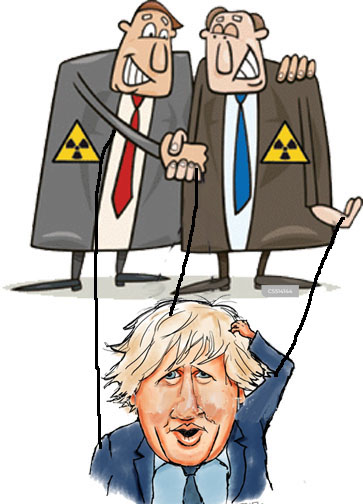
In response to the Prime Minister pledging £700 million of public money to
build a nuclear power station at Sizewell, Dr Doug Parr, Chief Scientist
for Greenpeace UK, said – “This money could insulate huge numbers of
draughty homes, and cut next year’s bills, instead of being thrown onto the
slow-burning financial bonfire that is EDF, to increase our bills for
decades.
Construction of this reactor type has gone massively over budget
and over schedule whenever they try to build it in Europe, and isn’t
operating as advertised anywhere. The funding model adopted to pay for it
was tried in the USA, and North Carolina households are still paying for a
nuclear reactor that was never built as the company went bust.
The contrast between these lumbering white elephants and the dynamic, cost cutting,
innovative technologies in the renewables sector could barely be more
striking. While this down payment on failure shows the government hasn’t
noticed, the market has, and investors have fled the nuclear sector.
To get Sizewell done, the government would have to step in and add the enormous
costs of building reactors to the enormous costs consumers are already
paying for their electricity. While Boris Island and the Boris Bridge
remain in the land of fantasy where they belong, Johnson will have his
legacy, the Boris Bill, and it will be very real for a very long time.”
Greenpeace 1st Sept 2022 https://www.greenpeace.org.uk/press-centre/
Stop Sizewell C urges Boris Johnson’s successor to totally review this costly nuclear project

Stop Sizewell C condemns Boris Johnson’s visit and support for Sizewell C,
speculating that the blessings of an outgoing Prime Minister may be the
kiss of death. Stop Sizewell said: “Like multiple vanity projects such as
the Bridge to Northern Ireland and “Boris Island” airport, Sizewell C
is another Boris Johnson infrastructure blowout that his successor should
consign to the bin.
When every penny matters, it’s totally wrong to shackle
the next Prime Minister and billions in taxpayers’ money to this damaging
project, whose ballooning cost, lengthy construction, failure-prone
technology and long term water supply are so uncertain.”
“Sizewell C would not be British, nor secure. It would be developed by an arm of a
foreign government, probably with considerable foreign ownership and be
reliant on overseas uranium.” Stop Sizewell C urges Boris Johnson’s
successor to totally review the Sizewell C project. Candidate Liz Truss has
said she plans to cancel green levies on bills, but if she were to continue
to support Sizewell C, it can only be financed if a nuclear levy is added
to household bills.
Stop Sizewell C 1st Sept 2022
Boris Johnson locking the next Prime Minister into unsustainable nuclear debt
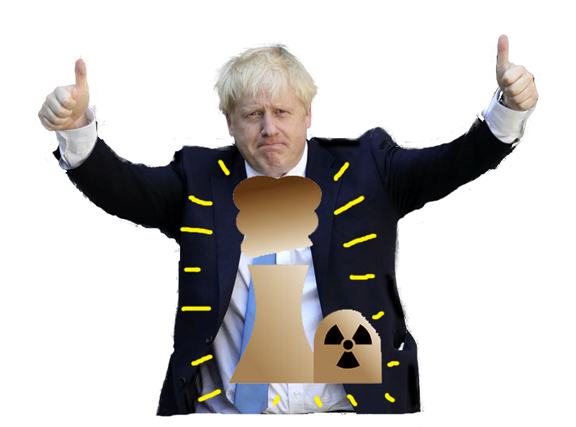
So long and thanks for all the nukes: Boris Johnson is marking his last week in No 10 by signing a £30 billion cheque that makes some allies of Liz Truss feel distinctly queasy.
With just five days until his successor takes office, this morning’s Times reveals that the prime minister is pressing ahead with plans to approve the Sizewell C nuclear power station in Suffolk.
It’s a decision some Truss allies would rather he had left to the next inhabitant of No 10. Earlier this month Simon Clarke, the chief secretary to the Treasury set for a senior role in the next cabinet, warned in a leaked letter that the costs of the project were “sufficient to materially affect spending and fiscal choices for an incoming government,
especially in the context of wider pressures on the public finances”. But Johnson looks set to bind the next PM’s hands anyway.
Times 31st Aug 2022
https://www.thetimes.co.uk/article/nuclear-option-spells-fallout-for-johnsons-successor-b68c9gh5w
Boris Johnson’s parting gift – a £30 billion nuclear debt.
Boris Johnson is poised to give approval this week for a nuclear power station costing up to £30 billion as ministers close in on a deal to reopen Britain’s biggest gas storage facility. The prime minister is preparing to announce an in-principle agreement to offer funding to the Sizewell C reactor in Suffolk before he leaves office, despite concerns about creating a multibillion-pound spending commitment for Liz Truss, the frontrunner to succeed him.
Johnson acknowledged yesterday that “it is going to be tough through to next year” because of the rising energy bills but said his successor would “provide a further package of support for helping people with the cost of energy”.
Johnson is thought to have privately decided to go ahead with Sizewell C earlier in the summer, but said yesterday that a public announcement was imminent. “We are going to have a long-term British energy security strategy, and we are putting in more nuclear — you’re going to be hearing more about that later this week,” he said on a visit to Dorset.
Johnson also promised “absolutely shedloads of wind
power” as he sought to pin the blame for high gas prices on Russia’s
invasion of Ukraine. “Be in absolutely no doubt that the gas price is
being driven by what Putin did in Ukraine,” he said. “I’m not going to
shrink from this — it is going to be tough in the months to come, it’s
going to be tough through to next year, and that’s because of Putin’s war
in Ukraine. But we’re going to get through it.” Kwarteng is also said to
be in the final stages of agreeing a deal with Centrica to reopen the Rough
gas storage facility under the North Sea, in an about-turn that could leave
taxpayers on the hook for hundreds of millions of pounds if the company
does not make as much as expected.
Times 31st Aug 2022
Compulsory purchase orders of land for Sizewell C nuclear project
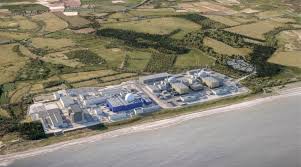
The majority of the compulsory purchase orders necessary for Sizewell C
have already been agreed, a spokesman has said. As part of the nuclear
power project, land is being purchased to build link roads, railways,
sports pitches and park and ride terminals. The full details of all the
properties affected is set out in a 1,000-page planning document.
East Anglian Daily Times 30th Aug 2022
https://www.eadt.co.uk/news/business/sizewell-c-compulsory-purchase-orders-suffolk-9236698
You can’t trust Liz Truss (oil and gas devotee) on energy policy for Britain
a frenzied building of eye-wateringly expensive new nuclear power plants.
the ramping up of nuclear power will add billions to UK consumers’ bills
Liz Truss’s energy plans will be disastrous for our bills and the planet.
Truss will oversee the greatest transfer of wealth in history, from UK
families to oil and gas executives she used to work for.
The celebratory champagne corks must have popped in the headquarters of the oil and gas
corporations on the day Ofgem announced the devastating rise in energy
prices for poverty-stricken British consumers. Especially after they read
Liz Truss’s disastrous “response” in the Daily Mail addressing the
lifting of the home energy price cap.
Truss, the former commercial manager
for the oil giant Shell, proposes a massive ramping up of commercial
projects by the oil corporations, including expansion of North Sea oil and
gas, a resumption of fracking on the UK mainland and a frenzied building of
eye-wateringly expensive new nuclear power plants.
The proposed explosion of oil and gas projects will not knock a single penny from fuel bills, as
the UK’s fossil fuel industry is fully integrated into global markets, and
so production will remain priced at inflated global prices for UK
consumers.
And the ramping up of nuclear power will add billions to UK
consumers’ bills, as nuclear energy is already over twice the cost of wind
and solar and it will take decades before any new plants could reduce
consumer addiction to fossil fuels.
Truss’s statement was silent on
insulation or energy efficiency investments that would actually bring down
bills for consumers, by reducing dependency on fossil fuels. After the
Mail’s 2011 successful “anti-green-crap” campaign – according to Carbon
Brief reportedly at the instigation of the then Lord Lawson’s Global
Warming Policy Foundation – destroyed the home insulation programme that
was then successfully insulating 2.4 million homes a year. If that
programme had been implemented, up to 18 million UK families would have
enjoyed lower bills this winter and the pressure on the UK’s electricity
and gas markets would have been far lower.
Truss has not committed to
lifting her government’s de-facto ban on onshore wind, the cheapest source
of energy in the UK, but has promised a crackdown on solar farms. Blocking onshore wind and solar increases consumer bills and keeps us enslaved to nuclear and oil corporations.
Further thrilling the oil executives, she
ruled out expanding windfall taxes on the huge profits pouring into their
coffers. She also opposes “handouts” for consumers. Nuclear electricity
is now also over twice the price of renewables. The Tory government
recently overrode the planning inspector’s refusal of planning permission
for the proposed new Sizewell C nuclear power plant, over uncertainty on
where the water required to run the plant would come from.
Ministers are proposing that a nuclear levy be added to bills to fund its construction –
before it produces a single kWh of electricity. And they still have nowhere
to safely secure its toxic radioactive waste for the thousands of years
required.
Independent 30th Aug 2022
USA’s Inflation Reduction Act a tidy little bonanza for the nuclear industry
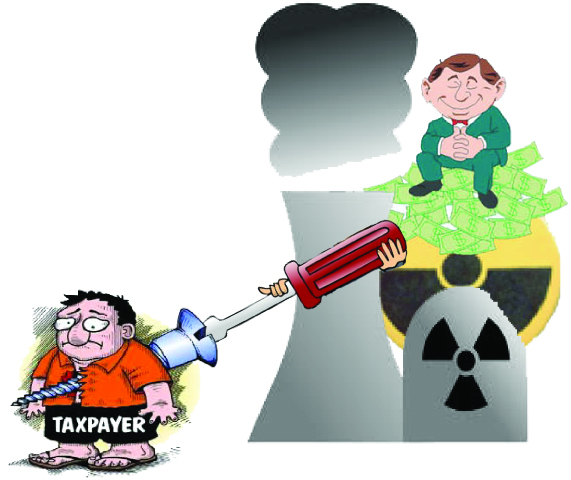
Nuclear Fuel for Advanced Reactors Spurred by Climate Bill Funds
https://news.bloomberglaw.com/environment-and-energy/nuclear-fuel-for-advanced-reactors-spurred-by-climate-bill-funds DEEP DIVE, Daniel Moore Aug. 29, 2022,
- Inflation Reduction Act includes $700 million for enrichment
- Energy Department still formulating plan for fuel supply
The Biden administration’s efforts to develop a more energy-dense nuclear fuel got a sudden $700 million windfall in the climate-and-tax bill signed into law this month, a boost for the agency’s plans to demonstrate two next-generation reactors before the end of the decade, energy officials and nuclear supporters said.
The funding—more than 15 times the program’s current annual appropriation—is a down payment for the Energy Department’s efforts to develop fuel supplies for advanced reactors, which are designed to be much smaller than the current fleet of nuclear plants………………..
Energy Secretary Jennifer Granholm told Congress in April the agency was “in final stages” of developing a HALEU strategy, which at that time had just $45 million appropriated by Congress for fiscal year 2022.
France braces for uncertain winter as nuclear power shortage looms
“Sky-high electricity prices are an economic threat, with France’s nuclear issues seemingly turning into a greater challenge than Russian gas flows,”
https://www.reuters.com/world/france-braces-uncertain-winter-nuclear-power-shortage-looms-2022-08-30/ By Forrest Crellin, Silvia Aloisi and Nina Chestney
PARIS, Aug 30 (Reuters) – France, once Europe’s top power exporter, may not produce enough nuclear energy this winter to help European neighbours seeking alternatives to Russian gas, and may even have to ration electricity to meet its own needs.
France has for years helped to underpin Europe’s electricity supply, providing about 15% of the region’s total power generation.
But this year, for the first time since French records began in 2012, France has become a net power importer as its own production of nuclear energy hit a 30-year low, based on data from consultancy EnAppSys
The supply squeeze, caused by a wave of repairs at the country’s nuclear power stations, couldn’t have come at a worse time. Europe is in the grip of an energy crisis as Russian gas supplies plummet in the wake of the Ukraine conflict and France, which derives 70% of its electricity from nuclear energy, has lost its edge.
French power prices have hit a string of all-time highs – topping 1,000 euros ($1,004.10) per megawatt hour earlier this month – on expectations the country will not have enough electricity to meet domestic demand. That surge, from prices of around 70 euros a year ago, has added to a cost-of-living crisis.
“Sky-high electricity prices are an economic threat, with France’s nuclear issues seemingly turning into a greater challenge than Russian gas flows,” said Norbert Rücker, head of economics and next generation research at Julius Baer.
Mothers For Peace disappointed that California Governor supports ”lifeline” for Diablo Canyon nuclear power station
California’s governor seeks lifeline for last nuclear plant, Ft.com 29 Aug 22,
State confronts extreme weather and rising demand as it rids carbon from the electric grid
After nearly 40 years of protesting against the Diablo Canyon nuclear power plant, Linda Seeley thought victory was finally at hand. Seeley and other members of Mothers for Peace — an activist group with roots in the 1960s antiwar movement — cheered when Pacific Gas and Electric, the utility that operates California’s last nuclear power station, announced in 2016 that it would close by 2025.
But governor Gavin Newsom, a longtime proponent of shutting down the plant, has reversed course and embarked on a last-minute effort to extend its operation by a decade. Newsom’s administration has cited “unprecedented stress” on the state’s energy system as a reason for keeping open Diablo Canyon, which alone accounts for 9 per cent of the state’s generation and 17 per cent of its electricity from [ed so-called] carbon-free sources. The California legislature will need to vote on whether to extend its operating life by Wednesday.
Seeley, who lives 7 miles from the plant in San Luis Obispo County, is furious. “With this proposal, Gavin Newsom is keeping an asset that is antiquated, needs tons of upgrades [and] has a six-year history of deferred maintenance,” she said. “It would be unconscionable to allow the plant to go on operating without doing the due diligence needed to make sure the plant is safe enough to work.” Beyond those concerns, she said, are the issues that have kept her up at night for decades. Diablo Canyon’s coastal location sits on faultlines, prompting concerns that seismic activity could trigger a nuclear meltdown. The plant, Seeley said, “is precariously perched on the edge of the ocean in an earthquake zone”………………..
California is a leader in renewable generation, with a quarter of its electricity powered by solar and wind resources in 2021 compared to 12 per cent for the US as a whole. But problems in the supply chain and cost inflation threaten to impede their expansion, according to state officials. The state’s power system will hit a “critical inflection point after Diablo Canyon retires”, the California Independent System Operator (Caiso), which manages most of the state’s grid, warned in a filing last year…………………………….. https://www.ft.com/content/58dfc631-a415-4954-b845-c563c93c6ceb
The cost of Ukraine’s de-Russification
the burgeoning de-Russification in Ukraine is one of the issues that needs a cool-headed examination. The process of removing Russian cultural and linguistic influence from the country is not an easy — or necessarily equitable — thing to do, when around a quarter of Ukrainians still identify as Russian speakers.
The country’s insistence on its right to exist as separate from Russia is understandable, but expunging Russian cultural and linguistic influence risks future trouble.
Politico. BY JAMIE DETTMER, AUGUST 29, 2022
Wars transform nations and people — leaving them, whether victorious or vanquished, “all changed, changed utterly,” as Irish writer W.B. Yeats noted.
Yeats was writing about the armed insurrection against British rule in Ireland during April 1916. The uprising had lasted just six days, but Ireland would never be the same.
Ukraine’s ongoing epic defense of its national identity, territorial integrity and sovereignty has already lasted six months, and there is no end in sight. It has left widespread devastation, with towns and buildings wrecked, families traumatized and uprooted, livelihoods upended and lives lost and mourned.
But there’s another transformation underway — and it’s in Ukrainian hearts.
Being told endlessly that they don’t exist has led to the understandable Ukrainian reaction of insisting on their existence, and their right to exist as separate from Russia. This is leading them to try and expunge Russian cultural and linguistic influence on their country. But how they do so, and to what degree, is fraught with future danger.
In a March 2014 speech marking the annexation of Crimea, Russian President Vladimir Putin had declared that Russians and Ukrainians “are one people. Kiev is the mother of Russian cities. Ancient Rus’ is our common source and we cannot live without each other.”
But, although the two nations are ensnared by history, the full-scale war he launched in February has only demonstrated the opposite, and has made it much more difficult for them to live with each other.
Indeed, for a nation that Putin has argued doesn’t exist, Ukraine has been kicking up a storm, and is now taking the fight well behind military frontlines, brazenly crossing the border into Russia and occupied Crimea, disrupting Russian supply lines and logistics, leaving the Kremlin to fall back on preposterous lies to explain explosions witnessed by vacationing Russians…………………
Ukrainians’ firmer sense of nationhood and identity, fueled by fury at what is befalling them, risks becoming less inclusive and more Russian-hating. How could it be otherwise?
……………. the burgeoning de-Russification in Ukraine is one of the issues that needs a cool-headed examination. The process of removing Russian cultural and linguistic influence from the country is not an easy — or necessarily equitable — thing to do, when around a quarter of Ukrainians still identify as Russian speakers.
……………………………… In January, Human Rights Watch also raised concerns about the lack of protections for Russian speakers in a new state language law that entered into force this year. The law requires print media outlets registered in Ukraine to publish only in the Ukrainian language, or to provide an accompanying Ukrainian version, or equivalent in content, volume and method of print, when publishing in another language. But while exceptions were made for other minority languages, such as English and official European Union languages, there were none provided for Russian.
………………….. in June, the Ukrainian parliament passed a set of new laws banning the distribution of Russian books printed overseas, and the playing or performance of Russian music by post-Soviet era artists, further seeking to distance the country from Russian culture.
But through the often tragic twists and turns of Ukraine’s tangled history, and the cultural imperialism of Russian czars and communist autocrats, Ukrainian and Russian culture are inextricably linked and have contributed to each other’s shaping — for good or ill.
…………………. there are risks in rejecting all things Russian……………..
In his independence day speech this week, Zelenskyy vowed Kyiv’s forces will retake Russian-occupied Crimea. But if that day comes, how will Kyiv approach de-Russification? Will it still insist on the use of the Ukrainian language in most aspects of public life on a peninsula where 65 percent of the population are ethnic Russian?
As Ukraine goes about trying to win this war, it also needs to think about how it will win the peace. https://www.politico.eu/article/the-cost-of-ukraines-de-russification/
It is really urgent” to “get out of this dependence on the nuclear fleet – French energy expert.

EDF: “It is really urgent” to “get out of this dependence on the nuclear
fleet which is weakening us more and more”, warns an expert. Yves Marignac
pleads among other things for a diversification of our electrical system
and a control of our electricity consumption, but also the development of
renewable energies.
France Info 25th Aug 2022
Ukraine and the Politics of Permanent War
Permanent war requires permanent censorship.

Day and night, the drums of war never stop beating. Its goal: to keep billions of dollars flowing into the hands of the war industry and prevent the public from asking inconvenient questions.
Chris Hedges, 29 Aug 22. No one, including the most bullish supporters of Ukraine, expect the nation’s war with Russia to end soon. The fighting has been reduced to artillery duels across hundreds of miles of front lines and creeping advances and retreats. Ukraine, like Afghanistan, will bleed for a very long time. This is by design.
On August 24, the Biden administration announced yet another massive military aid package to Ukraine worth nearly $3 billion. It will take months, and in some cases years, for this military equipment to reach Ukraine. In another sign that Washington assumes the conflict will be a long war of attrition it will give a name to the U.S. military assistance mission in Ukraine and make it a separate command overseen by a two- or three-star general.
Since August 2021, Biden has approved more than $8 billion in weapons transfers from existing stockpiles, known as drawdowns, to be shipped to Ukraine, which do not require Congressional approval.
Including humanitarian assistance, replenishing depleting U.S. weapons stocks and expanding U.S. troop presence in Europe, Congress has approved over $53.6 billion ($13.6 billion in March and a further $40.1 billion in May) since Russia’s February 24 invasion.
War takes precedence over the most serious existential threats we face. The proposed budget for the Centers for Disease Control and Prevention (CDC) in fiscal year 2023 is $10.675 billion while the proposed budget for the Environmental Protection Agency (EPA) is $11.881 billion. Our approved assistance to Ukraine is more than twice these amounts.
The militarists who have waged permanent war costing trillions of dollars over the past two decades have invested heavily in controlling the public narrative. The enemy, whether Saddam Hussein or Vladimir Putin, is always the epitome of evil, the new Hitler. Those we support are always heroic defenders of liberty and democracy. Anyone who questions the righteousness of the cause is accused of being an agent of a foreign power and a traitor.
The mass media cravenly disseminates these binary absurdities in 24-hour news cycles. Its news celebrities and experts, universally drawn from the intelligence community and military, rarely deviate from the approved script. The mass media cravenly disseminates these binary absurdities in 24-hour news cycles. Its news celebrities and experts, universally drawn from the intelligence community and military, rarely deviate from the approved script. Day and night, the drums of war never stop beating. Its goal: to keep billions of dollars flowing into the hands of the war industry and prevent the public from asking inconvenient questions.
In the face of this barrage, no dissent is permitted. CBS News caved to pressure and retracted its documentary which charged that only 30 percent of arms shipped to Ukraine were making it to the front lines, with the rest siphoned off to the black market, a finding that was separately reported upon by U.S. journalist Lindsey Snell. CNN has acknowledged there is no oversight of weapons once they arrive in Ukraine, long considered the most corrupt country in Europe. According to a poll of executives responsible for tackling fraud, completed by Ernst & Young in 2018, Ukraine was ranked the ninth-most corrupt nation from 53 surveyed.
There is little ostensible reason for censoring critics of the war in Ukraine. The U.S. is not at war with Russia. No U.S. troops are fighting in Ukraine. Criticism of the war in Ukraine does not jeopardize our national security. There are no long-standing cultural and historical ties to Ukraine, as there are to Great Britain. But if permanent war, with potentially tenuous public support, is the primary objective, censorship makes sense.
War is the primary business of the U.S. empire and the bedrock of the U.S. economy. The two ruling political parties slavishly perpetuate permanent war,………………………………………………
An organization like NewsGuard, which has been rating what it says are trustworthy and untrustworthy sites based on their reporting on Ukraine, is one of the many indoctrination tools of the war industry. Sites that raise what are deemed “false” assertions about Ukraine, including that there was a U.S.-backed coup in 2014 and neo-Nazi forces are part of Ukraine’s military and power structure, are tagged as unreliable. Consortium News, Daily Kos, Mint Press and Grayzone have been given a red warning label. Sites that do not raise these issues, such as CNN, receive the “green” rating” for truth and credibility. (NewsGuard, after being heavily criticized for giving Fox News a green rating of approval in July revised its rating for Fox News and MSNBC, giving them red labels.)
The ratings are arbitrary. The Daily Caller, which published fake naked pictures of Alexandria Ocasio-Cortez, was given a green rating, along with a media outlet owned and operated by The Heritage Foundation. NewsGuard gives WikiLeaks a red label for “failing” to publish retractions despite admitting that all of the information WikiLeaks has published thus far is accurate. …………..
NewsGuard, established in 2018, “partners” with the State Department and the Pentagon, as well as corporations such as Microsoft. Its advisory board includes the former Director of the CIA and NSA, Gen. Michael Hayden; the first U.S. Homeland Security director Tom Ridge and Anders Fogh Rasmussen, a former secretary general of NATO………………………………
As the persecution of Julian Assange illustrates, the throttling of press freedom is bipartisan. This assault on truth leaves a population unmoored. It feeds wild conspiracy theories. It shreds the credibility of the ruling class. It empowers demagogues. It creates an information desert, one where truth and lies are indistinguishable. It frog-marches us towards tyranny. This censorship only serves the interests of the militarists who, as Karl Liebknecht reminded his fellow Germans in World War I, are the enemy within.
1 This Month
23-25 October – on Zoom – World BEYOND War’s annual global conferenc


Shut down the radiation-damaged Heysham nuclear reactors now
To see nuclear-related stories in greater depth and intensity – go to https://nuclearinformation.wordpress.com

Say No to NASA’s Reckless Nuclear Reactor on the Moon
Say No to NASA’s Reckless Nuclear Reactor on the Moon

-
Archives
- October 2026 (199)
- September 2026 (339)
- August 2026 (330)
- July 2026 (355)
- June 2026 (287)
- May 2026 (306)
- April 2026 (356)
- March 2026 (251)
- February 2026 (267)
- January 2026 (308)
- December 2025 (358)
- November 2025 (359)
-
Categories
- 1
- 1 NUCLEAR ISSUES
- business and costs
- climate change
- culture and arts
- ENERGY
- environment
- health
- history
- indigenous issues
- Legal
- marketing of nuclear
- media
- opposition to nuclear
- PERSONAL STORIES
- politics
- politics international
- Religion and ethics
- safety
- secrets,lies and civil liberties
- spinbuster
- technology
- Uranium
- wastes
- weapons and war
- Women
- 2 WORLD
- ACTION
- AFRICA
- Atrocities
- AUSTRALIA
- Christina's notes
- Christina's themes
- culture and arts
- Events
- Fuk 2022
- Fuk 2023
- Fukushima 2017
- Fukushima 2018
- fukushima 2019
- Fukushima 2020
- Fukushima 2021
- general
- global warming
- Humour (God we need it)
- Nuclear
- RARE EARTHS
- Reference
- resources – print
- Resources -audiovicual
- Weekly Newsletter
- World
- World Nuclear
- YouTube
-
RSS
Entries RSS
Comments RSS

