Continuing campaign to stop the dumping of Hinkley nuclear power station mud off Cardiff coast
Campaigners attempting to stop mud from the construction of Hinkley Point
Nuclear Power Station, Somerset, being dumped into Welsh waters, have
announced they are working with leading environmental lawyers Leigh Day to
block the proposals. In February EDF Energy applied to National Resources
Wales for a licence to dump 800,0000 tonnes of mud dredged as part of
building work for the new plant that is being built on the site of the
disused Hinkley Point A facility.
Two years ago, EDF were given permission
to dump 300,000 tonnes of mud from the site off the Cardiff coast, despite
protests and following a Senedd debate. A petition against the latest
proposals received over 10,000 signatures and has triggered a debate in the
Senedd tomorrow. Earlier this month EDF Energy confirmed it will carry out
an Environmental Impact Assessment as part of its licence application. This
agreement reverses NRW and Welsh Government’s previous position that an
EIA was not needed for the dumping they permitted in 2018 just 2.1 miles
off the South Wales coast and 2.5 miles from Cardiff. Leigh Day has now
written to Natural Resources Wales (NRW) requesting full disclosure of
documents on the Environmental Impact Assessment (EIA)-screening
application from EDF and the agreement with NRW that “environmental
impact assessment is required”.
EDF are also facing a public inquiry over
a controversial fish management system that is being installed at the site
of the new facility. The Environment Agency granted a licence to EDF in
2013 that permitted sea water to be used for the nuclear power station’s
cooling system but required the deployment of a fish deterrent system on
the site to protect marine life in the estuary. Initially the operator
proposed the use of an acoustic deterrent system to reduce the number of
fish being killed by the cooling system but in 2017 abandoned the plans
without suggesting any alternative.
Currently the plant’s proposed Fish
Recovery and Return System will consist of a 5mm mesh barrier set up in the
water intake tunnel to stop large fish from being sucked in while another
channel will divert fish, dead or alive, back out to sea. Last year the
Sunday Times reported that marine and conservation groups estimated that
this system will kill 250,000 fish a day and called for it to be altered or
scrapped. EDF said the FRR will kills an estimated 650,00 fish a year.
Source: Nation Cymru 20th Oct 2020
https://nation.cymru/news/senedd-roundup-leading-environmental-lawyers-join-battle-to-block-mud-dump/
Belgium shuts down one reactor, in line with its “40 years life” rule for nuclear reactors
One of Belgium’s seven nuclear reactors
was disconnected from the grid on Friday evening. This follows legislation
passed in 2003 requiring reactors to be shut down after 40 years of
operation.
Belgium has two nuclear power plants: Doel near Antwerp and
Tihange near the town of Huy in Wallonia. The two plants consist of seven
reactors (four at Doel and three at Tihange) covering around 50 percent of
the country’s electricity needs, according to the news website Euractiv.
On Friday, the Doel 3 reactor was disconnected from the power grid in
accordance with the 2003 Nuclear Abandonment Act. The law was passed at the
insistence of the “green” parties that were part of the government at
that time. The legislation stipulates that reactors are to be shut down 40
years after being put into operation. A spokeswoman for the energy company
Engie, which operates Belgium’s nuclear power plants, Nele Scheerlinck,
stated that “the decision was made years ago” and “it is simply not
possible to change plans at such short notice”.
TVP World 24th Sept 2022
https://tvpworld.com/62949498/belgium-turns-off-nuclear-reactor-despite-energy-crisis
Sizewell C: Planning shake-up – getting rid of environmental assessment ‘runs roughshod over objectors’.

A government shake-up of planning which could bring forward the building of Sizewell C is “deeply dismaying”, campaigners said.
BBC News 24 Sept 22,
New legislation aims to cut planning rules and get rid of environmental assessments to speed up construction.
The nuclear power station in Suffolk is among projects to be “accelerated as fast as possible”, the Treasury said.
Stop Sizewell C said the plan “rode roughshod over the ability to fight damaging projects”.
The scheme, currently estimated to cost £20bn, was given government approval in July, against the advice of the Planning Inspectorate.
The new plant would be built by French-owned EDF next to the existing Sizewell B, which is still generating electricity, and Sizewell A, which has been decommissioned.
Fellow campaigners Together Against Sizewell C (TASC) has instigated a judicial review process over the planning approval, claiming it was illegal.
Chancellor of the Exchequer, Kwasi Kwarteng, who gave Sizewell the go-ahead when he was business secretary, made the latest announcement as part of his Autumn statement.
New legislation would be brought forward to “address barriers by reducing unnecessary burdens to speed-up the delivery of much-needed infrastructure”, the Treasury said………………………….. more https://www.bbc.com/news/uk-england-suffolk-6301233.
Is UK government’s nuclear power policy scientifically feasible? – asks House of Commons Science and Technology Committee .
The deadline to submit to the Commons Science and Technology Committee’s
inquiry on the Government’s approach to developing new nuclear power is
fast approaching. The Committee of MPs is accepting written evidence
submissions until Friday 30 September.
The Committee’s inquiry is looking
for evidence from experts on what is required for the Government to achieve
its aim to approve up to eight new nuclear fission reactors by 2030, as
committed in its energy security strategy, and for nuclear to supply 25% of
electricity by 2050.
More than half of the UK’s 11 nuclear reactors are due
to be retired by 2025 with no immediate replacements, an approach which was
criticised in a recent Public Accounts Committee report. The Science and
Technology Committee’s inquiry is examining how the gap in nuclear
generating capacity, which currently accounts for around 15% of the UK’s
electricity, will be filled and energy supply protected.
Other issues in
scope of the Committee’s inquiry are: the funding and regulation of nuclear
power, including provisions in the Energy Security Bill introduced into
Parliament this year; the status of the different nuclear power
technologies, including fusion, and their role in achieving the net zero by
2050 target; the technical challenges facing the next generation of nuclear
power plants; what further research and development is required to build
capacity and how the management of nuclear waste can be improved.
The House of Commons Science and Technology Committee scrutinises the Government and
exists to ensure that policies and decision-making are based on solid
scientific evidence and advice.
HoC Science & Technology Committee 22nd Sept 2022
https://committees.parliament.uk/work/6864/delivering-nuclear-power/
Italy’s far-right leader Giorgia Meloni favours return to nuclear power and increased gas production.
The front-runner to become Italy’s next prime minister in elections on
Sunday plans to focus on natural gas and nuclear energy, along with other
temporary market interventions to mitigate the country’s energy crisis.
The most recent opinion polls favour Giorgia Meloni, leader of the far-right
Fratelli d’Italia party, to win over her main rival Enrico Letta, leader of
the centre-left Democratic party. Much of the political campaign to replace
outgoing premier Mario Draghi has focused on the current tight energy
supplies, exacerbated by the Russian war in Ukraine, and skyrocketing
bills, which continue to pile pressure on Italian businesses and
households.
Gas, nuclear and EU green policies have emerged as contention
points. Meloni, who has teamed up with centre-right allies Matteo Salvini
and former premier Silvio Berlusconi, supports the reactivation of the
country’s long-shuttered nuclear power plants and an increase in domestic
gas production.
Montel 22nd Sept 2022
https://www.montelnews.com/news/1352753/front-runner-in-italian-election-focuses-on-gas-nuclear
Australian Capital Territory consumers reap rewards of 100 pct renewables as wind and solar farms hand back windfall profits.
The ACT is the only region of Australia’s main grid spared from sharp
increases in electricity bills, and its consumers can thank the shift to
100 per cent renewables and the structure of their deals with wind and
solar farms.
The ACT government has written contracts with 11 wind and
solar farms to provide the equivalent amount of electricity consumed by
homes and businesses in the ACT each year. The nature of these deals –
called contracts for difference (CfDs) – means that if the wholesale market
trades below the agreed strike price, the government (and consumers), top
up the difference to the wind and solar farms.
But if the wholesale prices are above the strike price – as they have been by a big distance over the
last six months – then the wind and solar farms must return these windfall
gains to ACT consumers. And in the last quarter, as wholesale prices soared
to record highs – and an average of more than $300/MWh in NSW – the wind
and solar farms paid back a total of $58 million to electricity consumers
in the ACT, shielding them from any significant bill hikes.
Renew Economy 22nd Sept 2022
Germany’s Environment Minister reaffirms the phaseout of nuclear power.
Speech by Federal Environment Minister Steffi Lemke on the draft of a
nineteenth law amending the Atomic Energy Act.
The phasing out of nuclear power, decided by a broad consensus in 2011, is coming.
Be proud, dear colleagues from the CDU / CSU , that you decided this with the FDP at the
time . That was responsible politics! Together we have settled a
decades-long social conflict. That is why this is not about Mr Trittin’s
life’s work, but about the fact that Mrs Merkel, as the responsible Federal
Chancellor at the time, implemented this nuclear phase-out in our country
with our support.
And you cannot hide the fact that you are now concerned
with reversing this decision with your draft law. With your draft law, you
not only want to enable an extension of the term until 2024, but beyond.
They want to turn back the wheel of nuclear history and that’s not going to
happen. It is irresponsible to treat this high-risk technology as if it
were a coffee maker that you turn on and off every once in a while, refill
with water, put in a new filter, and then turn it on again.
The valve leakage at the Isar 2 nuclear power plant is not a safety problem, but a
technical problem. Now we have to decide how to deal with it. In addition,
it is a mechanical problem that has been foreseeable for a long time, but
which means that the nuclear power plant will now have to be taken off the
grid in autumn, when we already have a problematic electricity situation
due to the lack of nuclear power plants in France.
The fact that this
information was not communicated to us in good time by the Bavarian nuclear
supervisory authority is something I will leave here without comment. We
will provide the necessary answers to the current energy situation. We are
driving the energy transition forward by massively expanding renewable
energies, focusing on energy efficiency and savings, and by using old
energy supply sources again this winter, thereby also enabling reserve
operation for two of the three nuclear power plants that are still in
operation if it becomes necessary.
German Environment Ministry 22nd Sept 2022
Nuclear Free Local Authorities (NFLA) want government assurances about new rules on compensation liability for nuclear accidents
New rules increasing the financial compensation payable by the nuclear
industry in the event of an accident have been welcomed by the Nuclear Free
Local Authorities, and a letter sent to a government energy minister
seeking assurance that the British public will be property protected.
Under amendments to the Paris Convention so far approved by most signatory
states, including Britain, the liability of nuclear plant operators to pay
compensation has increased to €700 million, with this figure increasing
by a further €100 million in each of the next five years.
Smaller amounts are payable by companies involved with the transportation of nuclear
materials. In the UK, the impact will be felt to the bottom line of EDF
Energy, which operates Britain’s nuclear power plants, and the Nuclear
Decommissioning Authority, with responsibility for transporting nuclear
materials.
Now Councillor David Blackburn, Chair of the NFLA Steering
Committee, has written to Lord Callanan, Minister of State with
responsibility for corporate governance and regulation in the nuclear
industry, to seek reassurance that nuclear operators will be required to
take out suitable insurance with private sector providers or make some
other financial provision to pay compensation in respect of an accident. He
is particularly concerned that ministers may attempt to subsidise the
industry by underwriting insurance provision or by downgrading their
operations to ‘low risk’ to reduce their liability.
NFLA 22nd Sept 2022
Liz Truss could break fracking election pledge to bypass local opposition
Liz Truss is considering designating fracking sites as nationally important
infrastructure, potentially cutting out local communities and breaking a
leadership election promise, the Guardian can reveal.
During her campaign
to be the Conservative party leader, Truss said new sites would only go
ahead with local consent. However, those familiar with discussions in the
Department for Business, Energy and Industrial Strategy (BEIS), led by
Jacob Rees-Mogg, say there have been discussions about pushing through
sites without local approval by designating them as nationally significant
infrastructure projects (NSIPs).
This means they would bypass normal local
planning requirements. The designations usually apply to infrastructure
such as roads, airports and energy sites.
Guardian 22nd Sept 2022
Nevada files motion regarding Yucca Mountain Nuclear Waste Project, launches dedicated website with educational resources.

Nevada’s staunch bi-partisan opposition to the project
Nevada Governor Steve Sisolak, CARSON CITY, NV – September 20, 2022
Today, Nevada Governor Steve Sisolak and the Nevada Agency for Nuclear Projects announced the filing of a new legal motion to bring an end to failed federal plans to construct a repository for the nation’s highly radioactive waste at Yucca Mountain, 65 miles northwest of Clark County’s populated areas.
The motion is being filed before the United States Nuclear Regulatory Commission. It asks the Nuclear Regulatory Commission to resume the adjudicatory portion of the licensing procedures so that Nevada may take specific additional steps aimed at stopping the project.
As a companion to the legal motion, today, the State launched a new webpage with resources recapping the failed policies that led to the designation of the Yucca Mountain Project and the geographic flaws in the site.
“It is time to take the lessons learned from the Yucca Mountain experiment and chalk them up to experience,” Governor Sisolak said. “This is a fight that Nevada has battled since 1987. The past three Presidential Administrations have agreed that Yucca Mountain is unworkable. It is time for this Administration and the Department of Energy to follow through and support the case made by Nevada’s leaders, legislators, experts and legal team.”
“I’ve opposed every attempt to revive the failed Yucca Mountain project, and it’s time we take this unsuitable site off the table once and for all,” said Senator Catherine Cortez Masto. “I support Nevada’s efforts to end the licensing process for Yucca Mountain, and I will continue to work with all stakeholders at the federal, state, local, and Tribal levels to find a safe, workable, and consent-based alternative.”
“For years, I have been fighting alongside our delegation to prevent Nevada from ever becoming the nation’s dumping ground for nuclear waste because it threatens our state’s security, economy, and public health,” said Senator Jacky Rosen. “That’s why I’m strongly supporting Nevada’s actions to finally put an end to Yucca Mountain, taking steps that would block future misguided efforts to try to revive this ill-conceived project against our state’s consent.”……………………………………………………………..
“Year after year, we’ve had to fight to ensure that Nevada does not become our nation’s dumping ground for nuclear waste,” said Rep. Susie Lee (NV-03). “I’m proud to sit on the Appropriations Committee’s Subcommittee on Energy and Water, where I’ve successfully blocked any funding going toward reviving Yucca Mountain, and I have worked with the Department of Energy to secure a commitment to finding consent-based alternatives to the proposed nuclear repository at Yucca Mountain. Now, it’s time to put an end to this failed project once and for all. That’s why I support the state of Nevada’s efforts to end the licensing for Yucca Mountain and to open the door to a productive consent-based solutions for nuclear waste storage.”
Videos and podcasts on the new webpage feature Nevada technical experts and document the project’s flaws, ill-conceived efforts to address site weaknesses with engineered barriers, and the need for nuclear waste and spent fuel solutions that are grounded in a robust consent-based siting process.
Nevada’s staunch bi-partisan opposition to the project and the history behind it is also featured on the webpage in an interview with former Nevada Rep. Jim Bilbray before his death last year about the so-called “Screw Nevada Bill,” that singled out Yucca Mountain as the nation’s sole repository site.
After more than three decades, continuing to pursue a license for the Yucca Mountain Project would expend additional time, millions more taxpayer dollars on a project that Nevada has demonstrated time and again will fail to securely and safely house the nation’s nuclear waste. The motion filed by the State today is the first step towards putting an end to thirty years of failed policy and acting on the need for a more fair, consent-based process to address the nuclear waste disposal needs of the United States. https://gov.nv.gov/News/Press/2022/2022-09-20_Yucca_Mountain_Nuclear_Waste/
Nukes Are Our Corporate Death Wish…the Sun is the People’s Cure

replacing nuke power and fossil fuels with solar, wind, batteries and LED/efficiency means a parallel apocalypse in the world of corporate power—-an end to the centralized multi-national control our global energy supply.
The Diablo deal clearly puts the global fossil-nuclear utility industry on the path to extinction. If these two immense reactors can be smoothly overtaken by cheaper, cleaner, safer renewable energy…what about the rest of the dying fossil/nuke fleet? What does that say about the future of centralized corporate power?
| Christina Macpherson <christinamacpherson@gmail.com> | 7:56 AM (0 minutes ago) |  | |
| to me |
https://www.counterpunch.org/2022/09/21/nukes-are-our-corporate-death-wishthe-sun-is-the-peoples-cure/ BY HARVEY WASSERMAN, 21 Sept22,
Humankind’s ultimate extinction is now flowing through an atomic death spiral.
A single errant shell at Ukraine’s Zaporizhzhia…a single seismic shock at California’s Diablo Canyon…can bury us all in apocalyptic radiation.
The eruptions already stretch from Kyshtym, Iron Mike, Castle Bravo, Windscale, SL-1, Chalk River, Santa Susanna, Fermi I, Perry, Davis-Besse, North Anna, Tokaimura, Three Mile Island, Church Rock, Surry, Chernobyl, Vandellòs, Sosnovy Bor, WIPP, Fukushima, Fort Calhoun to South Texas and too many more.
It’s been clear since 1945 that A-Bombs can extinct the human race. Commercial reactors supply them with fissionable material and a work force.
Burning alongside thousands of nuclear warheads there are 400+ commercial reactors worldwide…decrepit, decayed, expensive, under-maintained, unstable and uninsured (except by token taxpayer funds). Six in Ukraine currently tremble in a war zone.
The average age of the 92 nukes in the US is nearly 40. The 1000+-square-mile dead zone around Chernobyl could be easily duplicated by any nuke. Just superimpose a similar lethal wound anywhere on a US map and calculate the damage.
But it’s a double-sided apocalypse.
Bombs & reactors can obliterate the human species with both explosive bangs and the agonized whimpers of radioactive murder.
But replacing nuke power and fossil fuels with solar, wind, batteries and LED/efficiency means a parallel apocalypse in the world of corporate power—-an end to the centralized multi-national control our global energy supply.
Cheaper, cleaner, safer, more reliable, more job-producing democratized green energy stands to obliterate the monetary and political death grip King CONG (Coal, Oil, Nukes, Gas) has on our species’ throat.
The decentralized, community-controlled green vision is as terrifying to global energy barons as is biological extinction to the rest of us. And thus the atomic hucksters somehow try to convince us their apocalyptic reactors are “clean, green, carbon-free,” you name it.
The scam’s cutting edge is now in California, where would-be president Gavin Newson is pushing nuclear power while conspiring to kill renewables.
At the End Time vortex is Diablo Canyon.
For more than a half-century, plus grassroots citizens have fought two atomic power reactors on the central California coast, eight miles west of San Luis Obispo.
Unit One’s first components arrived on site in pre-digital 1967. By 1984-5, when the hardware was already obsolete, more than 10,000 citizens (including me) were arrested there.
As Jerry Brown’s greening Golden State has welcomed more than 17,000 wind turbines, 1.4+ million rooftop solar installations and massive advances in battery and LED/efficiency technologies now dwarf the output from the state’s one remaining nuke plant.
Some 1500 Californians now work at Diablo; over 70,000 work in renewables, batteries and efficiency. Shutting Diablo and replacing it with real green power would add thousands of jobs to the state’s energy mix.
Early on Pacific Gas & Electric vehemently denied that there were any active earthquake faults threatening Diablo. They refused to allow experts who said otherwise to testify in official hearings. They also refused to build in the safeguards required to withstand certain levels of seismic shaking.
But then in 1973 the company admitted that they knew about an active earthquake fault—-the Hosgri—-sitting just three miles from the reactor cores. Just 45 miles from the San Andreas, a dozen more fault lines intertwine near the core. Dr. Michael Peck, the Nuclear Regulatory Commission’s site inspector for five years, warned in 2014 a likely quake could shake Diablo to rubble.
But the NRC has refused to force PG&E to physically upgrade the facility. Instead a series of “waivers” let Diablo run where any number of fault lines could rattle it—-and millions of us downwind—-to outright oblivion.
The NRC has long since admitted that Unit One is seriously embrittled. It’s well-known throughout the industry that the steel cylinder containing its super-hot core reaction will shatter in a melt-down. Explosive radioactive death clouds will then pour into Los Angeles, the Central Valley and/or Bay Area….and into the jet-stream and around the globe, doing terminal damage to the human species.
Diablo has not recently—-if ever—-been independently inspected. It has no private insurance. There are no public evacuation plans for California’s major population centers.
In 2016-8, then-Governor Brown and now-Governor Newsom helped plan Diablo’s closure. Local citizens, elected officials, unions, regulators, environmental groups and more mapped out an orderly shut-down.
As a result, workers are being compensated, with some retiring, some staying for decommissioning, the younger ones being retrained to work in the booming renewable industry.
As a reward for not meeting legal safety and ecological requirements, PG&E has ducked a wide range of upgrades and maintenance The plant has been set to operate through the expiration of Unit One’s NRC license in 2024, then Unit Two’s in 2025. Its owner has been allowed to ignore routine upkeep, becoming more dangerous by the day.
Hot radioactive water still pours into ocean, killing billions of marine creatures. There remains just barely enough on-site space to accommodate the ensuing spent fuel through 2024-5. Managing more is an epic unknown, requiring at very least exceedingly dangerous manipulations of what’s already in the fuel pools, along with untenable expansions of the dry casks and concrete pads on the site.
The venerable Mothers for Peace—and thousands more—-want Diablo to immediately shut.
The nukes’ 2400 megawatts are already fading below a well-planned, cleanly executed symphony of solar panels, wind farms, batteries and LED/efficiency. Massive off-shore wind turbines will soon send mega-juice pouring into Diablo’s switching stations.
By public consensus the 2016 phase-out plan embodies as rational and well-calculated a transition as the human species could concoct…a model for winding down the other 90+ American reactors, and maybe even the 400+ worldwide. It offers a sustainable green escape from the obscene financial and ecological failures of atomic power to the proven reliability of a Solartopian future.
Which has pitched King CONG (Coal, Oil, Nukes, Gas) into a Luddite state of terminal atomic panic.
The Diablo deal clearly puts the global fossil-nuclear utility industry on the path to extinction. If these two immense reactors can be smoothly overtaken by cheaper, cleaner, safer renewable energy…what about the rest of the dying fossil/nuke fleet? What does that say about the future of centralized corporate power?
With this giant hole poked into the obsolete energy Luddites’ Maginot line, what will happen to the trillions of dollars still sunk in the old ways of scorching the Earth? What will trillions of kilowatts of Solartopian electricity pouring into the grid do to the future of fossil/nuclear fuels?
The industry does not want to know—-and it does not want YOU to know.
Wind, solar, batteries and efficiency already sustain much of California’s and the nation’s grid, now commonly providing the flexible, reliable, low-cost, zero-aaron essential power needed to avoid blackouts, unsustainable rate hikes and lethal climate chaos.
First and foremost, King CONG’s anti-green blitzkrieg disrupts supply chains and assaults rooftop solar with taxes and regulations designed to kill it. Endless genuflections to the dead bird each big turbine kills per year accompany the assault. So do rightful worries over mining of lithium and cobalt, major polluters in regions with bad labor practices.
But these are solvable, non-plutonium-based problems in comparison with mining, milling and enriching uranium while failing to manage its wastes.
No windmill ever killed a fish, but nukes kill billions of marine creatures every day.
Every reactor burns at roughly 570 degrees Fahrenheit, spewing radiation, carbon 14 and lethal pollutants into the eco-sphere. Massive quantities of carbon pour from mining, milling, enrichment and disposal. All reactors and fuel pools can explode at any time.
The Trumpian Big Lie is that these ancient, uninsured instruments of mass extinction are somehow “emission and carbon free.”
So Newsom has strong-armed California’s legislature to trash Diablo’s shut-down deal and hand PG&E $1.4 billion to operate til the next quake blows the place apart.
With utility and fossil/nuke money in his presidential war chest, Newsom is poised to pursue the White House against a hard-right Ron DeSantis who actually vetoed solar taxes like the ones Newsom is pushing.
Polls in both Florida and California show 80% support for renewables. Fierce campaigns now rage against Diablo’s extension and Newsom’s attempt to kill rooftop solar.
The Governor now has the radioactive winds to his back.
But as fossil/nukes scorch the planet, and as their apocalyptic clouds pour over our biggest cities, and as their over-the-top inefficiencies bankrupt our economy, what will be left for his corrupt, cynical ilk to govern?
Harvey Wasserman wrote SOLARTOPIA! Our Green-Powered Earth. His Green Power & Wellness Show is at www.prn.fm.
The Weapons Industry as a Taxpayer Scam
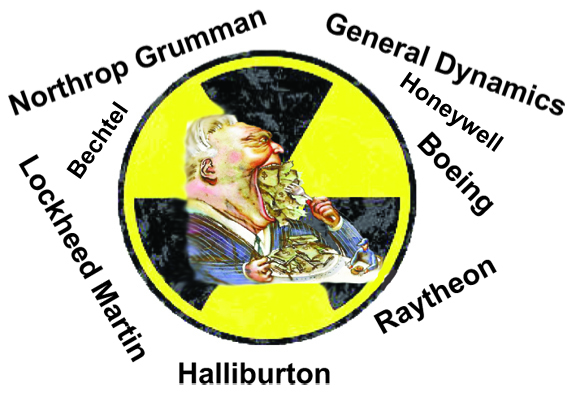
In all, the top five weapons contractors—Lockheed Martin, Raytheon, Boeing, General Dynamics, and Northrop Grumman—split more than $200 billion in “defense” revenue in the last fiscal year, mostly from the Pentagon but also from lucrative foreign arms sales. The new budget proposals will only boost those already astounding figures.
Military contractors and arms manufacturers cash in as Congress adds billions to the Pentagon budget each year.
The jobs card is the strongest tool of influence available to the arms industry in its efforts to keep Congress eternally boosting Pentagon spending, but far from the only one
So far, in the 2022 election cycle, weapons firms have already donated $3.4 million to members of the House Armed Services Committee
There are scant, if any, restrictions against members of Congress owning or trading defense company stocks, even those who sit on influential national-security-related committees. In other words, it’s completely legal for them to marry their personal financial interests to those of defense contractors.
https://www.commondreams.org/views/2022/09/12/weapons-industry-taxpayer-scam JULIA GLEDHILL, WILLIAM HARTUNG, September 12, 2022 Congress has spoken when it comes to next year’s Pentagon budget and the results, if they weren’t so in line with past practices, should astonish us all. The House of Representatives voted to add $37 billion and the Senate $45 billion to the administration’s already humongous request for “national defense,” a staggering figure that includes both the Pentagon budget and work on nuclear weapons at the Department of Energy. If enacted, the Senate’s sum would push spending on the military to at least $850 billion annually, far more—adjusted for inflation—than at the height of the Korean or Vietnam wars or the peak years of the Cold War.
U.S. military spending is, of course, astronomically high—more than that of the next nine countries combined. Here’s the kicker, though: the Pentagon (an institution that has never passed a comprehensive financial audit) doesn’t even ask for all those yearly spending increases in its budget requests to Congress. Instead, the House and Senate continue to give it extra tens of billions of dollars annually. No matter that Secretary of Defense Lloyd Austin has publicly stated the Pentagon has all it needs to “get the capabilities… to support our operational concepts” without such sums.
It would be one thing if such added funding were at least crafted in line with a carefully considered defense strategy. More often than not, though, much of it goes to multibillion dollar weapons projects being built in the districts or states of key lawmakers or for items on Pentagon wish lists (formally known as “unfunded priorities lists”). It’s unclear how such items can be “priorities” when they haven’t even made it into the Pentagon’s already enormous official budget request.
In addition, throwing yet more money at a department incapable of managing its current budget only further strains its ability to meet program goals and delivery dates. In other words, it actually impairs military readiness. Whatever limited fiscal discipline the Pentagon has dissipates further when lawmakers arbitrarily increase its budget, despite rampant mismanagement leading to persistent cost overruns and delivery delays on the military’s most expensive (and sometimes least well-conceived) weapons programs.
Inn short, parochial concerns and special-interest politics regularly trump anything that might pass as in the national interest, while doing no favors to the safety and security of the United States. In the end, most of those extra funds simply pad the bottom lines of major weapons contractors like Lockheed Martin and Raytheon Technologies. They certainly don’t help our servicemembers, as congressional supporters of higher Pentagon budgets routinely claim.
A Captured Congress
The leading advocates of more Pentagon spending, Democrats and Republicans alike, generally act to support major contractors in their jurisdictions. Representative Jared Golden (D-ME), a co-sponsor of the House Armed Services Committee proposal to add $37 billion to the Pentagon budget, typically made sure it included funds for a $2 billion guided-missile destroyer to be built at General Dynamics’ shipyard in Bath, Maine.
Similarly, his co-sponsor, Representative Elaine Luria (D-VA), whose district abuts Huntington Ingalls Industries’ Newport News Shipyard, successfully advocated for the inclusion of ample funding to produce aircraft carriers and attack submarines at that complex. Or consider Representative Mike Rogers (R-AL), the ranking Republican on the House Armed Services Committee and a dogged advocate of annually increasing the Pentagon budget by at least 3% to 5% above inflation. He serves a district south of Huntsville, Alabama, dubbed “rocket city” because it’s the home to so many firms that work on missile defense and related projects.
There are even special congressional caucuses devoted solely to increasing Pentagon spending while fending off challenges to specific weapons systems. These range from the House shipbuilding and F-35 caucuses to the Senate ICBM Coalition. That coalition has been especially effective at keeping spending on a future land-based intercontinental ballistic missile dubbed the Sentinel on track, while defeating efforts to significantly reduce the number of ICBMs in the U.S. arsenal. Such “success” has come thanks to the stalwart support of senators from Montana, North Dakota, Utah, and Wyoming, all states with ICBM bases or involved in major ICBM development and maintenance.
The jobs card is the strongest tool of influence available to the arms industry in its efforts to keep Congress eternally boosting Pentagon spending, but far from the only one. After all, the industrial part of the military-industrial-congressional complex gave more than $35 million in campaign contributions to members of Congress in 2020, the bulk of it going to those on the armed services and defense appropriations committees who have the most sway over the Pentagon budget and what it will be spent on.
So far, in the 2022 election cycle, weapons firms have already donated $3.4 million to members of the House Armed Services Committee, according to an analysis by Open Secrets.org, an organization that tracks campaign spending and political influence. Weapons-making corporations also currently employ nearly 700 lobbyists, more than one for every member of Congress, while spending additional millions to support industry-friendly think tanks that regularly push higher Pentagon spending and a more hawkish foreign policy.
The arms industry has another lever to pull as well when it comes to the personal finances of lawmakers. There are scant, if any, restrictions against members of Congress owning or trading defense company stocks, even those who sit on influential national-security-related committees. In other words, it’s completely legal for them to marry their personal financial interests to those of defense contractors.
The Cost of Coddling Contractors
Continue readingSizewell C nuclear project might be scrapped as UK faces ‘long winter’ due to energy crisis

A NEW NUCLEAR reactor which is planned for the Sizewell site in Suffolk could face numerous problems with funding and completion, an expert has warned.
Express UK, By MATTHEW DOOLEY, Sun, Sep 11, 2022 Sizewell C nuclear power station is a proposed nuclear plant in Suffolk which would meet up to seven percent of the UK’s energy demand. The project is owned by the French nuclear giant EDF and the China Nuclear group who own an 80 and 20 percent stake, respectively, in the project.
………. the plant will take years to complete, so it is unlikely it will have any effect on consumers’ bills in the short term.
Concerns have also been raised about the French company taking on the project, EDF. The company is reportedly heavily in-debt – €42.8billion (£37billion) at the end of June, according to Bloomberg.
In July, French Prime Minister Elisabeth Borne announced that EDF would be nationalised with the French Government buying 14 percent of the company which it did not already own.
This led some experts to express concern over the viability of the new Sizewell plant amidst an ongoing energy crisis.
Associate Fellow at the Science Policy Research Unit, Sussex Business School, University of Sussex Paul Dorfman is an expert in civil nuclear technology.
He said that following the winter, EDF may lose its appetite for building a nuclear project in the UK, particularly when the rest of Europe was struggling with its own energy crisis.
He said: “EDF has huge problems, as they are massively in debt – essentially bankrupt, right now about €42billion in debt, with huge waste and decommissioning costs on the horizon.
“At the moment half of all French EDF reactors are offline, many with ageing maintenance and corrosion safety problems. Because of all this, the French Government has been forced to fully nationalise EDF.
“This winter will be a long time in energy and in politics. It will be a cold winter, and what would happen if France needed all its power for Paris, and fails to deliver power to the UK? How will that go down with UK people and policy, and could that impact the any new nuclear decision at Sizewell C?”
“What will happen if France says, ‘well we are in such problems with our nuclear, we don’t want to commit to the UK?’ Already, just this week, the EDF Board has refused sign off on Johnson’s Sizewell C contract – are they getting cold feet because they worry about taking on more debt for another UK project, when they have their own problems at home.”
Dr Dorfman was referring to a number of sources close to the matter who apparently told the French magazine Le Figaro EDF’s board of directors had voted against the Government’s negotiated decision with EDF to build the reactor at Sizewell……………….
The Sizewell C project would be funded by three parties – EDF would fund 20 percent while the Government would take on another 20 percent of the project. Private investors would take on another 60 percent of the funding while current investor China General Nuclear Power is expected to ease out of its 20 percent investment.
This adds more uncertainty to the project, according to Dr Dorfman who claims the current market won’t “touch nuclear with a barge pole”.
A portion of the construction will be funded by the Regulated Asset Base (RAB) module, which will see consumers pay a premium on their energy bills to go towards the construction of the plant. https://www.express.co.uk/news/science/1667357/energy-crisis-sizewell-c-nuclear-plant-uk-long-winter-energy-crisis
Veteran Intelligence Professionals: Ukraine Decision Time for Biden
We hope you have been adequately briefed on the likely outcome of the recent Ukrainian “offensive”
by Veteran Intelligence Professionals for Sanity
MEMORANDUM FOR: The President
FROM: Veteran Intelligence Professionals for Sanity
SUBJECT: Ukraine Decision Time
REF: Nukes Cannot be Un-Invented, VIPS
Mr. President:
Before Defense Secretary Austin flies off to Ramstein for the meeting Thursday of the Ukraine Defense Contact Group we owe you a few words of caution occasioned by our many decades of experience with what happens to intelligence in wartime. If he tells you Kyiv is beating back the Russians, kick the tires – and consider widening your circle of advisers
Truth is the coin of the realm in intelligence analysis. It is equally axiomatic that truth is the first casualty of war, and that applies to the war in Ukraine as well as earlier wars we have been involved in. When at war, Defense Secretaries, Secretaries of State, and generals simply cannot be relied upon to tell the truth – to the media, or even to the President. We learned that early – the hard and bitter way. A lot of our comrades in arms did not come back from Vietnam.
Vietnam: President Lyndon Johnson preferred to believe Gen. William Westmoreland who told him and Defense Secretary McNamara in 1967 that South Vietnam could win – if only LBJ would supply an additional 206,000 troops. CIA analysts knew that to be untrue and that – worse still — Westmoreland was deliberately falsifying the number of forces he faced,……………………….
All being fair in love and war, the generals in Saigon were determined to offer a rosy picture……………………
The Demise of Imagery Analysis: Until 1996, CIA had an independent capability to do unencumbered military analysis enabling it to speak the truth – even during war. ……………the National Photographic Interpretation Center (NPIC,) a solid reputation for professionalism and objectivity.
………………………. In 1996, when NPIC and its 800 highly professional imagery analysts were given, kit and kaboodle, to the Pentagon, it was goodbye to impartial intelligence.
Iraq: Retired Air Force General James Clapper was eventually put in charge of NPIC’s successor, the National Imagery and Mapping Agency (NIMA) and thus was well positioned to grease the skids for the “war of choice” on Iraq.
Indeed, Clapper is one of the few senior functionaries to admit that, under pressure from Vice President Cheney, he was “leaning forward” to find weapons of mass destruction in Iraq; could find none; but went along anyway…………………………
Afghanistan: You will recall the extreme pressure on President Obama coming from Defense Secretary Gates, Secretary of State Clinton, and generals like Petraeus and McCrystal to double down in sending more troops to Afghanistan. They were able to push aside Intelligence Community analysts,……………………..
The President, as you well know, deferred to Gates and the generals. And, last summer, it was left to you to pick up the pieces, so to speak……………………..
Syria – Austin’s Reputation Not Without Blemish: Closer to home, Secretary Austin is no stranger to accusations of politicizing intelligence………………………….. The analysts claimed their reports were being changed by higher-ups to dovetail with the administration’s public line that the US was winning the battle against ISIS and the al-Nusra Front, al Qaeda’s branch in Syria……………………….
In Summary: We hope you take the time to review this history – and to take it into account before sending Secretary Austin off to Ramstein. …………………. (We hope you have been adequately briefed on the likely outcome of the recent Ukrainian “offensive”.)
You may also wish to seek counsel from CIA Director William Burns and others with experience in the history of Europe – and particularly of Germany. Media reports suggested earlier that in Ramstein Secretary Austin will commit to providing Ukraine with still more weaponry and will encourage his colleagues to do the same. If he follows that script, he may find few takers – particularly among those most vulnerable to winter cold.
FOR THE STEERING GROUP: Veteran Intelligence Professionals for Sanity
signed by 19 highly qualified members of Veteran Intelligence Professionals for Sanity (VIPs) is made up of former intelligence officers, diplomats, military officers and congressional staffers. https://original.antiwar.com/veteran-intelligence-professionals-for-sanity2/2022/09/05/veteran-intelligence-professionals-ukraine-decision-time-for-biden/
Western media continues to ignore Ukraine’s public ‘kill list’ aimed at those who question the Kiev regime

Ukraine has a list ( Myrotvorets) of people, giving addresses and contact numbers, – people considered as enemies of the state, – able to be killed by extreme nationalists. The Ukraine government does nothing to stop this.
“There are so many people in Ukraine who want to push for peaceful negotiations with Russia. But if anybody in Ukrainian society wants to stand up and push this line, they’re most likely going to be put on that list. Myrotvorets is very much a symbol of the extremist elements in Ukraine at the moment.”
https://ingaza.wordpress.com/2022/09/11/western-media-continues-to-ignore-ukraines-public-kill-list-aimed-at-those-who-question-the-kiev-regime/ September 10, 2022, -by Eva K Bartlett
The Myrotvorets list is an issue trending in independent and Russian media, but not in the mainstream international press
This week, a number of international and Russian journalists convened in Moscow – with more joining by video link – to discuss the now-infamous Ukrainian Myrotvorets “kill list.” Many of them are included themselves.
While some don’t take it seriously, the horrific car-bombing murder of Darya Dugina on August 20 and the subsequent marking on her Myrotvorets entry as “liquidated” makes it fairly clear the people behind the list do, in fact, want people dead.
The same thing happened to the entry of Russian photojournalist Andrei Stenin and many others listed and subsequently killed, including the Italian Andrea Rocchelli.
What it feels like to be on the list
The head of the Foundation to Battle Injustice, Mira Terada, who convened the panel, noted that of the thousands of names entered on the site, 341 are journalists and, shockingly, 327 are minors.
“Publishing personal data on minors is a crime. It’s like a menu for pedophiles or people doing human trafficking.”
While her concern is for the children, journalists, activists, political figures and even ordinary Ukrainians who have somehow angered the Kiev regime and those behind the list, Terada now needs to exercise some caution after she herself was added to the database.
An hour and a half after a July 21 press conference about children being placed on Myrotvorets, Mira found herself listed. “This changed my life. I have to be vigilant 24/7,” she said.
Christelle Néant, a French war correspondent reporting from Donbass for the past six and a half years, mentioned to me before the panel began that some of the information on the site is not disclosed to the general public, and is password-locked.
Néant, who said she’s been receiving death threats for years, spoke of how it impacts her: “Every time I use my car, I check underneath it for any unpleasant surprise,” referring to a potential car bomb. “I don’t publish any photos with people I live with or love. I have to be vigilant at all times.”
“I’m not a terrorist, not a criminal, I’m just a correspondent. This list must be closed and all of those involved must be held accountable.”
German journalist Thomas Röper rightly noted that Western media outlets prefer to look the other way. “They could have reported on this, but they’re saying nothing.”
He also pointed out the silence of the German government, even when asked at press conferences.
“A state has a duty to protect its citizens, but I haven’t seen anything from my government to condemn the fact that Germans are on this list and one German national has been killed.”
And, in fact, rather than protect German journalists, the government is persecuting them, as is the case with Alina Lipp, whose bank account, and that of her mother, was closed after the German government launched a criminal case against her for her reporting from Donbass.
Russian journalist Veronika Naydenova, originally from Crimea but living in Germany, was added to the list in January, also after raising the inclusion of children, including 13-year-old Faina Savenkova, from the Lugansk People’s Republic.
The same day my article was published, I was added to the list. But this hasn’t stopped me, I’ve written many articles since.”
She highlighted an additional, very real, threat: that of the refugees who’ve come to Germany from Ukraine, it isn’t possible to know who is merely a refugee and who holds Ukrainian nationalist extremist views. This is a very real fear for Naydenova, whose address is listed on Myrotvorets.
The same happened with Syrians who entered Germany and other countries as refugees. Some of them had affiliations to, or were members of, terrorist groups in Syria, and posed very real threats to supporters of Syria in Germany. As I wrote in a previous article, Kevork Almassian, a Syrian living in Germany, was chased, smeared, harassed and even physically attacked multiple times by the sympathizers of the Free Syrian Army (FSA) and other terrorist groups.”
Dutch journalist Sonya van den Ende likewise fears returning home. “I’m labeled an ‘enemy of the state’ now in the Netherlands. I cannot go back, it’s very dangerous for me to do so.”
Janus Putkonen, a Finnish journalist who has been living in Donbass since 2015, pointed out how the risk extends globally.
“Because the Myrotvorets kill list has not been stopped, people around the world are now in danger of falling victim to the state terrorism of Ukrainian Nazism, comparable to ISIS terrorism.”
But, most of all, it threatens Ukrainians within Ukraine, something British journalist Johnny Miller emphasized.
“If you’re a journalist, blogger, political figure, or a citizen in Ukraine who wants to criticize extremism in Ukraine, which there is a lot of, or if you want to criticize Ukrainian government policies, most likely you’re going to be put on that list. And be under serious threat of death.”
Miller, who has reported from areas of western Ukraine, raised another important point:
“There are so many people in Ukraine who want to push for peaceful negotiations with Russia. But if anybody in Ukrainian society wants to stand up and push this line, they’re most likely going to be put on that list. Myrotvorets is very much a symbol of the extremist elements in Ukraine at the moment.”
For myself, I’ve been on the list since 2019, after going to Crimea and reporting from areas of the DPR where civilians were being terrorized by Ukrainian shelling, houses destroyed “street by street” as a local told me.
1 This Month
23-25 October – on Zoom – World BEYOND War’s annual global conferenc


Shut down the radiation-damaged Heysham nuclear reactors now
To see nuclear-related stories in greater depth and intensity – go to https://nuclearinformation.wordpress.com

Say No to NASA’s Reckless Nuclear Reactor on the Moon
Say No to NASA’s Reckless Nuclear Reactor on the Moon

-
Archives
- October 2026 (199)
- September 2026 (339)
- August 2026 (330)
- July 2026 (355)
- June 2026 (287)
- May 2026 (306)
- April 2026 (356)
- March 2026 (251)
- February 2026 (267)
- January 2026 (308)
- December 2025 (358)
- November 2025 (359)
-
Categories
- 1
- 1 NUCLEAR ISSUES
- business and costs
- climate change
- culture and arts
- ENERGY
- environment
- health
- history
- indigenous issues
- Legal
- marketing of nuclear
- media
- opposition to nuclear
- PERSONAL STORIES
- politics
- politics international
- Religion and ethics
- safety
- secrets,lies and civil liberties
- spinbuster
- technology
- Uranium
- wastes
- weapons and war
- Women
- 2 WORLD
- ACTION
- AFRICA
- Atrocities
- AUSTRALIA
- Christina's notes
- Christina's themes
- culture and arts
- Events
- Fuk 2022
- Fuk 2023
- Fukushima 2017
- Fukushima 2018
- fukushima 2019
- Fukushima 2020
- Fukushima 2021
- general
- global warming
- Humour (God we need it)
- Nuclear
- RARE EARTHS
- Reference
- resources – print
- Resources -audiovicual
- Weekly Newsletter
- World
- World Nuclear
- YouTube
-
RSS
Entries RSS
Comments RSS

