http://www.nationalgeographic.com.au/people/how-5-people-survived-nagasakis-nuclear-hell.aspx Three days after Hiroshima, an American B-29 dropped an atomic bomb on Nagasaki. A new book tells stories of those who lived through horror. on August 9, 1945, an American B-29 dropped an atomic bomb on the Japanese city of Nagasaki, obliterating much of it and killing 74,000 people, mostly civilians. It was only the second time in history an atomic bomb had been used as a weapon.BY SIMON WORRALL 14 SEPTEMBER 2017In Nagasaki: Life After Nuclear War, Susan Southard follows the lives of five hibakusha (survivors) who escaped the firestorm and through extraordinary courage and resilience went on to live happy, fulfilled lives.
Speaking from her home in Arizona, she talks about the battle for the truth over what happened in Nagasaki; how square dancing helped heal the wounds of war; and why the survivors no longer harbour feelings of animosity towards Americans.
Yours is the first book to tell this story. Why has it taken so long?
“Some people may know about Hiroshima, but they don’t know about Nagasaki. They say, “Oh, there was a second bombing?” Many people also don’t know that people survived the bombings.
One of the reasons is that the bombs were kept top secret. Very few military leaders knew they existed, except for the people who were creating the bombs and those directly overseeing them. After the bombs were dropped, several factors, both in the U.S. and Japan, contributed to people not knowing the effects.
One was direct denial of any radiation effects by key U.S. military leaders like General Leslie Groves, General Thomas Farrell and the U.S. War Department. During the U.S. occupation of Japan, which lasted from 1945 to 1952, General Douglas MacArthur also instituted a strict press code banning “false or destructive criticism” of the Allied powers out of concern that too much anger could put the thousands of U.S. troops in Japan at risk.
General Groves and others promoted the idea that the Japanese were using the effects of the bomb as anti-American propaganda. So, the people of Japan, other than the people in the cities directly affected, didn’t know for years what was happening in their own country. There was medical censorship as well. Physicians working with the survivors weren’t allowed to publish studies or findings of what was happening.
They also didn’t want the decision to use the bombs to be challenged in the U.S., by books like John Hersey’s Hiroshima. So President Truman and the Secretary of War, Henry Stimson, made a concerted effort to publish articles justifying the use of the bombs, excluding any information about what happened to the people beneath the atomic clouds.
The justifications were so airtight that they became the dominant way of perceiving the decision to use the bombs on Japan: that the two bombs ended the war and saved a million American lives.”
What made you want to write this book?
“It has deep roots in my life. In high school, I spent a year as an exchange student in Japan and happened to go on a field trip to the southern island of Kyushu, where I visited the Nagasaki Atomic Bomb Museum. I stood next to my Japanese classmates as the only American and observed the destruction.
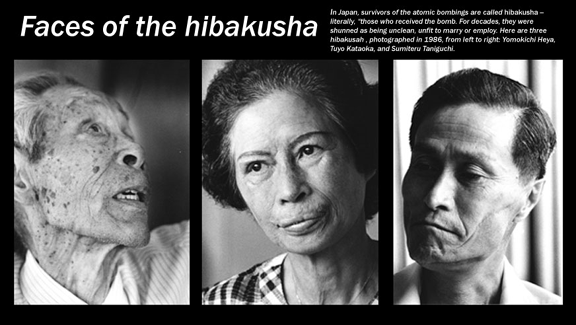
But the key event came in 1986, when one of the Nagasaki survivors, Taniguchi Sumiteru, who was 57 years old by then, came to Washington on a speaking tour. I went to hear him speak, then, through a series of unexpected events, his interpreter became unable to complete the last few days of his time in Washington, and I became his interpreter.
In between his presentations we spent hours together. I got to ask him questions and tried to grasp what his experience had been like; it was truly a horrific experience. His entire back had been burned off. From that time on I couldn’t get out of my mind what it would be like to have survived nuclear war.”
Explain the term “hypocenter” and describe the destructive power of the blast in relation to it.
“Contrary to what some of us might imagine, the bomb did not explode on the ground but about one-third of a mile above ground. The purpose was to maximize the blast force and the effect of the heat on the city because the blast and the heat would travel further.
The area directly beneath the blast is called the “hypocenter.” The heat on the ground directly below it was about 5,000 to 7,000 degrees Fahrenheit. For quite a long distance, buildings were pulverized and trees, plants, and animals were blown away or carbonized. It’s an unimaginable level of instantaneous destruction.”
You recount the stories of five survivors. I want to focus on two of them: Do-oh Mineko and Taniguchi. Where were they at the moment of impact and what happened to them?
“Taniguchi was 16 years old at the time. He was delivering mail in the northwestern part of the valley on his bicycle. He was facing away from the blast a little over a mile away. He was thrown off his bicycle and although he didn’t know it at the time, because he was in a daze, his entire back was burned off. He also had severe burns on his arms and legs.
The earth was shaking but he was able to stand up. He gathered the mail he could still see. All the children that had been playing around him were dead. He wandered to a factory and some men carried him to a hillside where they laid him on his stomach. He lay there for two nights, dipping in and out of consciousness, while his grandfather searched for him.
Do-oh was about three-fourths of a mile from the hypocenter, inside a Mitsubishi torpedo factory. The massive steel and concrete Mitsubishi factory collapsed on top of her and thousands of others. Remarkably, she was able to get up. She had a big gash in the back of her neck and was desperate to escape because fires were beginning to flare around her. She had to step over dead bodies to get to an embankment, where her father found her.”
Tanaguchi’s ordeal is of almost biblical proportions. Tell us about his first few years after the bombing.
“There were no hospitals or medical supplies in Nagasaki, so he was taken to a village outside Nagasaki with his grandfather and cared for in a very basic way for three months. He was finally taken to a naval hospital in Omura, 22 miles north of Nagasaki, where he finally began to get proper medical care.
He lay on his stomach in extraordinary agony for three years. As he wasn’t able to lie on his sides or his back, he got incredibly deep bedsores—so deep, that the doctors could see his internal organs, including his heart beating. He was finally released from the hospital on March 20, 1949, when he was 20 years old.”
One of the more bizarre actions taken by the Americans after the bombing was to introduce square dancing. What was that all about?
“It’s so crazy! And quite lovely in the end. It began in Nagasaki. The people assigned to lead the occupation efforts in Nagasaki were very sympathetic toward the suffering of the survivors and tried to find ways to help them. One night, the civilian education officer for the U.S. occupation in Nagasaki, Winfield Niblo, was at a dinner party with Japanese educators.
Afterwards, there was a presentation of Japanese folk dancing. Niblo decided to present some American square dancing to add to the festivities. It caught on nationally to become a post-war American contribution to Japanese life.”
One of the things that shocked me was the extent to which the hibakusha werediscriminated against and mocked by their fellow Japanese. They were even called “tempura face.”
“It was surprising to me as well. The children were made fun of and laughed at. Those who were disfigured, even after the economy recovered a decade later, had trouble getting jobs. Even those who had no physical disfigurement often kept their status as a hibakusha quiet. It made it difficult to get a job and their marriage prospects were almost completely eliminated. Anyone who found out they were hibakusha was afraid of the genetic effects that radiation would have on their children. Many of them married other hibakusha.”
It took many years for the survivors to tell their stories. Why was it so difficult for them to go public and what changed their minds?
“Recovering from nuclear war is a very long process—healthwise, psychologically and economically. Some lost every member of their family and all their friends. The survivors I write about were all in their teen years at the time of the bombing. It was something so extremely painful that they didn’t want to revisit it.
The people who did decide to speak out, including the five survivors I feature in my book, had very personal reasons. One told me that as he held his first granddaughter in his arms, he had a flashback of a baby’s charred body that he had to step over as he was helping in the relief effort. He suddenly realized I have to do something about this, I don’t want my beautiful granddaughter to ever experience what I experienced.
Together, he and other hibakusha are fighting to ensure that Nagasaki will be the last city to be destroyed by an atomic bomb.”
How did the survivors feel towards the United States?
“Each survivor is different. Two I know well had a lot of anger towards the U.S. for dropping the bomb and causing this suffering. Others were so preoccupied with survival and grief and trying to deal with the medical implications that they didn’t think about the Americans too much. They just had to survive. The five I know well no longer feel negatively toward Americans. They accept that it was the governments and militaries of each nation that waged war, not individuals.”
Do-oh’s story has a remarkable happy ending. Tell us about her afterlife in Tokyo.
“Do-oh lost all her hair after the bomb. It didn’t grow back for 10 years, so she remained in her house until she was 25 years old. Her father said she had to learn how to support herself as an adult.
Before the war, she had dreamed of being in fashion so she got a part time job in Nagasaki in a cosmetics shop and was eventually offered a job in Tokyo with that same company. Against her parents’ wishes and cultural norms, she went on her own to Tokyo and began a new life. She worked fiercely and over time rose in the ranks to become a Senior VP of Utena, one of Japan’s leading cosmetics companies. It was unheard of at that time for a woman to have such a high executive position with a corporation.
She then returned to Nagasaki for retirement. She was an artist and poet as well, and she created this beautiful work of art, with green stems and a purple flowering iris. In Japanese writing from the top right, down, she says, “Thank you for a good life.”
How did the time you spent with these survivors change your life, Susan?
“It expanded my appreciation of human courage, resilience and strength. I also learned to appreciate the complexity of political and military actions and decisions, the consequences of those decisions, and how we respond and react to them.
I’ve been changed very profoundly by getting to know these people and being allowed to know the many difficult, intimate moments of their lives, which were split in half by nuclear war.”
A Hiroshima survivor’s apocalyptic tale underscores Japanese abhorrence for the Bomb, Straits Times, Ravi Velloor, Associate Editor, 9 Sept 17 “……Mrs Yoshiko Kajimoto, now a sprightly 86, experienced the blast first-hand. She knows something of wars: She had just entered secondary school when the Second Sino-Japanese War broke out and in the sixth grade when the Pacific War, as Japanese call World War II, broke out. And she was in the 9th grade when the bomb arrived.
Middle school kids were mobilised for the war effort. For this reason, she was in a factory making propeller parts, 2.5km from the blast centre when the moment came.
“It was a clear day without the trace of a cloud,” she said, hands and voice steady as she recounted the trauma. “It had been warm since early morning and there were no warnings of an air raid.”
Then, a flash of light.
“The faces of my parents and my grandfather passed before my eyes and I thought I was dead. It was as though Earth had exploded.”
As she had been trained to do, Mrs Kajimoto pressed her fingers to her eyes to prevent them from falling out of their sockets, as the shock wave arrived moments later, meanwhile trying to scramble to safety under the machines.
“My body was lifted up and I passed out of consciousness. When I came to, my friend, stuck under a machine was whimpering: ‘Help me, Mother. Help me, Teacher!’ My shoulders and legs were trapped. I shook my head and the ash fell from my mouth. The flesh had been ripped off my bones. The factory roof had collapsed. I knew I was alive only because of the pain. People had gone insane. In the distance, I heard someone wail: ‘Hiroshima is gone’.”
Mrs Kajimoto tore off her blouse to put a tourniquet on her bleeding friend, and used her school headband to fasten it further. Around her was a scene so ghoulish that it was worse than the worst nightmares.
People had their nails ripped out, faces had puffed up like balloons, lips had turned inside out. A fellow student approached her, one hand holding a nearly torn-off arm. Suddenly, she knelt before her, and slumped to the ground, dead.
Fires raged everywhere. A mother holding a dead baby was spinning around, insanely.
Then, incredibly, the 14-year-old felt fear leave her as she stepped over bodies and on shiny skin as she helped carry friends to nearby Oshiba Park.
Then, the cremations started and a foul smell spread through the city. There were maggots everywhere, including on her own body.
On the third day, she heard her own neighbourhood was safe, and she staggered towards her home, meeting her father along the way. He had gone to the factory and turned over each body as he looked for her. Seeing her, he broke down and extracted a ball of rice he had been carrying in his pocket as a good luck charm.
For the next few weeks, she was bed-ridden, her grandmother removing maggots from her body with chopsticks.
Two months later, a doctor arrived to remove glass shards from her body. A year and a half later, the father died vomiting blood.
“He had probably been affected by the radiation from walking three days in the city,” she said. “Those days there was no concept of radiation, because it is colourless and odourless.”
Mrs Kajimoto herself suffered gastric cancer in later years and had two-thirds of her stomach removed.
Then peace arrived, and so did poverty. She had to provide for three brothers and food was frequently short.
“For the dead it was hell. For the survivors it was hell too.”
Mrs Kajimoto’s husband died 17 years ago, and she has two daughters, eight grandkids and two great grandchildren. Her fortunes have improved but for five decades, she said, she didn’t want to talk about her experience, until a grandson convinced her she must tell her story. That’s how I got to hear of it.
“I do not ask for disarmament, but I demand abolition of nuclear weapons,” she told me. “Nuclear weapons are an absolute evil and cannot exist with human beings. I do not want Hiroshima, or Nagasaki, to be repeated anywhere.”
“Am I concerned over the North Korean situation? Of course, I am. And I believe, that is the sentiment with the young as well. I say that Prime Minister Shinzo Abe should visit North Korea (for talks) even at the risk of his life.”
Is this point of view limited to the few thousands still around who saw the curse of Hiroshima? Not hardly. After a week in Japan, I’d say that there are millions who share the same view.
“He played a tremendous role,” said Terumi Tanaka, secretary general of the Japan Confederation of A- and H-Bomb Sufferers Organizations. “But unless all countries sign the treaty, there is no guarantee that nuclear weapons will disappear.”
Sumiteru Taniguchi, Nagasaki Survivor and Nuclear Arms Foe, Dies at 88By MOTOKO RICHhttps://www.nytimes.com/2017/08/31/world/asia/taniguchi-nagasaki-atomic-bomb.html Hisako Ueno, Makiko Inoue and Kaho Futagami contributed research.AUG. 31, 2017 TOKYO — Sumiteru Taniguchi, who survived the atomic bombing of Nagasaki as a teenager and went on to become a leading advocate for nuclear disarmament, died on Wednesday in Nagasaki. Overcoming a lifetime of debilitating pain and radiation-related illnesses, he lived to 88.
He saw a nuclear blast at 9, then spent his life opposing nuclear war and climate change, WP, By Dan ZakAugust 24 As a 9-year-old on an island between Hawaii and Australia, Tony deBrum witnessed the explosion of the largest bomb ever detonated by the United States. The “Castle Bravo” nuclear weapon was 1,000 times as powerful as the one dropped on Hiroshima in 1945.
From his perch 280 miles from ground zero, Mr. deBrum saw the flash of light — silent and brighter than the sun — and watched the sky turn red as blood. The terrifying thunder from the test explosion stayed with him the rest of his life, which he devoted to representing the people of the Republic of the Marshall Islands at home and abroad.
New head of A-bomb sufferers’ group strives for a world with no new hibakusha https://mainichi.jp/english/articles/20170812/p2a/00m/0na/025000c, August 13, 2017 (Mainichi Japan) “The dropping of an atomic bomb is an act decided by humans. Likewise, if humans decide to work together, we can eliminate nuclear weapons.” These were the words uttered by 77-year-old Sueichi Kido, who took over from Terumi Tanaka, 85, in June, as secretary-general of the Japan Confederation of A- and H-Bomb Sufferers Organizations after Tanaka had served in the role for 20 years.
Kido, himself an atomic bomb survivor (hibakusha), was just 5 years old when the atomic bomb was dropped on the city of Nagasaki. He was about 2 kilometers away from the hypocenter, and suffered burns to his face and upper body as a result.
The existence of hibakusha such as Kido became widely known once the press code that was in place during the Allied Occupation after World War II was lifted. He soon began to realize that he himself was a hibakusha. However, fearing discrimination, he decided not to tell people around him.
Twenty-five years after the atomic bomb was dropped on Nagasaki, Kido’s father died after bleeding from his eyes, nose and gums. Before Kido got married, he told his wife that he was a hibakusha. His wife’s older brother opposed the marriage and refused to attend the wedding.
In 1990, he attended a meeting in Gifu Prefecture aimed toward providing consultations for hibakusha, and the following year, he decided to set up a hibakusha group in the same prefecture. He came to feel that it was his duty as a hibakusha “to put his life on the line and strive toward making sure there are no more hibakusha in the future.”
In July this year, a historic treaty banning nuclear weapons was adopted — something hibakusha had wanted to see for many years. Nuclear nations and Japan are critical of the treaty, but Kido says, “There is no justice in the theory of nuclear deterrence. Nuclear nations and Japan are obviously being driven into a corner.”
To date, the Japan Confederation of A- and H-Bomb Sufferers Organizations has demanded that a clause on government compensation to people who have suffered from atomic bombs be inserted in the Atomic Bomb Survivors’ Assistance Act. As the new secretary-general of the confederation, Kido is striving toward achieving this goal.
“This clause isn’t just about atonement for the past. It is necessary in order to ensure that there are no more wars or damage involving nuclear weapons in the future,” Kido says.
Over time, his mental health seemed to decline. He threw more and bigger public tantrums; lied more often and less artfully. The media, also in decline and knowing a ratings magnet when it saw one, turned a blind eye.
In 2016, the precariousness of Trump’s mental health was clear to all with eyes to see, but like extras in a remake of “The Emperor’s New Clothes,” reporters averted their glances. The day after the election, they were all in a state of shock, like staff at an asylum who woke one morning to find that the patient who thought he was Napoleon had just been named emperor of France. Once he took office, many publications began keeping running tallies of his lies. But all take a more cautious approach to questions of their origins in his deeply troubled psyche. To date, no major network, newspaper or magazine has run an in-depth analysis of Trump’s mental health
My meeting with Donald Trump: A damaged, pathetic personality — whose obvious impairment has only gotten worseI didn’t get his endorsement when I ran for governor — but the severely troubled man I met has only gotten worse, Salon.com. BILL CURRY 12 Aug 17, In 1994, I visited the home of Donald Trump. He was a Democrat then, of sorts, and I was the party’s nominee for governor of Connecticut. He’d taken an interest in our state owing to his keen desire to lodge a casino in Bridgeport, an idea I found economically and morally dubious. I had scant hope of enlisting him, but made the trip anyway, thinking that if I convinced him I might win, he’d be less apt to bankroll my opponent.
I arrived at Trump Tower in early evening, accompanied by my finance chair and an old friend and colleague. Stepping off the elevator into his apartment, we were met by a display of sterile, vulgar ostentation: all gold, silver, brass, marble; nothing soft, welcoming or warm. Trump soon appeared and we began to converse, but not really. In campaigns, we candidates do most of the talking; because we like to, and because people ask us lots of questions. Not this time. Not by a long shot.
Trump talked very rapidly and virtually nonstop for nearly an hour; not of my campaign or even of politics, but only of himself, and almost always in the third person. He’d given himself a nickname: “the Trumpster,” as in “everybody wants to know what the Trumpster’s gonna do,” a claim he made more than once.
He mostly told stories. Some were about his business deals; others about trips he’d taken or things he owned. All were unrelated to the alleged point of our meeting, and to one another. That he seldom even attempted segues made each tale seem more disconnected from reality than the last. It was funny at first, then pathetic, and finally deeply unsettling.
On the drive home, we all burst out laughing, then grew quiet. What the hell just happened? My first theory, that Trump was high on cocaine, didn’t feel quite right, but he was clearly emotionally impaired: in constant need of approbation; lacking impulse control, self-awareness or awareness of others. We’d heard tales of his monumental vanity, but were still shocked by the sad spectacle of him.
That visit colored all my later impressions of Trump. Over time, his mental health seemed to decline. He threw more and bigger public tantrums; lied more often and less artfully. The media, also in decline and knowing a ratings magnet when it saw one, turned a blind eye. Sensing impunity, Trump revived the racist ‘birther’ lie. In 2011, he told the “Today” show’s Meredith Vieira he had unearthed some dark secrets:
Vieira: You have people now down there searching, I mean in Hawaii?
Trump: Absolutely. And they cannot believe what they’re finding
As Trump recycled old lies, Vieira had a queasy look but no apparent knowledge of the facts. Of course, there weren’t any. Trump had no proof of Obama being born in Kenya. (Since there is none.) It’s highly doubtful he had any researchers in Hawaii. (It was only after Vieira asked him that he claimed he did.) Later, when Trump’s story crumbled, he followed a rule taught by his mentor, Roy Cohn, infamous architect of McCarthyism: Admit nothing. To Trump, a lie is worth a thousand pictures.
By 2016, the private Trump was on permanent public display, raging over mere slights, seeing plots in every ill turn of events and, as always, stunningly self-absorbed. He was called a racist, a sexist and a bully. But his mental health issues were euphemized as problems of “temperament.” He lied ceaselessly, reflexively and clumsily, but his lies were called merely “unproven” or, later, “false.” The New York Times called the birther story a lie only after Trump grudgingly retracted it. Not till he was safe in office claiming that millions of phantom immigrants cast votes for Clinton did the paper of record use the word “lie” in reference to a tale Trump was still telling.
In 2016, the precariousness of Trump’s mental health was clear to all with eyes to see, but like extras in a remake of “The Emperor’s New Clothes,” reporters averted their glances. The day after the election, they were all in a state of shock, like staff at an asylum who woke one morning to find that the patient who thought he was Napoleon had just been named emperor of France. Once he took office, many publications began keeping running tallies of his lies. But all take a more cautious approach to questions of their origins in his deeply troubled psyche. To date, no major network, newspaper or magazine has run an in-depth analysis of Trump’s mental health……http://www.salon.com/2017/08/12/my-meeting-with-donald-trump-a-damaged-pathetic-personality-whose-obvious-impairment-has-only-gotten-worse/.
Climate change is turning cities into harsh, sweltering hotspotshttp://grist.org/article/climate-change-is-turning-cities-into-harsh-sweltering-hotspots/By Brian Kahnon Aug 5, 2017Tina Johnson has a sense of place. She’s a fourth-generation New Yorker who lives in the same apartment in West Harlem’s Grant housing development that her grandparents lived in. She calls that apartment her anchor, and the nine buildings that make up the development towering above 125th Street — home to roughly 4,400 residents spread across nine high rises — a small town.
“I have fond memories [of here] and this sense of belonging I want my children to have,” she said.
To keep that sense of place is going to take some work, though. Changes outside that “small town” nestled in a city of 8 million will only compound the stresses altering West Harlem..A mix of poverty, a lack of services, and aging infrastructure already make West Harlem one of the most vulnerable communities in Manhattan.
Climate change is putting further stress on Johnson and the 110,000 people that call the neighborhood home. And the biggest threat is rising temperatures.
As carbon pollution turns up the planetary heat, the impact is clearest on what’s happening to extremely hot days: They’re becoming more common and more intense.
New York has averaged three days above 95 degrees F over the past 20 years. If carbon pollution continues on its current trend, by 2075 that number is likely to increase to 31, according to a new Climate Central analysis.
Myriad cities across the country will be far worse off, though. Atlanta is projected to see 69 days above 95 degrees F, Boise could spend 80 days above that threshold, while Dallas is on track to have 140 days above 95 degrees F. Then there’s Phoenix, where residents may have to contend with more than half of the year above 95 degrees F (163 days in case you’re wondering).
Many small towns will suffer even more. Alva, Florida (population 2,182) could see 142 days above 95 degrees F while Salton City, California (population 3,763) could have to cope with a mind-bending 203 days where the mercury tops out at 95 degrees F or higher.
The biggest factor in the number of future hot days is how fast the world reins in carbon pollution today. However, even if emissions are dramatically cut, every place across the U.S. will face more hot weather.
But extreme heat is hardly some far-off problem for 2100. It’s already taking a toll on people and influencing the decisions they make.
For Johnson, living in public housing means paying a surcharge of $18 per month to keep air conditioning in her apartment. Her grandparents didn’t believe in getting an air conditioner both because of the cost and a “tough it out” attitude. Johnson herself used to tease her kids when they complained it was too hot, but she finally relented, especially as warm weather has become more common in New York.
“When I was growing up here, I knew the summer was going to be hot,” she said. “There might be some hot days, but there was a regular pattern of it getting really hot the first weeks of August and then summer would start to peter out. Now it’s harder to predict the weather.”
But because of New York City Housing Authority rules and antiquated wiring, she can only have two air conditioners in her apartment. In hot months, that effectively turns her three-bedroom apartment into a two-room apartment.
Johnson spends her summers sleeping in the living room with her two sons. Her 20-year-old daughter gets a small portable unit to herself and a series of fans to stay cool, but family tensions tend to bubble up more in the summer without enough space for everyone.
Access to adequate air conditioning isn’t just about maintaining family relationships, though. Staying cool can be a matter of life and death. In New York, that heat sends 450 people to the emergency room and kills 121 people directly or indirectly on average each year. A study published last year by Columbia University researchers showed that the city could see 3,331 heat-related deaths by 2080.
It will take more than air conditioning to make West Harlem a safe, habitable neighborhood if carbon pollution continues to rise.
Cutting carbon pollution will help mitigate some of the heat stress, but cities and towns across the country will have to act soon to protect citizens and the infrastructure and services upon which they rely.
New York just unveiled a $100 million plan to kickstart that preparation. It focuses on the most vulnerable areas like Harlem, the South Bronx, and other underserved neighborhoods.
“We know we can’t do business as usual dealing with heat impacts,” Kizzy Charles-Guzman, the deputy director of the New York Mayor’s Office of Recovery and Resiliency, said. “We need to prepare now.”
There’s a layer of urgency for cities like New York. Summer days in the city are up to 14 degrees F hotter than rural areas due to the urban heat island effect, a byproduct of all the pavement in cities trapping more heat than trees and fields. But there are heat islands within heat islands. Where Johnson lives in Harlem is one of them, underscoring that climate adaptation is as much a social justice issue as one of engineering and infrastructure (it’s also a problem playing out throughout the world).
In Midtown Manhattan, air conditioners keep office buildings cool, but they release heat into the surrounding air. Breezes from the south whisk that air into Harlem and the South Bronx, intensifying the heat island effect there.
For Johnson and thousands of others suffering with limited or no air conditioning, it’s adding injury to insult. A constellation of groups including WNYC public radio and WE ACT, a local environmental justice nonprofit, put together a pioneering study dubbed the Harlem Heat Project last summer. They put thermometers in 30 Harlem residents’ apartments and found that the temperature indoors frequently exceeded the ambient air temperature outdoors, particularly at night.
Building walls throbbed with heat they had absorbed throughout the day, radiating into homes and making sleeping and recovery from the day’s heat near impossible. That puts particular stress on elderly, the young, and the infirm. Those conditions are also partly why Johnson, who has lupus and can’t spend much time outdoors, decided to install air conditioning.
“The communities that will be hardest hit by climate change are already the most vulnerable to environmental pollution and inequity,” Peggy Shepard, executive director of WE ACT, said. “Heat exacerbates asthma, other respiratory problems, and cardiovascular disease.”
“It puts stress on the family and the house,” Johnson said.
To help ease some of the heat, New York’s $100 million plan will cover a host of initiatives, from planting trees and painting roofs white to cut the heat island effect, to connecting neighbors so that the elderly aren’t forgotten when the mercury skyrockets.
The latter idea holds particular promise, as it’s a low-cost program that could achieve major results. Charles-Guzman, the deputy director at the New York Mayor’s Office, said what happened in the wake of Sandy is a textbook example.
“The neighborhoods where everybody knew each other, those neighborhoods did better [with recovery],” she said. “Not everyone wants a city worker knocking on their door. There’s low trust in government. We’re trying to capitalize on social ties people have with their neighbors.”
It’s tempting to peg New York as an outlier. After all, it’s a massive city with a vibrant economy in a deep blue state. But adapting to extreme heat is hardly the purview of rich, liberal cities.
Across the country, cities and towns of all shapes, sizes, and political persuasions are reckoning with increasingly hot weather.
In Las Cruces, New Mexico, a city of 120,000 that sits in the shadows of the Organ Mountains, city planners are preparing residents for the even hotter future that climate change will bring.
At the town’s core is a clutch of low-slung adobe buildings punctuated by acres of parking lots that shimmer in the summer heat. Houses on the fringe of downtown blend with the desert dust and dead lawns that make up their front yards. Beyond that, the city tapers into the desert scattered with ocotillo, yucca, and sagebrush.
The harsh landscape is a product of the sweltering, dry conditions that overtake the southern tier of New Mexico each summer. Even though it’s less dense than New York, trees cover just 4.5 percent of Las Cruces. On days when the temperature tops out above 108 degrees F as it did earlier this summer, that translates to an intense heat island and very little shade for those braving the outdoors. The city is projected to see 64 days above 105 degrees F by 2100, up from just a single day in an average year.
Like New York, Las Cruces is considering how to improve neighborhood awareness as a means to battle more extreme heat. But rather than focusing solely on checking in on neighbors when summer temperatures are at their hottest, city planner Lisa LaRocque said she has a vision to get neighbors helping each other with home repairs that can help keep things cool indoors.
“One of our goals is social cohesion and having neighbors help each other and know each other and create that bonding that might not otherwise occur,” she said. “[One idea is] if we are doing some of the low-hanging fruit of improving energy efficiency, we would do it as a neighborhood cooperative situation where I help you with x and someone else helps me with y.”
About 450 miles to the west of Las Cruces, city planners in San Angelo, Texas, have already glimpsed their future and are weighing how to respond. The city of 100,000 had 100 days above 100 degrees F in 2011, an outlandishly hot year for the city. But that outlandishly hot summer could be routine if carbon pollution isn’t curbed. San Angelo is projected to have 110 days above 100 degrees F by 2100. That’s the equivalent of running from the beginning of May through the end of September with daily temperatures near triple digits (to make matters worse, 39 of those days are projected to top out at 110 degrees F or higher).
That makes the job of city planners in cities like San Angelo that much more important. When AJ Fawver, a city planner, convened a series of meetings to discuss how extreme weather affected basic city functions, managers were skeptical about why they were in the room together.
“Initially, there was a feeling it only affects certain types of people,” Fawver said. “But really it affects everyone. You could see that as we went around the room,” she said, rattling off how firefighters, road crews, utility workers, and even the human resources department found they shared more heat-related woes than they first thought.
Weighing the impacts heat is already having on San Angelo makes the climate projections of what comes next all the more sobering. Climate scientist Katharine Hayhoe made the three-hour trip down from Texas Tech to talk with the group about what the future holds if carbon pollution isn’t curtailed. The findings painted a picture of relentless heat that will change the way the city functions and people live their daily lives.
“That was a reality check,” Fawver said. “People started thinking about their children and grandchildren and remembering how dreadful that summer was. Then it really hit home.”
San Angelo hasn’t yet decided how to tackle the hotter future that awaits it. But in a county where climate change isn’t a front-burner topic like it is in New York, the conversation is a major first step.
“The idea of climate change is still very controversial for some folks,” said Fawver, who is now the planning director in Amarillo, Texas. “There are people that just don’t want to have that discussion, people that question the science, a whole host of reasons why people want to avoid a conversation. But generally when we try to avoid a conversation, it’s a conversation that’s imperative to have.”
(I apologise for the ads at the beginning of this video. Ads are part of the price of running this website with no funding whatsoever)
This Hiroshima Day anniversary, 72 years after we dropped the first atomic bomb as a weapon of war, will be different.
Just ask Setsuko Thurlow, who was in Hiroshima on Aug. 6, 1945. She was also present at the United Nations a month ago when Costa Rica ambassador, Elayne Whyte, announced that the treaty to ban nuclear weapons had been adopted.
“I have been waiting for this day for seven decades and I am overjoyed that it has finally arrived,” she said that day. “This is the beginning of the end of nuclear weapons.”
Ms. Setsuko was 13 years old when she saw the flash of the bomb. Bodies were thrown up in the air around her. The wooden building she was in collapsed, and she could hear the cries from her classmates in the darkness. She managed to extricate herself and escape to the hills, witness to grotesquely injured people trying to move away from the city in silence for lack of physical and emotional strength — whispering only for water. She remembers her 4-year-old nephew, a “blackened, scorched chunk of flesh wailing in a faint voice until his death released him from agony.”
On July 7th, 2017, the day Ms. Setsuko spoke before the U.N., 122 non-nuclear nations endorsed the treaty that, when ratified, binds signatories never to develop, test, produce, manufacture, acquire, possess, stockpile, transfer, use or threaten to use nuclear weapons. Nations that have hosted these massively lethal bombs pledge not to station, install or deploy them. It establishes humanitarian and human rights for those that have been victims of nuclear weapons or weapons testing, including the right to live in an environment that has been remediated from the damage done by them. It notes that women and children are disproportionately harmed by radiation. The treaty is open for signatures through Sept. 20, and once 50 nations have signed and ratified, it becomes law 90 days later.
“These obligations (of this treaty) break new ground. The prohibition on threatening to use nuclear weapons, for example, sets up a fundamental challenge to all policies based on nuclear deterrence. From now on, deterrence advocates are on the wrong side of the law, as understood and accepted by the majority of countries in the world,” Zia Mian, a Princeton University professor, wrote in the Bulletin of the Atomic Scientist……..
Because of this treaty, there is hope.
Soon nuclear weapons will not only be immoral but also illegal. Citizens of the world take notice.
The Fallout, In St. Louis, America’s nuclear history creeps into the present, leaching into streams and bodies. Guernica, By Lacy M. Johnson, 10 July 2017, Dawn Chapman first noticed the smell on Halloween in 2012, when she was out trick-or-treating with her three young children in her neighborhood of Maryland Heights, Missouri, a small suburb of St. Louis…….
Joe Trunko from the Missouri Department of Natural Resources … told Dawn that there is a landfill near her home, that it is an EPA Superfund site contaminated with toxic chemicals, that there has been an underground fire burning there since 2010. “These things happen sometimes in landfills,” he said. “But this one is really not good.”
Joe told Dawn that this landfill fire measures six football fields across and more than a hundred and fifty feet deep; it is in the floodplain of the Missouri River, less than two miles from the water itself, roughly twenty-seven miles upstream from where the Missouri River joins the Mississippi River before flowing out to the sea. “But to be honest, it’s not even the fire you should be worrying about,” Joe continued. “It’s the nuclear waste buried less than one thousand feet away.”
Joe explained how almost fifty thousand tons of nuclear waste left over from the Manhattan Project was dumped in the landfill illegally in 1973…….
Weeks later, she found herself standing outside the chain-link fence that surrounds the landfill with half a dozen environmental activists who had gotten hold of some air-sampling equipment……..
Karen Nickel didn’t know much about the landfill—she’d only just learned about it a few weeks before—but she knew about the waste……
Karen did look into it and learned that many of her classmates and neighbors and childhood friends had died of leukemias and brain cancers and appendix cancers—rare in the general population, but, again, apparently common among those who live or had lived near the creek. It couldn’t possibly be a coincidence…..
When Dawn and Karen learned what the EPA had proposed years earlier, in their Record of Decision, they immediately pushed back. They called the media, gave interviews, started a Facebook page. “I remember getting so excited when we hit two hundred members,” Karen told me. “Now we have over seventeen thousand.” They all lobbied their representatives, their senators, City Council members, mayors…….
“We’re just moms!” Karen and Dawn would answer. “We’re just citizens concerned about the health and safety of our kids and our community!”
Soon after, Karen and Dawn, along with another resident, Beth Strohmeyer, officially formed Just Moms STL………
After a few weeks of making these graphs, they realized the fire wasn’t under control, it wasn’t going out. It was, in fact, moving toward the waste, inching toward the known edge, spreading through the old limestone quarry. Now one thousand feet away. Now seven hundred………
Robbin and Mike Dailey moved to this house in 1999, after their kids had moved out and started families of their own. It’s a relief their children never lived here, she tells me. In this neighborhood children fall ill. There are brain cancers and appendix cancers, leukemias and salivary-gland cancers. Up the street from Robin and Mike there’s a couple with lung and stomach cancer. They bought their home just after it was built in the late 1960s.
I ask what they think might happen if the fire ever reaches the waste. The question hangs in the air for a moment as the TV flickers from the far wall. “Look, we know it won’t explode,” Robbin explains. “We’re not stupid. We know that’s not how it works. But just because there’s no explosion doesn’t mean there won’t be fallout.”…….
I’ve looked at thousands of pictures of this landfill, aerial photos and historical photos, elevation photos and topographical maps, but nothing has prepared me to see it in person, this giant belching mound of tubes and pumps and pipes. There’s some kind of engineered cover over the dirt itself, which is supposed to suffocate the fire and capture the fumes. It looks like little more than a green plastic tarp patched together over a hundred acres of sagging hills.
“This is the burning side,” Robbin tells me. “The radwaste is on the other side.” The patchwork is topographical and bureaucratic: the burning side is the southern section of the landfill and falls under the jurisdiction of the Missouri Department of Natural Resources; the radioactive waste is mostly on the northern side, and under EPA jurisdiction. On the burning side, workers drive over the tarp on utility carts, wearing hard hats and work clothes. No gloves, no masks, no protection from the destruction buried underneath their feet……….https://www.guernicamag.com/the-fallout/
The U.S. Tested 67 Nuclear Bombs in Their Country. Now They’re Dying in Oklahoma. Narratively, by Zoë Carpenter , 20 July 17 After a series of military experiments devastated their homeland, Marshall Islands residents were permitted to immigrate to the U.S. But they didn’t know their American dream came with a catch
Lately, Terry Mote has been going to a lot of funerals. There were at least five in the early spring, sometimes on consecutive weekends. The elderly get sicker when the weather changes, he’s noticed – though the friends dying lately aren’t all that old, and they aren’t dying just because of the weather.
One breezy evening in April, on a weekend with no funeral, Mote’s kitchen filled with steam and the snapping sound of hot oil. He’d driven a hundred miles the previous day, to Oklahoma City, to buy bitter melon and small fish that he placed delicately into the frying pan with a pair of tongs. They were among the things he missed from the Marshall Islands, where he grew up. Fresh seafood is hard to find in the dry, windy city where he lives now – Enid, Oklahoma, a hunkered-down prairie town at the eastern edge of the Great Plains…….
Many leave the islands in search of the same things as other migrants – work, education, health care. But an unusual shadow trails the Marshallese. Following the Second World War, the United States used the islands as a testing ground for its nuclear weapons program, detonating more than 60 bombs over a dozen years. The largest, the “Castle Bravo” test, blew a crater 6,510 feet wide in the lagoon of Bikini Atoll and ignited a fireball visible from 250 miles away. Children on neighboring islands played in the ashy fallout, which fell like snow from the sky.
Today, thanks to a treaty signed when the Marshall Islands gained independence from the U.S. in 1986, Marshallese citizens are allowed to live and work in the States. Between 2000 and 2010, the number here grew by 237 percent. This mass migration is driven in part by poverty and lack of services in the islands. But it’s also a legacy of the U.S. occupation and the various damages it left behind. And it’s accelerated by climate change, which has started to drown the low-lying archipelago……
Mote and many other Marshallese in the U.S. live in a precarious state of in-between. Granted residency but not citizenship, the Marshallese have virtually no political influence and rank as the single poorest ethnic group in the U.S. In 1996, the Personal Responsibility and Work Opportunity Reconciliation Act of 1996 (or welfare reform) eliminated federal health care funding for Marshallese by excluding them from the group of “qualified aliens” who are eligible for benefits. That means that Marshallese citizens who live, work and pay taxes in the U.S. are ineligible for Medicaid and Medicare unless states opt to provide it. Oklahoma has not done so.
Mote loves Enid, but life is more difficult than he anticipated. Rent and groceries are expensive, and there is the problem of the funerals. Few of the elderly Marshallese in the city live into their 70s, according to Mote and other residents I spoke with. Instead, they’re dying young – of diabetes, kidney failure and heart disease, illnesses they might have been able to manage under other circumstances. Often they leave behind families saddled with medical debt.
Mote described the struggle in his community as part of a legacy of broken promises made by the U.S. – promises that the islanders displaced by the nuclear program would be able to return; that those relocated or sickened would be provided for; that the testing was for “the good of mankind.” America tested 67 nuclear bombs in the islands, Mote reminded me. “Then they’re just going to let us die over here?”
…………Inside the clinic I met Daina Joseia, a 63-year-old woman wearing a loose, floral-print dress of a style worn by many Marshallese women. Joseia smiled easily, but she seemed frail and tired. She moved to Enid in 1999, seeking care for various physical ailments – too many for me to write down, she said. Once she arrived, she found she couldn’t afford insurance. She often feels scared or ashamed to see a doctor because she’s uninsured, but she’s sick enough that she can’t avoid it. She has a lot of bills to pay. The day we met, Joseia had a large sore on her back.
Joseia believes her ill health might be connected to something she saw in the islands when she was a little girl: an enormous flash of light, she told me through an interpreter, “a real bright color, like a fire.” It wasn’t until she was an adult that she understood what she’d seen.
Between 1946 and 1958, the United States tested 67 nuclear bombs on or near two atolls at the northern end of the Marshall Islands – an area that became known as the Pacific Proving Grounds. The largest weapons test, a hydrogen bomb set off on Bikini Atoll in 1954, detonated with more than a thousand times the power of the bomb dropped on Hiroshima during World War II. Though Bikini Atoll had been evacuated, the wind blew radioactive fallout onto several inhabited islands, and perhaps much further away. (A few days later, a doctor in Tennessee reported that cattle in the state showed unusually high levels of radioactivity in their thyroids.) Officially, the U.S. claimed only three inhabited islands were seriously affected by fallout from Bravo. But an internal report declassified in the 1990s suggested that radiation from that and subsequent tests may have affected as many as 13 atolls.
On neighboring islands, many health effects were immediate: radiation burns, damage to stomach linings, low blood cell counts. Others surfaced gradually in the following months and years. Rates of leukemia, breast cancer, and thyroid cancer rose. Children were born deformed, or had their growth stunted.
“In a nation that lacks a single oncologist or cancer treatment facility, the Marshallese experience extremely high rates of cancer; degenerative conditions associated with radiation exposure; miscarriage and infertility; and, the birth of congenitally deformed children,” environmental anthropologist Barbara Rose Johnston wrote in a 2013 report on the legacy of the tests. According to a 2012 report by a special rapporteur for the U.N., those health issues were “exacerbated by near-irreversible environmental contamination,” which in turn led to “indefinite displacement” for many Marshallese.
According to Dr. Neal Palafox, a cancer specialist at the University of Hawaii who worked in the Marshall Islands for nearly a decade, the weapons testing damaged more than flesh and bone. It constituted a form of cultural trauma, too. Palafox believes the U.S. chose to conduct the testing where it did because residents had little power to push back. “Not for a second does anybody believe that there was any kind of informed consent,” Palafox said in an interview. There is some evidence the U.S. knew that the winds had shifted before the Bravo test in a direction that endangered inhabited islands, yet proceeded anyway. Afterward, many of the people most heavily exposed to the Bravo fallout became test subjects in Project 4.1, a classified medical study of radiation exposure run by the U.S. government. Later in 1954, the Congress of the Marshall Islands requested a halt to the testing, which the U.S. rejected on the grounds that the islanders “had no medical reason to expect any permanent after-effects on the general health of the inhabitants.”
Joseia remembers the sickness that followed the bright light. She remembers women giving birth to babies that “didn’t look like human beings.” One man I met in Enid described infants born looking “like jellyfish.” Another woman, Joelynn Karben, told me she remembered infants born after the nuclear tests as incoherent lumps of flesh, like bunches of grapes. Her own brother was born missing part of his skull, and her mother died from what she thinks was thyroid cancer.
The bombings are deeply etched in the islands’ collective memory, and some people I met in Enid blamed them for all manner of illnesses. It’s impossible to say which, if any, of Joseia’s health issues are directly related. The sore she had on her back the day we met was actually a symptom of her diabetes, a nurse told me later – though that, too, is linked to the U.S. military presence in the islands, specifically to the dietary changes that accompanied imports of processed, sugary foods.
More than 90 percent of the food in the Marshall Islands is imported from the U.S. now. Before the U.S. occupation, the Marshallese ate mostly fish, breadfruit, coconut, and pandanus, a knobby fruit resembling a large pinecone. World War II and the nuclear testing that followed damaged local crops and created a stigma around local foods, which residents of islands affected by fallout had been warned by the U.S. not to eat. Some people were forced to relocate to desolate islands where growing food was impossible. Imported white rice, canned meats, refined sugar, and other cheap, processed foods filled the gap. Diabetes rates soared.
In Enid, it seemed like almost everyone I met had diabetes. In fact, the Marshallese have the second highest rate of Type II diabetes in the world. While the illness can be controlled, it becomes gruesome if not properly managed. Complications can escalate to blindness, nerve damage, and serious infections, which can require amputation.
Joseia’s diabetes is acute. Her kidneys are failing, and she needs dialysis. But there’s nowhere for her to get it in Enid without insurance. When her condition gets bad enough she can be admitted to an emergency room – but only in a crisis……..
Marshallese also bear the rare burden of radiation-related illness. Cancer killsmore Marshallese citizens than any other disease but diabetes, and according to a 2004 report by the U.S. National Cancer Institute, it is likely some radiation-related cancers have yet to develop or be diagnosed in people who lived on the islands between 1948 and 1970………
Mote is an optimistic guy, and a relentless jokester. He claims that “tired” is not part of his vocabulary. He hesitates to speak badly about anyone.
But watching Enid’s Marshallese families get sick so often, listening to them fret about coming up with rent money, going to all the funerals – it does wear on him. He constantly fields requests for help, but there’s only so much he can do; his toehold in the city bureaucracy is still tenuous. He’d like to run for a seat on the city council, but without citizenship he’s ineligible. Mote believes that if Oklahomans understood more about the history and culture of the islands, they might be more sympathetic to the plight of their people. But he also acknowledges that Enid, which is more than 80 percent white, “has a lot of issues with race” to overcome first.
July 17 2017 Terry R ScheidtSeems like Terry is the only responder, is there anyone else, It is July 2017, been writing to Trump to use his EO but he never responds either. Boy is this America?
January 12, 2014 Aloha, It is now 01/2014 (24 years) since RECA was enacted. We are still waiting for justice. Our country denied, deceived, has no integrity or values by denying victims of radiation they caused. The justice system denied and dismissed most litigation cases claiming the Congress had to enact better laws to address radiation.
They claimed radiation does not cause cancer, of course we know better in the PACIFIC, Micronesia, Guam, Johnston Island and many other location. The unfortunate thing is 70 years have passed and many have already died which is our countries hope.
May 13, 2017 It is now May 2017, yes Terry is still alive and still seeking equity, HA. Our delegates never heard such a word, denial is more like it. I will advocate for loyalty till I die. Hard to believe our nation does things I thought only others did.
I was a range rat, many friends on Midway, Eniwetok, Wake, French Frigate Shoals, Christmas, Johnston, Jarvis, Canton damn so many.
Way back in 2010, we made a small post about the the plight of residents of Guam, who were suffering from illnesses resulting from radiation exposure. Research presented to the National Academy of Science and National Research Council described the effects on this community, of atmospheric testing of nuclear weapons. The Pacific Association for Radiation Survivors, a nonprofit organization, was lobbying U.S. Congress to include Guam in the Radiation Exposure Compensation Act Program, so that they could receive help and compensation for their radiation-induced illnesses.
Well, what happened about this?
Thanks to one reader of this website, we have been kept up to date over the years:
TERRY R SCHEIDT by Terry R Scheidt January 6, 2011 I WAS A 1962 JOHNSTON ISLAND PARTICIPANT. I WAS AT GROUND ZERO AND EXPOSED TO HIGH LEVELS OF RADIATION FOR WHICH I GOT CANCER. I HAVE NOT BEEN COMPENSATED UNDER THE DOE/EEOICPA ACT BECAUSE I DID NOT WORK FOR DOE. I WAS DENIED. I RECEIVED UNEQUAL COMPENSATION FROM DOJ (RECA) BUT AT A MUCH LESSER AMOUNT THAN DOE (EEOICPA). NO MEDICAL AND LESS THAN HALF THAT OF DOE. PLEASE SUPPORT HR 5119/S3224.
April 23, 2011Do our representatives really care? Why have both HR5119/S3224 both died in committee. Our government does not live up to responsibility. They cause us harm than ignore us as if we do not exist. Aloha.
April 26, 2011 I am a 1962 ground zero victim of the Johnston Island PPG. Senators Pangelinan, Udalls and Rep Lujan have done nothing. All legislation died in committee. They turned their backs on us again. Shame.
Rare footage show the nightmare aftermath of Hiroshima after atomic bomb killed 140,000 people
Setsuko Thurlow, who survived the Hiroshima blast, was a 13-year-old schoolgirl when she was near to the hypocentre of the explosion on August 6, 1945.
“I have been waiting for this day for seven decades and I am overjoyed that it has finally arrived,” she told the Japan Times. “This is the beginning of the end of nuclear weapons.”
Recounting what happened in the aftermath to survivors, she said: “Their hair was standing on end — I don’t know why — and their eyes were swollen shut from the burns. Some peoples’ eyeballs were hanging out of the sockets. Some were holding their own eyes in their hands. Nobody was running. Nobody was yelling. It was totally silent, totally still. All you could hear were the whispers for ‘water, water.’
“How do you describe a hell on Earth?”
Toshiki Fujimori, assistant secretary-general of the Japan Confederation of A- and H-Bomb Sufferers Organisations also hailed the adoption of the treaty.
“I never would imagine this treaty was going to be concluded,” he said. “I think it is the collective effort of the humanity of all the people that came together here at the United Nations.”
The United Nation’s first-ever adoption of the nuclear weapons ban was agreed by a total of 122 countries, with only the Netherlands opposed and Singapore abstaining.
Dutch foreign affairs minister Bert Koenders said the Netherlands supported the ban on nuclear weapons but was concerned over issues with the resolution itself. Particularly, how checks and controls would be adhered to.
Costa Rican Ambassador Elayne Whyte Gomez, president of the UN conference on prohibiting nuclear weapons was jubilant. “We all feel very emotional today. We feel that we are responding to the hopes and to the dreams of present and future generations — that we undertake our responsibility as a generation to do whatever is in our hands to achieve and to move the world toward the dream of a world free of nuclear weapons.”
The treaty will enter into force three months after the document is ratified by 50 countries. It is legally binding for an unlimited period. The text of the charter also bans threats to use nuclear weapons.
In direct reference to A-bomb survivors, victims of the atrocity, which killed more than 140,000 people, will be provided with medical care and rehabilitation.
However, none of the countries known or believed to have nuclear weapons – the US, Britain, Russia, North Korea , France, India, Pakistan, and Israel — is backing the pact.
Nikki Hayley, the US Ambassador, agreed in principle on the ban but suggested “we have to be realistic”, according to Timemagazine.
She added that North Korea would be “cheering” such a ban on nuclear weapons, leaving US residents at risk.
The Man Who Saved Japan,Yoshida’s Dilemma, One Man’s Struggle to Avert a Nuclear Catastrophe Asia Times, 25 June 17“…….Almost nobody associated with the Fukushima disaster came out of it looking good, not Kan, not the regulators (such as they were), and certainly not the executives at Tepco’s downtown headquarters.
The exception was Yoshida, often touted as the “hero” of the Fukushima disaster, although he was too modest to claim the title for himself.
Gilhooly’s book is the best and most comprehensive account of the nuclear disaster in English so far (a Japanese translation is under discussion). Much of the subject matter is technical, but the author is skillful enough to make it readable and accessible to the general reader……
Yoshida explained to a government investigation committee that he had ordered the evacuation of nonessential personnel from the plant, but kept back 50 to 60 engineering staff to tackle the cascading disaster and at no time contemplated abandoning the plant on Japan’s Pacific coast.
He and his group of engineers became known as the “Fukushima 50” that risked their own lives to contain the calamity.
By most accounts, Yoshida, who had worked for Tepco for 32 years, was a typical Japanese company man, but he surmounted the stereotype in the way he handled the accident.
For example, massive amounts of water were being pumped into the damaged reactors for cooling and as all sources of fresh water were depleted at the site, Tepco executives ordered him not to use sea water as a replacement.
The executives, still apparently under the delusion that the reactors could be brought back into service some day, opposed salt water as it would have contaminated the reactors beyond all repair.
Yoshida ignored these orders from head office and ordered his plant workers to pump seawater into the damaged reactors. This was a critical decision at a critical moment in the disaster.
Just keep pumping,” he told subordinates. “Pretend you didn’t hear me [tell Tepco executives he was pumping fresh water] and just keep pumping.”
The Fukushima Nuclear Accident Independent Investigation Commission established by the parliament later concluded that (Yoshida’s) disregard for corporate headquarters instructions was possibly the only reason that the reactor cores did not explode.
Hibakusha remind us of the power of love in unstable nuclear climate https://mainichi.jp/english/articles/20170617/p2a/00m/0na/001000cBy Hiroshi Fuse, Editorial Writer and Expert Senior WriterJune 17, 2017 (Mainichi Japan) J“I have so many children and grandchildren that I could be put in the ‘Guinness Book of World Records!’” — That was the favorite joke of A-bomb survivor, or “hibakusha,” Kazue “Kaz” Suyeishi, who passed away on June 12 at the age of 90.
Photo above is not of Kazue Suyeishi, but of an unknown Hibakusha The Hiroshima-native moved to the United States, married and then became the president of the American Society of Hiroshima-Nagasaki A-bomb Survivors. She became known as “Kaz Mama” because of her unique style of talking about her experiences as a survivor. Not being one for lecture-style speaking, she spoke as though she was telling her story to her children or grandchildren.
When Suyeishi came to the U.S., health insurance wouldn’t cover hibakusha living there who suffered from conditions relating to the bombing. Some members of Congress even claimed that states shouldn’t give money to support “the enemy.” On top of all of that, Suyeishi’s husband had experienced the internment of Japanese Americans during the war. However, Kaz herself never once held any ill will toward the country that had become her home.
“They say that today’s enemies are tomorrow’s friends. If people all over the world could all feel love for one another, there would be no more war,” Suyeishi would say. “That’s what I keep telling the children. Even if they think it’s ridiculous, that is my life’s work.”
When I came across the news of her death, indescribable bitter feelings rose up inside of me. The feelings weren’t merely the pain of her loss, but also of being confronted by the reality that the hope for “a world without nuclear weapons” was dying out as well.
Then-U.S. President Barack Obama’s abstract but moving speech and attitude of reaching out to the hibakusha on a calm evening in Hiroshima in May last year will forever be burned into my memory. Not much more than a year has passed, and the world has changed drastically. While the U.S. administration under President Donald Trump has vowed to expand its arsenal of nuclear weaponry, North Korea conducts continuous missile tests, leading the world on a path toward the outbreak of nuclear war.
However, when I think about all of that, I feel this was inevitable. While President Obama looked at the Hiroshima A-Bomb Dome from a distance, he did not approach it and hastily made his exit. While the president moved the hearts of the Japanese people by presenting flowers and wreaths of folded paper cranes to the hibakusha, he moved forward with plans to modernize his country’s nuclear weapons at great expense. The cold truth remains unchanged.
It was Suyeishi who said, “Obama’s pleas will largely go unheard, and even the reach of my words are probably limited by time and place, but the only thing we can do is hold onto love and continue conveying our message.” Still, it makes me wonder just how sincere Obama really was about the elimination of nuclear weapons.
Some say it is Japan that has changed. Although it appeared the U.N. would adopt the Convention on the Prohibition of Nuclear Weapons, Japan stated that it would be “difficult to participate” in it, perhaps because of its ties to the U.S., and has opposed the negotiation of the treaty.
That’s why I sometimes can’t think of that evening in Hiroshima as anything other than some kind of Japan-America collaboration movie. Or was it a beautiful dream seen for a fleeting moment by a world heading for oblivion? To save this world in crisis, we need new efforts and, of course, what Suyeishi always taught — love.
The man who helped prevent a nuclear crisis,By Cindy Sui, BBC News, Taipei, 18 May 2017 In 1988 Taiwan was racing to build its first nuclear bomb, but one military scientist put a stop to that when he defected to the United States and exposed those plans. This is the story of a man who insists he had to betray his country in order to save it.
To this day, critics consider Chang Hsien-yi a traitor – but he has no regrets. “If I can ever do it all over again, I will do it,” says the calmly defiant 73-year-old, speaking from his home in the US state of Idaho.
The former military colonel has been living there since 1988 when he fled to the US, a close ally of the island, and this is his first substantial interview about that time.
It might seem a perplexing turn of events given the close relationship the US has with Taiwan, but Washington had found out that Taiwan’s government had secretly ordered scientists to develop nuclear weapons.
Taiwan’s enemy, the Communist government of China, had been building up its nuclear arsenal since the 1960s, and the Taiwanese were terrified this would be unleashed on the island.
Taiwan separated from China after the Chinese Civil War in 1949. To this day China considers Taiwan a breakaway province and has vowed to reunify with the island, by force if necessary.
The leadership of the island was also in an uncertain phase – its president, Chiang Ching-kuo, was dying, and the US thought that General Hau Pei-tsun, whom they saw as a hawkish figure, would become his successor.
They were worried about a nuclearisation of the Taiwan Strait and bent on stopping Taiwan’s nuclear ambition in its tracks and preventing a regional arms race.
So they secretly enlisted Mr Chang to halt Taiwan’s programme. When Mr Chang was recruited by the CIA in the early 1980s, he was the deputy director at Taiwan’s Institute of Nuclear Energy Research, which was responsible for the nuclear weapons programme. As one of Taiwan’s key nuclear scientists, he enjoyed a life of privilege and a lucrative salary.
But he says he began questioning whether the island should have nuclear weapons after the catastrophic Chernobyl accident in 1986 in the former Soviet Union. He was convinced by the Americans’ argument that stopping the programme would be “good for peace, and was for the benefit of mainland China and Taiwan”……..
Setting the record straight Mr Chang has remained silent for decades. But with his recent retirement he now wants to set the record straight with a memoir, titled Nuclear! Spy? CIA: Record of an Interview with Chang Hsien-yi.
The book, written with academic Chen Yi-shen and published in December, has reignited a debate about whether Mr Chang did the right thing for Taiwan……..
Mr Chang insists he feared then that ambitious Taiwanese politicians would use nuclear weapons to try to take back mainland China.
He claims Madame Chiang Kai Shek, the stepmother of dying President Chiang Ching-kuo, and a group of generals loyal to her had even gone so far as to set up a separate chain of command to expedite the development of nuclear weapons……
“You don’t have to be in Taiwan to love Taiwan; I love Taiwan,” says Mr Chang.






 nuclear-news