Mr. deBrum, who helped gain his nation’s independence from the United States — and then helped sue the U.S. for allegedly breaching an international treaty on nuclear nonproliferation — died Aug. 22 in Majuro, the capital city of his Pacific island nation. He was 72…… https://www.washingtonpost.com/local/he-saw-a-nuclear-blast-at-9-then-spent-his-life-opposing-nuclear-war-and-climate-change/2017/08/24/5b6d10e6-882e-11e7-a94f-3139abce39f5_story.html?utm_term=.18c641eccfdb
Nadezhda Kutepova and the growing danger for anti nuclear activists in Russia
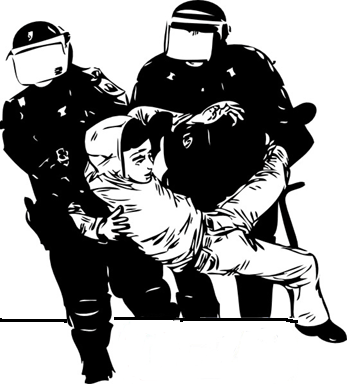 CRACKDOWN IN RUSSIA: CRITICS ACCUSE NUCLEAR AUTHORITIES OF SOVIET-STYLE COVER-UPS AND HEAVY-HANDED TACTICS, Newsweek, BY One thing that’s clear: The risks are growing for environmental and human rights activists who take on the powerful nuclear agency. Just ask Nadezhda Kutepova, 45, the head of a human rights organization that helped the victims of radiation pollution in and around Ozyorsk. “At first, I didn’t pay much attention to the reports about the radioactive pollution, but as soon as I heard that Rosatom had said everything was OK and that Mayak officials were denying an accident had taken place, I started to monitor the situation,” she tells Newsweek. “These are very cynical people.”
Kutepova was born in Ozyorsk in 1974. Her father worked at Mayak for 35 years and took part in the 1957 clean-up. He died of cancer in 1985, but the Soviet authorities never officially admitted that the illness was linked to his job. In 2007, after a long legal battle, Kutepova forced the government to recognize her father as a victim of occupational radiation sickness. Neither Kutepova nor her mother, however, received compensation.
Kutepova didn’t fight only for her family. She also tried to force Rosatom to pay for medical treatment for locals affected by illnesses related to decades of atomic pollution. In 2013, Kutepova discovered the first known case of third-generation radiation sickness in the region. The case involved a 6-year-old girl named Regina Khasanova who died of cancer. Medical experts said her death was caused by genetic mutations that resulted from the radiation her grandmother was exposed to during the 1957 clean-up at Mayak.
Two years later, Kutepova was forced to flee Russia after state TV accused her of trying to exploit the nuclear issue to foment revolution. Another report said she was attempting to destroy Russia’s nuclear deterrent on behalf of the United States. The purported evidence? Her human rights group received financing from the U.S. government–funded National Endowment for Democracy, which Russian officials have accused of seeking to topple Putin. (The NED says its aim is to promote worldwide democracy.) “We never covered up this funding,” Kutepova says. “We also received funds from organizations in Canada, Germany and the Netherlands.”
One of the televised reports even showed the door to Kutepova’s apartment, which caused her to fear for her safety. Kutepova and her four children now live in France, where she has political asylum…….http://www.newsweek.com/crackdown-russia-critics-accuse-nuclear-authorities-soviet-style-cover-ups-and-755389
My people are still suffering from Australia’s secret nuclear testing
 http://www.canberratimes.com.au/comment/my-people-are-still-suffering-from-australias-secret-nuclear-testing-20171208-h01a3l.html Sue Coleman-Haseldine,
My name is Sue Coleman-Haseldine. I was born into poverty on the margins of Australian society on the Aboriginal mission of Koonibba in 1951. At this time my people were not allowed to vote and we had very few means to be understood, let alone be heard.
I was born into one of the oldest living cultures known on Earth and into a place that I love – a dusty, arid paradise on the edge of a rugged coastline. Our land and waters are central to our outlook and religion and provide the basis for my people’s health and happiness.
And I was born just before the desert lands to our north were bombed by the deadliest weapons on Earth in an extensive, secretive and devastating manner by the Australian and British governments.
In the 1950s, areas known as Emu Fields and Maralinga were used to test nine full-scale atomic bombs and for 600 other nuclear tests, leaving the land highly radioactive. We weren’t on ground zero, but the dust didn’t stay in one place. The winds brought the poison to us and many others.
Aboriginal people, indeed many people at that time, knew nothing about the effects of radiation. We didn’t know the invisible killer was falling amongst us. Six decades on, my small town of Ceduna is being called the Cancer Capital of Australia. There are so many deaths in our region of various cancers. My grand-daughter and I have had our thyroids removed, and there are many others in our area with thyroid problems. Fertility issues appear common.
The impact of the Maralinga and Emu Fields testing has had far-reaching consequences that are still being felt today. Ask a young person from my area, “What do you think you will die from?” The answer is, “Cancer, everyone else is”.
I have lived my life learning about the bomb tests and also learning that the voice of my people and others won’t always be understood or heard. But I learnt from old people now gone that speaking up is important and by joining with others from many different places and backgrounds that our voices can be amplified.
Through these steps I found the International Campaign to Abolish Nuclear Weapons (ICAN), or perhaps ICAN found me.
ICAN – as an organisation, as a collective of passionate, educated people working for a clear goal – has been so important to me. To know that my story and my voice helps bring recognition to the past and can shape the future of nuclear prohibition has strengthened my resolve.
Being involved in ICAN has been a double-edged sword. On one hand and for the first time in my life, I no longer feel alone or isolated. I have met others from many parts of the globe who have similar stories and experiences and who are passionate advocates for a nuclear-free future.
But the flip side of this is my understanding of just how widespread and just how devastating the nuclear weapons legacy is across the globe. To learn that so many weapons still exist sends fear to my heart. ICAN is a worthy winner of the Nobel Peace Prize – in a short time we have gathered support for a treaty to finally outlaw nuclear weapons and help eliminate the nuclear threat.
The vision was reached in part with so many nations adopting the Treaty on the Prohibition of Nuclear Weapons in July 2017. And we should celebrate this win and the opportunity to work together to stop the suffering and assist countries to make amends to nuclear weapons victims by acknowledging the permanent damage done to land, health and culture.
Unfortunately, the Australian government, along with other first world nations, didn’t even participate in the treaty negotiations, and they haven’t signed the treaty yet, but over time we feel confident they will.
A lot has changed since I was born. Aboriginal people now have the right to vote in Australia, but still we battle for understanding about our culture and the Australian nuclear weapons legacy. My home is still remote and most of my people still poor. But we are also no longer alone. We have the means and the will to participate – to share and to learn and to bring about lasting change.
ICAN’s work is not done, our work is not done. We will continue to work together. A world without nuclear weapons is a world we need and are creating. I stand here in hope and gratitude for the opportunity to participate. I stand here with pride and I stand here for our future and the generations to come.
Sue Coleman-Haseldine is a Kokatha woman who lives in Ceduna, South Australia. This is an extract of her speech in Oslo marking the awarding of the Nobel Peace Prize to ICAN.
Aboriginal grandmother to testify on nuclear bomb test damage at Maralinga site, in Australia
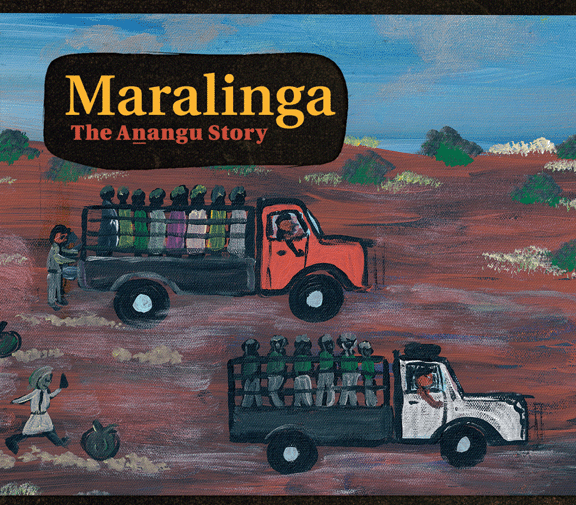 World spotlight shines on Maralinga horror, https://au.news.yahoo.com/a/38090548/world-spotlight-shines-on-maralinga-horror/ Lisa Martin, 30 Nov 17, Sue Coleman-Haseldine was a toddler crawling around in the dirt when the winds brought the black mist.
Her white nappies on the washing line were burnt.
It was in the 1950s when the British began testing nuclear weapons at Maralinga in the South Australian outback.
The legacy of the bombs dropped continues to haunt the 67-year-old Aboriginal grandmother. “We weren’t on ground zero at Maralinga, otherwise we would all be dead,” she told AAP. “I was born and grew up on a mission at Koonibba, but the winds came to us.”
Ceduna, the main township before the Nullarbor, is the cancer capital of Australia, Ms Coleman-Haseldine says. She’s had her thyroid removed and will be on medication for the rest of her life.
Her 15-year-old granddaughter is also battling thyroid cancer..
There are birth defects and cancers right across the community. “It’s changed our genes,” she said.”These diseases weren’t around before the bombs.”
On December 10, Ms Coleman-Haseldine will be in Oslo for the Noble Peace Prize award ceremony.
The International Campaign to Abolish Nuclear Weapons (ICAN) is being recognised for its work to achieve a treaty-based ban on nuclear weapons.
So far 122 countries have adopted the treaty, excluding Australia and countries with nuclear weapons – the US, UK, Russia, China, France, India, Pakistan, North Korea and Israel.
Only three countries have ratified the treaty and 50 are needed for it to become international law.
ICAN is a grassroots movement that began in Carlton, Melbourne more than a decade ago.
In Norway, Ms Coleman-Haseldine will tell the story of her people and their contaminated land.”You’ve got to keep the past alive to protect the future,” she said.
Ms Coleman-Haseldine hopes Australia will reverse its opposition and sign the treaty.
The Turnbull government has ruled that out but the Labor Party will debate the issue at its national conference next year.
Gaol for Australian anti-war protestors at USA’s secret base in theAustralian desert
An American Spy Base Hidden in Australia’s Outback, NYT The trials — and the Australian government’s uncompromising prosecution of the protesters — has put a spotlight on a facility that the United States would prefer remain in the shadows.

— Margaret Pestorius arrived at court last week in her wedding dress, a bright orange-and-cream creation painted with doves, peace signs and suns with faces. “It’s the colors of Easter, so I always think of it as being a resurrection dress,” said Ms. Pestorius, a 53-year-old antiwar activist and devout Catholic, who on Friday was convicted of trespassing at a top-secret military base operated by the United States and hidden in the Australian outback.
From the base, known as the Joint Defense Facility Pine Gap, the United States controls satellites that gather information used to pinpoint airstrikes around the world and target nuclear weapons, among other military and intelligence tasks, according to experts and leaked National Security Agency documents.

As a result, the facility, dotted with satellite dishes and isolated in the desert, has become a magnet for Australian antiwar protesters. ….Over the past two weeks, Ms. Pestorius and five other Christian demonstrators were convicted in two separate trials of breaching the site’s security perimeter last year. They could face seven years in prison……..
Born at the height of the Cold War, Pine Gap was presented to the Australian public in 1966 as a space research facility. But behind the scenes, the station was run by the C.I.A. to collect information from American spy satellites about the Soviet Union’s missile program……Photos taken from the air show a sprawling campus punctuated by white geodesic domes that look like giant golf balls. Inside these spheres, called radomes, are antenna systems that send and receive information from satellites in constant orbit above the earth…..Today, more than 800 people from both countries are believed to work at the base. But the United States is firmly in control.
“Pine Gap has changed and developed enormously,” said Richard Tanter, a senior research associate at the Nautilus Institute and honorary Melbourne University professor who has investigated and criticized the base for years.
In documents leaked by Edward Snowden, the American intelligence contractor turned whistle-blower, Pine Gap is described as playing “a significant role in supporting both intelligence activities and military operations What that actually means, Professor Tanter said, is that the station is involved in real-time contributions to the United States’ global military operations in Afghanistan, Iraq and Syria.
Pine Gap, he added, also “contributes data for C.I.A. drone operations in countries in which the United States is not at war — Yemen, Somalia, Pakistan and so forth. It is also critically important in whatever the United States is going to do on the Korean Peninsula.”
Professor Tanter has gleaned information about the secret site from unexpected public records, including the LinkedIn profiles of Pine Gap contractors and satellite photos that reveal new construction at the site.
Professor Tanter, who is president of the Australian board of the International Campaign for the Abolition of Nuclear Weapons, said he wanted the government to “make a very clearheaded assessment” of whether it is in Australia’s best interest to contribute data for drone assassinations and targeting nuclear weapons..”….. Last year, in the early hours of a cold, dark September morning, Ms. Pestorius, Mr. Dowling and three other “peace pilgrims,” as they call themselves, breached Pine Gap’s security perimeter.
As the activists scrambled up a rocky hill to get closer to the base, and with the police moving in, Ms. Pestorius picked up her viola. Another protester strummed his guitar. As they played a lament for those killed in war, Mr. Dowling held up a large, laminated photograph showing a bloodied young woman with her foot missing.
A sixth activist, Paul Christie, 44, carried out his own protest at Pine Gap days later; he was tried separately and convicted last week, charged, like the others, with entering a prohibited area. During the activists’ back-to-back trials this month, a modest band of supporters gathered at the courthouse. Many were members of the country’s antiwar movement, parts of which are religion-infused.
A Quaker knitted flower brooches. A Buddhist brewed coffee from the back of his van. A collection of colorful banners tied to fences read “Close Pine Gap” and “End the U.S. Alliance and Pine Gap Terror Base.” Mr. Dowling, who said he had been arrested between 50 and 100 times, was found guilty once before of trespassing at Pine Gap, in 2005. The conviction was later overturned.
One of his co-defendants this time was his 20-year-old son Franz, the guitar player at the protest last year. The younger Mr. Dowling and two other defendants — Andrew Paine, 31, and Timothy Webb, 23 — live together in a Dorothy Day Catholic Worker House in Brisbane, where they regularly take in homeless people.
All five were found guilty of entering a prohibited area, and Mr. Paine was convicted of an additional charge of possessing a photographic device.
During their trial, the five — who acted as their own attorneys — tried to argue that they had acted in the defense of others, but Justice John Reeves did not allow it.
Pine Gap has “to bear a big responsibility for all the murder and mayhem that has taken place in Iraq and Afghanistan,” said Jim Dowling….. https://www.nytimes.com/2017/11/23/world/australia/pine-gap-spy-base-protests.html?smid=li-share
Hiroshima Survivor Setsuko Thurlow to accept Nobel Peace Prize
 Canadian who survived Hiroshima nuclear bomb to accept Nobel Peace Prize. This is her story http://nationalpost.com/news/world/canadian-who-survived-hiroshima-nuclear-bomb-to-accept-nobel-peace-prize-this-is-her-story
Hiroshima Survivor Setsuko Thurlow Recalls U.S. Bombing
‘We learned how to step over the dead bodies’: Setsuko Thurlow, 85, was 13 when she survived the attack. She has spent her life since campaigning against nuclear weapons Setsuko Thurlow will be in Oslo, Norway, on Dec. 10 to jointly accept the 2017 Nobel Peace Prize on behalf of this year’s laureate, the International Campaign to Abolish Nuclear Weapons (ICAN).
The 85-year-old Toronto resident is a Hibakusha — a survivor of the atomic attacks on Japan in 1945. Her hometown of Hiroshima was destroyed by the Americans on August 6, 1945.
Thurlow’s sister, burned and bloated from the blast, lived for four days afterwards. When she spoke, what she expressed was a mother’s guilt: Her child had been badly burned. How could she have let it happen?
“It’s not easy to carry these memories,” Thurlow says. “We learned how to step over the dead bodies.” She recalls feeling numb. She couldn’t cry. All she could do was watch, as Japanese soldiers tossed the lifeless bodies of her sister, Ayako, and her four-year-old nephew, Eiji, into a shallow grave, dousing them with gasoline, throwing in a match. Thurlow was 13.
She has spent much of her life since campaigning against nuclear weapons.
Her weapon is her words — and her resolve to keep telling the story. Thurlow sat down with the National Post at her home in Toronto.
HOW 5 PEOPLE SURVIVED NAGASAKI’S NUCLEAR HELL
 http://www.nationalgeographic.com.au/people/how-5-people-survived-nagasakis-nuclear-hell.aspx Three days after Hiroshima, an American B-29 dropped an atomic bomb on Nagasaki. A new book tells stories of those who lived through horror. on August 9, 1945, an American B-29 dropped an atomic bomb on the Japanese city of Nagasaki, obliterating much of it and killing 74,000 people, mostly civilians. It was only the second time in history an atomic bomb had been used as a weapon. BY SIMON WORRALL 14 SEPTEMBER 2017 In Nagasaki: Life After Nuclear War, Susan Southard follows the lives of five hibakusha (survivors) who escaped the firestorm and through extraordinary courage and resilience went on to live happy, fulfilled lives.
Speaking from her home in Arizona, she talks about the battle for the truth over what happened in Nagasaki; how square dancing helped heal the wounds of war; and why the survivors no longer harbour feelings of animosity towards Americans.
Yours is the first book to tell this story. Why has it taken so long?
“Some people may know about Hiroshima, but they don’t know about Nagasaki. They say, “Oh, there was a second bombing?” Many people also don’t know that people survived the bombings.
One of the reasons is that the bombs were kept top secret. Very few military leaders knew they existed, except for the people who were creating the bombs and those directly overseeing them. After the bombs were dropped, several factors, both in the U.S. and Japan, contributed to people not knowing the effects.
One was direct denial of any radiation effects by key U.S. military leaders like General Leslie Groves, General Thomas Farrell and the U.S. War Department. During the U.S. occupation of Japan, which lasted from 1945 to 1952, General Douglas MacArthur also instituted a strict press code banning “false or destructive criticism” of the Allied powers out of concern that too much anger could put the thousands of U.S. troops in Japan at risk.
General Groves and others promoted the idea that the Japanese were using the effects of the bomb as anti-American propaganda. So, the people of Japan, other than the people in the cities directly affected, didn’t know for years what was happening in their own country. There was medical censorship as well. Physicians working with the survivors weren’t allowed to publish studies or findings of what was happening.
They also didn’t want the decision to use the bombs to be challenged in the U.S., by books like John Hersey’s Hiroshima. So President Truman and the Secretary of War, Henry Stimson, made a concerted effort to publish articles justifying the use of the bombs, excluding any information about what happened to the people beneath the atomic clouds.
The justifications were so airtight that they became the dominant way of perceiving the decision to use the bombs on Japan: that the two bombs ended the war and saved a million American lives.”
What made you want to write this book?
“It has deep roots in my life. In high school, I spent a year as an exchange student in Japan and happened to go on a field trip to the southern island of Kyushu, where I visited the Nagasaki Atomic Bomb Museum. I stood next to my Japanese classmates as the only American and observed the destruction.
But the key event came in 1986, when one of the Nagasaki survivors, Taniguchi Sumiteru, who was 57 years old by then, came to Washington on a speaking tour. I went to hear him speak, then, through a series of unexpected events, his interpreter became unable to complete the last few days of his time in Washington, and I became his interpreter.
In between his presentations we spent hours together. I got to ask him questions and tried to grasp what his experience had been like; it was truly a horrific experience. His entire back had been burned off. From that time on I couldn’t get out of my mind what it would be like to have survived nuclear war.”
Explain the term “hypocenter” and describe the destructive power of the blast in relation to it.
“Contrary to what some of us might imagine, the bomb did not explode on the ground but about one-third of a mile above ground. The purpose was to maximize the blast force and the effect of the heat on the city because the blast and the heat would travel further.
The area directly beneath the blast is called the “hypocenter.” The heat on the ground directly below it was about 5,000 to 7,000 degrees Fahrenheit. For quite a long distance, buildings were pulverized and trees, plants, and animals were blown away or carbonized. It’s an unimaginable level of instantaneous destruction.”
You recount the stories of five survivors. I want to focus on two of them: Do-oh Mineko and Taniguchi. Where were they at the moment of impact and what happened to them?
“Taniguchi was 16 years old at the time. He was delivering mail in the northwestern part of the valley on his bicycle. He was facing away from the blast a little over a mile away. He was thrown off his bicycle and although he didn’t know it at the time, because he was in a daze, his entire back was burned off. He also had severe burns on his arms and legs.
The earth was shaking but he was able to stand up. He gathered the mail he could still see. All the children that had been playing around him were dead. He wandered to a factory and some men carried him to a hillside where they laid him on his stomach. He lay there for two nights, dipping in and out of consciousness, while his grandfather searched for him.
Do-oh was about three-fourths of a mile from the hypocenter, inside a Mitsubishi torpedo factory. The massive steel and concrete Mitsubishi factory collapsed on top of her and thousands of others. Remarkably, she was able to get up. She had a big gash in the back of her neck and was desperate to escape because fires were beginning to flare around her. She had to step over dead bodies to get to an embankment, where her father found her.”
Tanaguchi’s ordeal is of almost biblical proportions. Tell us about his first few years after the bombing.
“There were no hospitals or medical supplies in Nagasaki, so he was taken to a village outside Nagasaki with his grandfather and cared for in a very basic way for three months. He was finally taken to a naval hospital in Omura, 22 miles north of Nagasaki, where he finally began to get proper medical care.
He lay on his stomach in extraordinary agony for three years. As he wasn’t able to lie on his sides or his back, he got incredibly deep bedsores—so deep, that the doctors could see his internal organs, including his heart beating. He was finally released from the hospital on March 20, 1949, when he was 20 years old.”
One of the more bizarre actions taken by the Americans after the bombing was to introduce square dancing. What was that all about?
“It’s so crazy! And quite lovely in the end. It began in Nagasaki. The people assigned to lead the occupation efforts in Nagasaki were very sympathetic toward the suffering of the survivors and tried to find ways to help them. One night, the civilian education officer for the U.S. occupation in Nagasaki, Winfield Niblo, was at a dinner party with Japanese educators.
Afterwards, there was a presentation of Japanese folk dancing. Niblo decided to present some American square dancing to add to the festivities. It caught on nationally to become a post-war American contribution to Japanese life.”
One of the things that shocked me was the extent to which the hibakusha werediscriminated against and mocked by their fellow Japanese. They were even called “tempura face.”
“It was surprising to me as well. The children were made fun of and laughed at. Those who were disfigured, even after the economy recovered a decade later, had trouble getting jobs. Even those who had no physical disfigurement often kept their status as a hibakusha quiet. It made it difficult to get a job and their marriage prospects were almost completely eliminated. Anyone who found out they were hibakusha was afraid of the genetic effects that radiation would have on their children. Many of them married other hibakusha.”
It took many years for the survivors to tell their stories. Why was it so difficult for them to go public and what changed their minds?
“Recovering from nuclear war is a very long process—healthwise, psychologically and economically. Some lost every member of their family and all their friends. The survivors I write about were all in their teen years at the time of the bombing. It was something so extremely painful that they didn’t want to revisit it.
The people who did decide to speak out, including the five survivors I feature in my book, had very personal reasons. One told me that as he held his first granddaughter in his arms, he had a flashback of a baby’s charred body that he had to step over as he was helping in the relief effort. He suddenly realized I have to do something about this, I don’t want my beautiful granddaughter to ever experience what I experienced.
Together, he and other hibakusha are fighting to ensure that Nagasaki will be the last city to be destroyed by an atomic bomb.”
How did the survivors feel towards the United States?
“Each survivor is different. Two I know well had a lot of anger towards the U.S. for dropping the bomb and causing this suffering. Others were so preoccupied with survival and grief and trying to deal with the medical implications that they didn’t think about the Americans too much. They just had to survive. The five I know well no longer feel negatively toward Americans. They accept that it was the governments and militaries of each nation that waged war, not individuals.”
Do-oh’s story has a remarkable happy ending. Tell us about her afterlife in Tokyo.
“Do-oh lost all her hair after the bomb. It didn’t grow back for 10 years, so she remained in her house until she was 25 years old. Her father said she had to learn how to support herself as an adult.
Before the war, she had dreamed of being in fashion so she got a part time job in Nagasaki in a cosmetics shop and was eventually offered a job in Tokyo with that same company. Against her parents’ wishes and cultural norms, she went on her own to Tokyo and began a new life. She worked fiercely and over time rose in the ranks to become a Senior VP of Utena, one of Japan’s leading cosmetics companies. It was unheard of at that time for a woman to have such a high executive position with a corporation.
She then returned to Nagasaki for retirement. She was an artist and poet as well, and she created this beautiful work of art, with green stems and a purple flowering iris. In Japanese writing from the top right, down, she says, “Thank you for a good life.”
How did the time you spent with these survivors change your life, Susan?
“It expanded my appreciation of human courage, resilience and strength. I also learned to appreciate the complexity of political and military actions and decisions, the consequences of those decisions, and how we respond and react to them.
I’ve been changed very profoundly by getting to know these people and being allowed to know the many difficult, intimate moments of their lives, which were split in half by nuclear war.”
One woman’s story of the horrific Hiroshima nuclear bombing

A Hiroshima survivor’s apocalyptic tale underscores Japanese abhorrence for the Bomb, Straits Times, Ravi Velloor, Associate Editor, 9 Sept 17 “……Mrs Yoshiko Kajimoto, now a sprightly 86, experienced the blast first-hand. She knows something of wars: She had just entered secondary school when the Second Sino-Japanese War broke out and in the sixth grade when the Pacific War, as Japanese call World War II, broke out. And she was in the 9th grade when the bomb arrived.
Middle school kids were mobilised for the war effort. For this reason, she was in a factory making propeller parts, 2.5km from the blast centre when the moment came.
“It was a clear day without the trace of a cloud,” she said, hands and voice steady as she recounted the trauma. “It had been warm since early morning and there were no warnings of an air raid.”
Then, a flash of light.
“The faces of my parents and my grandfather passed before my eyes and I thought I was dead. It was as though Earth had exploded.”
As she had been trained to do, Mrs Kajimoto pressed her fingers to her eyes to prevent them from falling out of their sockets, as the shock wave arrived moments later, meanwhile trying to scramble to safety under the machines.
“My body was lifted up and I passed out of consciousness. When I came to, my friend, stuck under a machine was whimpering: ‘Help me, Mother. Help me, Teacher!’ My shoulders and legs were trapped. I shook my head and the ash fell from my mouth. The flesh had been ripped off my bones. The factory roof had collapsed. I knew I was alive only because of the pain. People had gone insane. In the distance, I heard someone wail: ‘Hiroshima is gone’.”
Mrs Kajimoto tore off her blouse to put a tourniquet on her bleeding friend, and used her school headband to fasten it further. Around her was a scene so ghoulish that it was worse than the worst nightmares.
People had their nails ripped out, faces had puffed up like balloons, lips had turned inside out. A fellow student approached her, one hand holding a nearly torn-off arm. Suddenly, she knelt before her, and slumped to the ground, dead.
Fires raged everywhere. A mother holding a dead baby was spinning around, insanely.
Then, incredibly, the 14-year-old felt fear leave her as she stepped over bodies and on shiny skin as she helped carry friends to nearby Oshiba Park.
Then, the cremations started and a foul smell spread through the city. There were maggots everywhere, including on her own body.
On the third day, she heard her own neighbourhood was safe, and she staggered towards her home, meeting her father along the way. He had gone to the factory and turned over each body as he looked for her. Seeing her, he broke down and extracted a ball of rice he had been carrying in his pocket as a good luck charm.
For the next few weeks, she was bed-ridden, her grandmother removing maggots from her body with chopsticks.
Two months later, a doctor arrived to remove glass shards from her body. A year and a half later, the father died vomiting blood.
“He had probably been affected by the radiation from walking three days in the city,” she said. “Those days there was no concept of radiation, because it is colourless and odourless.”
Mrs Kajimoto herself suffered gastric cancer in later years and had two-thirds of her stomach removed.
Then peace arrived, and so did poverty. She had to provide for three brothers and food was frequently short.
“For the dead it was hell. For the survivors it was hell too.”
Mrs Kajimoto’s husband died 17 years ago, and she has two daughters, eight grandkids and two great grandchildren. Her fortunes have improved but for five decades, she said, she didn’t want to talk about her experience, until a grandson convinced her she must tell her story. That’s how I got to hear of it.
“I do not ask for disarmament, but I demand abolition of nuclear weapons,” she told me. “Nuclear weapons are an absolute evil and cannot exist with human beings. I do not want Hiroshima, or Nagasaki, to be repeated anywhere.”
“Am I concerned over the North Korean situation? Of course, I am. And I believe, that is the sentiment with the young as well. I say that Prime Minister Shinzo Abe should visit North Korea (for talks) even at the risk of his life.”
Is this point of view limited to the few thousands still around who saw the curse of Hiroshima? Not hardly. After a week in Japan, I’d say that there are millions who share the same view.
Japan has all the technology in place to build a nuclear arsenal. From the moment a decision is taken to having ready bombs will probably take a few weeks, no more. But it will be a brave Japanese prime minister who orders those final turns of the screws for Japan’s first atomic bomb. http://www.straitstimes.com/opinion/a-hiroshima-survivors-apocalyptic-tale-underscores-japanese-abhorrence-for-the-bomb
Death of Sumiteru Taniguchi, Nagasaki Survivor and Nuclear Arms Foe
 he gave a speech at the United Nations in New York during a meeting to consider a nonproliferation treaty.
A month before he died, the United Nations adopted the Treaty on the Prohibition of Nuclear Weapons.
“He played a tremendous role,” said Terumi Tanaka, secretary general of the Japan Confederation of A- and H-Bomb Sufferers Organizations. “But unless all countries sign the treaty, there is no guarantee that nuclear weapons will disappear.”
Sumiteru Taniguchi, Nagasaki Survivor and Nuclear Arms Foe, Dies at 88 Hisako Ueno, Makiko Inoue and Kaho Futagami contributed research.AUG. 31, 2017 TOKYO — Sumiteru Taniguchi, who survived the atomic bombing of Nagasaki as a teenager and went on to become a leading advocate for nuclear disarmament, died on Wednesday in Nagasaki. Overcoming a lifetime of debilitating pain and radiation-related illnesses, he lived to 88.
Never again – new Hibakusha victims – no nuclear weapons – Sueichi Kido
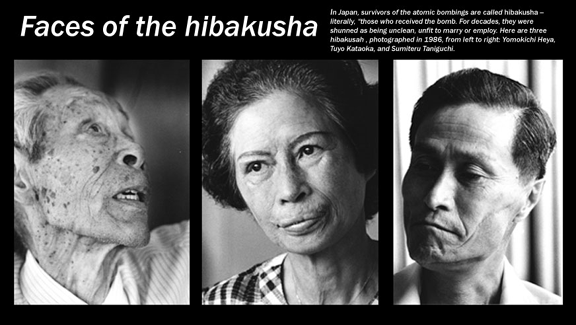 New head of A-bomb sufferers’ group strives for a world with no new hibakusha https://mainichi.jp/english/articles/20170812/p2a/00m/0na/025000c, August 13, 2017 (Mainichi Japan) “The dropping of an atomic bomb is an act decided by humans. Likewise, if humans decide to work together, we can eliminate nuclear weapons.” These were the words uttered by 77-year-old Sueichi Kido, who took over from Terumi Tanaka, 85, in June, as secretary-general of the Japan Confederation of A- and H-Bomb Sufferers Organizations after Tanaka had served in the role for 20 years.
Kido, himself an atomic bomb survivor (hibakusha), was just 5 years old when the atomic bomb was dropped on the city of Nagasaki. He was about 2 kilometers away from the hypocenter, and suffered burns to his face and upper body as a result.
The existence of hibakusha such as Kido became widely known once the press code that was in place during the Allied Occupation after World War II was lifted. He soon began to realize that he himself was a hibakusha. However, fearing discrimination, he decided not to tell people around him.
Twenty-five years after the atomic bomb was dropped on Nagasaki, Kido’s father died after bleeding from his eyes, nose and gums. Before Kido got married, he told his wife that he was a hibakusha. His wife’s older brother opposed the marriage and refused to attend the wedding.
In 1990, he attended a meeting in Gifu Prefecture aimed toward providing consultations for hibakusha, and the following year, he decided to set up a hibakusha group in the same prefecture. He came to feel that it was his duty as a hibakusha “to put his life on the line and strive toward making sure there are no more hibakusha in the future.”
In July this year, a historic treaty banning nuclear weapons was adopted — something hibakusha had wanted to see for many years. Nuclear nations and Japan are critical of the treaty, but Kido says, “There is no justice in the theory of nuclear deterrence. Nuclear nations and Japan are obviously being driven into a corner.”
To date, the Japan Confederation of A- and H-Bomb Sufferers Organizations has demanded that a clause on government compensation to people who have suffered from atomic bombs be inserted in the Atomic Bomb Survivors’ Assistance Act. As the new secretary-general of the confederation, Kido is striving toward achieving this goal.
“This clause isn’t just about atonement for the past. It is necessary in order to ensure that there are no more wars or damage involving nuclear weapons in the future,” Kido says.
1 This Month
To see nuclear-related stories in greater depth and intensity – go to https://nuclearinformation.wordpress.com/
12 February – Webinar The Big Push: New Nuclear Projects in Canada

Thursday, February 12, 7 pm Eastern | 2nd of 4 sessions in the 2026 Nuclear Waste Online webinar series
Join a webinar on the push for new nuclear generation in Canada. Go to Northwatch.org to register or use the registration link https://us02web.zoom.us/webinar/register/WN_ZfWOf1GITqSRIZX8CB-A9w
-
Archives
- February 2026 (127)
- January 2026 (308)
- December 2025 (358)
- November 2025 (359)
- October 2025 (376)
- September 2025 (258)
- August 2025 (319)
- July 2025 (230)
- June 2025 (348)
- May 2025 (261)
- April 2025 (305)
- March 2025 (319)
-
Categories
- 1
- 1 NUCLEAR ISSUES
- business and costs
- climate change
- culture and arts
- ENERGY
- environment
- health
- history
- indigenous issues
- Legal
- marketing of nuclear
- media
- opposition to nuclear
- PERSONAL STORIES
- politics
- politics international
- Religion and ethics
- safety
- secrets,lies and civil liberties
- spinbuster
- technology
- Uranium
- wastes
- weapons and war
- Women
- 2 WORLD
- ACTION
- AFRICA
- Atrocities
- AUSTRALIA
- Christina's notes
- Christina's themes
- culture and arts
- Events
- Fuk 2022
- Fuk 2023
- Fukushima 2017
- Fukushima 2018
- fukushima 2019
- Fukushima 2020
- Fukushima 2021
- general
- global warming
- Humour (God we need it)
- Nuclear
- RARE EARTHS
- Reference
- resources – print
- Resources -audiovicual
- Weekly Newsletter
- World
- World Nuclear
- YouTube
-
RSS
Entries RSS
Comments RSS
 nuclear-news