The Growing Dangers of the New Nuclear-Arms Race, The Trump Administration’s push for more nuclear weapons is part of a perilous global drive to miniaturize and modernize devices that already promise annihilation. New Yorker, By Eric Schlosser, 24 May 18, “…….On the morning of August 6, 1945, Setsuko Thurlow, then thirteen years old, was preparing to decode messages on the second floor of the Army headquarters in Hiroshima. About twenty girls from her school worked beside her, and thousands of other middle schoolers were employed at patriotic tasks throughout the city as part of the Student Mobilization Program. Thurlow noticed a bright bluish-white flash outside the window at 8:15 a.m. She never saw the mushroom cloud; she was in it. She felt herself fly through the air, blacked out, and awoke pinned in the rubble of the collapsed building, unable to move. Lying there in silence and total darkness, she had a feeling of serenity. And then she heard the cries of classmates trapped nearby: “God, help me!,” “Mother, help me!” Someone touched her, removed the debris on top of her, and told her to crawl toward the light.
She somehow made it out safely and realized that what was left of the headquarters was on fire. A half dozen or so other girls survived, but the rest were burned alive.
The smoke and dust in the air made the morning look like twilight. As Thurlow and a few classmates left the city center and walked toward the hills, they witnessed one grotesque scene after another: dead bodies; ghostly figures, naked and burned, wandering the streets; parents desperately searching for lost children. She reached an Army training ground in the foothills, about the size of two football fields. Every inch of ground was covered with wounded people begging for water. There seemed to be no doctors, no nurses, no medical help of any kind. Thurlow tore off strips of her clothing, dipped them in a nearby stream, and spent the day squeezing drops of water from them into the mouths of the sick and dying. At night, she sat on the hillside and watched Hiroshima burn.
Thurlow was reunited with her parents. But her sister and her sister’s four-year-old son died several days later. Her sister’s face had grown so blackened and swollen that she could only be recognized by her voice and her hairpin. Soldiers threw her body and that of her son into a ditch, poured gasoline on them, and set them on fire. Thurlow stood and watched, in a state of shock, without shedding a tear. Her favorite aunt and uncle, who lived in the suburbs outside Hiroshima and appeared completely unharmed, died from radiation poisoning a few weeks after the blast.
More than seven decades later on the afternoon of December 10, 2017, I watched Thurlow accept the Nobel Peace Prize on behalf of the International Campaign to Abolish Nuclear Weapons (ican). It was a remarkable moment, as she slowly walked to the podium with a cane, and the crowd in Oslo’s City Hall gave a standing ovation. After the bombing, Thurlow attended universities in Hiroshima and Lynchburg, Virginia. Later, she earned a master’s degree in social work at the University of Toronto. She married a historian and settled in Canada. She began her anti-nuclear activism in 1954, and became a leading advocate for survivors of the atomic bombings, known as the hibakusha. A few years ago, I spent time with her in Stockholm, meeting with academics and legislators to discuss the nuclear threat. In her early eighties, she was sharp, passionate, tireless, and free of bitterness. “Today, I want you to feel in this hall the presence of all those who perished in Hiroshima and Nagasaki . . . a great cloud of a quarter of a million souls,” Thurlow said in her Nobel speech. “Each person had a name. Each person was loved by someone. Let us insure that their deaths were not in vain.”………..https://www.newyorker.com/news/news-desk/the-growing-dangers-of-the-new-nuclear-arms-race
(Mainichi Japan) HIROSHIMA — In a room filled with the gentle spring sunshine at the city hall in the Nishi Ward of this city in the beginning of April, 93-year-old Sunao Tsuboi met Mayor Kazumi Matsui with a smile.
For his work campaigning for the abolition of nuclear weapons and support for other survivors of the 1945 U.S. atomic bombings, or “hibakusha,” Tsuboi was recognized as an honorary resident of Hiroshima in March, and on April 5, 2018, went to formally receive the title from Mayor Matsui at the municipal government.
“While my time left on Earth may be short, I will continue to be true to my name and ‘honestly’ work toward making a peaceful world with everyone until I burn up from my ardent passion,” said Tsuboi, whose given name is a homonym for “honesty” in Japanese. He made his fiery declaration with a mischievous expression after the medal with its green and white ribbon was draped around his neck. The audience then burst into applause…….. https://mainichi.jp/english/articles/20180515/p2a/00m/0na/017000c
FT 15th May 2018 ,I wish I had known Serhii Plokhy was writing this book. I would have told
him why the Chernobyl disaster is an indelible part of my life. When the
nuclear plant’s fourth reactor exploded in the early hours of Saturday,
April 26 1986, I was 130km away in Kiev. A Moscow-based reporter for
Reuters news agency, I was spending the weekend in the Ukrainian capital
with a friend who taught at Kiev university under a British Council
programme.
Like almost all the city’s 2.5m residents, we knew nothing about
the accident, the world’s worst nuclear disaster. Until the evening of
Monday April 28, the Kremlin held to its unforgivable decision to keep
Soviet citizens and the world in complete darkness. All that time,
radiation was spreading far beyond the stricken reactor. For the first few
days, the strongest winds blew to the north-west, so anyone in Kiev – which
is south of Chernobyl – got off relatively lightly.
However, when I returned to Moscow and underwent a radiation check at the US embassy, the
Geiger counter went beep-beep-beep, registering abnormal levels on my
clothes. Before my eyes an embassy official tossed my jeans into an
incinerator. Plokhy, a Harvard professor of Ukrainian background, is
ideally placed to tell the harrowing story of Chernobyl. He is the first
western-based historian to make extensive use of Chernobyl-related material
in Communist party, government and, especially, KGB security police
archives that became available after Ukraine’s 2014 pro-democracy
revolution. https://www.ft.com/content/f7101e6a-4eeb-11e8-9471-a083af05aea7
Why do we desperately need to listen to voices from the heart?
The corporate dominated world does not like to hear voices from the heart. Oh no, there must be no emotion. We must all stick to technical jargon, statistics, the “accepted” facts, in appropriately respectable academic language.
Of course statistics, facts, and technical language have their place in the nuclear-free movement. But as long as the anti-nuclear voices remain boring, the corporate global empires do not need to worry.
This voice came as a comment today on our sister ship antinuclear.net
Jan – Janotine@asia.com– 6 May 18-My grandad was half kiowa. His father married a native american lady, to expand his spread. She was his last wife. The other two died in child-birth. All, so he could have more slave kids to work his spread. May grandad ran away from home at age 12.
I am a westerner. I used to think the west was so grand! My family is from the west. Places like Utah, Arizona, Nevada, New Mexico, Washington, Oregon, Idaho, and yes parts of California.
Later, i realized, our frikin government, used the west as a sacrifice zone for open air nuclear bomb testing, biological and chemical warfare testing, uranium mining and processing, nuclear bomb testing.
I have been to every native nation in the west and, most in Alaska as a professional. No sane person thinks the anglos did the west any favors!
People ask me if natives or, even anglos are better off from the europeans coming in and taking america. The anglos used their rascist-Monroe Doctrine, as an excuse for the environmental destruction and genocides of the once pristine, western United States!
In the end, is the west better off? Hell no! They ruined turtle island, and the whole northern hemisphere with their insanity!
Shockley was the dumnest, white rascist ever! He might have helped invent transisters, but the genetics of Europeans and Americans are forever ruined, by the white evil-war-monkey obession, with the magic rocks.
There are very few radionuclide toxicologists in the world because, of the nuclear cosa nostra. Radionuclides are a billion times more genotoxic, teratogenic, mutagenic, carcinogenic, than the most dangerous manmade-mutagenic, chemicals, like agent orange.
Anything factual about radionuclides is verboten! Environmental health professionals, are pariahs in the war-monging, capitalist-paradigm. Health physics is nuclearist propaganda. Superior Northern-European culture and technology, is a sick-cosmic-joke.
The northern europeans culture, with it’s insane blood-lust and psychopathy, has made Europeans genetically inferior and, That’s a Fact Jack! That is the cruel irony
Two Long Island sisters who were exposed to radiation at Chernobyl in 1986 are urging others exposed to get checked for various types of cancer.
In 1986, Rebecca Sanders and Jennifer Fogarty were in western Germany with their father, who was in the military when Chernobyl exploded. Both were exposed to radiation.
The sisters want to get the word out that those who were exposed to radiation in 1986 should still be checked.
Sanders is now fighting stage 4 bladder cancer and Fogarty has thyroid disease.
Fogarty says that the military did not alert people who lived there at the time of the accident.
“They did not tell us anything for 10 days, and then after that it was martial law for 30 days where we had to stay inside. We could still go to school, and then after the 30 days, we were cleared to be outside and we were told we would be OK and we’re not,” says Sanders.
Fogarty says she and her sister want everyone to know that if they were in western Europe in 1986 when Chernobyl exploded, they are at very high risk of thyroid and or bladder cancer. She says that both are curable, but people need to get checked and treated.
Fogarty says there are many studies done in Germany that show a link between the Chernobyl incident and people getting sick.
Thursday marks the 32nd anniversary of Chernobyl, the world’s worst nuclear accident.
Saruhashi, born in Tokyo in 1920, lived through World War II as a young adult. Global events undoubtedly shaped her field of research.
Katsuko Saruhashi’s pioneering work
After graduating from Toho University (formerly the Imperial Women’s College of Science) in 1943, she went on to study carbon dioxide in ocean water at the Meteorological Research Institute. In 1957, she became the first woman in Japan to earn her PhD in chemistry from the University of Tokyo.
Few researchers were interested in studying carbon-dioxide levels in water when Saruhashi embarked on her work, which ended up being instrumental for decades. She penned the formula that would allow scientists to determine the amount of carbonic acid in oceans—now one of the hallmark measures of climate change—by hand. Now, researchers use computers for that task.
Saruhashi also studied the amount of radioactive isotopes of elements in seawater following nuclear- bomb test detonations. Working at the Central Meteorological Observatory, she found that tiny radioactive particles floating in the ocean waters along the coast of Japan resulting from the 67 nuclear explosions the US detonated in the Marshall Islands. “There was a controversy over her argument that the radioactive fallout in seawater was more than what they used to think,” Toshihiro Higuchi, a historian at Georgetown University, told the Verge.
Scientists at the US Atomic Energy Commission quickly became interested in her work, and invited Saruhashi to work at the Scripps Institution of Oceanography at UC San Diego to compare US methods of measuring these radioactive isotopes to those used by the Japanese. It wasn’t entirely a friendly working environment: One of her American male colleagues, Theodore Folsom, told her that there was no need for her to come into the office daily, and that instead she should work out of an isolated wooden hut (pdf, p. 4).
Nevertheless, Saruhashi persisted. Her analyses of radioactive isotopes were essentially identical to Folsom’s, despite her inferior working conditions.
Saruhashi became a beacon for women in science
Saruhashi became an advocate for her fellow female scientists and for world peace. In 1958, she co-founded Society of Japanese Women Scientists, and in 1981 established a prize in her name awarded annually to young Japanese female scientists for their excellence in research and mentorship. In 1980, she became the first woman elected to the Science Council of Japan, and went on to receive the Miyake Prize for geochemistry and the Tanaka Prize from the Society of Sea Water Sciences.
She died in September 2007, and her legacy as a scientist, pacifist, and feminist lives on. “I wanted to highlight the capabilities of women scientists,” she said. “Until now, those capabilities have been secret, under the surface.”
NGO Safecast co-founder Pieter Franken explains to schoolgirls how to assemble a Geiger counter kit in their classroom in Koriyama City, Fukushima Prefecture.
Tracking Fukushima’s radiation , https://www.shine.cn/feature/lifestyle/1803181780/Source: AFP Editor: Fu RongBeneath the elegant curves of the roof on the Seirinji Buddhist temple in Japan’s Fukushima region hangs an unlikely adornment: a Geiger counter collecting real-time radiation readings.
The machine is sending data to Safecast, an NGO born after the March 2011 Fukushima nuclear disaster that says it has now built the world’s largest radiation dataset, thanks to the efforts of citizen scientists like Seirinji’s priest Sadamaru Okano.
Like many, Okano lost faith in the government after the nuclear meltdown seven years ago.
“The government didn’t tell us the truth, they didn’t tell us the true measures,” he said.
Okano was in a better position than most to doubt the government line, having developed an amateur interest in nuclear technology 20 years earlier after the Chernobyl disaster. To the bemusement of friends and family, he started measuring local radiation levels in 2007.
“The readings were so high, 50 times higher than natural radiation,” he said of the post-disaster data. “I was amazed. The news told us there was nothing, the administration was telling us there was nothing to worry about.”
That dearth of trustworthy information was the genesis of Safecast, said co-founder Pieter Franken, who was in Tokyo with his family when disaster hit. Franken and friends had the idea of gathering data by attaching Geiger counters to cars and driving around.
“Like how Google does Street View, we could do something for radiation in the same way,” he said. “The only problem was that the system to do that didn’t exist and the only way to solve that problem was to go and build it ourselves. So that’s what we did.”
Within a week, the group had a prototype and got readings that suggested the 20-kilometer exclusion zone declared around the Fukushima plant had no basis in the data, Franken said.
“Evacuees were sent from areas with lower radiation to areas with higher radiation” in some cases, he said.
The zone was eventually redrawn, but for many local residents it was too late to restore trust in the government.
Okano evacuated his mother, wife and son while he stayed with his flock.
A year later, based on his own readings and after decontamination efforts, he brought them back. He learned about Safecast’s efforts and in 2013 installed one of their static counters on his temple.
“I told them: ‘We are measuring the radiation on a daily basis… so if you access the (Safecast) website you can choose (if you think) it’s safe or not’.”
Norio Watanabe has been a Safecast volunteer since 2011. In the days after the disaster evacuees flocked to Koriyama, which was outside the evacuation zone. He assumed his town was safe.
He sent his children away, but stayed behind to look after his mother, a decision he believes may have contributed to his 2015 diagnosis of thyroid cancer.
“As a scientist, I think the chance that it was caused by the Fukushima accident might be 50-50, but in my heart, I think it was likely the cause,” he said.
His thyroid was removed and is now healthy, but Watanabe worries about his students, who he fears “will carry risk with them for the rest of their lives.”
“If there are no people like me who continue to monitor the levels, it will be forgotten.”
Safecast now has around 3,000 devices worldwide and data from 90 countries. Its counters come as a kit that volunteers can buy through third parties and assemble at home.
This month marks the seventh anniversary of the triple disaster that hit the east coast of Japan on March 11, 2011, when a 9.1 magnitude quake and tsunami led to a meltdown at the Fukushima Daiichi Nuclear Power Plant. Almost 16,000 people were declared dead.
While the nuclear disaster is becoming a distant memory for most Japanese, for some others it is their everyday reality. Nuclear refugees and evacuees face discrimination, separation from loved ones, and in some cases, they are even forced to return to the former evacuation zone.
The government, worried about people getting exposed to radiation, declared a 20-km evacuation zone around the plant and uprooted close to 165,000 people. As of today, there are still 50,000 people who haven’t returned to Fukushima.
Keiko Owada, 66, is one of them. When I meet her in Tokyo, she refers to the Japanese capital as her home for the past seven years. That will soon change due to the government’s decision to withdraw her free housing subsidies.
Because decontamination work has made progress and food declared safe from radiation, it has been deemed safe to return to most villages within the evacuation zone. The same goes for Owada’s village Naraha, where the evacuation order was lifted two years ago.
Owada is not excited about the prospect of returning to Naraha. “Would I continue to get financial support for my apartment here in Tokyo, I would have stayed here, yes. I’ll tell you why: there is no hospital in Naraha, only a small hospital for first aid. There is no supermarket, only a small convenience store. And the reason is simple: only a few people have returned.”
Life as an evacuee hasn’t always been easy, Owada explains. “It wasn’t like people were treating me any different, but my neighbors never greeted me. I think it’s because of the compensation I received and the free housing. They knew I was from Fukushima, that’s why.”
According to Owada, some of the other evacuees in Tokyo she knows have faced harsher treatment. “I know of others whose cars were damaged on purpose because they had a Fukushima license plate. That’s why I never parked my car in the middle of the parking lot, but always in a corner, so no one could see it.”
If anything, Owada’s story illustrates how many evacuees continued to live in fear. Displaced from their homes, dropped in a new community—the disaster is anything but over for them.
As an evacuee in Tokyo, Owada went back to Fukushima on numerous occasions. She can still recall her first time back in June 2011. The town of Naraha was still a no-go-area, and she and her family only had one hour to visit. “We wore protective clothes against radiation, with only a small plastic bag for gathering some personal belongings. We had too little time, and the bag was too little for our entire family. But I can remember the smell—[there were] rats everywhere and small animals’ feces.”
Of course, there are things she misses about her old town, like growing vegetables and fruits on her land. But it doesn’t take away the concerns she has about the dangers of radiation exposure, despite the government’s reassurance that it is safe to live there.
“Even though the streets and houses are decontaminated, they didn’t even touch with mountains and forests. Radiation hasn’t been cleaned everywhere. My house is right next to the mountains, so my house might get contaminated.”
Akiko Kamata, 66, still remembers how she was surprised by the alarm warning for a tsunami in her village of Odaka. When I meet her at a Tokyo café, she recalls how she sheltered in Fukushima the first few weeks after the disaster. “I still remember taking my first bath after 10 days, it felt so good.”
When Kamata got in touch with relatives living in other parts of Japan, she was shocked to hear one sister-in-law’s initial response. “After the disaster, I wanted to flee to Chiba [a prefecture next to Tokyo], my sister-in-law picked up the telephone and told me I didn’t have to come to their house. ‘You’re contaminated,’ she told me.”
Eventually she did manage to find a place in Chiba, the region she grew up in as a child. “People were nice to us in Chiba. But still I noticed some skepticism. After I asked the regional authorities for financial support their answer was, ‘No, people in Chiba are victims of the earthquake as well.’”
Kamata did receive a one-off compensation payment from TEPCO: 7 million yen per person, or just over $65,600. Her husband received a similar amount.
Although Kamata is thankful for the financial support, they have not been compensated for the loss of income from their family business in Odaka. “I’m thinking about calling in the help of an organization that specializes evacuees with these type of claims,” she says.
Kamata has decided not to return to Odaka. Her husband’s illness (he suffers from a nerve disease that makes him reliant on Kamata’s support) got worse during the evacuation. She fears that it might worsen if they move back to Fukushima.
As Kamata remembers what life was like back in Fukushima, she uses a handkerchief to wipe a tear from her cheek. She barely speaks to her friends anymore.
“The disaster divided our communities, both physically as well as mentally. People got separated. One friend of mine in Chiba is thinking about divorcing her husband. He wants her to come back to Fukushima, but she doesn’t want this. One reason is exposure to radiation, but there are more reasons, such as her child’s school and the fact that they’ve gotten used to life in Tokyo.”
There is one more story she would like to share, Kamata says while crying. “One friend of mine is a farmer in Odaka. She had 10 cows. They evacuated to Chiba just like me and couldn’t go back to Fukushima to feed the cows. Once they could return for the first time to check on the animals, only three of them were still alive. The others died from starvation, and they were all looking at the same direction—the road the farmers would come from to feed them.”
On the seventh anniversary of the 2011 earthquake, tsunami and Fukushima nuclear accident, our thoughts and deepest sympathies continue to be with the people of Japan.
Every one of the tens of thousands evacuees from the 2011 Fukushima Daiichi triple reactor meltdown has a story to tell.
In our latest radiation survey we had the privilege to hear the experience of Mrs Mizue Kanno. As we entered the exclusion zone of Namie, Ms Kanno told us of the events seven years ago that were to change her life, her family and those of thousands of others.
Mrs Kanno was a social worker in Futaba less than 10 km from the nuclear plant. Eventually she made her way home after the devastating earthquake, and over the next few days thousands of people were evacuated to her home district of Tsushima. Families moved into her home. But soon they were warned by men in gas masks and protective clothing to get out immediately. The radioactive fallout from the nuclear plant, about 32 km away, had deposited high levels of contamination in this mountainous area of Namie.
Mrs Kanno now lives in western Japan, many hundreds of kilometres from her home in Fukushima. While she is a victim of nuclear power, she isn’t passive observer – instead she’s a female activist determined to tell her story. She campaigns across the Kansai region against nuclear power and for renewable energy.
Like thousands of other evacuees, she has joined lawsuits filed against the Tokyo Electric Power Company (TEPCO), and the Japanese government. Already found guiltyin multiple court proceedings of being criminally negligent in failing to take measures to prevent the meltdown, TEPCO and the government can expect many more rulings against them.
Because of the support of Mrs Kanno and her friends and neighbours, Greenpeace has been able to conduct a wide ranging survey inside the exclusion zone of Namie, published in our report, Reflecting in Fukushima.
While our survey report is filled with microsieverts and millisieverts, it’s far more about the lives and the land of Mrs Kanno her family, friends and neighbours.
Measuring thousands of points around homes, forests and farmland, it’s clear that this is an area that should not be opened to the public for many decades. Yet the government opened a main artery, route 114, while we were working in Namie.
One consequence is that people are stopping off and visiting areas high in radiation. At one house, radiation hot spots were over 11 microsieverts per hour (μSv/h) at one meter, and 137μSv/hat 10 centimetres. These levels are thousands of times the background level before the nuclear accident, and mean you’d reach your recommended maximum annual exposure in six days.
Yet, two people were working 10 meters away from the hot spot with no dosimeters or protective clothing. Mrs Kanno and our radiation specialists explained the levels of contamination and why it was necessary to take precautions.
In one zone in Obori, we measured radiation that would expose a decontamination worker to the 1 mSv/y limit in just 10 working days. The whole area is contaminated to varying high levels that will remain a threat into next century. How could the government be thinking of opening this area as early as 2023? More importantly, why?
It’s actually simple and wholly cynical. The Japanese government is desperate to restart nuclear reactors. Today only three are operating. Having areas of Japan closed to human habitation because of radioactive contamination is a very major obstacle to the government’s ambitions to operate 30-35 nuclear reactors. It’s a constant reminder to the people of Japan of the risks and consequences of nuclear power.
Yet, there are signs of positive change. Last month a panel of experts established by the Foreign Minister called for a mass scaling up of renewables, and warned of the risks from depending on coal plants and nuclear power. The voices of Mrs Kanno, the other thousands of Fukushima evacuees and the majority of people in Japan, and their demand for a different energy future, will be heard.
Throughout our time in Namie, as we visited the highly contaminated area of Obori and Tsushima – quiet, remote areas of natural beauty – Mrs Kanno told us about the life and traditions of families who for generations had supported themselves by farming. Now all of them are displaced and scattered across Japan. Yet the government is failing to even acknowledge their rights under domestic and international human rights law.
This week, we will be traveling to Geneva with mothers who are evacuees from Fukushima to the United Nations Human Rights Council session on Japan. The Japanese government has been under pressure to stop its violations of the human rights of Fukushima evacuees. Last week it accepted all recommendations at the UN to respect the human rights of Fukushima citizens. This included the German government recommendation to restore to a maximum annual public exposure of 1 mSv. This global safety standard has been abandoned by the Abe government.
The government’s decision is important, but now they need to be implemented if they are genuine in their commitments to the United Nations. On the 16 March this year, Mrs Kanno and other evacuees and their lawyers will attend the Tokyo high court for a ruling on Fukushima against TEPCO and the Government. One of the evacuee mothers, Akiko Morimatsu, together with Greenpeace, on the same day will speak at the United Nations to challenge the Japanese government to now fully apply the UN recommendations.
While we will be thousands of kilometers apart, we will be with Mrs Kanno on her day in court in Tokyo and she will be with us in Geneva. The Fukushima nuclear disaster has shattered lives but it has also brought us together determined to prevent such a terrible event from ever happening again and to transition Japan to a secure and safe energy future based on renewables.
Kazue Suzuki is an Energy Campaigner at Greenpeace Japan and Shaun Burnie is a Senior Nuclear Specialist at Greenpeace Germany
Plagued by disease, ridiculed for their explanation: A TMI ‘survivors’ group is growing, York Daily Record, Joel Shannon, jshannon@ydr.com 12 Feb 18,
They’re battling health issues and grieving lost loved ones — and they are confident that there’s an explanation for their suffering. Nearly 4,000 people now call themselves “Three Mile Island Survivors” in a private Facebook group.
The group, started in Nov. 2016, believes that the partial meltdown of a TMI reactor on March 28, 1979, was far more dangerous than has been publicly acknowledged. They link the incident to myriad health issues they or loved ones have experienced. They say most people disagree with their belief.
“Most of (the group members) just want the truth,” group administrator Christine Layman said.
The truth as the “TMI survivors” see it: That the incidents of cancer, thyroid issues and other health problems they’ve experienced can be traced back in some way to the incident at TMI. ………
Layman says the group of “survivors” feel pressured to keep quiet about their beliefs, for fear of ridicule. She’s said her mental soundness has been questioned as the result of her opinion: Doctors have attributed her beliefs to anxiety and fear.
But she still believes: She says the truth is hiding in plain sight.
She sees herself as an example. She says her list of health issues has been unusually long: melanoma, fibromyalgia, thyroid problems, infertility and brain lesions. And she lived in the Strinestown area — a few miles from TMI — during the partial meltdown.
She remembers the evacuation, being told to throw a blanket over her four-year-old daughter’s head and drive away. Being told that it was safe to return days later.
She says since then, her daughter has had a scare with cancer. Her granddaughter has spina bifida.
………. She refuses to believe all that suffering can exist so close to the scene of the TMI incident and not be linked — somehow.
And some in the scientific community suggest the “survivors” may — may — be on to something that can be measured, although so far evidence for their claims is thin.
Speaking of the mainstream view that TMI caused no adverse effects, the study’s leader commented: “I’m always wary when people say ‘there’s nothing to see, here.”
Dr. David Goldenberg, a surgeon and thyroid researcher, who led the study after seeing anecdotal evidence for a connection, stopped short of saying that the accident “caused” the thyroid cancer, instead saying there’s a “possible correlation” between the accident and the cancer.
Decades ago they witnessed nuclear weapons tests in the South Pacific. Now some veterans hope new DNA testing will prove it was responsible for their subsequent ill health, which they say ruined their lives.
“It was awe-inspiring, like another sun hanging in the sky. The blast bowled people over. A few men were on the ground screaming.”
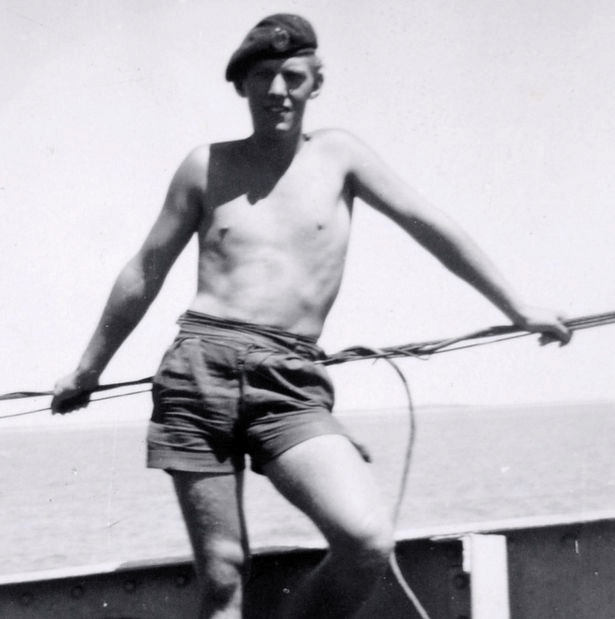
(Picture is not of Bob Fleming. It is of Gomer Hickman)
Bob Fleming was wearing a T-shirt, khaki shorts and flip flops when the bomb went off.
At just 24, he had just witnessed one of the most powerful weapons on earth detonate on Christmas Island in the Pacific Ocean.
It was 1956 and the Cold War threat was growing.
The RAF serviceman was one of around 22,000 British service personnel who witnessed nuclear weapons tests on mainland Australia, the Montebello Islands off Western Australia and Christmas Island in the South Pacific between 1952 and 1958.
With their backs to the bomb, they felt the intense heat from the explosion first.
Then, after the countdown, they were ordered to turn round and look directly at the huge mushroom cloud in front of them.
“We had no protective clothing,” said Bob, who’s from Downham Market in Norfolk.
“We were guinea pigs. It was so bright I could see the bones in my hands with my eyes closed. It was like an X-ray.”
‘Genetic curse’
The veterans say the nuclear tests ruined their lives, causing cancers, fertility problems and birth defects passed down the generations.
Now 83, the great-grandfather believes that three generations of his family are living with the “genetic curse” of those explosions. Sixteen out of 21 of his descendants have had birth defects or health problems.
His youngest daughter, Susanne Ward, has thyroid problems and severe breathing difficulties, and her teeth fell out prematurely.
“It just gets worse as the next generation comes along. Our grandchildren have similar problems,” Suzanne said.
“My dad blames himself, but it isn’t his fault.”
The Fleming family now hope new DNA testing could end decades of uncertainty.Last week, the UK’s first Centre for Health Effects of Radiological and Chemical Agents was launched at Brunel University in London.One of its projects is a three-year genetic study looking for any possible damage to the veterans’ DNA caused by the tests.
Blood samples will be taken from 50 veterans who were stationed at nuclear test sites, and compared with a control group of 50 veterans who served elsewhere.
Blood will also be taken from their wives and any children they have together.
Dr Rhona Anderson, who is leading the study, said a major question to answer is whether “there is a genetic legacy of taking part at these nuclear tests”.
“If no differences (in the DNA) are seen between test and control groups then this will be reassuring for the nuclear community.”
‘No valid evidence link’
Fewer than 3,000 nuclear veterans are still alive today.
They cannot volunteer for the study, as that might lead to bias in the results.
Veterans will be selected using military service records and information available about those who were most at risk of exposure to radiation.
The Ministry of Defence says it is grateful to Britain’s nuclear test veterans for their service, but maintains there is no valid evidence to link participation in these tests to ill health.
The UK is the only nuclear power to deny special recognition and compensation to its bomb test veterans.
The veterans took their case for compensation to the highest court in the land and lost in 2012.
The Supreme Court Justices said the veterans would face great difficulty proving a link between their illnesses and the tests.
In 2015 the Aged Veterans’ Fund was set up by the government using bank industry fines. It will help to fund a series of social and scientific projects.
Doug Hern, who’s 81, and his wife Sandie, from Lincolnshire have been campaigning tirelessly for years.
When Doug was 21 he saw five nuclear explosions on Christmas Island and has suffered ill health ever since.
He said is skeleton is “crumbling”. He has skin problems and bone spurs.
His daughter died, aged 13, from a cancer so rare it did not have a name. He believes this was a consequence of her inheriting his “corrupted genes”.
Sandie Hern is vice-chair of the British Nuclear Test Veterans’ Association (BNTVA)
“The veterans have been treated abominably. They’ve been forgotten. We need this research to see if anything can be done to help their children,” she said.
The overall aim of the new centre at Brunel is to work closely with the veteran community to improve their health and well-being in the future.
After years of personal suffering, the Flemings want to have their DNA tested and are waiting to hear if they have been selected.
Six decades on, nuclear families are still living in the aftermath of the bomb tests, and searching for answers.
The worker tested positive for inhalation of the potential lethal nuclear isotope of plutonium – a key ingredient to the production of nuclear bombs and warheads., KGW8 News: Susannah Frame, February 13, 2018 A Hanford worker directly impacted by safety failures at an extremely dangerous demolition project at the site has granted an interview to KING 5.
The worker tested positive for inhalation of the potential lethal nuclear isotope of plutonium – a key ingredient to the production of nuclear bombs and warheads.
“I’m pissed. I’m scared, like we all are, that sooner or later it’s going to bite me and I’m going to end up with cancer,” said the contaminated worker.
For fear of retaliation, the worker does not want to be identified. Eight months ago, on June 8, the person was one of hundreds working on the demolition of Hanford’s Plutonium Finishing Plant (PFP). The workers were told to ‘take cover’ as a ‘precaution’ because monitors detected radioactive plutonium particles could be in the air.
But the event ended up not being precautionary whatsoever. The contractor in charge of the demolition, CH2M Hill, had an enormous problem on its hands.
“It was complete chaos. It was a mess,” said the worker.
Indeed, radioactive particles had escaped and spread outside the demolition zone. Hundreds of workers were eventually tested. Thirty-one of them got bad news: They had inhaled or ingested plutonium, which emits alpha radiation, the worst kind of radiation to get inside your body.
“Plutonium will go to the bones and sit there for a long, long time,” said Dr. Erica Liebelt, a toxicologist and executive director, as well as medical director, of the Washington Poison Center.
“Your risks are lung cancer, liver cancer, and bone cancer. That’s where plutonium heads in the body.” “(After being told no one was hurt) I was angry. You carry that with you for the rest of your life. It’s a cancer causer,” said the worker interviewed by KING 5.
After that event in June CH2M Hill increased safeguards and promised to do better. But six months later the job got out of control again. More plutonium began escaping outside the demolition control zone on December 15. Instead of getting to the bottom of it right away, CH2M Hill waited two days to halt the job.
Radioactive particles ended up on all kinds of items including worker’s boots, office trailers, jersey barriers, tumbleweeds.
“The response was awful. To me (waiting was) unforgivable, inexcusable. That should never have happened and this contractor ought to be on the hot seat,” said Tom Carpenter, executive director of the advocacy group Hanford Challenge.
The plutonium spread also made it onto cars. The KING 5 Investigators have found 36 cars total. Seven of them were personal vehicles, driven off the site by unsuspecting employees. The vehicles, with contamination on them, were driven into town and to their homes. One of those cars belongs to the worker who was contaminated internally six months earlier. …..
Once you have contamination that gets on private party’s cars and then gets driven off the Hanford Site it’s a big concern for us,” said Alex Smith of the Washington state Department of Ecology. Smith is the state’s top-ranking regulator for the state over Hanford.
On January 9, the Department of Ecology and the EPA sent a joint letter to U.S Department of Energy officials to communicate their great concern. For the first time in Hanford’s history, the regulators enacted a provision allowing them to halt work on a project due to a “creation of danger” to people and the environment.
Captain who saved White Sea from nuclear disaster dies at 67, Barents Observer When a training missile exploded in the silo, Captain Igor Grishkov immediately dived his enormous Typhoon submarine to flush away burning rocket fuel before the other nuclear weapon-tipped missiles were set on fire. By Thomas Nilsen, February 03, 2018
One of Russia’s most unknown heros, submarine captain Igor Grishkov, is dead 67 years old, the blog site Korabel reports. After retirement, he moved to Severodvinsk by the White Sea where he lived until his death this week.
Severodvinsk Mayor, Igor Skubenko, is quoted saying Captain Grishkov will remain forever in the history of Severodvinsk and his successful experience and struggle to rescue the submarine will be adopted by many other submarine commanders.
Failed coup in Moscow
What happened in the White Sea in September 1991 is little known to open public sources. Captain Igor Grishkov was sailing out the White Sea to the area where he was told to launch a ballistic test missile supposed to hit the designated target on the Chukotka Peninsula in the Far East of the Soviet Union.
Grishkov’s vessel, TK-17, was the fifth of the six giant Typhoon class submarines……..
The Typhoon submarines and the on board SS-N-20 nuclear missiles are designed to launch its nuclear weapons from submerged position. So also for this test on September 27, 1991.
10-9-8-7-6….. , then suddenly the missile exploded, blowing off the cover of the silo. Captain Grishkov ordered his men in the command centre of the submarine to blow the tanks with air and make an emergency surfacing. At surface, the crew could see a massive fireball over the deck.
All 20 nuclear missile-silos on the Typhoons are in front of the tower.
The fire came from the solid propellant of the exploded missile that had leaked inside the silo and all around the deck near the blown-to-pieces part of the silo-cover. Also the rubber-cover of the outer hull was on fire. Within seconds, Captain Grishkov reportedly understood the danger. What would happen if the fire spread and triggered overheating of the highly flammable propellant in the other 19 missiles. Those who were not on board for test shooting but aimed for real nuclear war.
Dive man, dive!
There was only one option; dive down again and hope the seawater would extinguish the fire. He warned his crew members in the missile compartment to be prepared for flooding. Diving a more than 30,000 tons heavy vessel just after emergency surfacing is not easy, its dangerous and its risky.
But the alternative was so much worse.
The commanders on bridge managed the task quickly and then surfaced again. The manoeuvre was successful and a real nuclear catastrophe in the White Sea was miraculously prevented……….
Back in port, the accident was kept secret to most people. Damage control was done, the burnt silo was cleaned and sealed off and the rubber on the outer hull was repaired. The silo in question was never used again, and TK-17 continued to sail with 19 missiles until she was laid up in 2004 and put in reserve.
CRACKDOWN IN RUSSIA: CRITICS ACCUSE NUCLEAR AUTHORITIES OF SOVIET-STYLE COVER-UPS AND HEAVY-HANDED TACTICS, Newsweek, BY MARC BENNETTSOne thing that’s clear: The risks are growing for environmental and human rights activists who take on the powerful nuclear agency. Just ask Nadezhda Kutepova, 45, the head of a human rights organization that helped the victims of radiation pollution in and around Ozyorsk. “At first, I didn’t pay much attention to the reports about the radioactive pollution, but as soon as I heard that Rosatom had said everything was OK and that Mayak officials were denying an accident had taken place, I started to monitor the situation,” she tells Newsweek. “These are very cynical people.”
Kutepova was born in Ozyorsk in 1974. Her father worked at Mayak for 35 years and took part in the 1957 clean-up. He died of cancer in 1985, but the Soviet authorities never officially admitted that the illness was linked to his job. In 2007, after a long legal battle, Kutepova forced the government to recognize her father as a victim of occupational radiation sickness. Neither Kutepova nor her mother, however, received compensation.
Kutepova didn’t fight only for her family. She also tried to force Rosatom to pay for medical treatment for locals affected by illnesses related to decades of atomic pollution. In 2013, Kutepova discovered the first known case of third-generation radiation sickness in the region. The case involved a 6-year-old girl named Regina Khasanova who died of cancer. Medical experts said her death was caused by genetic mutations that resulted from the radiation her grandmother was exposed to during the 1957 clean-up at Mayak.
Two years later, Kutepova was forced to flee Russia after state TV accused her of trying to exploit the nuclear issue to foment revolution. Another report said she was attempting to destroy Russia’s nuclear deterrent on behalf of the United States. The purported evidence? Her human rights group received financing from the U.S. government–funded National Endowment for Democracy, which Russian officials have accused of seeking to topple Putin. (The NED says its aim is to promote worldwide democracy.) “We never covered up this funding,” Kutepova says. “We also received funds from organizations in Canada, Germany and the Netherlands.”
My name is Sue Coleman-Haseldine. I was born into poverty on the margins of Australian society on the Aboriginal mission of Koonibba in 1951. At this time my people were not allowed to vote and we had very few means to be understood, let alone be heard.
I was born into one of the oldest living cultures known on Earth and into a place that I love – a dusty, arid paradise on the edge of a rugged coastline. Our land and waters are central to our outlook and religion and provide the basis for my people’s health and happiness.
And I was born just before the desert lands to our north were bombed by the deadliest weapons on Earth in an extensive, secretive and devastating manner by the Australian and British governments.
In the 1950s, areas known as Emu Fields and Maralinga were used to test nine full-scale atomic bombs and for 600 other nuclear tests, leaving the land highly radioactive. We weren’t on ground zero, but the dust didn’t stay in one place. The winds brought the poison to us and many others.
Aboriginal people, indeed many people at that time, knew nothing about the effects of radiation. We didn’t know the invisible killer was falling amongst us. Six decades on, my small town of Ceduna is being called the Cancer Capital of Australia. There are so many deaths in our region of various cancers. My grand-daughter and I have had our thyroids removed, and there are many others in our area with thyroid problems. Fertility issues appear common.
But there has been no long-term assessment of the health impacts in the region and even those involved in the botched clean-ups of the test sites have no recourse because they cannot prove their illness is linked with exposure to nuclear weapons testing.
The impact of the Maralinga and Emu Fields testing has had far-reaching consequences that are still being felt today. Ask a young person from my area, “What do you think you will die from?” The answer is, “Cancer, everyone else is”.
I have lived my life learning about the bomb tests and also learning that the voice of my people and others won’t always be understood or heard. But I learnt from old people now gone that speaking up is important and by joining with others from many different places and backgrounds that our voices can be amplified.
Through these steps I found the International Campaign to Abolish Nuclear Weapons (ICAN), or perhaps ICAN found me.
ICAN – as an organisation, as a collective of passionate, educated people working for a clear goal – has been so important to me. To know that my story and my voice helps bring recognition to the past and can shape the future of nuclear prohibition has strengthened my resolve.
Being involved in ICAN has been a double-edged sword. On one hand and for the first time in my life, I no longer feel alone or isolated. I have met others from many parts of the globe who have similar stories and experiences and who are passionate advocates for a nuclear-free future.
But the flip side of this is my understanding of just how widespread and just how devastating the nuclear weapons legacy is across the globe. To learn that so many weapons still exist sends fear to my heart. ICAN is a worthy winner of the Nobel Peace Prize – in a short time we have gathered support for a treaty to finally outlaw nuclear weapons and help eliminate the nuclear threat.
The vision was reached in part with so many nations adopting the Treaty on the Prohibition of Nuclear Weapons in July 2017. And we should celebrate this win and the opportunity to work together to stop the suffering and assist countries to make amends to nuclear weapons victims by acknowledging the permanent damage done to land, health and culture.
Unfortunately, the Australian government, along with other first world nations, didn’t even participate in the treaty negotiations, and they haven’t signed the treaty yet, but over time we feel confident they will.
A lot has changed since I was born. Aboriginal people now have the right to vote in Australia, but still we battle for understanding about our culture and the Australian nuclear weapons legacy. My home is still remote and most of my people still poor. But we are also no longer alone. We have the means and the will to participate – to share and to learn and to bring about lasting change.
ICAN’s work is not done, our work is not done. We will continue to work together. A world without nuclear weapons is a world we need and are creating. I stand here in hope and gratitude for the opportunity to participate. I stand here with pride and I stand here for our future and the generations to come.
Sue Coleman-Haseldine is a Kokatha woman who lives in Ceduna, South Australia. This is an extract of her speech in Oslo marking the awarding of the Nobel Peace Prize to ICAN.




 nuclear-news