Rosyth councillor doesn’t want Trident submarines at yard
10th November, By Ally McRoberts, Herald Scotland
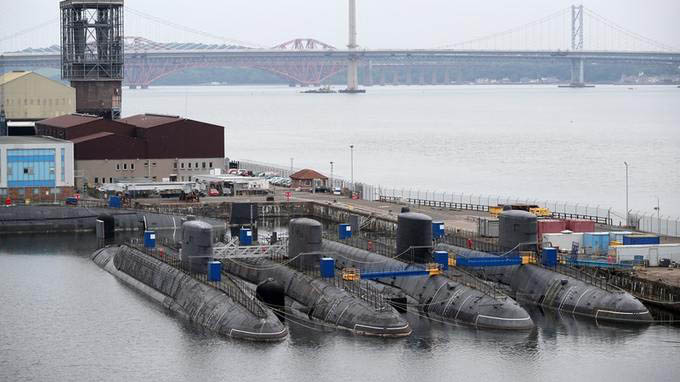
Iodine tablets to counteract the effects of radiation would need to be given to “half the population of Rosyth” if proposals to bring more nuclear subs to the dockyard go ahead.
That’s the fear of local SNP councillor Brian Goodall who said the emergency planning measures that would be needed was an issue of “great public concern”.
The next generation of Trident submarines is the Dreadnought class and, in September, Babcock bosses said that a £340 million investment from the UK Government would help pay for a contingent dock for the boats to come into Rosyth.
There are already seven decommissioned nuclear subs being cut up at Rosyth and the defence firm are due to give an update on the dismantling project to councillors at next month’s South and West Fife area committee meeting.
At this week’s meeting Cllr Goodall said: “I am hopeful that we can make a request to Babcock and the Ministry of Defence that they include in that update some more information about the proposal to use Rosyth as a contingent docking base for the Trident submarines.
“Apparently the MoD has decided it is the only suitable venue other than Faslane.”
He said he first heard of the proposal at a recent Rosyth Dockyard Local Liaison Committee meeting and added: “They did say that one of the issues, if it was to go ahead, the emergency planning would have to involve issues like arrangements to distribute iodine tablets to half the population of Rosyth, which to me means this is an issue of great public concern.
“Certainly something that should be subject to wider public consultation rather than just a decision being taken by the MoD that this is the only suitable site to do it.”
Committee convener, Cllr David Barratt, said he had attended the recent Rosyth Community Council meeting and added: “They were clear as well that there is significant community interest on this and consultation and community engagement is essential if significant changes are proposed for the use of the dockyard.
“I hope we can write to the MoD and ask that that is addressed or that they are prepared to answer questions when they attend in December.”
Iodine tablets, taken at the right time, can block the absorption of radioactive iodine by flooding the thyroid gland.
The UK Government have detailed plans for providing the tablets – potassium iodate or potassium iodide – in the event of a radiation emergency involving a release of radioactive iodine.
The possibility of bringing more subs to Rosyth was raised after the UK Government’s £340m investment in the dockyard was confirmed in September………………………………………………………….. https://www.heraldscotland.com/news/25607814.rosyth-councillor-doesnt-want-trident-submarines-yard/
Golden Rule: The Journey for Peace
Today, on Armistice Day, we honor the original meaning of this date: a day dedicated to peace, to the end of war, and to the hope that we can build a different future. It is with that precise intention that we are incredibly proud to release our documentary:
Golden Rule: The Journey for Peace

We chose this day deliberately. While the world often focuses on military service, we seek to reclaim the radical hope of the original 1918 armistice, a moment that declared, “The war to end all wars is over.” Our film is a continuation of that promise, a testament to the courage it takes to sail for peace in a world still gripped by violence.
This film is a piece of our hearts, a story of the waves, the wind, and the unwavering commitment that carried our historic ketch across the Pacific, c
This Film is Our Armistice Day Commitment.
In a time of escalating conflict and a dangerous new nuclear arms race, this film is our active prayer for peace. It is our stand for climate justice and our pledge to protect our most vulnerable. ontinuing a 65-year legacy of bold, anti-nuclear activism.
New U.S. nuclear power boom begins with old, still-unsolved problem: What to do with radioactive waste
“I’m not sure that the tech industry has really thought through whether they want to be responsible for managing nuclear waste at their data center sites.”
Bob Woods CNBC, Sun, Nov 9 2025
Key Points
- The Trump administration aims to quadruple the current nuclear energy output over the next 25 years through construction of conventional reactors and next-gen small modular reactors, but a clear solution has yet to emerge for the old issue of radioactive waste.
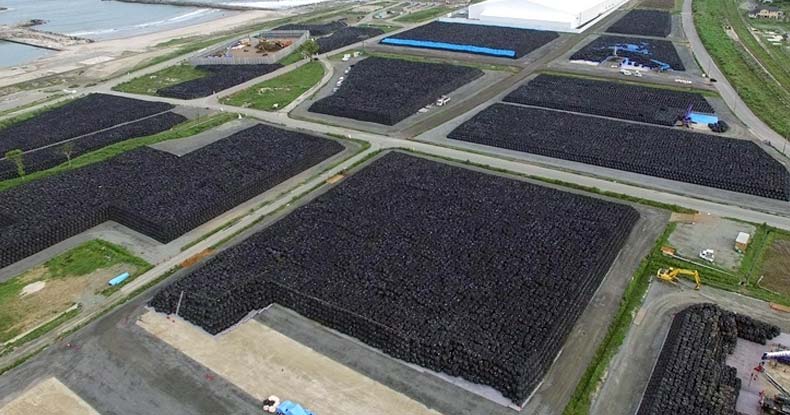
- More than 95,000 metric tons of spent nuclear fuel (with a minority from weapons programs) sits temporarily stockpiled in special water-filled pools or dry casks at 79 sites in 39 states.
- The Department of Energy has no permanent disposal facility for nuclear waste, leaving taxpayers on the hook for payments to utilities of up to $800 million every year in damages, a bill that has reached $11.1 billion since 1998, and could grow to $44.5 billion in the future.
Nuclear power is back, largely due to the skyrocketing demand for electricity, including big tech’s hundreds of artificial intelligence data centers across the country and the reshoring of manufacturing. But it returns with an old and still-unsolved problem: storing all of the radioactive waste created as a byproduct of nuclear power generation.
In May, President Trump issued executive orders aimed at quadrupling the current nuclear output over the next 25 years by accelerating construction of both large conventional reactors and next-gen small modular reactors. Last week, the U.S. signed a deal with Westinghouse owners Cameco and Brookfield Asset Management to spend $80 billion to build nuclear plants across the country that could result in Westinghouse attempting to spinoff and IPO a stand-alone nuclear power company with the federal government as a shareholder.
There’s a growing consensus among governments, businesses and the public that the time is right for a nuclear power renaissance, and even if the ambitious build-out could take a decade or more and cost hundreds of billion of dollars, it will be an eventual boon to legacy and start-up nuclear energy companies, the AI-fixated wing of the tech industry and investors banking on their success.
But there are plenty of reasons to be skeptical. Only two nuclear power plants have been built since 1990 — more than $15 billion over budget and years behind schedule — and they went online in just the last two years. Almost all of the 94 reactors currently operating in 28 states, generating about 20% of the nation’s electricity, were built between 1967 and 1990. And though often unspoken, there’s the prickly issue that’s been grappled with ever since the first nuclear energy wave during the 1960s and ’70s: how to store, manage and dispose of radioactive waste, the toxic byproduct of harnessing uranium to generate electricity — and portions of which remain hazardous for millennia.
Solutions, employing old and new technologies, are under development by a number of private and public companies and in collaboration with the Department of Energy, which is required by law to accept and store spent nuclear fuel.
The most viable solution for permanently storing nuclear waste was first proffered back in 1957 by the National Academy of Sciences. Its report recommended burying the detritus in deep underground repositories (as opposed to the long-since-abandoned notion of blasting it into low-Earth orbit). It wasn’t until 1982, though, that Congress passed the Nuclear Waste Policy Act, assigning the DOE responsibility for finding such a site…………………………………
Other nations have moved forward with the idea. Finland, for instance, is nearing completion of the world’s first permanent underground disposal site ………………………………………..
An American startup, Deep Isolation Nuclear, is combining the underground burial concept with oil-and-gas fracking techniques. The methodology, called deep borehole disposal, is achieved by drilling 18-inch vertical tunnels thousands of feet below ground, then turning horizontal. Corrosion-resistant canisters — each 16 feet long, 15 inches in diameter and weighing 6,000 pounds — containing nuclear waste are forced down into the horizontal sections, stacked side-by-side and stored, conceivably, for thousands of years………………………………………………………………..
Recycling radioactive waste for modular reactors
An entirely different, old-is-new-again technology, pioneered in the mid-1940s during the Manhattan Project, is gathering steam. It involves reprocessing spent fuel to extract uranium and other elements to create new fuel to power small modular reactors. The process is being explored by several startups, including Curio, Shine Technologies and Oklo.

Oklo has gained attention among investors drawn to its two-pronged approach to nuclear energy. The company — which went public via a SPAC in 2024, after early-stage funding from OpenAI CEO Sam Altman, Peter Thiel’s venture capital firm and others — announced in September that it is earmarking $1.68 billion to build an advanced fuel reprocessing facility in Oak Ridge, Tennessee. Concurrently, the company signed an agreement with the Tennessee Valley Authority “to explore how we can take used nuclear fuel sitting on its sites and convert it into fuel we can use in our reactors,” said a company spokeswoman……………………………..
Oklo exemplifies both the promise and the perplexity associated with the rebirth of nuclear power. On one hand is the attraction of repurposing nuclear waste and building dozens of SMRs to electrify AI data centers and factories. On the other hand, the company has no facilities in full operation, is awaiting final approval from the NRC for its Aurora reactor, and is producing no revenue. Oklo’s stock has risen nearly 429% this year, with a current market valuation of more than $16.5 billion, but share prices have fluctuated over the past month.
“It’s a high-risk name because it’s pre-revenue, and I anticipate that the company will need to provide more details around its Aurora reactor plans, as well as the [fuel reprocessing] program on the [November 11] earnings report call,” said Jed Dorsheimer, an energy industry analyst at William Blair in a late October interview. “
In the meantime, more than 95,000 metric tons of spent nuclear fuel (about 10,000 tons is from weapons programs) sits temporarily stockpiled aboveground in special water-filled pools or dry casks at 79 sites in 39 states, while about 2,000 metric tons are being produced every year. ………………………………………………………………………
Allison Macfarlane, professor and director of the School of Public Policy and Global Affairs at the University of British Columbia, as well as the chair of the NRC from 2012–2014, deems spent fuel reprocessing as far too expensive and a source of new waste streams, and dismisses deep borehole disposal as a “non-starter.”……………………
As far as nuclear waste, “we need to put [it] deep underground,” Macfarlane said.
………………………………………………………………….the rush to build new reactors — and generate even more waste — marches on alongside the data center boom……………………………….
Those long timelines alone should be a deterrent, said Tim Judson, executive director of the Nuclear Information Resource Service, a nonprofit advocate for a nuclear-free world. “It is fanciful to think that nuclear energy is going to be helpful in dealing with the increases in electricity demand from data centers,” he said, “because nuclear power plants take so long to build and the data centers are being built today.”
And then there’s the waste issue, Judson said. “I’m not sure that the tech industry has really thought through whether they want to be responsible for managing nuclear waste at their data center sites.”
But you can count Gates, the big tech billionaire who was backing nuclear even before the AI data center boom, as having not only thought about the waste problem, but dismissed it as major impediment. “The waste problems should not be a reason to not do nuclear,” Gates said in an interview with the German business publication Handelsblatt back in 2023….. https://www.cnbc.com/2025/11/09/nuclear-power-energy-radioactive-waste-storage-disposal.html
Stop the nuclear MADness

by Harlan Ullman,- 11/10/25 , https://thehill.com/opinion/national-security/5595645-strategic-nuclear-weapons-resurgence/
For better or for worse, strategic nuclear weapons are back on the docket.
Given that the Cold War ended 35 years ago, most Americans have little understanding of or interest in these weapons that could literally obliterate much if not all of our society. The marvelous Stanley Kubrick movie “Dr. Strangelove” satirized the notion of mutual assured destruction and the Soviet Union’s “doomsday device” that, once triggered, would destroy the world.
During the Cold War, the image of two scorpions in a bottle, representing the U.S. and Soviet Union, was popularized, meaning both could sting the other to death. Decades later, at least three scorpions inhabit that bottle, with the addition of China pursuing a serious strategic nuclear arsenal rivaling that of the other two military superpowers.
If not in the same bottle, certainly in the same room are the other nuclear states: Britain, France, North Korea, Israel, India and Pakistan. Iran and Saudi Arabia are in the anteroom.
Now, these strategic nuclear matters have been brought to a head by the expiration of the New START Treaty in January and President Trump’s confusing and unhelpful comment that the U.S. will resume testing its nuclear weapons.
The New START treaty limited both the U.S. and Russia to 1,550 deployed nuclear warheads and 800 deployed and non-deployed launchers. Russian President Vladimir Putin has proposed a voluntary extension of the treaty limits on warheads and launchers.
Trump’s comments on testing have completely disrupted the arms control process. By testing, does Trump mean actually exploding current warheads? Does he mean continuing the non-critical testing that does not require actual fission or fusion to take place? Or does he mean testing launchers?
If he’s talking about explosive testing, virtually all experts regard that as highly dangerous and unnecessary.
Worse, in response to Trump’s proposal to build a Golden Dome around and over America to defend against missile or bomber attacks, Putin held a press conference discussing Russia’s efforts surrounding the Skyfall and Poseidon missiles.
Skyfall is NATO’s designation for a nuclear powered, nuclear tipped cruise missile with nearly unlimited range. Poseidon is a nuclear powered, nuclear tipped unmanned underwater torpedo with transoceanic range.
While Skyfall is subsonic, flying feet above the surface, it could attack from any direction. Poseidon could sail undetected into U.S. harbors — say New York or San Francisco — and detonate a multi-megaton warhead
Megaton weapons can deliver 1,000 times more explosive power than the two nuclear bombs dropped on Japan in 1945. Multiple Poseidon attacks could destroy the American economy.
The strategic nuclear balance has been further complicated by conventional weapons with the capacity to strike and destroy these systems with pinpoint accuracy — cruise missiles such as Tomahawk and long-range convention bombs that can be launched at significant distances from targets. None of these have been included in arms control agreements, and the U.S. abrogated the Anti-Ballistic Missile Treaty in 2001.
The U.S. government has also lost experts who were deeply engaged in these issues. For example, not one of the current Joint Chiefs of Staff has any experience along these lines, as strategic arms control has not been a high priority. The same is true in the White House.
China, so far, has been unwilling to engage in arms control talks, probably waiting until it has expanded its own nuclear capability to a certain level. So under these circumstances, what if anything, can be done beyond leaders agreeing that nuclear weapons can never be used and nuclear war can never be fought?
The options are not good. Engagement with China must continue. Perhaps agreements for mutual inspection of nuclear systems to ensure safety and reliability can begin confidence-building measures. Military-to-military talks on nuclear issues and safeguards are always a good idea. However, given Russia’s intervention in Ukraine, is anyone willing to raise this possibility?
The only concrete step is to ensure that kinetic nuclear testing — namely exploding warheads underground or on the surface and in the air — remains forbidden. Otherwise, a new and unwanted and potentially threatening arms race will be on, and that cannot be permitted.
Harlan Ullman, Ph.D. is UPI’s Arnaud deBorchgrave Distinguished Columnist, a senior advisor at the Atlantic Council, the chairman of two private companies and the principal author of the doctrine of shock and awe. He and former United Kingdom Defense Chief David Richards are the authors of a forthcoming book on preventing strategic catastrophe
Destroying Europe in order to save it: Extortion, theft, and the EU’s two disastrous choices
Strategic Culture Foundation, Joaquin Flores, November 5, 2025
Europe can postpone recognition of failure, but it cannot postpone the bill.
Europe now faces a stark choice forced by its disastrous war policy against Russia: either allow the EU to successfully move toward a centralized state over the heads of its member states, risking a mass Eurexit that may or may not succeed in reaction to that gamble, or delay the larger crisis through member states quietly accepting one of several schemes that will cripple the economy and create social strife regardless.
The Union must decide whether to use frozen Russian sovereign assets to finance a €140 billion “reparation” loan for Ukraine, or to issue joint debt through Eurobonds.
Both paths carry severe legal risks and impose heavy costs on citizens: one through contingent liabilities, the other through immediate taxes, austerity, and political instability. Pushing through the Eurobond option would amount to a structural coup, a radical re-engineering of the EU against its current form. A recent Politico piece framed these in terms of Option A and B, which helps to contrast these two potential ways forward.
Commission President Ursula von der Leyen’s scheme from the European Commission reveals the depths of EU tyranny in its failed gambit to defeat Russia and guarantee investment outcomes in Ukraine.
SAFE, (Security Action for Europe), a €150 billion defense loan program, was initially proposed in March by von der Leyen with the goal of stimulating rapid defense investment. By May, EU ministers had given their final approval to the program, without consulting the European Parliament, provoking a suit from the Parliament.
Whether or not the Eurobond or Russian asset-seizure (theft) scheme is being proposed in light of (perhaps) likely-to-succeed challenges to the SAFE loan program, or if the Commission is trying to actually raise a total of nearly €300 billion, remains to be seen. What is certain is the push for SAFE comes chronologically after there was significant push-back from EU member states and ministers themselves on the feasibility of spending seized/frozen Russian assets (including interest on the moneys, for war against Russia, or anything else). And the Commission push for this Eurobond scheme comes after the EU Parliament presented a suit against SAFE.
What the Eurobond scheme and SAFE both have in common, nevertheless, is the mechanism for implementation, recklessly assuming authority to do so under a radically broadened interpretation of its powers re Article 122 TFEU.
The Commission is using threats to force member states to spend the frozen Russian assets. Refuse and each government faces a political crisis. Eurobonds are deeply unpopular because the mutualized debt falls on the population, leading to the overturning of governments at the ballot-box, and imposing them unilaterally would break EU treaties, leading to an emboldened Eurexit movement. Member states are being pushed to approve the use of unlawfully seized assets, completing the illegal expropriation through their own consent.
The stakes are far higher than money. This is a coup against the EU as it was conceived, a total re-envisioning of the Union itself. Ursula von der Leyen is not merely leveraging bonds to secure Ukraine funding. She is playing a game of chicken that risks the Union’s structure………………………………
Option A: Frozen Russian assets – huge legal risk, long-term cost to citizens
Legally, tapping frozen Russian assets is precarious………………………………….
….sovereign assets normally enjoy immunity from seizure under international law and bilateral treaties, reflected in the United Nations Convention on Jurisdictional Immunities of States and Their Property (2004) and the 1989 Belgium–Russia bilateral investment treaty.…………………………………………………………………………………..
Option B: Eurobonds – unconstitutional overreach and overt social burden
Unilateral Eurobonds generally collide with the EU’s treaty architecture: the Commission cannot force the issuing of mutualized debt; joint borrowing requires unanimous backing and national ratification.
To do otherwise requires violating the EU’s treaty itself. Brussels is signaling it might act first and fight legal challenges later. …………………………………………………………………………………………………………………..
If forced, citizens face higher taxes, constrained public services, and renewed austerity. Debt obligations do not disappear with elections; social unrest could deepen inequality, provoke Euroscepticism, and trigger exit pressures. Constitutionally, this makes the Commission behave as a sovereign treasury without legitimacy.
€140 bn in debt spread across 200 million workers equals €700 per worker. At 3 % annual interest, servicing costs €21 bn/year, or €105 per worker annually over ten years. Principal plus €42 bn interest totals €182 bn, or €910 per worker. This translates into grandmothers skipping groceries, students delaying college, and curtailed public services. Trade unions, left-wing groups, and small-business forces could trigger a pan-European ‘Yellow Vests’-style crisis.
Conclusion: Evergreening, sunk costs, and Who pays
Both options are evergreening: keeping failing policies alive to avoid losses. Option A buries legal risk and hands latent liabilities to future citizens; Option B openly burdens taxpayers and risks constitutional rupture. And even worse, both scenarios ignore the chronic economic hazard to Europe if it continues its course of sanctions on Russian energy, which could make it the least competitive economy in the developed world.
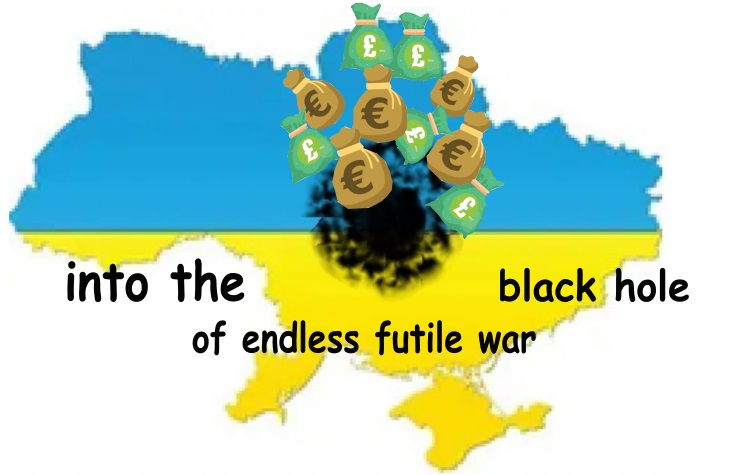
In both options, the EU is pouring billions either directly into Ukraine or into arms to supply it yet the war is almost certainly lost and the billions spent on expected returns from reconstruction of Russian-liberated territories will never be recovered, turning these investments into sunk costs that serve only to prolong the illusion of economic coherence.
Europe suffers a paradigm problem and an existential crisis at the level of its ‘Eurocracy.’ Paradoxically, the policies that are politically hardest to enact at this bureaucratic level are also the most necessary and potentially fruitful. Since the EU proposes to embark upon a radical reconstruction of the Union itself, perhaps it is appropriate to presume something as radical, but in the direction of stability, growth, and peace: 1) reversing its war-footing; 2) rapprochement with Russia along the U.S.-Russia model; 3) restoring energy pipelines like Nord Stream 2; 4) recognizing Ukraine as Russia’s legitimate sphere of influence; 5) joint investment with Russia in the post-Warsaw Pact sphere; 6) building on the OSCE and 1975 Helsinki Final Act framework; 7) developing a joint Eurasian economic and security architecture. This ensures stability, development, and prosperity for generations.
For Europe, this requires overcoming chronic Russophobia and eschewing Atlanticist paranoia. Europe can postpone recognition of failure, but it cannot postpone the bill. Who will be left holding it, and will there even be an EU that can pull this off? https://strategic-culture.su/news/2025/11/05/destroying-europe-in-order-to-save-it-extortion-theft-and-the-eus-two-disastrous-choices/
US-Led ‘Coordination Center’ Replaces Israel as ‘Overseer’ of Gaza Aid Deliveries
Israel has continued to restrict aid deliveries into Gaza in violation of the ceasefire deal
by Dave DeCamp | November 9, 2025, https://news.antiwar.com/2025/11/09/us-led-coordination-center-replaces-israel-as-overseer-of-gaza-aid-deliveries/
The US military-led Civil-Military Coordination Center (CMCC) that was recently established in southern Israel has replaced Israel as the “overseer” of Gaza aid deliveries, The Washington Post reported on Friday.
Since the ceasefire deal was supposed to be implemented on October 10, Israel has violated it by continuing to restrict aid deliveries entering Gaza. “Israel is blocking the Trump plan’s humanitarian clauses,” Jan Egeland, secretary general of the Norwegian Refugee Council, told the Post.
Egeland said it was “very good news” that the US is more engaged in aid deliveries, though it remains unclear whether the restrictions will be lifted. “Our appeal is make the plan a reality,” he said. “Of course, the credibility of the United States is at stake here.”
One of the biggest impediments to aid deliveries is that Israel has only allowed trucks to enter Gaza through two border crossings, with most deliveries going through the Kerem Shalom crossing in southern Gaza. “We need full access. We need everything to be moving fast. We are in a race against time. The winter months are coming. People are still suffering from hunger, and the needs are overwhelming,” Abeer Etefa, a spokeswoman for the UN’s World Food Program, said last week.
There have been no direct aid deliveries to northern Gaza, where people need food the most, and, according to the Post report, many of the trucks allowed to enter Gaza carry commercial goods that few Palestinians can afford to purchase.
The Post report said the responsibility for Gaza aid was being shifted to the CMCC from the Coordination of Government Activities in the Territories (COGAT), a unit of the Israeli Defense Ministry that oversees Israeli-occupied and controlled territory.
In response to the report, COGAT characterized the shift differently, saying the “Americans will be integrated into the formulation and implementation of coordination, supervision, and control mechanisms in the context of humanitarian aid, in full cooperation with the Israeli security services.”
An unnamed Israeli official said that the “Americans will take the lead in engaging with the international community on humanitarian matters. … It should be emphasized that this does not constitute a transfer of authority or responsibility from COGAT to the Americans.”
While the US leads the CMCC, where about 200 US troops have been deployed, the Post report said more than 40 other countries and organizations are also involved. The CMCC is also supposed to oversee an international force that may be deployed to Gaza under the ceasefire deal, but it remains unclear whether it will come together, as countries willing to participate want more clarity about exactly what their troops will be doing.
In the meantime, Israeli troops continue to occupy more than 50% of Gaza’s territroy and continue to carry out attacks against Palestinians. Since the ceasefire went into effect on October 10, at least 241 Palestinians have been killed by Israeli forces, according to Gaza’s Health Ministry.
Iran says West will have to recognize it as nuclear science hub
By Xinhua,, November 11, 2025 https://www.chinadailyasia.com/hk/article/623347
TEHERAN – Iranian Foreign Minister Seyed Abbas Araghchi said on Monday that Western countries would eventually have to acknowledge Iran as a scientific hub in the field of peaceful nuclear technology, state media reported.
Speaking during a visit to the Atomic Energy Organization of Iran, Araghchi praised the country’s achievements in the nuclear sector and reaffirmed Teheran’s commitment to defending its nuclear rights.
“The West’s main goal is to deprive Iran of its nuclear capabilities and maintain its monopoly,” Araghchi said, adding that “Western countries will ultimately have no choice but to recognize Iran as a scientific hub for the peaceful nuclear industry.”
He said Iran’s progress in nuclear science was the result of years of effort and sacrifice by Iranian scientists, and reiterated that no one in Iran would give up the country’s nuclear rights.
He said Iran has consistently sought to demonstrate the peaceful nature of its nuclear program by cooperating with international bodies, including the International Atomic Energy Agency (IAEA).
Western governments have long accused Iran of pursuing nuclear weapons. Teheran denies the charge, saying its nuclear program is aimed at power generation and medical purposes.
THE ELITE EURO SUICIDERS.
Tragically, some intent on suicide carry through with no one able to convince them not to. Currently most European leaders have such a mindset, risking the total economic destruction of their nations.
Aearnur, Nov 11, 2025
Idealism in its purest form is a noble and selfless endeavor when put into action. It can move mountains and radically shift perceptions when it is used to appeal to the masses……………..
True idealism in these days of relentless disinformation campaigns and all-pervasive western propaganda, is as rare as hens’ teeth. Nonetheless, most of the leadership we find across Europe appear driven by a certain fixed concept of ultimate rightness and ultimate wrongness. This distorted, heavily blinkered form of idealism permits no opposing thought to disrupt its 100% crusader mentality.
The idea of moderating their “idealistic”, totally fixed viewpoints or any of their set in stone foreign policies is anathema to them. To view the geopolitical realities holistically to them is totally unthinkable and unacceptable. Their aggressive drive toward mindless war with Russia, and now also with China, has no reverse gear. For them it is a matter of do… or die. And now we see that their economies are indeed dying.
Naturally it is not be the political leadership of Europe who are doing the dying. Those continuing to die by thousands per week are Ukrainians. These Ukrainians have a leadership equally locked into the same faux idealism driving their European sponsors.
Thus, from the two most influential spheres of power who preside over them the hapless Ukrainians are being driven to personal and national suicide along with the European tax payers footing the bill. No retreat from this reality is contemplated by Zelemsky or the EU elite for a moment. It clearly makes no difference to the fixed position of Zelensky or the majority of European leaders that their misbegotten cause is long lost.
Ukraine’s economy will never fully recover. With the conflict kept endlessly going by Zelensky and his sponsors refusing to confront reality and come to terms with the Russians the damage to it can only increase. At whatever distant point the conflict ends we can only image the cost to Ukraine’s sponsors (and taxpayers) to begin its reconstruction. Will it ever be a sovereign nation again one might ask? How many in-house industries will remain and how many large European and U.S. corporations and major business concerns will replace almost all of them while taking control of any Ukrainian entity at boardroom level? Ukraine, on this reading, is clearly doomed, at least by comparison with how she stood before this all began by the western coup of 2014.
And Europe, what of it? Doomed also? Perhaps not doomed, but we can already see the clear economic decline all across it, de-industrialization in Germany, constant turmoil in France and rising prices everywhere. Soon will come reduced investment and rising unemployment. With rival companies across the global south fueled by inexpensive Russian oil and gas while European nations buy expensive U.S. energy products instead things can only move in one inexorable direction. That direction can only be down through being constantly and increasingly out-priced and outproduced. Jobs will inevitably be shed as U.S. and European companies seek to cut labor costs in a frantic bid to somehow stay competitive.
The vast majority of European political elites, bound as slaves to the unelected bureaucracy in Brussels are, to all intents and purposes held tightly within an economic suicide pact. Only here and there, in Hungary and Slovakia do we see leaders determined not to go down with a ship holed below the water line by its own captain. Viktor Orbán and Robert Fico refuse to join the hate-blinded, faux idealistic warmongers of the Brussels elite.
Will the citizens of Germany and France and those of all others within the European Union continue to sit on their hands awaiting the signs of full economic collapse? Or will they now release themselves from the effects of at least two decades of misinformation, propaganda and barefaced lies that have been till now conditioning their reflexes to inaction? Will they at last derail the European juggernaut heading ever faster toward the blank wall of economic death and vote these faux idealistic elite European suiciders out?
Proposed solar farm could help make Island ‘centre of excellence’ – minister.

FARMERS should be able to “grow” solar power in their fields in the
same way as other crops, the Environment Minister has said during a speech
in which he highlighted the growing use of technology in agriculture.
Deputy Steve Luce, who was one of two members of the Council of Ministers
to address the 2025 Jersey Farming Conference, said that a proposed solar
farm in St Martin presented a “wonderful opportunity” for the Island to
play its part in combatting climate change. “The site could become a
European centre of excellence, showing how we could be helping farmers, and
producing sustainable energy, by enabling research and education to happen
at the same time,” he said. “In combining the latest agrivoltaics,
solar technologies, and innovations, Jersey could well end up leading on
this type of agricultural initiative.”
Jersey Evening Post 8th Nov 2025, https://jerseyeveningpost.com/news/2025/11/08/proposed-solar-farm-could-help-make-island-centre-of-excellence-minister/
Ukraine facing widespread power cuts after generating capacity reduced to ‘zero’ by Russian attacks
Power to be cut for as much as 16 hours a day across most of Ukraine while repairs are carried out
Guardian, Agence France-Presse, 9 Nov 25
Power will be cut for between eight and 16 hours across most regions of Ukraine on Sunday, state transmission system operator Ukrenergo has said, after Russian attacks targeting energy infrastructure reduced the country’s generating capacity to “zero”.
Moscow, which has escalated attacks on Ukraine’s infrastructure in recent months, launched hundreds of drones at energy facilities across the country from Friday into Saturday, which killed at least seven people, according to Ukrainian officials.
The Russian attacks have disrupted electricity, heat and water supplies in several Ukrainian cities, with state power firm Centerenergo warning generating capacity “is down to zero”.
Ukrenergo has said repairs were carried out and energy sourcing diverted.
While the situation had somewhat stabilised, regions including Kyiv, Dnipropetrovsk, Donetsk, Kharkiv, Poltava, Chernihiv and Sumy could continue to experience regular power cuts, Ukraine’s energy minister said on Saturday night.
“The enemy inflicted a massive strike with ballistic missiles, which are extremely difficult to shoot down. It is hard to recall such a number of direct strikes on energy facilities since the beginning of the invasion,” Svitlana Grynchuk told local broadcaster United News.
Russian drones had targeted two nuclear power substations deep in western Ukraine, Kyiv’s foreign minister Andrii Sybiha said, calling on the UN’s nuclear watchdog to respond.
The substations powered the Khmelnytskyi and Rivne nuclear plants, about 120km and 95km (75 miles and 59 miles) respectively from Lutsk, he said………………………………
Ukraine has in turn stepped up strikes on Russian oil depots and refineries in recent months, seeking to cut off Moscow’s vital energy exports and trigger fuel shortages across the country.
Early on Sunday, Russia’s air defence units destroyed 44 Ukrainian drones, RIA news agency reported, citing daily data from the Russian defence ministry. https://www.theguardian.com/world/2025/nov/09/ukraine-facing-widespread-power-cuts-after-generating-capacity-reduced-to-zero-by-russian-attacks
US conducts its Intercontinental Ballistic Missile (ICBM) test.

ICBMs have been sold to the public as a guarantor of security, when in fact, they are an imminent threat.
Maintaining these weapons is a huge waste of resources.
Influential right wing think tanks like The Heritage Foundation have come out in opposition to the Comprehensive Test Ban Treaty, and have directly called for the U.S. to prepare to resume explosive nuclear weapons testing
by beyondnuclearinternational, https://beyondnuclearinternational.org/2025/11/09/us-conducts-its-icbm-test/
Although not carrying a nuclear warhead, the test is still provocative, say Defuse Nuclear War and Tri-Valley CAREs
In the early morning hours of November 5th, Vandenberg Space Force Base launched a Minuteman III missile, the current intercontinental ballistic missile (ICBM) ground-based nuclear warhead delivery system in roughly 400 underground silos across five states that would target US adversaries in a full-scale nuclear war.
This ICBM test, which landed roughly 30 minutes later at Kwajalein Atoll in the Marshall Islands, is one of several that occur at Vandenburg every year — as they have for many decades. According to the Space Force Press Release, today’s test “validates” the “reliability, operational readiness, and accuracy of the ICBM system.” While these tests are launched without the nuclear warhead, the purpose is to practice nuclear war fighting and these tests are just as provocative to US adversaries as their nuclear-capable missile tests are to us.
This launch has an increased gravitas, as it comes hardly a week after the President used his social media platform to make a confusingly provocative announcement that, “Because of other countries’ testing programs, I have instructed the Department of War to start testing our nuclear weapons on an equal basis.”
Exactly what was meant by the President’s vague statement has been debated in the days since. The President could not have been referencing other countries conducting explosive nuclear tests, because no nation except North Korea has conducted an explosive nuclear test this century.
The reference to “equal basis” with other “countries testing programs” has been thought to be in reference to nuclear weapon delivery system tests, which have been conducted by both Russia and China. But as today’s launch displays, these delivery system tests are nothing new, and the United States has long tested all of the delivery vehicles in its triad, including today’s ICBM test.
If the US were to resume explosive nuclear testing, Russia and others have already signaled they will follow. This reckless move would break a 30-year taboo that has kept the world safer. If the US resumes testing, it won’t just poison the air: it could destroy decades of progress toward preventing nuclear war.
Resuming explosive nuclear testing at this time would solely be a political decision, and it would be a very bad one. The human and environmental toll would be immense: radiation poisoning that seeps into lungs, water, and soil; children born with preventable cancers; ecosystems rendered unlivable. Testing again would repeat history’s worst mistakes on purpose.
US resumption of explosive nuclear testing would open the door to all of the other nuclear powered states conducting their own tests for both their existing stockpile warhead designs, and those that are in development, potentially opening the door to decades of testing and associated releases of radiation into the environment.
Influential right wing think tanks like The Heritage Foundation have come out in opposition to the Comprehensive Test Ban Treaty, and have directly called for the U.S. to prepare to resume explosive nuclear weapons testing at the Nevada National Security Site (NNSS). For example, in its January 2025 report, America Must Prepare to Test Nuclear Weapons, it claims that testing is necessary for the global image of America and would be a display of resolve.
Additionally, Project 2025 calls for the United States to “Reject ratification of the Comprehensive Test Ban Treaty and indicate a willingness to conduct nuclear tests in response to adversary nuclear developments if necessary. This will require that the National Nuclear Security Administration be directed to move to immediate test readiness…”
Officials from the Lawrence Livermore and Los Alamos National Labs who manage the existing nuclear weapons stockpile have expressed that there’s no military or technical justification for explosive nuclear testing at this time. The billions spent on the Labs’ supercomputer modeling, National Ignition Facility laser testing and multiple other simulation systems allow them to ensure that the stockpile will work as designed in a “use scenario.”
The US conducted 100 atmospheric and 828 underground explosive nuclear tests at NNSS between 1951 and 1992. The agency currently needs 36 months to get “ready” for a full-scale, underground, explosive nuclear test at NNSS.
In response to the President’s sudden announcement, on October 30th Congresswoman Dina Titus (NV-01) introduced the Renewing Efforts to Suspend Testing and Reinforce Arms Control Initiatives Now (RESTRAIN) Act to prohibit the United States from conducting explosive testing of nuclear weapons.
In her press release announcing the RESTRAIN Act, Representative Titus states, “Donald Trump has put his own ego and authoritarian ambitions above the health and safety of Nevadans. His announcement to resume nuclear testing in the United States goes against the arms control and nonproliferation treaties that the U.S. has spearheaded since the end of the Cold War, and will trigger new tests by Russia and China, reigniting an international arms race. It also puts Nevadans back in the crosshairs of toxic radiation and environmental destruction. With just 97 days until the only arms control agreement between the U.S. and Russia expires, now should be the time to negotiate further arms-control agreements, not create mushroom clouds in the Nevada desert.”
The RESTRAIN Act amends U.S. Code to insert a prohibition of explosive nuclear testing while simultaneously preventing any funding from going toward the Trump Administration’s effort to conduct explosive nuclear tests.
Emma Claire Foley with the Defuse Nuclear War coalition said of today’s launch, “ICBM tests make war more likely and damage the place they supposedly protect. Scheduling this latest test on Election Day is an attempt to avoid public attention on a weapons system that experts agree makes the U.S. less safe.” She added, “ICBMs are a threat to the life and health of every single person in the United States and around the world. We ask that the upcoming ICBM test, all future scheduled tests, be canceled, and that the U.S. hold to its decades-long record of not conducting nuclear tests.”
ICBMs have been sold to the public as a guarantor of security, when in fact, they are an imminent threat. In the words of the late Daniel Ellsberg, author of The Doomsday Machine, these weapons make “any conflict enormously more dangerous than it has to be” by increasing “the danger that any armed conflict between major nuclear states can escalate to all-out war.” ICBMs are on hair-trigger alert and, once launched, cannot be recalled, virtually guaranteeing a strike on the country that launches them. As long as ICBMs exist, we live with the constant risk that misinterpreted intelligence, human error, or a single rash decision could end civilization as we know it within an hour.
Maintaining these weapons is a huge waste of resources. The U.S. has committed to spending hundreds of billions of dollars to “modernize” its ICBM force, which in practice means replacing the Minuteman III system that was tested today with an entirely new missile system – the Sentinel ICBM, and a new nuclear warhead design.
Thus far, the Sentinel ICBM program is now an astonishing 81% over budget and years behind schedule, not including the expense for its new W-87-1 nuclear warhead development being done at Lawrence Livermore National Laboratory or the new plutonium pits that will be built at Los Alamos National Laboratory. Yet the U.S. Secretary of Defense has certified, through a “comprehensive, unbiased review” not shared with the public, that the program will proceed.
Scott Yundt, Executive Director of Livermore-based Tri-Valley CAREs criticized the launch from Vandenburg, saying, “Test launches like today’s damage human communities and ecosystems. The Marshall Islands, already forced to bear the overwhelming environmental costs of U.S. nuclear weapons testing, are still used as a target test area.”
Yundt went on to say “When tensions among nuclear-armed states are high, each test launch carries an added risk. The U.S. military has acknowledged as much by pausing these launches at high points of tension in the war in Ukraine. The risk of nuclear escalation remains too high to introduce the possibility of misinterpretation of a test into the mix.”
“ICBM tests are damaging and provocative acts masquerading as business as usual. We condemn all wasteful, destructive tests that keep the world at the edge of nuclear destruction,” Yundt concluded.
TriValley CAREs watchdogs the nuclear weapons complex and its Lawrence Livermore Lab, one of two locations that develops all US nuclear bombs and warheads. Defuse Nuclear War is a coalition of more than 200 organizations and organizers dedicated to reducing the risk of nuclear war.
Michael Mann to Bill Gates: You can’t reboot the planet if you crash it
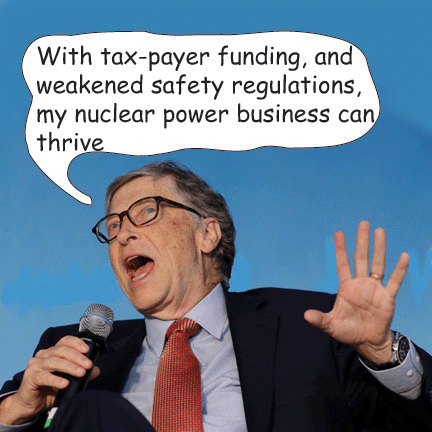
Gates downplays the role of clean energy and rapid decarbonization. Instead, he favors hypothetical new energy tech, including “modular nuclear reactors” that couldn’t possibly be scaled up over the time frame in which the world must transition off fossil fuels.
By Michael E. Mann | October 31, 2025, https://thebulletin.org/2025/10/you-cant-reboot-the-planet-if-you-crash-it/
“I suppose it is tempting, if the only tool you have is a hammer, to treat everything as if it were a nail.” Thus wrote the famous psychologist Abraham Maslow in 1966.
If Maslow were around today, I imagine he might endorse the corollary that if your only tool is technology, every problem appears to have a technofix. And that’s an apt characterization of the “tech bro”-centered thinking so prevalent today in public environmental discourse.
There is no better example than Bill Gates, who just this week redefined the concept of bad timing with the release of a 17-page memo intended to influence the proceedings at the upcoming COP30 international climate summit in Brazil. The memo dismissed the seriousness of the climate crisis just as (quite possibly) the most powerful Atlantic hurricane in human history—climate-fueled Melissa—struck Jamaica with catastrophic impact. The very next day a major new climate report (disclaimer: I was a co-author) entitled “a planet on the brink” was published. The report received far less press coverage than the Gates missive. The legacy media is apparently more interested in the climate musings of an erstwhile PC mogul than a sober assessment by the world’s leading climate scientists.
Gates became a household name in the 1990s as the Microsoft CEO who delivered the Windows operating system. (I must confess, I was a Mac guy.) Microsoft was notorious for releasing software mired with security vulnerabilities. Critics argued that Gates was prioritizing the premature release of features and profit over security and reliability. His response to the latest worm or virus crashing your PC and compromising your personal data? “Hey, we’ve got a patch for that!”
That’s the very same approach Gates has taken with the climate crisis. His venture capital group, Breakthrough Energy Ventures, invests in fossil fuel-based infrastructure (like natural gas with carbon capture and enhanced oil recovery), while Gates downplays the role of clean energy and rapid decarbonization. Instead, he favors hypothetical new energy tech, including “modular nuclear reactors” that couldn’t possibly be scaled up over the time frame in which the world must transition off fossil fuels.
Most troublingly, Gates has peddled a planetary “patch” for the climate crisis. He has financed for-profit schemes to implement geoengineering interventions that involve spraying massive amounts of sulfur dioxide into the stratosphere to block out sunlight and cool the planet. What could possibly go wrong? And hey, if we screw up this planet, we’ll just geoengineer Mars. Right Elon?
Such technofixes for the climate, in fact, lead us down a dangerous road, both because they displace far safer and more reliable options—namely the clean energy transition—and because they provide an excuse for business-as-usual burning of fossil fuels. Why decarbonize, after all, if we can just solve the problem with a “patch” later?
Here’s the thing, Bill Gates: There is no “patch” for the climate crisis. And there is no way to reboot the planet if you crash it. The only safe and reliable way out when you find yourself in a climate hole is to stop digging—and burning—fossil fuels.
It was arguably Gates who—at least in part—inspired the tech-bro villain Peter Isherwell in the Adam McKay film “Don’t Look Up.” The premise of the film is that a giant “comet” (a very thinly veiled metaphor for the climate crisis) is hurtling toward Earth as politicians fail to act. So they turn to Isherwell who insists he has proprietary tech (a metaphor for geoengineering, again thinly veiled) that can save the day: space drones developed by his corporation that will break the comet apart. Coincidentally, the drones are designed to then mine the comet fragments for trillions of dollars’ worth of rare metals, that all go to Isherwell and his corporation. If you haven’t seen the film (which I highly recommend), I’ll let you imagine how it all works out.
For those who have been following Gates on climate for some time, his so-called sudden “pivot” isn’t really a “pivot” at all. It’s a logical consequence of the misguided path he’s been headed down for well over a decade.
I became concerned about Gates’ framing of the climate crisis nearly a decade ago when a journalist reached out to me, asking me to comment on his supposed “discovery” of a formula for predicting carbon emissions. (The formula is really an “identity” that involves expressing carbon emissions as a product of terms related to population, economic growth, energy efficiency, and fossil fuel dependence). I noted, with some amusement, that the mathematical relationship Gates had “discovered” was so widely known it had a name, the “Kaya identity,” after the energy economist Yōichi Kaya who presented the relationship in a textbook nearly three decades ago. It’s familiar not just to climate scientists in the field but to college students taking an introductory course on climate change.
If this seems like a gratuitous critique, it is not. It speaks to a concerning degree of arrogance. Did Gates really think that something as conceptually basic as decomposing carbon emissions into a product of constituent terms had never been attempted before? That he’s so brilliant that anything he thinks up must be a novel discovery?
I reserved my criticism of Gates, at the time, not for his rediscovery of the Kaya identity (hey—if he can help his readers understand it, that’s great) but for declaring that it somehow implies that “we need an energy miracle” to get to zero carbon emissions. It doesn’t. I explained that Gates “does an injustice to the very dramatic inroads that renewable energy and energy efficiency are making,” noting peer-reviewed studies by leading experts that provide “very credible outlines for how we could reach a 100 percent noncarbon energy generation by 2050.”
The so-called “miracle” he speaks of exists—it’s called the sun, and wind, and geothermal, and energy storage technology. Real world solutions exist now and are easily scalable with the right investments and priorities. The obstacles aren’t technological. They’re political.
Gates’ dismissiveness in this case wasn’t a one-off. It was part of a consistent pattern of downplaying clean energy while promoting dubious and potentially dangerous technofixes in which he is often personally invested. When I had the chance to question him about this directly (The Guardian asked me to contribute to a list of questions they were planning on asking him in an interview a few years ago), his response was evasive and misleading. He insisted that there is a “premium” paid for clean energy buildout when in fact it has a lower levelized cost than fossil fuels or nuclear and deflected the questions with ad hominem swipes. (“He [Mann] actually does very good work on climate change. So I don’t understand why he’s acting like he’s anti-innovation.”)
This all provides us some context for evaluating Gates’ latest missive, which plays like a game of climate change-diminishing bingo, drawing upon nearly every one of the tropes embraced by professional climate disinformers like self-styled “Skeptical Environmentalist” Bjorn Lomborg. (Incidentally, Lomborg’s center has received millions of dollars of funding from the Gates Foundation in recent years and Lomborg recently acknowledged serving as an adviser to Gates on climate issues.)
Among the classic Lomborgian myths promoted in Gates’ new screed, which I’ll paraphrase here, is the old standby that “clean energy is too expensive.” (Gates likes to emphasize a few difficult-to-decarbonize sectors like steel or air travel as a distraction from the fact that most of our energy infrastructure can readily be decarbonized now.) He also insists that “we can just adapt,” although in the absence of concerted action, warming could plausibly push us past the limit of our adaptive capacity as a species.
He argues that “efforts to fight climate change detract from efforts to address human health threats.” (A central point of my new book Science Under Siege with public health scientist Peter Hotez is that climate and human health are inseparable, with climate change fueling the spread of deadly disease). Then there is his assertion that “the poor and downtrodden have more pressing concerns” when, actually, it is just the opposite; the poor and downtrodden are the most threatened by climate change because they have the least wealth and resilience.
What Gates is putting forward aren’t legitimate arguments that can be made in good faith. They are shopworn fossil fuel industry talking points. Being found parroting them is every bit as embarrassing as being caught—metaphorically speaking—with your pants down.
For years when I would criticize Gates for what I consider to be his misguided take on climate, colleagues would say, “you just don’t understand what Gates is saying!” Now, with Donald Trump and the right-wing Murdoch media machine (the Wall Street Journal editorial board and now an op-ed by none other than Lomborg himself in the New York Post) celebrating Gates’ new missive, I can confidently turn around and say, “No, you didn’t understand what he was saying.”
Maybe—just maybe—we’ve learned an important lesson here: The solution to the climate crisis isn’t going to come from the fairy-dust-sprinkled flying unicorns that are the “benevolent plutocrats.” They don’t exist. The solution is going to have to come from everyone else, using every tool at our disposal to push back against an ecocidal agenda driven by plutocrats, polluters, petrostates, propagandists, and too often now, the press.
Nuclear power will get the most Energy Department loans, Chris Wright says
Mon, Nov 10 2025, Spencer Kimball, CNBC
Key Points
- Nuclear power plants will receive the bulk of the money from the Energy Department’s loan office, Secretary Chris Wright said.
- The Trump administration struck a deal last month with the owners of Westinghouse to invest $80 billion to build nuclear plants across the U.S.
Nuclear power will receive most of the money from the Energy Department’s loan office as the Trump administration pushes to quickly break ground on new reactors, Secretary Chris Wright said on Monday.
“We have significant lending authority at the loan program office,” the Secretary of Energy said at a conference hosted by the American Nuclear Society in Washington D.C. “By far the biggest use of those dollars will be for nuclear power plants — to get those first plants built.”
President Trump signed an executive order in May that called for the U.S. to break ground on 10 large nuclear reactors by 2030. Alphabet, Amazon, Meta Platforms and Microsoft are investing billions of dollars to restart old nuclear plants, upgrade existing ones, and deploy new reactor technology to meet the electricity demand from artificial intelligence data centers.
Wright said he expects electricity demand from AI to attract billions of dollars in equity capital to build new nuclear capacity from “very creditworthy providers.” The Energy Department could match those private dollars by as much as four to one with low cost debt financing from the loan office, he said………..
Westinghouse deal
The Trump administration struck a deal last month with the owners of Westinghouse to invest $80 billion to build nuclear plants across the U.S. Westinghouse is owned by uranium miner Cameco and Brookfield Asset Management…………………………….
Cameco Chief Operating Officer Grant Isaac said last week that the U.S. government has a number of options available to facilitate the financing of Westinghouse reactors, including the Energy Department’s loan office.
“We’re assured that there is a lot of interest in investing this minimum $80 billion in order to begin the process,” Isaac told investors on Cameco’s third-quarter earnings call.
Under the terms of the October deal, Westinghouse could spin out as a separate, publicly-traded company with the U.S. government as a shareholder.
But Westinghouse has struggled in the past to build the AP1000 on time and on budget. It went bankrupt in 2017 from cost overruns at big nuclear projects in Georgia and South Carolina.
Two AP1000 reactors entered service at Plant Vogtle in Georgia in 2023 and 2024, years behind schedule and billions of dollars over budget. The South Carolina project was cancelled. https://www.cnbc.com/2025/11/10/nuclear-power-energy-department-chris-wright-loan-westinghouse-ai-data-center.html
Legalising the theft of Russian assets
There are, I’m afraid to say, still too many truly believers in the Russia total defeat delusion. Ukraine can still win! With what troops and, critically, what money?
With Glenn Diesen, Ian Proud. Nov 10, 2025
Following my recent article on the topic of the so-called EU reparations loan (a cheap ruse to fund the Ukrainian state for another 2-3 catastrophic years of war), I discussed the issue in more detailed with Glenn Diesen,
The more I consider this issue, the more clear it becomes that attempting to exproprirate Russian assets is a desperate measure to prevent EU Member States from giving Ukraine the money themselves, money which they do not have.
The Commission idea, should the Russian asset option continue to be blocked by Belgium, to borrow the money on international markets and then lend it to Ukraine, which can’t borrow money itself, appears similarly desperate. Who will make repayments on that loan? Becauses Ukraine won’t.
Suddenly, the EU idea of common debt becomes more worrying still. Who wants to give Kaja Kallas a blank cheque to fund proxy wars in other countries, with repayments being share among Member States?
Amid all of this, with Pokrovsk falling, Kupiansk and Siversk almost lost, the Russian army pushing into Zaporizhia, does anyone in Brussels take a step back and ask whether, in fact, it would be better to support the US in leveraging Zelensky to settle?
There are, I’m afraid to say, still too many truly believers in the Russia total defeat delusion. Ukraine can still win! With what troops and, critically, what money?
The dark side of Zelenskyy’s rule
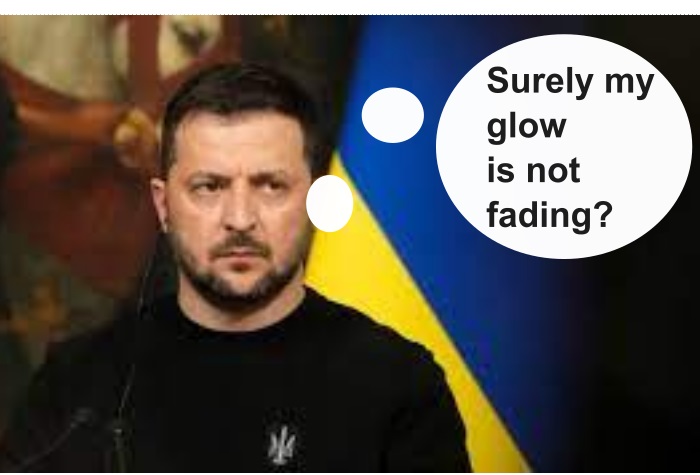
Opposition lawmakers and civil society activists say Ukraine’s leadership is using lawfare to intimidate opponents and silence critics.
Politico, October 31, 2025, By Jamie Dettmer
As Russia began its full-scale invasion of Ukraine nearly four years ago, Volodymyr Kudrytskyi, then head of Ukraine’s state-owned national power company Ukrenergo, was scrambling to keep the lights on.
Somehow, he succeeded and continued to do so every year, earning the respect of energy executives worldwide by ensuring the country was able to withstand Russian missile and drone strikes on its power grid and avoid catastrophic blackouts — until he was abruptly forced to resign in 2024, that is.
Kudrytskyi’s dismissal was decried by many in the energy industry and also prompted alarm in Brussels. At the time, Kudrytskyi told POLITICO he was the victim of the relentless centralization of authority that Ukrainian President Volodymyr Zelenskyy and his powerful head of office Andriy Yermak often pursue. He said he feared “corrupt individuals” would end up taking over the state-owned company.
According to his supporters, it is that kind of talk — and his refusal to remain silent — that explains why Kudrytskyi ended up in a glass-enclosed cubicle in a downtown Kyiv courtroom last week, where he was arraigned on embezzlement charges. Now, opposition lawmakers and civil society activists are up in arms, labeling this yet another example of Ukraine’s leadership using lawfare to intimidate opponents and silence critics by accusing them of corruption or of collaboration with Russia. Zelenskyy’s office declined to comment.
Others who have received the same treatment include Zelenskyy’s predecessor in office, Petro Poroshenko, who was sanctioned and arraigned on corruption charges this year — a move that could prevent him from standing in a future election. Sanctions have frequently been threatened or used against opponents, effectively freezing assets and blocking the sanctioned person from conducting any financial transactions, including using credit cards or accessing bank accounts.
Poroshenko has since accused Zelenskyy of creeping “authoritarianism,” and seeking to “remove any competitor from the political landscape.”
That may also explain why Kudrytskyi has been arraigned, according to opposition lawmaker Mykola Knyazhitskiy, who believes the use of lawfare to discredit opponents is only going to get worse as the presidential office prepares for a possible election next year in the event there’s a ceasefire. They are using the courts “to clear the field of competitors” to shape a dishonest election, he fears.
Others, including prominent Ukrainian activist and head of the Anti-Corruption Action Center Daria Kaleniuk, argue the president and his coterie are using the war to monopolize power to such a degree that it threatens the country’s democracy.
Kaleniuk was in the courtroom for Kudrytskyi’s two-hour arraignment, and echoes the former energy boss’s claim that the prosecution is “political.” According to Kaleniuk, the case doesn’t make any legal sense, and she said it all sounded “even stranger” as the prosecutor detailed the charges against Kudrytskyi: “He failed to show that he had materially benefited in any way” from an infrastructure contract that, in the end, wasn’t completed, she explained……………………………………………………………………………
for former Deputy Prime Minister Ivanna Klympush-Tsintsadze, the case “doesn’t look good from any angle — either domestically or when it comes to international partners.” The timing, she said, is unhelpful for Ukraine, as it coincides with Kyiv’s ongoing appeal for more European energy assistance ahead of what’s likely to be the war’s most perilous winter.
With Russia mounting missile and drone strikes on a far larger scale than before, Ukraine’s energy challenge is likely to be even more formidable. And unlike previous winters, Russia’s attacks have been targeting Ukraine’s drilling, storage and distribution facilities for natural gas in addition to its electrical power grid. Sixty percent of Ukrainians currently rely on natural gas to keep their homes warm.
Some Ukrainian energy executives also fear Kudrytskyi’s prosecution may be part of a preemptive scapegoating tactic to shift blame in the event that the country’s energy system can no longer withstand Russian attacks.
Citing unnamed sources, two weeks ago Ukrainian media outlet Ukrainska Pravda reported that former energy executives fear they are being lined up to be faulted for failing to do enough to boost the energy infrastructure’s resilience and harden facilities.
“They need a scapegoat now,” a foreign policy expert who has counseled the Ukrainian government told POLITICO. “There are parts of Ukraine that probably won’t have any electricity until the spring. It’s already 10 degrees Celsius in Kyiv apartments now, and the city could well have extended blackouts. People are already pissed off about this, so the president’s office needs scapegoats,” he said, speaking on condition of anonymity to discuss the matter freely.
“The opposition is going to accuse Zelenskyy of failing Ukraine, and argue he should have already had contingencies to prevent prolonged blackouts or a big freeze, they will argue,” he added……..https://www.politico.eu/article/dark-side-zelenskyy-rule-ukraine/
1 This Month

of the week – Shut Down Drone Warfare!


Tell the Ukrainian Government to Drop Prosecution of Peace Activist Yurii Sheliazhenko

Petition to revoke the licensing of the Near Surface Nuclear Disposal Facility (NSDF) at Chalk River. https://www.ourcommons.ca/petitions/en/Petition/Details?Petition=e-7247
To see nuclear-related stories in greater depth and intensity – go to https://nuclearinformation.wordpress.com
-
Archives
- April 2026 (114)
- March 2026 (251)
- February 2026 (268)
- January 2026 (308)
- December 2025 (358)
- November 2025 (359)
- October 2025 (376)
- September 2025 (257)
- August 2025 (319)
- July 2025 (230)
- June 2025 (348)
- May 2025 (261)
-
Categories
- 1
- 1 NUCLEAR ISSUES
- business and costs
- climate change
- culture and arts
- ENERGY
- environment
- health
- history
- indigenous issues
- Legal
- marketing of nuclear
- media
- opposition to nuclear
- PERSONAL STORIES
- politics
- politics international
- Religion and ethics
- safety
- secrets,lies and civil liberties
- spinbuster
- technology
- Uranium
- wastes
- weapons and war
- Women
- 2 WORLD
- ACTION
- AFRICA
- Atrocities
- AUSTRALIA
- Christina's notes
- Christina's themes
- culture and arts
- Events
- Fuk 2022
- Fuk 2023
- Fukushima 2017
- Fukushima 2018
- fukushima 2019
- Fukushima 2020
- Fukushima 2021
- general
- global warming
- Humour (God we need it)
- Nuclear
- RARE EARTHS
- Reference
- resources – print
- Resources -audiovicual
- Weekly Newsletter
- World
- World Nuclear
- YouTube
-
RSS
Entries RSS
Comments RSS
 nuclear-news