‘Peacemaker’ of death: This Ukrainian website threatens hundreds of thousands with extrajudicial killings — some are Americans
And every time someone unlucky enough to have had his or her home address or other personal data revealed turns up dead, the site is updated: the name of the deceased now appears in bright flickering letters reminiscent of a Las Vegas casino, and the person’s photo is crossed out with the callous inscription: ‘liquidated’.
Rt.com, By Olga Sukharevskaya, ex-Ukrainian diplomat, 28 Aug 22,
Mirotvorets, which compiles lists of ‘enemies of Ukraine’, has been operating with impunity for eight years
For the last eight years, a group of publicly unknown activists in Ukraine have been compiling lists of ‘enemies of the people’ with impunity. Hundreds of thousands have been declared criminals without trial.
Among them are not only Russian citizens, but also Ukrainian opposition figures and bloggers, European politicians, and US citizens. At the very least, being added to this list is a stigma that makes life difficult in Ukraine, but it can also serve as justification for imprisonment or, in some cases, even being killed. This is exactly what happened last weekend to Daria Dugina, daughter of world-famous Russian philosopher Alexander Dugin, who’s name also can be found on that list.
RT explains what is behind the Mirotvorets, or ‘Peacemaker’, website, whose creators seek to bring ‘peace’ to their country with the help of extrajudicial killings, and why the Ukrainian authorities have done nothing about this despite condemnation from the international community.
What is Mirotvorets?
The main page of the Ukrainian Mirotvorets website proclaims that the outlet represents a ‘Center for Research of Signs of Crimes against the National Security of Ukraine, Peace, Humanity, and the International Law’. It claims to have been created by a group of academics, journalists, and other specialists. However, their names are known to no one, and the outfit itself has never even been officially registered in Ukraine.
Nevertheless, this organization has been in operation for nine years, since August 2014. And although it positions itself as “independent, non-state media,” government officials still had a hand in its creation. In fact, the website emerged at the initiative of Anton Gerashchenko, a former adviser to the Ukrainian minister of internal affairs.
Mirotvorets’ activities boil down to publishing personal information on people who the site’s administrators consider a threat, in one way or another, to Ukrainian statehood.
The site’s owners urge the country’s law enforcement agencies to take note of the personal data and activities of the people it lists. However, street radicals sometimes also take heed of Mirotvorets’ lists.
And every time someone unlucky enough to have had his or her home address or other personal data revealed turns up dead, the site is updated: the name of the deceased now appears in bright flickering letters reminiscent of a Las Vegas casino, and the person’s photo is crossed out with the callous inscription: ‘liquidated’.
For example, the current Mirotvorets’ web page design displays this way the data of the Russian journalist Darya Dugina, daughter of the philosopher Aleksandr, who was brutally killed last weekend in her own car.
Despite the accusations from the Russian FSB, Ukraine denies any involvement in that murder. On Mirotvorets, however, Dugina’s death is described with a brief, dehumanizing commentary, along with a conspiracy theory: “Liquidated by the special services of fascist russia (sic) due to interspecies disagreements.”
Who gets on the Mirotvorets lists and how?…………………………..
Mirotvorets not only accuses people of committing ‘crimes’ but also includes more abstract offenses in its lists, such as producing “anti-Ukrainian propaganda” and “participating in anti-Ukrainian propaganda events.” The list even has a section for “agents of influence of the Russian Orthodox Church in Ukraine.” However, such areas are regulated by articles 9-11 of the ‘European Convention on Human Rights’, which concern freedom of expression, conscience, religion, thought, assembly, and association. The Mirotvorets center’s administrators are essentially seeking to deprive people whose opinions and beliefs do not suit them of their right to expression.
In addition, in the site’s ‘On Interaction and Cooperation with the Center’ section, there is a sample form for reporting personal information on ‘criminals’ and their relatives, which includes fields for addresses, phone numbers, photos, links to social network profiles, and their ‘crime’ (i.e., categorization as ‘militant’ or ‘terrorist’), all without trial or investigation.
The ‘criminals’ on public display, along with their wives, children, and parents, don’t even know they’re in ‘Purgatory’, let alone given a chance to defend themselves or cross-examine witnesses and confront their accusers.
A scandal in the noble family
As long as Mirotvorets was limiting itself to publishing information on Ukrainian citizens living in Crimea and Donbass, Ukrainian opposition politicians and journalists, and Russian residents and officials, the odious organization went unnoticed in the ‘civilized world’. But a scandal erupted in 2016, when Mirotvorets published information on employees of a host of media outlets, including the BBC, Reuters, Al Jazeera, AFP, Le Monde, the Guardian, Le Figaro, France 24, El Mundo, CBS News, CNN, Sky News, The Daily Telegraph, The Times, Cheska Televize, Radio France, Channel 9 Australia, the Associated Press, Japan TV, the Daily Mail, Die Welt, the Washington Post and New York Times, as well as representatives of Human Rights Watch and many other organizations, for “cooperating with a terrorist organization” (i.e., the Donetsk and Lugansk People’s Republics).
US State Department spokeswoman Elizabeth Trudeau noted at the time that the US was “very concerned about the hacking of a database and publication of personal information about journalists in combat areas.”
………….. In addition to journalists and human rights defenders, politicians have also made it into Mirotvorets’ database. The website published information on German Bundestag deputies who visited Crimea, a list that includes Evgeny Schmidt, Rainer Balzer, Gunar Lindeman, Harold Latch, Nick Vogel, Helmut Seifen, and Blakes Christian.
Ten US citizens, as well as French actor Samy Naceri, were relegated to ‘Purgatory’ for the same ‘offense’. According to the website, the Greek ‘enemies of Ukraine’ include former Energy Minister Panagiotis Lafazanis, cartoonist Stathis Stavropoulos, retired Air Force Lieutenant General Pavlos Hristou, and ‘Russian Athens’ editor Pavel Onoiko. While former Greek Prime Minister Alexis Tsipras also visited Crimea, he was removed from the database after expressing support for Petro Poroshenko. Top-tier politicians are also represented in Mirotvorets’ lists. Former German Chancellor Gerhard Schroeder can be found there, while Croatian President Zoran Milanovic and Hungarian Prime Minister Viktor Orban have also been recently added, as has authoritative American diplomat Henry Kissinger.
………….. Benjamin Moreau, deputy head of the UN’s human rights monitoring mission in Ukraine, stressed that the problem is moving from a purely legal to a practical one: some banks refuse to issue loans to persons included in the Mirotvorets database.
…………………… Closing Mirotvorets
There have been repeated demands to shut down the website. In 2018, Germany joined the chorus of journalists and human rights activists protesting Gerhard Schroeder’s inclusion in the database. According to the Cabinet of Ministers, “the Government of the Federal Republic of Germany most definitely condemns Mirotvorets and demands that the Ukrainian government and authorities assist in its removal.”
…………………… The Mirotvorets site is still up and continually updated with new data to this day. https://www.rt.com/russia/560965-ukrainian-mirotvorets-website/
Boris Johnson told: “It’s time to deliver justice for Britain’s nuclear test veterans”
Campaigners have asked the Prime Minister to use his last week in office to fulfil his promise to the victims of Cold War radiation experiments
Mirror. Susie Boniface, Reporter. 28 Aug 2022
Politicians and celebrities have joined forces with survivors of Britain’s nuclear tests to ask the Prime Minister to deliver justice in his last week in Downing Street.
They have written Boris Johnson an open letter, urging him to decide whether to “turn his back on our national heroes” or honour them before the 70th anniversary next month of the UK’s first atomic bomb.
The PM met families affected by the Cold War radiation experiments in June, but with only days left in Downing Street has yet to make any announcement about the medal they asked him for.
Both his potential successors have said they support it – but no decision has been made, with officials on leave and all eyes on the leadership campaign.
Mirror editor Alison Phillips said: “It is imperative this medal is delivered quickly, because these veterans are over 80 and have complex health problems. The window is closing for this PM to make a real difference to their need for recognition.”
Labour leader Sir Keir Starmer, who met the veterans a year earlier than the PM and promised them his support, said: “It’s appalling that Britain’s nuclear test veterans and their families shave not yet had justice after years of maltreatment, and I’m saddened that their long campaign is exceeding the life of so many of them.
“The PM has a very clear choice now: deliver on his promise to give real recognition ahead of the October 3 Plutonium Jubilee, or turn his back on our national heroes.”
He added: “The country owes a huge debt of honour to these veterans. The PM must act to deliver the appreciation, respect and justice they deserve, and Labour will continue to support their campaign every step of the way.”
The medal committee has been given fresh evidence to help its decision. Government insiders have told the Mirror that they have been trying to “force” a medal through, but have met a brick wall of officialdom, made worse by Tory turmoil.
“All it takes is for Boris to give this his attention,” said one. “If he just asked the Queen it could be done in a week.”
The letter has been signed by dozens of MPs, peers, famous faces, and everyone who was at the meeting with the PM. They include Operation Grapple veteran John Morris, 85, who saw four nuclear explosions and told Johnson: “It’s the ideal moment, Prime Minister, for you to look me in the eye and tell me, ‘you deserve a medal’. Or say, ‘sod off’.”
Nuclear descendants Steve Purse, Alan Owen, Laura Jackson, and Laura Morris have signed, along with Tory grandee Sir John Hayes and Labour’s Rebecca Long-Bailey, who secured the meeting between them.
Backing them are broadcaster Kirstie Allsopp, and comedians Al Murray, Rory Bremner and Mark Steel. Call The Midwife star Stephen McGann, and its scriptwriter, Heidi Thomas, also supported the call after a nuclear veteran featured in two series of their show.
McGann earlier likened the scandal to Hillsborough, and called on the PM to cut through the “Pooterish nonsense” that meant they were denied a medal.
Other supporters include shadow defence secretary John Healey, shadow attorney general Emily Thornberry, and SNP leader Ian Blackford, along with 47 other MPs from Labour, the SNP and Conservative Party, and the metro mayors Andy Burnham, Dan Jarvis and Steve Rotheram.
The veterans are also backed by Tory, Labour, and cross-bench peers Ruth Davidson, Shami Chakrabarti, John Hendy, Prem Sikka, Christine Blower, Pauline Bryan and Sayeeda Warsi.
Here is the letter in full…
* You can add your own name by clicking HERE
https://www.mirror.co.uk/news/politics/boris-johnson-justice-nuclear-veterans-27854059
Are Russia and NATO trying to destroy the nuclear Non-Proliferation Treaty?

Not only will they not begin negotiations to eliminate their nuclear arsenals, as they promised decades ago; they will not even pledge not to start World War III.
Russia and NATO aren’t afraid to start World War III
Wrecking ball — Beyond Nuclear International By Ira Helfand 28 Aug 22, Since it was adopted more than 50 years ago, the Treaty on the Non-Proliferation of Nuclear Weapons (NPT) has been described as the cornerstone of international efforts to limit the danger of nuclear war, its preservation a key, shared policy objective of the P5, the five permanent members of the United Nations Security Council. In the lead-up to this year’s NPT Review Conference, which opened on August 1 in New York, Russia and NATO are putting the treaty at risk.
The NPT was conceived as a grand bargain between nations who did not have nuclear weapons and promised not to develop them and the P5, who did have them in 1968 and promised, in Article VI of the treaty, to undertake good faith negotiations to eliminate their nuclear arsenals.
In the five decades since, these five nuclear-armed states have continued to insist that other signatories to the treaty honor their commitment not to build nuclear weapons, but they have never seriously considered meeting their obligations to disarm.
Tension over this blatant failure to uphold their end of the bargain has been growing for years and helped fuel the 2017 adoption by 121 non-nuclear-armed states of the Treaty on the Prohibition of Nuclear Weapons, a new treaty consistent with Article VI and intended to pressure the countries that have nuclear weapons to meet their obligations to get rid of them.
The gap between the promises of the P5 and their behavior has grown into a chasm since the Russian invasion of Ukraine. Russia has made repeated threats to use nuclear weapons and NATO — representing France, the United Kingdom and the United States — has replied with nuclear threats of its own.
Responding to this escalating danger of nuclear war, 18 Nobel Peace Laureates issued a statement in April urging Russia and NATO to pledge publicly that they will not use nuclear weapons under any circumstances in the current war. The statement was endorsed by more than 1 million people after it was posted to the Avaaz website. The response from Russia and NATO was a thunderous silence.
It is now clear: Not only will they not begin negotiations to eliminate their nuclear arsenals, as they promised decades ago; they will not even pledge not to start World War III…………………………….
The current threats by Russia and NATO reveal the truth: Nuclear-armed states possess these weapons to threaten and bully the rest of the world — and they are prepared to use them. As former Defense Secretary Robert McNamara famously observed, we have not avoided nuclear war because of sound doctrine or wise leaders or infallible technology. “We lucked out,” he said. “It was luck that prevented nuclear war.”……….. more https://beyondnuclearinternational.org/2022/08/28/wrecking-ball/
A nuclear showdown? One of the greatest ‘realist’ fears about the Russia-Ukraine conflict is actually groundless, and here’s why
The US will not intervene directly, because it’s not an existential crisis for Washington – it stands to lose little from Kiev’s inevitable defeat.
the Ukraine conflict is not an existential one for either the US or NATO; a loss in Ukraine will be another setback – Afghanistan on steroids. But a Ukrainian defeat does not, in and of itself, threaten NATO with collapse or spell the end of the American Republic.
Scott Ritter, 23 Aug 22, Fears that the Ukraine conflict is now bogged down into some sort of stalemate which risks dangerous escalation from the parties involved in order to achieve victory are misplaced. There is only one victor in the Ukraine conflict, and that is Russia. Nothing can change this reality.
Renowned American intellectual John Mearsheimer has written an important article about the conflict, entitled: ‘Playing with Fire in Ukraine: The Underappreciated Risks of Catastrophic Escalation’. The article paints a dark picture about both the nature of the war in Ukraine (prolonged stalemate) and probable outcome (decisive escalation by the parties involved to stave off defeat
Mearsheimer’s underpinning premises, however, are fundamentally flawed. Russia possesses the strategic initiative – militarily, politically, and economically – when it comes to the war in Ukraine and the larger proxy engagement with NATO. Moreover, neither the US nor NATO is in a position to escalate, decisively or otherwise, to thwart a Russian victory, and Russia has no need for any similar escalation on its part.
In short, the Ukraine conflict is over, and Russia has won. All that remains is a long and bloody mopping up.
The key to understanding how Mearsheimer got it so wrong is to dissect his understanding of the ambitions of both the US and Russia when it comes to the issue. According to Mearsheimer, “Since the war began, both Moscow and Washington have raised their ambitions significantly, and both are now deeply committed to winning the war and achieving formidable political aims.”
This passage is especially difficult to parse out. First and foremost, it is extremely difficult to articulate a sound baseline when it comes to assessing US “ambitions” vis-à-vis Ukraine and Russia. President Joe Biden’s administration inherited a policy which had been conceived in the George W. Bush-era and partially implemented under the team of Barack Obama (where Biden played a critical role). This was a very aggressive policy geared toward undermining Russia with the goal of weakening the Russian president, Vladimir Putin, to such an extent that eventually he would be replaced by a figure more amenable to adhering to a US-dictated policy line.
But one cannot pretend that there were not four years of Trump administration policy which threw the anti-Putin – and, by extension, anti-Russia – narrative promulgated by the Obama administration on its head. While Trump was never able to gain traction for his ‘why can’t we be friends’ approach to US-Russian diplomacy, he was able to seriously undermine two major policy pillars which propped the Obama-era policy up, namely NATO unity and Ukrainian solidarity.
The Biden administration was never able to resuscitate the Obama-era policy direction regarding Russia, inclusive of its anti-Putin goals and objectives. Trump’s undermining of NATO’s unity and purpose, when combined with the humiliating pull-out from Afghanistan, put the bloc on the back foot when it came to standing up to the challenge of a Russian state determined to be more assertive about what it viewed as its legitimate national security interests, inclusive of a new European security framework respectful of the notion of a Russian ‘sphere of influence’.
……………………………. neither the US military nor its NATO allies are able to generate the kind of meaningful military capability needed to effectively challenge Russia on the ground in Ukraine.
This reality severely limits the scope and scale of any possible US ambitions regarding Ukraine. At the end of the day, Washington has only one path forward – to continue to waste billions of dollars of taxpayers’ money sending military equipment to Ukraine, which has no chance of changing the outcome on the battlefield, to convince a domestic American audience that their government is ‘doing the right thing’ in a losing effort.
There is no ‘military option’ in Ukraine for either the US or NATO because, simply put, there is no military capable of meaningfully executing such an option.
This conclusion is critical to understanding Russia’s ‘ambitions’. Unlike the US, Russia has articulated clear and concise objectives regarding its decision to dispatch military forces into Ukraine. These can be described as follows: Permanent Ukrainian neutrality (i.e., no NATO membership), the de-Nazification of Ukraine (the permanent eradication of the odious nationalistic ideology of Stepan Bandera), and the de-militarization of the state – the destruction and elimination of all traces of NATO involvement in the security affairs of Ukraine.
These three objectives only reflect the immediate goals of the Special Military Operation in Ukraine. The ultimate objective – a restructured European security framework that has all NATO infrastructure withdrawn to the 1997 boundaries of that alliance – remains as a non-negotiable requirement that will have to be addressed after Russia secures its final military and political victory in Ukraine.
In short, Russia is winning on the ground in Ukraine, and there is nothing either the US or NATO can do to alter this outcome. And once Russia secures this victory, it will be in a far stronger position to insist that its concerns about a viable European security framework be respected and implemented.
Mearsheimer believes that the situation on the ground in Ukraine provides both the US and Russia with “powerful incentives to find ways to prevail and, more important, to avoid losing.”
At the end of the day, the Ukraine conflict is not an existential one for either the US or NATO; a loss in Ukraine will be another setback – Afghanistan on steroids. But a Ukrainian defeat does not, in and of itself, threaten NATO with collapse or spell the end of the American Republic.
Simply put, Mearsheimer’s fear that a loss in Ukraine “means that the United States might join the fighting either if it is desperate to win or to prevent Ukraine from losing” is unfounded.
So, too, is his contention that “Russia might use nuclear weapons if it is desperate to win or faces imminent defeat, which would be likely if US forces were drawn into the fighting.” Russia neither “faces defeat” nor has anything to worry about, existentially, from a US military intervention which, from all practical points of view, could not materialize even if the US wanted to be so bold…… https://www.rt.com/russia/561376-ukraine-russia-conflict-us/
Pakistan’s desperate plight after monster flooding
Pakistan is appealing for further international assistance after floods
wreaked havoc across the country. The US, UK, United Arab Emirates and
others have contributed to a monsoon disaster appeal but more funds are
needed, an interior ministry official told the BBC. More than 1,000 people
have died and millions have been displaced since June, Salman Sufi said. He
said Pakistan’s government was doing everything in its power to help
people.
BBC 28th Aug 2022
The long process of shutting down Hunterston B nuclear power station
Experts say that the site of the current Hunterston B power station could
be available for use again in around 90 years. Details of the upcoming
decommissioning process for the nuclear site have been revealed as part of
a public consultation over the next stage of the power station site’s
life. Defuelling of the site is currently under way, with decommissioning
expected to start in 2025/26 and it will take around 12 years to demolish
the majority of buildings. A long period of inactivity, thought to be
around 70 years, will follow before the remaining site will be
decommissioned and potentially ready for reuse. Following defuelling,
operators EDF will hand over responsibility to the Nuclear Decommissioning
Authority. The authority’s subsidiary Magnox will deliver decommissioning
activities for the decades to come. A report drawn up for the consultation
reveals that a giant ‘safestore’ will be created from the existing
reactor building, which can shield decaying radioactive materials for up to
100 years. It says: “Buildings and structures will be demolished to ground
level, with basement areas and tunnels backfilled and regraded using
material produced from the decommissioning process.
Largs & Millport News 26th Aug 2022
https://www.largsandmillportnews.com/news/20777753.hunterston-b-site-available-use-90-years/
Imperiled Ukrainian nuclear power plant has the world on edge – a safety expert explains what could go wrong
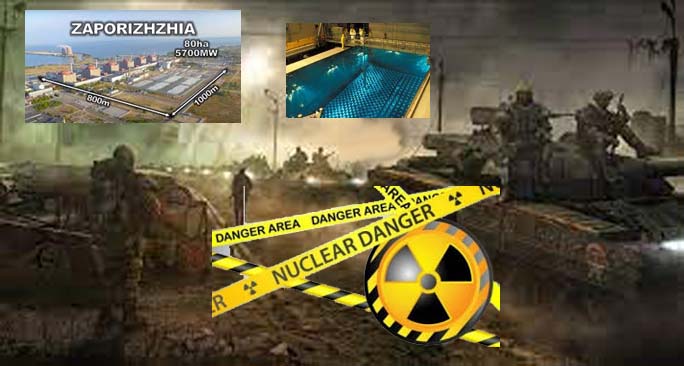
The Conversation, Najmedin Meshkati, 26 Aug 22, “…………………………………… What are the risks to a nuclear plant in a conflict zone?
Nuclear power plants are built for peacetime operations, not wars.
The worst thing that could happen is if a site is deliberately or accidentally shelled. If a shell hit the plant’s spent fuel pool – which contains the still-radioactive spent fuel – or if fire spread to the spent fuel pool, it could release radiation. This spent fuel pool isn’t in the containment building, and as such is more vulnerable.
Containment buildings, which house nuclear reactors, are also not protected against deliberate shelling. They are built to withstand a minor internal explosion of, say, a pressurized water pipe. But they are not designed to withstand a huge explosion.
As to the reactors in the containment building, it depends on the weapons being used. The worst-case scenario is that a bunker-buster missile breaches the containment dome – consisting of a thick shell of reinforced concrete on top of the reactor – and explodes. That would badly damage the nuclear reactor and release radiation into the atmosphere, which would make it difficult to send in first responders to contain any resulting fire. It could be another Chernobyl.
What are the concerns going forward?
The safety problems I see are twofold:
1) Human error……….
2) Power failure
The second problem is that the nuclear plant needs constant electricity, and that is harder to maintain in wartime.
Even if you shut down the reactors, the plant will need off-site power to run the huge cooling system to remove the residual heat in the reactor and bring it to what is called a cold shutdown. Water circulation is always needed to make sure the spent fuel doesn’t overheat.
Spent fuel pools also need constant water circulation to keep them cool, and they need cooling for several years before they can be put in dry casks. One of the problems in the 2011 Fukushima disaster in Japan was the emergency generators intended to replace lost off-site power got inundated with water and failed. In situations like that, you get “station blackout” – and that is one of the worst things that could happen. It means no electricity to run the cooling system.
In that circumstance, the spent fuel overheats and its zirconium cladding can create hydrogen bubbles. If you can’t vent these bubbles, they will explode, spreading radiation.
If there is a loss of outside power, operators will have to rely on emergency generators. But emergency generators are huge machines – finicky, unreliable gas guzzlers. And you still need cooling waters for the generators themselves.
My biggest worry is that Ukraine suffers from a sustained power grid failure. The likelihood of this increases during a conflict because power line pylons may come down under shelling, or gas power plants might get damaged and cease to operate. …………………….
How else does a war affect the safety of nuclear plants?
One of the overarching concerns about the effects of war on nuclear plants is that war degrades safety culture, which is crucial in running a plant……………………..
War adversely affects safety culture in a number of ways. Operators are stressed and fatigued and may be scared to death to speak out if something is going wrong. Then there is the maintenance of a plant, which may be compromised by lack of staff or unavailability of spare parts.
Governance, regulation and oversight – all crucial for the safe running of a nuclear industry – are also disrupted, as is local infrastructure, such as the capability of local firefighters. In war, everything is harder…………….. https://theconversation.com/imperiled-ukrainian-nuclear-power-plant-has-the-world-on-edge-a-safety-expert-explains-what-could-go-wrong-189429
Russia-Ukraine war: Ukraine announces mandatory evacuations
Guardian 27 Aug 22, Residents near the Zaporizhzhia nuclear power plant in Ukraine have reportedly been given iodine tablets, amid mounting fears that the fighting around the complex could trigger a catastrophe. It comes after the plant, Europe’s biggest nuclear power plant, was temporarily disconnected from Ukraine’s national grid after all lines to it were cut on Thursday.
……………..
- By Friday afternoon, Energoatom, Ukraine’s state nuclear agency, said one of the two working reactors had been reconnected to the grid. The one reactor is building up capacity, the agency said, thanking the plant’s working for “tirelessly and firmly” keeping “the nuclear and radiation safety of Ukraine and the whole of Europe on their shoulders”.
- ………………………….A team of inspectors from the UN nuclear watchdog are poised to make an emergency visit to the Russian-occupied Zaporizhzhia nuclear power plant in southeastern Ukraine, according to reports. Sources have told the Wall Street Journal that it is “almost certain” that a mission from the International Atomic Energy Agency (IAEA) will visit the plant early next week, although details are still being completed.
- EU energy ministers will gather for an urgent meeting as soon as possible to discuss the current energy crisis following Russia’s invasion of Ukraine, the Czech prime minister said. The Czech Republic currently holds the presidency of the European Council.
- Ukraine’s deputy prime minister, Iryna Vereshchuk, has announced plans to expand mandatory evacuations for civilians living on the war’s front lines. Speaking on national television, Vereshchuk said evacuating women with children and elderly people would be a priority from some districts of the eastern Kharkiv region and the southern Zaporizhzhia and Mykolaiv regions.
- …………………………………….. The German ambassador to the UK has acknowledged that there is a risk that public support for Ukraine could wane this winter as the energy crisis intensifies.
Bruce Gagnon Interview: An Objective Look at U.S. Foreign Policy

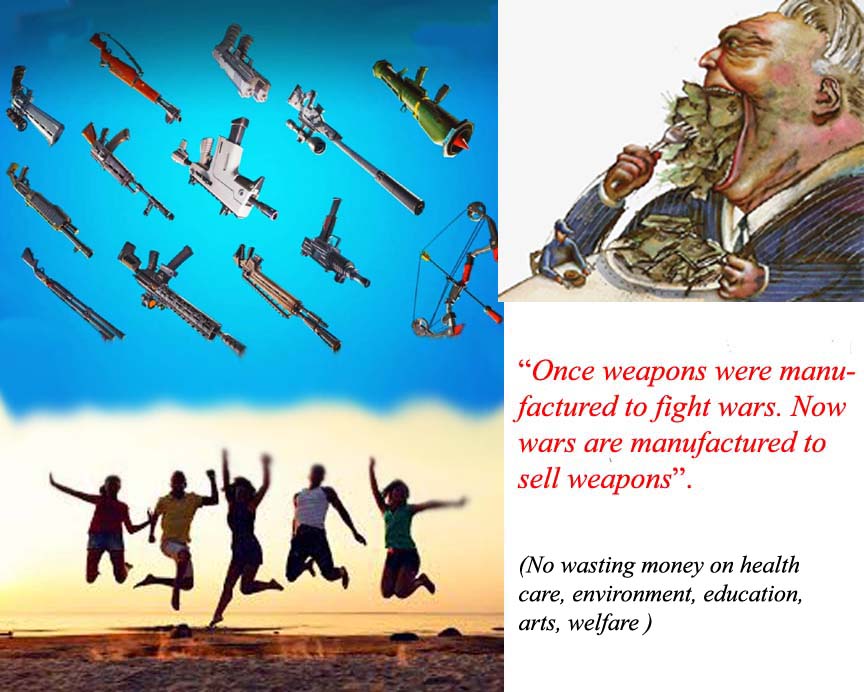
“Once weapons were manufactured to fight wars. Now wars are manufactured to sell weapons”.
BY JOHN RACHEL, 26 Aug 22,
Events continue to unfold at a quickening pace. Facing an alarming escalation in tensions around the world, we asked Bruce Gagnon for his most current thoughts.
Bruce Gagnon is the Coordinator of the Global Network Against Weapons & Nuclear Power in Space, and was a co-founder of the Global Network when it was created in 1992………………. He is currently an active member of Veterans for Peace.
……………Here is what Bruce had to say.
Q. We hear a lot of terms and acronyms bandied about. ‘Deep State’ … ‘MIC’ … ‘FIRE sector’ … ‘ruling elite’ … ‘oligarchy’ … ‘neocons’. Who actually defines and sets America’s geopolitical priorities and determines our foreign policy? Not “officially”. Not constitutionally. But de facto.
A. The banksters in London and Wall Street are the essential movers and shakers of US-UK-NATO foreign policy. The CIA is their primary arm of control. Add to them the burgeoning global military industrial complex and the political ‘mis-leaders’ they generously contribute to. The corporate controlled mainstream media are also accessories to the present day crimes. Together they add up to a formidable crew of what I call ‘pirates’ who are stealing the national treasures throughout the western capitalist world and using them to supress and colonize others across the Global South and here at home.
Q. We’ve had decades of international tensions. Recent developments have seen a sharp escalation in the potential for a major war. ……………….. war inevitable and peace impossible?
A. During the reign of George W. Bush in Washington, at the time of the US ‘shock and awe’ attack in Iraq, I was watching C-SPAN one evening. They introduced then Naval War College instructor Thomas Barnett (author of a book called ‘The Pentagon’s New Map’) and they announced that in the audience were hundreds of top-level Pentagon officers and CIA bigwigs. During his talk Barnett told the assembled that due to globalization of the world economy every nation would have a specific role to fill. In the US he said we won’t make ‘consumer products’ anymore because it was cheaper to send those jobs overseas. Our role in the US, Barnett said, would be ‘security export’. Thus it should be no surprise that the #1 industrial export product of the US today is weapons. When weapons are your #1 industrial export product, what is your ‘global marketing strategy’ for that product line?
Barnett (introduced as Rumsfeld’s ‘strategy guy’) also told the leading brass that the Pentagon would be endlessly fighting to take control of the ‘non-integrating gap’ around the globe – those parts of the world that were not submitting to the authority of corporate globalization. He instructed the audience to go and teach these ‘new concepts’ to those under their authority if they hoped to get promoted within the system in the years ahead.
For more than a year after this Barnett presentation I witnessed him being squired around Washington speaking to Republican and Democrat audiences on C-SPAN. It was evident to me that his ‘new doctrine’ was a bi-partisan plan. Since that time it has become quite clear that this is true as we now see the Democrats leading the proxy war on Russia – using Ukraine as the hammer in this dangerous and provocative attempt to force regime change in Moscow. Pelosi’s recent ill-fated trip to Taiwan also indicates the plan to force regime change in Beijing.
Imagine that Washington and its NATO allies, who limped out of Afghanistan after 20 years of brutal occupation there, are now planning for war with Russia and China. The absurdity is beyond imagination. It reveals much about their psychopathology.
As long as this reality persists then we will move from one war to another. Arundhati Roy says, “Once weapons were manufactured to fight wars. Now wars are manufactured to sell weapons”. She is right on the money…………………..
Q. Our leaders relentlessly talk about our “national interests” and our “national security”, warning that both are under constant assault. Yet, we spend more than the next nine countries combined on our military. Why does such colossal spending never seem to be enough?
A. When they talk about ‘national interests’ they are actually talking about the interests of the banksters. When they talk about ‘freedom’ they are talking about their freedom to steal the national wealth from nations with resources and the people around the world. Washington claims that Russia wants to re-create the former Soviet Union and take control of Europe. In 2022 Russia is spending $66 billion on their military. It is a defensive military to protect their vast border regions. The US this year is spending $800 billion plus. When you add up the hidden military spending in the other pots of gold – like the nuclear weapons spending inside the Department of Energy budget – the US total is around $1.2 trillion this year. They are robbing us blind and we keep handing over our hard-earned tax dollars. Why?………………………………………………….
- We need to convert the military industrial complex (the war machine) to build public mass transit systems, tidal power systems, solar, wind power and the like – all of which would create more jobs than weapons manufacturing does.
- We need to ban corporate funding of elections. We need to open up a multi-party system so that more voices can be heard by the voters.
- We need to end the massive poverty that exists (which will be worsening in the near future) by taxing the rich and corporations.
- Stop the massive corporate subsides – welfare for the rich.
- We need to close down the more than 800 US military bases around the world and cut the Pentagon budget by at least 80%.
- We only need a defensive military that protects our borders.
- Do all these things and we might have a chance if we don’t first perish from a red-hot nuclear war or climate crisis.We don’t have time to fool around.
- Folks need to get off their arses and speak out NOW. ………..
Biden Pledges Nearly $3 Billion To Ukraine In Largest U.S. Military Aid Package Yet
U.S. President Joe Biden has announced nearly $3 billion in new U.S. military aid for Kyiv as Ukraine marked its independence day six months after Russia invaded the country.
“On behalf of all Americans, I congratulate the people of Ukraine on their Independence Day,” Biden said in a statement on August 24.
“The United States of America is committed to supporting the people of Ukraine as they continue the fight to defend their sovereignty. As part of that commitment, I am proud to announce our biggest tranche of security assistance to date: approximately $2.98 billion of weapons and equipment to be provided through the Ukraine Security Assistance Initiative,” Biden said.
The financial package will allow Kyiv to obtain air-defense and artillery systems, ammunition, counter-unmanned aerial systems, and radars, the statement said…………….
Since Russia invaded Ukraine on February 24, the United States has provided $10.6 billion in military assistance to President Volodymyr Zelenskiy’s government.
On August 23, Germany said it will soon ship more than 500 million euros’ ($499.3 million) worth of weapons to Ukraine. https://www.rferl.org/a/biden-pledges-3-billion-military-aid-ukraine/32002639.html
All About Groundwater – Hanford part 2
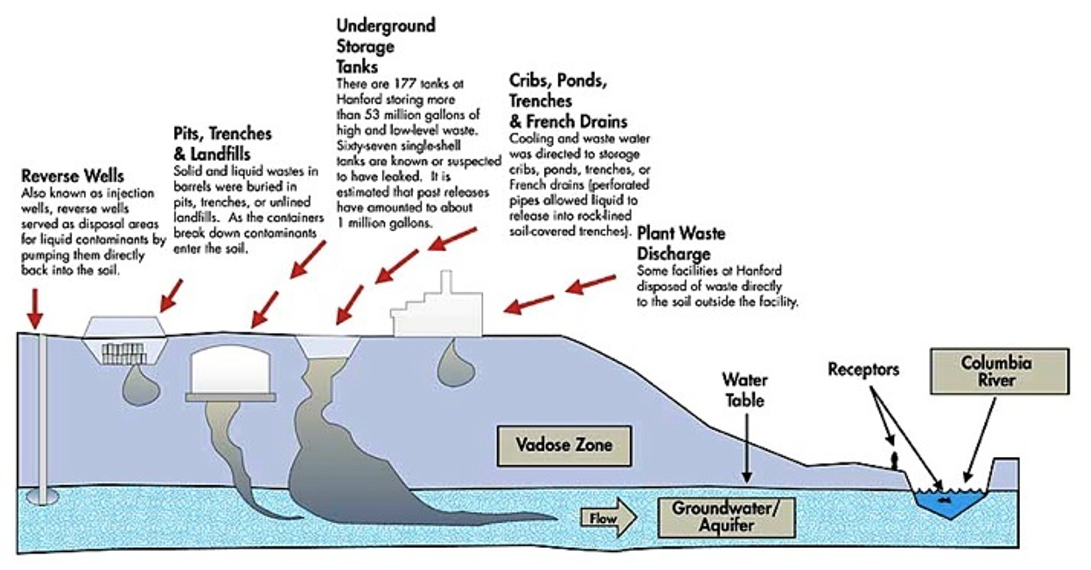
In Part 1 we covered the basics of the Pacific Northwest National Laboratory report, Adaptive Site Management Strategies for the Hanford Central Plateau Groundwater, that outlines an innovative strategy to tackle the challenge of groundwater cleanup. In Part 2 we’ll cover the history of Hanford’s soil and groundwater contamination, current cleanup strategies, and the various challenges to cleaning up the soil and groundwater.
Hanford’s history of soil contamination
The Hanford Site has a history of dumping radioactive and chemical waste directly into the ground on site. About 450 billion gallons of nuclear and chemical waste were dumped directly into the soil during the plutonium production years—the equivalent of more than 680,000 Olympic-size swimming pools. Manhattan Project workers dumped waste in unlined cribs, ponds, ditches, and trenches—four different types of holes in the ground used for disposing of waste. Injection wells pumped the toxic waste directly into the soil to dispose of it.
Workers constructed 177 underground tanks (149 single-shell tanks and 28 double-shell tanks) to hold the most dangerous, high-level waste. However, the soil contamination didn’t stop there. These enormous underground tanks were connected in a row of three or four tanks. The Manhattan Project workers used a process called cascading—which allowed them to fill up one tank with waste, and while the waste solids settled to the bottom, the liquids would flow from one tank to another. If too much waste was added to the final tank, it would overflow to the soil. “From 1944 through the late 1980s, Hanford generated nearly 2 million cubic meters (525 million gallons) of high-level tank waste. Liquid evaporation, discharge to the ground, chemical treatment, and tank leakage reduced this volume by 90%—to 204,000 cubic meters (54 million gallons).”[1]
Cascading wasn’t the only way that waste reached the soil from the tanks. The tank farms were backfilled under an 8-to-10-foot layer of soil before waste was added. Workers built the single-shell tanks between 1943 and 1964. As their name suggests, they only have one liner of carbon steel to contain the waste. Sixty-seven single-shell tanks are known or suspected to have leaked 1 million gallons of waste into the surrounding soil. Two single-shell tanks—B-109 and T-111—are currently leaking. The single-shell tanks were designed to contain the waste for 20-25 years, and they are now more than 40 years past their design life. As these tanks get older and older, they are more likely to fail—causing the waste to leak out into the soil. Once the waste gets into the soil it may remain there—making it very hard to remove—or it may travel with water through the soil and reach the groundwater.
Current cleanup of the groundwater
Today, the soil at the Hanford Site (particularly in the Central Plateau) remains heavily contaminated. Some radioactive and chemical contaminants are more mobile in water, which means a rainstorm may cause those contaminants to move with the water through the soil—reaching the groundwater and ultimately the Columbia River.
One of the cleanup methods to prevent contaminants from spreading and reaching the groundwater is to remove contaminated soil by digging it up and disposing of it in the Environmental Restoration Disposal Facility. Hanford Challenge is concerned that USDOE will decide that it doesn’t need to dig up all of the contaminated soil and will leave it in place—which would increase the risk of harm to future generations.
USDOE implements specific strategies for cleaning up the groundwater. One of those strategies is pump and treat. Pump and treat is the process of pumping contaminated water to the surface, filtering out some of the contaminants, and injecting the water back into the ground. Monitoring wells, extraction wells, and injection wells are interspersed throughout the Hanford Site to implement the pump and treat process. There are six pump and treat facilities on site.
Soil flushing is one strategy used to enhance the pump and treat process. Some contaminants remain in the soil and may take a long time to reach the groundwater. Until the contaminants hit the groundwater, they are impossible to capture with the pump and treat system. Soil flushing speeds up the process by using 225 gallons of water per minute to force—or flush—these hard-to-reach contaminants down to the groundwater where they can be brought up to the surface with the pump and treat system. USDOE has found success using soil flushing to push hexavalent chromium to the groundwater to treat it.
An additional strategy for meeting water quality standards is monitored natural attenuation. Contamination is left to naturally attenuate, which means letting the radiation decay over time. It sounds like a do-nothing approach, and it basically is.
Challenges to groundwater cleanup
USDOE faces many challenges when pursuing groundwater cleanup. As previously mentioned, there are hundreds of contaminated soil sites at Hanford due to past dumping practices and leaking underground tanks. The extent of groundwater contamination is vast.
- There are significant data gaps regarding the number of contaminants in the vadose zone (the area of soil between the ground surface and the water table), the depth and location of the contamination, and the risk the contamination poses to groundwater.
- Some hard-to-control, persistent contaminants, such as technetium-99, iodine-129, uranium, nitrate, and chromium, are located in the deep vadose zone and pose a long-term risk to the groundwater.
- There are extensive groundwater plumes with intermixed contaminants (or contaminants located together), making it difficult to accurately measure the total amount in the aquifer and the contaminant distribution.
Depending on the contaminant, one specific treatment may work better than another. When contaminants are intermixed, the treatment process becomes more complex. Multiple technologies used in tandem or various treatment methods may need to be used to effectively treat intermixed contaminants.- The soil underneath the tank farms is contaminated by tank leaks, accidental spills, and intentional releases, which creates an additional pathway for contaminants in the soil to reach groundwater. As tanks leak—potentially more frequently—they become an additional complexity in groundwater cleanup.
- A borehole is a circular hole drilled into soil or rock that draws samples from deep below ground. USDOE uses boreholes to characterize, or identify, the physical and chemical properties of the contaminants in the vadose zone. Unfortunately, deep borehole characterization is limited in certain areas due to the high price of drilling—contributing to the lack of information regarding the amount, location, and strength of contaminants in the soil.
Geological challenges to groundwater cleanup
Hanford’s geology poses unique challenges to groundwater cleanup. Manhattan Project managers chose the site partially for its geology and proximity to the Columbia River. The reprocessing facilities were sited in certain areas at Hanford because the gravelly soil allowed them to dump waste into the ground, where it percolated down and vanished without a trace. It was a handy way of disposing of the waste—it just disappeared—but the dumped waste now requires a complicated cleanup strategy.
The 200 Area in the Central Plateau contains a high hydraulic conductivity zone that consists of porous soils and rocks that allow contaminants to quickly move through the soil to groundwater and eventually to the Columbia River. USDOE doesn’t know the exact size and location of the hydraulic conductivity zone in the 200 Area, which means that the underground movement of liquids between the Central Plateau and the Columbia River is still an area of considerable uncertainty. On the other hand, some places at Hanford’s Central Plateau have less permeable soils that trap specific contaminants, making it difficult to separate the contaminants from the soil and treat them using the most common cleanup strategies.
Ancient lake beds are hidden underneath the surface and cause contaminants to move laterally (horizontally) instead of vertically down to the groundwater. Lake beds cause contaminants to take longer to reach the groundwater because they aren’t taking the most direct route straight down, and are instead moving sideways. USDOE uses models to predict when specific contaminants will reach groundwater. USDOE bases its models on the assumption that contaminants move vertically to the groundwater. However, ancient lake beds and the lateral flow of contaminants challenge that assumption and highlight the need for USDOE to update its models to better account for the geologic conditions underneath the site.
Perched water also complicates groundwater cleanup. Imagine a bird’s nest that is perched or sitting in a tree. Now, imagine that bird’s nest perched in a tree underground and filled with water. As contaminants move through the soil they can get caught and trapped in that underground bird’s nest. The underground nest creates a pocket of contaminants that is hidden and hard to reach. USDOE is aware of several contaminated perched water areas at Hanford, but lacks information about the size, what contaminants they hold, and how full the perched water areas are. USDOE must incorporate perched water areas into its strategies to ensure a comprehensive cleanup plan for groundwater.
Groundwater cleanup at Hanford is incredibly complex due to the history of waste disposal, the inherently dangerous nature of the contaminants, and the challenges created by the site’s geology. Hanford Challenge urges USDOE to update its groundwater models to include the intricacies of Hanford’s geology, such as ancient lake beds and perched water. Hanford Challenge also encourages USDOE to recognize, investigate, and resolve the uncertainties present in groundwater cleanup.
If you are interested in learning more about Hanford’s geology, check out Tim Connor’s presentation on the cataclysmic floods that shaped the Hanford Site and Vince Panesko’s presentation on the ancient lake beds that impact cleanup.
This blog post is funded through a Public Participation Grant from the Washington State Department of Ecology. The content was reviewed for grant consistency, but is not necessarily endorsed by the agency.
[1] Gephart, Roy. E. (2003). A Short History of Hanford Waste Generation, Storage, and Release. Pacific Northwest National Laboratory, PNNL-13605.
Russia says it destroyed howitzer used to shell Zaporizhzhia nuclear plant
Aug 26 (Reuters) – Russia’s Defence Ministry said on Friday that its forces had destroyed a U.S.-made M777 howitzer which it said Ukraine had used to shell the Russian-controlled Zaporizhzhia nuclear plant.
In its daily briefing, the Defence Ministry said that the howitzer had been destroyed west of the town of Marganets, in Ukraine’s Dnipropetrovsk region.
Reuters could not immediately verify the report.
The Zaporizhzhia nuclear plant, Europe’s largest, was captured by Russian forces in March. It remains near the frontline, and has repeatedly come under fire in recent weeks. Both Ukraine and Russia have accused each other of shelling the facility.
A Crucial Week For The Iran Nuclear Deal
Iran Nuclear Deal Has Never Been Closer, https://oilprice.com/Energy/Energy-General/A-Crucial-Week-For-The-Iran-Nuclear-Deal.html 26 Aug 22, Indirect talks between the United States and Iran are moving closer to a final stage as both Tehran and Washington have responded to the European Union’s final draft, with further talks expected next week.
-It remains to be seen if the Iranian authorities would drop demands such as scrapping the IRGC from the US terrorist list or demanding written guarantees there would be no sudden US snapback on the JCPOA.
-Iranian crude exports have averaged approximately 800,000 b/d so far this year, the highest level since the Trump administration quit the JCPOA, as oversight turned laxer.
-There have been no exports to Europe since November 2018, whilst almost all of Asian demand is coming from China which takes in cargoes either directly or via ship-to-ship transfers in Malaysia.
Iran’s UN envoy slams Israel refusal to join NPT, urges nuclear-weapon-free zone in Middle East
Israel, which pursues a policy of deliberate ambiguity about its nuclear weapons, is estimated to possess 200 to 400 nuclear warheads in its arsenal, making it the sole possessor of non-conventional arms in West Asia.
Friday, 26 August 2022,
A senior Iranian diplomat has denounced Israel’s continued refusal to join the Nuclear Non-Proliferation Treaty (NPT), stressing that establishing a Middle East region free of nuclear weapons is of utmost importance.
Iran’s ambassador and permanent representative to the United Nations, Majid Takht-Ravanchi, made the remarks while speaking to reporters on Friday on the sidelines of the Tenth Review Conference of the Parties to the Treaty on the Non-Proliferation of Nuclear Weapons held at the UN headquarters in New York.
“The issue of the Middle East as a region free of nuclear weapons is one of the important discussions… because the Israeli regime, as the only possessor of hundreds of nuclear warheads, is not ready to join the Nuclear Non-Proliferation Treaty and place its nuclear facilities under the supervision of the International Atomic Energy Agency,” he said.
He added that Israel’s refusal to join the NPT comes as some countries are cooperating with the regime and have always supported it.
The Iranian delegation attending the tenth NPT review conference played a constructive role in highlighting the significance of a Middle East region free of weapons of mass destruction, he said
As documents relating to the NPT review conferences in 1995, 2000, and 2010 have explicitly announced that the Israeli regime must join the treaty, the Iranian team emphasized that the issue should also be included in the final statement of the 10th NPT review meeting, Takht-Ravanchi added.
He emphasized that during the current conference, the Islamic Republic clearly announced that it would not back down from its stance on the importance of a Middle East without any weapons of mass destruction.
“We said that this issue is one of the red lines of the Islamic Republic of Iran and if they want to act honestly and constructively, the literature used in the statements of previous conferences should also be used in this conference in order to move towards a Middle East without nuclear weapons,” the senior Iranian diplomat pointed out.
He noted that Iran seeks to reach a consensus with the participants at the current NPT review conference but it has principles and certain measures must be carried out.
n a Monday address to the Tenth Review Conference of the Parties to the Treaty on the Non-Proliferation of Nuclear Weapons, Takht-Ravanchi expressed concern over the lack of progress in the implementation of the 1995 Nuclear Nonproliferation Treaty (NPT) resolution and the 2010 action plan on the Middle East, saying the Israeli regime must eliminate its stockpile of nuclear weapons.
Takht-Ravanchi also slammed the US double standards, saying Israel’s accession to the NPT “without precondition and further delay” and the placement of all of its nuclear activities and facilities under the comprehensive IAEA safeguards are “essential in realizing the goal of universal adherence to the Treaty in the Middle East and the establishment of a nuclear-weapon-free zone in the Middle East.”
Israel, which pursues a policy of deliberate ambiguity about its nuclear weapons, is estimated to possess 200 to 400 nuclear warheads in its arsenal, making it the sole possessor of non-conventional arms in West Asia.
The illegitimate entity has, however, refused to either allow inspections of its military nuclear facilities or sign the NPT.
What has emboldened Tel Aviv to accelerate its nuclear activities, according to observers, is the support from the US and Europe, the two countries most critical of Iran’s peaceful nuclear program.
The regime has assassinated at least seven Iranian nuclear scientists and conducted a series of sabotage operations against the Islamic Republic’s nuclear facilities.
The west’s false narrative about Russia and China
https://johnmenadue.com/the-wests-false-narrative-about-russia-and-china/ The Western narrative about the Ukraine war is that it is an unprovoked attack by Putin in the quest to recreate the Russian empire. Yet the real history starts with the Western promise to Soviet President Mikhail Gorbachev that NATO would not enlarge to the East, followed by four waves of NATO aggrandisement:
At the core of all of this is the US attempt to remain the world’s hegemonic power, by augmenting military alliances around the world to contain or defeat China and Russia. It’s a dangerous, delusional, and outmoded idea.
There is only one country whose self-declared fantasy is to be the world’s dominant power: the US.
https://johnmenadue.com/the-wests-false-narrative-about-russia-and-china/ By Jeffrey Sachs, Aug 24, 2022, The world is on the edge of nuclear catastrophe in no small part because of the failure of Western political leaders to be forthright about the causes of the escalating global conflicts. The relentless Western narrative that the West is noble while Russia and China are evil is simple-minded and extraordinarily dangerous. It is an attempt to manipulate public opinion, not to deal with very real and pressing diplomacy.
The essential narrative of the West is built into US national security strategy. The core US idea is that China and Russia are implacable foes that are “attempting to erode American security and prosperity.” These countries are, according to the US, “determined to make economies less free and less fair, to grow their. militaries, and to control information and data to repress their societies and expand their influence.”
The irony is that since 1980 the US has been in at least 15 overseas wars of choice (Afghanistan, Iraq, Libya, Panama, Serbia, Syria, and Yemen just to name a few), while China has been in none, and Russia only in one (Syria) beyond the former Soviet Union. The US has military bases in 85 countries, China in 3, and Russia in 1 (Syria) beyond the former Soviet Union.
President Joe Biden has promoted this narrative, declaring that the greatest challenge of our time is the competition with the autocracies, which “seek to advance their own power, export and expand their influence around the world, and justify their repressive policies and practices as a more efficient way to address today’s challenges.” US security strategy is not the work of any single US president but of the US security establishment, which is largely autonomous, and operates behind a wall of secrecy.
The overwrought fear of China and Russia is sold to a Western public through manipulation of the facts. A generation earlier George W. Bush, Jr. sold the public on the idea that America’s greatest threat was Islamic fundamentalism, without mentioning that it was the CIA, with Saudi Arabia and other countries, that had created, funded, and deployed the jihadists in Afghanistan, Syria, and elsewhere to fight America’s wars.
Or consider the Soviet Union’s invasion of Afghanistan in 1980, which was painted in the Western media as an act of unprovoked perfidy. Years later, we learned that the Soviet invasion was actually preceded by a CIA operation designed to provoke the Soviet invasion! The same misinformation occurred vis-à-vis Syria. The Western press is filled with recriminations against Putin’s military assistance to Syria’s Bashar al-Assad beginning in 2015, without mentioning that the US supported the overthrow of al-Assad beginning in 2011, with the CIA funding a major operation (Timber Sycamore) to overthrow Assad years before Russia arrived.
Or more recently, when US House Speaker Nancy Pelosi recklessly flew to Taiwan despite China’s warnings, no G7 foreign minister criticised Pelosi’s provocation, yet the G7 ministers together harshly criticised China’s “overreaction” to Pelosi’s trip.
The Western narrative about the Ukraine war is that it is an unprovoked attack by Putin in the quest to recreate the Russian empire. Yet the real history starts with the Western promise to Soviet President Mikhail Gorbachev that NATO would not enlarge to the East, followed by four waves of NATO aggrandisement: in 1999, incorporating three Central European countries; in 2004, incorporating 7 more, including in the Black Sea and Baltic States; in 2008, committing to enlarge to Ukraine and Georgia; and in 2022, inviting four Asia-Pacific leaders to NATO to take aim at China.
Nor do the Western media mention the US role in the 2014 overthrow of Ukraine’s pro-Russian president Viktor Yanukovych; the failure of the Governments of France and Germany, guarantors of the Minsk II agreement, to press Ukraine to carry out its commitments; the vast US armaments sent to Ukraine during the Trump and Biden Administrations in the lead-up to war; nor the refusal of the US to negotiate with Putin over NATO enlargement to Ukraine.
Of course, NATO says that is purely defensive, so that Putin should have nothing to fear. In other words, Putin should take no notice of the CIA operations in Afghanistan and Syria; the NATO bombing of Serbia in 1999; the NATO overthrow of Moammar Qaddafi in 2011; the NATO occupation of Afghanistan for 15 years; nor Biden’s “gaffe” calling for Putin’s ouster (which of course was no gaffe at all); nor US Defence Secretary Lloyd Austin stating that the US war aim in Ukraine is the weakening of Russia.
At the core of all of this is the US attempt to remain the world’s hegemonic power, by augmenting military alliances around the world to contain or defeat China and Russia. It’s a dangerous, delusional, and outmoded idea. The US has a mere 4.2% of the world population, and now a mere 16% of world GDP (measured at international prices). In fact, the combined GDP of the G7 is now less than that of the BRICS (Brazil, Russia, India, China, and South Africa), while the G7 population is just 6 percent of the world compared with 41 percent in the BRICS.
There is only one country whose self-declared fantasy is to be the world’s dominant power: the US. It’s past time that the US recognised the true sources of security: internal social cohesion and responsible cooperation with the rest of the world, rather than the illusion of hegemony. With such a revised foreign policy, the US and its allies would avoid war with China and Russia, and enable the world to face its myriad environment, energy, food and social crises.
Above all, at this time of extreme danger, European leaders should pursue the true source of European security: not US hegemony, but European security arrangements that respect the legitimate security interests of all European nations, certainly including Ukraine, but also including Russia, which continues to resist NATO enlargements into the Black Sea. Europe should reflect on the fact that the non-enlargement of NATO and the implementation of the Minsk II agreements would have averted this awful war in Ukraine. At this stage, diplomacy, not military escalation, is the true path to European and global security.
1 This Month



Read the Public Inquiry Report, the Commissioners’ report, Surrendering Australia: The AUKUS Deception is available to download for free at aukuspublicinquiry.com. Or just watch the replay of the National Press Club Luncheon.

19 November – Webinar – The Reality of Reprocessing
Time: 11:00 AM Pacific Time (US & Canada) / 2:00 PM Eastern / 7:00 PM UK / 8:00 PM CET
Register for the Zoom Event Here


Shut down the radiation-damaged Heysham nuclear reactors now
To see nuclear-related stories in greater depth and intensity – go to https://nuclearinformation.wordpress.com

Say No to NASA’s Reckless Nuclear Reactor on the Moon
Say No to NASA’s Reckless Nuclear Reactor on the Moon
-
Archives
- November 2026 (128)
- October 2026 (302)
- September 2026 (339)
- August 2026 (330)
- July 2026 (355)
- June 2026 (287)
- May 2026 (306)
- April 2026 (356)
- March 2026 (251)
- February 2026 (267)
- January 2026 (308)
- December 2025 (358)
-
Categories
- 1
- 1 NUCLEAR ISSUES
- business and costs
- climate change
- culture and arts
- ENERGY
- environment
- health
- history
- indigenous issues
- Legal
- marketing of nuclear
- media
- opposition to nuclear
- PERSONAL STORIES
- politics
- politics international
- Religion and ethics
- safety
- secrets,lies and civil liberties
- spinbuster
- technology
- Uranium
- wastes
- weapons and war
- Women
- 2 WORLD
- ACTION
- AFRICA
- Atrocities
- AUSTRALIA
- Christina's notes
- Christina's themes
- culture and arts
- Events
- Fuk 2022
- Fuk 2023
- Fukushima 2017
- Fukushima 2018
- fukushima 2019
- Fukushima 2020
- Fukushima 2021
- general
- global warming
- Humour (God we need it)
- Nuclear
- RARE EARTHS
- Reference
- resources – print
- Resources -audiovicual
- Weekly Newsletter
- World
- World Nuclear
- YouTube
-
RSS
Entries RSS
Comments RSS

