Pilgrim power plant owner Holtec still considering dumping nuclear waste into Cape Cod Bay
Holtec International has 1.1 million gallons of radioactive wastewater to get rid of.
Boston.com By Susannah Sudborough, September 28, 2022 ,
The company working to decommission the Pilgrim Nuclear Power Plant in Plymouth is still considering dumping radioactive waste into Cape Cod Bay despite pushback from activists, lawmakers, and the EPA.
Holtec International has 1.1 million gallons of leftover wastewater from the plant, which closed in 2019, that it needs to get rid of.
NBC 10 Boston reported Tuesday that a representative from Holtec gave an update on the company’s plans at a town hall meeting Monday evening.
“When you do liquid discharges, it is diluted with seawater to non-detectable levels pretty quickly once it’s released, and doing it in small batches is actually the safest manner,” Holtec spokesman Patrick O’Brien told the news station.
But activists from Save Our Bay, a coalition of conservation groups, local leaders, and citizens who oppose the proposed dumping, say Holtec wants to dump the nuclear waste in Cape Cod Bay simply because it’s cheaper.
While O’Brien denied to NBC 10 Boston that dumping is the cheaper option, the group, which protested in Plymouth before the meeting Monday, says the waste will make the bay’s and local waters unsafe.
“The contaminated water will inevitably flow into Plymouth, Duxbury, and Kingston Bays. The bays are semi-enclosed, and circulation currents tend to keep the water in them. It [does] not quickly flush out and disperse in the ocean, but is likely to end up in the sediments at the bottoms of the bays or beaches,” the group wrote on its website.
Additionally, Save Our Bay says, the nuclear waste could contaminate the fish, oysters, clams, and mussels that support the local aquaculture industry, making a major local product dangerous.
The loss of the local fishing and potentially tourism, due to contaminated waters would devastate the local economy, the group says.
Save Our Bays is not alone in opposing the proposed dumping. In January 2022, Sen. Elizabeth Warren, Sen. Ed Markey, Rep. Bill Keating, and Rep. Seth Moulton sent a letter to Holtec stating their opposition.
Additionally, in July, the EPA wrote to the company saying it doesn’t think the company is allowed to dump the waste according to its permit.
According to The Boston Globe, Nuclear Regulatory Commission rules say Holtec can dump the water as long as its radioactivity is not above specified limits……………………….
A decision could come early next year, NBC 10 Boston reported. https://www.boston.com/news/local-news/2022/09/28/pilgrim-power-plant-owner-considering-dumping-nuclear-waste-into-cape-cod-bay-holtec-international-plymouth/—
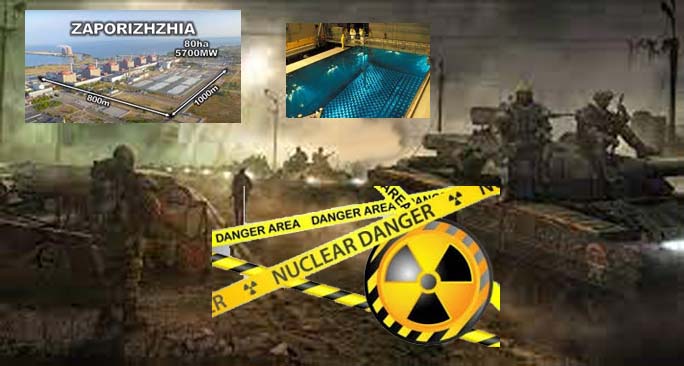
Missile strike near Ukrainian nuclear plant raises new fears. But the real question is why is it there at all?
https://beyondnuclearinternational.org/2022/09/26/another-close-call/ By Linda Pentz Gunter, 28 Sept 22,
“What is Russia thinking?” asked CNN news anchor Ana Cabrera of her guest, retired Air Force colonel, Cedric Leighton, after reports that Russian missiles landed within 328 yards of the South Ukraine nuclear power plant on September 19.
But here’s the question that should have been asked — but rarely is: why are we still using such a profoundly dangerous technology to generate electricity? What are WE thinking? (We will leave aside here the conflicting accusations about who is shelling the reactors. The point is their very presence in a war zone and all that implies.)
Nothing has brought that risk into sharper focus than the Russian invasion of Ukraine, where 15 operational reactors at four sites are sitting duck targets that could release a radioactive nightmare if struck — whether accidentally or deliberately — by either side as battle rages.
When the invasion began on February 24, it was the closed Chornobyl site — scene of the world’s worst, and most notorious, nuclear power plant disaster in 1986 — that was first occupied. Although none of the four reactors there are operating any longer, there is a significant radioactive waste inventory on site. This was stirred up by Russian forces and their heavy equipment. Soldiers even dug sleeping trenches, apparently unaware of the radiation exposure risks that resulted.
This time around, however, Chornobyl is of lesser concern than the four other nuclear sites in Ukraine, although it remains a potential disaster scene largely due to the irradiated fuel stocks on site.
The four active nuclear sites — at Rivne and Khmelnitsky in western Ukraine, and South Ukraine and Zaporizhzhia in the south and eastern regions— are generally described as “newer” than Chornobyl, but this is only true in the technological sense. Chornobyl was an old Soviet RBMK design, lacking containment. Incredibly, Russia still reportedly operates 10 Chornobyl-style RBMK reactors, albeit modified to try to avoid the fatal design flaws that contributed to the 1986 explosion and meltdown.
The operating reactors in Ukraine are VVER pressurized water reactors similar to those used in the United States, for example. The VVER is also a Russian design but with an actual containment, so in theory, more robust than the old RBMKs. However, there is a great deal of doubt that the VVERs, like any reactor today, are robust enough to withstand an onslaught of missiles under war conditions.
Yet, in another sense, the VVER reactors are far older than Chornobyl Unit 4 was when it exploded. That reactor had only been operating approximately two years when disaster struck. The present day 1,000 megawatt reactors in Ukraine have been operational mostly since the 1980s, accumulating much larger radioactive inventories.
As Beyond Nuclear has continued to warn, the radiological — and therefore health — consequences of a major breach of one of these reactors would be far worse than those of the 1986 Chornobyl accident.
But it needn’t take a war. The dangers presented by commercial nuclear power plants are inherent. They are there every day. They are made worse by warfare, which increases the likelihood of a nuclear disaster — and that same war now also increases the danger that nuclear weapons might be used.
And yet, as we continue to “play with fire”, as even IAEA chief, Rafael Grossi described the insanity of shelling near or at nuclear plants in Ukraine, the obvious connection isn’t made.
We’ve seen scientists and media outlets map out how far a deadly radioactive plume would spread if, say, Zaporizhzhia suffered a fatal missile strike. But scarcely if ever do they go on to observe that we are only holding our collective breath so tightly because of the persistent threat that these reactors pose on any given day.
We don’t need to use nuclear power today. We never needed it. And it is a totally insane way to boil water.
Linda Pentz Gunter is the international specialist at Beyond Nuclear and writes for and curates Beyond Nuclear International.
Save the fish: Nuclear Free Local Authorities call for acoustic deterrent at Sizewell C
https://www.nuclearpolicy.info/news/save-the-fish-nuclear-free-local-authorities-call-for-acoustic-deterrent-at-sizewell-c/ 28 Sept 22, The Nuclear Free Local Authorities have written to the Environment Agency calling for the developers of a new nuclear power plant at Sizewell C to be required to install an acoustic fish deterrent to save local fish stocks from destruction should the plant become operational.
The Environment Secretary George Eustace has recently decided that EDF Energy should be required to install a similar device at Hinkley Point C, a new nuclear plant currently being built on the Somerset coast, and as Sizewell C would be built to the same design the NFLA can see no reason why the same condition should not be applied to the Suffolk plant.
Councillor David Blackburn, Chair of the NFLA Steering Committee, has just written to the Environment Agency responding to a consultation over the permits that will be issued to EDF by the Environment Agency now that a Development Consent Order has been granted by a government minister.
Commenting he said: “We are still a very long way from Sizewell C becoming operational and it is far from a done deal. Most of the finance is not in place, there remains doubts about the safety and reliability of the proposed EDR reactor, EDF appears to be having cold feet given its financial position and poor operational performance at home, and local activists are looking to challenge the decision to go-ahead in the courts.
“I hope that the decision to grant approval can be successfully challenged in the courts or that EDF’s many troubles elsewhere may still kibosh the plan, but if somehow, despite the odds, this insane plan goes ahead it is important that we ensure that high standards are encapsulated in the conditions attached to the operation of Sizewell C to protect the natural environment and the people who live in adjoining communities – at least as far as is possible when your neighbour is a huge nuclear power plant.”
Although the NFLA submission to Environment Agency covers many points but two particular concerns are plans for long-term salination and the welfare of marine life.
Councillor Blackburn further explained: “We are grateful to Sizewell C for their advice on our response to this consultation; we completely share their concerns about the adverse impact of this plant on the lives of local people and the local environment. Our two key points in our response are that should EDF Energy look to desalination as a long-term solution to the lack of potable water that an extensive public consultation should take place prior to a decision on approval and that an acoustic fish deterrent should be installed at Sizewell C.
“The Environment Secretary has creditably recently upheld his inspector’s decision to require EDF Energy to install an Acoustic Fish Deterrent at Hinkley Point C. The EPR reactors proposed for Sizewell C will be the same as those proposed for Hinkley Point C. Both sites will be heavily reliant upon sucking in vast amounts of seawater to cool the plant, the impact on local sea life is likely to be similarly destructive. Accordingly, the NFLA believes that an acoustic fish deterrent, which projects sound waves to deter fish entering the plant, should be installed at Sizewell C as a condition of any permit issued by the Environment Agency giving the go ahead.”
White House requests Ukraine nuclear security funding to expand assistance due to nuclear power plant concerns
By Phil Mattingly, CNN, September 27, 2022,
The White House requested $35 million be included in the short-term government funding bill to assist Ukraine’s nuclear security as US officials continue to closely watch the precarious conditions around Europe’s largest nuclear power plant, according to an administration official.
The additional funds would serve to bolster the significant assistance already provided by the US National Nuclear Security Administration to Ukrainian officials in the months since Russia invaded the country, the official said. It comes as US officials and their international counterparts have been on high alert over the potential for a nuclear accident at the Zaporizhzhia nuclear power plant in southern Ukraine.…………………….
The facility, held by Russian troops since March, has for weeks served as an increasingly hazardous flashpoint in the war. Shelling at and around the site has damaged infrastructure, cut power lines and drawn a sustained international effort to de-escalate the situation. Russia and Ukraine have blamed each other for the shelling…………………… https://edition.cnn.com/2022/09/27/politics/ukraine-funding-request-nuclear-power-plant/index.html
Iran Nuclear Deal Talks at Dead End, Biden Admin Tells Congress in Classified Briefing
Adam Kredo • September 28, 2022, The Biden administration’s negotiations with Iran over a revamped version of the 2015 nuclear deal have hit a dead end, jeopardizing the likelihood of a new agreement, senior U.S. officials informed Congress during a classified briefing…………………………………. more https://freebeacon.com/national-security/iran-nuclear-deal-talks-at-dead-end-biden-admin-tells-congress-in-classified-briefing/
Maryland couple pleads guilty to selling nuclear-related secrets
The couple was charged with selling nuclear information to a foreign country.
abc news, By Aaron Katersky and Luke Barr, September 28, 2022,
Jonathan and Diana Toebbe pleaded guilty for a second time on Tuesday to federal charges that they tried to sell secrets about U.S. submarine nuclear propulsion systems to a foreign country.
The couple originally pleaded guilty in February but a judge threw out the plea agreements last month after deciding the sentences called for were too low……………………………………………….
The new plea agreement appeared to call for a sentence of about 12 years in prison, four times as long as Diana Toebbe’s prior agreement. Magistrate Judge Robert Trumble accepted her plea but noted a different judge would determine whether the new sentencing terms were sufficient.
Jonathan Toebbe, 43, also pleaded guilty to a single count of conspiring to communicate restricted data pursuant to an agreement that calls for a sentence of up to 17 years in prison. https://abcnews.go.com/Politics/maryland-couple-pleads-guilty-selling-nuclear-related-secrets/story?id=90581860
Subsidies to Nuclear Power in the Inflation Reduction Act still won’t save the poor economics of nuclear power – Cato Institute
Subsidies to Nuclear Power in the Inflation Reduction Act, Cato Institute By David Kemp and Peter Van Doren, 28 SEpt 22, Last month, the United States enacted the Inflation Reduction Act (IRA),……… The act includes many provisions to subsidize clean power plants, including nuclear generators.
Many believe that nuclear is the perfect solution to climate change…….. Our recent working paper examines the economics of nuclear power and concludes that it is very high‐cost relative to natural gas generators. Most importantly in the context of climate change, we also determine that the potential climate benefits of nuclear are insufficient to offset its costs.
From the 1960s to 1980s, many nuclear power plants were built, but nuclear construction costs rose dramatically resulting in a severe decline in new construction. Very few plants have been built in the United States and Western Europe in the past several decades. In fact, the most recent projects in the West (the United States, France, the United Kingdom, and Finland) have experienced numerous issues with quality control, supply chains, and labor force management, leading to a more than doubling of construction schedules and costs. The fact that nuclear construction costs increased dramatically in countries with different regulatory regimes suggests that the problem is not simply overly cautious regulators.[1]………………..
Nuclear power is capital intensive. Thus, its levelized cost of electricity (LCOE) depends mostly on its construction cost. To model different scenarios, our calculations use three levels of construction costs for nuclear. The highest level (a cost of $9,000 per kilowatt of capacity constructed) represents the average construction costs of the West’s most recent projects. The middle and low levels ($6,700 and $4,000 per kilowatt, respectively) envision substantial reductions in nuclear construction costs through some combination of regulatory reform, improvements to construction management, or innovation. The low level, which is nearly 65 percent lower than the most recent nuclear project in the United States (the Vogtle plant in Georgia where ongoing construction has reached costs of about $11,000 per kilowatt), is particularly optimistic. Whether such a reduction is achievable is not known, but historically US nuclear construction costs have increased as new capacity has been built………………………………………………………..
The IRA expands subsidies to new nuclear plants through two options for tax credits, a production tax credit (PTC) and an investment tax credit (ITC)……………………………………………………………………………………..
The IRA subsidies are not sufficient to change the economics of nuclear power. ………..https://www.cato.org/blog/subsidies-nuclear-power-inflation-reduction-act
The Insanity That Grips Washington – militarism applauded in New York Times
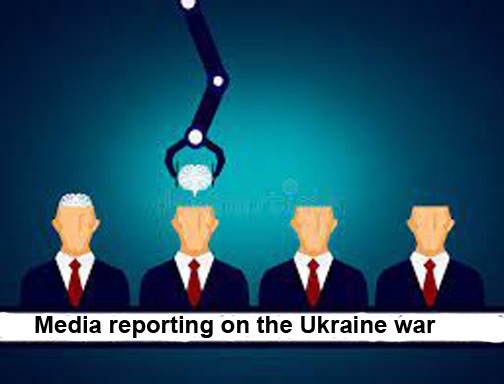
You know you’re living in a profoundly sick society when the world’s most influential newspaper runs propaganda for World War III while voices pushing for truth, transparency and peace are marginalized, silenced, shunned, and imprisoned, writes Caitlin Johnston.
https://consortiumnews.com/2022/09/28/the-insanity-that-grips-washington/ By Caitlin Johnstone, CaitlinJohnstone.com, 28 Sept 22,
The New York Times, which consistently supports every American war, has published an op-ed by a neoconservative think tanker titled “Biden’s Cautious Foreign Policy Imperils Us“.
This would be Joseph Biden, the president of the United States who has been consistently vowing to go to war with the People’s Republic of China if it attacks Taiwan, and whose administration has been pouring billions of dollars into a world-threatening proxy war in Ukraine which it knowingly provoked and from which it has no exit strategy.
With this administration’s acceleration toward global conflict on two different fronts, one could easily argue that Biden actually has the least cautious foreign policy of any president in history.
“In the aftermath of Vladimir Putin’s recent nuclear threat and call-up of reservists, it was reassuring for the leader of the free world to be unflinching,” writes the article’s author Kori Schake, who then adds, “Rhetoric aside, the administration has signaled in numerous other ways that Putin’s threats have constrained support for Ukraine.”
As though the possibility of nuclear war should not constrain U.S. proxy warfare in that country. As though the crazy thing is not the U.S. government’s insane nuclear brinkmanship with Russia, but its reluctance to go further.
More Money for War
Schake criticizes the fact that while Biden has been saying a PRC attack on Taiwan would mean a direct U.S. hot war with China, the U.S. military would need far more funding and far greater expansion to be able to win such a war, so it should definitely do those things instead of simply not rushing into World War Three.
“But worse are the real gaps in capability that call into question whether the United States could indeed defend Taiwan,” Schake writes, adding:
“The ships, troop numbers, planes and missile defenses in the Pacific are a poor match for China’s capability. The director of national intelligence, Avril Haines, has assessed that the threat to Taiwan between now and 2030 is ‘acute,’ yet the defense budget is not geared to providing improved capabilities until the mid-2030s. More broadly, the Biden administration isn’t funding an American military that can adequately carry out our defense commitments, a dangerous posture for a great power. The Democratic-led Congress added $29 billion last year and $45 billion this year to the Department of Defense budget request, a measure of just how inadequate the Biden budget is.”
As Shchake discusses the urgent need to explode the U.S. military budget [already at $777.7 billion] in order to defend Taiwan, The New York Times neglects to inform us that Schake’s employer, the American Enterprise Institute (AEI), has been caught accepting a small fortune from Taiwan’s de facto embassy while churning out materials urging the U.S. government to go to greater lengths to arm Taiwan.
In a 2013 article titled “The Secret Foreign Donor Behind the American Enterprise Institute,” The Nation’s Eli Clifton reports that, thanks to a filing error by AEI, the Taipei Economic and Cultural Representative Office was found to have been one of the think tank’s top donors in 2009. Had that filing error not been made, we never would have learned this important information about AEI’s glaring conflict of interest in its Taiwan commentary.
AEI is one of the most prominent neoconservative think tanks in the United States, with extensive ties to Bush-era neocons like John Bolton, Paul Wolfowitz, and the Kristol and Kagan families, and has played a very active role in pushing for more war and militarism in U.S. foreign policy. Dick Cheney sits on its board of trustees, and Mike Pompeo celebrated his one year anniversary as C.I.A. director there.
Epitome of the Revolving Door
Schake herself is as intimately interwoven with the military-industrial complex as anyone can possibly be without actually being a literal Raytheon munition.
Her resume is a perfect illustration of the life of a revolving door swamp monster, from a stint at the Pentagon, to the university circuit, to the National Security Council, to the U.S. Military Academy, to the State Department, to the McCain-Palin presidential campaign, to the Hoover Institution, to the International Institute for Strategic Studies, to her current gig as director of foreign and defense policy studies at AEI.
Her entire career is the story of a woman doing everything she can to promote war while being rewarded with wealth and prestige for doing so.
And now here she is being granted space in The New York Times, a news media outlet of unrivaled influence where enemies of U.S. militarism and imperialism are consistently denied a platform, to tell us all that the Biden administration is endangering us not with its insanely reckless hawkishness, but by being too “cautious”.
One of the craziest things happening in the world today is the way westerners are being trained to freak out all the time about Russian propaganda, which barely exists in the west, even as we are hammered every day with extreme aggression by the immensely influential propaganda of the U.S.-centralized empire.
You know you are living in a profoundly sick society when the world’s most influential newspaper runs propaganda for World War Three while voices pushing for truth, transparency and peace are marginalized, silenced, shunned, and imprisoned.
HISTORIC CONTEXT OF THE REFERENDA IN UKRAINE.
Popular Resistance, By Moon of Alabama., September 24, 2022, Educate!
Voting for membership in the Russian Federation has started in four oblast of Ukraine:
………………….. The Ukrainian regime has resorted to pure terrorism to prevent the votes from happening:
” Ukrainian partisans, sometimes working with special operations forces, have blown up warehouses holding ballots and buildings where Russian proxy officials preparing for the vote held meetings. Ukrainian officials have acknowledged that they are engaged in a campaign to assassinate key Russian administration officials; more than a dozen have been blown up, shot and poisoned, according to Ukrainian and Russian officials.“
Such behavior by the Zelenski regime against its still Ukrainian compatriots will only encourage the people in the four oblast to vote for an alignment with Russia.
The propaganda in the ‘west’ will declare that the vote is irregular and that the results, likely to be pro-Russian, will be fake.
But a view on historic election outcomes since Ukrainian independence in 1991 show clear geographic preferences in east and south Ukraine for pro-Russian policies:
[ The original here shows a graphic chart illustrating voting patterns over the years]
The graphic above is from research published by the Eurasian Research Institute of the International Hoca Ahmet Yesevi Turkish-Kazakh University. Its author writes:
“As we can see, the have always been a clear-cut geographical split in the way the regions of Ukraine vote for particular candidates. The East and West division or also referred as Southeast and Northwest division was always present throughout the electoral history of the independent Ukraine. It is conventionally believed that the eastern part of Ukraine is more influenced by Russia politically, economically and culturally. Therefore, the presidential candidates proposing more pro-Russian agenda usually gain much more political support in eastern regions than in other parts of Ukraine.
On the other hand, the western part of the country has traditionally been more pro-European with strong reference to traditional core Ukrainian ethnic traditions and values. Consequently, presidential candidates with pro-European political agenda and traditional Ukrainian appeal usually had strong support in western regions of the country. It is interesting to note that preferences of the electorate were not related to the geographical origin or background of the presidential candidates and any candidate could easily become popular in the east as well as in the west. Moreover, the same candidate could be both pro-eastern and pro-western in different periods of time as did Leonid Kuchma in 1994 and 1999, who is the only Ukrainian president to serve two consecutive terms from 1994 to 2005.“
The division is consistent with ethnic and linguistic differences between those parts of Ukraine.
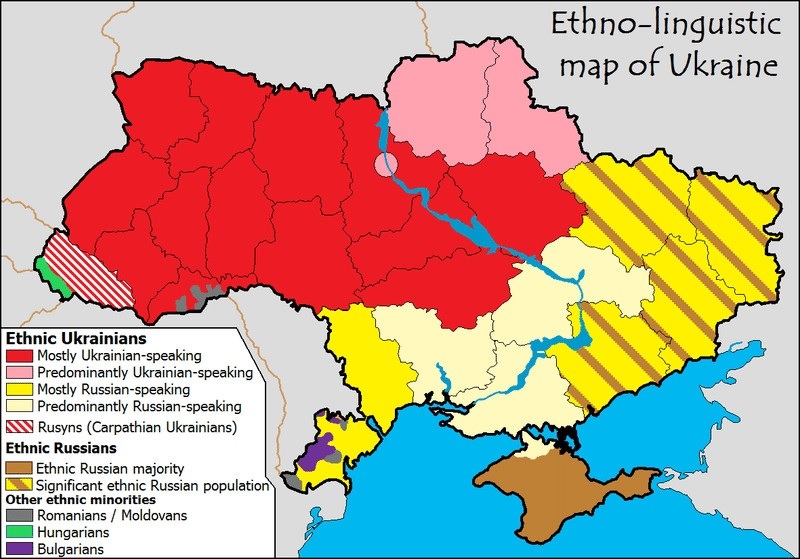
In 2014, after the violent fascist coup in Kiev, one of the first laws implemented by the new government removed the Russian language from official use. Instead of overcoming the differences between its people it only sealed the predominant split in Ukraine.
The election promise of the current Ukrainian president Vladimir Zelenski to make peace with the Russia aligned rebellious Donbas region by adhering to the Minsk 2 agreements was rewarded with a large share of southeastern votes for his presidency. However, after having been threatened with death by fascists, Zelenski has made a 180 degree turn and has since posed as Ukrainian nationalist. In consequence he has lost all support in southeastern Ukraine.
The southeastern parts of today’s Ukraine have for centuries been part of the central Russian empire. They were only attached to the Soviet Republic of Ukraine under Lenin’s rule in 1922 and, in the case of Crimea, in 1954 under Nikita Khrushchev who himself had grown up in the Donbas region.

A likely high turnout and majority vote for membership in the Russian Federation will only correct the historic misalignment created by those illogical transfers.
https://popularresistance.org/historic-context-of-the-referenda-in-ukraine/
UK government to change the rules – so that billions of pounds of pension funds can go to dodgy new nuclear projects

Pension fund reforms will help to unleash wave of investment in nuclear energy, according to senior industry sources. The Chancellor, Kwasi Kwarteng, announced a plan on Friday to unlock billions of pounds of cash that could be poured into major infrastructure programmes and innovative businesses. The Government is scrambling to get energy projects off the ground following the Russian invasion of Ukraine.
French state energy giant DF is developing Sizewell C and has received UK Government backing. But
the project still needs to drum up billions of pounds in private investment. Kwarteng’s plan will relax rules in order to allow fund managers to invest in assets that will potentially take a long time to make a return.

Details of the changes are likely to be closely monitored by regulators and pension campaigners. Tom Greatrex, chief executive of the Nuclear Industry Association, said pension money ‘will be a boost to the
prospect of getting new nuclear plants built to fix our energy security crisis’, adding: ‘The first big infrastructure project where this will have an effect could well be Sizewell C.’ He said it was a ‘very important step’ alongside two other major changes that are shaking up the industry.

The first is a new financing model, called the ‘regulated asset base’, which allows investors to receive returns during the construction phase of big projects.
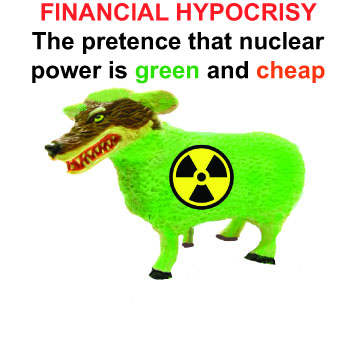
The second is a planned rebranding – expected later this year – of nuclear as green energy, which it is hoped will attract backers that are currently barred from putting money into the sector. Kwarteng’s plan
could also help spur funding for a fleet of mini nuclear reactors being developed by engine maker Rolls-Royce. A spokesman for Rolls-Royce said: ‘This broadens the pool for vital UK infrastructure funding. SMRs are perfectly sized for pension investment owing to the lower project costs of around £2billion.
Mail on Sunday 24th Sept 2022
Vladislav Ugolny: Ukraine is targeting civilians for retribution in the east while its Western backers turn a blind eye
Tens of thousands of residents of Kharkov region may become victims of Kiev’s “justice”
https://www.rt.com/russia/563216-future-victims-of-ukrainian-justice/ By Vladislav Ugolny, a Russian journalist based in Donetsk, 23 Sept 22
The Ukrainian offensive in Kharkov Region, launched earlier this month, led to Russia’s armed forces losing control of a number of settlements.
These include the towns of Balakleya, Izium, Kupiansk, Volchansk and a number of villages and small locales. Nevertheless, the Russian army, by concentrating on rearguard battles, was able to avoid significant losses and managed to retreat to the left bank of the Oskol River to regroup.
However, the primary victims of this turn of events were the inhabitants of the aforementioned areas who are now in the hands of Ukraine.
Left behind
There is no exact information about the population of this region. The last census was conducted by Kiev more than 20 years ago, and the country’s statistics are known to be wildly inaccurate.
At the outset, we can estimate the pre-war population at 200,000 people. After the outbreak of hostilities, some were forced to flee. The number of refugees depended on the intensity of the fighting. For example, in the Russia-border town of Volchansk, people continued to live normally – they had not heard firing in the city since March – and there has always been humanitarian aid. However, the frontline villages south of Izium were virtually wiped off the face of the earth.
In any case, we are talking about tens of thousands of people. Most likely, at least 100,000 people lived in the Russian-controlled territories. Some of them remain under the protection of the Russian army, which controls the left bank of the Oskol, and villages such as Kupiansk-Uzlovoi and Borovaya, which have now become the sites of intense hostilities.
After the beginning of the Ukrainian offensive, some Kharkov Region residents were forced to leave their homes. An evacuation was carried out in Volchansk, Veliky Burluk, Kupiansk and Izium. Various estimates suggest that between 5,000 and 25,000 people have fled to Russia in September alone.
According to Readovka journalists, Voronezh Region accommodated about a thousand refugees. Another small number left Kharkov and headed to the Donetsk and Lugansk People’s Republics, in particular to the nearest district center of Svatovo.
In any case, most local residents have remained in situ. Based on the communication with residents of small Donbass front-line towns that have been shelled for eight years, it is safe to say that such a decision is not politically motivated. Residents of such areas, many of whom are older people, those with disabilities, families with household plots or low-mobility relatives who require care, usually cling to their land, homes and traditional way of life to the end. They are the ones who have not evacuated their homes in recent months, and it is they who are now under threat.
Ukraine is preparing ‘mop-ups’
A number of channels have appeared in the Telegram messenger app, one of the leading social media platforms for both sides of the conflict, which publish the personal data of so-called “collaborators.” The basis for accusations could be anything, including communicating with the Russian military or receiving humanitarian aid. Some of these channels are currently blocked, after a wave of complaints to Telegram’s technical support.
Despite this, some remain operational and many dehumanize Russia’s supporters as “zhduny(rus) – waiters.” According to the public consensus in Ukraine, such people who sympathize with Moscow are the cause of the conflict. In the eyes of Ukrainian radicals, anyone who expresses a positive attitude towards Russia is a threat to national security.
Thus, personal data in the early days of the offensive was published for one purpose: to point out enemies so that they would be killed during the “sweep” – a set of actions aimed at establishing control over occupied territory undertaken by the army, mercenaries and nationalist battalions. ‘Mopping-up’ is outside the criminal procedure code and is not regulated by any laws. Law may come to the territory later but, in the very first days, “revolutionary justice” is carried out, without lawyers and with the functions of judge, prosecutor and executioner performed by Ukrainian combatants.
To help their murderous cause, similar channels are being created that publish personal data with calls for lynching.
After the ‘cleansing’ is completed, elements of the Ukrainian legal system will come to the captured cities. They will focus on the concealment of war crimes committed during the ‘clean-up‘, and instead point the finger at Russia. The last two tasks will be carried out simultaneously, such as in Bucha, and those killed by Ukrainians will be cynically presented as victims of the Russian army.
Demonstrative detentions
According to the Security Service of Ukraine (SBU), as of last week 16 people suspected of collaborating with Russian authorities had already been detained. The security agents are first and foremost interested in tax officials responsible for the functioning of local businesses during Moscow’s control of the territory. However, local teachers who switched to teaching the Russian curriculum are also at risk.
Despite international humanitarian law, which obliges the party in control of a territory to preserve the educational process and emphasizes that no harm be done to educators, Kiev seems determined to punish teachers, to use them as an example to others.
Deputy Prime Minister of Ukraine Irina Vereshchuk says that these teachers committed crimes and should be punished for high treason. Such measures by the Ukrainian government are aimed primarily at intimidating educators in Russian-controlled territory. By showing a willingness to prosecute civilian workers, Kiev is raising the stakes.
Ukrainian law enforcement is also known to detain forestry workers, for having helped the Russian army to collect firewood. The details are unknown: whether they supplied the Russians with firewood on a commercial basis, felled the forests entrusted to them, or simply told the soldiers where to chop, remains unknown.
Traditions of Ukrainian ‘justice’
Any civilian living in Russian-controlled territory could be charged with collaboration. Ukraine has a special ministry for the reintegration of “temporarily occupied territories,” which since 2016 has been developing a policy of “filtering” the civilian population. Initially, its activity was concentrated around Donbass and Crimea but its scope has now expanded.
The most striking example is the law ‘On the State Policy of the Transitional Period’, which has been criticized by, among others, the Venice Commission [on constitutional law] for the fact that Ukrainian state policy in the territories it occupies is aimed at investigating only the alleged war crimes of the opposite side, ignoring the goal of establishing the truth about all crimes. This law also introduced differentiated treatment of citizens, depending on their level of interaction with Russia and/or the Donbass republics.
The topic of differentiating guilt – and, according to Ukraine, the entire civilian population is guilty to a greater or lesser degree – was then promoted by all sorts of non-profit organizations. So the Crimean Tatar Resource Center engaged with the Soros Foundation’s ‘Vozrozhdeniye’ and the extremist organization ‘Mejlis of the Crimean Tatar people,’ who claim to be the exiled Ukrainian government of Crimea, developed a whole methodology for evaluating the degree of collaboration.
For a demonstration of this scale, Ukrainians cited three respective examples: a doctor at a Crimean city hospital, an acting city council deputy and the ex-chief prosecutor of Crimea, Natalya Poklonskaya.
According to the methodology, the doctor scores 17 points, the deputy 30, and Poklonskaya 86. Thus, any Crimean doctor is already guilty of collaborationism, having 17 points. Since 2014, Ukrainian society, represented by non-profit organizations, has debated the doctor’s degree of guilt and the punishment which ought be meted out. We see the results of such discussions in Kharkov Region.
Preparing the ‘next Bucha’
In addition to fighting teachers and foresters, Ukrainian law enforcement and the media are also busy falsifying war crimes. They open the so-called “cellars” – illegal prisons and torture chambers, in which alleged prisoners of war and civilians were kept. The process of falsification relies on vivid shots – frames with a prayer scratched on the wall of one of the basements.
Another fabrication involved seven Sri Lankan students attending the Kupiansky Medical College, which was allegedly held by Russian military personnel since March, who testified about torture by the Russians.
The official position is simple: angry Russians simply detained and tortured foreigners. That the Russian army in fact evacuated them from Mariupol and Kherson is ignored. For the time being, Sri Lanka’s Ministry of Foreign Affairs is asking Kiev to provide more information about its citizens. A fair investigation, however, should not be expected until those Sri Lankans find themselves outside the hands of the Ukrainian state.
Speaking of Kiev’s hand, another media symbol of the “genocide of the Ukrainian people” was presented as the hand of a deceased man with rubber bracelets in the colors of the Ukrainian flag. This was apparent evidence of a hate crime: a man killed for wearing Ukrainian symbols. As it turned out, the body was that of Sergey Sova, a member of the 93rd Mechanized Brigade, who was killed during fighting near Izium.
In general, the only mass graves that Ukrainian propaganda now clings to are the cemeteries organized by Russians, where the victims of the military conflict were buried, including Ukrainian soldiers. There is an inscription on one of the crosses, in particular, “APU [Ukrainian Armed Forces] 17 people, Izium, from the morgue.” Ukrainians claim that there are 440 bodies there. Some of the crosses have memorial plaques, some only an inventory number.
The bodies were buried by the Russian army in accordance with the traditions of the region. Perhaps, of course, among those buried under the cross are Muslims, Jews, or adherents to pagan beliefs popular among Ukrainian neo-Nazi battalions, but the Russians did everything possible on their part to ensure the remains of the enemy were not desecrated.
In normal circumstances, these bodies would have been given to the Ukrainian side in return for the bodies of dead Russian soldiers, but Ukraine boycotted these exchanges due to an unwillingness to admit significant losses. In particular, the son of the aforementioned Sergey Sova learned a few months later about the fate of his father and through the media requested the body be transferred back home for a proper burial. Prior to that, Sova had most likely been listed as missing, a ploy that suppresses official numbers of dead Ukrainian soldiers and avoids compensation payments to their families.
Now, however, the Ukrainian soldiers killed in battle and buried in accordance with the dominant religious traditions in Ukraine will be counted as victims of an “alleged genocide.” After a while, when it is impossible to distinguish whether people were killed in early September or mid-September, they will be presented as victims of the retreating Russian army.
All of this is a sinister and cynical story, the truth of which we can learn only after the return of the Russian army to Kharkov. Only then will the massive machine of lies, propaganda and disinformation, which is the work of the Ukrainian government in the occupied territories, be broken, and the world will be able to learn about the real war criminals. As when we discovered after the liberation of Mariupol and the establishment of control over the buildings of Mariupol Airport, that the Ukrainian Security Service and Azov turned it into a concentration camp, known as ‘The Library.’
The deadly game of nuclear escalation

https://barbadostoday.bb/2022/09/25/btcolumn-the-deadly-game-of-nuclear-escalation/ Article by
Sasha Mehter, 25 Sept 22, by Lenrod Nzulu Baraka
Military mobilisation in Russia has led to thousands of Russians fleeing their country to escape conscription. Russians, perhaps mindful of the 27 million of their countrymen that fell defending the motherland against Nazi aggression, are saying no to the prospects of becoming cannon fodder for another war between Russia and the rest of Europe. Direct flights from Russia to countries that do not require Russians to have visa are already sold out.
Russian mobilisation comes at a time when European and America belligerence is at an all time high. President of the European Commission Ursula von der Leyen has doubled down on Russian sanctions saying that the sanctions were here to stay and that now was a time to show resolve not appeasement. Maybe she is trying hard to shore up the commitment of European nations that are staring down a bleak winter of discontent.
President Biden fresh from his 60 Minute interview in which he bluntly stated that he was willing to send American troops to assist Taiwan if that country was threatened by invading Chinese forces, amplified Ursula von der Leyen’s hawkish rhetoric. With a very straight face President Biden berated Russia for wanting to extinguish Ukraine’s right to exist as a state. I guess he forgot what the American government did to Iraq, Libya, and Yugoslavia.In his speech at the UN President Biden reminded his fellow world leaders that no nation should be allowed to pursue imperialistic ambitions without consequences. He probably winked at the leaders of Israel and Saudi Arabia as he said these words to remind them that his statement did not apply to their nations. The US has used its veto over fifty times to shield Israel from UN resolution condemning Israeli actions against Palestinians. And who could forget the famous fist bump between President Biden and Crown Prince Mohammed bin Salman after President Biden pariah threat.
Undaunted and undeterred by the European Community, NATO, and the US and its allies, President Putin ordered a military mobilisation of 300 000 reservists. In a televised address to his nation President Putin stated that if the territorial integrity of his nation was threatened, he would use every available means to protect Russia and its people. President Putin’s cryptic weathervane comment in connection with his nuclear statement preceding it, suggests that the deadly game of nuclear escalation has started.
The US and NATO bring to the table an impressive array of military and economic weapons many of which have already been deployed against Russia. On its own, Russia will not be able to withstand the American /NATO assault indefinitely. The longer the Ukrainian war drags on the weaker Russia’s position becomes. A major Russian escalation could however turn the tide in Russia’s favor.
The formal annexation of new Ukrainian territory may fit the bill for an escalation that might prove to be decisive. The West will have to decide whether President Putin is bluffing about his nuclear threat as they decide on an appropriate response. Ukrainian attacks against territory formally annexed by Russia will be interpreted as an attack on Russia by Ukraine. The path to total war will be open and Russia will unleash its most potent weapons on Ukraine and secondly on any NATO or American forces that come to Ukraine’s assistance.
Since Russia will be the underdog in an all out dogfight with NATO and the US, Russia will have to rely on its nuclear arsenal either as a deterrent to outright invasion of Russia by NATO and US forces or as a game changing strategy to decimate the opposition. Russia may very well decide to go nuclear for the same reason the US went atomic against the Japanese. Rather than throwing his population into the meat grinder of a conventional war, Putin may go instead for a few precision strikes designed to instill terror in the camp of the enemy. Once that first nuclear button is pushed everything changes and the world that we know will be transformed.
Lenrod Nzulu Baraka is the founder of Afro-Caribbean Spiritual Teaching Center.
The Ukraine war could open the nuclear Pandora’s box
If neither Russia nor the West backs down, the scope and dimension of the conflict will change dramatically
Nato could be forced to intervene directly, for example to protect Ukraine’s nuclear reactors, if Mr Zelenskyy requests it. Ukraine is home to 14 reactors in addition to the Russian-controlled Zaporizhzhia plant in the south-east. In such a scenario, the war would become a European war.
The US, also to help protect the nuclear reactors, might be willing to supply missiles to Ukraine with a range of up to 400 kilometres, long enough to reach Crimea and perhaps even the Russian capital. In which case, according to a Russian expert, Moscow could deploy nuclear weapons.
The National RAGHIDA DERGHAM 25 Sept 22, The war in Ukraine has entered a decisive phase, with Russian President Vladimir Putin ordering referendums in the Donbas last week. The outcome of these referendums, which the West believes Moscow has designated with the purpose of annexing Ukraine’s Russian-controlled regions, will change the rules of the conflict. At the same time, Mr Putin has invoked his government’s nuclear options and declared a partial mobilisation of up to 300,000 conscripts, indicating the expansion of the war in the coming weeks.
It is now clear to anyone who previously thought Mr Putin might take steps to negotiate with Kyiv or back down that he is convinced he can – and is determined to – prevail in Ukraine and will not entertain the idea of a defeat. The Kremlin is not afraid of inviting a western military intervention and has put Nato on edge by talking about victory at any cost, including a nuclear cost.
On the other hand, it is clear that American and European leaders have made their decision in the equation of victory-or-defeat and will not allow Russia to seize Ukraine, no matter the cost. This means that, what appeared impossible a month or two ago is now in the realm of plausibility, meaning direct western intervention in the war, in the event of Russia deploying tactical nukes – which are not strictly “tactical” or “small radius” weapons.
So who will win and who will lose in Ukraine?
First, let’s address the big picture – the US strategy that many believe is to implicate the Russian leadership and its system, if not Russia itself, for calculations related to Washington’s grand strategy vis-a-vis China’s rise. It must be said that no matter the planners’ genius, it requires the target to fall into the trap. Indeed, Moscow did not resist this trap. It even doubled down. Its leadership thought its ultimatums and escalations would force the West to back down and comply with its demands, and therefore, enable a Russian victory in Ukraine. So far, it has lost its bets and continues to follow the path charted for it by the western powers towards an ambush that could prove disastrous for Russia.
Comparisons have been made between Moscow’s intervention in Afghanistan, which eventually led to the break-up of the Soviet Union, and the Ukraine war that could have dire consequences for the Russian Federation. Backing down now could amount to a significant setback for Moscow. Yet, the paradox is that continuing this war carries the same risks, particularly if Russia loses. For this reason, defeat is not a word in its dictionary and not an option for its military, especially after the war exposed the latter’s weaknesses and undermined its prestige.
From Washington’s point of view, defeating Russia helps the American strategy against China. US National Security Council strategists believe that defeating Russia would cause Beijing to lose a strategic partner practically and psychologically. It also means, according to one informed expert, that China would lose its Russian “buffer zone”, forcing it to the frontline in its strategic stand-off with the US………………..
Russia will not allow Ukraine to be shared by the two sides. But nor will Ukrainian President Volodymyr Zelenskyy back down. He sees Moscow’s failure to remove him from power as a decisive moment in the war. He is also confident that Nato will guarantee Kyiv the military edge. Modern warfare is not limited to what goes on in the battlefield; it’s also a technological war, and Mr Zelenskyy is using Nato’s advanced technology to fight Moscow.
Nato could be forced to intervene directly, for example to protect Ukraine’s nuclear reactors, if Mr Zelenskyy requests it. Ukraine is home to 14 reactors in addition to the Russian-controlled Zaporizhzhia plant in the south-east. In such a scenario, the war would become a European war. The US, also to help protect the nuclear reactors, might be willing to supply missiles to Ukraine with a range of up to 400 kilometres, long enough to reach Crimea and perhaps even the Russian capital. In which case, according to a Russian expert, Moscow could deploy nuclear weapons.
The Kremlin is seen to be paving the way towards being able to use these weapons. The referendums in the Donbas, to conclude on Tuesday with the Russian expectation that majorities will vote in favour of joining its federation, will be followed by the annexation of those regions. Subsequently, from September 29-30, after the Russian Duma endorses the results, any assault on those regions would amount to an assault on Russia, giving the Kremlin the right to respond by all means necessary, included nuclear ones.
Put differently, according to another expert, “the buffer zone between Russia and Ukraine will disappear, and the war will enter a new threshold that includes the activation of Russian strategic nuclear instruments based on national laws to defend Russian territories using all available means”.
A Russian military victory, if it were to transpire, may require an escalation that would bring with it much destruction. For this reason, the next two weeks will not only be crucial, but possibly also dangerous. https://www.thenationalnews.com/opinion/comment/2022/09/25/the-ukraine-war-could-open-the-nuclear-pandoras-box/
International Day for the Total Elimination of Nuclear Weapons 2022: History, Significance and Celebration
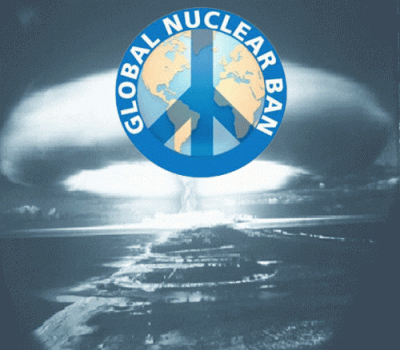
https://www.news18.com/news/lifestyle/international-day-for-the-total-elimination-of-nuclear-weapons-2022-history-significance-and-celebration-6028441.htmlBy: Lifestyle Desk
The day reminds people of the dangers of nuclear weapons and urges world governments to cooperate and bring about a permanent and complete nuclear disarmament.
nternational Day for the Total Elimination of Nuclear Weapons is observed on September 26 every year. The devastating impact of the 1945 Hiroshima and Nagasaki bombings is well known. This apart, over 2000 nuclear tests have been conducted to date; the last one in 2017, by North Korea. Such tests have caused cancers, birth defects and chronic diseases, among other illnesses in people, and severely damaged the natural world.
Though there has been a reduction in the number of deployed nuclear weapons since the peak of the Cold War, an estimated 12,705 nuclear weapons still exist in the world as of 2022, with the United States and Russia, who appear to be on opposing sides, owning most of them.
History
The United Nations’ (UN) objective to achieve total nuclear disarmament was underlined in the first resolution of the United Nations General Assembly (UNGA) in 1946. Nuclear disarmament was made a priority objective in the first Special Session of the UNGA on disarmament in 1978. The nations which possess nuclear weapons include a doctrine of nuclear deterrence in their security policies.
To raise public awareness about nuclear weapons, the UNGA, in 2009, declared August 29 as the International Day against Nuclear Tests. Then, in December 2013, the UNGA declared September 26 as the International Day for the Total Elimination of Nuclear Weapons to mark the high-level UNGA meeting on nuclear disarmament on September 26 that year.
Celebration
Each year, the UN member states, civil society, parliamentarians, non-governmental organisations, mass media, academia, and individuals celebrate and promote the international day through various educational activities.
Significance
The International Day for the Total Elimination of Nuclear Weapons reminds people of the dangers of nuclear weapons and urges world governments to cooperate and bring about a permanent and complete nuclear disarmament.
Nuclear Disarmament
Even though total nuclear weapons elimination remains a dream for now, the 1987 Christopher Reeve-starring film, ‘Superman IV: The Quest for Peace,’ (1987) shows the title character destroying all of Earth’s nuclear weapons. People, however, not aliens, are needed to establish permanent peace. The International Day for the Total Elimination of Nuclear Weapons rekindles that dream each year.
Operation Sellafield: inside Britain’s deadliest clean-up job

Few people ever enter the storage silo at Cumbria’s nuclear facility. David
Collins goes behind the scenes to see how engineers are disposing of waste
six times more radioactive than the Chernobyl explosion. Plus, take our
exclusive video tour.
Liz Truss, picking up where her predecessor Boris
Johnson left off, wants to expand Britain’s nuclear industry to tackle
the energy crisis, increasing capacity from 7GW to 24GW by 2050, providing
power to about a quarter of homes.
The Sellafield project I have come to see is a reminder that the nuclear solution can leave a very long-term legacy of logistical problems. Mistakes have been made in Britain’s
nuclear past; the Sellafield clean-up may provide reassurance that we have
learnt from them.
Britain’s first nuclear power station, Calder Hall,
went online here in 1956, powered by a Magnox nuclear reactor. It was
switched off in 2003. Sellafield may be best known to some as the scene of
the Windscale fire, one of the world’s worst nuclear disasters, which
raged for three days in October 1957.
Milk from cows for 200 square miles
was contaminated and 260 people developed cancer, with 32 dying as a
result.
No power for the national grid or weapons material is produced at
Sellafield today, its role now perhaps less glamorous but essential: making
nuclear waste safe. This waste includes the leftovers from the four EDF
nuclear power stations at Torness, Heysham, Sizewell and Hartlepool, as
well as radioactive materials from the likes of hospital scanners.
Until 2018, it also dealt with others’ waste: Germany, Spain and the
Netherlands would ship hazardous by-products to Sellafield to be processed
and returned in metal barrels. At one point Sellafield was handling 800
tonnes of foreign waste a year at a lucrative fee of £1 million per tonne.
The Magnox Swarf Storage Silo is essentially a nuclear waste dump, its
contents dating from a time when less thought was given to how the waste
should be handled in the long term. According to a 2020 public accounts
committee report, the Nuclear Decommissioning Authority, the body
responsible for the clean-up of the country’s nuclear waste, has a
“perpetual” lack of knowledge about the condition of the UK’s nuclear
sites due to Cold War-era mismanagement.
Accurate records were simply not kept. “I wouldn’t judge the future on the history of the past,” says
Halliwell. “I don’t condone what’s gone on previously. But if we
demonstrate we can manage these materials successfully, we can offer some
confidence to an expanded nuclear industry, because I fully believe, given
some of the problems we are experiencing at the moment, that we need a
buoyant nuclear industry for electricity generation.”
The government wants to build more reactors — mostly Small Modular Reactors, or SMRs.
These are basically mini nuclear power stations, with reactors capable of
generating about one third of the capacity of a traditional nuclear power
reactor. Rolls-Royce is developing a type of SMR with help from government
funding. It believes they are clean, low-cost and easier to set up than a
traditional nuclear plant. Sellafield is bidding to build one of the
new-generation mini reactors on its own site, continuing its legacy of
being at the forefront of Britain’s nuclear history.
Times 24th Sept 2022
1 This Month


Read the Public Inquiry Report, the Commissioners’ report, Surrendering Australia: The AUKUS Deception is available to download for free at aukuspublicinquiry.com. Or just watch the replay of the National Press Club Luncheon.



19 November – Webinar – The Reality of Reprocessing
Time: 11:00 AM Pacific Time (US & Canada) / 2:00 PM Eastern / 7:00 PM UK / 8:00 PM CET
Register for the Zoom Event Here



Shut down the radiation-damaged Heysham nuclear reactors now
To see nuclear-related stories in greater depth and intensity – go to https://nuclearinformation.wordpress.com

Say No to NASA’s Reckless Nuclear Reactor on the Moon
Say No to NASA’s Reckless Nuclear Reactor on the Moon
-
Archives
- November 2026 (119)
- October 2026 (302)
- September 2026 (339)
- August 2026 (330)
- July 2026 (355)
- June 2026 (287)
- May 2026 (306)
- April 2026 (356)
- March 2026 (251)
- February 2026 (267)
- January 2026 (308)
- December 2025 (358)
-
Categories
- 1
- 1 NUCLEAR ISSUES
- business and costs
- climate change
- culture and arts
- ENERGY
- environment
- health
- history
- indigenous issues
- Legal
- marketing of nuclear
- media
- opposition to nuclear
- PERSONAL STORIES
- politics
- politics international
- Religion and ethics
- safety
- secrets,lies and civil liberties
- spinbuster
- technology
- Uranium
- wastes
- weapons and war
- Women
- 2 WORLD
- ACTION
- AFRICA
- Atrocities
- AUSTRALIA
- Christina's notes
- Christina's themes
- culture and arts
- Events
- Fuk 2022
- Fuk 2023
- Fukushima 2017
- Fukushima 2018
- fukushima 2019
- Fukushima 2020
- Fukushima 2021
- general
- global warming
- Humour (God we need it)
- Nuclear
- RARE EARTHS
- Reference
- resources – print
- Resources -audiovicual
- Weekly Newsletter
- World
- World Nuclear
- YouTube
-
RSS
Entries RSS
Comments RSS

