Health Implications of re-licensing the Cameco nuclear fuel manufacturing plant .

“Health Implications of re-licensing the Cameco Fuel Manufacturing plant (CFM)” Gordon Edwards 12 Oct 22
my submission to the Canadian Nuclear Safety Commission, on behalf of the Port Hope Community Health Concerns Committee. Port Hope is in Ontario, on the north shore of Lake Ontario just east of Toronto. This town houses one of the largest uranium “conversion” plants in the world, turning refined uranium into (1) drums of uranium hexafluoride for export to enrichment plants in other countries, and (2) uranium dioxide powder to be turned into ceramic fuel pellets used in Canadian nuclear reactors.
The paper deals with the health implications of the low-level radioactive dust that escapes into the air of Port Hope from the Fuel Fabrication Plant – the plant that manufactures fuel pellets and assembles them into CANDU fuel bundles.
Before they are used, these fuel bundles are weakly radioactive but safe to handle (with gloves, for a short time). After they are used, the fuel bundles are millions of times more radioactive — when freshly discharged from the reactor, one fuel bundle will kill an unshielded human standing one metre away in less than 20 seconds. That’s a very HIGH level of radiation, caused by all the broken pieces of uranium atoms that are left Inside the used fuel bundle and are constantly disintegrating.
But that is not the case in Port Hope. Here we have only naturally occurring radioactive uranium that has been brought to the surface to make fuel for nuclear reactors. The problem is that the uranium dust specks are so tiny they are totally invisible, and when inhaled they “stick” in the lungs and stay there for a long time, damaging the tissue so that it might begin to grow in the wrong way, eventually becoming a lung cancer years later. It is a much slower kind of illness and death that may be caused by LOW level radiation exposure. It’s like a lottery with a negative “prize” – not everyone will be so affected, but the unlucky “winners” will suffer the consequences.
Gordon Edwards
Joshua Frank’s book Atomic Days shows the nuclear industry’s only real role – it is essential for the USA’s ‘permanent war economy’

As the atomic energy business is increasingly priced out of the electricity market by wind, solar, batteries, and increased efficiency and conservation, we will likely see the nuclear power industry increasingly admitting to what it always was — a necessary servant of the nuclear weapons industry.

Nuclear Power Isn’t Clean — It Creates Hellish Wastelands of Radioactive Sewage, Harvey Wasserman, Truthout October 12, 2022,
“……………………………..To put the nuclear power industry in a larger context, Frank guides us through the “permanent war economy” birthed during WWII, and discusses Franklin Roosevelt’s ambivalent relations with the “Malefactors of Great Wealth” who often stood in the way of making the U.S. the “Arsenal of Democracy,” and who once even plotted to kill him.
With the decision to build an A-Bomb, the giant Bechtel Corporation used the 120-square-mile reservation at Hanford to produce 103.5 metric tons of plutonium, perhaps the deadliest substance known to humanity.
But there was no effective solution for what might happen to the place in the aftermath. The Waste Treatment Plant meant to “vitrify” rad wastes into glass began construction in 2002, with plans to open in 2011. It has become, in both cost and area, “the largest single construction operation taking place anywhere in the United States,” now with an estimated price tag of $41 billion and a projected opening in 2036.
With “a string of bungled jobs under its belt,” Bechtel’s failed “Big Dig” in Boston — a much-vaunted tunnel from Logan Airport to downtown — reflected its work at Hanford when a collapse killed a 39-year-old woman and resulted in $357.1 million settlement exempting management from criminal prosecution.
As the U.S.’s fourth-largest privately held company, Bechtel spending $1.8 million on D.C. lobbying in 2019-20 was par for the course. The payback, Frank writes, comes in the tragic diseases suffered by Hanford workers like Abe Garza and Lawrence Rouse, usually amid terse, well-funded official denials. Researchers like Karen Wetterhahn and veterans like Victor Skaar have joined Vietnam victims of Agent Orange in being victimized by exposures they were repeatedly assured were “safe.” Whistleblowers like Ed Bricker were even subjected to intense spying and sabotage by close associates he was deceived into accepting as friends.
Meanwhile activists like Russell Jim of the Yakama Tribe began to force “an immeasurable amount of transparency” around the Hanford disaster. Their decades of hardcore community organizing came with a growing demand for accountability that has changed the political atmosphere surrounding the cleanup.
The debate has carried into the use of commercial atomic power.
Because of Hanford’s nuclear presence, five atomic reactors were constructed in Washington State, promising electricity that would be “too cheap to meter.”
But like the soaring costs of plutonium production and clean-up, the Washington Public Power System plunged into the biggest public bankruptcy in U.S. history, due to massive delays and cost overruns. Only one of the nukes now operates.
Sadly, some self-proclaimed climate activists have fallen into the atomic pit, arguing that in the face of the acute threat of climate change, nuclear power should be pursued as a way to lower emissions.
But they all ignore the big lesson Joshua Frank teaches us about Hanford: All the rhetoric in the world can’t cover for the physical realities of dealing with atomic radiation. And atomic fires burning at 571 degrees Fahrenheit will never cool the planet. The mines, the mills, the fuel fabrication, the reactors themselves, the waste dumps, all that horrendous multitrillion-dollar paraphernalia — they together comprise the most lethal and expensive technological failure in human history.

Many reactor promoters have long vehemently denied any connection between their “peaceful atom” and the scourge of war, but anti-nuclear activists have exposed the falsity of those claims. For example, the Campaign for Nuclear Disarmament, a British advocacy organization that opposes both nuclear weapons and the building of new nuclear power facilities, writes:
The civil nuclear power industry grew out of the atomic bomb programme in the 1940s and the 1950s. In Britain, the civil nuclear power programme was deliberately used as a cover for military activities…. The development of both the nuclear weapons and nuclear power industries is mutually beneficial. Scientists from Sussex University confirmed this once again in 2017, stating that the government is using the Hinkley Point C nuclear power station to subsidise Trident, Britain’s nuclear weapons system.
As the atomic energy business is increasingly priced out of the electricity market by wind, solar, batteries, and increased efficiency and conservation, we will likely see the nuclear power industry increasingly admitting to what it always was — a necessary servant of the nuclear weapons industry.
Fittingly, the only future for atomic reactors will be as a bottomless pit for ecological suicide and massive public subsidies — exactly like Hanford.
Indeed, for readers truly interested in the future of atomic energy, take a good look at how it plays in Joshua Frank’s Atomic Days. Then ask how soon we can cover the whole damn place with solar panels. https://truthout.org/articles/nuclear-power-isnt-clean-it-creates-hellish-wastelands-of-radioactive-sewage/
How nuclear testing leaves lasting environmental scars
https://www.dw.com/en/nuclear-testing-north-korea-environment-biodiversity/a-6341. Edited by: Tamsin Walker 13 Oct 22,
With analysts predicting further nuclear tests in North Korea, the planet stands to lose. The ongoing environmental effects of nuclear testing are felt worldwide and for millions of years.
Since late September, North Korea has launched a flurry of ballistic missile tests as part of what experts believe is a program to develop so-called tactical nuclear weapons. If the reclusive state were to move beyond testing missiles to testing actual nuclear warheads, as some analysts are predicting, it would not only ramp up political tensions, but also pose a significant environmental threat.
In the past, countries such as the United States, the former Soviet Union and the United Kingdom tested their nuclear weapons in the open atmosphere and in the sea — and around Pacific Islands, the Australian desert, mainland US, remote parts of the USSR and other places. These tests left contaminated landscapes and spread their radioactive clouds far afield.
Thanks to global treaties, nuclear tests were largely moved underground after 1963, a slightly preferable scenario environmentally speaking. And since a 1996 test ban, only India, Pakistan and North Korea have tested weapons at all.
North Korea is the only country known to have conducted tests in the 21st century.
The impact of nuclear testing on mammals
“The legacy of nuclear weapons testing has been absolutely catastrophic for humans and for the environment,” said Alicia Sanders, the policy research coordinator at the International Campaign to Abolish Nuclear Weapons.
One of the unique consequences for the environment, she added, “is that it lasts essentially forever.”
Putting aside the development required to set up test sites, the first major effects are felt in the microseconds after the explosion.
A 2015 paper on the environmental impact of military actions found that nuclear blasts represent an extreme threat to local biodiversity.
The massive energy released in the thermal emission from the blast — comprising light and heat — kills any organisms unfortunate enough to be near the epicenter. Depending on the yield of the bomb, even organisms several kilometers away face lethal temperatures. What remains is a charred mess.
The effect from the thermal shock on animals is not well researched, but humans face serious, life-threatening burns even several kilometers away, depending on the power of the bomb. A similar effect is assumed for other mammals. They also suffer from the pressure of the blast, which causes lung damage and hemorrhaging.
And animals that aren’t killed immediately are more likely to die from infections in the days and weeks following the explosion, leading to a localized die-off event, the 2015 review found.
The impact on plants, birds and marine life
Plants are also not spared the effects of a nuclear blast. The sheer force strips trees of their foliage, tears down branches and uproots vegetation.
For fish, meanwhile, the impact is similar to that of a non-nuclear explosion, but on a much larger scale. The US tests in Alaska, and those of France in French Polynesia in the late 1960s and early 70s were associated with large-scale die-offs of fish, as their gas-filled swim bladders ruptured.
Marine mammals and diving birds suffered similarly, post-mortem analysis showed. However, marine non-vertebrates appeared to be more resistant to pressure waves as they do not have gas-containing organs, according to defense studies at the time.
Long-term environmental impacts
During the Cold War, the United States detonated scores of nuclear weapons in atmospheric tests in the Pacific. Entire islands were incinerated and many are still uninhabitable. Local residents were forced to leave. A 2019 study found that some of the affected areas had radiation levels 1,000-times that of those found in Chernobyl and Fukushima.
Significant long-term environmental consequences of nuclear testing are the contamination of surface soil and groundwater, land disturbances in the form of craters or partially collapsed mountains — as in the case of the North Korean testing site — and the addition of radionuclides to sediments in seabeds.
Atmospheric nuclear tests spread radionuclides — unstable particles that releases radiation as they break down — far and wide, contaminating topsoil.
But even in underground testing, high pressure conditions can propel radionuclides into the atmosphere — a phenomenom known as venting — where they can be carried by winds and deposited far away from the test sites and enter food-chains.
Ankit Panda, a senior fellow at the Carnegie Endowment for International Peace’s nuclear policy program, says Pyongyang has thus far avoided the pitfall of venting.
“The North Koreans have actually, with their last five nuclear tests at least, been very effective at preventing the venting of radionuclides,” he said. “Because some of these radionuclides can even offer hints about the specific materials that are being used in the nuclear device.”
At the very least, underground tests deposit huge quantities of radioactive material which will remain there for millions of years. The long-term ecological damage from such contamination is unknown.
The impact on drinking water
Underground testing also poses a threat of radionuclides leeching into drinking water.
Studies at the US nuclear testing site near Las Vegas, found that some contaminants released by underground nuclear tests can get into the surrounding water. Plants and animals are particularly liable to pick up radioactive strontium and caesium, which are easily spread in water.
With a half-life of 30 years, these two radionuclides can cause health issues in the food chain for decades. A common shrub in New Mexico, chamisa, has roots that extend deep into the ground, bringing strontium back up to the surface near the Los Alamos testing site in New Mexico, from where it can be widely distributed as the leaves fall, decay, and contaminate the soil understory.
“Animals will eat from contaminated land and that becomes very dangerous. These can be key sources of food for people,” ICAN’s Sanders said.
Organizations such as ICAN continue to push for complete denuclearization.
Until that happens, one factor that might help clean up the legacy of nuclear testing is a provision in the 2017 Treaty on the Prohibition of Nuclear Weapons, which requires signatories to provide assistance to victims of nuclear weapons and begin to remediate contaminated environments. States should next year begin initial assessments of environmental damage and use that as a basis for future remediation efforts.
Finnish pharmacies run out of iodine pills as Russian nuclear fears increase
SMH 13 Oct22, Helsinki: Many Finnish pharmacies ran out of iodine tablets on Wednesday, a day after the Nordic country’s health ministry recommended that households buy a single dose in a case of a radiation emergency amid increasing fears of a nuclear event due to Russia’s war in Ukraine.
“An accident at a nuclear power plant could release radioactive iodine into the environment, which could build up in the thyroid gland,” the Finnish Ministry of Social Affairs and Health said on Tuesday.
Chemists in many locations in Finland reported on Wednesday they had run out of iodine tablets as citizens rushed to purchase the medicine. Drug wholesalers also said their stockpiles were emptied out.
The ministry said the iodine tablet recommendation is limited to those aged 3-40 because of the potential risks that radiation exposure poses to that age group…………………………
In a case of a radiation emergency, sheltering indoors is the main way for people to protect themselves from hazardous radiation, the Finnish health ministry stressed. https://www.smh.com.au/world/europe/finnish-pharmacies-run-out-of-iodine-pills-as-russian-nuclear-fears-increase-20221013-p5bpef.html
France’s Finance Minister : Priority is to restart nuclear reactors a soon as possible
https://www.reuters.com/business/energy/frances-le-maire-priority-is-restart-nuclear-reactors-soon-possible-2022-10-11/—PARIS, Oct 11 (Reuters) – French Finance Minister Bruno Le Maire said on Tuesday the government’s priority was to restart EDF’s (EDF.PA) nuclear reactors – with more than half of them currently offline – as soon as possible.
During a press conference at the headquarters of grid operator RTE, Le Maire also said the goal was still to go back to 50GW of nuclear production capacity for the network at the start of 2023.
French nuclear power output is at a 30-year low for the year, owing to an unprecedented number of outages at EDF’s fleet of 56 reactors, with more than half offline because of corrosion issues and scheduled maintenance.
EU Taxonomy Labelling Gas and Nuclear as ‘Green’ Faces Legal Challenges
Activists and environmental organisations immediately opposed the decision, saying the new law discredits EU efforts to establish itself as a global leader on climate policy and only risks delaying Europe’s transition to a net-zero economy by further encouraging investments in the fossil fuel industry.
In September, Greenpeace and a separate alliance of environmental groups, including Client Earth and the World Wildlife Fund (WWF), requested a legal review of the decision. Austria’s recent lawsuit is now adding to the legal challenges the European Commission is already facing.
https://earth.org/eu-taxonomy-legal-challenges/ MARTINA IGINIE OCT 13TH 2022
Austria has filed a lawsuit against the European Commission’s decision to label nuclear and gas as ‘green’ investments. The controversial EU taxonomy approved by the European Parliament in July is already facing two other legal challenges from environmental groups.
On Friday, Austria submitted a lawsuit to the Court of the European Union, asking for an overturn of the contentious EU taxonomy.
Approved in July, the legal text designated natural gas and nuclear as environmentally sustainable energy sources, encouraging investments in these energy sources. Under the EU taxonomy, new nuclear and gas-fired plants built through 2030 will be recognised as a transitional energy source as long as they are used to replace dirtier fossil fuels such as oil and coal.
The country’s minister for climate action and Green politician, Leonore Gewessler, described the EU’s decision as “irresponsible” and “unreasonable” and said it was “misleading” to consumers and investors to label gas – a fossil fuel responsible for climate change for its greenhouse gas emissions – as “green”.
However, Brussels reassured that gas and nuclear-related activities may be labeled as “green” only if they meet certain criteria. Particularly, the legal text specifies that gas projects should only be financed if direct emissions are kept under a maximum cap and they switch to fully renewable energy by 2035. Similarly, nuclear power may be funded only in compliance with certain standards for the disposal of radioactive waste.
Activists and environmental organisations immediately opposed the decision, saying the new law discredits EU efforts to establish itself as a global leader on climate policy and only risks delaying Europe’s transition to a net-zero economy by further encouraging investments in the fossil fuel industry.
In September, Greenpeace and a separate alliance of environmental groups, including Client Earth and the World Wildlife Fund (WWF), requested a legal review of the decision. Austria’s recent lawsuit is now adding to the legal challenges the European Commission is already facing.
Despite not joining the legal action, Germany supported the country’s decision to file a lawsuit, adding that “it is good that the objections to the taxonomy regulation will now be reviewed by the courts.”
Georgia nuclear plant’s cost now forecast to top $30 billion
https://www.gpb.org/news/2022/05/09/georgia-nuclear-plants-cost-now-forecast-top-30-billion?fbclid=IwAR3OXo4tKdYJgJPMQxXjl_l4VnbN1cFZkTtiYE7KZ-NEPngOb5_FnB_GpRY May 9, 2022 Associated Press,
A nuclear power plant being built in Georgia is now projected to cost its owners more than $30 billion.
A financial report from one of the owners on Friday clearly pushed the cost of Plant Vogtle near Augusta past that milestone, bringing its total cost to $30.34 billion.
That amount doesn’t count the $3.68 billion that original contractor Westinghouse paid to the owners after going bankrupt, which would bring total spending to more than $34 billion.
Vogtle is the only nuclear plant under construction in the United States, and its costs could deter other utilities from building such plants, even though they generate electricity without releasing climate-changing carbon emissions.
The latest increase in the budget, by the Municipal Electric Authority of Georgia, wasn’t a surprise after lead owner Georgia Power Co. announced delays and $920 million in overruns on March 3. Georgia Power’s costs only cover the 45.7% of the plant it owns, meaning that the cooperatives and municipal utilities that own the majority of the two-reactor project later update their financial projections as well.
MEAG, which owns 22.7% of Vogtle and provides power to city-owned utilities, raised its total cost forecast, including capital spending and borrowing costs, to $7.8 billion from the previous level of $7.5 billion.
Oglethorpe Power Corp., which provides power to 38 cooperatives in Georgia, owns 30% of Vogtle. In March bumped up its cost projects by $250 million to $8.5 billion.
The city of Dalton, which owns 1.6%, estimated its cost at $240 million in 2021. It hasn’t released a public update.
The municipal utility in Jacksonville, Florida, as well as some other municipal utilities and cooperatives in Florida and Alabama are obligated to buy power from the plant.
When approved in 2012, the third and fourth reactors were estimated to cost $14 billion, with the first electricity being generated in 2016. Now the third reactor is set to begin operation in March 2023, and the fourth reactor is set to begin operation in December 2023.
Atlanta-based Southern Co., which owns Georgia Power, has been charging increasing shares of its cost overruns as shareholder losses, saying it’s unlikely that the Georgia Public Service Commission will approve adding amounts to the bills of Georgia Power’s 2.6 million customers. But Oglethorpe, MEAG and Dalton don’t have shareholders, meaning customers are fully exposed to overruns.
Georgia Power’s customers, as well as some Oglethorpe customers, are already paying the costs of Vogtle.
To protect themselves, the other owners signed an agreement with Georgia Power in 2018 specifying that if costs reach a certain point, the other owners can choose to freeze their costs at that level. In exchange for paying more of the costs, Georgia Power would own a larger share of the reactors.
Oglethorpe wants to freeze its costs at $8.1 billion, selling 2% of the reactor to Georgia Power in exchange for Georgia Power paying $400 million more in costs. MEAG also said Friday it wants to freeze its costs, but didn’t say how much it sought to shift to Georgia Power.
Southern has acknowledged it will have to pay at least $440 million more to cover what would have been other owners’ costs, and has said another $460 million is in dispute.
Georgia Power is disputing the cost threshold at which it must shoulder more of the burden and saying it shouldn’t have to pay the other owners’ share of extra costs stemming from COVID-19. The owners are in talks aimed at resolving their disagreements.
“Cost sharing is imminent, however, until the parties reach agreement, Oglethorpe will continue to pay its full share of the construction costs as billed by Georgia Power, but will do so under contractual protest,” Oglethorpe CEO Mike Smith said in March.
All the owners did vote to continue construction on Feb. 25. Also, the owners report that the U.S. Nuclear Regulatory Commission in March completed a follow-up inspection of wiring problems at the third reactor and signed off that problems it identified in November had been fixed, returning the reactor to its less intensive baseline inspection regime.
Death by Nationalism?
The game may be almost over. more http://commonwonders.com/death-by-nationalism/ By Robert C. Koehler, 12 Oct 22,
Medea Benjamin and Nicolas J.S. Davies put it this way:
“The irresolvable dilemma facing Western leaders is that this is a no-win situation. How can they militarily defeat Russia, when it possesses 6,000 nuclear warheads and its military doctrine explicitly states that it will use them before it will accept an existential military defeat?”
Neither side is willing to let go of its commitment: to protect, to expand, a piece of the whole planet, no matter what the cost. The game of conquest — the game of war, and all that comes with it, e.g., the dehumanization of most of humanity, the indifference to its toll on the planet itself — has been going on for thousands of years. It’s our “history.” Indeed, history is taught from war to war to war.
Wars — who wins, who loses — are the building blocks of who we are, and they have managed to consume the various counter-philosophies that crop up, such as religious belief in love and interconnectedness, and turn them into allies. Love thy enemy? Nah, that’s silly. Love isn’t possible until you defeat the devil. And, oh yeah, violence is morally neutral, as per St. Augustine and the “just war theory” he came up with sixteen hundred years ago (as I wrote about last week). This made things so convenient for would-be conquerors.
And that philosophy has hardened into reality: We’re number one! Our empire is better than yours! And humanity’s weaponry — its ability to fight and kill — has advanced, from clubs to spears to guns to . . . uh, nukes.
Slight problem! Nuclear weapons clarify a truth we have previously been able to ignore: The consequences of war and dehumanization always, always, always come home. There are no “nations,” except in our imagi-nations.
So are we stuck with all this power we’ve aligned against ourselves in defense of a falsehood? That seems to be the case, as the war in Ukraine continues and escalates, pushing itself (and all of us) closer to Armageddon. Much of the world is aware of the danger of this falsehood; we even have a global organization, the United Nations, that keeps trying to unite the world, but it has no power to force unity (or sanity) on the planet. The fate of all of us seems to be in the hands of a few leaders who actually possess nuclear weapons, and will use them if “necessary.”
And sometimes I fear the worst: that the only way such leaders will lose their power — to develop and maybe use their nukes — is for one or several of them to, oh my God, launch a nuclear war. Ladies and gentlemen, we’re a split-second decision away from such an occurrence. Seemingly, in the wake of such a war — if human life has survived and is able to begin rebuilding civilization — sanity and a sense of global wholeness might find its way to the core of the human social structure; and our collective thinking, having no other choice, will finally see beyond war and war preparation.
Let me drop the narrative at this point. I have no idea what’s going to happen, let alone what’s going to happen “next.” I can only reach into the depths of my soul and begin praying, you might say, to every God on this planet. Oh Lords, let humanity grow up before it kills itself.
And as I pray, who shows up but the French philosopher and political activist Simone Weil, who died in 1943, two years before the nuclear age birthed itself, but who knew something was deeply wrong. And of course much was already wrong. The Nazis controlled her country. She was able to flee France with her parents, but she died at age 34, apparently of a combination of tuberculosis and self-starvation.
But what she left behind in her writing is a precious pearl of awareness. Is it too late? Here’s where I drop to my knees.
“Weil,” wrote Christy Wampole in a New York Times op-ed three years ago, “saw in her historical moment a loss of a sense of scale, a creeping ineptitude in judgment and communication and, ultimately, a forfeiture of rational thought. She observed how political platforms being built upon words like ‘roots’ or ‘homeland’ could use more abstractions — like ‘the foreigner,’ ‘the immigrant,’ ‘the minority’ and ‘the refugee’ — to turn flesh-and-blood individuals into targets.”
No human being is an abstraction? Is this where the rebuilding starts?
And then a song started playing in my head, in my soul. The song is “Deportee,” written and sung by Woody Guthrie 75 years ago, after a plane crashed over California’s Los Gatos Canyon, killing 32 people — mostly Mexicans, being sent back to Mexico because they were either here “illegally” or their guest worker contracts had expired. Initially the media identified by name only the actual Americans who died (pilot, copilot, stewardess). The rest were simply deportees.
Goodbye to my Juan, goodbye, Rosalita,
Adios mis amigos, Jesus y Maria;
You won’t have your names when you ride the big airplane,
All they will call you will be “deportees.”
What does this have to do with a Doomsday Clock at 100 seconds to midnight, ongoing slaughter and nuclear powers at odds with each other in Ukraine, a world in endless and bloody conflict almost everywhere? I have no idea.
Except, maybe, this: If a nuclear war happens, everyone on the planet is no more than a deportee.
Growing the economy – but growth of what?

Michael Jacobs: Liz Truss dreams of growth – but even if she pulls it off, it won’t help Britain. Fifty years ago, the landmark report The Limits to Growth warned that, unless the composition of growth was
radically changed, its environmental impacts would lead to ecological and social collapse within 100 years.
Many of the projections made by The Limits to Growth have proved prescient. Yet it is also true that developed economies have been able to “uncouple” growth from some environmental
impacts. Over the past 20 years, the UK and others have notably seen rising GDP accompanied by falling greenhouse gas emissions.
Economists have described this as “green growth”, and many have argued that this, rather than growth per se, should be governments’ goal. Some environmentalists argue that environmental sustainability does not allow for any economic growth. Only the “degrowth” of western economies, they claim, is compatible with ecological salvation (and indeed, wellbeing). Others claim that GDP could still grow in a radically greener form. But in present circumstances this is a rather arcane dispute.
Both sides agree that some parts of the economy must degrow, notably the fossil fuel sector and fossil-intensive industries, while growth is clearly needed in others, such as renewable energy and the “care economy” of health, education, social care and childcare. The real question is therefore not “growth or
not?”, but “growth of what?”
Guardian 10th Oct 2022
https://www.theguardian.com/commentisfree/2022/oct/10/liz-truss-dreams-growth-income-stall-gdp
“Pure-play” clean-energy” Brookfield Renewable Partners goes dirty as it partners with Cameco and the nuclear industry

Brookfield Renewable operates one of the world’s largest publicly traded, pure-play renewable power platforms.
Westinghouse Electric, a US nuclear power company, is being bought by a
private equity-backed consortium in a $7.9bn deal four years after it
emerged from bankruptcy, as the war in Ukraine spurs fresh interest in an
industry that had fallen out of investor favour.
Brookfield Renewable Partners, one of the world’s largest clean energy investors, and Cameco,
a supplier of uranium fuel, are buying the company in a bet that climate
and energy security concerns will revive the nuclear sector’s fortunes.
They will purchase the group, which makes technology used in about half the
world’s roughly 440 nuclear reactors, from a separate division of
Brookfield Asset Management that runs its private equity investments. The
sale of Westinghouse represents a large windfall for Brookfield’s private
equity business. It invested $1bn in equity to acquire Westinghouse after
Toshiba, its former owner, put it into bankruptcy in 2017 amid large cost
overruns at projects in Georgia and South Carolina. It will receive roughly
$5.5bn through the sale and dividends.
FT 11th Oct 2022
https://www.ft.com/content/46df2aa9-0963-47a6-881c-f715a18a8527
Even a small nuclear test by North Korea would be a big US worry
Mint, 13 Oct 22,
s North Korea moves closer to its first nuclear test in five years, one of the biggest worries for the US and its allies might be a relatively small blast.
Kim Jong Un has made clear he wants to build an arsenal of “tactical” nuclear weapons, meaning lower-yield bombs that could be used on the battlefield rather than on whole cities. First it must produce miniaturized warheads to fit on the expanding array of short-ranged ballistic missiles it has designed to threaten US troops and their allies in Asia.
This week, Kim said a barrage of missiles launched in recent days were intended for tactical nuclear strikes, while warning Washington that any attempted attack could be met by strikes at American forces in South Korea and Japan. The comments were a fresh sign that North Korea could be preparing for its first nuclear test since September 2017, something the US has been ringing alarm bells about for months………..
While there were more than 2,000 tests of nuclear devices in the decades after the US bombed Japan in 1945, North Korea remains the only country that has conducted physical detonations of atomic bombs this century, according to data from the Arms Control Association. Nuclear powers such as the US now rely on supercomputers to simulate tests of their weapons to predict performance and reliability. …..
Kim has embarked on a two-pronged nuclear strategy of developing tactical weapons for the Asian region and far more powerful thermonuclear devices for longer-range missiles that can hit the US mainland. The US, Japan and South Korea have all said North Korea is ready to conduct a test at its mountainous Punggye-ri test site, where it has held all of its previous six tests……………
“Tactical” is an inexact term for a nuclear weapon that could be used within a theater of war, which to North Korea probably includes South Korea, Japan and US assets in places such as Guam. A tactical weapon has a less powerful warhead and is delivered at a shorter range. The explosive yields can be of less than 1 kiloton, but many are in the tens of kilotons……..
Tactical nuclear weapons can still cause massive destruction and non-proliferation advocates argue their use could quickly spin out of control. Such concerns were evident in US President Joe Biden’s warning last week that any use of such weapons by President Vladimir Putin in Ukraine could lead to “Armageddon.”………………
Kim laid out a nuclear weapons plan just before Biden’s inauguration in January 2021 that called for smaller and lighter weapons. He also urged the development of a solid-fuel intercontinental ballistic missile that would be quick to deploy and strike strategic targets within 15,000 kilometers (9,320 miles) — a thinly veiled reference to the US.
The North Korean leader oversaw the launch of two long-range cruise missiles that flew in figure-8 loops over the country for a total of about 2,000 kms, the official Korean Central News Agency reported Thursday. Cruise missiles, which can carry nuclear warheads, are designed to fly below radar and there are no United Nations resolutions barring Pyongyang from tests……….
Kim has shown that he has mastered tactical delivery systems by testing almost 70 short-range missiles since 2019. These are quick to deploy, designed to evade US-operated interceptors in the region and capable to hitting American military bases in South Korea in less than five minutes after launch………….https://www.livemint.com/news/world/even-a-small-nuclear-test-by-north-korea-would-be-a-big-us-worry-11665618154062.html
‘Technology geriatrics’ will not ensure survival of nuclear power, says analyst
Comparing the 2021 trajectory of nuclear power with that of renewable energy, the authors of the report noted that investments in non-hydro renewables totaled $366 billion, which is 15 times more than the investments made for the construction of nuclear power plants, which reached 8.8 GW last year.
The latest World Nuclear Industry Status Report shows that nominal net nuclear generating capacity fell by 0.4 GW between 2020 and 2021, even though six new reactors were switched on throughout the world last year. This brought the share of nuclear power in the global electricity mix to below 10% for the first time in four decades.
https://www.pv-magazine.com/2022/10/07/technology-geriatrics-will-not-ensure-survival-of-nuclear-power-says-analyst/— OCTOBER 7, 2022 EMILIANO BELLINI
The current energy crisis, triggered by the pandemic and the war in Ukraine, seems to have given some oxygen to the global nuclear energy industry, with six new reactors going online last year. That compares to none in 2020 and six in 2019.
According to the latest annual edition of the World Nuclear Industry Status Report, published by French nuclear consultant Mycle Schneider, three of the six reactors are located in China and the other three are located in India, Pakistan and the United Arab Emirates.
“Last year was a bit better in terms of power generation and construction starts,” Schneider told pv magazine. “Six reactors came online in 2021 but the closure decision was taken for ten, two of which did not generate any power since 2018, so in our statistics, they are closed retroactively in 2018.”
He said this slight upward trend cannot be described as a global rebound.
“There were 10 construction starts in 2021, including six in China, and four built by Russia,which is double the five in 2020, including four in China and one by Russia. In the first half of 2022, there were three construction starts in the world, all in China,” he said. “So it looks as if China is increasing construction again. But it is much too early to call this a trend. And outside China, absolutely nothing is happening, except for the few Russian projects – and who knows what impact sanctions will have, even if the nuclear sector is so far excluded.”
Schneider acknowledged that there is huge pressure to extend lifetimes due to the current energy crisis. And there have been some results, like in Belgium and California, for example. But he also said this may not be enough to help the industry recover, with nominal net nuclear electricity generating capacity declining by more than 0.4 GW in the year leading up to 2021.
“Technology geriatrics cannot ensure nuclear power species’ survival,” he said.
In the report, Schneider and his team of experts revealed that there have been 98 startups and 105 closures of nuclear power plants over the past two decades.
“Of these, 50 startups were in China which did not close any reactors,” the team said. “Thus, outside China, there was a net decline by 57 units over the same period; net capacity dropped by 25 GW.”
Currently, there are 411 reactors operating across 33 countries. That’s four units less than last year, seven less than in 1989, and 27 less than the 2002 peak of 438.
“Nuclear production increased by 3.9% in 2021, but remained just below the 2019 level,” the report said. “China produced more nuclear electricity than France for the second year in a row and remains in second place – behind the United States – for the top nuclear power generators.”
Comparing the 2021 trajectory of nuclear power with that of renewable energy, the authors of the report noted that investments in non-hydro renewables totaled $366 billion, which is 15 times more than the investments made for the construction of nuclear power plants, which reached 8.8 GW last year.
The analysts cited recent figures from US-based Lazard showing that between 2009 and 2021, the levelized cost of energy of large-scale solar and wind fell by 90% and 72%, respectively, while that of nuclear power rose by 36%.
“In 2021, wind and solar alone reached a 10.2% share of power generation, the first time, they provided more than 10% of global power and surpassed the contribution of nuclear energy that fell to 9.8%,” they said. “The nuclear share is below 10% for the first time in four decades.”
The report also presents data on individual countries, potential emerging countries, the decommissioning of existing plants, and the current status of the small modular reactor technology. It also includes a chapter on the difficult decommissioning of the Fukushima reactor in Japan and a new section on the vulnerabilities of nuclear reactors during wars.
France won’t retaliate with nuclear weapons if Russia uses them in Ukraine
French President Emmanuel Macron says he intends to avoid ‘global war’
https://www.thenationalnews.com/world/europe/2022/10/13/france-wont-retaliate-with-nuclear-weapons-if-russia-uses-them-in-ukraine/ Soraya Ebrahimi, Oct 13, 2022,
France will not respond with nuclear weapons should Russia use them against Ukraine, French President Emmanuel Macron has said.
“Our doctrine rests on the fundamental interests of the nation,” Mr Macron told public broadcaster France 2 on Wednesday.
“They are defined clearly and wouldn’t be directly affected at all if, for example, there was a ballistic nuclear attack in Ukraine, in the region.”
It was the first time he has discussed France’s nuclear deterrence doctrine regarding Ukraine in detail.
Mr Macron said it was not good to talk about it too much.
So far, despite his threats, there is no sense that Russian President Vladimir Putin is moving nuclear assets.
Mr Macron said Mr Putin must “return to the table” to discuss peace in Ukraine and that he thought Kyiv would have to negotiate with him at some point.
“Today, first of all, Vladimir Putin must stop this war, respect Ukraine’s territorial integrity and come back to the table for talks,” he said.
Asked if he would back a Ukrainian offensive to recapture Crimea, which was annexed by Russia in 2014 in a move not recognised internationally, Mr Macron said that “at some point as the conflict develops”, Russia and Ukraine “will have to come back to the table”.
“The question is whether the objectives of the war will only be reached by military means,” he said, although “it’s up to the Ukrainians to decide” what those aims should be.
When reminded that Ukraine no longer wanted to negotiate with Mr Putin, Mr Macron replied: “I tell you that at some point … it will be necessary. That’s why I have always refused maximalist positions.”
He said France would supply air defence systems to Ukraine after Russia’s wave of air strikes this week, which was aimed at “breaking Ukrainian resistance”.
“We’re going to deliver … radars, systems and missiles to protect them from these attacks,” Mr Macron said.
He said France was also negotiating to send another six Caesar mobile artillery units.
Putin vows continued ‘tough’ attacks against Ukraine – video
He said the war had entered “an unprecedented stage” since the weekend because “for the first time all over Ukraine civilians have been killed … and electricity and heating facilities have been destroyed”.
“The aim of the Russians these last few days has been to break, to shatter Ukrainian resistance,” Mr Macron said.
He acknowledged that France was “unable to deliver as much as the Ukrainians ask for. I’m obliged to keep some for us to protect ourselves and our eastern flank (of Nato)”. The extra Caesar guns were made for Denmark, but talks are under way to redirect them to Ukraine.
Ukraine held talks with Britain for destruction of Crimean bridge
https://apa.az/en/europe/ukraine-held-talks-with-britain-for-destruction-of-crimean-bridge-382809—15 August 2022,
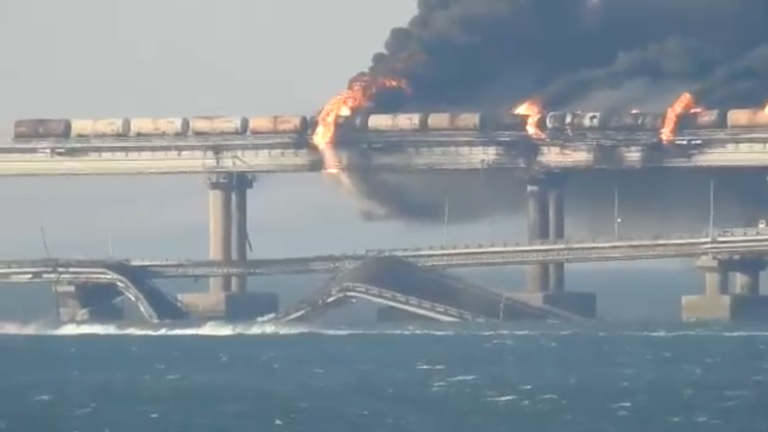
Deputy of the Rada Goncharenko announced negotiations with Wallace on the destruction of the Crimean bridge, APA reports.
Ukraine held talks with British Defense Secretary Ben Wallace on a plan to destroy the Crimean Bridge at the NATO summit in June, Verkhovna Rada deputy Oleksiy Goncharenko said.
The parliamentarian drew attention to the statement of expert Igor Korotchenko, who said on the air of the Rossiya 1 TV channel that, according to some information, the plan for striking the bridge was allegedly being developed under the personal supervision of the head of the British military department.
“Ben Wallace and I discussed the plan to destroy the Crimean bridge back in June,” Goncharenko wrote, posting a photo from the talks, which, in addition to him and the head of the British Ministry of Defense, shows British Prime Minister Boris Johnson.
In July, Aleksey Arestovich, an adviser to the head of Vladimir Zelensky’s office, said that Ukraine could attack the Crimean Bridge as soon as the first technical opportunity appeared.
Maintenance on eight French nuclear reactors delayed by strike
https://www.reuters.com/markets/europe/maintenance-five-french-nuclear-reactors-delayed-over-strike-2022-10-12/ By Forrest Crellin, 12 Oct 22,
PARIS, (Reuters) – France’s FNME trade union said on Wednesday that some workers at EDF’s (EDF.PA) nuclear plants resumed their strike over salaries, delaying maintenance work on eight reactors as the union sent a message of support to striking refinery workers.
Reporting by Forrest Crellin; Editing by Tomasz Janowski and Elaine Hardcastle
Three of the Cruas nuclear plant’s reactors are affected by the strike, while two reactors at the Cattenom and Tricastin plants and one Bugey reactor have had their maintenance delayed by the strike, FNME said.
1 This Month


Read the Public Inquiry Report, the Commissioners’ report, Surrendering Australia: The AUKUS Deception is available to download for free at aukuspublicinquiry.com. Or just watch the replay of the National Press Club Luncheon.



19 November – Webinar – The Reality of Reprocessing
Time: 11:00 AM Pacific Time (US & Canada) / 2:00 PM Eastern / 7:00 PM UK / 8:00 PM CET
Register for the Zoom Event Here



Shut down the radiation-damaged Heysham nuclear reactors now
To see nuclear-related stories in greater depth and intensity – go to https://nuclearinformation.wordpress.com

Say No to NASA’s Reckless Nuclear Reactor on the Moon
Say No to NASA’s Reckless Nuclear Reactor on the Moon
-
Archives
- November 2026 (119)
- October 2026 (302)
- September 2026 (339)
- August 2026 (330)
- July 2026 (355)
- June 2026 (287)
- May 2026 (306)
- April 2026 (356)
- March 2026 (251)
- February 2026 (267)
- January 2026 (308)
- December 2025 (358)
-
Categories
- 1
- 1 NUCLEAR ISSUES
- business and costs
- climate change
- culture and arts
- ENERGY
- environment
- health
- history
- indigenous issues
- Legal
- marketing of nuclear
- media
- opposition to nuclear
- PERSONAL STORIES
- politics
- politics international
- Religion and ethics
- safety
- secrets,lies and civil liberties
- spinbuster
- technology
- Uranium
- wastes
- weapons and war
- Women
- 2 WORLD
- ACTION
- AFRICA
- Atrocities
- AUSTRALIA
- Christina's notes
- Christina's themes
- culture and arts
- Events
- Fuk 2022
- Fuk 2023
- Fukushima 2017
- Fukushima 2018
- fukushima 2019
- Fukushima 2020
- Fukushima 2021
- general
- global warming
- Humour (God we need it)
- Nuclear
- RARE EARTHS
- Reference
- resources – print
- Resources -audiovicual
- Weekly Newsletter
- World
- World Nuclear
- YouTube
-
RSS
Entries RSS
Comments RSS

