Macron pushes a “renaissance” while French nuclear flops

A farce that would make Feydeau blush — Beyond Nuclear International
A farce that would make Feydeau blush — Beyond Nuclear International
Will USA take any notice at all, as Australia’s Prime Minister and world media call for Julian Assange’s release?
The telling question here is whether Albanese will get any purchase with the Washington set. While enjoying a reputation as a pragmatic negotiator able to reach agreements in tight circumstances, the pull of the US national security establishment may prove too strong. “We now get to see Australia’s standing in Washington, valued ally or not,” was the guarded response of Assange’s father John Shipton.
Julian Assange and Albanese’s Intervention https://theaimn.com/julian-assange-and-albaneses-intervention/ December 1, 2022, by: Dr Binoy Kampmark
The unflinching US effort to extradite and prosecute Julian Assange for 18 charges, 17 of which are chillingly based upon the Espionage Act of 1917, has not always stirred much interest in the publisher’s home country. Previous governments have been lukewarm at best, preferring to mention little in terms of what was being done to convince Washington to change course in dealing with Assange.
Before coming to power, Australia’s current Prime Minister Anthony Albanese had made mention of wishing to conclude the Assange affair. In December 2019, before a gathering at the Chifley Research Centre, he described the publisher as a journalist, accepting that such figures should not be prosecuted for “doing their job”. The following year, he also expressed the view that the “ongoing pursuit of Mr Assange” served no evident “purpose” – “enough is enough”.
The same point has been reiterated by a number of crossbenchers in Australia’s parliament, represented with much distinction by the independent MP from Tasmania, Andrew Wilkie. In a speech given earlier this year to a gathering outside Parliament House, the Member for Clark wondered if the UK and Australia had placed their relations with Washington at a premium so high as to doom Assange. “The US wants to get even and for so long the UK and Australia have been happy to go along for the ride because they’ve put bilateral relationships with Washington ahead of the rights of a decent man.”
The new Australian government initially gave troubling indications that a tardy, wait-and-see approach had been adopted. “My position,” Albanese told journalists soon after assuming office, “is that not all foreign affairs is best done with the loudhailer.”
Documents obtained under freedom of information also showed an acknowledgment by the Albanese government of assurances made by the United States that the WikiLeaks founder would have the chance to serve the balance of any prison sentence in Australia. But anybody half-versed in the wiles and ways of realpolitik should know that the international prisoner transfer scheme is subordinate to the wishes of the relevant department granting it. The US Department of Justice can receive the request from Assange, but there is nothing to say, as history shows, that the request will be agreed to.
Amidst all this, the campaign favouring Assange would not stall. Human rights and press organisations globally have persistently urged his release from captivity and the cessation of the prosecution. On November 28, The New York Times, the Guardian, Le Monde, El País and Der Spiegel published a joint open letter titled, “Publishing is not a Crime.”
The five outlets who initially worked closely with WikiLeaks in publishing US State Department cables 12 years ago have not always been sympathetic to Assange. Indeed, they admit to having criticised him for releasing the unredacted trove in 2011 and even expressed concern about his “attempt to aid in computer intrusion of a classified database.”
Had the editors bothered to follow daily trial proceedings of the extradition case in 2020, they would have noted that the Guardian’s own journalists muddied matters by publishing the key to the encrypted files in a book on WikiLeaks. A mortified Assange warned the State Department of this fact. Cryptome duly uploaded the cables before WikiLeaks did. The computer intrusion charge also withers before scrutiny, given that Chelsea Manning already had prior authorisation to access military servers without the need to hack the system.
But on this occasion, the publishers and editors were clear. “Cablegate”, with its 251,000 State Department cables, “disclosed corruption, diplomatic scandals and spy affairs on an international scale.” They had “come together now to express [their] grave concerns about the continued prosecution of Julian Assange for obtaining and publishing classified materials.”
Very mindful of their own circumstances, the media outlets expressed their grave concerns about the use of the Espionage Act “which has never been used to prosecute a publisher or broadcaster.” Such an indictment set “a dangerous precedent, and threatens to undermine America’s First Amendment and the freedom of the press.”
The same day of the letter’s publication, Brazil’s President-elect Lula da Silva also added his voice to the encouraging chorus. He did so on the occasion of meeting the WikiLeaks editor-in-chief Kristinn Hrafnsson and Joseph Farrell, an associate of the organisation, and expressed wishes that “Assange will be freed from his unjust imprisonment.”
The stage was now set for Albanese to make his intervention. In addressing parliament on November 30 in response to a question from independent MP Monique Ryan, Albanese publicly revealed that he had, in fact, been lobbying the Biden administration for a cessation of proceedings against Assange. “I have raised this personally with the representatives of the US government.”
The Australian PM was hardly going to muck in on the issue of the WikiLeaks agenda. Australia remains one of the most secretive of liberal democracies, and agents of radical transparency are hardly appreciated. (Witness, at present, a number of venal prosecutions against whistleblowers that have not been abandoned even with a change of government in May.)
Albanese drew a parallel with Chelsea Manning, the key figure who furnished WikiLeaks with classified military documents, received a stiff sentence for doing so, but had her sentence commuted by President Barack Obama. “She is now able to participate freely in society.” He openly questioned “the point of continuing this legal action, which could be caught up now for many years, into the future.”
For some years now, the plight of Assange could only be resolved politically. In her address to the National Press Club in Canberra delivered in October this year, Assange’s lawyer Jennifer Robinson acknowledged as much. “This case needs an urgent political solution. Julian does not have another decade to wait for a legal fix.” This point was reiterated by Ryan in her remarks addressed to the prime minister.
The telling question here is whether Albanese will get any purchase with the Washington set. While enjoying a reputation as a pragmatic negotiator able to reach agreements in tight circumstances, the pull of the US national security establishment may prove too strong. “We now get to see Australia’s standing in Washington, valued ally or not,” was the guarded response of Assange’s father John Shipton.
Australia a”pot of gold” for America’s military section to wage war in space

US Space Force eyes ‘prime’ Australian real estate for future warfare operations, ABC News, By defence correspondent Andrew Greene 3 Dec 22
Visiting senior US military officers believe Australia is a “pot of gold at the end of the rainbow”, as they eye off this continent’s “prime” geography for future space operations.
Key points:
- US military officials visiting Australia say conflict in space in the next few years is a very real prospect
- They believe the war in Ukraine is demonstrating the growing importance of space as a new war-fighting domain
- Australia’s southern location and potential launch sites near the equator make it an attractive prospect for future operations
Top-ranking members of the US Space Force are warning of China’s growing capability in the emerging military domain as they meet defence counterparts and local industry representatives.
“I’m visiting my allies and we’re talking about future partnerships that we can have,” US Space Force Lieutenant-General Nina Armagno told reporters in Canberra.
“This is prime country for space domain awareness,” the director of staff of the US Space Force added while speaking at the Australian Strategic Policy Institute.
The three-star general has travelled to Canberra along with Lieutenant-General John Shaw, the deputy commander of the US Space Command who is responsible for America’s combat capabilities above Earth……………………………..
Both of the visiting military officers believe the war in Ukraine is demonstrating the growing importance of space as a new war-fighting domain…………………………..
Australia’s own Defence Space Command was only formally stood up in March, but General Armagno says this country already has the natural advantage of its southern-hemisphere geography and potential launch sites close to the equator.
“It seems as [if] Australia is sitting on a pot of gold at the end of the rainbow, really, for our common national security interests,” she said. https://www.abc.net.au/news/2022-12-02/us-space-force-eyes-australian-real-estate-future-warfare/101724368
NATO Narratives and Corporate Media Are Leading to ‘Doorstep of Doom’
The number of countries now signed onto the treaty to end nuclear arms has risen to 91. That most of the world is not on the side of the US is information that is absent from big journalism’s reporting. The many entreaties from governments across the globe to negotiate an end to the war in Ukraine are not on corporate news agenda.
The fact that 30 progressive politicians felt compelled to pull back a letter requesting negotiations to end the war in Ukraine the day after it was delivered to President Biden indicates the severity of the lockdown on public debate about war in the US.
FAIR ROBIN ANDERSEN 2 Dec 22
A popular cartoon aptly expresses the political angst provoked by media pundits today as they chatter on about nuclear war: Two people, both a little hunched over, burdened with the world, are walking down a city street. The woman says to the man, “My desire to be well-informed is currently at odds with my desire to remain sane.”
As we slide closer to what was once considered the ultimate insanity—nuclear Armageddon—corporate media seem to be egging on reckless leaders as they make thinly veiled threats across an imaginary nuclear line. On 60 Minutes (9/18/22), in response to the question, “What [would you] say to [Vladimir Putin] if he is considering using chemical or tactical nuclear weapons?” Joe Biden said, “Don’t. Don’t. Don’t. You will change the face of war unlike anything since World War II.” The president was, of course, referencing the US bombing of Hiroshima and Nagasaki.
Biden also reiterated the US’s goal of total victory: “Winning the war in Ukraine is to get Russia out of Ukraine completely.” Interviewer Scott Pelley did not point out that this would mean driving Russia out of Crimea—territory that Russia has long promised to defend with nuclear weapons (Diplomat, 7/11/14).
Two months into the war in Ukraine, the Wall Street Journal (4/27/22) proclaimed, “The US Should Show It Can Win a Nuclear War.” Gone are the days of rational deterrence and Mutually Assured Destruction (MAD), a doctrine based on knowledge of the deadly consequences of nuclear war: Just the threat of using such awesome destruction against an enemy would prevent the enemy’s use of those same weapons.
‘Dangerous’ peace deals
In a moment of sanity, the LA Times (8/15/22) admitted that a nuclear exchange involving only 3% of the world’s stockpiles would kill a third of the global population within two years. And The Nation (10/18/22) admonished the US and Russia both for what it called “playacting nuclear war,” each with its own nuclear games. Consortium News (10/31/22) warned that the US deploying nuclear-capable B-52s to Australia, presumably to threaten China, is “military madness.”
But other media have engaged in strained linguistic maneuvering to promote the murder of billions of people. One pretzeled headline from Insider (10/15/22): “Putin’s Nuclear Threats Are Pushing People Like Trump and Elon Musk to Press for a Ukraine Peace Deal. A Nuclear Expert Warns That’s ‘Dangerous.’” The article began, “An understandable desire to avoid a nuclear war could actually make the world more dangerous if it means rushing to implement a ‘peace.’”
Seeking to explain how we’re learning to love to bomb and give up our engagement with reasoned thought, sports writer Robert Lipsyte (TomDispatch, 10/18/22) noted that we’ve been trained to look for something huge, like a big bang or grand slam:
The dream of the game-changing home run has shaped our approach to so much, from sports to geopolitics. Most significantly, it’s damaged our ability to solve problems through reason and diplomacy.
When the Bomb is treated as the ultimate home run, the loss of reason and diplomacy lies directly at the feet of war censorship and propaganda, which have permeated corporate news since World War I. The domination of NATO narratives has followed this lead, even as the stakes have become existentially higher.
Demonize the enemy
There has been no better villain than Vladimir Putin…………………………………………………………
Beyond redemption
While rape and sexual assault are indeed military strategies in war, tales of raping and killing babies have also long served to foster outrage toward official enemies, from World War I German soldiers bayoneting babies to Kuwaiti babies yanked out of their incubators in the first Persian Gulf War.
But most Americans, especially young people, don’t recognize propaganda, because even when it is exposed at the time, it is not incorporated into the broader narratives of war. Debunked tales have gone down the Orwellian memory hole, and most of the true history of war goes down the same hole.
As Bryce Greene pointed out on Counterspin (2/24/22), the roots of the escalations leading up to the war in Ukraine were “completely omitted from the Western media.”
Because the evil enemy is always solely responsible and beyond redemption, there is no need to include an accurate history, or correct the false claims, or include the reasons for war. As FAIR (3/4/22) pointed out, the Russian invasion of Ukraine is frequently described as “unprovoked.” The explanation for war is simple: It’s good vs evil.
And the US is always good, even though the country has perpetrated a senseless, expensive and brutal war in the Middle East for the entire 21st century. When corporate media did “explain” the war in Ukraine, it “almost universally gave a pro-Western view of US/Russia relations and the history behind them” (FAIR.org, 1/28/22). Common Dreams (3/18/22) observed that journalists were more hawkish at news conferences than Biden’s press secretary, often “cheerleading for US escalation in Ukraine,” with more weapons and no-fly zones.
Getting to the edge of doom
Foreign Affairs (9–10/22), citing US officials, reported that in April 2022, two months into the war, “Russian and Ukrainian negotiators appeared to have tentatively agreed on the outlines of a negotiated interim settlement,” in a deal worked out in Turkey. This deal was scuttled, however, reportedly after British Prime Minister Boris Johnson went to Kiev and told President Volodymyr Zelenskyy that the West wasn’t ready for a deal, and that there would be no Western security for Ukraine if he signed the accord (Ukrainska Pravda, 5/5/22; see ScheerPost.com, 9/1/22).………………………………
The US has likewise continually refused to negotiate the end to the war. The Real News Network (10/28/22) reported that before the war started, the Kremlin told Biden that Russia was interested in “legally fixed guarantees that rule out NATO expansion eastward and the deployment of offensive strike weapons systems in states adjacent to Russia.” The talks were not pursued—in the context of US establishment media offering opinions that a war would hurt Russia, and would therefore be a good thing for the US (FAIR.org, 1/15/22).
Protests across the country, organized by Code Pink and the Peace in Ukraine Coalition, hit the streets in September to call for an end to the war. The organizers interrogated the ahistorical, one-sided, distorted NATO narrative that leaves out NATO’s role in the conflict. Led by the US, NATO has now expanded from 12 countries to 30. The inclusion of Latvia, Estonia, Poland and Lithuania pushed right up to Russia’s borders (Common Dreams, 9/20/22).
On a long Twitter thread (2/28/22), commentator Arnaud Bertrand cited over a dozen “top strategic thinkers” who had warned what was coming if NATO continued on the path it was taking. In 1998, George Kennan said NATO expansion would be a “tragic mistake” that would certainly provoke a “bad reaction from Russia.” John Mearsheimer, a leading US geopolitical scholar, warned in 2015 that the West was leading Ukraine down a “primrose path,” and it would result in Ukraine getting “wrecked.” Russia scholar Stephen Cohen told Democracy Now! (4/17/14) that moving NATO toward Russia’s borders would militarize the situation. These arguments are rarely included in corporate news reporting on the Ukraine War.
Further, the US supported the 2014 coup in Ukraine, and has loaded Ukraine with arms to undermine the 2015 Minsk II peace agreement. Russia and Ukraine signed the accord to end the civil war that followed the coup and left an estimated 14,000 people dead in Ukraine’s industrial Donbas region. Corporate media habitually omit Minsk II, and actively deny the documented history of fighting between the neo-Nazi Azov Battalion and Russian separatists.
‘This isn’t a card game’
Without context and accuracy, reasoned discourse and the ability to find solutions or engage in diplomacy are beyond our reach as we approach nuclear Armageddon. Corporate newsframes regularly exclude alternative voices of peace and those who call for an end to war, leaving out an entire discourse that has animated global discussions about conflict resolution for decades.
Karl Grossman (FAIR.org, 8/5/22) reported that talk of nuclear weapons proliferated in US newspapers this year—mentioned 5,243 times between February 24 and August 4, 2022—but calls for an end to the nuclear threat were rare. The Treaty on the Prohibition of Nuclear Weapons, which went into effect in 2021, was mentioned only 43 times, mostly in letters to the editor or opinion columns.
There is a reason that threatening war, and threatening violence against another state, are violations of Article 2.4 of the UN Charter. As Chris Hedges says, war itself is the greatest evil. War itself causes the ultimate humanitarian disasters.
Speaking at an event to commemorate the International Day for the Total Elimination of Nuclear Weapons, UN Secretary-General António Guterres (Axios, 9/26/22) said:
The era of nuclear blackmail must end. The idea that any country could fight and win a nuclear war is deranged. Any use of a nuclear weapon would incite a humanitarian Armageddon.
And the International Campaign to Abolish Nuclear Weapons (ICAN) observed:
This isn’t a card game, the risk of nuclear war is increasing with every threat. Using nuclear weapons or threatening to use nuclear weapons is unacceptable and this must stop now.
The number of countries now signed onto the treaty to end nuclear arms has risen to 91. That most of the world is not on the side of the US is information that is absent from big journalism’s reporting. The many entreaties from governments across the globe to negotiate an end to the war in Ukraine are not on corporate news agenda.
Choosing planet over war
Journalists and peace activists alike have argued that war in general, and the war in Ukraine exacerbate the climate crisis………………………………
The fact that 30 progressive politicians felt compelled to pull back a letter requesting negotiations to end the war in Ukraine the day after it was delivered to President Biden indicates the severity of the lockdown on public debate about war in the US………………………………………………………………….
Declassified Australia (9/22/22) detailed a “covert online propaganda operation” promoting “pro-Western narratives” for two decades, operating mostly out of the United States. Declassified Australia (11/3/22) further revealed that a team of researchers at the University of Adelaide unearthed millions of tweets by fake “bot” accounts pushing disinformation on the Ukraine war. The “anti-Russia propaganda campaign” of automated Twitter accounts flooded the internet at the start of the war. Of the more than 5 million tweets studied (both bot and non-bot), 90% came from accounts that were pro-Ukraine.
Every day we move closer
Navy Adm. Charles Richard (DoD News, 11/3/22; AntiWar.com, 11/6/22), the commander of US Strategic Command, stated that so far in Ukraine, it’s been “just the warmup.” He warned: “The big one is coming…. We’re going to get tested in ways that we haven’t been tested [in] a long time.”
Recently the US released the 2022 Nuclear Posture Review (NPR), which reported that “arms control has been subdued by military rivalry.” The position document affirmed the US doctrine allowing for the first use of nuclear weapons, and identified one use of nuclear weapons as to “achieve US objectives if deterrence fails.”
As journalist and war critic Ben Norton put it on Twitter (11/6/22), “The US empire really is threatening all life on Earth with potential nuclear apocalypse.”
Even in the face of the lack of reasoned nuclear war reporting in corporate media, nearly 60% of Americans support diplomatic efforts to end the war in Ukraine “as soon as possible,” even if that means Ukraine having to make concessions to Russia.
As Alfred de Zaya, former UN independent expert on the promotion of a democratic and equitable international order, tweeted:
If the US were a functioning democracy, US citizens would be asked whether they want billions of dollars to be given to Ukraine for war, or whether they would prefer promoting mediation with a view to a ceasefire and sustainable peace.
Corporate media are failing democracy, and failing to disclose our current, stark choice between war on the one hand and life and the planet on the other. They speak in a loud voice that shouts for more war. In doing so, they censor and poison public discourse and position Americans as targets of propaganda—the denizens of empire—instead of citizen participants in a democracy who determine their own fates.
The Bulletin of Atomic Scientists (1/20/22) warned, “The doorstep of doom is no place to loiter.” The sane alternative to war—and the humane thing to d0—would be to close the door on war, lock it, and throw away the key. https://fair.org/home/nato-narratives-and-corporate-media-are-leading-to-doorstep-of-doom/
USA trying to use Philippines as a guinea pig for its unviable small nuclear reactors – and for military purposes.

“With recent plans by the US Department of Defense to build an advanced mobile nuclear microreactor prototype in Idaho, Manila should not allow Washington to use Philippine military bases as prototype areas for these reactors.
Save the country from the perils of nuclear reactors, NAKED THOUGHT
By Charlie V. Manalo, December 3, 2022
AS the United States government, invoking provisions of the Enhanced Defense Cooperation Agreement (EDCA), requests for additional military bases, five on the island of Luzon alone, the idea of the country playing host to mobile nuclear reactors is not far-fetched.
This is for the simple reason that whoever crafted the agreement made it so vague, it did not provide for any restrictions on the type of facilities and materials the US would be using in constructing its bases in the Philippines.
And this has been aggravated further by the enactment of the Public Service Law which opens the country’s airports to foreign ownership, giving the US all the resources needed to construct its own airports which it could use as military bases under the guise of a commercial airport.
Anyway, former congressman Terry Ridon, convenor of Infrawatch Philippines, sent me a copy of an article he wrote on the subject, explaining clearly its implications. It’s entitled, “Reject mobile nuclear reactors in PH bases-Infrawatch Philippines,” which I’m publishing in its entirety.
“With recent plans by the US Department of Defense to build an advanced mobile nuclear microreactor prototype in Idaho, Manila should not allow Washington to use Philippine military bases as prototype areas for these reactors.
According to an April report by The Associated Press, the US DoD ‘signed off on the Project Pele plan to build the reactor and reactor fuel outside of Idaho and then assemble and operate the reactor at the lab.’
As this is a project initiated by the US defense department, its military objectives had been disclosed by Jeff Waksman, project manager for Project Pele, saying, “Advanced nuclear power has the potential to be a strategic game-changer for the United States, both for the (Department of Defense) and for the commercial sector.”
The US DoD further said that the reactor designs are ‘high-temperature gas-cooled reactors using enriched uranium for fuel.’
PH microreactor deployment
Under the Enhanced Defense Cooperation Agreement between the Philippines and the United States, there are no restrictions to Washington on the type of facilities and materials it will construct and install in Philippine military bases, except a specific restriction against installing nuclear weapons.
However, Philippine authorities should be reminded that this restriction does not assuage fears that the country will not be involved in regional military conflicts because EDCA allows the installation of conventional military weapons which may approximate the breadth and fatal impact of nuclear weapons.
More importantly, in the event that nuclear microreactors are produced by the US DoD at scale, these small nuclear plants can, in fact, be installed in EDCA locations in different parts of the country.
This is alarming because the country has yet to decide and implement its national policy on nuclear development based on the policy direction of President Ferdinand Marcos Jr.
In fact, it needs to be made clear that nuclear microreactors in EDCA locations in the country will not be used for civilian purposes but for military objectives by the United States in the Indo-Pacific.
This distinction alone should give the current government pause on allowing nuclear microreactors to be deployed in EDCA locations in the future.
More importantly, military nuclear microreactors will allow Washington to deploy different kinds of weapons to influence the security arrangement in the South China Sea and the greater Indo-Pacific.
Military purposes
Further, as nuclear microreactors in EDCA areas will certainly be used for military purposes, this might prompt other regional actors to accuse Manila of violating the Bangkok Treaty, the treaty declaring Southeast Asia as a nuclear weapons-free zone and other weapons of mass destruction.
With a military nuclear microreactor in Philippine soil, Washington may be able to operate high-powered conventional military weapons which may be equivalent to weapons of mass destruction.
Certainly, Manila should follow its treaty obligations in the region, particularly as other strong powers are also looking at Manila to temper its pivot toward Washington.
Finally, allowing this kind of deployment in EDCA areas diminishes the current call of President Marcos to carefully proceed with nuclear research and development for civilian purposes.
The focus of the government should be considering whether nuclear energy should be part of the current energy mix and whether the Bataan Nuclear Power Plant should be revived.
It should also consider developing other aspects of nuclear technology, which can benefit health care and other critically important sectors.
As such, allowing nuclear microreactors in EDCA areas or anywhere in the Philippines should not be on the agenda.”
Weapons company Raytheon continues to be the winner in the Ukraine war, with new $1.2 billion surface-to-air missile contract .

Raytheon wins $1.2 billion surface-to-air missile order for Ukraine, By Jen Judson, Defense News, 1 Dec 22
WASHINGTON — The U.S. Army awarded Raytheon Missiles and Defense a contract worth as much as $1.2 billion to deliver six National Advanced Surface to Air Missile System batteries for Ukraine.
The contract is part of the fifth Ukraine Security Assistance Initiative package and includes training and logistical support to Ukraine’s military and security forces, the Army said in a a Nov. 30 statement.
Raytheon, the world’s second-largest defense contractor, won a contract in August to deliver to NASAMS batteries to Ukraine as part of the third USAI package. The new contract is a follow-on…………………
The work to award Raytheon a contract was led by the Army’s Program Executive Office for Missiles and Space, along with others across the Defense Department.
Ukraine has requested an integrated air and missile defense system that the U.S. and other allies are striving to fulfill. The system would be made up of short-range, low-altitude systems; medium-range, medium-altitude systems; and long-range, high-altitude systems that together would neutralize the threat of Russian aircraft and missiles.
Ukrainian forces had been using Russian-made SA-6 and SA-8 air defenses. In addition to NASAMS, the country also asked for Cold War-era Hawk systems – a medium-range, medium-altitude system, that’s considered to still be effective. https://www.defensenews.com/land/2022/12/01/raytheon-wins-12-billion-surface-to-air-missile-order-for-ukraine
‘Deliberate ambiguity’: Israel’s nuclear weapons are greatest threat to Middle East
https://peoplesworld.org/article/deliberate-ambiguity-israels-nuclear-weapons-are-greatest-threat-to-middle-east/ December 2, 2022 11:06 AM CST BY RAMZY BAROUD
As Western countries are floating the theory that Russia could escalate its conflict with Ukraine to a nuclear war, many of those governments continue to turn a blind eye to Israel’s nuclear weapons capabilities. Luckily, many other countries around the world do not subscribe to this endemic hypocrisy.
The Conference on the Establishment of a Middle East Zone Free of Nuclear Weapons and Other Weapons of Mass Destruction was held between Nov. 14-18, with the sole purpose of creating new standards of accountability that, as should always have been the case, would apply equally to all Middle Eastern countries.
The debate regarding nuclear weapons in the Middle East could not possibly be any more pertinent or urgent. International observers rightly note that the period following the Russia-Ukraine war is likely to accelerate the quest for nuclear weapons throughout the world. Considering the seemingly perpetual state of conflict in the Middle East, the region is likely to witness nuclear rivalry as well.
For years, Arab and other countries attempted to raise the issue that accountability regarding the development and acquisition of nuclear weapons cannot be confined to states that are perceived to be enemies of Israel and the West.
The latest of these efforts was a United Nations resolution that called on Israel to dispose of its nuclear weapons, and to place its nuclear facilities under the monitoring of the International Atomic Energy Agency (IAEA). Resolution number A/C.1/77/L.2, which was drafted by Egypt with the support of other Arab countries, passed with an initial vote of 152-5. Unsurprisingly, among the five countries that voted against the draft were the United States, Canada and, of course, Israel itself.
U.S. and Canadian blind support of Israel notwithstanding, what compels Washington and Ottawa to vote against a draft entitled “The risk of nuclear proliferation in the Middle East?” Keeping in mind the successive right-wing extremist governments that have ruled over Israel for many years, Washington must understand that the risk of using nuclear weapons under the guise of fending off an “existential threat” is a real possibility.
Since its inception, Israel has resorted to, and utilized the phrase “existential threat” countless times. Various Arab governments, later Iran and even individual Palestinian resistance movements, were accused of endangering Israel’s existence per se. Even the non-violent Palestinian civil society-led Boycott, Divestment and Sanctions (BDS) Movement was accused by then-Prime Minister Benjamin Netanyahu in 2015 of being an existential threat to Israel. Netanyahu claimed that the boycott movement was “not connected to our actions; it is connected to our very existence.”
This should worry everyone, not just in the Middle East, but the whole world. A country with such hyped sensitivity about imagined “existential threats” should not be allowed to acquire the kinds of weapons that could destroy the entire Middle East several times over.
Some may argue that Israel’s nuclear arsenal was intrinsically linked to real fears resulting from its historical conflict with the Arabs. However, this is not the case. As soon as Israel completed Stage 1 of its ethnic cleansing of Palestinians from their historic homeland, and long before any serious Arab or Palestinian resistance was carried out in response, Israel was already on the lookout for nuclear weapons.
As early as 1949, the Israeli army had found uranium deposits in the Negev Desert, leading to the establishment, in 1952, of the highly secretive Israel Atomic Energy Commission (IAEC).
In 1955, the U.S. government sold Israel a nuclear research reactor. But that was not enough. Eager to become a full nuclear power, Tel Aviv resorted to Paris in 1957. The latter became a major partner in Israel’s secretive nuclear activities when it helped the Israeli government construct a clandestine nuclear reactor near Dimona in the Negev Desert.
The father of the Israeli nuclear program at the time was none other than Shimon Peres who, ironically, was awarded the Nobel Peace Prize in 1994. The Dimona Nuclear Reactor is now named “Shimon Peres Nuclear Research Center-Negev.”
With no international monitoring whatsoever, thus with zero legal accountability, Israel’s nuclear quest continues to this day. In 1963, Israel purchased 100 tons of uranium ore from Argentina, and it is strongly believed that during the October 1973 Israel-Arab war, Israel “came close to making a nuclear preemptive strike,” according to Richard Sale, writing for United Press International (UPI).
Currently, Israel is believed to have “enough fissionable material to fabricate 60-300 nuclear weapons,” according to former U.S. Army Officer Edwin S. Cochran.
Estimates vary, but the facts about Israel’s weapons of mass destruction (WMDs) are hardly contested. Israel itself practices what is known as “deliberate ambiguity,” so as to send a message of its lethal power to its enemies, without revealing anything that may hold it accountable to international inspection.
shows what now is known as the Shimon Peres Negev Nuclear Research Center near the city of Dimona, Israel. A long-secretive Israeli nuclear facility that gave birth to its undeclared atomic weapons program appeared to be undergoing its biggest construction project in decades recently, according to newly taken satellite photos analyzed by The Associated Press. | U.S. Center for Earth Resources Observation and Science / U.S. Geological Survey | via AP
Estimates vary, but the facts about Israel’s weapons of mass destruction (WMDs) are hardly contested. Israel itself practices what is known as “deliberate ambiguity,” so as to send a message of its lethal power to its enemies, without revealing anything that may hold it accountable to international inspection.
What we know about Israel’s nuclear weapons has been made possible partly because of the bravery of former Israeli nuclear technician Mordechai Vanunu, a whistleblower who was held in solitary confinement for a decade due to his courage in exposing Israel’s darkest secrets.
Still, Israel refuses to sign the Treaty on the Non-Proliferation of Nuclear Weapons (NPT), endorsed by 191 countries.
Israeli leaders adhere to what is known as the “Begin Doctrine,” in reference to Menachem Begin, the rightwing Israeli prime minister who invaded Lebanon in 1982, resulting in the killing of thousands. The doctrine is formulated around the idea that, while Israel gives itself the right to own nuclear weapons, its enemies in the Middle East must not. This belief continues to direct Israeli actions to this day.
U.S. support for Israel is not confined to ensuring the latter has “military edge” over its neighbors in terms of traditional weapons, but also to ensure Israel remains the region’s only superpower, even if that entails escaping international accountability for the development of WMDs.
The collective efforts by Arab and other countries at the UN General Assembly to create a Middle East Zone Free of Nuclear Weapons are welcomed initiatives. It behooves everyone, Washington included, to join the rest of the world in finally forcing Israel to join the Non-Proliferation Treaty, a first but critical step toward long delayed accountability.
No place for nuclear in New York’s clean energy future
syracuse.com, by Joseph J. Heath & Betty Lyons 2 Dec 22
As New York energy demand and prices spike heading into winter, the state’s Climate Action Council (CAC) works on its final Scoping Plan for implementing New York’s landmark climate legislation, the Climate Leadership and Community Protection Act (CLCPA). The Scoping Plan will lay out the details of how the state will accomplish the transition to clean energy, and how the transition will serve environmental justice.
Justice is a cornerstone of New York’s climate law, which stipulates that actions must not disproportionately burden disadvantaged communities. In a recent meeting, CAC members proposed strengthening Scoping Plan language to explain exactly why such burdens are unacceptable, and why climate and environmental justice must include every community in the state, including serious consultation with Indigenous Nations.
Continued reliance on nuclear plants — both existing and untested “advanced” nuclear or “small modular reactors” — violates these priorities. The Onondaga Nation, Haudenosaunee Environmental Task Force and the American Indian Law Alliance concluded that nuclear power is not viable in combating climate change. The CAC should reach the same conclusion.
The CAC’s Climate Justice Working Group has called on the CAC to draft a serious plan to phase out Oswego County’s three aging nuclear plants (on the traditional territory of the Onondaga Nation): Nine Mile Point (NMP) Unit 1, NMP 2 and FitzPatrick. So far, CAC has not responded to that call.
All three plants are old and obsolete. NMP Unit 1 is the oldest operating U.S. reactor, commissioned in 1969; FitzPatrick in 1975. These two are already past the 40-year lifespan they were designed for. However, their operating licenses are dangerously extended — through 2029 for NMP Unit 1, 2034 for FitzPatrick and 2046 for NMP Unit 2 (commissioned in 1988). These plants require increasing repair and replacement as components age, and, since they cannot compete in an unrigged market, rely on massive state and federal subsidies taken from ratepayers.
The three Oswego plants have GE Boiling Water Reactors, the same flawed design as Fukushima: weak containment vessels and highly radioactive spent fuel stored on an upper floor. The vulnerable pools are packed with more fuel rods than they were designed to hold. If the pools leak or water circulation fails, risk of fire and major radiation rises significantly. Water levels at Lake Ontario in recent years came within one foot of flooding these cement pools, a major problem at Fukushima. With rain events increasing due to climate change, flooding-related catastrophes increase in likelihood…………
The longer the Oswego plants run, the worse their impacts will be. The plants’ day-to-day operation kills millions of fish, causes thermal pollution, withdraws 13 million gallons of water from Lake Ontario a year, and releases tritium (a non-filterable radioactive hydrogen isotope) into air and water, to be absorbed by plants and our skin, lungs and GI tracts.
A leading point in CAC’s consideration of how to serve justice through the Scoping Plan should be that the whole nuclear lifecycle disproportionately harms Indigenous Nations and Peoples.
Seneca Nation citizens living on the Cattaraugus “Reservation” have already been impacted by the West Valley nuclear fuel reprocessing facility south of Buffalo. Tritium and lethal isotopes Cesium 137 and Strontium 90 contaminate the soil, groundwater and surface waters including Cattaraugus Creek, which flows into Lake Erie…………………..
Impacts from existing and proposed nuclear plants are not trivial or dismissible. New York should not waste resources in so-called advanced nuclear plants or even riskier small modular reactors. This is no better than existing technology: They have the same life-cycle impacts, accident risks, high costs and toxic waste. The growing dangers of continuing spent fuel rod accumulation, with no safe storage mechanism and no plan, is enough of a reason for reasonable CAC members to refuse money for new nuclear plants.
Not only is new nuclear not a just option, the state should cease subsidizing Nine Mile Point Units 1 and 2 and FitzPatrick. Nuclear energy harms the environment and public health and violates Indigenous rights and sovereignty. Investing in any nuclear energy goes against New York’s commitment to environmental justice and climate justice.
Joe Heath has served as General Legal Counsel for the Onondaga Nation since 1982. He was a leader in the effort to ban fracking in New York state. Prior to law school, Heath served as an officer on nuclear submarines.
Betty Lyons is the president and executive director of The American Indian Law Alliance (AILA) and an Onondaga Nation citizen. AILA was founded in 1989; it is an Indigenous, nonprofit, nonpartisan organization that works with Indigenous nations, communities and organizations for sovereignty, human rights and social justice for Indigenous Peoples.
Secrecy on USA’s new nuclear stealth bomber, and of course, secrecy on its cost to taxpayers.


The fact that the price is not public troubles government watchdogs.
Pentagon unveils new nuclear stealth bomber after years of secrecy The HillBY THE ASSOCIATED PRESS VIA NEXSTAR MEDIA WIRE – 12/02/22
WASHINGTON (AP) — America’s newest nuclear stealth bomber is making its public debut after years of secret development and as part of the Pentagon’s answer to rising concerns over a future conflict with China.
The B-21 Raider is the first new American bomber aircraft in more than 30 years. Almost every aspect of the program is classified. Ahead of its unveiling Friday at an Air Force facility in Palmdale, California, only artists’ renderings of the warplane have been released. Those few images reveal that the Raider resembles the black nuclear stealth bomber it will eventually replace, the B-2 Spirit.
The bomber is part of the Pentagon’s efforts to modernize all three legs of its nuclear triad, which includes silo-launched nuclear ballistic missiles and submarine-launched warheads, as it shifts from the counterterrorism campaigns of recent decades to meet China’s rapid military modernization………………………………….
Six B-21 Raiders are in production; The Air Force plans to build 100 that can deploy either nuclear weapons or onventional bombs and can be used with or without a human crew. Both the Air Force and Northrop also point to the Raider’s relatively quick development: The bomber went from contract award to debut in seven years. Other new fighter and ship programs have taken decades.
The cost of the bombers is unknown. The Air Force previously put the price for a buy of 100 aircraft at an average cost of $550 million each in 2010 dollars — roughly $753 million today — but it’s unclear how much the Air Force is actually spending.
The fact that the price is not public troubles government watchdogs.
“It might be a big challenge for us to do our normal analysis of a major program like this,” said Dan Grazier, a senior defense policy fellow at the Project on Government Oversight. “It’s easy to say that the B-21 is still on schedule before it actually flies. Because it’s only when one of these programs goes into the actual testing phase when real problems are discovered. And so that’s the point when schedules really start to slip and costs really start to rise.”
The Raider will not make its first flight until 2023. However, using advanced computing, Warden said, Northrop Grumman has been testing the Raider’s performance using a digital twin, a virtual replica of the one being unveiled.
…………………… Given advances in surveillance satellites and cameras, the Raider will debut very much under wraps and will be viewed inside a hangar. Invited guests including Defense Secretary Lloyd Austin will witness the hangar doors open to reveal the bomber for its public introduction, then the doors will close again. https://thehill.com/homenews/3759575-pentagon-unveils-new-nuclear-stealth-bomber-after-years-of-secrecy/
Misleading claims about the supposed recycling of nuclear wastes
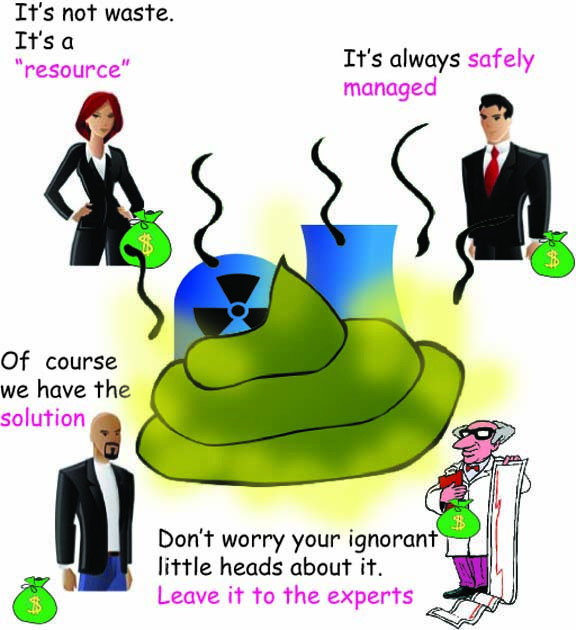
EPZ, the operator of the Borssele nuclear power plant, has long claimed
that they recycle “95 percent” of their nuclear fuel, and that only “5
percent” remains as nuclear waste.
Following a complaint by Laka, the Board
of Appeals of the Dutch Advertising Authority, ruled yesterday that these
are misleading environmental advertisement claims. In its ruling, the board
blames EPZ all the more because theses misleading claims appear on EPZ’s
website under the header “Environment & Health”, where “unsuspecting
visitors should expect accurate and balanced information about nuclear fuel
and nuclear waste.
Laka 1st Dec 2022
Small modular reactor plans to be blocked by the Scottish government
Plans to power a refinery in Scotland with a Rolls-Royce small modular
reactor (SMR) are likely to stall due to opposition from the Scottish
government. Government officials have said they will block any moves to
power the Grangemouth refinery on the Firth of Forth with a nuclear
reactor. According to the Sunday Telegraph, talks have taken place between
chemicals group Ineos and Rolls-Royce, and the two companies are understood
to have considered whether the plant could be powered by an SMR.
New Civil Engineer 30th Nov 2022 https://www.newcivilengineer.com/latest/scottish-small-modular-reactor-plans-to-be-blocked-by-government-30-11-2022/
Broken promises: how nuclear armed states are failing on their commitments to disarm

2 Dec22
As the US Air Force shows off its new B-21 stealth bomber and Russia and China are expanding and updating their own nuclear arsenals, we explore how these states are violating their commitments under international law and increasing the risk of nuclear catastrophe.
The United States Air Force today showed off its latest means of using weapons of mass destruction: the B-21 stealth bomber. This aircraft, developed by Northrop Grumman, is designed to drop two new types of nuclear weapons: the B61-12 nuclear gravity bomb and the LRSO nuclear-armed air-launched cruise missile, as well as various conventional weapons. The B61-12 nuclear bomb has an explosive yield of up to 50 kilotons; in comparison, the bomb that destroyed Hiroshima in 1945, killing more than 140,000 people, had a yield of just 16 kilotons.
A single B61-12 bomb dropped by a Northrop Grumman B-21 would likely kill hundreds of thousands of civilians and injure many more, and cause massive damage to civilian infrastructure and the environment; radioactive fallout could contaminate large areas across multiple countries.
The development of the B-21 represents yet another step in the modernisation of the US nuclear arsenal. The B-21 bomber will reportedly be deployed at three bases in the US, resulting in an increase of the number of bomber bases with nuclear weapons from two bases today to five bases by the 2030s. The B-21 will carry new and “improved” nuclear weapons, and is obviously intended to do so for decades to come.
Northrop Grumman, the manufacturer of the B-21, received $5 billion in income from nuclear-weapon-related contracts in 2021, and spent $11 million on lobbying elected officials, including those who approve such contracts. The company also contributed several million dollars to think tanks researching and writing about nuclear weapons.
But the US is certainly not alone: Russia and China are also expanding and updating their nuclear arsenals. Russia has developed and successfully tested its new Sarmat ICBM; the missile was displayed in public in November. The Sarmat is intended to replace the SS-18 ICBM and will likely carry the same warheads: 10 warheads per missile, each with a yield of 500-800 kilotons. That means that one Sarmat missile could carry the same destructive force as at least 250 Nagasaki-size warheads, only one of which killed 74,000 people in 1945. According to a US report, China has recently increased its nuclear arsenal beyond 400 warheads, and now has 300 ICBMs, an increase of 200 since 2021. Chinese nuclear submarines are reportedly now patrolling while armed with nuclear missiles. (Since both Russia and China are much less transparent than the US about their nuclear capabilities, it is possible that they are also modernizing and expanding their arsenals in other ways.)
All these steps by China, Russia and the US are directly contrary to their obligations under the Nuclear Non-proliferation Treaty (NPT). The NPT requires them to “pursue negotiations in good faith on effective measures relating to cessation of the nuclear arms race at an early date and to nuclear disarmament”. Under the NPT, the three countries have made an “unequivocal undertaking … to accomplish the total elimination of their nuclear arsenals” and have committed to “pursue policies that are fully compatible with the Treaty and the objective of achieving a world without nuclear weapons”. …………………………….
ICAN Executive Director, Beatrice Fihn, commented “This is why the Treaty on the Prohibition of Nuclear Weapons (TPNW) is so important. Now that the treaty is in force, nuclear weapons are comprehensively prohibited under international law. By joining the TPNW and participating actively in its implementation, countries can contribute to stigmatising and delegitimising nuclear weapons and building a robust global norm against them. The TPNW is clear: the actions of nuclear-armed states to retain, modernize and expand their nuclear arsenals are illegal, immoral and unacceptable,” https://www.icanw.org/nuclear_weapons_modernisation_russia_china_us_failing_commitments_to_disarm
UK Funding subsidy to French firm EDF, for the £26bn Hinkley Point C nuclear plant even if it does not start operating until 2036
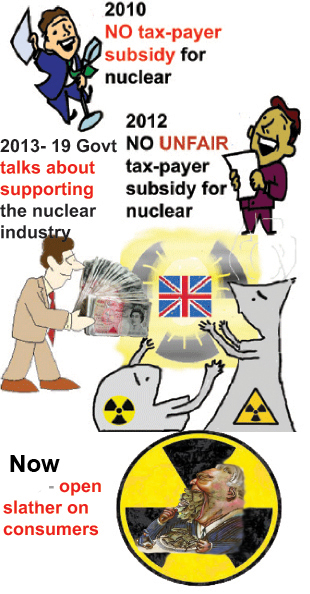
EDF has secured 14 years of funding for the UK’s upcoming nuclear plant
Hinkley Point C in case of the risk of further delays. The French energy
giant has agreed a new contract ensuring its funding even if it does not
start operating until 2036.
EDF confirmed to City A.M. the project is still
on course for completion in 2027, following an approximately two year delay
driven by the pandemic and supply chain disruptions. It is also roughly 45
per cent over budget – having initially been projected to cost £18bn, but
now expected to be priced at £26bn.
The new subsidy contract still includes
clauses in the former deal, which was set to expire just three years
earlier in 2033. This includes stipulations such as shortened payments to
EDF if Hinkley Point C fails to start generating power by May 2029.
If the plant is up and running by that date, EDF receives a guaranteed £92.50 per
megawatt hour for its electricity for the first 35 years of its life. The
latest deal instead reflects a renegotiated settlement between the UK and
China, with the Government paying CGN a £100m exit fee from the next
project – Sizewell C.
City AM 1st Dec 2022
https://www.cityam.com/edf-secures-further-funding-for-hinkley-point-c-in-new-settlement/
Warning of power cuts for France, as nuclear reactors are working at half capacity
France could face the risk of power cuts this winter when electricity
supply may not be enough to meet demand, Xavier Piechaczyk, the head of
grid operator RTE, said on Thursday, citing the price to pay for slow
renewables and a nuclear energy infrastructure working at half capacity.
There is a risk of red-alert days this winter, but it would mostly depend
on the weather, Piechaczyk told Franceinfo radio today, noting that power
cuts are not necessarily “inevitable”. Due to lower nuclear generation
availability, France will import electricity this winter from most of its
neighbors, including Benelux, the manager added.
Oil Price 1st Dec 2022
Vladimir Putin open to talks on Ukraine if West accepts Moscow’s demands

ABC News 3 Dec 22
Russian President Vladimir Putin is “open to negotiations” on Ukraine but the West must accept Moscow’s demands, the Kremlin says, a day after US President Joe Biden said he was willing to talk with the Russian leader.
Key points:
- The Kremlin says the US’s refusal to recognise annexed territory in Ukraine as Russian was hindering a search for ways to end the war
- The IAEA wants to establish a protective zone around the Zaporizhzhia nuclear plant, which has been repeatedly shelled over the last few months
- An investigation into whether the Moscow branch of the Orthodox church is entitled to operate in Kyiv is underway
Speaking after talks on Thursday at the White House with French President Emmanuel Macron, Mr Biden said he was ready to speak with Mr Putin “if in fact there is an interest in him deciding he’s looking for a way to end the war”, adding the Russian leader “hasn’t done that yet”.
Mr Biden has not spoken directly with Mr Putin since Russia invaded Ukraine on February 24.
In March, Mr Biden branded Mr Putin a “butcher” who “cannot stay in power”.
In Moscow’s first public response to Mr Biden’s overture, Kremlin spokesman Dmitry Peskov told reporters: “The president of the Russian Federation has always been, is and remains open to negotiations in order to ensure our interests.”
Mr Peskov said the US refusal to recognise annexed territory in Ukraine as Russian was hindering a search for ways to end the war.
Moscow has previously sought sweeping security guarantees, including a reversal of NATO’s eastern enlargement………………………………….. more https://www.abc.net.au/news/2022-12-02/russia-open-to-talks-on-ukraine-if-west-accepts-moscows-demands/101730102
1 This Month

Read the Public Inquiry Report, the Commissioners’ report, Surrendering Australia: The AUKUS Deception is available to download for free at aukuspublicinquiry.com. Or just watch the replay of the National Press Club Luncheon.


19 November – Webinar – The Reality of Reprocessing
Time: 11:00 AM Pacific Time (US & Canada) / 2:00 PM Eastern / 7:00 PM UK / 8:00 PM CET
Register for the Zoom Event Here



Shut down the radiation-damaged Heysham nuclear reactors now
To see nuclear-related stories in greater depth and intensity – go to https://nuclearinformation.wordpress.com

Say No to NASA’s Reckless Nuclear Reactor on the Moon
Say No to NASA’s Reckless Nuclear Reactor on the Moon
-
Archives
- November 2026 (109)
- October 2026 (302)
- September 2026 (339)
- August 2026 (330)
- July 2026 (355)
- June 2026 (287)
- May 2026 (306)
- April 2026 (356)
- March 2026 (251)
- February 2026 (267)
- January 2026 (308)
- December 2025 (358)
-
Categories
- 1
- 1 NUCLEAR ISSUES
- business and costs
- climate change
- culture and arts
- ENERGY
- environment
- health
- history
- indigenous issues
- Legal
- marketing of nuclear
- media
- opposition to nuclear
- PERSONAL STORIES
- politics
- politics international
- Religion and ethics
- safety
- secrets,lies and civil liberties
- spinbuster
- technology
- Uranium
- wastes
- weapons and war
- Women
- 2 WORLD
- ACTION
- AFRICA
- Atrocities
- AUSTRALIA
- Christina's notes
- Christina's themes
- culture and arts
- Events
- Fuk 2022
- Fuk 2023
- Fukushima 2017
- Fukushima 2018
- fukushima 2019
- Fukushima 2020
- Fukushima 2021
- general
- global warming
- Humour (God we need it)
- Nuclear
- RARE EARTHS
- Reference
- resources – print
- Resources -audiovicual
- Weekly Newsletter
- World
- World Nuclear
- YouTube
-
RSS
Entries RSS
Comments RSS

